Not such a bizarre post title as you might think!
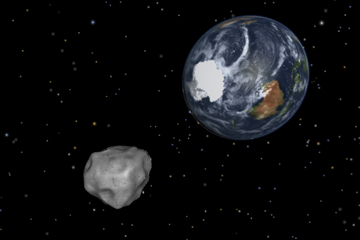
DA14, or to give it’s full name, Asteroid 2012 DA14, is calling by Planet Earth rather soon. To quote the item on the Planetary Society’s website,
Asteroid 2012 DA14 Discovery Enabled by Planetary Society Grant
On Friday, February 15, 2013, Asteroid 2012 DA14 will travel just 17,000 miles above the Earth – closer to our planet than the orbit of the communications satellite that broadcast the Super Bowl around the world. About half the size of a football field and with more than 100 times the energy impact of the nuclear bomb that fell on Hiroshima, DA14 will miss Earth this time around, but if it had impacted, this asteroid could have taken out any major metropolitan city on our planet.
The discovery of Asteroid DA14 was made by a small team of observers at La Sagra Observatory in Southern Spain, on February 22, 2012, enabled with a grant provided by The Planetary Society. One of the observatory’s telescopes had recently been upgraded with funds donated by The Planetary Society’s NEO Shoemaker Grant program. Its new camera enabled detection of fast moving objects like 2012 DA14 – requiring very fast imaging for discovery and determination of their paths. The upgraded instrument has far outperformed the Observatory’s other telescopes.
Now, we get to point the world’s telescopes at this 2013 close flyby and learn more about this asteroid and its orbit because of the support of our Planetary Society Members all over the world.
This asteroid won’t hit Earth, at least for many, many decades. But it is a reminder we live in a cosmic shooting gallery. We need to find, track, and characterize these objects and develop the technical and political capability to deflect an asteroid. It is not a matter of whether there will be a dangerous impact, it is a matter of when.
The Planetary Society and its members are working to do our part through programs like ourShoemaker NEO Grants, like the one that made the discovery of 2012 DA14 possible, and projects like Laser Bees, exploring new ways to potentially deflect a dangerous asteroid.
NASA have recently released a video, see below, but a search on YouTube will find more, some of which are more engaging than the rather dry style of the NASA release.
Have questions? Bet you do! Here are some of the answers to the obvious ones. Including these:
What is the time of closest approach
Feb. 15, 2013, 19:25 UTC (11:25 PST)
What is the closest approach altitude?
Approximate altitude above the surface of the Earth will be 27,330 km, 17,000 mi (34,100 km, 21,200 mi from center of Earth). That is closer than the altitude of geosynchronous satellites, e.g., satellite TV satellites, at 35,786 km (22,236 mi) altitude.
Will it be visible with the naked eye, how bright will it be?
It will not be a naked eye object. At closest approach, its brightness will be about a magnitude of 7. It will be bright enough that it could be seen with steady binoculars or a small telescope if you are on the side of Earth it will be passing.
What parts of Earth will have a chance to observe it telescopically?
Near closest approach when it is brightest, most of Europe, Asia, and Africa. It will pass from the southern hemisphere to northern hemisphere. Though it will be much dimmer, it is observable by larger telescopes for days to weeks before and after closest approach.
Finally, well done those gents that first spotted DA14.

Winners of a Planetary Society Shoemaker NEO Grant in 2010
Now where did I put my tin helmet?
 Learning from Dogs