Our truths, our home, our serenity; all flow from stillness.
Soon silence will have passed into legend. Man has turned his back on silence. Day after day he invents machines and devices that increase noise and distract humanity from the essence of life, contemplation, meditation.
As is often the way, a number of disparate items came together for today’s post in a way of lovely connectivity.
A few weeks ago when meeting our local doctor for the first time since we moved to Oregon, I had grumbled about bouts of terrible short-term memory recall and more or less had shrugged my shoulders in resignation that there was nothing one could do: it was just part of getting older, I guessed!
“On the contrary”, responded Dr. Hurd, continuing, “There’s growing evidence that our information-crowded lives: cell phones; email; constant TV; constant news, is pumping too much for our brains to manage.”
Dr. Hurd continued, “Think about it! Our brains have to process every single sensory stimulus. The research is suggesting that our brains are being over-loaded and then the brain just dumps the excess data. If that is the case, and the evidence is pointing in that direction, then try thirty minutes of meditation each day; give your brain a chance to rest.”
So that was the first revelation.
The second was a recent science programme on the BBC under the Horizon series. The programme was called, The Truth About Personality.
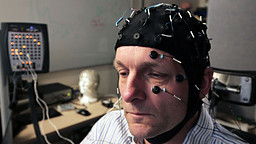
Michael Mosley’s brain being measured.
Michael Mosley explores the latest science about how our personalities are created – and whether they can be changed.
Despite appearances, Mosley is a pessimist who constantly frets about the future. He wants to worry less and become more of an optimist.
He tries out two techniques to change this aspect of his personality – with surprising results.
And he travels to the frontiers of genetics and neuroscience to find out about the forces that shape all our personalities.
Within the programme came the astounding fact that even ten minutes a day meditation can help the brain achieve a more balanced personality (balance in terms of not being overly negative in one’s thoughts).
The third revelation came from Jean and me watching a TED Talk last night. Just 14 minutes long, please watch it – you will be transformed!
Published on Jul 17, 2013
More and more people worldwide are living in countries not considered their own. Writer Pico Iyer — who himself has three or four “origins” — meditates on the meaning of home, the joy of traveling and the serenity of standing still.
Then, just three days ago, John Hurlburt, a long-time supporter and regular contributor to Learning from Dogs, emailed me his reflection on meditation. John quickly gave permission for it to be published here.
oooOOOooo
The stillness of evening.
Evening Meditation
Our world is increasingly spiritually, morally, mentally, physically and economically bankrupt. Many people would like to change the world one way or another. Most don’t really know why. Some folks simply don’t care. The idea is to leave life a bit better than we found it when we were born.
The fact is we’re all intrinsically sacred in a universe we didn’t create. We tend to prioritize illusion and delusion above reality. Playing God is a precursor of evil. A supreme faith in Money is self contradictory and ultimately fatal. Arrogance compounds the problem.
We connect in unified awareness through serene meditation. We experience harmony within an emerging celestial symphony. Answers flow from the inside out as we surrender to the eternal energy flow.
Be still and know…
an old lamplighter
oooOOOooo
Finally, after having a real struggle to find the place, both psychologically and physically, where I could start my own relationship with meditation, on Wednesday afternoon, when walking the quarter-mile up to our mail-box, it struck me as obvious.
Embraced by nature.
This quiet place on our creek where the water trickles down from an old flood irrigation dam. Somewhere to sit under the shade of a tree, somewhere to be still, somewhere as perfect a home as anyone could ever find.
Meditation is the dissolution of thoughts in Eternal awareness or Pure consciousness without objectification, knowing without thinking, merging finitude in infinity.
A closer look at the excellent work undertaken by Dr. Krista Varady.
Back on the 16th I wrote a post that was a follow-up to the previous day’s post about living a long life. My follow-up was called, hardly surprisingly, Postscript to Long Life post.
In that follow-up post, I wrote this,
Over on the Healthy Fellow blogsite, there’s an interview with Dr. Varady. The web link of that interview is here and crossing over and reading the full interview is much recommended. Here’s a taste, pardon the pun, of that interview:
JP: Can you help explain the distinctions between alternate day fasting and caloric restriction?
Dr. Varady: Caloric restriction is basically daily calorie restriction where an individual would restrict themselves by about 15% to 40% of their energy needs daily. So basically every single day you’re undergoing the same amount of restriction, whereas alternate day fasting involves a fast day wherein the individual would only eat 25% of their energy needs. So about 500 calories or so and that’s alternated with something called a “feed day” where the individual would eat ad libitum – so as much as they want. However in our studies we show that people end up losing weight because they can’t fully make up for the lack of food on the fast day on the feed day.
I’ve been in touch with JP wondering if I might have permission to republish the full interview. Unfortunately that wasn’t possible. However JP did say that republishing a couple of paragraphs would be fine and I’m going to be cheeky in adding a couple to the one I already published above!
Anyway, before inserting those paragraphs, let me set the scene. A very quick web search comes across the fact that Dr. Varady is an Assistant Professor at the UIC College of Applied Health Sciences. Her research work is described thus,
Research Interests
Dr. Varady, PhD
My research investigates the ability of novel dietary restriction strategies to facilitate weight loss and decrease cardiovascular risk in obese subjects. The most common dietary restriction protocol implemented is daily calorie restriction (CR), which involves reducing energy intake by 15 to 40% of needs daily. Another dietary restriction regimen employed, although far less commonly, is alternate day fasting (ADF). ADF regimens include a “feed day” where food is consumed ad-libitum over 24-h, alternated with a “fast day”, where food intake is partially or completely reduced for 24-h. ADF regimens were created to increase adherence to dietary restriction protocols since these regimens only require energy restriction every other day, rather than every day, as with CR. Recent findings from our lab demonstrate that ADF is an effective means of facilitating weight loss and improving several indicators of cardiovascular disease risk in overweight and obese subjects. Our findings also show that changes in adipose tissue physiology during weight loss may mediate these improvements in vascular health.
Current research activities
Developing novel diet and exercise regimens to facilitate weight loss and decrease cardiovascular disease risk in humans; Examining the intermediate role of adipose tissue in mediating the cardio-protective effects of diet and exercise; Investigating the behavioral factors that influence adherence to dietary restriction strategies.
So this is one lady that ought to understand the effects of what we shovel down our mouths. OK, on to that interview. From Part One, I selected this exchange,
JP: How long does it generally take for people to adapt to this new way of eating?
Dr. Varady: A lot of the subjects were saying that for the first two weeks it was pretty tough to basically change from a 3 meal a day eating pattern to just eating 1 meal a day and then 3 slightly bigger meals the next day. But they said that about after two weeks they totally got used to it and weren’t that hungry on the fast day anymore. They could undergo these really long periods of fasting without really feeling deprived. The other interesting thing that they were telling us was with regard to the feed day. The people didn’t binge. They only ate about 100% to 110% of their calorie needs.
Then from the second part of the interview, JP underlines an important point, “The truth of the matter is that research into ADF is still in its infancy and Dr. Varady is the first person to admit it. ” I then went on to select this exchange between JP and Dr. Varady,
JP: It seems as though ADF provides a very broad array of health benefits. Do you have a theory about why this is possible?
Dr. Varady: In the human data the main thing you see is weight loss. Even if it’s done in normal weight people. The minute you start losing weight you all of a sudden see an improvement in the majority of these factors. A lot of the effects of alternate day fasting are mediated through weight loss. Losing weight is so tightly correlated with your blood pressure, your cholesterol levels and heart rate, etc.
Fasting May Reduce Age-Related Disease Risk Factors
So this is not something of trivial interest, it’s serious research that could have a remarkable effect on the huge problems of obesity and poor diet that affect millions. Do yourself a favour and read the interview now. Part One and Part Two.
Finally, in that post on the 16th, I owned up to having got my weight down to 161.6 lbs (73.30 kgs). Now here we are having completed my third week of 5:2 fasting and last Saturday morning my weight was 159.0 lbs (72.12 kgs). The routine is very comfortable and as Dr. Varady mentioned, there is no sense of wanting to binge after the two days of fasting.
More information about fasting, not about being female!
In yesterday’s post on Learning from Dogs, I wrote that there are two important aspects of living a longer life. The first one was be a female and the second one was about fasting. I propose to expand a little on that second aspect because of the number of people who found the topic so interesting.
Valter D. Longo and students.
In yesterday’s post there was reference to the work that Professor Valter D. Longo of the University of Southern California (USC) has been undertaking. As the USC web reference explains, Valter Longo is the Director of the Longevity Institute, a Professor of Gerontology and Biological Sciences and the Edna Jones Chair of Biogerontology, so if anyone understands how humans tick, it’s likely to be this man! As his research overview states,
He is interested in understanding the mechanisms of aging in organisms ranging from yeast to humans. The focus is on the conserved nutrient signaling pathways that can be modulated to protect against age-dependent oxidative damage and delay or prevent diseases of aging including cancer, diabetes and neurodegenerative diseases.
(Any questions, ask Prof. Longo not me!)
BBC Presenter Michael Mosley with Dr Krista Varady
The other learned person referred to in yesterday’s post was Dr. Krista Varady. This is what was written,
Dr Krista Varady of the University of Illinois at Chicago carried out an eight-week trial comparing two groups of overweight patients on ADF. (ADF = Alternative Day Fasting)
Over on the Healthy Fellow blogsite, there’s an interview with Dr. Varady. The web link of that interview is here and crossing over and reading the full interview is much recommended. Here’s a taste, pardon the pun, of that interview:
JP: Can you help explain the distinctions between alternate day fasting and caloric restriction?
Dr. Varady: Caloric restriction is basically daily calorie restriction where an individual would restrict themselves by about 15% to 40% of their energy needs daily. So basically every single day you’re undergoing the same amount of restriction, whereas alternate day fasting involves a fast day wherein the individual would only eat 25% of their energy needs. So about 500 calories or so and that’s alternated with something called a “feed day” where the individual would eat ad libitum – so as much as they want. However in our studies we show that people end up losing weight because they can’t fully make up for the lack of food on the fast day on the feed day.
Let me add a personal perspective on this. On the morning of the first day after our two-day fast, my weight was 162.5 lbs (73.71 kg), on the morning of the second day after our fasting days my weight was 161.8 lbs (73.39 kgs) and on the morning of the third day after our fasting, my weight was 161.6 lbs (73.30 kgs). Ergo even though we were back to eating normally for three days after our two days of fasting, I continued to lose 0.9 lbs (0.4 kgs).
So if you have any concerns over cardiovascular health or want to explore a realistic way of losing excess weight, then do read the interview. Part One of that interview is here and Part two here.
As is said, we are what we eat and I shall close this postscript with a link to an article on the Mother Nature Network website that was published a little over a year ago: 18 foods that fight common ailments – Try healthy eats that help fight diabetes, heart disease, migraines and more.
OK, a change to the theme of the last few days, to a topic that must cross the minds of practically every single human being at some point; what is our lifespan going to be? Who doesn’t want to live a long and healthy life, and I don’t wish to be insensitive to those who labour under mental and physical troubles, of course.
So a recent couple of fascinating stories have given an insight into just how to live that longer and healthier life.
The first one is easy – be a woman!
Actress Michelle Ryan as the Bionic Woman was destined to live even longer!
OK, a bit of an issue if you are a man like me but did you realise, because I didn’t, that being the female of many species offers a significant advantage. This came from a BBC item published on the 2nd August, from which I quote,
Scientists believe they have discovered a clue to why women tend to live longer than men – by studying fruit flies.
Writing in Current Biology, they focus on mutations in mitochondrial DNA – the power source of cells.
Mitochondria are inherited only from mothers, never from fathers, so there is no way to weed out mutations that damage a male’s prospects.
Then came an extraordinary fact [my italics below],
By the age of 85, there are approximately six women for every four men in the UK, and by 100 the ratio is more than two to one.
And females outlive males in many other species.
If you are of the scientific bent and/or a woman! you can read a fuller account of the research findings on the Science Daily website. As well as that link you can also read the Monash University press release on those research findings.
As a fella’ I think I’m moving on!
The second one is almost as easy – Fasting
Again, this news came from the BBC website, the news about the power of fasting. In an article promoting the showing of a BBC Horizon programme, Michael Mosley wrote this,
Scientists are uncovering evidence that short periods of fasting, if properly controlled, could achieve a number of health benefits, as well as potentially helping the overweight, as Michael Mosley discovered.
I’d always thought of fasting as something unpleasant, with no obvious long term benefits. So when I was asked to make a documentary that would involve me going without food, I was not keen as I was sure I would not enjoy it.
But the Horizon editor assured me there was great new science and that I might see some dramatic improvements to my body. So, of course, I said, “yes”.
I am not strong-willed enough to diet over the long term, but I am extremely interested in the reasons why eating less might lead to increased life span, particularly as scientists think it may be possible to get the benefits without the pain.
For obvious reasons I can’t republish the full BBC article but I encourage you to read it here. And stay with me for some more research links that are most interesting.
But I will just include this part from the BBC item,
The IGF-1 hormone (insulin-like growth factor) is one of the drivers which keep our bodies in go-go mode, with cells driven to reproduce. This is fine when you are growing, but not so good later in life.
There is now evidence suggesting that IGF-1 levels can be lowered by what you eat. Studies on calorie restrictors suggest that eating less helps, but it is not enough.
As well as cutting calories you have to cut your protein intake. Not entirely – that would be a very bad idea. It’s about sticking to recommended guidelines, something most of us fail to do.
The reason seems to be that when our bodies no longer have access to food they switch from “growth mode” to “repair mode”.
As levels of the IGF-1 hormone drop, a number of repair genes appear to get switched on according to ongoing research by Professor Valter Longo of the University of Southern California.
Intermittent fasting
One area of current research into diet is Alternate Day fasting (ADF), involving eating what you want one day, then a very restricted diet (fewer than 600 calories) the next, and most surprisingly, it does not seem to matter that much what you eat on non-fast days.
Dr Krista Varady of the University of Illinois at Chicago carried out an eight-week trial comparing two groups of overweight patients on ADF.
“If you were sticking to your fast days, then in terms of cardiovascular disease risk, it didn’t seem to matter if you were eating a high-fat or low-fat diet on your feed (non-fast) days,” she said.
Michael Mosley explains how he couldn’t manage Alternate Day Fasting and found it was just too impractical.
Instead I did an easier version, the so-called 5:2 diet. As the name implies you eat normally 5 days a week, then two days a week you eat 500 calories if you are a woman, or 600 calories, if you are a man.
The BBC Horizon programme was screened on the 6th August but is available on the BBC iPlayer for UK viewers. Here’s how it was promoted on the BBC website,
Michael Mosley has set himself a truly ambitious goal: he wants to live longer, stay younger and lose weight in the bargain. And he wants to make as few changes to his life as possible along the way. He discovers the powerful new science behind the ancient idea of fasting, and he thinks he’s found a way of doing it that still allows him to enjoy his food. Michael tests out the science of fasting on himself – with life-changing results.
This programme clip will also attract your attention, trust me!
and if you would prefer a more inspiring antidote then here’s another clip from the programme,
Tomorrow, I’m going to link to the scientists behind these new findings because this is very significant research that could revolutionize the future health for millions.
Finally, I’m here to tell you that Jean and I have ‘signed up’ to the 5:2 pattern and had our fast days last Thursday and Friday. They were much easier than I expected and, frankly, will be fun to maintain. Leave a comment if you would like details of the food and calorific values of what Jean served those two days.
A powerful new look at exercise from a recent BBC Horizon programme.
The first 15 seconds of the BBC Horizon Programme – The Truth About Exercise – sum it up in a nutshell.
Exercise! I know I should but I don’t particularly enjoy it, I begrudge the time and I never seem to make much progress!
So say many of us!
I’m 68 next birthday and while I try and watch my weight and eat a healthy diet I know my overall fitness is far from what it should be. A neighbour lent me a bicycle the other day because I had this notion that riding into town, just over a mile away, would make a great healthy difference. In my younger days, I would ride dozens of miles on a bike and think nothing of it. But when I jumped on the bike and set off up the road, in less than 300 yards I had come to a halt stumped by the very first incline! So much for my fitness!
Thus when we watched this BBC Horizon programme, I could hardly believe what was being proposed. That surprising new research suggests many of us could benefit from just three minutes of high intensity exercise a week. Yes, I did write three minutes a week!
Here’s how the video is introduced,
Like many, Michael Mosley want to get fitter and healthier but can’t face hours on the treadmill or trips to the gym. Help may be at hand.
He uncovers the surprising new research which suggests many of us could benefit from just three minutes of high intensity exercise a week.
He discovers the hidden power of simple activities like walking and fidgeting, and finds out why some of us don’t respond to exercise at all
Using himself as a guinea pig, Michael uncovers the surprising new research about exercise, that has the power to make us all live longer and healthier lives.
The video is 58 minutes long and I thoroughly recommend that you find a comfortable seat and remain undisturbed while you watch every minute of this mind-blowing programme.
P.S. Jean and I were down in Phoenix last week and a local fitness store had a sale of exercise bikes. I purchased what looked like a well-built bike, listed at $249, for $159. Now a week later, I can confirm that 20 seconds of ‘flat out’ pedalling really does have one heaving for breath. So watch the video!!
P.P.S. Doesn’t need to be said but if any reader is motivated by the video to buy a bike and adopt the exercise regime they should take into account their own health and, if in any doubt, see a doctor first.






 Learning from Dogs