Tag: Meaning

On being … well, honest!

Conscientiousness isn’t all it’s cracked out to be!

(Foreword from Paul.)

Jon is one of those rare individuals who not only has been committed to a path of self-awareness for more than 30 years but who has also studied incredibly hard so as to be able to help others and do so from a base of real competence, as his own Blog describes.  I can speak as a current ‘client’ of Jon who is assisting me in my own journey.

But then I realised the great strength in what Jon has written.  It is this.

There are many notable teachers out there who thousands upon thousands have turned to for a deeper understanding of what life is all about.  As far back as time itself teachers have surfaced and given spiritual guidance to those that come in need.  But it’s very difficult to read or listen to these great teachers and connect with the fact that they were born, as we are all born, with nothing.  And all of them, like many of us, went through Hell on wheels to come out the other side with a greater self-awareness and a deeper understanding of the real truths in nature.  Like all of us who wish to rise above our present place they first acknowledged their own frailties. It is the starting point.

So, let me get to the point.  Jon has the awareness and understanding to offer real help to those that seek answers that are currently beyond reach.  Jon’s article is an wonderful illustration that he experiences the same fears and feelings of helplessness that you and I feel.  You and I and Jon and all of humanity are much more closely connected than we realise.

Paul H.

—————————————–

To see in is to see out!

I’ve been running my own business for about 12 years now. In the beginning it started because I had a thirst for wanting to make a difference in small business in our local area and a passion for wanting to do it through working with people directly, on their behaviours. Still have, really.

I think this came as a form of acknowledgement to the few exceptional people managers I experienced while I was employed, and the all too common, terrible ones.

I was also mentored by a group of people to whom no developmental tool was barred. My eyes were well and truly opened to how a change of view could change outcomes.

The final boot up the backside was redundancy in the late 90s. I was all ready to go and just needed a kick.

My work ethic, trained at home and then through an engineering apprenticeship, was to conscientiously work hard and try hard and to treat people the way you want to be treated. Nothing wrong with that. I assumed automatic reward would follow as long as I did those things.

Over time I wised up and became a bit less idealistic and a little more politically aware but carried on in much the same way.

Much later I found myself embarking on a whole new adventure, with a lovely wife and family, all dependent on me, with a few contacts to start getting work from!

It took a year before the first jobs came in that didn’t necessitate robbing the almost non-existent savings and redundancy payment just to keep food on the table. Then, work slowly picked up and it started to get quite good for a one-man band. We were able to go on holiday once a year, camping, but still great, and then abroad.

All the time, I beavered away, trying hard, being very conscientious, as I’d been brought up to be, but slowly getting very stressed.

Time was when it took Friday night to de-stress, then 3 days, then 10 days and recently, not at all.

So faced with this present downturn, which is likely to go on for much longer than any of the others I’ve seen and survived, I’m wondering just what new strategy to adopt. Money is already getting very tight and everything is feeling very ‘hand to mouth’. Can’t really see one month in front of the other.

I notice our local farmer who I went to school with but didn’t really know.

I’ve got degrees, lived abroad, can speak Finnish fluently, (what use is that, I hear you say!), and can turn my hand to most things, but I still feel quite dis-empowered and at a bit of a loss.

My farmer friend is always smiling, he’s got a flock of geese he’s fattening up, the same with his beef cattle, does livery for half a dozen horses or so, has fields planted with various cereal crops, and has his finger in lots of different pies – and definitely does not look stressed. He is also renting his land plus another farm.

I honestly don’t know what to make of this all except for a few really important things – the importance of diversification, relationships and appreciating what you’ve got, especially people things, here, in the now.

I have also come to the realisation that I still haven’t cracked the main thing with being self-employed, and that is replacing fear with trust.

It’s been said by various enlightened people that we see a reflection of the world we hold in mind. Going forward into this brave new world I would like to see opportunities rather than fear, I will diversify into things which make more use of my wide range of talents, and I will swap fear for trust.

By Jon Lavin

Thoughts on Humanitarianism

“An ethic of kindness, benevolence and sympathy extended universally and impartially to all human beings.” WikiPedia

Introduction

Friedrich Nietzsche

I do not in any of this mean to say that humanitarianism is a negative thing, I am merely attempting to describe why humanitarianism exists in the world today in much larger proportion than it has in the past.

I hope also in some of this to disagree, hopefully intelligently, with Nietzsche’s claim that humanitarianism decreases the overall strength of the human race, or at least its higher echelons.

Self-interest

Human beings are either entirely or nearly entirely driven by self-interest, this much has been made clear by both ancient and modern philosophy.

Different philosophers have realized this point in different ways.

  • Mises said that all people are rational maximizers.
  • Nietzsche said that the natural human being attempts to exert his force upon the world surrounding him.
  • Plato said that all men desire good things, but each man has his own subjective opinion of the “good” which he came to via his own experiences (both during and before “life”.)

I highly doubt that human nature has changed a great deal in 100 years.

However, 100 years ago it was very common for European nations to do just about whatever they wanted to the rest of the world.  In fact, human nature is in all likelihood not very different now than it was in the days of the early church, when Christians were wrapped in lambskin, covered in oil, and burned alive in order to serve as torches.

Humanitarianism goes mainstream

Read more of Elliot’s essay

Fire lighting

The answer to whom we turn to when the times are tough.

Light your own fire!

Regular readers of Learning from Dogs will know that a few days ago, Sherry wrote a piece entitled Light My Fire? It expressed her view that lately she was finding it a problem to be inspired, finding the passion as Sherry put it.

I have been thinking about Sherry’s article for the last few days and a couple of peripheral things come to mind.

We tend to get more of what we notice and orient towards. By allowing ourselves to become absorbed in the negative, that is what we tend to notice.  The fact is that the media thrive and make vast sums of money focusing on the negative. Just compare the amount of negative with the positive in any news cast.

That is not to say that we should not be aware of the negative or hide our heads in the sand. We can however change the way we view things and that has to come from within.

In fact, the answer rarely lies “out there”.

Change in how we view things, i.e. our attitude, needs to start coming from “within” ourselves.

The one thing that characterises these times is uncertainty.

A lot of us don’t even know where the next bit of money to pay the bills is coming from. In spite of the tendency to look ‘out there’ for strong direction, I still feel that the inner resolve has got to come for inside.

Another thing, I don’t believe it’s possible to think ourselves out of this one.

Although it’s a subject I go on a lot about, the sense of direction and well being has to come from us, or rather the feeling of interconnectedness that we share with everything. At a level, we are all connected.

We are all connected.

The one thing that gets us all through is a faith in some higher consciousness, that we can all tap into when we remember and ask for that miracle of clarity.

This is not thinking. The opposite in fact. This is a process of trust and ‘allowing’.

Allowing requires a power that few can sustain for long as we’re all geared to doing.  ‘Allowing’ requires us to turn off the noise machine that is in our head and creating a quietness and space for awareness to surface.

Paul recently wrote an article on Living in the Present that describes this way of letting go rather well.  I know for a fact that Paul is new to these ideas but already he is finding a peace and clarity emerging that shows that there’s always a good time to start – NOW!

Back to my thoughts. I am not advocating lying down and letting the world roll over us – the opposite in fact. By bringing awareness into this whole mess, we are more likely to take the right action.

I have honestly noticed that the more effort and circular thinking I have put into my present financial difficulties, and I’m a real expert in worry and circular thinking, the worse things have got.

I notice that by returning to silence and simply observing, a background is created that allows solutions and options to rise.

By asking to be shown the way forward and then letting go of the need for an instant solution, subtle options and ways forward present themselves.
Then right action follows.

An acceptance that in any moment we are all operating at our maximum level of consciousness. We are all doing the best we can. If we knew better, we would do better.

Therefore, what is going on in the world is a reflection of ourselves and is absolutely perfect for where the sum total of all of us are. (“Perfect”, does not mean we have to like it but it is, never the less, inevitable)

It follows, therefore, that the best way to help the world is to work on ourselves by striving to be the best we can, in every way. And the only way to do that is with awareness.

I think it was Abraham Maslow who coined the phrase, “Self Actualising”, meaning, being the best we can in every way, mentally and physically.

During these undoubtedly troubled times in the earth’s history, we all tend to turn to someone or something to provide a sense of direction.  That someone you need to turn to is yourself.

By Jon Lavin

Letter from Payson – The Farmers Market

A foreigner but not a foreigner!

Despite the fact that we have now been living in Payson, Arizona, since the end of February and, therefore, a degree of familiarity exists in both directions, the local Saturday Farmers Market prompted this thought.

Why do I not feel a foreigner here?

There is no question that America, in general, and Arizona, in particular, is very different to England.  In many ways the differences are far greater than, say, England and Australia, or England and New Zealand (I’m picking other English speaking countries to avoid to obvious difference between countries of different languages).

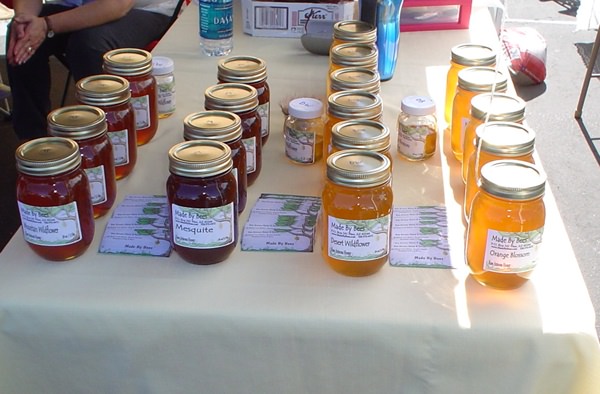
Local goats' cheese

I love Farmers Markets.  They seem to encapsulate the wholeness of locals growing meat and produce for other locals. They seem to serve as a reminder of the integrity that is needed just as much in food as in all other areas of life.

Of course, I am not so naive to think that we could wind the food revolution back to before the days of supermarket chains – food is wonderful value nowadays especially for those families on tight incomes.

But I can’t be the only one that ponders what the long term effect of all those

Local jellies (jams to Brits!)

E-numbers and other strange ingredients that one reads on most packets of most items, and whether or not fruit is sprayed with anything that we should know about, and so on and so forth.

That’s why that place in my psyche is ‘stroked’ so well by wandering around the Farmers Market.

One would expect if there was going to be any place where yours truly, dressed and sounding like the Englishman that he is, is going to feel foreign, it would be at the Payson Farmers Market.  I don’t even try to hide my origins, responding to a “Howdy folks” from the stall-holder with a quintessentially English “Good Morning!

Inevitably there are reasons why I am made to feel welcome here in Payson, my hunch is that it is much to do with this being a pioneering town for most of the last 100 years, and therefore co-operation, collaboration and a welcoming attitude were key elements of sustaining a way of life, but, in the end, analysis is pointless.

What matters is how we are made to feel, and we are made to feel very welcome.

Indeed, Payson with it’s predominance of right-wing, independent thinking, tough ‘cow-boy’ inhabitants echoing a recent past, may have an important lesson for all of us, across the globe, as the forces of disconcerting change build and build: be local, think local, preserve local.

I’m very proud to be slowly but surely turning into a Payson local.

By Paul Handover

Freedom starts at home

Freedom as something one must endeavor to gain and maintain!

The power of a cup of tea!

There is a quiet self-contradiction developing in the Tea Party movement that needs addressing, for it is a contradiction that, if left uncorrected, could turn a force with truly revolutionary potential into one more element of an oligarchic political stasis.

This movement, which as a culture attempts in many ways to be an imitation of the founders, is steering away from its origins and failing to take hold of perhaps the single most important insight of the entire American Revolution – that national change is the result of local change, not its cause.

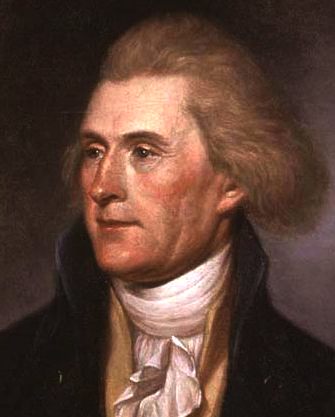
It was not homesickness that led Thomas Jefferson to return to his home state of Virginia and decline a re-election to

Thomas Jeffersen

Congress after penning the Declaration of Independence. At the forefront in Jefferson’s mind on July 5, 1776, was not the welfare of the new nation as a whole, but rather the welfare of his home state of Virginia.

For Jefferson, Virginia was not simply one part of the ultimate goal of the United States, but in fact an ultimate goal in itself. It was at the local level that Jefferson knew provisions for the future freedom of his fellow Virginians had to be made.

Voltairine de Cleyre, an anarchist who lived in the late 19th and early 20th centuries, greatly admired the founding generation and Jefferson in particular.

In her essay “Anarchism and American Traditions,” she wrote that one of the greatest traits of the American revolutionaries was their recognition “that the little must precede the great; that the local must be the basis of the general; that there can be a free federation only when there are free communities to federate; that the spirit of the latter is carried into the councils of the former.”

“Anarchism” today is often employed as a pejorative term rather than as a description of the political and economic philosophy taken seriously by such great minds as J.R.R. Tolkien, Henry David Thoreau, Thomas Jefferson and William Lloyd Garrison. In fact, de Cleyre’s political philosophy had many similarities with modern libertarianism and traditional conservatism.

Continue reading “Freedom starts at home”

Giving Up!

[With this Post, Jon introduces a series of forthcoming articles looking at the inner person and exploring ways in which each of us can enhance our feelings of contentment and happiness. Ed.]

Stop the world, I want to get off!

Starting again requires giving up

Whichever way we look, there appear to be huge problems. Not insurmountable but, metaphorically speaking, sheer vertical cliffs without any easy way up.

One might ponder if the last 50 years, that post-war period of growth and prosperity, have, in reality given society real, sustainable, core improvements or whether all the ‘gains’ have come at such a cost that the net benefit is questionable?

This could be seen as pessimism gone mad. Undoubtedly, there have been some huge gains from a scientific point of view and we now enjoy lives that are greatly enhanced and longer. But not to ask such a fundamental question is to assume the alternative, that everything in the garden is rosy.

Now this may seem a strange introduction to a topic that is going to be deeply personal and private.

But both the private, individual world of the ‘self’ and the great, interconnected world of the planet are indivisible. Every aspect of our lives, our livelihoods, our environment and the future of our children depends on how well, and how sustainably, we manage our personal, local, national and international interests.

For example, if Prof. Lovelock’s theory on the planet being a self-regulating organism is correct, his Gaia theory,  then possibly in the lifetimes of our children, and certainly in the lifetimes of our grandchildren, worrying about a job or repaying the mortgage will be irrelevant. Our descendants will be worrying about their very survival!

I called this piece Giving Up. Why?

Because the only way forward is to give up on the present. I will expand on this theme in future Posts.

The future depends on each of us being happy and contented with ourselves and avoiding looking out there for the magic cure to all our troubles. Being, as far as we are able, at peace with our circumstances and able to do the best, individually, as well as the best for our families, our friends and the larger world in which we work and play.

I have heard people ask the question before, “How can I best help the world?” The only truthful answer is to develop ourselves as individuals. In doing this, the field of consciousness that we are all connected to is also lifted or elevated to a higher level.

At this stage of history, either…the general population will take control of its own destiny and will

Noam Chomsky

concern itself with community interests guided by values of solidarity and sympathy and concern for others or alternately there will be no destiny for anyone to control.

-Noam Chomsky

By Jon Lavin

[Anyone who has been affected by this article and wishes to contact Jon may find his contact details here. Ed.]

Letter from Payson – the language barrier!

America and England are two Nations divided by a common language

The other day I was in Payson’s local Home Depot looking for what I call a torch.  As usual, if one has an air of not knowing where to look, it is only a matter of moments before a sales assistant asks if he or she may help.

The Home Depot - Payson, Az

Me: Excuse me but do you sell rechargeable torches?

Sales Assistant: I don’t think so, Sir, you would be best advised to ask at the Information Desk.

A few moments later, at said Information Desk … Do you stock rechargeable torches?

The young girl types on a keyboard, looks up at the screen and replies … I’m sorry Sir, we don’t stock those.

Surprised, I get on looking for the other items that I need.

About 10 minutes later, halfway down an aisle I notice – guess what – a decent selection of rechargeable torches! Pleased, I make my selection and on the way out to the tills pass by the original sales assistant who came to help me.

Me: You see you do sell rechargeable torches!

Sales Assistant:  Ah, we call them flashlights!

The point of this rather mundane story is to point out that the differences in language between American English and UK English are much more involved than the famous ones such as rubber and condom!

In fact there are so many different terms in the D-I-Y arena that I have stopped asking for items in what, to me, is the

Ace Hardware

obvious name and now tend to describe the problem that I am trying to fix.

Thank goodness, most of the assistants in Home Depot, and the equally efficient Ace Hardware, now see me coming and know that I’m still learning to speak American!

Is there a deeper element to this language difference?

I believe so.  Because the assumption is that you are going to be understood straight off.  If one was in a country where the natural language was other than English then, without doubt, you would know that verbal communication was going to be strained, to say the least.

In America we just take the language for granted. In practice, I suspect that verbal communications are much less effective than one assumes.

Finally, it’s interesting to note that Jean, who was married to an American for 30 years, effortlessly switches to both an American accent and vocabulary as soon as she is talking to the locals.  Will I, too, make the switch over time?

(If you are in need of a rechargeable torch yourself, here is a Home Depot coupon. Good luck!)

By Paul Handover

P.S. The quote that started this article appears to have been originated by George Barnard Shaw and not Winston Churchill as I previously thought.

Why do we cheat?

Behavioral Economist concludes that most people cheat.

In a very interesting video on the website TED, Dan Ariely, Professor of Behavioral Economics at Duke University, explains his research into why people think it is okay to cheat and steal.

Here is Ariely’s presentation from YouTube:

From his research, he concludes the following:

  • A lot of people will cheat.
  • When people cheat, however, they cheat by a little, not a lot.
  • The probability of being caught is not a prime motivation for avoiding cheating.
  • If reminded of morality, people cheat less.
  • If distanced from the benefits from cheating, like using “chips” instead of actual money in transactions, people cheat more.
  • If your in-group accepts cheating, you cheat more.
Dan Ariely

I quibble with the interpretation of some of his findings, which may justify a separate post on how people perceive what they do and do not know, but there are always issues of this sort with a given research project.  Where I draw the line is when he expands his conclusions to include all of Wall Street and the stock market, which is totally beyond the scope and nature of his research.

On what basis does he draw this conclusion?  As explained in this short video (as I have not read his book, though I’ve read excerpts and am familiar with the study upon which the book is based), Ariely claims that because stocks and derivatives are not in the form of money, they “distance people from the benefits of cheating,” which leads individuals who engage in the stock market to cheat more.  He alludes to Enron as proof.

This is almost too silly to spend a lot of time on trying to discredit, but I fear that a lot of people who hear his talks or read his book may be lulled into accepting what he says about the stock market as true.  But it is not! Enron is the exception, not the rule.

Companies who issue stocks are raising money to provide a good or service that is valued by society; they are rewarded by profits.  Investors who buy and sell stocks, trade derivatives, and invest in portfolios are trying to make their money go further. They are trying to earn a return on their savings.  Cheaters do not survive in the stock market, unlike the “consequences-free” classroom in Areily’s experiment.

On the other hand, these factors are in glaring abundance in the government:  politicians never “see” the taxes they spend as the hard-earned income of the citizens. And the “benefits” of cheating, including power and privilege, are amorphous and vague, and couched in the so-called morality of “doing the greater good.”  I’m surprised Ariely does not condemn the federal government using the same logic as his does the stock market.

His last take-away from this research project?  That we find it “hard to believe that our own intuition is wrong.”

I think Dr. Ariely ought to apply that caveat to the conclusions he draws about his own research.  Very interesting, very compelling, but his interpretation of the results as they apply to the stock market falls victim to the very same biases that he claims to find in others.

by Sherry Jarrell

Brief encounter

A gift from one stranger to another

I was waiting for a flight to London one day in January, a spare seat opposite me at the table in the lounge.

A middle-aged German woman asked to sit down. She was she stopping briefly in Dubai on her way back from Australia and it seemed from the conversation that her month long trip had been some sort of possible life changing experience. By her simple back pack and even her shoes I could tell she was an individual with character.

In the minutes that passed by she talked about Tasmania and how different life was there from the one she knew at home.  I don’t recall exactly what I said to share the pleasure of her trip but did agree that it was possible to make major changes in one’s life; it obviously struck a chord.

Not so long after this brief meeting, I received an email.  She had made those big changes and she sent me a picture that she took in Tasmania as a thank you.

A Tasmanian bird greeting the morning sun

You never know how sometimes people just need someone who can see that their dreams are possible!

By Bob Derham

The Old Jacket

The ways we remember those close to us that have died.

I saw our neighbour at school today, and was surprised the she was wearing an old faded jacket which was torn at the back, and the feathers from the lining were coming out.

One of the other Mums was also a little surprised perhaps because the lady is the wife of a Barrister.

Yes she said “It used to belong to my cousin that died. Every time a feather falls out I think of him!

I thought that was lovely, but we all laughed when the other parent quickly retorted.

You must think of him a lot” – as another feather fell out.

By Bob Derham