Tag: London

The story of transition, part two.

More of the fun collection of short films about Transition.

A series of 10 delightful short films, courtesy of Transition Culture – For the introduction and the first three films, click here.

Film Four – An Egg Origin: Transition Town Forres’s Community Garden

Like many Transition initiatives, Transition Town Forres (TTF) saw the rebuilding of food resilience as a key part of its work. It sought to bring land into community management for new food production. TTF was invited to negotiate a lease with Moray Council for 0.59ha (1.45 acre) of horticultural land starting on the 1st April 2009.

With an 11 year lease, work began on the site. Rather than divide it into the traditional rectangles of allotments, it was divided into circular allotments, called ‘pods’, each one 250m2, and shared by 4-6 people. The garden now has 75 gardeners, 60 local scouts and 26 chickens (hence the egg). Participation is from a broad cross section of the community, and the dropout rate has been less than half that of other local allotments. The next step that is planned is a Farmers’ Market in the town.

Film Five – Mini Draughtbusters Origin: Transition Belsize’s Draughtbusters

Transition Belsize, one of over 40 Transition initiatives active within London, was inspired by ‘Draught Busting Saturdays’ created in South London by Sue Sheehan and a group from Hyde Farm Climate Action Network. They started working with Camden Council to deliver Draughtbusters in Belsize. The idea is a simple one. The area has many Victorian homes with leaky sash and casement windows.

Up to 15 people meet in someone’s house and learn to draught-proof by working on the host’s house. The host gets given £50 of materials, and the participants £20 worth each. It has proven very popular, and 15 local schools have also been draught-proofed by keen Draughtbusters. It has now spread to many other London Transition groups, just one example of how Transition groups can incubate ideas that can then be rapidly replicated by others. Our object here is a miniature version of the Draughtbusters team: Patrick (doing the door) and Sarah and Lauren (working on the window).

Film Six – A Clove of Garlic Origin: The Green Valley Grocer, Slaithwaite

When the local greengrocer went out of business, members of Marsden and Slaithwaite Transition Towns (MASTT) in Yorkshire wondered if perhaps the community might take over the running of the shop. They realised this would only work with the support of the community so they held a public meeting where people expressed enthusiasm for the idea.

Time was tight, so they set up an Industrial and Provident Society and designed a share launch which was unveiled three weeks later. The goal was to raise £15,000, and this was achieved within 10 days.

From initial idea to the shop opening? Two months.  The shop is now a busy thriving community enterprise, and MASTT is setting up a growing co-operative called ‘Edibles’ to supply the shop with local produce.

Early on in running the shop, they found that all the wholesale garlic available to them was imported from China, and so they set up the Green Valley Grocer Garlic Challenge, making garlic cloves available to customers at cost and offering to buy back whatever people produce, with the aim of making Slaithwaite self-sufficient in garlic within two years (well you have to start somewhere…).

The final four films will be shown shortly after Christmas.

I must down to the seas again

History repeating itself in terms of the commercial sailing ship.

Tea clipper 'Cutty Sark'

Most Brits have heard of the tea clipper Cutty Sark.  As the Cutty Sark website explains,

Cutty Sark has travelled across the world, sailing under both the Red Ensign and the Portuguese flag, visiting every major port in the world through the course of her working life. In admiration of her beauty and in recognition of her fame, she was preserved for the nation by Captain Wilfred Dowman in 1922.

Since then, the old clipper has been berthed in Falmouth and Greenhithe, finally arriving at her current resting place in Greenwich in 1954.

And elsewhere on that website,

Cutty Sark matters because:
  • She is the epitome of the great age of sail.
  • She is the only surviving extreme clipper, and the only tea clipper still in existence.
  • Most of her hull fabric survives from her original construction and she is the best example of a merchant composite construction vessel.
  • She has captured the imagination of millions of people, 15 million of whom have come on board to learn the stories she has to tell.
  • She was preserved in Greenwich partly as a memorial to the men of the merchant navy, particularly those who lost their lives in both world wars.
  • She is one of the great sights of London.

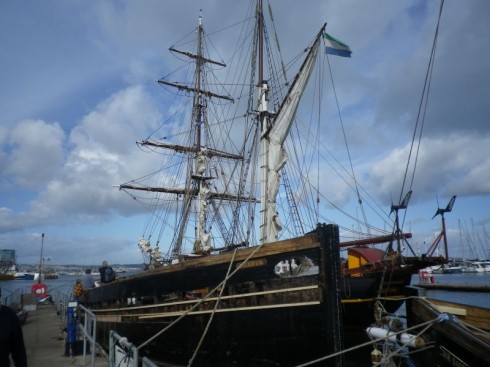
I mention the Cutty Sark because it seems a historic connection with something very relevant to today’s world that was the subject of a recent item on Rob Hopkin’s Transition Culture blogsite.  In it Rob presents his first podcast, the topic being the sailing ship Tres Hombres, that is being used for commercial sea transport.  The link to the Transition Culture story is here, and the podcast follows, (just click on the link to listen to the fascinating 14 minutes audio story about the ship Tres Hombres.)

Tres Hombres podcastfinal

Sailing ship Tres Hombres

The first Transition podcast! A visit to the Tres Hombres, tasting a revolution in shipping

Last week I did a course with the Media Trust on how to make podcasts (highly recommended).  So, here, with some fanfare, is the first ‘Transition podcast’, I hope you like it.  If so, do embed it in other places.  It means I spent the time I would spend writing editing pieces of audio.  Let me know what you think.  So, the podcast is about a fascinating morning I spent visiting the sailing ship Tres Hombres which visited Brixham earlier this week.  It explores the potential of sail-powered shipping as the price of oil rises and the economy tightens.  It’s an exciting story.

Finally, let me close with a very well-known poem about sailing the big ships.

“Sea-Fever”

I must down to the seas again, to the lonely sea and the sky,
And all I ask is a tall ship and a star to steer her by,
And the wheel’s kick and the wind’s song and the white sail’s shaking,
And a grey mist on the sea’s face, and a grey dawn breaking.

I must down to the seas again, for the call of the running tide
Is a wild call and a clear call that may not be denied;
And all I ask is a windy day with the white clouds flying,
And the flung spray and the blown spume, and the sea-gulls crying.

I must down to the seas again, to the vagrant gypsy life,
To the gull’s way and the whale’s way where the wind’s like a whetted knife;
And all I ask is a merry yarn from a laughing fellow-rover
And quiet sleep and a sweet dream when the long trick’s over.

By John Masefield (1878-1967).
(English Poet Laureate, 1930-1967.)

Dogs, humans and hope

A new book about dogs by John Bradshaw offers a theme for today.

Yesterday, I mentioned an article from the current issue of The Economist.  Also in that issue was a review of a new book from John Bradshaw, called Dog Sense: How the New Science of Dog Behaviour Can Make You a Better Friend to Your Pet.  You can read the review here. But in terms of the theme of today’s post, read this paragraph from that review,

Dogs are not like nicely brought-up wolves, says the author, nor are they much like people despite their extraordinary ability to enter our lives and our hearts. This is not to deny that some dogs are very clever or that they are capable of feeling emotion deeply. But their intelligence is different from ours. The idea that some dogs can understand as many words as a two-year-old child is simply wrong and an inappropriate way of trying to measure canine intellect. Rather, their emotional range is more limited than ours, partly because, with little sense of time, they are trapped almost entirely in the present. Dogs can experience joy, anxiety and anger. But emotions that demand a capacity for self-reflection, such as guilt or jealousy, are almost certainly beyond them, contrary to the convictions of many dog owners.

That last sentence is key, “But emotions that demand a capacity for self-reflection, such as guilt or jealousy, are almost certainly beyond them, contrary to the convictions of many dog owners.

So in yesterday’s post, when I wrote about the terrible uncertainty that millions and millions of humans must be experiencing, there is no useful metaphor available to link this human idea to how the dogs feel; as John Bradshaw writes, this level of reflection is just beyond them.

We hug a dog (or any animal) to escape from matters complex.  As Sue Miller wrote so beautifully, “I was taken up by them [pets] and their life and energy, by what they needed and asked of me.  I let go of everything difficult or complex in my life.  As I was driving home, I thought of all this, and it seemed to me that I’d chosen work which offered me daily the presence of pure innocence, a forgiveness for all my human flaws.”

So accept the gift of pure innocence that our pets give us.

But what ‘gift’ can we humans accept that relates to the very complex world that we humans see all around us?

What about hope?  Let’s accept the gift of hope.  As I wrote recently in an email to a friend (before the London riots burst upon our consciousness),

‘Hope’ is going to be the key message over the coming weeks and months because the feeling that the ‘end of the world is nigh’ is incredibly strong, well it is to me!

Of course, the ‘end of the world’ feeling is, as you well know from me, really the end of an era.  But an era where for decades money has equalled power; ergo money has equalled control.

Now the speed of change must be terrifying to millions across the world.  So out of that terror must come a new order, a new way of understanding that how we have treated our planet is a busted model and that it is time, indeed the 11th hour as it were, to find that new order, of love and sustainability with our planet, both in earthly and spiritual ways.

We must have faith in the hope that we are living through the chaotic transition from an era of greed and destruction to one where we have a future that goes on for thousands of years.

A self-affirmation
For today, I am in charge of my life.
Today, I choose my thoughts.
Today, I choose my attitudes.
Today, I choose my actions and behaviours.
With these, I create my life and my destiny.

Summer Solstice 2011

Let’s all pause for a moment (and my apologies for the late posting!)

The precise time of the summer solstice today is 17.16 Greenwich Mean Time (GMT/UTC).

Our sun, giver of life

In terms of local times that will be 10.16 here in Arizona and also in California, 13.16 in New York, 18.16 in London, and 03.16 (Wed) in Sydney, Australia, to pick just a few places.

What a year it has been so far!

So let’s just pause for a moment, as the Sun appears to pause, and put out our combined thoughts across this wonderful Planet Earth and pray for peace and tranquillity for all during the rest of this ‘interesting’ year.

Basic geometry

North-West Europe’s Winter weather.

As I write this article, the temperature in London (it’s 5pm on Tuesday 14th.) is 4 deg C/ 38 F heading down to a forecast -2 deg C/28 F overnight.  Similarly cold temperatures are forecast during the rest of the week.

Here’s something that was published in October:

Coldest winter in 1,000 years on its way

04 October, 2010, 22:20

After the record heat wave this summer, Russia’s weather seems to have acquired a taste for the extreme.

Forecasters say this winter could be the coldest Europe has seen in the last 1,000 years.

The change is reportedly connected with the speed of the Gulf Stream, which has shrunk in half in just the last couple of years. Polish scientists say that it means the stream will not be able to compensate for the cold from the Arctic winds. According to them, when the stream is completely stopped, a new Ice Age will begin in Europe.

So far, the results have been lower temperatures: for example, in Central Russia, they are a couple of degrees below the norm.

“Although the forecast for the next month is only 70 percent accurate, I find the cold winter scenario quite likely,” Vadim Zavodchenkov, a leading specialist at the Fobos weather center, told RT. “We will be able to judge with more certainty come November. As for last summer’s heat, the statistical models that meteorologists use to draw up long-term forecasts aren’t able to predict an anomaly like that.”

In order to meet the harsh winter head on, Moscow authorities are drawing up measures to help Muscovites survive the extreme cold.

Read the rest of the article here.

So why the heading for this Post, as in Basic Geometry?

Because places on the Globe are measured using Latitude and Longitude.  Let’s look at the Latitude of some places:

London 51°30′N

Calgary, Alberta 51°03′N

Kiev, Ukraine 50°27′N

Krakow, Poland 50°03′N

Now let’s look at those Cities again with the current temperatures (you have to accept the local time differences):

London 51°30′N +4 deg C

Calgary, Alberta 51°03′N -9 deg C

Kiev, Ukraine 50°27′N -6 deg C

Krakow, Poland 50°03′N -12 deg C

In other words, Britain enjoys, or should enjoy, a much warmer Winter than most other places of the same or similar latitudes because of the effect of the Gulf Stream.

Just a muse!

By Paul Handover


Greenwich Observatory

A rich and beautiful place in British History

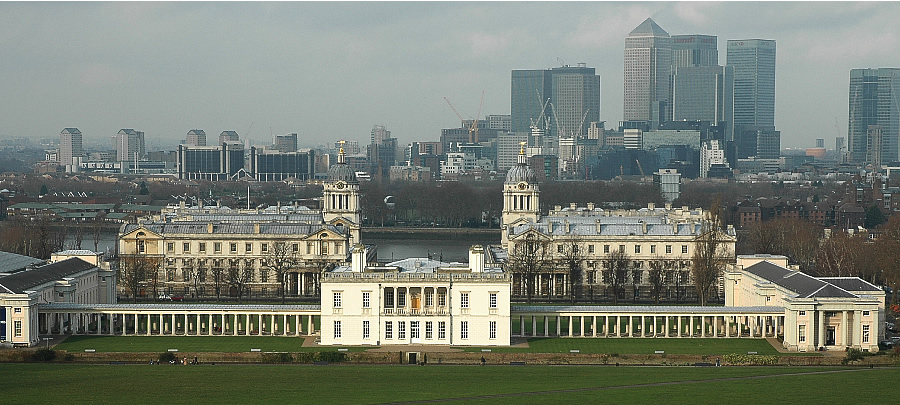
View from Observatory Hill of Queen Anne's Palace, the old naval buildings & across the river Canary Wharf

Paul Handover recently published an article about “Daylight Saving” and the Greenwich Meridian.  THIS SITE with its photos and links is of particular interest to those with little personal knowledge of London.

Greenwich Park – where stands the magnificent Royal Observatory – is one of the jewels of London. Steeped in history, it provides the perfect day-out for the family, including foreign tourists. Forget the jostling crowds in the frenzied den of useless consumption that is Oxford Street and take a train out to Greenwich. There you will find a magnificent park, wonderful views of London and the Thames, the Royal Observatory and the National Maritime Museum. Too much to mention in detail, but if for nothing else just go to see the clocks of John Harrison, horologer extraordinaire in a time when chronometry meant everything to men at sea. You don’t have to be British to take pleasure in the great skills and achievements of British sailors and explorers, backed up by men of science responsible for some of the most important advances in scientific history.

I can’t count how many times I’ve been to Greenwich Park, but every time I get back to London from my current home in Germany, I try to take my son there.  I want him to see this rich place in British history, but also to enjoy its enormous beauty.

More French Anglo-Saxon Bashing

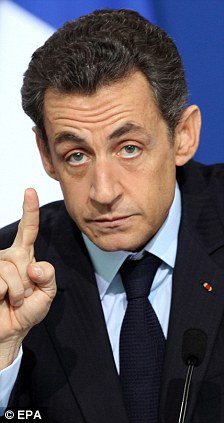
Pres. N Sarkozy

“Do you know what it means for me to see for the first time in 50 years a French European commissioner in charge of the internal market, including financial services, including the City (of London)? I want the world to see the victory of the European model, which has nothing to do with the excesses of financial capitalism.” (As quoted by The Daily Telegraph.)

“Victory”? So we were at  war, then? Oh dear ….. you are 60 years out of date old boy, or perhaps 500 years! Does Agincourt still hurt so much?

One has for some time had the feeling that Europe’s leaders are a mediocre lot, with “statesmen” being very thin on the ground. Unfortunately, this impression has just been reinforced by Nicholas Sarkozy’s outrageous, finger-wagging gloating about the appointment of Michel Barnier to the EU post of  Internal Markets Commissioner.

From this lofty position this mighty expert on world financial markets threatens to regulate the City to “European” (aka French) “‘standards”.  The rationale will be to avoid another financial crisis by “reining in” the banks. The not-so-hidden agenda will be to sap the vitality of London so that Paris and Frankfurt in particular can cream off some of the rich pickings.

This is stupid and reprehensible for a number of reasons.

Firstly, any cutting-off of the City at the knees will not result in financial firms emigrating to sclerotic, over-regulated, pretentious, high-cost, overblown Europe but to the USA or elsewhere. True, the US is reeling at present, but I for one won’t bet on the mighty beast remaining on its knees for very long. And when it does rise up again, Europe will still be the same old bureaucratic, state-interfering, suffocating, high-tax business and financial environment that we know and hate.

Moreover, Sarko’s diatribe is extraordinarily partisan. If London’s City is a world financial centre, then this is to Europe’s advantage as much as Britain’s.  Sapping its vitality will hurt Europe, ensuring that more financial business flows elsewhere. In the electronic age, it is not fine French wines or German Wurst that will keep these companies in France or Germany.

And what sort of pro-Europe message are such comments going to send to ordinary British voters, who all polls suggest would actually vote to leave Europe if given a choice, which of course they will not be? Britain has lost almost all its once-mighty fishing industry, still pays to support French farming, has almost no indigenous motor industry any more … but at least we have the City. If Sarko’s hatchet-man gets his way, it will be regulated to its knees …..

Sarkozy’s comments were the most prattish, partisan, nationalistic and stupid comments ever made by one of the principal leaders of Europe. And apart from anything else, Barnier has to swear to uphold the interests of ALL EUROPE when taking up his post; the fact that he is French should be IRRELEVANT. The nationalistic cynicism of Sarkozy’s comments are breathtaking. There have  been frantic efforts by Barnier himself to backtrack in recent days, as London seethed at Sarko’s comments. But you can’t undo the past. Sarkozy said what he said; one has no reason to suppose he didn’t mean it.

Yes, there have been terrible excesses, but not all the City is to blame. And German and Franco banks hardly kept their snouts  out of the trough, almost ALL European banks having been clobbered,  so inter-connected is the banking world. And I for one haven’t forgotten the shameful fiasco at French Credit Lyonnais a few years ago, nor the recent £5 billion loss ($8 bn) by a rogue trader at Société Générale two years ago.

“The European Model”? It is laughable ……. Continental Europe has nothing to teach us about creating a healthy economy and sustainable jobs.

Sadly, Sarkozy’s narrow-minded nationalism have been matched by the stupefying incompetence of the British government in failing to block the appointment of Barnier, a well-known regulator à la française and the last thing Europe needs. We need reforms, yes, but throwing the baby out with the bathwater was never a good idea, and nor is it now.

And Mr President – less of that finger-wagging please …..

By Chris Snuggs