Tag: LiveScience

The origins of the dog

Dogs and humans go back even further than previously thought.

Humans and dogs were constant companions well before our ancestors settled in villages and started growing crops 10,000 years ago

I have no doubt that thousands of dog owners all around the world must be enthralled by the way that dogs relate to us and, in turn, how we humans relate to dogs. More than once a day, one of our dogs will do something that has me and Jean marvelling at their way of living so close to us.

Then when one starts to reflect on how long dogs and humans have been together, perhaps it could be seen as the direct result of that length of relationship.

Now there’s nothing new in me writing this, after all the home page of Learning from Dogs states:

Yet they have been part of man’s world for an unimaginable time, at least 30,000 years. That makes the domesticated dog the longest animal companion to man, by far!

Back in May the website Livescience published an article that revealed more about the length of our relationship with dogs. This is how it opened:

Ancient Wolf DNA Could Solve Dog Origin Mystery

by Becky Oskin, Senior Writer

Humans and dogs were constant companions well before our ancestors settled in villages and started growing crops 10,000 years ago, a new study suggests.

Genetic evidence from an ancient wolf bone discovered lying on the tundra in Siberia’s Taimyr Peninsula reveals that wolves and dogs split from their common ancestor at least 27,000 years ago. “Although separation isn’t the same as domestication, this opens up the possibility that domestication occurred much earlier than we thought before,” said lead study author Pontus Skoglund, who studies ancient DNA at Harvard Medical School and the Broad Institute in Massachusetts. Previously, scientists had pegged the wolf-dog split at no earlier than 16,000 years ago.

The Livescience article referred to results that were published in the journal Current Biology on May 21st this year. One needs a subscription to read the full report but here is their summary:

The origin of domestic dogs is poorly understood [ 1–15 ], with suggested evidence of dog-like features in fossils that predate the Last Glacial Maximum [ 6, 9, 10, 14, 16 ] conflicting with genetic estimates of a more recent divergence between dogs and worldwide wolf populations [ 13, 15, 17–19 ]. Here, we present a draft genome sequence from a 35,000-year-old wolf from the Taimyr Peninsula in northern Siberia. We find that this individual belonged to a population that diverged from the common ancestor of present-day wolves and dogs very close in time to the appearance of the domestic dog lineage. We use the directly dated ancient wolf genome to recalibrate the molecular timescale of wolves and dogs and find that the mutation rate is substantially slower than assumed by most previous studies, suggesting that the ancestors of dogs were separated from present-day wolves before the Last Glacial Maximum. We also find evidence of introgression from the archaic Taimyr wolf lineage into present-day dog breeds from northeast Siberia and Greenland, contributing between 1.4% and 27.3% of their ancestry. This demonstrates that the ancestry of present-day dogs is derived from multiple regional wolf populations.

That summary page also includes the following Graphical Abstract:
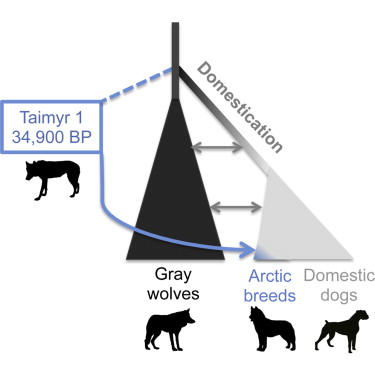
fx1

I don’t have permission to republish the Livescience article in full but would like to offer the closing paragraphs of this fascinating report.

“It is a very well-done paper,” Perry [George Perry, an expert in ancient DNA at Pennsylvania State University] told Live Science. “This topic is a critical one for our understanding of human evolution and human-environment interactions in the Paleolithic. Partnership with early dogs may have facilitated more efficient hunting strategies.”

If dogs first befriended hunter-gatherers, rather than farmers, then perhaps the animals helped with hunting or keeping other carnivores away. For instance, an author of a new book claims humans and dogs teamed up to drive Neanderthals to extinction. Skoglund also suggested the Siberian husky followed nomads across the Bering Land Bridge, picking up wolf DNA along the way.

“It might have been beneficial for them to absorb genes that were adapted to this high Arctic environment,” Skoglund said.

This is the first wolf genome from the Pleistocene, and more ancient DNA from prehistoric fossils could provide further insights into the relationship between wolves, dogs and humans, the researchers said.

Yes, our dogs have been part of man’s world for an unimaginable time – and Jean and I, as with tens of thousands of others, can’t imagine a world without dogs.
The rights that animals deserve.

The compelling reasons for the rights of animals.

I opened the week last Monday by publishing a post under the title of Beyond humans. That post included me writing about Michael Mountain’s talk at the Personhood Beyond the Human conference at Yale University.  That talk, that may be listened to in that post, was described in the following abstract:

Abstract: The past 50 years have seen enormous growth in the animal protection movement. But the situation for nonhuman animals in every sphere, with the exception of homeless pets, continues to deteriorate. Any small advances remain incremental. Animal rights and welfare groups find themselves at a loss to explain their inability to influence the general public. But the work of Ernest Becker (The Denial of Death) and of psychologists in the field of Terror Management Theory (TMT) offer essential insight.

In this talk, we discuss how our need, as humans, to proclaim that “I am not an animal!” and to deny personhood to other animals affects our relationship with them at a fundamental level. We argue that to be effective, the animal protection movement needs to understand TMT and take it into account. And we conclude that a new kind of relationship to the world of nature in the 21st Century is not only essential to the mitigation of the catastrophic effects of the Sixth Great Extinction, but that it also holds the key to Becker’s still-unanswered question of how we can begin to relate positively to our own terror of personal mortality — and therefore our own future as a species.

Thus I want to close the week by reinforcing Michael Mountain’s message by using an article published yesterday over at Mother Nature Network.

ooOOoo

Many Americans support equal rights for animals

Animal rights cases and films like ‘Blackfish’ are credited with influencing public opinion.

By: Tanya Lewis, LiveScience
Tue, May 26, 2015 at 11:08 AM

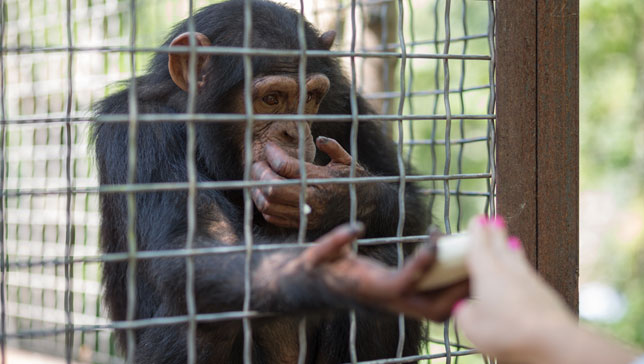
About 33 percent of people said they were 'very concerned' about the use of animals in research, and 21 percent were very concerned about zoo animals. (Photo: Pavel L Photo and Video/Shutterstock)
About 33 percent of people said they were ‘very concerned’ about the use of animals in research, and 21 percent were very concerned about zoo animals. (Photo: Pavel L Photo and Video/Shutterstock)

Nearly one-third of Americans believe animals should have the same rights as people, a recent poll finds.

Thirty-two percent of the people surveyed believe animals and humans should have equal rights, up from 25 percent in 2008. Another 62 percent believe animals deserve some protection from harm and exploitation, but it is “still appropriate to use them for the benefit of humans.” Only 3 percent believe animals don’t require protection from harm and exploitation “since they are just animals,” according to the poll.

Gallup interviewed a random sample of more than 1,000 people across the United States on May 6 to 10, 2015. About half of those surveyed were asked about the protection of animals, while the other half were surveyed about the treatment of animals in various settings. The poll’s margin of sampling error was 5 percentage points. [The 5 Smartest Non-Primates on the Planet]

Across all demographic groups, an increasing fraction of people support equal rights for animals, although women were more likely than men to have this view, the poll found. About 42 percent of the women polled supported full animal equality in 2015, compared with 22 percent of men. However, the percentage of men and women who support this view has increased by about the same amount since 2008 — from 35 percent to 42 percent for women, and 14 percent to 22 percent for men.

In addition, Democrats and Democratic-leaning independents were more likely than their Republican counterparts to support complete animal equality. About 39 percent of liberal-leaning people supported that view this year, compared with 23 percent of conservative-leaning people. But the number of both Democrats and Republicans who support animal equality has increased since the last poll, according to Gallup.

The poll found little difference between the views of younger and older Americans.

Gallup also asked Americans how they felt about the treatment of animals in different settings. About 33 percent of people said they were “very concerned” about the use of animals in research, compared with 21 percent who were very concerned about zoo animals. About two-thirds of people said they were “very or somewhat” concerned about animals in the circus; in competitive animal sports or contests; or in research. About 46 percent of people said they were very or somewhat concerned about the treatment of household pets.

The increasing concern for animals can be seen, for example, in the recent court case where animal-rights advocates sought personhood for chimpanzees. The Nonhuman Rights Project has argued for a writ of habeas corpus — a court order to prevent unreasonable detention — to free a pet chimpanzee named Tommy being kept in a cage in upstate New York.

Meanwhile, views on the treatment of marine or farm animals may have been influenced by popular documentaries such as “Blackfish” and “Food, Inc.,” which sought to expose truths about the treatment of whales at SeaWorld and of farm animals raised for consumption, respectively.

Concerns about the treatment of pets may reflect campaigns to stop cruelty toward these animals by organizations such as the American Society for the Prevention of Cruelty to Animals.

Follow Tanya Lewis on Twitter. Follow us @livescience, Facebook & Google+. This story was originally written for LiveScience and was republished with permission here. Copyright 2015 LiveScience, a Purch company. All rights reserved.

ooOOoo

The MMN article above included a number of links; too many on balance for me to insert in this republication.

So I recommend strongly that if this article strikes a chord of interest with you that you go to this place and check out all the many links.