On the 17th March, I wrote another piece inspired by Lester Brown’s book, World on the Edge. That piece was about what Lester Brown calls Plan B and shows that there are positive, real solutions to the dilemma that us humans have got ourselves in.
Anyway, I was delighted to see in my email in-box the following,
PLAN B:MOBILIZING TOSAVECIVILIZATION—THE FILM
Plan B video
For the month of April only, you can watch a streaming edition of the film Plan B on the PBS website. So if you missed the initial release for whatever reason, here is your opportunity to watch it at your leisure.
Based on Lester Brown’s Plan B book series, this 90-minute film, by the award-winning film producers Marilyn and Hal Weiner, follows Lester as he speaks in Beijing, Seoul, Tokyo, New Delhi, Rome, Istanbul, Ankara, and Washington, DC, and visits with world leaders to discuss ways to respond to the challenges of climate change.
The film begins with a dramatic portrayal of a world where there is a mounting tide of public concern about melting glaciers and sea level rise and a growing sense that we need to change course in how we react to emerging economic and social pressures. The film also spotlights a world where ocean resources are becoming scarce, croplands are eroding, and harvests are shrinking.
But what makes Plan B significant and timely is that it provides hopeful solutions—a road map that will help eradicate poverty, stabilize population, and protect and restore our planet’s fisheries, forests, aquifers, soil, grasslands, and biological diversity.
Along with Lester Brown, you will hear from notable scholars and scientists including Nobel Laureate Paul Krugman, Pulitzer Prize winner and New York Times columnist Thomas Friedman, and former Governor and Secretary of the Interior Bruce Babbitt.
Narrated by Matt Damon, well-known for his work raising environmental awareness.
The film is available to view here. Note that it is only free to watch for the month of April.
Continuing the review of Lester Brown’s book World on the Edge.
Regular readers will be aware that I have been summarising each chapter of this pivotal book. Chapters 2, 3 and 4 are part of the section that Lester Brown calls A Deteriorating Foundation. But I am aware that wall-to-wall gloom is often too much for people to take in so I wanted to let you know that the third section, The Response: Plan B, is very much a realistic and pragmatic approach to the alternative, a planet that will let countless future generations live in harmony and sustainably.
So please take in the dire situation that we are in by reading these summaries or, better still, buy the book!
Chapter Four, Rising Temperatures, Melting Ice, and Food Security.
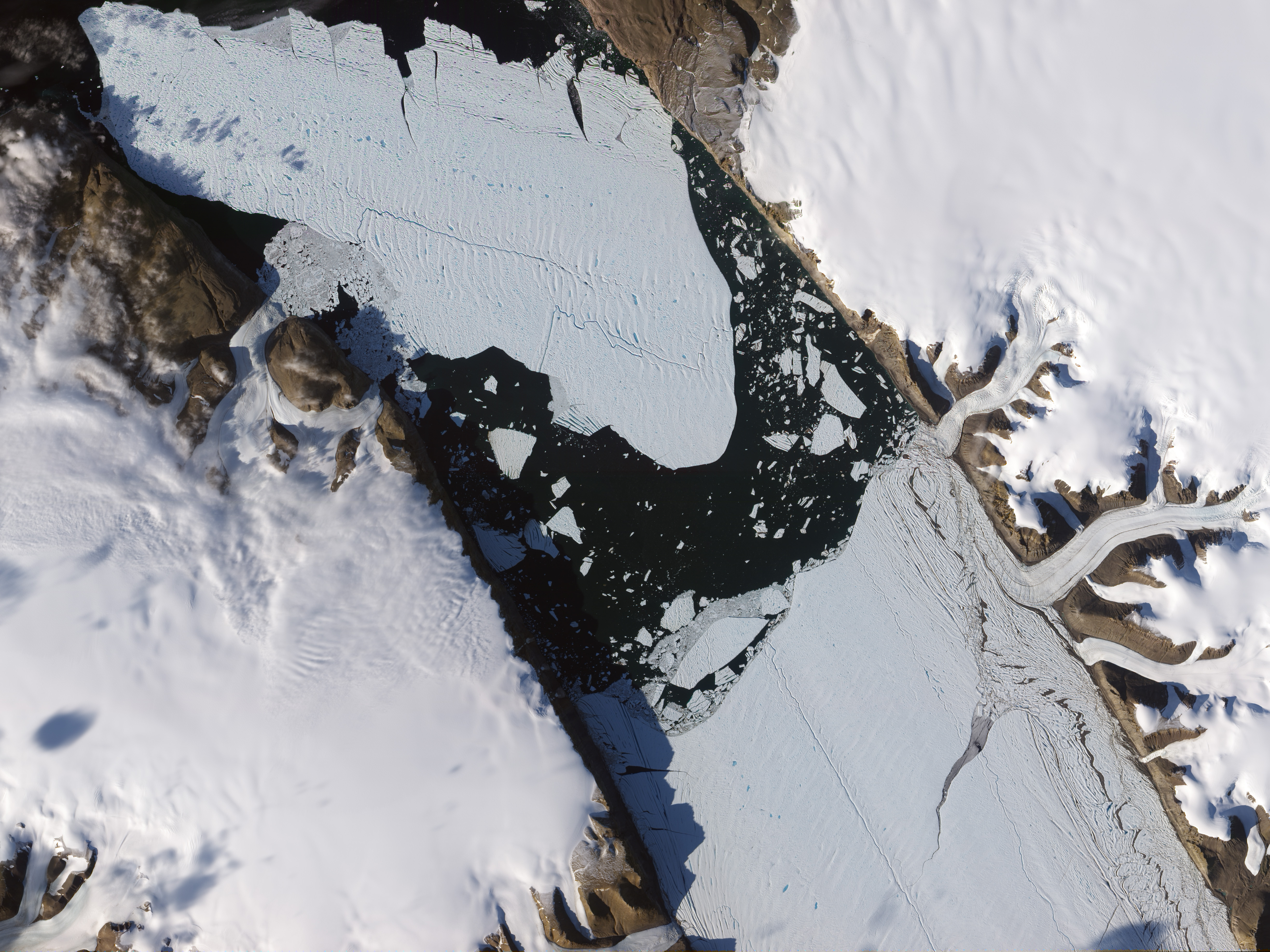
The Petermann Glacier calves an iceberg that covered 97 square miles on August 5th, 2010.
Scientists for some years have been reporting that the Greenland ice sheet was melting at an accelerating rate.
Richard Bates, from the University of St Andrews, part of a team monitoring Greenland ice melt, was reported as saying:
Dr Richard Bates, who is monitoring the ice alongside researchers from America, said the expedition had expected to find evidence of melting this year after “abnormally high” temperatures in the area. Climate change experts say that globally it has been the warmest six months globally since records began.
But he was “amazed to see an area of ice three times the size of Manhattan Island had broken off.
“It is not a freak event and is certainly a manifestation of warming. This year marks yet another record breaking melt year in Greenland; temperatures and melt across the entire ice sheet have exceeded those in 2007 and of historical records.”
A temperate rise of between 2C and 7C would cause the entire Greenland ice mass to melt – raising sea-levels world-wide by 23 feet (7 metres)!
In the United States last year saw record hot temperatures on the East Coast.
On September 27th Los Angeles recorded an all-time high of 113 degrees F, then the official thermometer broke.
A nearby thermometer survived to register a temperature of 119 degrees F, a record for the region.
Crop ecologists use a rule of thumb that for each 1-degree-Celsius rise in temperature above the optimum during the growing season, we can expect a 10-percent decline in grain yields.
Temperatures are rising much faster in the Arctic than elsewhere. Winter temperatures in the Arctic, including Alaska, western Canada and eastern Russia, have climbed by 4-7 degrees F. over the last half-century.
This record rise in temperatures in the Arctic region could lead to changes in climate patterns that will affect the entire planet.
Even a 3-foot rise in sea level would sharply reduce the rice harvest in Asia. It would inundate Bangladesh, a country of 164 million people, submerge part of the Mekong Delta ( a region that produces half of Viet Nam’s rice).
That’s enough from me, simply because although this chapter in the book continues with many more frightening facts, I can’t continue to list them in this particular Post. If the above doesn’t cause you to think and want to change, then a couple of dozen more facts aren’t going to do it either.
Just look at the photograph below and ponder on what we are leaving our children and our grand-children. Indeed, if you are, say 50 years or younger, ponder on what the next few decades could offer for you.
We have to break our addiction with our modern way of living – or Planet Earth will do it for us.
A mother of an iceberg!
On Aug. 5, 2010, an enormous chunk of ice, roughly 97 square miles (251 square kilometers) in size, broke off the Petermann Glacier, along the northwestern coast of Greenland. The Canadian Ice Service detected the remote event within hours in near real-time data from the Moderate Resolution Imaging Spectroradiometer (MODIS) on NASA’s Aqua satellite. The Petermann Glacier lost about one-quarter of its 70-kilometer (40-mile) long floating ice shelf, said researchers who analyzed the satellite data at the University of Delaware. Taken from here.
The way we are most likely treating Planet Earth is almost beyond comprehension.
I have mentioned before the Earth Policy Institute and Lester Brown’s latest book, World on the Edge. Details of the book are here.
At the time of writing this Post (10am US Mountain Time on the 4th Feb.) I have read through to the end of Chapter 5 of the book and will have it completed soon. It’s opening my eyes hugely!
I have decided over the next week or so to summarise each chapter, hoping that this encourages many readers of Learning from Dogs to reflect, go to the EPI website, buy the book or think about making a difference in any way that you can.
Chapter One, On the Edge, sets the background:
Summer of 2010 sees record-high temperates in Moscow, Russia’s grain harvest shrank by 40 million tons (40%) to 60 million tons.
Record high temperatures in south-central Pakistan were recorded. Snow and glaciers in the Himalayas melted fast, 20 million Pakistanis were affected by the resultant flooding, 2,000 died, 6 million acres of crops damaged.
A 2002 study by Mathis Wackernagel concluded that, “humanity’s collective demands first surpassed the earth’s regenerative capacity around 1980. By 1999, global demand’s on the earth’s natural systems exceeded sustainable yields by 20 percent. Ongoing calculations show it at 50 percent in 2007. Stated otherwise, it would take 1.5 Earths to sustain our current consumption.” [my emphasis]
“No previous civilisation has survived the ongoing destruction of its natural supports. Nor will ours.”
Let’s turn to NOAA. A few salient points from there State of the Climate – Global Review for 2010.
For 2010, the combined global land and ocean surface temperature tied with 2005 as the warmest such period on record, at 0.62°C (1.12°F) above the 20th century average of 13.9°C (57.0°F). 1998 is the third warmest year-to-date on record, at 0.60°C (1.08°F) above the 20th century average.
The 2010 Northern Hemisphere combined global land and ocean surface temperature was the warmest year on record, at 0.73°C (1.31°F) above the 20th century average. The 2010 Southern Hemisphere combined global land and ocean surface temperature was the sixth warmest year on record, at 0.51°C (0.92°F) above the 20th century average.
The global land surface temperature for 2010 tied with 2005 as the second warmest on record, at 0.96°C (1.73°F) above the 20th century average. The warmest such period on record occurred in 2007, at 0.99°C (1.78°F) above the 20th century average.
2010 is becoming the year of the heatwave, with record temperatures set in 17 countries.
Record highs have occurred in Russia, Belarus and Ukraine – the three nations at the centre of the eastern European heatwave which has lasted for more than three weeks – but also African, Middle Eastern and Latin American countries.
Temperatures in Moscow, which have been consistently 20C above normal, today fell to 31C (86F), and President Dmitry Medvedev cancelled a state of emergency in three out of seven Russian regions affected by forest fires.
Thousand of hectares of forest burned in the fires, killing 54 people and leaving thousands homeless. For days, Moscow was shrouded in smog, and environmentalists raised fears that the blaze could release radioactive particles from areas contaminated in the 1986 Chernobyl disaster.
Wildfires have also swept through northern Portugal, killing two firefighters and destroying 18,000 hectares (44,500 acres) of forests and bushland since late July. Some 600 firefighters were today struggling to contain 29 separate fires.
But the extreme heat experienced in Europe would barely have registered in Iraq, Saudi Arabia, Niger, Pakistan and Sudan, all of which have recorded temperatures of more than 47C (115F) since June. The number of record highs is itself a record – the previous record was for 14 new high temperatures in 2007.
The freak weather conditions, which have devastated crops and wildlife, are believed to have killed thousands of elderly people, especially in Russia and northern India. The 2003 European heatwave killed about 15,000 people.
Be worried, be concerned but don’t panic – you and I, all of us, have the collective power to sort this all out. More about this soon.


 Learning from Dogs