Tag: Learning

Natural selection, at work?

I want to be like you!

Recently there was an event at which Bill Gates and Warren Buffett answered questions from students of the Columbia Business School in New York. I referred to the event recently when writing about Warren Buffett.

So why were these students interested in Messrs Gates and Buffett? It is, of course, because they are successful.

While different people define success in many different ways, we can be reasonably sure that, in the context of a business school, most of those business students would categorise Gates and Buffett as being among the most successful people alive.

So what did the students ask about? Well, of course, they asked about success! The questions were of two main types.

Read the rest of this Post

Aerial photography

Some chilling reminders of the reality of war!

Britain has a National Collection of Aerial Photography.  It is held within the offices of the Royal Commission on the Ancient and Historical Monuments of Scotland – perfectly logical!

A summary of the different collections is listed here, many of them wartime photographs that bring a multitude of emotions to the surface: incredible bravery of the pilots; photographic standards of 70 years ago, man’s inhumanity to man; and so on.

I pondered a bit about writing this Post because, well ….. well…, see what you make of it!

Author's Mum

Being born in England in the early part of November, 1944, World War 2 still resonates within me.

Early home in an industrial part of West London meant that my mother and father had a ring-side view of the German V1 and V2 rockets that were being visited on London at that time.

My mother, 90, still recounts her enormous sense of relief when VE Day was announced (May 8th, 1945) because she then thought that her son’s future life was more or less assured.

So back to these aerial photographs held in those collections.

Here’s a picture of the visitation of war on the beautiful French town of Caen.

Linger a while and look at the damage, mostly to private homes.  The photograph was taken just slightly more than a month before I was born.

So where’s this Post leading to….?

Read more of this Post

Remarkable people: Tim Smit

The Eden Project in Cornwall, England

To lead the project which took an old clay pit in a remote corner of the UK and converted it into a world class environmental visitor attraction is a tremendous achievement.

Homo sapiens? A game show!

Tim Smit had some fun with the business community at the 2009 Annual Convention of the UK Institute of Directors. Everyone, including he, was in their best business attire, but very few people could get away with crumpled shirt and jeans!

However, he has a serious message about the environment (1:55) and he knows a thing or two about people as well!

Monty Python: is there intelligent life on earth?

For fun, and on an Australian tack, Eric Idle is not so sure.

By John Lewis

What makes “a good school”?

A very obvious explanation of good schooling from a British perspective.

There is frequent reference in the media to “good schools”, usually concerning how to create one or get one’s children into one. It is clearly assumed by writers that use this phrase that everyone understands what it means. I am not so sure ….

So what exactly IS “a good school” as far as a parent who wants the best for his children is concerned?

Do the teachers make “a good school”?
Well, teachers are clearly an important contributor to the quality of a school, but are they the critical factor? I think not ….

The premises, facilities, equipment and environment?
The answer is for me the same as for the first question.

The relevance, logic, variety and quality of the curriculum?
Once again, we have the same answer ….. and in truth, it is not too difficult to work out a curriculum that corresponds to these criteria.

So, what IS the critical factor then?

Read more of this Post

WOMD

Mass Destruction?

No, it’s not weapons – I just wanted to get your attention; it’s “Words”. Last week two words of enormous significance crept into the news, and the first of them was the word “fair“.

This is a very interesting and potentially devastating word, but I wonder if the Minister was wise in letting it out of the box? Has he read the story of Pandora?

The word was used in connection with a report by British Schools Adjudicator Ian Craig, who had been asked by the British Labour government to look into the procedures and practice of admissions to secondary schools in Britain.

It seems that many parents, desperate to get their child into a good school, are devising ways to get round the strict allocation procedures put in place to ensure “fairness”. As has been brilliantly explained by Judith Woods in “The Telegraph” these desperate tricks include “using grandparents’ addresses on admissions forms for sought-after schools, renting homes in the catchment area, feigning marriage break-up and then reporting that one parent has moved nearer the school, and swapping houses with friends.”

According to Mr Craig – and the government – this is “cheating” and not “fair”, and the former is asking for local authorities to “use all means open to them to deter parents from cheating the admissions system. This includes removing places from the guilty and pursuing them through the courts, possibly using the Perjury Act.”

My interest here is not so much in the minutiae of the details of this current spat but the concept of “fairness” in society, which strikes me as pretty fundamentally complex.

It is of course a fairly modern concept, not one that much preoccupied Genghis Khan or even the Victorians, who were much happier with the principles outlined in this verse of the hymn “All things bright and beautiful”.

The rich man in his castle,
The poor man at his gate,
God made them, high or lowly,
And order’d their estate.

Interestingly, the concept is also one that is not often explicitly discussed by governments. I wonder if this is because the power and moneyed elite know that they might be on a sticky wicket in any discussion of “fairness”?

As ever, one cannot hope to find the answers until one has clearly posed the questions. So here goes:

Minister, as you have introduced into evidence the concept of fairness and labelled those trying to get round the school admission regulations as “cheats”, could you possibly answer these questions?

  • Is it fair that many families – desperate to provide a good education for their children – cannot afford to move to an area where there are good schools but are stuck through their limited means in an educational ghetto?
  • Is it fair that people can play the religion card and send their kids to a high-quality “faith” school outside of their catchment area, Tony Blair, former British PM, being the best recent example.
  • Is it fair that a substantial minority of parents don’t have to bother about finding a good state school at all since they can go private? (And shockingly, according once more to  Judith Woods: “the advantage of being educated at an independent school is greater in Britain than in almost any other country.”)
  • Is it fair that many of the same substantial minority own multiple dwellings while hundreds of thousands of ordinary families do not own their own home and have to pay rent to someone, a system that seems to me to be a direct descendent of the feudal system where you slaved all day in return for the right to live on some Lord’s property? (Speaking of which – much as I love the Queen – is it fair that the small Royal Family owns vast, multiple dwellings that could house thousands of homeless people?)
  • Is it fair that poor person A should die of some horrible disease or disability while person B of limited means can pay for special treatment and survive?

And of course, the ultimate question: Is it fair that I wasn’t born with the voice of Elvis Presley and the brain of Albert Einstein?

Yes indeed; the concept of “fairness” goes far. Once you introduce it as a premise, then where do you stop? And either you base your government on “fairness” or you don’t. You can’t have your cake and eat it, can you?

I look forward in coming days to hearing more from Ministers – and indeed from readers – on the concept of “fairness”. One thing is sure to me, in a world of rapidly-increasing problems and people we risk hearing the word a lot more often as we struggle to find solutions which are “fair”.  Of course, that assumes we think things should be “fair”.

Looking around, my conclusion is that we pretend to think it’s important but only if it doesn’t affect us too much personally.

Oh, the second Word of Mass Destruction? You’ll have to wait till next time …..

By Chris Snuggs

Single-handed sailing

A personal reflection on this rather strange way of travelling!

The recent Post about young Jessica Watson sailing alone around the world raised a few comments but also reminded me of my own experiences of solo sailing.

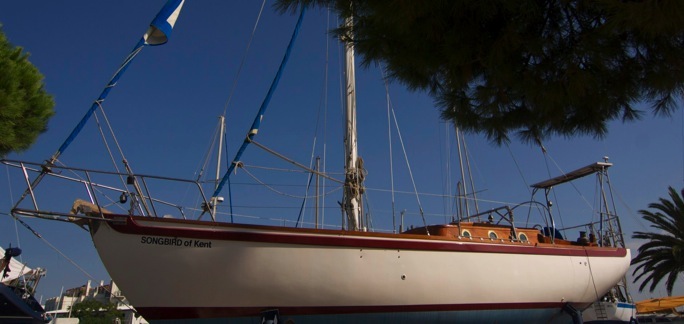
Some years ago, having successfully sold my own IT company, I warmed to the idea of being a full-time yachtie! A second-hand Tradewind 33 was discovered on the Island of Corfu.  (Now here’s a surprise!  I was just browsing the web looking for a picture of a Tradewind and came across my old yacht currently up for sale.  Her name is Songbird of Kent! Picture below.)

Songbird of Kent
Tradewind 33 - Songbird of Kent

Anyway, the deal was done and having sold my house in England I flew out to Corfu to collect Songbird of Kent. Inevitably it was a number of months before the boat was ready to head out into the Mediterranean but in early Spring 1988 it was time to explore the long coastlines of Greece and Turkey.

After a fantastic summer cruising from one idyllic anchorage to another mostly with friends or family on board, it was time to find a winter haven.  Many recommended Larnaca Marina in Cyprus.  Thus it was late in the summer of 1988 that I said goodbye to friends and set out on my own to cross from Antalya in Turkey to Cyprus and for Larnaca, on the SE side of the island.

That sea crossing, only a little over 200 nautical miles, was to become a regular solo experience at the start and end of each summer season. Impossible to do in a single day it was always a night at sea and rarely, if things didn’t go well with the weather, a couple of nights. I hated it! Maybe it was the sudden transition from coastal sailing to a deep water crossing, often going from having friends on board to being alone, but whatever it was I never enjoyed my time on my own and knew that long-distance solo sailing was never going to be my scene.

Read more of this Post

Feeling safe is good!

Safe, as in psychologically as well as physically, has its rewards.

Jon 05'I had a very interesting session recently. I did some coaching work with a client company who managed a small team. The day was split into two – the morning with the client and the afternoon with the whole team.

What struck me about the day was the power of good leadership and the importance of leaders who are aware of how they come across and are capable of forming a relationship with their teams. My client was struggling with her team because she was unaware how she was communicating, not only with her team but with other people in the organisation.

Unfortunately, becoming aware of how we are in a relationship with others brings us face to face with ourselves and requires a willingness to accept ourselves, warts and all, before trying to change anything.

After we all had lunch together and broke the ice a bit we focused on what was working (not what was not working), what was missing, what inspired and what was possible. By examining these areas and so creating a safe environment, everybody was able to reveal more of themselves and what they needed to have a satisfactory, safe working relationship with each other.

By Jon Lavin

How far can you push people?

Debt stress in Middle Class America – how may this play out?

On Saturday, October 24th Yves Smith of Naked Capitalism ran a Post on her Blog about an anonymous couple who were over their heads in debt.  (Yves has given me written permission to reproduce the Post.) The story of this couple then generated a huge response of comments. Read the comments, each and every one of them.

Then ask yourself abraham-lincoln-picturewhere this is all heading?  These comments may, almost certainly are, just be the tip of the iceberg.  Seems a long way from Lincoln’s Gettysburg address in which he was reputed  to have used the words: “… government of the people, by the people, for the people, shall not perish from the earth.”

Some days I worry; worry a lot!

The extract from Yves Post about this couple is reproduced below but far better is to go and read the whole Post and all the comments.

UPDATE: Since writing this Post Yves has published a further Post on the topic again generating a huge volume of comments.  That was Sunday, November 1st.  Then bright and early on November 2nd James Kwak of Baseline Scenario weighs in with his version, Do smart, hard-working people deserve to make more money? 150 comments (at the time of writing) for that one.  Interestingly, as the days have gone on the mood of the commentators has become more reflective and thoughtful thus partly negating the theme behind this Post.

Read the Post from Naked Capitalism

Improved clarity

The authors of Learning from Dogs held a conference call last Sunday to review the progress of the Blog.  As a result, we have added both a Vision and Purpose and amended the Welcome page.

We hope that it greatly improves your understanding of what motivates us to be authors.

Without you, the Reader, this Blog is pointless.  Here are some more ways you may want to participate.

Finally, all of us at this end of the Blog really appreciate you stopping by to read what we have to say and the growing audience is all the thanks we need.

Fate is the Hunter, part two

The introduction to this Post was published yesterday. The rest of this Post is Lex’s words and published with his written permission.

Fri – January 9, 2004 (post date)
The worst day ever

I don’t tell this story very often. Although the events inside it happened almost 12 years ago, the memory is still fresh, and still painful.

Over the years I’ve told it to two ready rooms, both by way of instruction – a kind of “been there, seen that,” in order to prevent anything like it from ever happening again. But it’s not one of those sea stories you tell over a beer, among friends. It’s a sad story. Maybe I post this one. Maybe I don’t.

Read more about Lex’s powerful story