Tag: Learning

Fear versus Faith

“Fear comes from uncertainty. When we are absolutely certain, whether of our worth or worthlessness, we are almost impervious to fear.”  William Congreve, English playwright and poet.

It’s Sunday (i.e. yesterday).  I woke around 6am to a cold morning (28 deg F/-2.2 deg C), the result of a clear, moonlit night.

Then as the night sky lightened with the coming dawn, the green, forest-cloaked valleys, visible to the East through the bedroom windows filled with a white, morning mist.  In a metaphorical sense that descending mist matched a mood of gloom that was trying to descend on me.

Early morning mist, Merlin, Oregon
Early morning mist, taken 7:15 am Sunday, 24th Feb.

As I lay back against the headboard of the bed, Jean still sleeping close to me, dogs Cleo, Hazel and Sweeny snoozing on and around me, I pondered on my mood.  It came to me that I might be picking up the growing sense of anxiety, of uncertainty, that seems to be ‘in the air’.  Me reading too many blog articles about global warming, climate change, et al.  Being three-quarters through Professor Guy McPherson’s book Walking Away from Empire: A Personal Journey wasn’t helping either!

Then I recalled a recent conversation with dear friend and colleague from our Payson, AZ. days, John Hurlburt, who said that fear is the absence of faith.  That if we trust what will be will be, then we can counter the fear of the unknown and embrace the present day, one day at a time.  Living in the now as, you’ve guessed it, that dogs do so supremely well.  Something else to learn from dogs!

I made a decision to take a stroll in the forest, emotionally speaking, for this week, so far as Learning from Dogs is concerned.  Enjoy the beauty of the world around me and offer a few essays on the meaning of life. No blog posts at all about anything that engenders fear from any quarter!

And if that doesn’t slash the readership figures, I don’t know what will! So there! You have been warned.

So let me start by offering this essay from John.  John is one of those rare people who has been through more than his fair share of ‘challenges’ over the years, yet has grown from those experiences.

Here’s John – I’m turning over and going back to sleep!

oooOOOooo

Education, Formation and Transformation

Most Americans remain comfortably complacent despite world economic brinksmanship, the escalating deterioration of our planetary environment and raging world discontent. Although we may be caring and compassionate in our personal lives, we are often reluctant to take any risk of reducing our personal comfort.

Education is a process. A process of learning how to think life through in order to become aware of whom we are, what we are, where we are, and why we exist. Education has always been the human gateway to a better future.

Knowledge does not guarantee wisdom. Education, formation and transformation are an integrated process which includes studying to gain knowledge, making natural connections based on the best information available, and experiencing the higher levels of conscious awareness we recognize as wisdom. The educational process works best when it is open minded, factual and sustained. We learn best when we learn together.

The human wisdom tradition is rich in myth, mysticism, symbols, imagination and creativity. It tells a common story of emergence through centuries of sacred writings stretching back through time to the earliest human cave scratchings roughly 17,000 years ago, and the beauty of the prayers of the Rig-Veda 12,000 years ago which all begin with an homage to the natural energy of the Sun.

We’re conscious components of a living planet. We’re surface dwellers with exposure to universal and planetary energies. Our species is only 200,000 years old. The universe is roughly 13 billion years old. Our planet is deteriorating and we’ve lost our collective moral compass. What can we do to make a local difference?

We only recently learned to hunt woolly mammoths in packs using bows, arrows and spears as tools. A perception of God in relation to our responsibility to each other and creation exists as the foundation of a human wisdom tradition which, relatively speaking, has just began.

In many ways, nothing seems to have changed as we have passed through successive cyclic waves of emergence and contraction. It becomes simultaneously increasingly more complex and exquisitely simple to understand. That is as we begin to realize how our metanexus emerges, contracts and turns inside out without breaking … like a pulse.

The next ten years are more important than the next several thousand years in respect to the choices we make about our biosphere.

There seems to be little doubt that our world problems are steadily increasing. What’s the next right thing to do?  It’s time to grow our conscious connection in God. It’s time to share the spring of human wisdom from the ground up. It’s time to develop a world economy which is gentle to the earth.

The Clearing Rests in Song and Shade

The clearing rests in song and shade.
It is a creature made
By old light held in soul and leaf.
By humans joy and grief,
By human work,
Fidelity of sight and stroke,
By rain, by water on
The parent stone.
We join our work to Heaven’s gift,
Our hope to what is left,
That field and woods at last agree
In an economy
Of widest worth.
High Heaven’s Kingdom come on earth,
Imagine Paradise
O dust, arise!

Wendell Berry; 1909

oooOOOooo

The illiterate of the future will not be the person who cannot read. It will be the person who does not know how to learn.” Alvin Toffler

Dogs ‘copy’ their owners

More evidence that shows there’s more to dogs than we realise.

Earlier on this year, a series of Posts was published on Learning from Dogs based on a science programme on the BBC (BBC Horizon) that revealed the degree of sophistication that is inherent in these clever animals.

This is the link to that article.  Unfortunately the YouTube videos have now been removed but there are some clips available on the BBC website here.  As the programme was introduced:

We have an extraordinary relationship with dogs – closer than with any other animal on the planet. But what makes the bond between us so special?

Research into dogs is gaining momentum, and scientists are investigating them like never before. From the latest fossil evidence, to the sequencing of the canine genome, to cognitive experiments, dogs are fast turning into the new chimps as a window into understanding ourselves.

Anyway, all this is a lead in to an item on the news today regarding a study into dogs by the University of Vienna.

Dogs “automatically imitate” the body movements of their owners, according to a study.

This automatic imitation is a crucial part of social learning in humans.

But Austrian researchers report that the phenomenon – where the sight of another’s body movement causes the observer to move in the same way – is evident in many other animals.

They say that it reveals clues about how this type of learning evolved.

The study, which was led by Dr Friederike Range from the University of Vienna in Austria, also suggests that the way in which people interact with and play with their dogs as they are growing up shapes their ability to imitate.

The phenomenon under investigation is known as "selective imitation" and implies that dogs -- like human infants -- do not simply copy an action they observe, but adjust the extent to which they imitate to the circumstances of the action. (Credit: iStockphoto/David Brimm)

There’s more to the news release on Science Daily from which is quoted:

New research by Friederike Range and Ludwig Huber, of the University of Vienna, and Zsofia Viranyi, of the Eötvös University in Budapest, reveals striking similarities between humans and dogs in the way they imitate the actions of others. The phenomenon under investigation is known as “selective imitation” and implies that dogs–like human infants–do not simply copy an action they observe, but adjust the extent to which they imitate to the circumstances of the action.

By Paul Handover

Mau Piailug

A Pacific master navigator sails into the sunset

The Economist, for me, is one of the great newspapers of our time.  I have often referred to it on Learning from Dogs.

Last Saturday’s edition (July 24th – 30th 2010) carried a most beautiful obituary about Mau Piailug who in 1976 demonstrated that ancient seafarers could indeed have voyaged from Hawaii to Tahiti, a distance of some 2,500 miles, before the age of compasses, sextants or charts.  Here is an extract from that obituary (you may need to register to view it):

As a Micronesian he did not know the waters or the winds round Tahiti, far south-east. But he had an image of Tahiti in his head. He knew that if he aimed for that image, he would not get lost. And he never did. More than 2,000 miles out, a flock of small white terns skimmed past the Hokule’a heading for the still invisible Mataiva Atoll, next to Tahiti. Mau knew then that the voyage was almost over.

On that month-long trip he carried no compass, sextant or charts. He was not against modern instruments on principle. A compass could occasionally be useful in daylight; and, at least in old age, he wore a chunky watch. But Mau did not operate on latitude, longitude, angles, or mathematical calculations of any kind. He walked, and sailed, under an arching web of stars moving slowly east to west from their rising to their setting points, and knew them so well—more than 100 of them by name, and their associated stars by colour, light and habit—that he seemed to hold a whole cosmos in his head, with himself, determined, stocky and unassuming, at the nub of the celestial action.

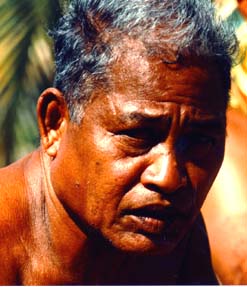
Mau Piailug creating model of his canoe - Steve Thomas Photo

Here’s an extract from the website Suite101.com:

Mau Piailug was born in 1932 on Satawal, a tiny Pacific island no wider than a mile in Micronesia. When he was still a little baby, his grandfather put him in a tide pool as though he were putting him in a cradle. There the sea gently rocked him back and forth with the rhythm of the tides.

When Mau was six, his grandfather began to teach him about navigation. He started by telling him about the stars; the grandfather made a star compass out of a circle of coral rocks, and in the center he put a little canoe he had made of palm fronds. Then he explained how the stars rose in the sky and traveled from east to west.

As he grew older, Mau spent his evenings in the canoe house. There he asked the elders to teach him about navigation. In this way, and with his grandfather’s help, he learned the paths of more than a hundred stars. He also learned that when clouds covered the sky, he could use the direction of the ocean waves to guide the canoe. He could also follow the birds toward land when they headed home in the evening, and he studied the creatures of the sea, for in times of trouble they, too, could help him find land.

A film was made about Mau called The Last Navigator.  Do click on the link and read more about what Steve ‘learnt’ from Mau – here’s a closing taste:

It has been nearly fifteen years since I first met Piailug. In that time I have been blessed with relative fame and prosperity – an eventuality, by the way, that Piailug foretold to me. As I look back, I am impressed now by the twin qualities in the man that impressed me then: his generosity and his courage. Piailug took me into his family, assumed responsibility for my material and political well-being, and taught me his navigation without reserve. The knowledge he gave me about navigation is considered priceless in his culture. The knowledge he gave me about myself, I have come to see, is priceless as well. I often think of Piailug, and the fierceness and determination with which he defends a way of life he knows will die as the wise elders died. He has the courage to live and teach and voyage in spite of the certain knowledge that his struggle can never stem the tide of Westernization, which will change the character of his archipelago and may well eliminate the very role of the navigator as steward of his island’s sustenance and keeper of the flame of cultural knowledge.

Mau - asleep in the waves

A remarkable man.

By Paul Handover

10 Questions Dalai Lama video extract 2

The film was mentioned in a Post here.

Parts 1 and 2 were included in a Post yesterday.

Enjoy!

10 Questions Dalai Lama video extract 1

The film was mentioned in a Post here.

Enjoy!

10 Questions for the Dalai Lama

If you only had one hour what would you ask?

10 Questions for HH

This is how an excellent film by Rick Ray on the Dalai Lama is introduced.  We watched the DVD a few evenings ago and it was heart-stirring and full of the extraordinary wisdom from one of the leading spiritual leaders alive today.

Do watch it if you can.  Here’s the official trailer from YouTube:

As so often seems to be the case these days, there is a website for the movie here.  And the Dalai Lama’s website is here.

Finally, I see that part of the film, where Rick Ray is having an audience with His Holiness, is available on YouTube.  I’ll post links to the four videos over the next two days.

By Paul Handover

The Four Divine States

A route to be free of hate and ill-will and a guarantee of happiness – read on:

The Brahma Viharas are also known as the Four Divine Emotions or The Four Divine Abodes. They are the meditative states, thoughts, and actions to be cultivated in Buddhist meditation. They are the positive emotions and states that are productive and helpful to anyone of any religion or even to the one with no religion.

The result will be a good person, free from hate and ill-will. Those who cultivate the brahma viharas are guaranteed to happiness. Those who further cultivate equanimity, may reach insightful states and wisdom of enlightenment experiences.

The Four Divine Emotions

1. Loving-kindness (Pali: Metta)
2. Compassion (Pali:Karuna)
3. Joy with others (Pali: Mudita)
4. Equanimity (Pali: Upekkha)

The Four Divine Emotions are known in Pali (Pali is a literary and liturgical language only) as the Brahma-viharas and are also known as the divine abidings or the divine abodes. They are emotional states to be strived for.  By practising and developing the divine emotions, we will have a peaceful and patient daily life practice.

Joy

Loving-kindness is a soft, affection and care for others and yourself.It is not a hard, romantic type of love and not a love that includes extreme attachment or controlling feelings.

Compassion is like an open heart that cares for everyone. It includes empathy, being able to see the other person’s position and caring for and about them.

Joy with others, sometimes is called sympathetic joy or appreciative joy. It is the ability to be happy when you see others happy. Their joy becomes your joy as you welcome less suffering and happiness of others.

Equanimity is the balanced state of mind. It is the middle way state of mind that is neither clinging nor pushing away.

The above was an excerpt from the best selling book The Complete Book of Buddha’s Lists — Explained, by David N. Snyder, Ph.D., with a Foreword by the Venerable Madewela Punnaji. The full version can be downloaded for free from here.

By Jon Lavin

Fire lighting

The answer to whom we turn to when the times are tough.

Light your own fire!

Regular readers of Learning from Dogs will know that a few days ago, Sherry wrote a piece entitled Light My Fire? It expressed her view that lately she was finding it a problem to be inspired, finding the passion as Sherry put it.

I have been thinking about Sherry’s article for the last few days and a couple of peripheral things come to mind.

We tend to get more of what we notice and orient towards. By allowing ourselves to become absorbed in the negative, that is what we tend to notice.  The fact is that the media thrive and make vast sums of money focusing on the negative. Just compare the amount of negative with the positive in any news cast.

That is not to say that we should not be aware of the negative or hide our heads in the sand. We can however change the way we view things and that has to come from within.

In fact, the answer rarely lies “out there”.

Change in how we view things, i.e. our attitude, needs to start coming from “within” ourselves.

The one thing that characterises these times is uncertainty.

A lot of us don’t even know where the next bit of money to pay the bills is coming from. In spite of the tendency to look ‘out there’ for strong direction, I still feel that the inner resolve has got to come for inside.

Another thing, I don’t believe it’s possible to think ourselves out of this one.

Although it’s a subject I go on a lot about, the sense of direction and well being has to come from us, or rather the feeling of interconnectedness that we share with everything. At a level, we are all connected.

We are all connected.

The one thing that gets us all through is a faith in some higher consciousness, that we can all tap into when we remember and ask for that miracle of clarity.

This is not thinking. The opposite in fact. This is a process of trust and ‘allowing’.

Allowing requires a power that few can sustain for long as we’re all geared to doing.  ‘Allowing’ requires us to turn off the noise machine that is in our head and creating a quietness and space for awareness to surface.

Paul recently wrote an article on Living in the Present that describes this way of letting go rather well.  I know for a fact that Paul is new to these ideas but already he is finding a peace and clarity emerging that shows that there’s always a good time to start – NOW!

Back to my thoughts. I am not advocating lying down and letting the world roll over us – the opposite in fact. By bringing awareness into this whole mess, we are more likely to take the right action.

I have honestly noticed that the more effort and circular thinking I have put into my present financial difficulties, and I’m a real expert in worry and circular thinking, the worse things have got.

I notice that by returning to silence and simply observing, a background is created that allows solutions and options to rise.

By asking to be shown the way forward and then letting go of the need for an instant solution, subtle options and ways forward present themselves.
Then right action follows.

An acceptance that in any moment we are all operating at our maximum level of consciousness. We are all doing the best we can. If we knew better, we would do better.

Therefore, what is going on in the world is a reflection of ourselves and is absolutely perfect for where the sum total of all of us are. (“Perfect”, does not mean we have to like it but it is, never the less, inevitable)

It follows, therefore, that the best way to help the world is to work on ourselves by striving to be the best we can, in every way. And the only way to do that is with awareness.

I think it was Abraham Maslow who coined the phrase, “Self Actualising”, meaning, being the best we can in every way, mentally and physically.

During these undoubtedly troubled times in the earth’s history, we all tend to turn to someone or something to provide a sense of direction.  That someone you need to turn to is yourself.

By Jon Lavin

Gulf Oil Spill – that feeling of déjà vu!

Rachel Maddow on how we have been here before.

Rachel M

(Thanks to Peter Nauman for this tip.)

Well done the Rachel Maddow on MSNBC-TV.

Watch this YouTube video of a recent show and run out of words!

By Paul Handover

Feeling safe!

Safe, as in psychologically as well as physically, has its rewards.

Jon 05'
Jon Lavin

I had a very interesting session recently. I did some coaching work with a client company who managed a small team. The day was split into two – the morning with the client and the afternoon with the whole team.

What struck me about the day was the power of good leadership and the importance of leaders who are aware of how they come across and are capable of forming a relationship with their teams.

My client was struggling with her team because she was unaware how she was communicating, not only with her team but with other people in the organisation.

Unfortunately, becoming aware of how we are in a relationship with others brings us face to face with ourselves and requires a willingness to accept ourselves, warts and all, before trying to change anything.

After we all had lunch together and broke the ice a bit we focused on what was working (not what was not working), what was missing, what inspired and what was possible. By examining these areas and so creating a safe environment, everybody was able to reveal more of themselves and what they needed to have a satisfactory, safe working relationship with each other.

By Jon Lavin