Tag: Keystone Pipeline

The power of big money!

Disappointing news about the Keystone XL pipeline project.

I have previously written about the madness of this proposed project, in fact have written six or seven times before.  You may like to dip back into this Post.  This one, too, shows starkly how our relationship with oil is changing the world we live in.

So it is with some sadness that I reproduce in full a recent circulation from Duncan Meisel from 350.org.

Dear friends,

I’m writing to share some disappointing news: yesterday, the U.S. House of Representatives voted in favor of rushing approval of the Keystone XL oil pipeline.

This doesn’t mean the pipeline is getting built — not by a long shot. The bill would still have to pass the Senate and be signed by the President, neither of which are likely to happen. It does show that we need to be vigilant after our temporary victory to stop Keystone XL — the corporate polluters pushing this climate disaster never sleep.

Since we blocked the front door, Big Oil is now trying to bring Keystone in through the back — their representatives in Congress are attaching the pipeline as an amendment to a crucial bill about taxes and the economy. If we want to make sure the pipeline never gets built, once again we need to get loud and bring this fight back into the public.

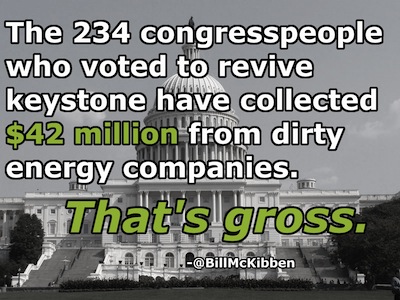
Here’s the truth: much of our Congress is bought and sold by corporations. The 234 members of the House who supported this bill took $42,374,100 from corporate polluters in the last decade. If we want Congress to start working for us, and for the planet, we need to call them out on this corruption whenever it happens.

Can you share this image (with a quote from Bill McKibben) on Facebook or Twitter to show just how much this corrupt attempt to revive the pipeline stinks?

We’ll never have the money and the lobbyists of Big Oil, so we’ve got to use our voices and our bodies to make our point.

Over the past six months, we’ve signed petitions, led actions in communities coast-to-coast, and organized large-scale civil disobedience against this pipeline. All that work added up. President Obama’s announcement about the pipeline delay was HUGE, and gave us the chance to shut Keystone XL down for good.

Ultimately, we’re in a long term fight to save the planet from the polluters who would buy their way to total catastrophe. It’s up to us to use this moment to show just how dangerous they have become, and begin making the case that corporate control over government must end. Let’s make sure all of our friends know how much their latest Keystone XL stunt stinks.

Many thanks for raising your voice,

Duncan Meisel, for the 350.org team

P.S. In case you were wondering, we’re not only spreading the word online — folks in certain states are calling their senators and we’re continuing to ratchet up our actions across the country. As I type this, activists in Ohio are staging a “human oil spill” to House Speaker Boehner’s front door. We’ll need all sorts of creative tactics on the road ahead — more on that in a future email!

Please do everything to spread this message.  Thank you.

Finally, go and put your arms around your dog, give him or her a very big hug, and pray that mankind might learn something about truth and integrity from the humble dog!

Learning from dogs!

Oil, sustainability, and American politics

The strange affairs of humans.

A quick piece of web research turned up a quote by the famous physicist, Richard P. Feynman, as follows,

In physics the truth is rarely perfectly clear, and that is certainly universally the case

in human affairs.

I thought the quote an apt introduction to an article written by Bill McKibben of 350 org fame, recently published on Tom Engelhardt’s TomDispatch blog.  As always, a vote of thanks to Tom for giving me permission to reproduce his pieces.

The topic is the Keystone XL pipeline, recently sidelined by Pres. Obama and now generating some interesting musings about the political strategy that may be at play here.  I have written previously about this pipeline and a quick search from the home page of Learning from Dogs using the search terms ‘keystone pipeline’ will find these articles.

Do read the full article from Bill McKibben.  Despite it’s length it’s full of thought-provoking ideas.  As Tom Engelhardt says in the closing sentences of his introduction, “Mark my words on this one: sooner or later, Americans are going to wake up to climate change, just as they have this year on the issue of inequality, and when they do, watch out.  There will be political hell to pay.Tom”

With no more ado, to the TomDispatch article,

Tomgram: Bill McKibben, Puncturing the Pipeline

Posted by Bill McKibben at 8:07am, November 15, 2011.

What’s the biggest story of the last several weeks?  Rick Perry’s moment of silence, all 53 seconds’worth?  The Penn State riots after revered coach JoePa went down in a child sex abuse scandal? The Kardashian wedding/divorce?  The European debt crisis that could throw the world economy into a tailspin?  The Cain sexual harassment charges?  The trial of Michael Jackson’s doctor?

The answer should be none of the above, even though as a group they’ve dominated the October/November headlines.  In fact, the piece of the week, month, and arguably year should have been one that slipped by so quietly, so off front-pages nationwide and out of news leads everywhere that you undoubtedly didn’t even notice.  And yet it’s the story that could turn your lifeand that of your children and grandchildren inside out and upside down.

On the face of it, it wasn’t anything to shout about — just more stats in a world drowning in numbers.  These happen to have been put out by the U.S. Department of Energy and they reflected, as an Associated Press headline put it, the “biggest jump ever seen in global warming gases.”  In other words, in 2010, humanity (with a special bow to China, the United States, and onrushing India) managed to pump more carbon dioxide into the atmosphere than at any time since the industrial revolution began — 564 million more tons than in 2009, which represents an increase of 6%.

According to AP’s Seth Borenstein, that’s “higher than the worst case scenario outlined by climate experts just four years ago.” He’s talking about the Intergovernmental Panel on Climate Change, or IPCC, which is, if anything, considered “conservative” in its projections of future catastrophe by many climate scientists.  Put another way, we’re talking more greenhouse gases than have entered the Earth’s atmosphere in tens of millions of years.

Consider as well the prediction offered by Fatih Birol, chief economist at the International Energy Agency: without an effective international agreement to staunch greenhouse gases within five years, the door will close on preventing a potentially disastrous rise in the planet’s temperature.  You’re talking, that is, about the kind of freaky weather that will make October’s bizarre snowstorm in the Northeast look like a walk in the park.  (That storm had all the signs of a climate-change-induced bit of extreme weather: New York City hadn’t recorded an October snowfall like it since the Civil War and it managed to hit the region in a period of ongoing warmth when the trees hadn’t yet had the decency to lose their leaves, producing a chaos of downed electrical wires.)  And don’t get me started on what this would mean in terms of future planetary hot spells or sea-level rise.

Honestly, if we were sane, if the media had its head in the right place, this would have been screaming headlines.  It would have put Rick Perry and Herman Cain and the Kardashians andItaly and Greece and Michael Jackson’s doctor in the shade.

The only good news — and because it unsettled the politics of the 2012 election, it did garner a few headlines — was that the movement Bill McKibben and 350.org spearheaded to turn back the tar-sands pipeline from Hades (or its earthly global-warming equivalent, which is Alberta, Canada) gained traction in our Occupy Wall Street moment.  Think of it as a harbinger.  Mark my words on this one: sooner or later, Americans are going to wake up to climate change, just as they have this year on the issue of inequality, and when they do, watch out.  There will be political hell to pay.Tom

Obama’s Positive Flip and Romney’s Negative Flop
Is Global Warming an Election Issue After All? 

By Bill McKibben

Conventional wisdom has it that the next election will be fought exclusively on the topic of jobs. But President Obama’s announcement last week that he would postpone a decision on the Keystone XL pipeline until after the 2012 election, which may effectively kill the project, makes it clear that other issues will weigh in — and that, oddly enough, one of them might even be climate change.

The pipeline decision was a true upset.  Everyone — and I mean everyone who “knew” how these things work — seemed certain that the president would approve it. The National Journal runs a weekly poll of “energy insiders” — that is, all the key players in Washington. A month to the day before the Keystone XL postponement, this large cast of characters was “virtually unanimous” in guaranteeing that it would be approved by year’s end.

Transcanada Pipeline, the company that was going to build the 1,700-mile pipeline from the tar-sands fields of Alberta, Canada, through a sensitive Midwestern aquifer to the Gulf of Mexico, certainly agreed.  After all, they’d already mowed the strip and prepositioned hundreds of millions of dollars worth of pipe, just waiting for the permit they thought they’d bought with millions in lobbying gifts and other maneuvers. Happily, activists across the country weren’t smart enough to know they’d been beaten, and so they staged the largest civil disobedience actionin 35 years, not to mention ringing the White House with people, invading Obama campaign offices, and generally proving that they were willing to fight.

No permanent victory was won. Indeed, just yesterday Transcanada agreed to reroute the pipeline in Nebraska in an effort to speed up the review, though that appears not to change the schedule.  Still, we’re waiting for the White House to clarify that they will continue to fully take climate change into account in their evaluation.  But even that won’t be final.  Obama could just wait for an election victory and then approve the pipeline — as any Republican victor certainly would.  Chances are, nonetheless, that the process has now gotten so messy that Transcanada’s pipeline will die of its own weight, in turn starving the tar-sands oil industry and giving a boost to the global environment.  Of course, killing the pipeline will hardly solve the problem of global warming (though heavily exploiting those tar sands would, in NASA scientist James Hansen’s words, mean “game over for the climate.”)

In this line of work, where victories of any kind are few and far between, this was a real win.  It began with indigenous activists, spread to Nebraska ranchers, and eventually turned into the biggest environmental flashpoint in many years.  And it owed no small debt to the Occupy Wall Street protesters shamefully evicted from Zuccotti Park last night, who helped everyone understand the power of corporate money in our daily lives.  That these forces prevailed shocked most pundits precisely because it’s common wisdom that they’re not the sort of voters who count, certainly not in a year of economic trouble.

In fact, the biggest reason the realists had no doubts the pipeline would get its permit, via a State Department review and a presidential thumbs-up of that border-crossing pipeline, was because of the well-known political potency of the jobs argument in bad economic times. Despite endless lazy reporting on the theme of jobs versus the environment, there were actually no net jobs to be had from the pipeline. It was always a weak argument, since the whole point of a pipeline is that, once it’s built, no one needs to work there.  In addition, as the one study not paid for by Transcanada made clear, the project would kill as many jobs as it would create.

The Washington Post’s Juliet Eilperin and Steven Mufson finally demonstrated this late in the game with a fine report taking apart Transcanada’s job estimates. (The 20,000 jobs endlessly taken for granted assumed, among other stretches, that modern dance troupes would move to Nebraska, where part of the pipeline would be built, to entertain pipeline workers.)  Still, the jobs trope remained, and you can be sure that the Chamber of Commerce will run 1,000 ads during the 2012 presidential campaign trying to hammer it home. And you can be sure the White House knew that, which was why it was such a tough call for them — and why the pressure of a movement among people whose support matters to them made a difference.

Let’s assume the obvious then: that one part of their recent calculations that led to the postponement decision might just be the suspicion that they will actually win votes thanks to the global-warming question in the next election.

For one thing, global warming denial has seen its apogee. The concerted effort by the fossil-fuel industry to underwrite scientific revision met its match last month when a team headed by Berkeley skeptic and prominent physicist Richard Muller– with funding from the Koch Brothers, of all people — actually found that, what do you know, all the other teams of climate-change scientists were, um, right. The planet was indeed warming just as fast as they, and the insurance companies, and the melting ice had been insisting.

Still, scientific studies only reach a certain audience.  Weird weather is a far more powerful messenger. It’s been hard to miss the record flooding along the Mississippi and Missouri Rivers, and across the Northeast; the record drought andfires across the Southwest; the record multi-billion dollar weather disasters across the country this year; the record pretty-much everything-you-don’t-want across the nation. Obama certainly noticed.  He’s responsible for finding the cash every time some other state submerges.

As a result, after years of decline, the number of Americans who understand that the planet is indeed warming and that we’re to blame appears to be on the rise again. And ironically enough, one reason may be the spectacle of all the tea-partying GOP candidates for the presidency being forced to swear fealty to the notion that global warming is a hoax. Normal people find this odd: it’s one thing to promise Grover Norquist that you’ll never ever raise taxes; it’s another to promise that you’ll defeat chemistry and physics with the mighty power of the market.

Along these lines, Mitt Romney made an important unforced error last month. Earlier in the primaries, he and Jon Huntsman had been alone in the Republican field in being open to the idea that global warming might actually be real. Neither wanted to do anything about it, of course, but that stance itself was enough to mark them as realists.  It was also a sign that Romney was thinking ahead to the election itself, and didn’t want to be pinned against this particular wall.

In late October, however, he evidently felt he had no choice but to pin himself to exactly that wall and so stated conclusively: “My view is that we don’t know what’s causing climate change on this planet.” In other words, he not only flip-flopped to the side of climate denial, but did so less than six months after he had said no less definitively: “I don’t speak for the scientific community, of course, but I believe the world’s getting warmer… And number two, I believe that humans contribute to that.”  Note as well that he did so, while all the evidence, even some recently funded by the deniers, pointed the other way.

If he becomes the Republican presidential candidate as expected, this may be the most powerful weathervane ad the White House will have in its arsenal.  Even for people who don’t care about climate change, it makes him look like the spinally challenged fellow he seems to be. But it’s an ad that couldn’t be run if the president had okayed that pipeline.

Now that Obama has at least temporarily blocked Keystone XL, now that his team has promised to consider climate change as a factor in any final decision on the pipeline’s eventual fate, he can campaign on the issue. And in many ways, it may prove a surprise winner.

After all, only people who would never vote for him anyway deny global warming.  It’s a redoubt for talk-show rightists. College kids, on the other hand, consistently rank it among the most important issues. And college kids, as Gerald Seib pointedout in the Wall Street Journal last week, are a key constituency for the president, who is expected to need something close to the two-thirds margin he won on campus in 2008 to win again in 2012.

Sure, those kids care about student loans, which threaten to take them under, and jobs, which are increasingly hard to come by, but the nature of young people is also to care about the world.  In addition, independent voters, suburban moms — these are the kinds of people who worry about the environment.  Count on it: they’ll be key targets for Obama’s presidential campaign.

Given the economy, that campaign will have to make Mitt Romney look like something other than a middle-of-the-road businessman.  If he’s a centrist, he probably wins. If he’s a flip-flopper with kooky tendencies, they’ve got a shot. And the kookiest thing he’s done yet is to deny climate science.

If I’m right, expect the White House to approve strong greenhouse gas regulations in the months ahead, and then talk explicitly about the threat of a warming world. In some ways it will still be a stretch.  To put the matter politely, they’ve been far from perfect on the issue: the president didn’t bother to waste any of his vaunted “political capital” on a climate bill, and he’s opened huge swaths of territory to coal mining and offshore drilling.

But blocking the pipeline finally gave him some credibility here — and it gave a lot more of the same to citizens’ movements to change our world. Since a lot of folks suspect that the only way forward economically has something to do with a clean energy future, I’m guessing that the pipeline decision won’t be the only surprise. I bet Barack Obama talks on occasion about global warming next year, and I bet it helps him.

But don’t count on that, or on Keystone XL disappearing, and go home.  If the pipeline story (so far) has one lesson, it’s this: you can’t expect anything to change if you don’t go out and change it yourself.

Bill McKibben is a founder of 350.org, a TomDispatch regular, and Schumann Distinguished Scholar at Middlebury College. His most recent book is Eaarth: Making a Life on a Tough New Planet.

Copyright 2011 Bill McKibben

A small step

Fabulous news from The President’s Office re the Keystone XL pipeline.

On the 27th October, I introduced an article about the pipeline, thus,

“Have the courage to say no. Have the courage to face the truth.  Do the right thing because it is right.  These are the magic keys to living your life with integrity.”

The above is attributed to W. Clement Stone, a businessman, philanthropist and author who died in 2002, aged 100.  It seemed an appropriate quotation with which to introduce a recent article by Bill McKibben, on the Grist blog, about the proposed Keystone XL pipeline.

A short time ago (Thursday) I received the following from Bill McKibben, 350.org.

Dear Friends,

Um, we won. You won.

Not completely. The President didn’t outright reject the Keystone XL pipeline permit. My particular fantasy — that he would invite the 1253 people arrested on his doorstep in August inside the gates for a victory picnic by the vegetable garden — didn’t materialize.

But a few minutes ago the President sent the pipeline back to the State Department for a thorough re-review, which most analysts are saying will effectively kill the project. The president explicitly noted climate change, along with the pipeline route, as one of the factors that a new review would need to assess. There’s no way, with an honest review, that a pipeline that helps speed the tapping of the world’s second-largest pool of carbon can pass environmental muster.

And he has made clear that the environmental assessment won’t be carried out by cronies of the pipeline company — that it will be an expert and independent assessment. We will watch that process like hawks, making sure that it doesn’t succumb to more cronyism. Perhaps this effort will go some tiny way towards cleaning up the Washington culture of corporate dominance that came so dramatically to light here in emails and lobbyist disclosure forms.

It’s important to understand how unlikely this victory is. Six months ago, almost no one outside the pipeline route even knew about Keystone XL. One month ago, a secret poll of “energy insiders” by the National Journal found that “virtually all” expected easy approval of the pipeline by year’s end. As late as last week the CBC reported that Transcanada was moving huge quantities of pipe across the border and seizing land by eminent domain, certain that its permit would be granted. A done deal has come spectacularly undone.

Our movement spoke loudly about climate change and the President responded. There have been few even partial victories about global warming in recent years so that makes this an important day. We need to let the president and oil companies know that we’re ready to take action should they try to push this pipeline through in a couple of years. There’s a pledge to take bold action against the pipeline up on our site, and I’ll be keeping your names an emails safely stored away so that you’ll be the first to know about anything we need to do down the road.

Please sign the pledge here.

The President deserves thanks for making this call — it’s not easy in the face of the fossil fuel industry and its endless reserves of cash. The deepest thanks, however, go to you: to indigenous peoples who began the fight, to the folks in Nebraska who rallied so fiercely, to the scientists who explained the stakes, to the environmental groups who joined with passionate common purpose, to the campuses that lit up with activity, to the faith leaders that raised a moral cry, to the labor leaders who recognized where our economic future lies, to the Occupy movement that helped galvanize revulsion at insider dealing, and most of all to the people in every state and province who built the movement that made this decision inevitable.

Our fight, of course, is barely begun. Some in our movement will say that this decision is just politics as usual: that the President wants us off the streets — and off his front lawn — until after the election, at which point the administration can approve the pipeline, alienating its supporters without electoral consequence. The president should know that If this pipeline proposal somehow reemerges from the review process we will use every tool at our disposal to keep it from ever being built; if there’s a lesson of the last few months, both in our work and in the Occupy encampments around the world, it’s that sometimes we have to put our bodies on the line.

In the meantime, since federal action will be in abeyance for a long stretch, we need to figure out how best to support our Canadian brothers and sisters, who are effectively battling against proposed pipelines west from the tar sands to the Pacific. And we need to broaden our work to take on all the forms of ‘extreme energy’ now coming to the fore: mountaintop removal coal mining, deepsea oil drilling, fracking for gas and oil. We’ll keep sending you updates; you keep letting us know what we need to do next.

Last week, scientists announced that the planet had poured a record amount of CO2 into the atmosphere last year; that’s a sign of how desperate our battle is. But we take courage from today’s White House announcement; it gives us some clues about how to fight going forward.

And I simply can’t say thank you enough. I know, because of my own weariness, how hard so many of you have worked. It was good work, done in the right spirit, and it has secured an unlikely victory. You are the cause of that victory; you upended enormous odds.

I’m going to bed tired tonight. But I’ll get up in the morning ready for the next battle, more confident because I know you’re part of this fight too.

Onwards,

Bill McKibben for the 350.org Team

P.S. Victories need to be shared. Let’s make this one fly all over the web: share it on Twitter here and share it on Facebook here.


The Keystone XL pipeline

“Have the courage to say no. Have the courage to face the truth.  Do the right thing because it is right.  These are the magic keys to living your life with integrity.”

The above is attributed to W. Clement Stone, a businessman, philanthropist and author who died in 2002, aged 100.  It seemed an appropriate quotation with which to introduce a recent article by Bill McKibben, on the Grist blog, about the proposed Keystone XL pipeline.

Bill McKibben

Keystone pipeline’s last defense: Cold, hard cash

What do you do if you’ve lost an argument?

Say you really really want to build a big pipeline from the tar sands of Alberta so that you can sell your bitumen to the world

But 20 of the nation’s top scientists have written to the president to say it’s a terrible idea — and the planet’s leading climatologist says burning the tar sands would be “game over for the climate.” And nine recent winners of the Nobel Peace Prize have condemned the plan. And Robert Redford has just made a video explaining why the plan is an attack on the nation’s heartland. Then, if you’re a poor forlorn oil industry feeling unloved and under assault, what do you do?

There’s really only one answer: Flash your wad.

As we get to the final chapters of the Keystone pipeline saga (the president has said he’ll make his decision by year’s end), money’s the only argument these guys have left.

They managed to buy a favorable environmental review from the U.S. State Department, which helpfully outsourced the job to a company that was a “major client” of TransCanada, the pipeline builder.

And yesterday, they proposed a $100 million “performance bond” to the state of Nebraska, whose Republican governor and senator have come out against the pipeline. The money is apparently designed to pay for damage to the Ogallala Aquifer if the pipeline starts to leak.

Meanwhile, when 33 Democratic representatives sent a letter to the White House demanding a rejection of the plan, lobbyists for TransCanada rounded up their own list of lawmakers from the president’s party to issue a rejoinder. But they only found 22. And what do you know — they included nine of the top 10 Democratic recipients of oil money in the House. On average the signatories received over 4.25 times more oil money than the average House Democrat in the 112th Congress. That would be 325 percent more. That would be how the game is played.

The other side — that is, scientists, Nobelists, and the kind of average people who went to jail in record numbers this summer to block the plan — doesn’t have that kind of money. We’ve had to figure out other currencies to work in: spirit, passion, creativity. We’ve spent our bodies, putting them on the line. The odds are still against us, but the odds are changing; we’re on a roll as we head toward Nov. 6, when we’ll ring the White House with people, exactly one year before the election. (You can sign up here.)

But every once in a while we get to play the money game too! While TransCanada was out there setting the $100 million price on the Ogallala Aquifer, this news story rolled across my screen. It described a big Democratic giver, Barbarina Heyerdahl. She gave 120 grand to Obama and the Democratic National Committee over the last three years, not to mention knocking on doors for the 2008 campaign. But she said Keystone is a bridge too far, that “she won’t be writing any more checks to Obama if he approves the carbon conduit that’s become the focus of the climate-change movement. ‘It’s a baseline issue,’ she says.”

I have no doubt that, even with Heyerdahl and other donors accounted for, the oil industry has all the money they need to win this fight. The Koch brothers are the third and fourth richest men in America, and they filed papers in Canada declaring their “direct and substantial” interest in the project. If money’s the only thing that matters, they’ll carry the day.

But if money’s the only thing that matters, we’re done for anyway. So we’ll keep using science and art and courage. And we’ll hope that Barack Obama hasn’t sold his soul. We’re going to find out in the next few weeks.

Bill McKibben is founder of 350.org and Schumann Distinguished Professor at Middlebury College in Vermont. He also serves on Grist’s Board of Directors.

Bill’s website may be found here.  Also, please PLEASE watch the video made by Robert Redford.  Only 3 mins 25 seconds long, the ink to the video is here.

Finally, a YouTube video from Tars and Action.

All that’s necessary for the forces of evil to win in the world is for enough good men to do nothing.” Edmund Burke

Common sense

The ways of our carbon-consuming past & present cannot be continued into the future.

In many ways that sub-heading above is not controversial for millions of citizens of Planet Earth.  The challenge is in changing behaviours, ending old habits of energy use, and working towards a truly sustainable relationship with the only planetary home we have!

Some time ago, I wrote about Lester Brown’s book, World on the Edge, quickly following it up with Plan B Movie for Planet Earth.  Since reading Lester’s book, I have subscribed to the Blog/website Earth Policy Institute, Lester Brown is President of EPI.

Like many others, Jean and I are of the view that the Keystone XL Pipeline is not required.  Last week there was an update from EPI about this subject illustrating how the pipeline is not required.  That update is published in full, as follows,

Plan B Updates

OCTOBER 06, 2011

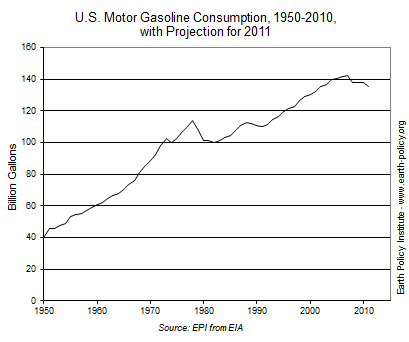
U.S. Gasoline Use Declining: Keystone XL Pipeline Not Needed

Lester R. Brown

As the debate unfolds about whether to build a 1,711-mile pipeline to carry crude oil from the tar sands in Canada to refineries in Texas, the focus is on the oil spills and carbon emissions that inevitably come with it. But we need to ask a more fundamental question. Do we really need that oil?

The United States currently consumes more gasoline than the next 16 countries combined. Yes, you read that right. Among them are China, Japan, Russia, Germany, and Brazil. (See data.)

But now this is changing. Not only is the affluence that sustained this extravagant gasoline consumption eroding, but the automobile-centered lifestyle that was considered part of the American birthright is fading as well. U.S. gasoline use has dropped 5 percent in four years.

Four key developments are set to further reduce U.S. gasoline use: a shrinking car fleet, a decline in the miles driven per car, dramatic mandated future gains in new car fuel efficiency, and the shift from gasoline to electricity to power our cars.

The U.S. fleet appears to have peaked at 250 million vehicles in 2008. From 1994 through 2007, new-car sales were in the range of 15–17 million per year. Since then they have totaled 10–13 million per year, and they are unlikely to top 14 million again. Retirees likely will exceed sales of new cars throughout this decade.

The contraction that began when the fleet dropped from 250 million in 2008 to 248 million in 2010 is likely to continue. Sales of new cars are not matching those of earlier years in part because the economic prospect has dimmed and in part because we are still urbanizing. Today 82 percent of us live in urban areas where cars are becoming less essential.

On top of urbanization, we also have a change in the manner in which young people socialize. For teenagers in rural communities a half century ago, getting a driver’s license and something to drive—a car, a pickup, or even a farm truck—was a rite of passage. That’s what everyone did.

This too is changing. Today’s teenagers, most of whom grew up in an urban setting, socialize through smartphones and the Internet. For many of them, a car is of little interest. The number of licensed teenage drivers in this country—the car owners of the future—has dropped from a peak of 12 million in 1978 to 10 million today.

Cities are also being redesigned for people. Among other things, this means cities are becoming pedestrian- and bicycle-friendly, with ready access to public transit.

Many cities are building a cycling infrastructure of bicycle trails, dedicated bike lanes, and bike racks for parking. Bike-sharing programs are showing up, too. In Washington, D.C., the Capital Bikeshare program that began in 2010 has expanded to 116 stations with 1,100 bicycles. Within the first year, some 16,000 riders signed up for annual membership in the program. Denver and Chicago have similar bike share programs. And New York City is about to launch a huge program of its own.

The second reason that gasoline use is falling is the decline in miles driven per car. This is partly in response to economic uncertainty and the high price of gasoline. When gas costs nearly $4 a gallon, people think twice before jumping in a car and using a gallon of gasoline to pick up a half-gallon of milk.

A third trend that is reducing gasoline use is the rising fuel efficiency of the U.S. automobile fleet. New cars sold in 2008 averaged 27 miles per gallon. But in early 2009, President Obama raised the average fuel efficiency standard so that those sold in 2016 will get 36 miles per gallon. Additional standards announced in 2011 mean that new cars sold in 2025 will use less than half as much gasoline as the 2008 models.

The game changer in reducing gasoline use is going to come as drivers shift from gasoline to electrically powered vehicles, including plug-in hybrids and all-electric cars. General Motors recently introduced the Chevrolet Volt, designed to run largely on electricity, and Nissan unveiled the Leaf, an all-electric vehicle. Beyond these, Toyota is accepting orders for the plug-in version of its Prius hybrid, the pacesetter in fuel efficiency. It will be followed by a steady flow of new plug-in hybrid and all-electric car models coming to market.

Although these electrically powered vehicles are typically more costly to buy, the day-to-day cost of operating them is extraordinarily low. An analysis by Professor Michael McElroy at Harvard indicates that running a car on wind-generated electricity could cost less than the equivalent of 80-cent-a-gallon gasoline.

With the auto fleet shrinking, with the average car being driven less, with the fuel use of new cars to be cut in half by 2025, and with electricity starting to replace gasoline as a fuel, why do we need to build a pipeline to bring crude oil from Canada’s tar sands to oil refineries in Texas? The answer is we don’t.

Lester R. Brown is president of the Earth Policy Institute and author of World on the Edge.

Copyright © 2011 Earth Policy Institute

There’s a footnote that I would like to add from the Center for Biological Diversity (great website!) that came out in a recent newsletter.

Here it is,

Lawsuit Seeks to Halt Work on Controversial Keystone XL Pipeline

Keystone Pipeline

The hotly contested Keystone XL pipeline hasn’t been approved for construction, but federal officials don’t seem to care; they’ve allowed the pipeline company to mow down 100 miles of native prairie grasslands in Nebraska to clear the way — before any public hearings were held on whether Keystone XL should move forward at all.

The Center for Biological Diversity and Friends of the Earth filed a lawsuit in federal court in Omaha Wednesday to halt that work. Specifically, we’re challenging decisions by the State Department and U.S. Fish and Wildlife Service to allow work to begin before a decision’s been made on the pipeline or the public hearings, which look like little more than a sham at this point.

If approved, TransCanada’s 1,700-mile pipeline would carry up to 35 million gallons of oil a day from tar sands in Canada to refineries in Texas. Not only will this project add fuel to the global climate crisis, but the pipeline will cut across Nebraska’s legendary Sandhills, hundreds of rivers and streams, and the Ogallala Aquifer, which provides drinking water for millions of people. TransCanada’s existing pipeline, called Keystone 1, has reportedly leaked 14 times since it started operating in June 2010.

Please will there be some common sense over this?

The XL pipeline. What comes next?

Full copy of an email just in from Bill McKibben.

Dear Friends—

I’m writing this from the lawn in front of the White House.

In front of me there’s a sprawling rally underway, with speakers ranging from indigenous elders to the great Canadian writer Naomi Klein. In back of me, another 243 courageous people are being hauled away to jail — it’s the last day of Phase 1 of the tar sands campaign, and 1,252 North Americans have been arrested, the biggest civil disobedience action this century on this continent.

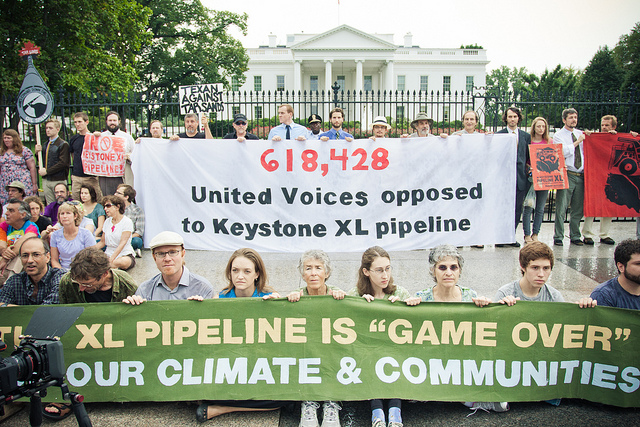
But we’ve been just as cheered by the help that has poured in from around the world — today, activists in front of the White House held a banner with a huge number on it: 618,428. That’s how many people around the world who signed on to the “Stop the Tar Sands” mega-petition to President Obama, including many of you in the 350.org network. Check out this beautiful photo of passion and courage on display:

(Photo Credit: Josh Lopez. If you can’t see the photo above, click here to see it and more inspirational photos from DC.)

But this movement does more than sign petitions: many of you stood strong in front of the White House risking arrest, and protesters on every continent have picketed outside embassies and consulates. That makes sense, for global warming is the one problem that affects everyone everywhere.

And the next moment to prove that is Sept. 24 for Moving Planet — the massive day of climate action that will unite people all over the world. We’ve heard news of amazing actions from every corner of the earth -— from a massive bike rally in the Philippines to an incredible eco-festival in Philadelphia. I truly can’t wait to see the pictures pour in.

But here’s why it’s important: we’re not just a movement that opposes things, we’re also a movement that dreams of what’s coming. And we don’t just dream, we also transform those dreams into reality. On September 24, on bike and on foot and on boards, we’re going to point the way towards that future. By days’ end, we’ll have shown why the bicycle is more glamorous than the car, and why the people have the potential to be more powerful than the polluters.

On some days fighting global warming means swallowing hard, mustering your courage, and making a sacrifice — other days it means getting all your friends up in the saddles of their bikes to have some fun and help move the planet forward.

September 24 is the second kind of day; it’s going to be powerful, it’s going to be beautiful, and I can’t wait to see how it turns out.  Please find or join a local event to get involved. 

Onwards,

Bill McKibben for the whole 350.org team


350.org is building a global grassroots movement to solve the climate crisis. Our online campaigns, grassroots organizing, and mass public actions are led from the bottom up by thousands of volunteer organizers in over 188 countries. You can join 350.org on Facebook by becoming a fan of our page atfacebook.com/350org and follow us on twitter by visiting twitter.com/350. To join our list (maybe a friend forwarded you this e-mail) visitwww.350.org/signup. To support our work, donate securely online at 350.org/donate.

What is 350? 
350 is the number that leading scientists say is the safe upper limit for carbon dioxide in our atmosphere. Scientists measure carbon dioxide in “parts per million” (ppm), so 350ppm is the number humanity needs to get below as soon as possible to avoid runaway climate change. To get there, we need a different kind of PPM–a “people powered movement” that is made of people like you in every corner of the planet.

Feel free to circulate this as far and wide as you wish.  Thanks, Learning from Dogs

Tell President Obama: Stop the Keystone XL Pipeline

This is so important.

Regular readers will know that I wrote about the XL Pipeline on the 29th August setting out the arguments of those who know much more of the detail as to why the tar sands of Canada are just the worst possible way to continue the madness of using oil.  If you didn’t read that then it’s here, and please do so.

The rest of this Post is taken from the Credo Action website.  Please do participate. Sign the petition NOW.

Do something, please!

Tell President Obama: Stop the Keystone XL Pipeline

“Essentially game over” for the climate.

That’s what climate scientist James Hansen calls the proposed Keystone XL pipeline — which would carry oil out of Canada’s vast tar sands oil fields to Texas, where it will be refined, then burned across the globe, dealing a catastrophic blow to our chance of returning earth to a stable climate.

This project requires a presidential permit to start building — and it is President Obama’s decision alone to grant or deny that permit. He will make the decision as soon as September.

Tell President Obama: Stop the Keystone XL pipeline.

The Alberta tar sands are a carbon bomb. The 3rd largest oil field in the world, the difficult extraction and transportation of the tar sands oil ultimately produces up to three times the carbon emissions of traditional oil. (And extreme environmental devastation along the way.)1

The Keystone XL pipeline is the fuse to this bomb – a highway to swift consumption of this dirty, dangerous crude. As if that wasn’t enough, it poses a massive spill risk in the six states along the pipeline route, including over the Ogallala Aquifer which provides up to 30% of our nation’s agricultural water.

We. Must. Stop. This.

Tell President Obama: Stop the Keystone XL pipeline.

Twenty leading climate scientists have just sent a letter to President Obama urging him to deny the permit.

And from August 20th to September 3rd, there will be a massive, historic, daily sit-in outside the White House where more than 1500 people, including CREDO staff, have already signed up to risk arrest in peaceful protest. (For more about the sit in, see below.)

The administration’s previous decisions on climate do not inspire confidence that they will deny the permit. Recently the administration has opened new areas to offshore drilling and coal mining, and late last year, Secretary of State Hillary Clinton even said she was “inclined” to approve Keystone XL.

But President Obama still has the final word. He does not have to negotiate with Congress or industry. As his State Department reviews the permit, the decision — which could have a devastating impact on the livability of our nation, and our world — is entirely in his hands.

We’ve lost too many climate fights already. We need a massive, historic show of pressure to make sure we don’t lose this one. Please sign the petition and read below for other ways to get involved.

Tell President Obama: Stop the Keystone XL pipeline.

1. “Keystone XL Pipeline,” Friends of the Earth

————————————————————-

Because this fight is so important, leading climate activists including Bill McKibben, Naomi Klein and climate scientist James Hansen are organizing a historic, daily series of peaceful protests between August 20th and Sept. 3rd. The CEO’s and Directors of nearly 30 leading Environmental Organizations, including CREDO’s Michael Kieschnick and Laura Scher, are urging people to participate.

More than 1500 people from across the country, including CREDO staff, have already signed up to join the sit-in outside the White House and risk arrest.

Please read the invitation letter below for more information. If you would like to sign up to join the protest, and possibly be arrested, click here.

Dear Friends,

This will be a slightly longer letter than common for the internet age–it’s serious stuff.

The short version is we want you to consider doing something hard: coming to Washington in the hottest and stickiest weeks of the summer and engaging in civil disobedience that will quite possibly get you arrested.

The full version goes like this:

As you know, the planet is steadily warming: 2010 was the warmest year on record, and we’ve seen the resulting chaos in almost every corner of the earth.

And as you also know, our democracy is increasingly controlled by special interests interested only in their short-term profit.

These two trends collide this summer in Washington, where the State Department and the White House have to decide whether to grant a certificate of ‘national interest’ to some of the biggest fossil fuel players on earth. These corporations want to build the so-called ‘Keystone XL Pipeline’ from Canada’s tar sands to Texas refineries.

To call this project a horror is serious understatement. The tar sands have wrecked huge parts of Alberta, disrupting ways of life in indigenous communities–First Nations communities in Canada, and tribes along the pipeline route in the U.S. have demanded the destruction cease. The pipeline crosses crucial areas like the Oglalla Aquifer where a spill would be disastrous–and though the pipeline companies insist they are using ‘state of the art’ technologies that should leak only once every 7 years, the precursor pipeline and its pumping stations have leaked a dozen times in the past year. These local impacts alone would be cause enough to block such a plan. But the Keystone Pipeline would also be a fifteen hundred mile fuse to the biggest carbon bomb on the continent, a way to make it easier and faster to trigger the final overheating of our planet, the one place to which we are all indigenous.

As the climatologist Jim Hansen (one of the signatories to this letter) explained, if we have any chance of getting back to a stable climate “the principal requirement is that coal emissions must be phased out by 2030 and unconventional fossil fuels, such as tar sands, must be left in the ground.” In other words, he added, “if the tar sands are thrown into the mix it is essentially game over.” The Keystone pipeline is an essential part of the game. “Unless we get increased market access, like with Keystone XL, we’re going to be stuck,” said Ralph Glass, an economist and vice-president at AJM Petroleum Consultants in Calgary, told a Canadian newspaper last week.

Given all that, you’d suspect that there’s no way the Obama administration would ever permit this pipeline. But in the last few months the administration has signed pieces of paper opening much of Alaska to oil drilling, and permitting coal-mining on federal land in Wyoming that will produce as much CO2 as 300 powerplants operating at full bore.

And Secretary of State Clinton has already said she’s ‘inclined’ to recommend the pipeline go forward. Partly it’s because of the political commotion over high gas prices, though more tar sands oil would do nothing to change that picture. But it’s also because of intense pressure from industry. The US Chamber of Commerce–a bigger funder of political campaigns than the RNC and DNC combined–has demanded that the administration “move quickly to approve the Keystone XL pipeline,” which is not so surprising–they’ve also told the U.S. EPA that if the planet warms that will be okay because humans can ‘adapt their physiology’ to cope. The Koch Brothers, needless to say, are also backing the plan, and may reap huge profits from it.

So we’re pretty sure that without serious pressure the Keystone Pipeline will get its permit from Washington. A wonderful coalition of environmental groups has built a strong campaign across the continent–from Cree and Dene indigenous leaders to Nebraska farmers, they’ve spoken out strongly against the destruction of their land. We need to join them, and to say even if our own homes won’t be crossed by this pipeline, our joint home–the earth–will be wrecked by the carbon that pours down it.

And we need to say something else, too: it’s time to stop letting corporate power make the most important decisions our planet faces. We don’t have the money to compete with those corporations, but we do have our bodies, and beginning in mid August many of us will use them. We will, each day, march on the White House, risking arrest with our trespass. We will do it in dignified fashion, demonstrating that in this case we are the conservatives, and that our foes–who would change the composition of the atmosphere are dangerous radicals. Come dressed as if for a business meeting–this is, in fact, serious business.

And another sartorial tip–if you wore an Obama button during the 2008 campaign, why not wear it again? We very much still want to believe in the promise of that young Senator who told us that with his election the ‘rise of the oceans would begin to slow and the planet start to heal.’ We don’t understand what combination of bureaucratic obstinacy and insider dealing has derailed those efforts, but we remember his request that his supporters continue on after the election to pressure his government for change. We’ll do what we can.

And one more thing: we don’t just want college kids to be the participants in this fight. They’ve led the way so far on climate change–10,000 came to DC for the Powershift gathering earlier this spring. They’ve marched this month in West Virginia to protest mountaintop removal; a young man named Tim DeChristopher faces sentencing this summer in Utah for his creative protest.

Now it’s time for people who’ve spent their lives pouring carbon into the atmosphere to step up too, just as many of us did in earlier battles for civil rights or for peace. Most of us signing this letter are veterans of this work, and we think it’s past time for elders to behave like elders. One thing we don’t want is a smash up: if you can’t control your passions, this action is not for you.

This won’t be a one-shot day of action. We plan for it to continue for several weeks, till the administration understands we won’t go away. Not all of us can actually get arrested–half the signatories to this letter live in Canada, and might well find our entry into the U.S. barred. But we will be making plans for sympathy demonstrations outside Canadian consulates in the U.S., and U.S. consulates in Canada–the decision-makers need to know they’re being watched.

Twenty years of patiently explaining the climate crisis to our leaders hasn’t worked. Maybe moral witness will help. You have to start somewhere, and we choose here and now.

If you think you might want to be a part of this action, we need you to sign up here.

As plans solidify in the next few weeks we’ll be in touch with you to arrange nonviolence training; our colleagues at a variety of environmental and democracy campaigns will be coordinating the actual arrangements.

We know we’re asking a lot. You should think long and hard on it, and pray if you’re the praying type. But to us, it’s as much privilege as burden to get to join this fight in the most serious possible way. We hope you’ll join us.

Maude Barlow — Chair, Council of Canadians
Wendell Berry — Author and Farmer
Tom Goldtooth — Director, Indigenous Environmental Network
Danny Glover — Actor
James Hansen — Climate Scientist
Wes Jackson — Agronomist, President of the Land Insitute
Naomi Klein — Author and Journalist
Bill McKibben — Writer and Environmentalist
George Poitras — Mikisew Cree Indigenous First Nation
Gus Speth — Environmental Lawyer and Activist
David Suzuki — Scientist, Environmentalist and Broadcaster
Joseph B. Uehlein — Labor organizer and environmentalist