No bloated hyperbole about past achievements! No slagging off of the opposition! No daft prognostications. No ludicrous excuses. No pretentious blather. No lies! No wild scare-mongering!! No spin-ridden soundbites! Yup, deciding whether Britain staggers back to its feet again or sinks ever-deeper into irrelevant, bureaucratic and debt-ridden mediocrity is pretty important, but you also have to see the funny side of things.
Just recently Peter Hain said:
I think it’s important for people to act intelligently in this election.
This is brilliant advice, suggesting of course that once the election is over we can all happily go back to being stupid.
It is so useful to get really good advice from our prospective leaders. Thanks Peter.
I will try to act intelligently, but it’s never been a real strong point. Got any hints?
Would voting Labour be intelligent, perhaps? Or indeed the opposite? I am a bit confused ….. which is sad, as the future of my country is at stake.
Without intelligence we are done for. Such a shame it has been so lacking in government for the last 13 years of course.
Uncontrolled borders and Washington’s lack of self-control
[This article appeared in the online version of the Wall Street Journal on May 1st. Copyright exists with the WSJ and it is reproduced below without permission. However, it seems to me to be such an insightful commentary on present conditions that the decision was taken to publish it on Learning from Dogs. Ed.]
By Peggy Noonan
Peggy Noonan
We are at a remarkable moment. We have an open, 2,000-mile border to our south, and the entity with the power to enforce the law and impose safety and order will not do it. Wall Street collapsed, taking Main Street’s money with it, and the government can’t really figure out what to do about it because the government itself was deeply implicated in the crash, and both political parties are full of people whose political careers have been made possible by Wall Street contributions. Meanwhile we pass huge laws, bills so comprehensive, omnibus and transformative that no one knows what’s in them and no one—literally, no one—knows how exactly they will be executed or interpreted. Citizens search for new laws online, pore over them at night, and come away knowing no more than they did before they typed “dot-gov.”
It is not that no one’s in control. Washington is full of people who insist they’re in control and who go to great lengths to display their power. It’s that no one takes responsibility and authority. Washington daily delivers to the people two stark and utterly conflicting messages: “We control everything” and “You’re on your own.”
All this contributes to a deep and growing alienation between the people of America and the government of America in Washington.
This is not the old, conservative and long-lampooned “I don’t trust gummint” attitude of the 1950s, ’60s and ’70s. It’s something new, or rather something so much more broadly and fully evolved that it constitutes something new. The right never trusted the government, but now the middle doesn’t. I asked a campaigner for Hillary Clinton recently where her sturdy, pantsuited supporters had gone. They didn’t seem part of the Obama brigades. “Some of them are at the tea party,” she said.
None of this happened overnight. It is, most recently, the result of two wars that were supposed to be cakewalks, Katrina, the crash, and the phenomenon of a federal government that seemed less and less competent attempting to do more and more by passing bigger and bigger laws.
Add to this states on the verge of bankruptcy, the looming debt crisis of the federal government, the likelihood of ever-rising taxes. Shake it all together, and you have the makings of the big alienation. Alienation is often followed by full-blown antagonism, and antagonism by breakage.
Which brings us to Arizona and its much-criticized attempt to institute a law aimed at controlling its own border with Mexico. It is doing this because the federal
The US-Mexico border
government won’t, and because Arizonans have a crisis on their hands, areas on the border where criminal behavior flourishes, where there have been kidnappings, murders and gang violence. If the law is abusive, it will be determined quickly enough, in the courts. In keeping with recent tradition, they were reading parts of the law aloud on cable the other night, with bright and sincere people completely disagreeing on the meaning of the words they were reading. No one knows how the law will be executed or interpreted.
Every state and region has its own facts and experience. In New York, legal and illegal immigrants keep the city running: They work hard jobs with brutal hours, rip off no one on Wall Street, and do not crash the economy. They are generally considered among the good guys. I’m not sure New Yorkers can fairly judge the situation in Arizona, nor Arizonans the situation in New York.
But the larger point is that Arizona is moving forward because the government in Washington has completely abdicated its responsibility. For 10 years—at least—through two administrations, Washington deliberately did nothing to ease the crisis on the borders because politicians calculated that an air of mounting crisis would spur mounting support for what Washington thought was appropriate reform—i.e., reform that would help the Democratic and Republican parties.
Both parties resemble Gordon Brown, who is about to lose the prime ministership of Britain. On the campaign trail this week, he was famously questioned by a party voter about his stand on immigration. He gave her the verbal runaround, all boilerplate and shrugs, and later complained to an aide, on an open mic, that he’d been forced into conversation with that “bigoted woman.”
He really thought she was a bigot. Because she asked about immigration. Which is, to him, a sign of at least latent racism.
The establishments of the American political parties, and the media, are full of people who think concern about illegal immigration is a mark of racism. If you were Freud you might say, “How odd that’s where their minds so quickly go, how strange they’re so eager to point an accusing finger. Could they be projecting onto others their own, heavily defended-against inner emotions?” But let’s not do Freud, he’s too interesting. Maybe they’re just smug and sanctimonious.
The American president has the power to control America’s borders if he wants to, but George W. Bush and Barack Obama did not and do not want to, and for the same reason, and we all know what it is. The fastest-growing demographic in America is the Hispanic vote, and if either party cracks down on illegal immigration, it risks losing that vote for generations.
But while the Democrats worry about the prospects of the Democrats and the Republicans about the well-being of the Republicans, who worries about America?
No one. Which the American people have noticed, and which adds to the dangerous alienation—actually it’s at the heart of the alienation—of the age.
In the past four years, I have argued in this space that nothing can or should be done, no new federal law passed, until the border itself is secure. That is the predicate, the commonsense first step. Once existing laws are enforced and the border made peaceful, everyone in the country will be able to breathe easier and consider, without an air of clamor and crisis, what should be done next. What might that be? How about relax, see where we are, and absorb. Pass a small, clear law—say, one granting citizenship to all who serve two years in the armed forces—and then go have a Coke. Not everything has to be settled right away. Only controlling the border has to be settled right away.
Instead, our national establishments deliberately allow the crisis to grow and fester, ignoring public unrest and amusing themselves by damning anyone’s attempt to deal with the problem they fear to address.
Why does the federal government do this? Because so many within it are stupid and unimaginative and don’t trust the American people. Which of course the American people have noticed.
If the federal government and our political parties were imaginative, they would understand that it is actually in their interests to restore peace and order to the border. It would be a way of demonstrating that our government is still capable of functioning, that it is still to some degree connected to the people’s will, that it has the broader interests of the country in mind.
The American people fear they are losing their place and authority in the daily, unwinding drama of American history. They feel increasingly alienated from their government. And alienation, again, is often followed by deep animosity, and animosity by the breaking up of things. If our leaders were farsighted not only for themselves but for the country, they would fix the border.
Peggy Noonan is a columnist for The Wall Street Journal whose work appears weekly in the Journal’s Weekend Edition and on OpinionJournal.com.
She is the author of eight books on American politics and culture. The most recent, “Patriotic Grace,” was published in October 2008. Her first book, the bestseller “What I Saw at the Revolution: A Political Life in the Reagan Era,” was published in 1990.
She was a special assistant to the president in the White House of Ronald Reagan. Before that she was a producer at CBS News in New York. In 1978 and 1979 she was an adjunct professor of journalism at New York University.
The art of saying something and meaning something totally different.
I must confess to being a bit fed up with Greece.
In Anglo-Saxon language their attitude used to be called “taking the piss“. Today’s “funny” (or if preferred take your pick from: tragic, surreal, ludicrous, ridiculous,bizarre, insane or indeed all of these at once) is something the Greek Prime Minister said. Admittedly he said it in February and I’ve only just picked up on it.
‘We are a country which cannot alone deal with the speculation. So this has become a European problem, because if we do have a major problem, this could create a contagion for other countries too who are not to blame.’
Brilliant and I especially love the use of the word “speculation”.
This makes it seem as if it isn’t Greece’s fault at all; it’s all down to those nasty fat people in suits and sunglasses, the evil international financial mafia seeking to destabilize his country.
Then there is the “if” word. Now normally this is associated with a condition, but anyone who even in February thought that there was any conditionality involved in Greece’s meltdown must have been looney, or perhaps the Head of the International Monetary Fund (IMF) who said this on March 8th:
Greece will be able to deal with its own financial problems without needing a bailout, the head of the International Monetary Fund said today.
IMF managing director Dominique Strauss-Kahn said that Greece’s debt mountain is unlikely to spread to other eurozone countries with high levels of public debt.
And Mr Strauss-Kahn dismissed market speculation of potential default by other heavily indebted eurozone countries such as Portugal, Spain or Ireland as scare-mongering.
IMF Director Dominique Strauss-Kahn answers questions on a panel with Bob Geldof in Nairobi yesterday. Mr Strauss-Kahn has said he believes Greece will not need an IMF bailout .
Yes, this is the same DSK who is paid a vast salary and expenses and could be the next President of the EU.Of course he could have been lying to try to restore “confidence”. However, lying is lying, for whatever reason. Or he could have just been humungously wrong.
That’s the trouble with our leaders and financial experts these days; you never know whether they’re lying or just stupid; it’s usually one or the other and sometimes of course both.
And Papandreou’s quote continues: ” a contagion for other countries“. Indeed, Mr P. And what do we do with a “contagion” in the body? We destroy it and get rid of it …. and finally we have “other countries too who are not to blame“.
AHA! At last! Proof that my old Mum in the UK on her measly pension is not to blame. Thanks Mr P. At last some recognition fo the truth. Let’s have a bit more of that ….
As for the merits of Greece’s plea for funds, you only have to read this devastating article to feel your flabber gasting to breaking point.
No wonder the Germans are increasingly threatening to dump Greece, and so they should. Not the German government (all governments seem currently to lack the guts to do anything really necessary or serious).
No, this time it’s an economics professor threatening to take the EU to court if they allow this blatantly EU-illegal bailout, and public opinion is increasingly on his side.
It is a horrendous mess, but the only solution is for Greece to leave the euro. Bailing them out is a black hole. Does anyone in their right mind think the Greeks can really change their traditional practices and suddenly become honest, thrifty and hard-working?
Well, the answer is probably “Yes”, but then cloud-cuckoo land is becoming seriously over-populated.
Which reminds me, I must get back to the British General Election Campaign ……
Such a shame that British electioneering couldn’t be honest.
Well, the British General Election Campaign meanders along towards the final week before we are put out of our misery on May 6th.
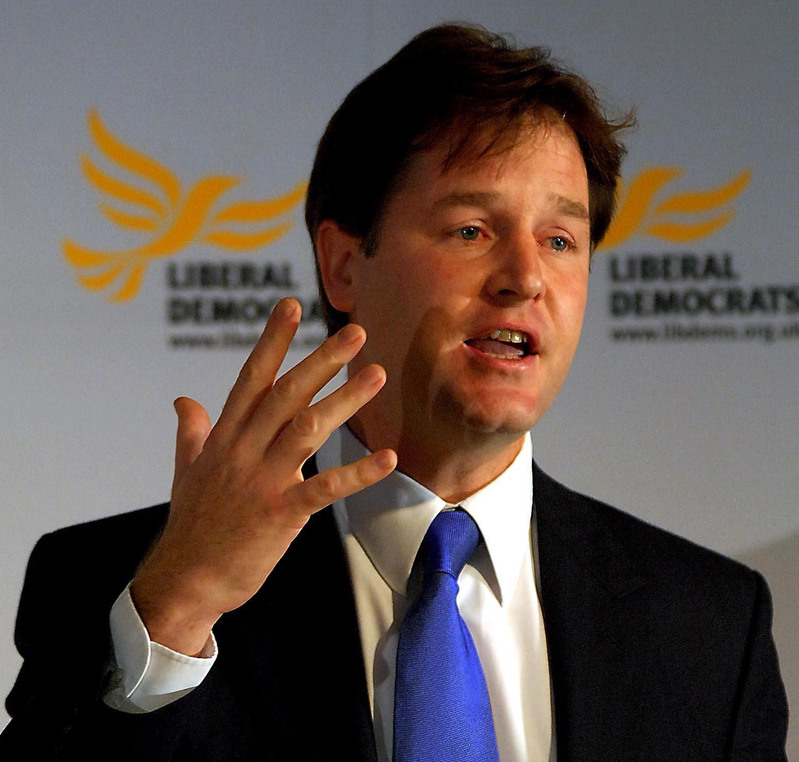
Sadly, the main topic of interest has been the success of Nick Clegg in the Leaders’ TV debates. The new young face on
Nick Clegg
the block has proved once and for all the huge power of television. Not one single Lib-Dem policy or personnel changed during the debate, yet the mere appearance on the telly of a new, personable kid on the block has rocketed his party up the ratings.
Well, not exactly rocket science, but sobering all the same. However, more importantly, most policy discussion seems mired in a series of scare-mongering ploys along the lines of, “Don’t vote for that lot or this terrible thing will happen.”
Yes, perhaps this is the stuff of all elections, but this one should have been a bit different since
A) it comes after a long period of power held by the Labour Party and whichever way it goes will mark a historic change and,
B) the stakes are so high as Britain hovers on the edge of joining the economically-challenged PIIGS [Portugal, Italy, Ireland, Greece, Spain, Ed.] of Europe.
We desperately need a government that can take us safely away from that particular event horizon, but to choose one rationally, we need the “truth” about what really needs to be done to reduce debt.
But sadly, we seem infected by the Greek syndrome, an ability to see the bleedin’ obvious, which is that nobody can live beyond their means for ever, much as they might like to.
So, we’re having to look for “the truth” further afield, to the Institute for Fiscal Studies (IFS), for example. According to them, the cuts in public costs will have to be as deep as any made since World War II. (Oh, and thank you to Labour and the banks for jointly getting us into this sorry mess.)
They may disagree in public, but privately they couldn’t agree more. On the single most important issue facing the country after this election, our politicians think it’s better to keep us in the dark.
WHERE is the party explaining this clearly and unambiguously to the people? In other words, TELLING THE TRUTH?
I don’t see it. Neither of the big, old dinosaur parties are being straight with us. The Tories are proposing to spend even MORE on the NHS, (National Health Service) that sacred cow that nobody dare speak any ill of, while Labour seem to be promising to spend more on just about everything despite our £163 billion borrowing this year.
Why is this? It can – I submit – only be because they don’t think the public will understand and accept “the truth”.
If party A tells the truth and admits the cuts in public services will be deep and involve some pain and party B LIES and says it will “preserve frontline services” (the Labour line) then they (Party A) fears the public will not buy their version and opt for whoever promises them a fantasy instead, or in other words a gradual recovery without too much pain and in particular for themselves.
So, there is deep cynicism and an extreme economy with the truth from all parties who fear a voter backlash if they tell it. This is rather a sad reflection on the Labour Party’s proud boast of “education, education, education” of 1997.
Apparently, the British public is so stupid that they can’t be trusted to believe the truth when they get it. Of course, this could possibly be because they are so UNUSED to getting it and moreover because this policy of spinning smoke and mirrors worked so well in previous Labour victories.
[With this Post, Jon introduces a series of forthcoming articles looking at the inner person and exploring ways in which each of us can enhance our feelings of contentment and happiness. Ed.]
Stop the world, I want to get off!
Starting again requires giving up
Whichever way we look, there appear to be huge problems. Not insurmountable but, metaphorically speaking, sheer vertical cliffs without any easy way up.
One might ponder if the last 50 years, that post-war period of growth and prosperity, have, in reality given society real, sustainable, core improvements or whether all the ‘gains’ have come at such a cost that the net benefit is questionable?
This could be seen as pessimism gone mad. Undoubtedly, there have been some huge gains from a scientific point of view and we now enjoy lives that are greatly enhanced and longer. But not to ask such a fundamental question is to assume the alternative, that everything in the garden is rosy.
Now this may seem a strange introduction to a topic that is going to be deeply personal and private.
But both the private, individual world of the ‘self’ and the great, interconnected world of the planet are indivisible. Every aspect of our lives, our livelihoods, our environment and the future of our children depends on how well, and how sustainably, we manage our personal, local, national and international interests.
For example, if Prof. Lovelock’s theory on the planet being a self-regulating organism is correct, his Gaia theory, then possibly in the lifetimes of our children, and certainly in the lifetimes of our grandchildren, worrying about a job or repaying the mortgage will be irrelevant. Our descendants will be worrying about their very survival!
I called this piece Giving Up. Why?
Because the only way forward is to give up on the present. I will expand on this theme in future Posts.
The future depends on each of us being happy and contented with ourselves and avoiding looking out there for the magic cure to all our troubles. Being, as far as we are able, at peace with our circumstances and able to do the best, individually, as well as the best for our families, our friends and the larger world in which we work and play.
I have heard people ask the question before, “How can I best help the world?” The only truthful answer is to develop ourselves as individuals. In doing this, the field of consciousness that we are all connected to is also lifted or elevated to a higher level.
At this stage of history, either…the general population will take control of its own destiny and will
Noam Chomsky
concern itself with community interests guided by values of solidarity and sympathy and concern for others or alternately there will be no destiny for anyone to control.
-Noam Chomsky
By Jon Lavin
[Anyone who has been affected by this article and wishes to contact Jon may find his contact details here. Ed.]
One of the fascinating aspects of my new American life is seeing how loud the volume of dissent is from the American
Bill Moyers
people about the shenanigans on Wall Street and the Too Big To Fail banks. There is an intensity and passion that I can’t see happening on the other side of the Pond. Maybe this is the cultural legacy of a people that just a short time ago, relatively speaking, were opening up this giant country seeking a better way of life than the ‘old countries’.
This intensity and passion is why, in the end, I believe that the solution to the huge crisis that still awaits us will start from this side of the Atlantic. But it will get a whole lot worse before it gets better, such is the complexity and depth of the fraud that is being visited on decent, ordinary folks in this and many other fine countries.
Bill Moyers of the Bill Moyers Journal on PBS is retiring. He’s approaching 76 and that’s a grand age to be dealing with the workload and stress of a weekly television presentation. His last Journal was broadcast on the 23rd April, a week ago today airing two really important topics. My only regret is that I haven’t been here sufficiently long to view many more of his Journals.
William K Black
In that last broadcast on the 23rd, Bill had two key interviews. In this Post, I want to bring to your attention his first report, which was an interview with William K Black, now an academic but, just as importantly, a former bank regulator. William Black really understands what is going on in banking.
The interview is both fascinating and captivating because, well to me anyway, it explains in terms that us laymen can understand, exactly what is going on and why it is so terribly important that legislation and regulations are brought into force to stop this fraud ever happening again.
This interview has not yet made it’s way onto YouTube so I can only post the link to the Bill Moyers website.
But, please, if you care about what is happening to us in whatever country you live in, click on this link and watch the interview.
And if you want to watch the earlier interview that Bill Moyers had with William Black then here it is.
Regular readers of Learning from Dogs will know that we usually only post a single article on week-end days. But yesterday I received news that a business friend of many years standing had lost his battle against ill-health and died peacefully in the afternoon. His name was Tom Murray and it’s my wish to celebrate his life by reproducing in full the email that was sent to me. It’s serendipitous that the planned posts by John Lewis for this week-end are aviation related.
Capt. Tom Murray
On Thursday afternoon the world lost a respected, influential, and creative aviator, one of the “Great Ones”.
Captain Thomas Murray was a pilot, artist, inventor, musician, and father.
A noted jet pilot, he explored the far corners of the globe, mapping out the Canadian Arctic, flying thousands of hours in Africa, Europe, the Himalayas, and the Americas.
Whether flying Gulf streams, Falcon, Hawkers, Learjets or old DC3s, Tom was a pilot’s pilot, the friendly, knowledgeable kind of guy who knew his craft so thoroughly that airmen the world over would “just call Tom”, whenever they needed answers.
He thrilled everyone he met with exciting stories of his travels…
…such as the time he found himself lost while flying over what should have been a large African lake, only to realize the lake had dried up. The only hope of finding civilization was to dead-reckon his way in a straight line and hope he hit the tiny “dot of a town” that was his final destination.
…Or the time his oxygen system failed in the Himalayas at 20,000 feet forcing him to dive the airplane into an 8000-foot valley to find out he was the only conscious crewmember.
…Or the time the entire front panel of his Hawker 800 fell onto his lap during takeoff because someone had forgotten to screw it in.
An adventurer to the max, he was also an inventor and visionary.
Tom took an ordinary problem such as converting hard-to-read aircraft performance charts into easy-to-read tables, and then turned that process into a successful business.
Tom created one of the first electronic documents to find its way into a cockpit – tables of aircraft performance data that minimized the chance of pilot error due to miscalculation that he called “EPADS”.
Constantly working to organize the cockpit, provide higher levels of safety and better information to the pilots, he invented one of the world’s first electronic flight bags, and established the process of managing aircraft electronic checklists, a process that the FAA later modeled their ECL guidelines after.
He joked that the entire cockpit should have a mode that turned it into a simulator during flight to alleviate boredom amongst pilots and give them a chance to train in truly challenging simulations during long flights.
He invented games for children, played flute, and wrote a storybook.
An accomplished artist, he relaxed by attending artist workshops and amazing all with his skill and precision. Just last summer, Tom held his first art exhibition.
His greatest creation with wife Daisy was his son, Thomas Alexander Murray, who was born with the charismatic smile and sense of mischief that characterized Tom at his best.
Tom’s inventions were his “other child”. He would latch onto a design problem like a pit bull.
He cherished the fact that he would uncompromisingly focus on a design and refuse to leave it go it until it was “perfect”, even to his own financial detriment when those around him insisted he was losing sight of the “big picture”.
To this effect, during his last year, he asked me to form a foundation in his name, to offer an annual award (which I’ll see if it’s possible to do)…
“To the individual who focuses on solving difficult problems; who is clearly addicted to finding the solution; who is unrelenting in the face of opposition – which may seem to be (or genuinely be) to their own personal detriment”
Perhaps he wanted an award, he knew he’d win!
Tom was well known for acting as “pilot in command” in his daily life, often forcing people to act “my way or the highway” and insisting that his way was the “right way”.
While this trait was annoying and frustrating to colleagues and friends, what was possibly more frustrating was the number of times one was forced to humble oneself when he was indeed “right”.
In the last year of his life, Tom worked relentlessly to teach others his design philosophy and prepare several of us to run the company he’d created, the vessel that would carry his vision and concern for the safety of his fellow pilots into the future.
Tom loved life and spent his days on a personal mission to make the world a better place, a more interesting place, a more ordered place, a more beautiful place, a more fun place to live…
Tom wasn’t always too clear with his emotions, and though he often maintained a “business” exterior, at heart he was the artist, and his appreciation and depth of love for his family, fellow pilots, and the people who worked for him and with him, his friends — was endless.
You always knew when he respected you, he’d give you a big pilot’s “Thumbs up!”
We will miss him dearly.
Today, we salute a great airman, Captain Thomas Murray.
On behalf of Tom, I know he would wish you a warm, “Thumbs up!”
This is the second Guest post from AJ Easton, a 13-year-old girl from North Carolina, USA. AJ first wrote about Learning from Horses on January 17th this year. This is a more reflective essay that would have been a credit to someone with many, many more years.
Trust is a complicated thing…
You have to learn to trust, but it is not something that can be taught in schools. You also have to earn trust, by keeping secrets and not spreading rumors.
With the people you trust, you do things you wouldn’t do with other people . Your true self comes out with the people you trust. You don’t worry about being judged; you don’t worry about people disliking you for who you are.
AJ Easton
But, in our modern-day world, it seems as if everyone judges.
People seem to hate for reasons as stupid as one’s appearance. People don’t trust people anymore because it seems that we are constantly warned to avoid strangers because they might hurt you, murder you, or completely mess up your life in some way, shape, or form.
And in school, if you trust someone enough to tell them a secret, they don’t keep it. And then, in your point of view, the world has ended.
All because of some secret that got out about who you like, or what you did with the person you were dating, or something else that, in the end, isn’t all that important.
Then everyone will judge you based on that rumor until you leave the school or graduate. They do this to make themselves feel “cool” and “important.” And you learn not to trust.
Social status has become such a big factor in everything we do these days. Everyone feels as though they have to be highly ranked socially to mean anything to the world.
But, truly, all you have to do is love what you do and respect yourself, to follow your dream and be determined. We should make decisions that help us move forward, not dwelling on the past. Every second is different; everything is unique. Nothing is the same. Not a single person, or tree, or moment. Each moment represents a new opportunity.
Don’t have regrets. What has happened has already happened and you can’t change it. Time travel is fictitious, not a reality. You can’t rewind your life to change what you have already done. There is a reason behind everything: remember this when you are having doubts about what you have done. Learn from your past but don’t let it eat at you.
Live your own life. And learn to trust yourself, and those who love you.
Nonsense, Sir? Then why are the police involved again?
Again?
Yes, Sir. They’re also investigating the mysterious unthinking think-tank remember?
Oh yes, I’d forgotten that.
There’s a rumour going round the canteen that the police are going to set up an incident room on the terrace of the House of Commons, Sir.
On the terrace?
Yes Sir. The idea is to save time going to and fro’ the house; deal with the criminals, sorry MPs, in batches – benefit from economies of scale sort of thing ….
Perkins! That’s the kind of silly rumour started by malicious gossips. I’m surprised you even listen to such tittle-tattle.
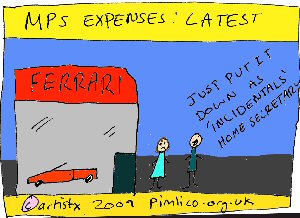
But you must admit it’s a rum do, Sir – using public money to finance his son’s university education!
But Perkins, it was only his expenses that he used!
That money is supposed to be used – if I may say so – for expenses, Sir.
But those WERE expenses, Perkins! Goodness, you are being obtuse, today. When your son goes to university you certainly have expenses, I can tell you!
I meant his parliamentary expenses, Sir.
Oh really, Perkins. If we’re going to start nit-picking over every pound in every expense account in the House of Commons then where will we be?
I don’t know where we’ll be, Sir, but I know where the police will be and where half of our illustrious MPs will end up ……..
But Perkins, we’re talking about money already earmarked for expenses. Once it’s allocated then it doesn’t really exist any more; it’s virtually spent!
Well, it seems this money was actually spent, Sir – and after all, it was public money, Sir!
Public money? What on earth are you talking about, Perkins! It was the government’s money!
But it came from the public, Sir!
Aha! Got you there, Perkins. Granted it WAS the public’s money originally but once it left their bank accounts it became Government money! Surely you can see the distinction?
A tribute to Alistair Cooke of Letter from America
Many, many people of a certain age will remember with very fond affection the weekly BBC Radio broadcasts of Alistair Cooke under the title of Letter from America.
Alistair’s broadcast title, Letter from America, came to mind because I have been thinking for a couple of weeks about what to call my impressions about moving to Payson in Arizona.
Payson Perceptions? Pictures of Payson? Payson Profile? No! They all seemed naff!
But would it be too presumptuous to echo Cooke’s hugely famous programme title? Hopefully not.
(And regular readers will know that yesterday, the first Letter from Payson was published.)
I did a Google search on Alistair Cooke and immediately found the BBC web page devoted to him. For those that don’t know Cooke here are a few details from WikiPedia.
Born in 1908 in Salford, Lancashire, England, Cooke first started broadcasting for the BBC in 1946 and continued until the 20th February, 2004, a total of 58 years and making Letter from America the longest-running speech radio show in the world.
I hope the BBC will forgive me in reproducing here on Learning from Dogs the obituary that is on the Alistair Cooke website. He was a wonderfully interesting man and his weekly Letter from America seems to have been part of my complete life (in a sense it was).
——————-
He read his Letter from America for 58 years
Esteemed writer and BBC broadcaster Alistair Cooke, famed for his programme Letter From America, has died aged 95. BBC News Online looks back at his long and respected career.
For more than half a century, Alistair Cooke’s weekly broadcasts of Letter from America for BBC radio monitored the pulse of life in the United States and relayed its strengths and weaknesses to 50 countries.
His retirement from the show earlier this month after 58 years, due to ill health, brought a flood of tributes for his huge contributing to broadcasting.
Born in Salford, near Manchester, northern England, Alistair Cooke’s father was an iron-fitter and Methodist lay-preacher.
Alistair Cooke: Consummate broadcaster
Winning a scholarship to Jesus College, Cambridge he read English, edited the undergraduate magazine, Granta, and founded the Cambridge University Mummers.
Alistair Cooke made his first visit to the United States in 1932, on a Commonwealth Fund Fellowship which took him to both Yale and Harvard universities.
Following his return to Britain, he became the BBC’s film critic and, in 1935, London correspondent for America’s National Broadcasting Corporation.
He returned to the United States in 1937 to work as a commentator on American affairs for the BBC. He made his home there and, in 1941, became an American citizen.
A passion for jazz
March 1946 saw the first edition of American Letter, which became Letter from America in 1949.
The series was the longest-running series in history to be presented by a single person.
Alistair Cooke never decided what he was going to talk about until he wrote the script, made no notes during the preceding week and preferred to rely on his memory.
In an interview given at the time of the 3,000th edition of Letter from America, he appeared to have mixed feelings about the future of the United States.
“In America,” he said, “the race is on between its decadence and its vitality, and it has lots of both.”
He addressed Congress in 1973
Cooke led his listeners through the American vicissitudes of Korea, Kennedy, Vietnam, Watergate, Nixon’s resignation and Clinton’s scandals.
In all of this, Cooke pulled no punches. The lyricism of his broadcasting and the urbanity of his voice did not disguise his fears for America which he saw becoming a more violent society.
A liberal by nature, he reserved particular dislike for what he saw as the shallow flag-waving of the Reagan presidency.
Alongside working for the BBC and The Guardian, for which he wrote from 1945 to 1972, he developed a passion for jazz and golf and, as a film critic, he mixed with Hollywood stars.
As a commentator on history, Cooke was sometimes an eyewitness too. He was just yards away from Senator Bobby Kennedy when the latter was assassinated in 1968.
He was never as comfortable on television as radio but, by the 1970s, his hugely successful television series America recounted his personal history of his adopted homeland and won international acclaim, two Emmy Awards and spawned a million-selling book.
British or American?
The Queen awarded him an honorary knighthood in 1973 and the following year, for a journalist, he received the ultimate recognition – he was asked to address the United States Congress on its 200th anniversary.
He told his audience he felt as if he was in a dream, standing naked before them and there was only one thing he could find to say.
Teasing, he exclaimed to the assembled legislators, “I gratefully accept your nomination for President of the United States!”
Naturally, he brought the house down.
Many Britons thought he was American, but to the Americans he was the quintessential Brit, the man who brought them the best of British television as presenter of Masterpiece Theatre. For his part, he explained, “I feel totally at home in both countries.”
He impressed both audiences with his high quality work. With his unquenchable curiosity, Alistair Cooke remained for decades the consummate broadcaster, an elegant writer and a man of enormous wit and charm who made sense of the American Century.
By Paul Handover (still missing Letter from America on the radio.)












 Learning from Dogs