As I spoke about yesterday in my introduction, when my mother remarried my sister and I had a new man about the house, so to speak. He was Richard Mills.
I was 13 or thereabouts and already struggling with my school work (the result of my father’s sudden death). And ‘Dad’ as we called him was finding his feet in the strange world of going from having no children to instantly having two step children!
Anyway, Dad found a theme with me that I enjoyed: building a shortwave radio receiver. It was full of learning for me and over the years I became hooked on listening to radio stations both near and far transmitting in morse code. I also joined the Harrow Radio Society and went across to their weekly meetings by tube and bus. (Despite the Society no longer being at the Harrow address it is amazing that they are still going strong.)
It was also a time when there was a great deal of ‘radio surplus’ equipment going for next to nothing and I ‘upgraded’ to an R-1152 receiver.
War surplus R-1152 receiver.
In time I became sufficiently old to take driving lessons and pass my driving licence. I then got a secondhand car. It helped because then I could drive up to Bushey and spend Sunday mornings at the house of Ron Ray. Ron was a keen amateur. On Sunday mornings Ron had a small group of people who wanted to pass the morse code test and apply for a licence.
I was already a member of the RSGB, the Radio Society of Great Britain, and that surely encouraged me further to study for my amateur licence.
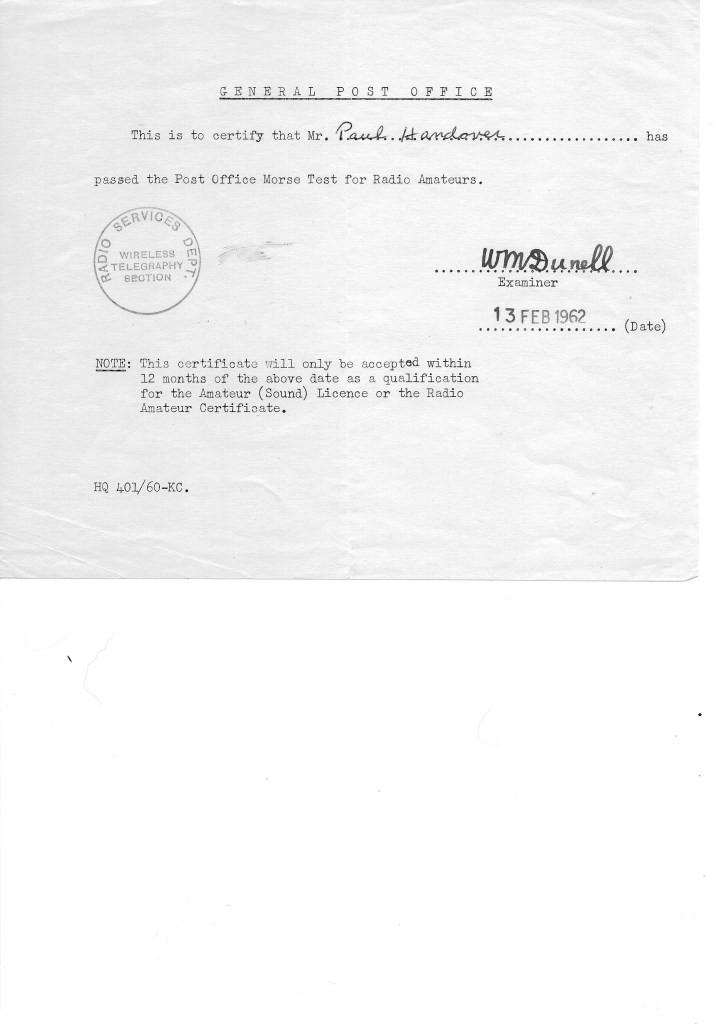
In time, I sat the exam and much to my amazement passed!
oooo
oooo
So that is the story of me and amateur radio.
Well, almost the full story.
In 1963 I volunteered for the Royal Naval Reserve, London Division. In time I was accepted and chose the join the radio branch, my G3PUK status coming in useful, because I reckoned that when we went to sea, on flat-bottomed minesweepers, it was better to be sick into a bucket between the knees than be sick on deck!
In my recent post Electrosensitivity, I wrote about “spending a number of years studying for a Diploma in Electrical Engineering at Faraday House, Southampton Row, London and becoming a UK Radio Amateur at the age of 17 (G3PUK)“.
In reverse order, I shall start with becoming a UK Radio Amateur, now rather back in the mists of time!
After my father died in 1956 my mother subsequently remarried. Her new husband was Richard Mills and he was very knowledgeable about radio matters; he was a technical author in the radio-communications industry. It was Richard, my step-dad, who showed me how to make a crystal set and I started listening to the strange world of wireless radio. It fascinated me and motivated me to save up my pennies and buy an ex-military radio receiver known as a R1155.
I had joined the Harrow Radio Society who, amazingly, are still active today, as their website demonstrates.
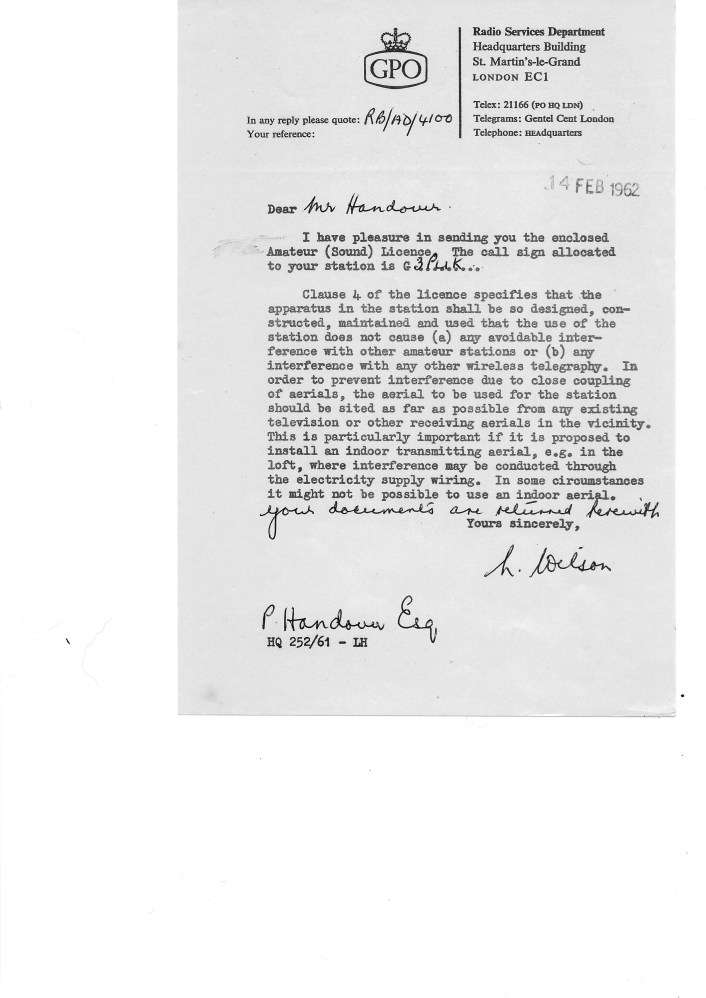
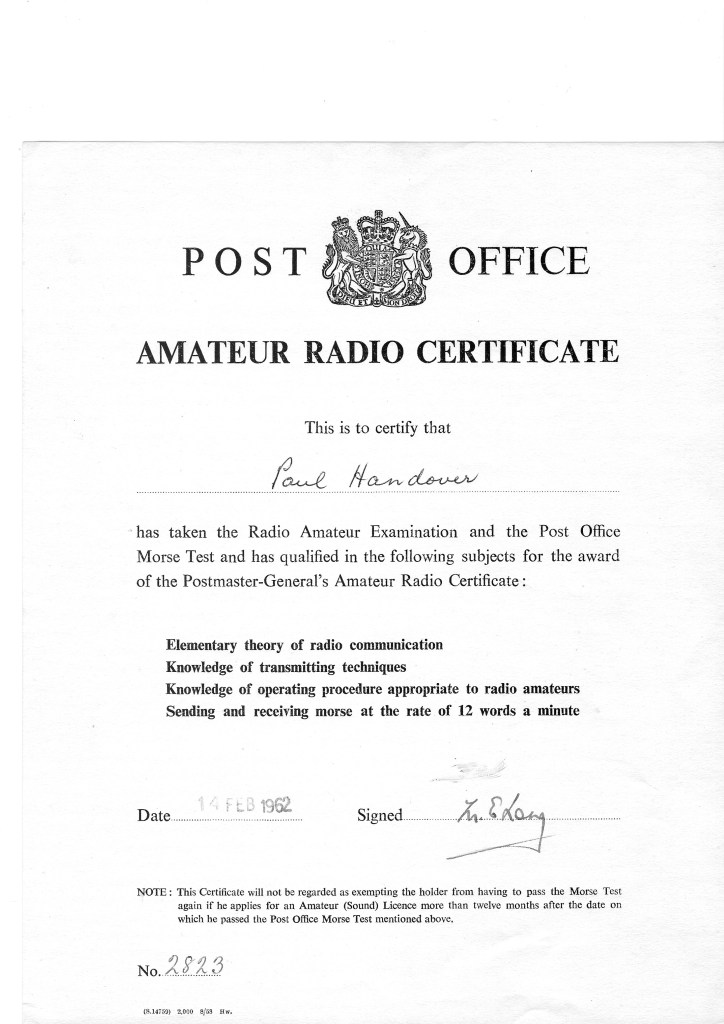
Under the fabulous tutelage of many of the older ‘hams’ I went on to sit my exams and on Valentine’s Day 1962 was awarded the Postmaster-General’s Amateur Radio Certificate. I applied for a call-sign and was allocated G3PUK. I was just 17 years old!
oooOOOooo
Now some memories of Faraday House. I can do no better than refer you to an article that appeared on the Electrical Review website in the UK. As the article was published over three years ago, I think republishing it on Learning from Dogs isn’t being too naughty.
Faraday House Association closes after 105 years
FRIDAY, 29 JANUARY 2010
It is with sadness we report the Faraday House Old Students Association (FHOSA) is to close after operating continuously over the last 105 years. It had been host to thousands of chartered electrical engineers. The Association membership is derived from old students of Faraday House.
In 1888 the revised Electric Lighting Act encouraged many local authorities to apply for Parliamentary Powers to establish generating stations to transmit power. Faraday House was founded to train engineers in this new practice. The college started life as the Electrical Standardising, Testing and Training Institution at Charing Cross but in June 1890 used the name Faraday House. It was located in the Charing Cross area, and fees were 100 guineas per annum. The first Faraday House Dinner was held in 1895 – it was free and some 170 attended. In 1905 the FHOSA was formed and 100 old students joined. A move was then made to Southampton Row. By now the college had 110 students.
In 1909 Dr Russell was appointed principal, and pioneered the sandwich course. This meant students had a year or so of theory and then experienced work in industry, returning again to more theory. By 1914 many old students joined up and a crash course was started to aid the war effort. By 1919 some 350 had been in the services and 34 had died. In 1920 the fees had risen to 300 guineas.
By 1928 1000 students had joined the Old Students Association and in 1929 a 40th anniversary dinner was held. In 1939 a discussion with the governors resulted in a decision to evacuate the college to Thurlestone in Devon. A new principal, Dr WRC Coode-Adams, took over from Dr Russell. Faraday House took over the Links Hotel. Staff and students who were married lived in the hotel or in houses that had been taken over by the college.
In 1942 the college returned to Southampton Row. After the war Faraday House had difficulty in recruiting, students were lured to other colleges and universities by grants. In 1957 Mr GH Randolph Martin was appointed Principal. He had been a lecturer at the college since 1948. The college closed its doors in 1967 as losses were now running at £20,000 per year.
During its lifetime Faraday House produced a succession of engineers who attained the most senior positions in industry and electrical supply in many countries, and six old students have been president of the Institution of Electrical Engineers (now the IET).
The Old Students Association has a membership that is steadily growing older and shrinking as members die. The closure was inevitable without younger people coming forward to run it. The FHOSA will shut its doors finally after the Annual General Meeting in March 2010.



 Learning from Dogs