For every case of cruelty towards animals there is an example of boundless love.
I first saw this story on the popular Grist website, from which I quote,
Watch rescued ducks discover the water for the first time in this heartwarming video
These ducks were rescued from a hoarder, who was keeping over 160 fowl in filthy, overcrowded conditions. The neglected birds had never even seen a pond. But the Woodstock Farm Animal Sanctuary has nursed them back to health, repairing infections, injured feet, and nutritional deficiencies — and now you can watch these newly rehabilitated duckies learn to swim. They’re a bit confused about it at first, but eventually, they take to it like a … well, you know.
Just be warned that the embedded link to that story about the hoarder is a tough read. Although it does have a happy ending, a very happy ending.
Rescue: Over 130 Neglected Birds from Hoarding Case
Almost a year after our initial efforts to rescue over 160 ducks, geese, turkeys and chickens that were living with a hoarder in appalling conditions, we were finally able to bring them to safety. They are now enjoying sunshine on their feathers, water to swim in, clean bedding, warmth, grass under their feet and room to roam for the very first time. Initially, we tried working with their owner towards an amicable surrender, pleading with her to consider the quality of life for the birds and used many of our own resources to help provide a cleaner environment for them. The hoarder’s initial intentions were good and her love for the animals apparent, but she neglected to see how their overcrowding, over-breeding, lack of shelter and space and filthy conditions were hurting them. She also continued to buy chicks and ducklings online and mail ordered to her.
We are treating all of their health issues by providing veterinary care, nutritional supplements, quality food and vitamins daily in their water. They are beginning to thrive with their new freedom. It’s a joy for us to see and we’re so happy to be able to give these animals the lives they deserve. YOUR SUPPORT helps in many cases like this and give them life-long shelter and the care and love they need and so deserve.
Much gratitude to the ASPCA for a grant to help to care for all of these very-deserving animals.
Many of these birds are up for adoption, please contact us if interested.
So back to the ducks!
Probably my favorite part is when the ducks keep running away from the water in what, as one Woodstock worker points out, looks just like a Benny Hill routine. Or maybe it’s the part where the sanctuary workers go for the “tough love uncle” approach to swimming lessons, and just chuck the birds in the pond. Or maybe it’s watching that first duck figure out that the water is amazing. Or maybe it’s watching ALL of them figure out that the water is amazing! What I’m saying is that I could, and will, watch this video all day.
So back to non-doggy stuff although I hope the themes of truth and integrity continue to rein supreme though this blog!
In the last couple of weeks, I have devoted a number of posts to the subject of change, as in how do we humans change. The first post was Changing the person: Me where I started examining the process of change; by process I mean the models of change commonly understood in, say, management change.
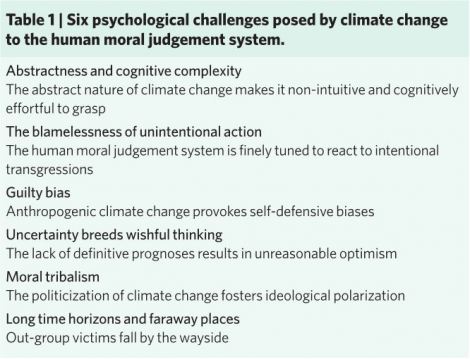
The next post was You have to feel it! which drew heavily on research from Ezra M. Markowitz & Azim F. Shariff regarding the psychological aspects posed by climate change to the human moral judgement system.
The final post was From feeling to doing. In this post, David Roberts of Grist showed that one could put aside all the ‘head stuff’ about change and in just 15 minutes cover all that one would ever want to know about the biggest issue of all facing this planet.
So rather a long introduction to two guest posts that today and tomorrow set out the case for what we all have to consider; doing nothing is just not a viable option. The first is from Martin Lack of the popular and hard-hitting blog Lack of Environment.
oooOOOooo
Avoiding the catastrophe of indifference.
by Martin Lack.
Paul has very kindly invited me to follow-up his recent post regarding David Roberts’ item on the Grist blog entitled ‘Why climate change doesn’t spark moral outrage, and how it could’ followed by a second post in which was embedded David Roberts’ excellent video ‘Climate change is simple – we do something or we’re screwed’.
So my guest post is an expansion of a comment I submitted in response to the first of those two posts, You have to feel it. However it would be wrong not to first add my voice to all those that have applauded David Roberts for all his excellent work.
Reading Hamilton’s book was one of the reasons I decided, as part of my MA in Environmental Politics, to base my dissertation on climate change scepticism in the UK.
In the process, I read much but Hamilton’s book was one of very few that I actually read from cover to cover – I simply did not have time to read fully all the books for my research. However, because I have a background in geology and hydrogeology, my greatest challenge was learning to think like a social scientist.
I was all for taking these climate change sceptics head on and demolishing their pseudo-scientific arguments or taking them to task for the ideological prejudices that drive them to reject what scientists tell us. Thus, it fell to my dissertation supervisor to mention politely but firmly that I needed to disengage with the issues and analyse patterns of behaviour and frequency of arguments favoured by different groups of people. In short, I needed to stop trying to prove the scientific consensus correct and start understanding the views held by those that dispute that consensus.
Having said how I read Professor Hamilton’s book in full, I must admit to learning about a load of other equally-scary sounding books since subscribing to Learning from Dogs; Lester Brown’s World on the Edge: How to Prevent Environmental and Economic Collapsebeing just one that comes to mind!
David Roberts
Then of course there is what David Roberts himself says, which is just as scary. I think we have good reason to be scared. However, as Hamilton points out, we must move beyond being scared, which is simply debilitating, and channel our frustration into positive action.
Because if we do not, there is a great deal of circumstantial evidence to suggest that civilisation may well fail. If that means engaging in acts of civil disobedience, as it has done for James Hansen and many others, well, so be it. I suspect that nothing worthwhile has ever been achieved without someone breaking the law in order to draw attention to injustice – the abolition of slavery and child labour, the extension for all of the right to vote including women, come to mind.
That is the conclusion of Hamilton’s book; that civil disobedience is almost inevitable (p.225). Just as turkeys won’t vote for Christmas, our politicians are not going to vote for climate change mitigation unless we demand that they do so.
So it was the steer from my dissertation supervisor that lead me to read David Aaronovitch’s Voodoo Histories: How Conspiracy Theory Has Shaped Modern History, and much more about psychology. All of which guided the Introductory section of my dissertation, which summarised the philosophical roots of scepticism, the political misuse of scepticism, and the psychology of denial; see a recent post on my blog Lack of Environment. In terms of what I want to say here, it is an elaboration of the last of those topics, the psychology of denial. Indeed, it formed the preamble to the findings of my research.
Despite my initial reluctance to learn about psychology, the more I read the more I realised just how central psychology was to explaining why we humans have failed to address the problem of climate change.
I ended up summarising the work of Dickinson, together with other sources of material, in the following manner.
In considering reasons for the collective human failure to act to prevent anthropogenic global warming (AGW), a number of authors appear to have been influenced by Ernest Becker’s The Denial of Death (1973). For example, Aaronovitch proposed that we try to avoid the “catastrophe of indifference” that a world devoid of meaning or purpose represents (p. 340). Hamilton suggested that climate disruption “has the smell of death about it” (p. 215).
Janis Dickinson elaborates a little more, exploring what she describes as “…one of the key psychological links between the reality of global climate change and the difficulty of mobilizing individuals and groups to confront the problem in a rational and timely manner”, then referring to what psychologists call terror management theory (TMT) – Dickinson also categorises denial of climate change; denial of human responsibility and immediacy of the problem as proximal responses (Dickinson 2009).
Furthermore, as referenced here, both Dickinson and Hamilton suggest that other distal TMT responses, such as focussing on maintaining self-esteem or enhancing self-gratification, can be counter-intuitive and counter-productive. Dickinson summarises the recent work of Tim Dyson by saying “[b]ehavioral response to the threat of global climate change simply does not match its unique potential for cumulative, adverse, and potentially chaotic outcomes” (ibid).
Based on the evidence of the most frequently used arguments for dismissing the scientific consensus regarding climate change, I collated the findings of my research and which might be summarised as follows:
Having analysed the output of such UK-based Conservative think-tanks (CTTs), along with that of scientists, economists, journalists, politicians and others, it would appear that the majority of CTTs dispute the existence of a legitimate consensus, whereas the majority of sceptical journalists focus on conspiracy theories; the majority of scientists and economists equate environmentalism with a new religion; and politicians and others analysed appear equally likely to cite denialist or economic arguments for inaction.
As I find myself saying quite frequently, the most persistent arguments against taking action to mitigate climate change are the economic ones.
However, as all the authors mentioned have suggested, or at least inferred, I think it is undoubtedly true that the most potent obstacle to people facing up to the truth of climate change is our psychological reluctance to accept responsibility for something that is obviously deteriorating – namely our environment!
Nevertheless, all is not yet lost. We do not all need to go back to living in the Dark Ages to prevent societal and environmental collapse but we do need to accept a couple of fundamental realities:
Burning fossilised carbon is trashing the planet. Therefore, fossil fuel use must be substituted in every possible process as rapidly as possible. Unfortunately, it is not substitutable in the most damaging process of all; aviation. That merely increases the urgency of substituting where we can (i.e. power, lighting and temperature control).
Poor people in developing countries have a legitimate right to aspire to having a more comfortable life but the planet definitely cannot cope with 7 to 10 billion people living like we do in the “developed” countries.
Once we accept these realities, we will learn to use less fossil fuels and, if we can become self-sufficient using renewable energy sources, we can have a flat-screen TV in every room and leave them on standby and the A/C on full power 24/7 and still have a clear conscience. However, we must get off fossil fuels ASAP.
oooOOOooo
I am indebted to Martin for writing such an insightful analysis of how we all have to change. Tomorrow, another guest post further exploring the options that face us all as we work towards a sustainable future. As I opened this post, doing nothing is not an option!
Fascinating insight into our complex relationship with complex ideas!
There’s a powerful saying in the world of writing: If you can’t feel it you can’t write it!
But our feelings are so, so much a part of what it is to be human. That’s why I spent some time exploring how our resistance to change is so wrapped up in the emotions that change brings about in an article back on the 2nd August: Changing the person: Me.
So a post on the grist online magazine not so long ago really caught my eye. It was called Why climate change doesn’t spark moral outrage, and how it could, and was written by David Roberts. I would dearly love to have sought David’s permission to republish it in full; it’s so relevant to understanding how we humans have to approach turning back from our present course of making the Earth’s biosphere uninhabitable for we humans.
But in a couple of days time, I have a Post coming out that is republished with David’s written permission called Cutting CO2 emissions – who leads the world! It felt greedy to ask David for another full republication. So I’m going to dip into this one, hopefully to the point where you will go across to grist and read it for yourself.
David opens up as follows:
Perhaps the single biggest barrier to action on climate change is the fact that it doesn’t hit us in the gut. We can identify it as a great moral wrong, through a chain of evidence and reasoning, but we do not instinctively feel it as one. It does not trigger our primal moral intuitions or generate spontaneous outrage, anger, and passion. It’s got no emotional heat. (Ironic!)
David’s article then goes on to refer to a recent paper published on the Nature.com website called Climate change and moral judgement by Ezra M. Markowitz & Azim F. Shariff. The abstract sets out that:
Converging evidence from the behavioural and brain sciences suggests that the human moral judgement system is not well equipped to identify climate change — a complex, large-scale and unintentionally caused phenomenon — as an important moral imperative. As climate change fails to generate strong moral intuitions, it does not motivate an urgent need for action in the way that other moral imperatives do. We review six reasons why climate change poses significant challenges to our moral judgement system and describe six strategies that communicators might use to confront these challenges. Enhancing moral intuitions about climate change may motivate greater support for ameliorative actions and policies.
M’mmm – not sure how that leaves me. (Which is my way of saying that I don’t really understand that!) Luckily David goes on to say that the authors “go on to identify six reasons why, “unlike financial fraud or terrorist attacks, climate change does not register, emotionally, as a wrong that demands to be righted.” and refers to an interesting table in the research paper.
Now go to the article on grist to better understand how those challenges are explained.
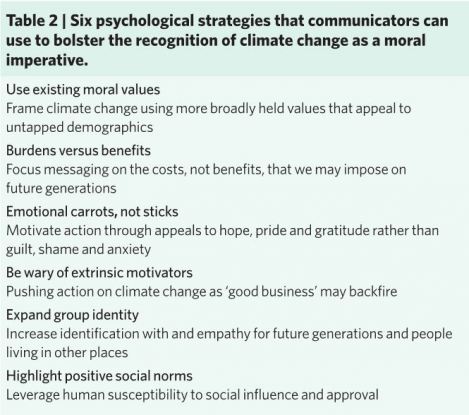
Then later on in the research paper, there is a second table, as below:
Again, these strategies are expanded upon in David’s article. What I will do is to copy his final few paragraphs:
6. Highlight positive social norms: This is, to me, the Big Kahuna. As I was reading about all the psychological barriers to climate action, I kept thinking, “one thing can overcome all these: peer pressure!” If people see others that they view as peers or leaders doing something, they will tend to do it too, and retrofit reasons for it after the fact. This is the essence of humans as social creatures.
The recommendation is twofold, though: not just to “highlight pro-environmental, prosocial injunctive norms such as prohibitions against being wasteful,” but also to “be careful not to inadvertently highlight negative, but existent, descriptive norms, which can actually encourage individuals to follow suit in the wrong direction.”
In other words, you want to emphasize that climate hawkery is good, socially desirable, admirable, and that all the cool kids are doing it. You don’t want to give people the impression that “everyone’s doing it” if it is bad. Even if you state clearly that it’s bad, the fact that others are doing it is, in and of itself, a powerful incentive to do it too. It’s the herd instinct. This is good reason not to whine on and on about how everyone drives too much or everyone wastes electricity. The subtext is, “it’s the social norm.”
—-
Aaaanyway, this is a lot of food for thought. But it’s the kind of stuff — not about science but about people — that far too many climate hawks ignore or disregard. Climate change is not only the economic and ecological crisis of our time, it’s also a moral crisis. What we are doing to our descendants is a moral crime. Finding ways to help people get that, feel it in their guts the way they would if someone threatened their own families, is a precondition for serious, sustained action.
Let me repeat David’s closing words, “Climate change is not only the economic and ecological crisis of our time, it’s also a moral crisis. What we are doing to our descendants is a moral crime.”
OK, so how strongly do you feel that? Great, so you do feel it – even feel it deep inside you.
Now that you do, let’s all get stuck into making a difference. It is all about doing. As someone of huge stature, and a wonderful person of action no less, said;
I have been impressed with the urgency of doing. Knowing is not enough; we must apply. Being willing is not enough, we must do. Leonardo da Vinci (1452-1519)
We must do! Start your own ‘doing’, don’t wait upon others, actively look for ideas (there are a few here) and together we can make a positive difference.
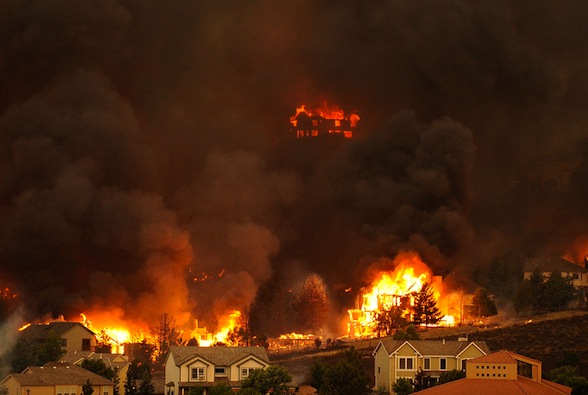
This summer has seen nature visiting on man a series of catastrophes. To name just a few, we have the record-breaking rainfall in Britain in June, the Colorado wildfires and the 1,400,000 storm-struck households in the eastern US.
Colorado burning
Inevitably, many wonder if this is connected to climate change as a result of mankind’s behaviours. Many now believe so.
But we have to stand on the rock of science.
So it was great to come across a recent article on Grist that led me to this organisation, Climate Communication. As they say on the About Us page,
Climate Communication is a non-profit science and outreach project funded by the Rockefeller Brothers Fund and the ClimateWorks Foundation. Climate Communication operates as a project of the Aspen Global Change Institute, a non-profit organization dedicated to furthering the scientific understanding of Earth systems and global environmental change.
That review on Climate Communication includes the following video,
Not convinced?
Then try this evidence from an interview with Kevin Trenberth of the National Center for Atmospheric Research shown on PBS Newshour,
Want more? Go for it!
The PBS video came from the British Guardian newspaper (link thanks to Naked Capitalism). The Guardian reported,
Is it now possible to blame extreme weather on global warming?
Wildfires, heatwaves and storms witnessed in the US are ‘what global warming looks like’, say climate scientists
Posted by Leo Hickman
Tuesday 3 July 2012
Whenever an episode of extreme weather – heatwave, flood, drought, etc – hits the headlines, someone somewhere is sure to point the finger of blame at human-induced climate change.
Such claims are normally slapped down with the much-aired mantra: “You cannot blame a single episode of bad weather on global warming.” But with the on-going record high temperatures affecting large parts of the US, there seems to be a noticeable reduction in such caveats and notes of caution.
This week, scientists have been queuing up, it seems, to explain how the wildfires in Colorado, the heatwave across the eastern seaboard, and the “super derecho” are all indicative of “what global warming looks like“. Most pulled back, though, from directly blaming global warming for such weather events.
“In the future you would expect larger, longer more intense heat waves and we’ve seen that in the last few summers,” Derek Arndt of NOAA Climate Monitoringtold the Associated Press.” The same report added: “At least 15 climate scientists told the Associated Press that this long hot US summer is consistent with what is to be expected in global warming.”
So, can we now say, or not, that specific extreme weather events are caused, or at least exacerbated, by global warming? Has anything changed in climate scientists’ understanding of the attribution – or “anthropogenic fingerprint” – of such events? Are they now more confident about making such links?
I put this question to a number of climate scientists ….
Leo Hickman then reports the assessments of eight leading scientists. Go and read their words here. If you can do it now!
The science is solid!
So as you watch these scientists talking about the meaning of climate extremes think what you can do today to reduce your own impact on this planet. Just as importantly, think how you can influence those around you and those that represent you that now is the time to wake up to the fact that nature is telling us to slow down!
The growth in awareness of what we are doing to the planet is astounding. There is hope, we have to promote hope and we have to acknowledge that hope is a powerful agent of change.
Yesterday, I introduced a 50-minute film concerning the famous biologist E O Wilson, Lord of the Ants which, as well as being a wonderful tribute to Prof. Wilson, also allowed us humans to have a better understanding of our deeper human issues.
Coincidentally, around the same time of watching that film, I saw an article on the Grist website that referred to some research published in Nature magazine. This what I read, first from Grist, reprinted with the kind permission of Libby S., Senior Marketing Manager of Grist.
Scientists have been doing studies for years that show you are more likely to suffer from mental illness if you live in a city. What they haven’t figured out is why.
Now, researchers in Germany have conducted experiments that they believe might begin to get at the neuroscience behind the crazy-making nature of urban areas.
Publishing in the journal Nature, a group led by Andreas Meyer-Lindenberg of the University of Heidelberg’s Central Institute of Mental Health in Mannheim, Germany, looked at how social stress affected the minds of subjects, some city-dwellers and some not.
If we then turn to that article in Nature (to get access you will need to arrange prior free sign-up) we get to read this,
City living marks the brain
Neuroscientists study social risk factor for mental illness.
Epidemiologists showed decades ago that people raised in cities are more prone to mental disorders than those raised in the countryside. But neuroscientists have avoided studying the connection, preferring to leave the disorderly realm of the social environment to social scientists. A paper in this issue of Naturerepresents a pioneering foray across that divide.
Using functional brain imaging, a group led by Andreas Meyer-Lindenberg of the University of Heidelberg’s Central Institute of Mental Health in Mannheim, Germany, showed that specific brain structures in people from the city and the countryside respond differently to social stress (see pages 452 and 498). Stress is a major factor in precipitating psychotic disorders such as schizophrenia.
The work is a first step towards defining how urban life can affect brain biology in a way that has a potentially major impact on society — schizophrenia affects one in 100 people. It may also open the way for greater cooperation between neuroscientists and social scientists. “There has been a long history of mutual antipathy, particularly in psychiatry,” says sociologist Craig Morgan at the Institute of Psychiatry in London. “But this is the sort of study that can prove to both sides that they can gain from each others’ insights.”
I feel uncomfortable about reproducing more of this fascinating study without some formal permission to do so, therefore, if you want to read the full article then do sign up for access at the Nature website.
Back to the article from Grist written by Sarah Goodyear, Grist’s cities editor,
I called Dr. Meyer-Lindenberg to ask him more about the implications of his experiment, and what he thought might be the cause of heightened sensitivity to social stress among urban dwellers.
“On the neural level, we find two things,” he told me. “A, the neural effects are completely dissociated, so current urban living only affects the amygdala, urban upbringing only affects the cingulate. And B, these areas are associated with these illnesses. The amygdala is sort of a danger center, and it’s critically important for fear. And it is clear that the amygdala is a major player in depression. The cingulate is a prefrontal area regulating negative emotion, and it’s known to be one of the earliest areas affected by schizophrenia.”
So what accounts for the hyperactivity of the amygdala-cingulate circuit in urban dwellers? “That exact circuit that we found hyperactive has also shown to be activated when someone comes too close to you and crowds your personal space,” Meyer-Lindenberg told me.
But he cautioned against inferring that mere density of population is at fault. “It’s still speculation,” he said. “There could be myriad components of the urban experience that might or might not be bad for you from the point of your risk for mental illness. No one really knows. People are annoyed by noise or by traffic, or it could also be lead, or air pollution, but there’s no evidence base to say this is an important factor, this is not an important factor. Therefore there’s no basis for urban planning that’s grounded in human biology, at least with regard to mental illness.”
Later in the Grist article, Dr. Meyer-Lindenberg told Sarah Goodyear,
“Social status is closely linked to socioeconomic variables. What we found in our imaging studies is that if your social status becomes labile, and especially if you are in danger of losing it, a very similar brain circuit becomes active. There is a convergence of socially relevant risk factors on that circuit.”
Different types of urban environments might also affect people in different ways. “It’s very different if you live in Manhattan and you sort of live in a series of overlapping villages, if you will, or if you live in a city like Sao Paolo, in which no such microstructure is immediately available to you, or if you live in a large spread-out area,” said Meyer-Lindberg.
The social connections that are fostered in more walkable neighborhoods could help city dwellers from losing it. “A previous study found that that the size of your social support network is actually correlated to the size of the exact brain circuit we found in this study,” Meyer-Lindenberg said. “So that’s a protective factor. The more friends you have, the bigger those brain structures are.”
Already, more than half the human population lives in cities. That proportion will only increase. New cities are springing up all over the developing world, some built to order, some completely unplanned. The form they take could be crucial.
More knowledge about what exactly drives people could lead to concrete solutions that would make for better mental health — the same way the discovery of how disease was spread by waterborne germs finally ended the scourge of cholera in London.
“I think it would be important to make cities better, given that we can’t escape cities, given the dynamics of urbanization,” said Meyer-Lindenberg. “That’s a reality that we’re not going to get rid of.”
Fascinating article made doubly interesting by E O Wilson’s lifetime study of ants!

 Learning from Dogs