The mistake we all make is to look behind us and think the future will be the same.
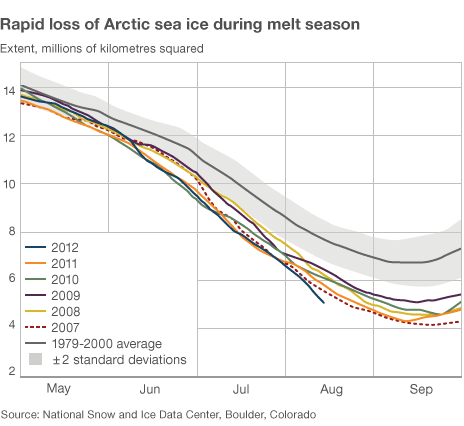
Let me start with something that is not really news. Not news in the sense that it has been very widely reported. I’m speaking of the probability, the high probability, that this year’s summer ice area in the Arctic will be a record low, with all the implications that this carries. Let me refer to a recent BBC news item that included a stunningly powerful chart.
Scientists at the US National Snow and Ice Data Center said data showed that the sea ice extent was tracking below the previous record low, set in 2007.
Latest figures show that on 13 August ice extent was 483,000 sq km (186,000 sq miles) below the previous record low for the same date five years ago.
The ice is expected to continue melting until mid- to late September.
“A new daily record… would be likely by the end of August,” the centre’s lead scientist, Ted Scambos, told Reuters.
“Chances are it will cross the previous record while we are still in ice retreat.”
The US National Snow and Ice Data Center may be found here.
So to the piece that generated the title of this post, the future of the car.
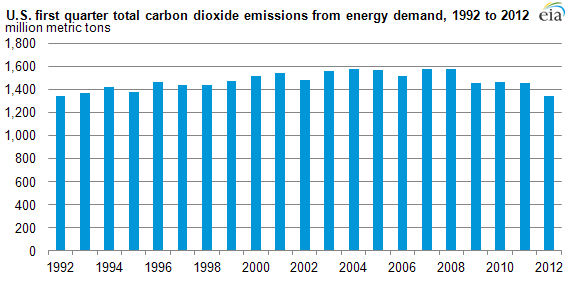
On the 17th August, I wrote an article highlighting the fact that the U.S. leads the world in cutting CO2 emissions. That was endorsed by an item published on the U.S. Energy Information Administration’s (EIA) website, that said,
U.S. carbon dioxide (CO2) emissions resulting from energy use during the first quarter of 2012 were the lowest in two decades for any January-March period. Normally, CO2 emissions during the year are highest in the first quarter because of strong demand for heat produced by fossil fuels. However, CO2 emissions during January-March 2012 were low due to a combination of three factors:
- A mild winter that reduced household heating demand and therefore energy use
- A decline in coal-fired electricity generation, due largely to historically low natural gas prices
- Reduced gasoline demand
It was the last item that caught my eye. Because it resonated with an article on Chris Martensen’s Peak Prosperity blog just over a week ago. That article, written by Gregor Macdonald, was called The Demise of the Car.
About a third of the way into the article, Gregor writes,
But it’s not just India that has incorrectly invested in automobile transport. The other giant of Asia, China, has also placed large resources into auto-highway infrastructure.
It appears that at least a decade ago, the developing world made the same assumption about future oil prices as was made in Western countries. The now infamous 1999 Economist cover, Drowning in Oil, reflected the pervasive, status-quo view that the global adoption of the car could continue indefinitely. A decade later, however, we find that after oil’s extraordinary price revolution, the global automobile industry is now starved for growth.

Then a little further down in this interesting article there is this,
More broadly, however, global governments are captured by sunk-cost decision making as the past 60-70 years of highway infrastructure investment is now a legacy just too painful to leave behind. Interestingly, whether citizens and governments want to face this reality or not, features of the oil economy are already going away as infrastructure is increasingly stranded. Moreover, there are cultural shifts now coming into play as young people are no longer buying cars – in the first instance because they can’t afford them, and in the second instance because it’s increasingly no longer necessary to own a car to be part of one’s group. See this piece from Atlantic Cities:
Young People Aren’t Buying Cars Because They’re Buying Smart Phones Instead
Youth culture was once car culture. Teens cruised their Thunderbirds to the local drive-in, Springsteen fantasized about racing down Thunder Road, and Ferris Bueller staged a jailbreak from the ‘burbs in a red Ferrari. Cars were Friday night. Cars were Hollywood. Yet these days, they can’t even compete with an iPhone – or so car makers, and the people who analyze them for a living, seem to fear. As Bloomberg reported this morning, many in the auto industry “are concerned that financially pressed young people who connect online instead of in person could hold down peak demand by 2 million units each year.” In other words, Generation Y may be happy to give up their wheels as long as they have the web. And in the long term, that could mean Americans will buy just 15 million cars and trucks each year, instead of around 17 million.
If future car sales in the US will be limited by the loss of 2 million purchases just from young people alone, then the US can hardly expect to return to even 15 million car and truck sales per year. US sales have only recovered to 14 million. (And that looks very much like the peak for the reflationary 2009-2012 period)
Indeed, the migration from suburbs back to the cities, the resurrection of rail, and the fact that oil will never be cheap again puts economies – and culture – on a newly defined path to other forms of transport and other ways of working.
It’s a long and interesting article that demonstrates an old truth, no better put than in this quotation reputed to have been said by John F. Kennedy,
Change is the law of life. And those who look only to the past or present are certain to miss the future.
 Learning from Dogs