A guest post from Chris Snuggs, a long-term supporter and author on Learning from Dogs.
Chris Snuggs
EU QUESTIONNAIRE – C Snuggs, 26 November, 2010
This questionnaire is designed to test your knowledge and opinions of the EU. Your answers will be collated and go towards the production of a report to present to your MEP (Member of the European Parliament)– if you can find him or her. Please give your opinion by ticking either T (true) or F (false) for each proposition.
a
THE EURO
1 Greece falsified its statistics in order to “qualify” for entry to the euro.
2 EU leaders KNEW this (like almost everyone else), but ignored it.
3 The EU’s OWN economists had told them that Greece and others could not live in the Eurozone alongside Germany.
4 Ergo, the EU elite connived in a LIE about the finances of Greece and the future of the euro..
5 Once Greece was in the Eurozone it spent money wildly and wastefully with many people retiring at 50, a bloated and overpaid civil service, civil servants who often didn’t bother to turn up, pensions bequeathed to relatives and so on.
6 The EU elite knew all this but DID NOTHING EFFECTIVE about it.
7 Now European taxpayers are having to pay BILLIONS to bail out feckless countries that vastly overspent.
8 The EU elite that lied and ignored these deep problems have been utterly incompetent guardians’ of EU taxpayers’ money. More than incompetent, they have been party to DEFRAUDING many millions of taxpayers for their own ambitions and political ends.
9 The VAST payouts of taxpayers’ money to bail out Greece, Ireland and soon Belgium, Portugal, Spain and Italy DO NOTHING TO FIX THE UNDERLYING PROBLEMS as highlighted in 3 above. This policy therefore represents an appalling further waste of money and merely postpones difficult decisions that EU leaders must make, and should in fact have made YEARS ago.
10 According to the EU’s OWN RULES it is ILLEGAL to “bail out” a bankrupt country. Despite this, the EU countries have bailed out Greece and now Ireland. Mr Van Rompuy was charged with finding a way that this could be done legally. Frau Merkel has suggested that the Lisbon Treaty be amended to allow bailouts to be done legally. How she proposes to amend this Treaty without the consent of member countries is a mystery.
11 The EU elite, knowingly having illegally bailed out Greece and now Ireland should be arrested en masse for illegal use of public money. The EU is very strong on law, except apparently for itself when it suits it.
EU FINANCE, SPENDING & REMUNERATION
12 The EU has failed to get its accounts signed off for the nth year in succession; NO PRIVATE CONCERN COULD GET AWAY WITH THIS.
13 At this time of economic crisis the EU wants to spend SIX BILLION EUROS on a new diplomatic service, including the placing of FORTY-SIX “diplomats” on Barbados and over FIFTY on Madagascar.
14 The number of EU citizens demanding this vast expenditure must be microscopic; though nobody knows for sure since the EU would never dream of asking its paymasters their opinion.
15 Europe is going through the worst period of financial chaos since WWII. Jobs are being lost almost everywhere; many EU countries are technically bankrupt; people’s living standards and public services are being drastically cut, except it seems in the EU in Brussels.
16 The EU has just won a court case against the people that finance it, the national governments. As a consequence, EU workers will receive a payrise backdated to last year with interest of 3.7% at a time of desperate economic hardship for many millions of EU citizens.
17 The head of the vast new “diplomatic” organisation is a Brit who has NEVER BEEN ELECTED to any post of significance and earns more than TWICE as much as ANY European leader, plus very considerable expenses. She is far from unique in the EU circle of the elite.
18 EU workers receive extraordinary perks (benefits) and also pay around 8% income tax. Very few of their electors (who pay their wages) benefit from anything like this sort of remuneration.
19 Peter Mandelson RESIGNED from his post as Commissioner to become an English Lord. Since his ludicrous remuneration for this was LOWER than his EU income the EU is paying him around £62,000 of taxpayers’ money for FOUR years to make up the difference, EVEN THOUGH HE RESIGNED.
20 The above-mentioned practice amounts to institutionalised THEFT of taxpayers’ money.
21 The EU has just created an English-language website to inform us of how wonderful they are. In other words, WE are paying to have EU PROPAGANDA shoved down our throats.
22 The EU paying some 300,000€ for a dogs’ home in Poland at a time when millions of people in Europe are suffering real economic hardship is just one example of frivelous use of taxpayers’ money.
THE RATIONALE OF THE EU
23 Mr van Rompuy, unelected “President” from a failing and disintegrating state (is this the reason for his obsession?), has said that “The nation states are dead.”He and the EU elite seek the creation of a European “superstate” controlled from Brussels.
24 Mr Van Rompuy has presumably informed President Sarkozy, Chancellor Merkel and other EU leaders personally that their states “are dead”. Their reactions have not been published so far.
25 This agenda was denied by the EU elite for many decades, which of course represents yet another LIE.
26 This unelected “President” earns more than any national leader in the EU. This is to give the impression that he is more important, since clearly the more money you are paid the more important you must be.
MEPs & DEMOCRACY
27 MEPs have just demanded a near 6% increase in the EU budget.
28 In this they are certainly not reflecting the wishes of the majority of their electors.
29 Many turn up in Brussels, sign on to qualify for their attendance allowance and then go away.
30 I do not know of any other profession where you get paid a vast salary and expenses and then EXTRA MONEY just for attending a meeting.
31 Most people haven’t got the foggiest idea who is supposed to be “representing” them in Brussels.
32 The EU as it stands is a top-down decision-making organisation whose leaders have a degree of self-righteousness (“Only we know what is good for you.”) that has to be suffered to be believed.
33 MEPs do not take their electors wishes into account.
34 The EU hates referendums since they give an opportunity to the people to express their opinion and actually make a decision. Naturally they can’t be trusted with decisions.
35 When a referendum goes against the EU the usual reaction is to oblige the country involved to do it again and again till the “right” answer is produced. In this the EU is a laughing stock, but the elite do not care as long as they get their way
36 MEPs periodically flog up and down from Brussels to Strasbourg. Sitting in Strasbourg is supposed to be some sort of symbol, but I don’t know of any voters who were asked if they wanted to pay through the nose for a symbol at vast expense, not least in carbon emissions.
CONCLUSIONS
37 The modern world is characterized by greed, arrogance and incompetence. These are qualities that the EU elite has demonstrated in abundance.
38 The EU elite has totally and utterly FAILED the people of Europe and is not fit for purpose.
39 Most people believe in cooperation within Europe, but not in a European superstate ruled from Brussels, a country both disintegrating and vastly endebted.
40 The EU elite has completely destroyed the faith that many ordinary people had in the EU as primarily a “common market”.
My overall reaction to the EU elite and its management of the EU is as follows. (Please tick ONE box.)
A) In general I am very pleased with the EU leadership.
B) I am quite pleased, even if some things could be improved.
C) I don’t care much either way. They can get on with it as far as I’m concerned.
D) I am not very pleased with the way the EU is run.
E) I am very dissatisfied indeed about the way that my money is being spent.
F) It is such a corrupt, wasteful and undemocratic shambles that we have to abolish it up and start again. My country is certainly better off outside the EU AS IT IS CURRENTLY RUN. I am profoundly disappointed.
F) I am disgusted at the EU elite’s arrogance, incompetence, dishonesty and venality.
[NB. If after reading the above, you really would like to submit your answers to the above questions to your local MP or MEP, then Chris has a form you may use that may be downloaded from here. Ed]
Financial crises can be very difficult events to understand. Even for those who have spent a great deal of time studying such areas as finance and economics, comprehension of these disasters can be elusive. However, analyzing shared elements in the recent American and Greek financial crises can help give even the economic layman insight into their common causes.
One word can be used to sum up the basic concept behind both of these crises – overextension. Both the American and Greek governments attempted to take on a much heavier economic load than either could handle. While, in both cases, this has been painted by some as a noble, humanitarian effort to help those in need, methods such as inflationary monetary policy tantamount to theft and the disguising of massive budgetary deficits (in both cases with the help of Goldman Sachs) would not justify the means employed even had these efforts been successful, and certainly should be taken to task considering the disastrous ramifications of these actions.
In both cases, many are citing unrestrained spending as the source of the problem. For example, CNN wrote of the Greek crisis that “years of unrestrained spending, cheap lending and failure to implement financial reforms…whisked away a curtain of partly fiddled statistics to reveal debt levels and deficits that exceeded limits set by the Eurozone.”
Without suggesting that CNN was attempting to be deceptive in this explanation, as the points made certainly are important, it must be noted that things like unrestrained spending, cheap lending, and fiddled statistics are merely symptoms of the deeper disease. Instead of asking the government to spend less, tighten lending laws, and implement financial reform, one should instead ask the deeper question – how does the government even have the power to cause such problems in the first place, and why are the results of such government power so often much more hurtful than helpful?
This deeper problem, whose symptoms we are now dealing with, is central banking. The Federal Reserve System and its Greek counterpart, the Bank of Greece, each had a heavy hand in their respective nations’ financial collapses. This is due to these banks’ attempts at economic manipulation – the Federal Reserve directly sets interest rates, while the Greek system uses more indirect methods to do nearly the same thing. Note that it is due to their attempts at economic manipulation, as attempting to set economic law is about as useful as attempting to set gravity.
Consider this metaphor of setting gravity. A man claims to be able to set the force of gravity on the earth. He tells a stunt biker that he can set gravity to be half as much as normal. So, the biker attempts to jump a distance that is much longer than he normally would attempt. Upon jumping, the biker finds that, obviously, the first man never was able to set the nature of gravity at all, and he falls to the ground long before reaching his destination.
This is exactly what happened due to the actions of central banks in the cases of both the United States and Greece. Interest rates and other natural economic restrictions were said to be more flexible than they truly were. Thus, individuals who based their actions on this information ended up engaging in activities that were far more risky than usual. However, once they had “jumped,” so to speak, they found that, in fact, economic law was as strict as ever, and they “fell.”
However, if the answer is so obvious, why are we not hearing more about it? Each of these financial crises is extremely complicated, and the above described scene is, it must be admitted, an oversimplification. This is not to say that it is not accurate, but rather that this nature of the crises’ root cause is not immediately apparent to all upon examining the situation.
For example, a person who has been educated their entire life in an economic school that praises central banking, deficit spending, and government action in general would certainly seek to find another cause for the crisis, perhaps by blaming business owners for making risky investments or stating that government controls were not strict enough. However, a person who has studied and understands the damage done by central banking and government economic controls will be quick to realize what has occurred.
People with such knowledge are becoming more and more common in both the United States and around the world. “Even today, with an economic crisis raging, the response by our government and the Federal Reserve has been characteristic,” Ron Paul writes in his recent book, End the Fed. “Interest rates are driven to zero and trillions of dollars are pushed into the economy with no evidence that any problems will be solved. The authorities remain oblivious to the fact that they are only making our problems worse in the long run.”
While he may be one of the most popular adversaries of central banking, it is not just Ron Paul, or even Austrian economists, who are calling out government for its role in these financial crises. In an e-mail to supporters, Democratic congressman Dennis Kucinich cited “the 1913 Federal Reserve Act, the banks’ fractional reserve system and our debt-based economic system” as major factors in the American crisis.
Such complex and important issues as economic crises need all the attention we can give them, and it is impossible here to provide the in-depth analysis that these situations merit. It also must be noted that while both the United States and Greece have to an extent both engaged in central banking to their detriments, each country does have a different system. Still, the general principles hold, always returning us to that first word – overextension. As long as nations attempt to manipulate the laws of economics to engage in far grander pursuits than they can sustain, we can expect to see such economic crises as have been seen in the United States and Greece in the future.
German Chancellor Angela Merkel’s party and its coalition allies have been defeated in regional elections in North Rhine-Westphalia.
North Rhine-Westphalia, Germany
German Chancellor Merkel appears to have lost the state vote in NRW and may see her control of parliament reduced or eliminated. It’s her own fault.
Germany and in particular NRW (the industrial powerhouse of Germany) are in a serious economic situation with enforced cuts left, right and centre and yet she has loaned (aka given) billions to feckless, idle, corrupt and shambolic Greece.
The Germans have had to tighten their belts and are still paying vast sums to bring East Germany up to speed, yet Merkel feels she can fritter away her people’s money to “save the euro“. It won’t save Greece or the euro.
The Greeks fully deserve to go bankrupt and are incapable of complying with the degree of “cuts” the Germans are demanding. Other European countries will lose money if Greece defaults. Tough.
Better to suffer a one-off loss than an endless shelling-out into a black hole. No bailout of Greece, Portugal, Spain, Ireland or Britain. Did the PEOPLE of ANY of the rest of EU countries have ANY say in this at all?
It seems the French pushed hard for a bailout. What a coincidence that some of their insurance companies have invested heavily in Greece. TOO BAD. Greece’s problems have been well-known for years; which moron poured billions into their black-hole, retire-at-53, inherit-your-sister’s-pension, go-to-work-if-you-feel-like-it economy?
And the Greeks? They seem to feel it is the fault of the REST of us that they have to make cuts. Was a reality check ever more fully needed? Sadly, but inevitably, there will be social breakdown in Greece from which something new will emerge. What that is, one cannot say, but I do not believe it can include membership of the Euro.
The Brussels Overlords think differently. Their little Euro brainchild must be saved at all costs. But they are all personally very well off and have no problems with money, unlike the majority of their constituents thanks to the despicable fraud perpetrated on them by the banks under the appallingly-negligent supervision of a multitude of governments.
I have written about Greece several times in recent weeks since to me it is a symbol of the combination of arrogance and utter folly of many of Europe’s governments – and in particular Brussels – who have overspent wildly, who have allowed their banks to make fraudulent loans and have imposed an ever-increasing burden of bureaucracy, Human rights, paperwork and regulations on the peoples of Europe.
How we are supposed to compete effectively when we A) price ourselves out of the market and B) wildly overspend is a mystery.
Has Europe now to prepare itself for a long period of decline and retrenchment in living standards as Asia maintains its inexorable growth and raw materials rocket in price? I fear so, but it’ll be the ordinary people bearing the brunt of all this, not the increasingly-remote politicians in national governments and Brussels.
Greece is a warning for the rest of us. There is no law that says we cannot go the same way. The UK and France in particular have bloated, feather-bedded public sectors. The chickens always come home to roost, and they are now flocking rapidly towards the hen-house.
Just to try to help put stock market swings into perspective,consider this:
the 347.8 point fall in the Dow Jones Industrial Average last week, from 10868.12 at the start of the trading day on Thursday, May 6, 2010 to 10520.32 at the close of trading, can be COMPLETELY explained by an increase in the perceived cost of capital from 12% to 12.23%.
do the math. Using the constant dividend growth model, a very simplified model of the market value of equity, or Market Value = Current Dividend/(cost of equity capital – dividend growth rate), and assuming a long-term average cost of U.S. equity capital of 12% and average growth rate of 5%, we find that the opening level of 10868.12 = 760.77/(.12 -.05), and the closing level of 10520.32= 760.77/(.1223 -.05).
I think it is entirely possible that the chaos in Greece and surrounding nations, and the interconnections between worldwide supplies of liquidity and financial capital, that an increase in the perceived risk and uncertainty of the returns to equity from 12% per year to 12.23% per year makes perfect sense.
The market’s are working. Market participants, from the individual investor using on-line trading at 2:00 in the morning from their living room to the most sophisticated computerized large-scale institutional trader, understands that a borrower’s ability to pay back its investors depends on the real productivity and growth of private industry, whether the borrower is a company or a country.
The art of saying something and meaning something totally different.
I must confess to being a bit fed up with Greece.
In Anglo-Saxon language their attitude used to be called “taking the piss“. Today’s “funny” (or if preferred take your pick from: tragic, surreal, ludicrous, ridiculous,bizarre, insane or indeed all of these at once) is something the Greek Prime Minister said. Admittedly he said it in February and I’ve only just picked up on it.
‘We are a country which cannot alone deal with the speculation. So this has become a European problem, because if we do have a major problem, this could create a contagion for other countries too who are not to blame.’
Brilliant and I especially love the use of the word “speculation”.
This makes it seem as if it isn’t Greece’s fault at all; it’s all down to those nasty fat people in suits and sunglasses, the evil international financial mafia seeking to destabilize his country.
Then there is the “if” word. Now normally this is associated with a condition, but anyone who even in February thought that there was any conditionality involved in Greece’s meltdown must have been looney, or perhaps the Head of the International Monetary Fund (IMF) who said this on March 8th:
Greece will be able to deal with its own financial problems without needing a bailout, the head of the International Monetary Fund said today.
IMF managing director Dominique Strauss-Kahn said that Greece’s debt mountain is unlikely to spread to other eurozone countries with high levels of public debt.
And Mr Strauss-Kahn dismissed market speculation of potential default by other heavily indebted eurozone countries such as Portugal, Spain or Ireland as scare-mongering.
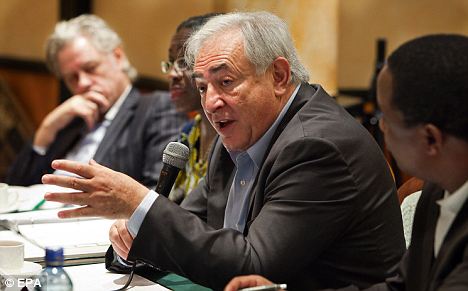
IMF Director Dominique Strauss-Kahn answers questions on a panel with Bob Geldof in Nairobi yesterday. Mr Strauss-Kahn has said he believes Greece will not need an IMF bailout .
Yes, this is the same DSK who is paid a vast salary and expenses and could be the next President of the EU.Of course he could have been lying to try to restore “confidence”. However, lying is lying, for whatever reason. Or he could have just been humungously wrong.
That’s the trouble with our leaders and financial experts these days; you never know whether they’re lying or just stupid; it’s usually one or the other and sometimes of course both.
And Papandreou’s quote continues: ” a contagion for other countries“. Indeed, Mr P. And what do we do with a “contagion” in the body? We destroy it and get rid of it …. and finally we have “other countries too who are not to blame“.
AHA! At last! Proof that my old Mum in the UK on her measly pension is not to blame. Thanks Mr P. At last some recognition fo the truth. Let’s have a bit more of that ….
As for the merits of Greece’s plea for funds, you only have to read this devastating article to feel your flabber gasting to breaking point.
No wonder the Germans are increasingly threatening to dump Greece, and so they should. Not the German government (all governments seem currently to lack the guts to do anything really necessary or serious).
No, this time it’s an economics professor threatening to take the EU to court if they allow this blatantly EU-illegal bailout, and public opinion is increasingly on his side.
It is a horrendous mess, but the only solution is for Greece to leave the euro. Bailing them out is a black hole. Does anyone in their right mind think the Greeks can really change their traditional practices and suddenly become honest, thrifty and hard-working?
Well, the answer is probably “Yes”, but then cloud-cuckoo land is becoming seriously over-populated.
Which reminds me, I must get back to the British General Election Campaign ……
…. is how Gavin Hewitt recently headed up a post on his BBC Europe blog. The headline caught my eye and then when I read the full article it seemed as yet another piece of western civilisation was sliding into chaos. Maybe it’s my age!
Gavin Hewitt
Gavin Hewitt is the BBC’s Europe Editor and as you can see from his bio, Gavin is a very experienced reporter. Here’s how this Eurozone article starts:
Friday [April 23rd, Ed] will be remembered as the day the euro needed rescuing. Sure it is Greece that has asked to be bailed out but it was still a day that the architects of the single currency had never envisaged. For when it came to it, there were no plans to save a euro member in trouble.
You see what I mean about grabbing one’s attention!
In fact the article is so powerful that I am going to run the risk of incurring the wrath of the BBC’s legal department by republishing it in full.
This bloke needs a reality check. If he is not going to ask for the dosh “formally” how IS he going to ask for it? Over a pint
George Papandreou
at the pub?
And what exactly are “preparatory moves”? A long sidle up to the Treasurer standing at the bar? And how do you “prepare” to ask for 30 billion euros? Either you ask for it or you don’t? Oder?
Perhaps something is lost in translation ……
Greek Prime Minister George Papandreou has said his country is making “preparatory moves” to take advantage of a multi-billion euro rescue package.
He added, however, that Greece would not necessarily make a formal request for help.
STOP PRESS: Alex Brummer of “The Daily Mail” makes a very serious charge here in relation to Goldman Sachs and Greece’s financial status before entering the euro.
STOP PRESS TWO: The BBC are reporting that Greece has formally asked for the dosh!
Well, Ancient Greeks used to have tragedies; modern ones are better at farce, and so the “Shall we bung Greece billions of taxpayers’ money or not” farce rumbles on ….
It seems that the rising cost of borrowing for Greeks plus various warnings from people like George Soros about the possible collapse of the euro have pushed the EU (and in particular Germany) down a path they would have preferred not to go.
A vast loan at 5% has been offered, which is substantially below what the Greeks were having to pay before. So, crisis over? They can sleep well in Brussels again?
Errrmmmm …… hands up those who think Greece will ever be able to repay this money? Oh, at the time of writing (Monday 12th April) they haven’t yet ASKED for the money …. it really IS a farce rather than a tragedy, isn’t it?
Is there anyone on the planet who thinks they WON’T have to take the money? That they can get out of this mess WITHOUT it? No, nobody, except perhaps (as I speak) the Greek government itself. Well, they got the country into this humungous shambles in the first place so you’d hardly expect them to know what to do about getting out of it. This of course is in sharp contrast to the British government, which claims it is the ONLY party that can get out of the mess it itself created.
The reaction of German and British taxpayers to the bailing out of Greece (even though technically speaking it hasn’t yet occurred) is not yet clear ……. Neither is that of the other group of PIGS (Portugal, Italy and Spain). Incidentally, I am not sure how close the UK is to becoming a member of this rather grisly club, but as the country is still borrowing vast amounts at every tick of the clock it can’t be far off qualifying for full membership.
I did see a calculation this morning that the British taxpayer (I refuse to say government; all they do is pass on OUR money) will have to cough up around £600 million to help save Greece.
Of course, in return the Greeks will immediately start working as long and hard as we do, collecting taxes as efficiently as we do and avoiding corruption as well as we do. Yes, I am reporting from cloud-cuckoo land.
Well, we seem to be around Act III, Scene I in this farce, so there is plenty more entertainment yet to come, no doubt some of it tragic.
Today’s quiz question: What have lazy, corrupt, inefficient little countries in common with large, obscenely-rich banks? Answer -> They can’t be allowed to fail and some poor, hard-working mutt somewhere is going to have to bail them out, not that he’ll have any choice in the matter, this all being decided by the Great and Good (and Rich) in some posh office somewhere far away.
What you once couldn’t have made up now seems an almost daily occurrence.
The euro, long in planning by some European institutions, was introduced minimally, namely without the governmental apparatus generally associated to a currency. This is the way Europeans have found to progress peacefully towards greater harmony: do what is necessary, and nothing more than that, and do it with total consensus.
Everybody knew that a currency without a government to create and anchor it had never happened before, and was unlikely to endure.
The European Union
Part Two continues
That fit the European federalists just right, and could not have escaped the understanding of Paris and Berlin. As it turned out, the PIIGS’ crisis is putting back Paris and Berlin, the historical engine of Europe, back on top, and this, for an excellent reason.
“PIIGS” stand for Portugal Ireland Iceland Greece Spain. All of them ran bubble economies, partially propelled by taxes from the richest European countries (including France and Germany). It became ridiculous as, for example, Ireland was getting European subsidies while the Irish were already way richer than those subsidizing them. (OK Iceland is not in the EU, yet, but it begged to enter the Eurozone, and it has disappeared the savings of countless Brits and Dutch, which means it has some outstanding business with the rest of Europe, that it will have to sort out, after executing a few more whales, guilty as charged.)
Some acknowledge the convenience of a common European currency and easier border transits, while remaining obsessed by what they view as gigantic differences between European countries. Those quaint nationalists and parochial types obsess that core differences between countries are so strong and deep-rooted that any form of real European union is a ridiculous concept. This is triply erroneous.
On the 22nd March, Learning from Dogs had the pleasure of a Post from our first Guest Author, Elliot Engstrom. We were then doubly delighted to have Per Kurowski join us as our second Guest Author with his introductory Post.
Now we have the additional honour of welcoming Patrice Ayme to the growing ranks of Guest Author to Learning from Dogs.
Patrice, like Elliot and Per, also is a prolific blogger. He describes himself as:
I was born in Europe, raised in Africa, and lived in America. So doing, I learned to compare different cultures, even during my early childhood, and to appreciate superiority of many of their traits, even the most surprising. I consider myself Senegalese, and proudly so.I studied, and know, several languages, not just Latin, and several cultures, deeply, by living through and inside them for years. I have done formal studies in mathematics and physics at three leading Universities receiving the highest degrees, and putting me in a good position to learn to differentiate between hard knowledge and wishful thinking, differently from many a common philosopher. I am a specialist of non commutative geometry, arguably the most abstract field of knowledge in existence (even hard core logic, model theory, is used in my approach).
Here is Patrice’s first Guest Post for Learning from Dogs.
——————————
GREEK TROJAN HORSE TO CONQUER BETTER EUROPEAN UNION
Abstract:
The European currency, the euro, is, foremost, a solution to a problem. War. All other problems, and the euro solves many, pale in significance relative to this one.
Many talk about “problems” with the euro, and, oozing with glee all over, perceive weakness. They are right, there is weakness, but it is not European weakness. Just the opposite.
What those skeptics are seeing with their uncomprehending neurology is the further construction of the European imperium, according to its core principle: fix what needs to be fixed, but with complete consensus of the parties concerned, which means do it just so. It appears messy, because it’s democratic, and before the people (demos) can use its kratos (power), it needs to think right, which means it has to argue thoroughly. It looks like squabbling, but it is thinking aloud. Europe is not built for some parties to gain advantage anymore (as it was with Napoleon, or Hitler), but to solve problems and gain opportunities for all.
The euro is, for the first time, used as a weapon against Europe’s enemies. Hence all the squealing. Far from weakening Franco-German resolve, the recourse to the IMF adds another layer of authority to the European Communities. When the IMF, speaking in the name of Franco-German taxpayers, tell restive exploiters in Greece that they have to pay more taxes (only 6 plutocrats declare more than one million euro income in Greece, and more than 500 professions can retire at 50 years of age, whereas Germany just brought up the retirement age to 67!), they will have to submit under orders (imperare, to use the Roman notion)





 Learning from Dogs