Tag: German Shepherd

Four years old!

How time flies!

Four years ago this day, the first post was published on Learning from Dogs.  Here it is again:

Parenting lessons from Dogs!

Much too late to make me realise the inadequacies of my own parenting skills, I learnt an important lesson when training my GSD (who is called Pharaoh, by the way).  That is that putting more emphasis into praise and reward for getting it right ‘trains’ the dog much quicker than telling it off.  The classic example is scolding a dog for running off when it should be lots of hugs and praise for returning home.  The scolding simply teaches the dog that returning home isn’t pleasant whereas praise reinforces that home is the place to be.  Like so many things in life, very obvious once understood!

Absolutely certain that it works with youngsters just the same way.

Despite being a very dominant dog, Pharaoh showed his teaching ability when working with other dogs.  In the UK there is an amazing woman, Angela Stockdale, who has proved that dogs (and horses) learn most effectively when being taught by other dogs (and horses).  Pharaoh was revealed to be a Beta Dog, (i.e. second in status below the Alpha Dog) and, therefore, was able to use his natural pack instinct to teach puppy dogs their social skills and to break up squabbles within a pack.

When you think about it, don’t kids learn much more (often to our chagrin!) from other kids than they do from their parents.  Still focusing on giving more praise than punishment seems like a much more effective strategy.

As was read somewhere, Catch them in the act of doing Right!

By Paul Handover.

As it happens, it feels a little like ‘what goes around, comes around’.  Why do I say that?

Because just last Saturday, I sent off a selection of pictures and videos to Angela Stockdale.  Stay with me for a while as to the reason why.

Angela trades under the name of The Dog Partnership and, frankly, what she doesn’t know about the behaviour of dogs isn’t worth bothering about!

Just take a peek at the page on her website under the heading of Teaching Dogs.  Here’s a little of what Angela writes:

I consider myself so lucky for dogs alone to have been my teachers. I learnt from watching how my own dogs responded to another dog’s body language and vice versa their language. Watching, learning and working with Teaching Dogs was the only way I knew.

I was and always will be in awe of a Teaching Dog’s dogs ability to consciously adapt their body language in accordance to how the other dog was feeling. The result being, they could relax nervous dogs but at the same time maintain control of a problem situation. Remember, dogs talk dog far better than we do.

It came as quite a shock to me when I learnt about other approaches. It seemed foreign for people to have so much input in resolving what were described as ‘ behavioural’ issues. For me, working with these dogs was far more than resolving a behavioural issue. It was about improving the quality of lives of dogs who were not coping with everyday life. If they found dogs or people worrying, sometimes this was shown in displays of aggression. It is important to understand, these dogs were not aggressive, they simply displayed aggressive behaviour.

Now, I would like to introduce you to the world of Teaching Dogs and how these special dogs change the lives of less fortunate dogs, who never had the opportunity to really understand how to communicate with their own species.

Do read the rest here.

Back to why those photographs and videos had been sent to Angela.  A couple of weeks ago, we enjoyed an evening meal with friends of friends, so to speak.  This other couple owned a beautiful-looking male German Shepherd dog: Duke.  Duke was 4-years-old.  Our hostess remarked that he was very boisterous and had nipped a couple of strangers who had called at the house.  She added that he seemed difficult to control.  Duke had been there for about a month and he was a rescue so they had little or no knowledge of past behaviour.

Well, I’m no expect with dogs, that’s Jean’s domain.  But there was something about Duke that captivated me.  Something in the way he looked at me, his eyes linking so directly with mine, allowing me to see a dog that offered an honest openness.

More or less on impulse I stood up, held my right arm up at 45 degrees, looked Duke in the face and said, “Duke! Sit!”

Duke held my gaze and sat back on his haunches.

I moved my arm in a complete circle, around to the right, and said, “Duke! Lie down!” Duke lay down.

H’mm, I thought. Fascinating.  This dog has been professionally trained at some point in the past, using the same ‘command’ system of voice and arm signalling as I had learnt with Pharaoh way back in 2003/2004.

The food was now on the table.  I grabbed a small piece of meat off my plate and returned to Duke who had, of course, resumed his pottering around the room.  “Duke! Here boy!”  Duke came over to me.  “Duke! Lie down!”  Duke did so.  I placed the piece of meat on the wooden floor about three feet in front of him.  Duke’s eyes were riveted on the meat.  “Duke!”  Duke’s eyes reluctantly engaged with mine.  “Duke! Stay!”  I repeated the Stay command a couple more times as I backed away about 6 or 8 feet.

“Go on, Boy. Take the meat!”  Duke gleefully grabbed the piece of meat.  Gracious, I thought, this dog is magnificent.  I wonder ……..

I took another piece of meat, “Duke! Sit!”  “Duke! Stay!”  I then backed off that 8 feet again, got down on my knees and placed the piece of meat just between my lips.  I knew this was potential madness with a dog I had only met some 30 minutes previously, but there wasn’t an ounce of doubt in my mind.  I voiced in my throat for Duke to fetch the meat. Duke came straight over and confidently and carefully removed the meat from my lips.

What a truly fabulous dog! It was a wonderful evening and once home both Jean and I were eulogising about Duke.

Then two days later, our dinner hostess rang me.  “You know, I have decided we can no longer keep Duke.  He is too strong a dog, I can’t control him.  Is there any chance of you finding a new home for Duke?”

Without question, Jean and I would have offered Duke a new home; in a heartbeat.  The only thing stopping that was me wondering if this strong-willed, male German Shepherd might be a Beta dog, as Pharaoh was. Or just might be too dominant a male dog to fit in comfortably with our dogs, especially Pharaoh who was at the stage of life where the last thing that should happen is for his happiness and contentment to be disturbed.

I hadn’t a clue as to how to answer that question.  But I knew someone who would know: Angela Stockdale.

I rang her, caught up on old times and then explained the background to Duke’s situation.  Angela said to repeat the exercise that I had witnessed when I took Pharaoh to her all those years ago, when I wondered if Pharaoh was an aggressive dog.  My uncertainty with regard to Pharaoh followed a number of times when walking him in a public area with other dogs and he had been very threatening, both in voice and posture, towards some of those other dogs.

This is what Angela arranged.  I took Pharaoh up to her place at Wheddon Cross, near Minehead in Somerset.  When we arrived, Angela was standing just by a gate into a fenced paddock, maybe a half-acre in size.  In the far corner were two dogs.

Angela asked me to bring Pharaoh to the gate and let him off the leash.  It was clear that Pharaoh was going to be let into the paddock.  I cautioned that Pharaoh could be quite a handful with other dogs and, perhaps, it would be better that I walked him into the area still on his lead.  Angela said that wouldn’t be necessary.  So as she held the gate open sufficient for Pharaoh to enter the paddock, I slipped the lead off him and backed away, as requested.

Pharaoh had hardly taken 2 or 3 paces when Angela called out, “Paul, there’s nothing wrong with him!”

I was astounded and stammered, “But, er, er, how can you tell so quickly?”  “Because my two dogs haven’t taken any notice!”, came the reply.

Later Angela explained that in the paddock were her female Alpha dog and her male Beta dog.  Ergo, the two top dogs in terms of status so far as dogs see other dogs.

In fact, Pharaoh was utterly subservient to these dogs, in a way that I had never witnessed before.  Later on, as Pharaoh relaxed and started playing, Angela said that she thought that Pharaoh was a Beta dog.  Mixing some of her other dogs into the group was later able to confirm that.

So back now to present times and Duke.

Thus last Saturday, as Angela recommended, we selected two of our dogs, Cleo our female German Shepherd and the most socialable of dogs, and Casey, a strong but not aggressive male (he had some PitBull in him).

Duke arrived and was allowed freely to nose around the large grassed area some way from the fenced-off horse paddock that we were using for the ‘introduction’.

Duke pottered around and then caught sight of Cleo and Casey in the paddock.
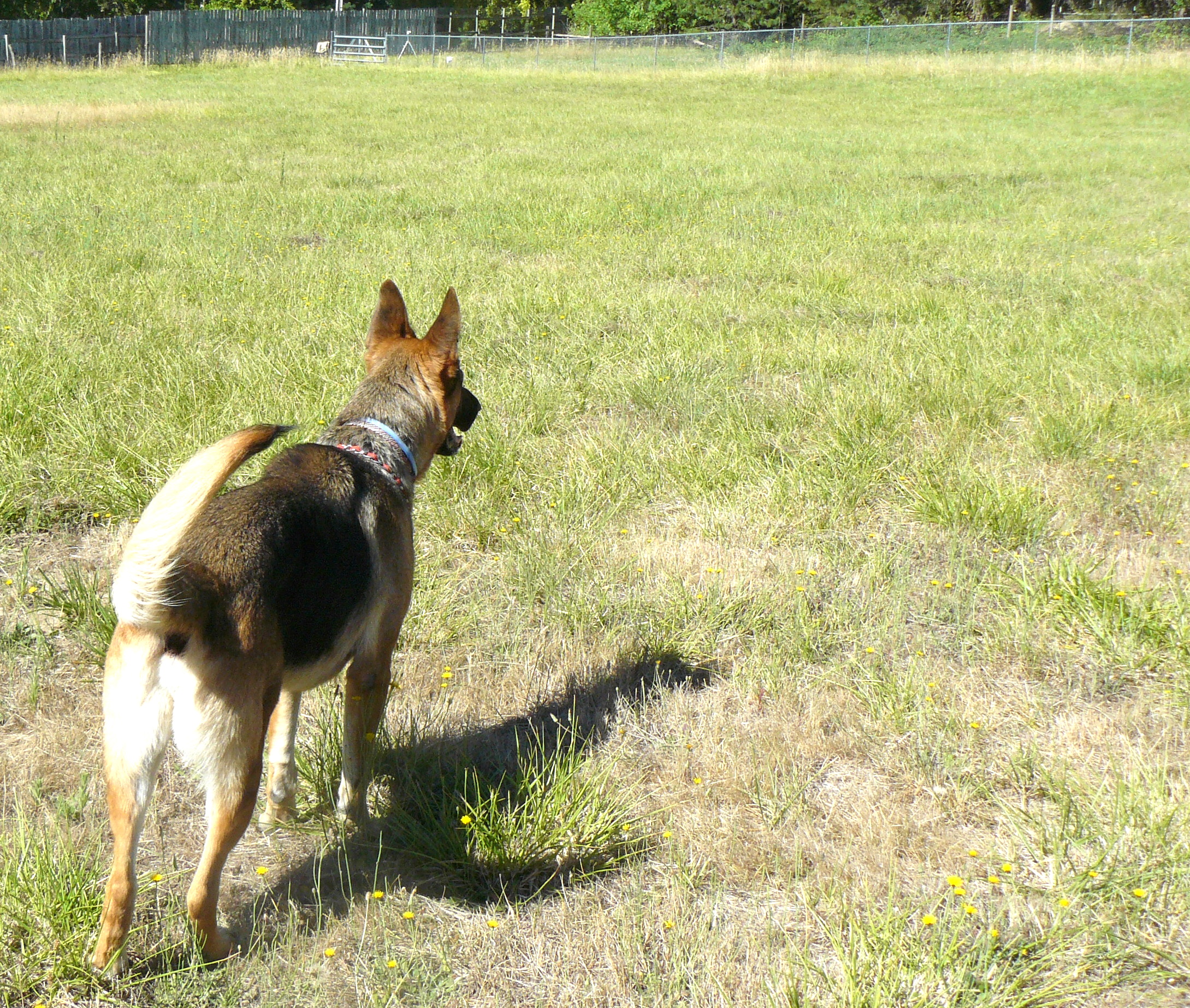
First sighting of Cleo and Casey.

Then the meetings began!

Hello! My name is Duke.  Do I smell OK? Mr. Casey?
Hello! My name is Duke. Do I smell OK? Mr. Casey?

And play didn’t seem to be too far off the agenda!
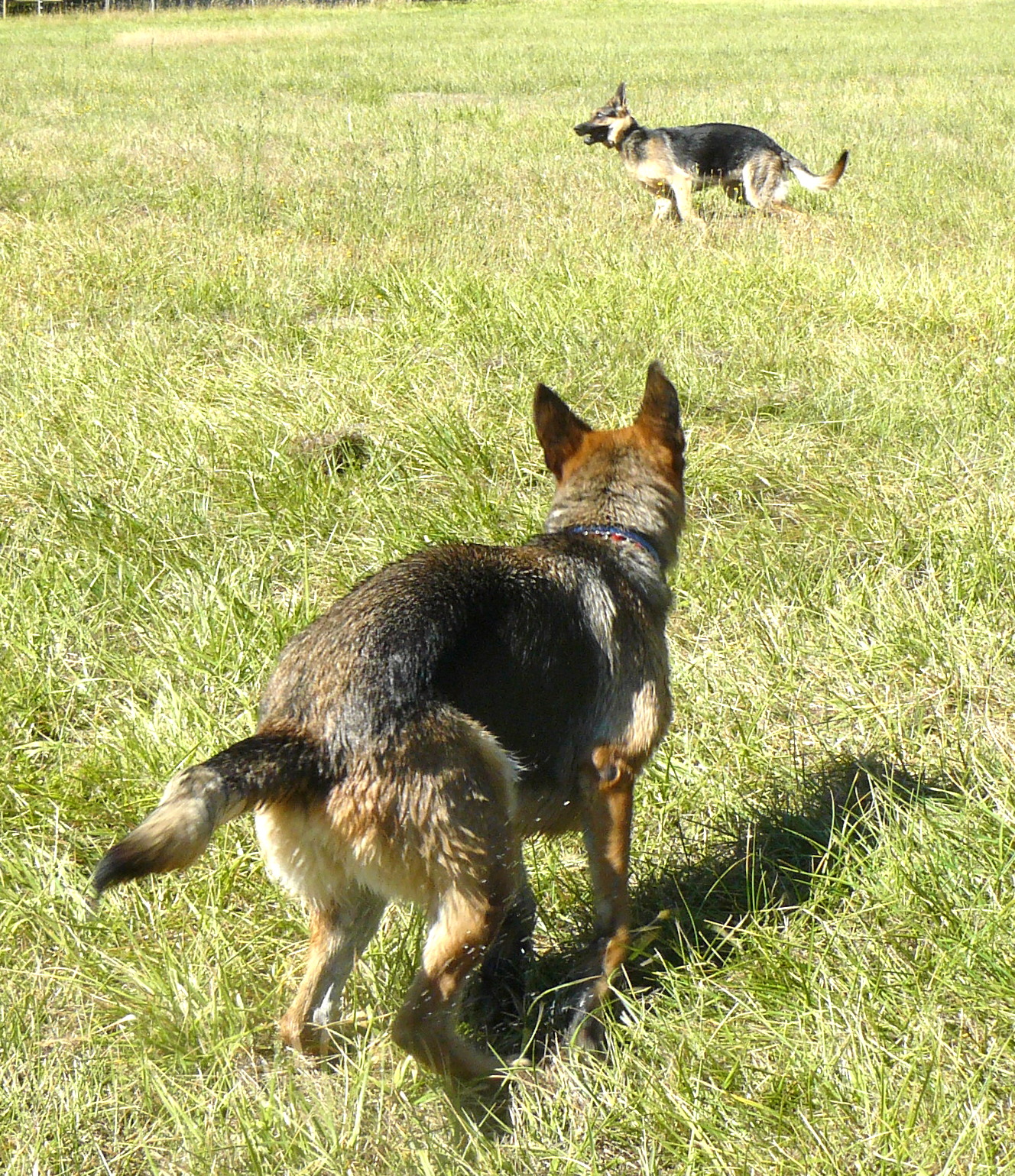
You lead, Cleo, I'll chase!
You lead, Cleo, I’ll chase!

So all the photographs and videos have been sent to Angela, and we will see what the conclusion is!

As Angela put it, “Remember, dogs talk dog far better than we do.”

I cry for the wolves.

This is so wrong.

Like thousands of others I have been supporting the efforts to ensure that the US Government did not proceed with the proposal to remove wolves from endangered species protection.

Wolves are the animals that enabled early man to ‘progress’ from hunter-gatherer to the life of farming, and thence to our modern world.  As I write elsewhere on Learning from Dogs,

There is no hard evidence about when dogs and man came together but dogs were certainly around when man developed speech and set out from Africa, about 50,000 years ago.

So it utterly breaks my heart to republish a recent post on The Sand County, Jeremy Nathan Marks wonderful and evocative blog.  Here it is, republished with Jeremy’s kind permission.

oooOOOooo

I used to believe

As some of you may have heard, late last week the Obama Administration officially delisted gray wolves from endangered species protection. This means that 40 years of wolf recovery efforts have come to an end. Wolves only occupy a tiny fraction of their former habitat and with anti-wolf governments occupying the state houses in the few places that still have wolf populations, states like Montana, Wyoming, Idaho and Wisconsin, it is hard to imagine that wolves have a bright future in the lower 48 states.

I am deeply, profoundly saddened by this decision. I have learned over time how wolves -like so many other species- just don’t register on the list of national concerns and priorities. A great many people oppose the delisting, in fact one gets the impression that the effort to remove these protections has consistently been guided by political pressures and a political agenda and not by a true commitment to a sustainable and enduring wolf recovery. I know that I am hardly alone in registering my disappointment and voice of protest.

I cannot let this sad milestone pass without acknowledging it here on this blog. If you do not like wolves -if you feel hatred or resentment towards them or are pleased at what has recently transpired, I respectfully request that you refrain from sharing your feelings here. I seldom offer any “directives” like this, but if you are a reader of this blog then you know how strongly I feel about this issue. I am sharing these thoughts because I want to not only draw attention to what has happened, but also because I feel the need to mourn it. I tremble at the thought of a United States -or a North America- without wolves. Defenders of the administration and the Department of Interior’s position will say that the United States Government is committed to protecting wolves and ensuring their future but I am afraid I see things quite differently. This is not a partisan political issue: Democratic and Republican administrations alike are behind this stance towards wolves.

I would like to share a poem which I feel is very incomplete and does not begin to adequately draw upon the well of feelings, concerns and thoughts I have on this subject. But I would be remiss I think if I did not mark what has just happened.

I used to believe

I used to believe that one day
I might live carefully, cooperatively
beside the wolves

I would go to them but respect their
space; wait for their return and tend
my garden with local mind, open my windows

When they moved off I would wait
and make a space; I would lock my guns
in bolted cabinets to honor and not to intrude

I used to believe that there was a chance
of this because there were others who saw
in wolves the same uncertainties and histories

And we, a new community, would redraw
the map, eradicate “the frontier” and perhaps
expunge that word altogether from our plans

It is ironic really how a word, a concept,
one invisible line can have more tendrils
and seeds than a weed, more pups than a pack.

Jeremy Nathan Marks

oooOOOooo

The Center for Biological Diversity has been incredibly active in fighting for the continued protection of the wolf. The Press Release about the loss of protection is here.  Do read it and do everything you can to help. PLEASE!

Let me share some of my special feelings about wolves.

Back in September, 2009, I wrote about An amazing true story of a relationship between a wild wolf and a man, from which this picture is taken.

Luna, the wild wolf, sleeping with Tim and Tim's dog, taken in 2006.
Luna, the wild wolf, with Tim and Tim’s dog; taken in 2006.

Then in February this year, I wrote about Oregon and the wolf.  The following picture was in that Post.

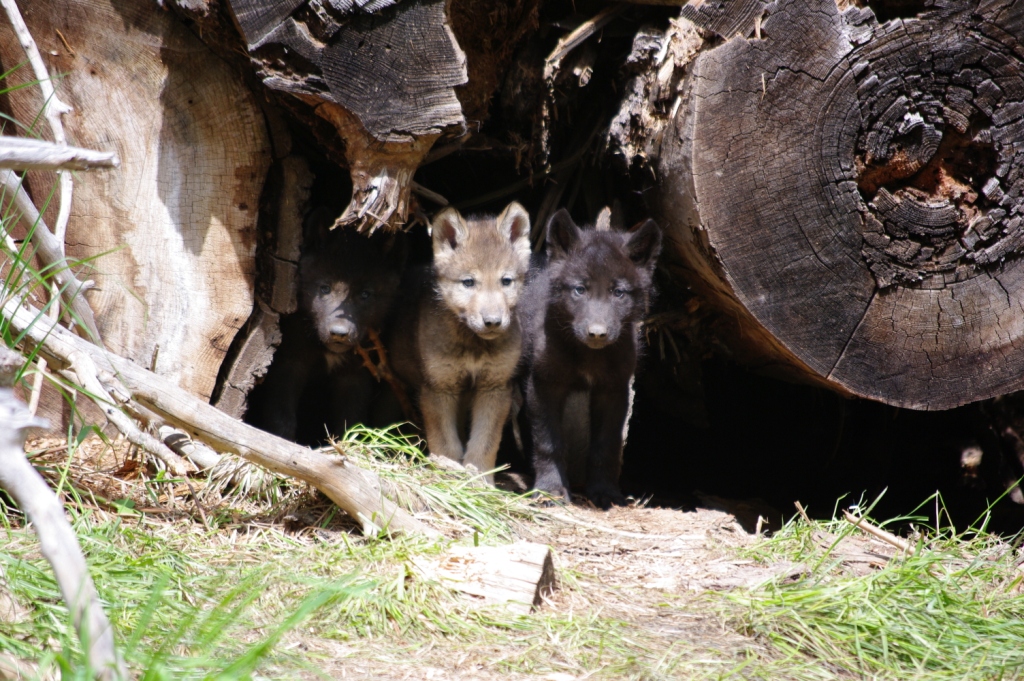
These wolf pups born to the Wenaha Pack in 2012 helped get recovery back on track. But their future remains tenuous (photo courtesy ODFW)

Please now listen to this:

So you can see that I have written frequently about wolves; indeed just a few days ago did so and included this photograph.

Wolf greets man.
Wolf greets man.

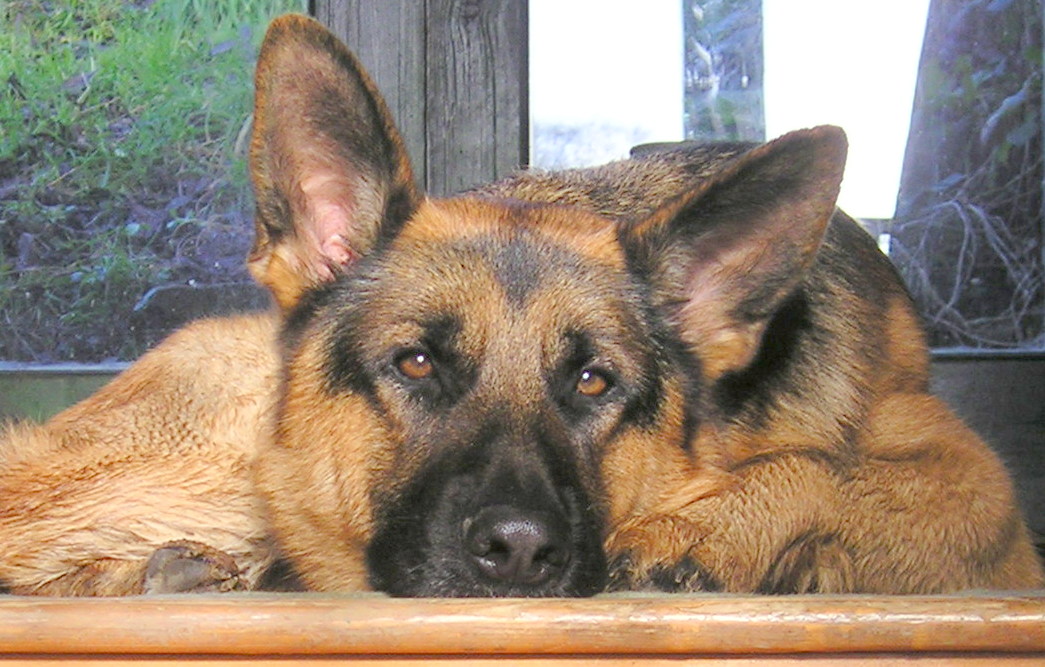
Now just look at those eyes of the Grey Wolf above and compare them to the eyes of the German Shepherd dog below and tell me that wolves aren’t as close to man as dogs.

OLYMPUS DIGITAL CAMERA

Finally, feel free to share this post as far and wide as you can.  Learning from Dogs is published under a Creative Commons License. This link covers how to share my material.

Please do something to help these ancient animals who, more than any other creature, helped put mankind ‘on the map’.

Thank you.

Happy Birthday to Pharaoh

Our lovely old German Shepherd is 10 today.

Yes, Pharaoh was born back on June 3rd 2003.  So today, in human years he is 10.  In the old traditional ‘dog years is seven times times human years‘ he would be 70.  But according to a recent item on BBC News there is a more accurate way of calculating dog years.

Longevity secrets of readers’ pets who lived past 100 ‘dog years’

Thanks to our dog age calculator, people have been reassessing the age of their furry friends.

It put a new spin on the old saying that the age of dogs could be better understood by multiplying the number of years since their birth by seven.

You can read more here.  That dog age calculator is here.

Dog years: The calculator

Working out your dog’s true age used to be a case of simply multiplying it by seven. But it’s more complicated than that, and here’s a handy calculator to do it for you.

A recent Magazine feature explained that:

  • Different breeds of dog age at varying speeds
  • Dogs age at varying speeds at different stages of their lives

With that in mind, we’ve built a calculator for you to work out your dog’s true age – its age in “dog years”.

Alternatively, you can find out how old you would be if you were a dog. You can choose to be a labrador, a spaniel, a whippet, or any one of 20 breeds.

The calculator uses these multipliers for the first two years of a dog’s life:

  • 12.5 for small dogs
  • 10.5 for medium-sized dogs
  • 9 for large dogs

Then, for the third and subsequent years of the dog’s life, each human year has to be multiplied by between 4.3 and 13.4 years, depending on the breed:

Small: Dachshund (Miniature) 4.32, Border Terrier 4.47, Lhasa Apso 4.49, Shih Tzu 4.78, Whippet Medium 5.30, Chihuahua 4.87, West Highland White Terrier 4.96, Beagle 5.20, Miniature Schnauzer 5.46, Spaniel (Cocker) 5.55, Cavalier King Charles 5.77, Pug 5.95, French Bulldog 7.65

Medium: Spaniel 5.46, Retriever (Labrador) 5.74, Golden Retriever 5.74, Staffordshire Bull Terrier 5.33, Bulldog 13.42

Large: German Shepherd 7.84, Boxer 8.90

The calculator does not work for cross breeds, sadly, but on average these live 1.22 years longer than pure breeds, according to Dan O’Neill (from Petts Wood in London…) who is researching the subject for a PhD at the Royal Veterinary College.

Nor does the calculator work for cats. What we can say is that the average life expectancy of a cat is 12.1 years, which equates to 64 human years.

Guidelines issued by the American Association of Feline Practitioners say that cats reach 10 human years in their first six months and are approximately 24 at the age of two years. After this their age increases by four “cat years” every year.

So dear Pharaoh is the equivalent of an 80-year-old human! The breed has an average life expectancy of 9.73 years. (Source: BBC calculations on data from UK Kennel Club and US Veterinary Medical Database.)

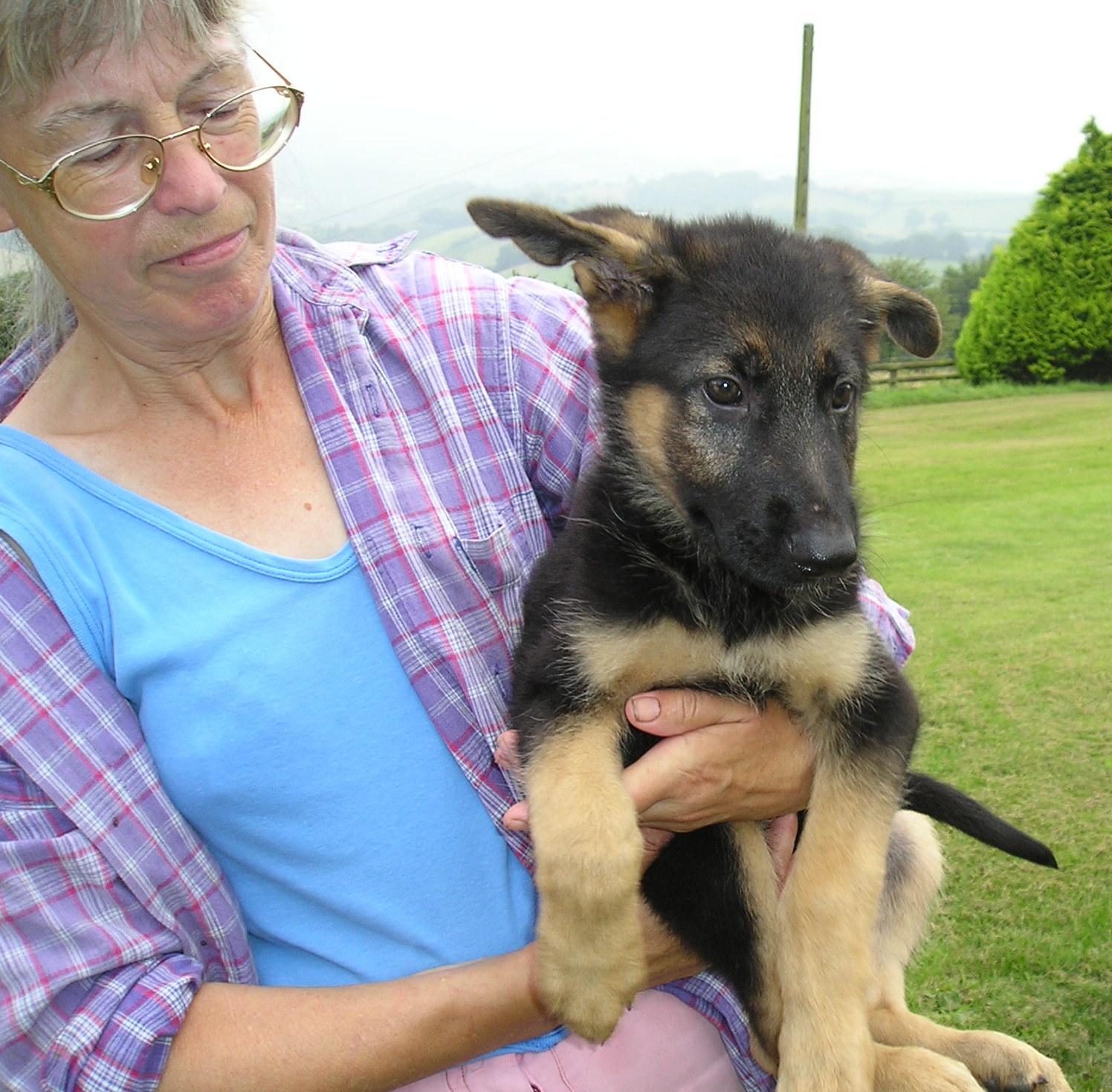
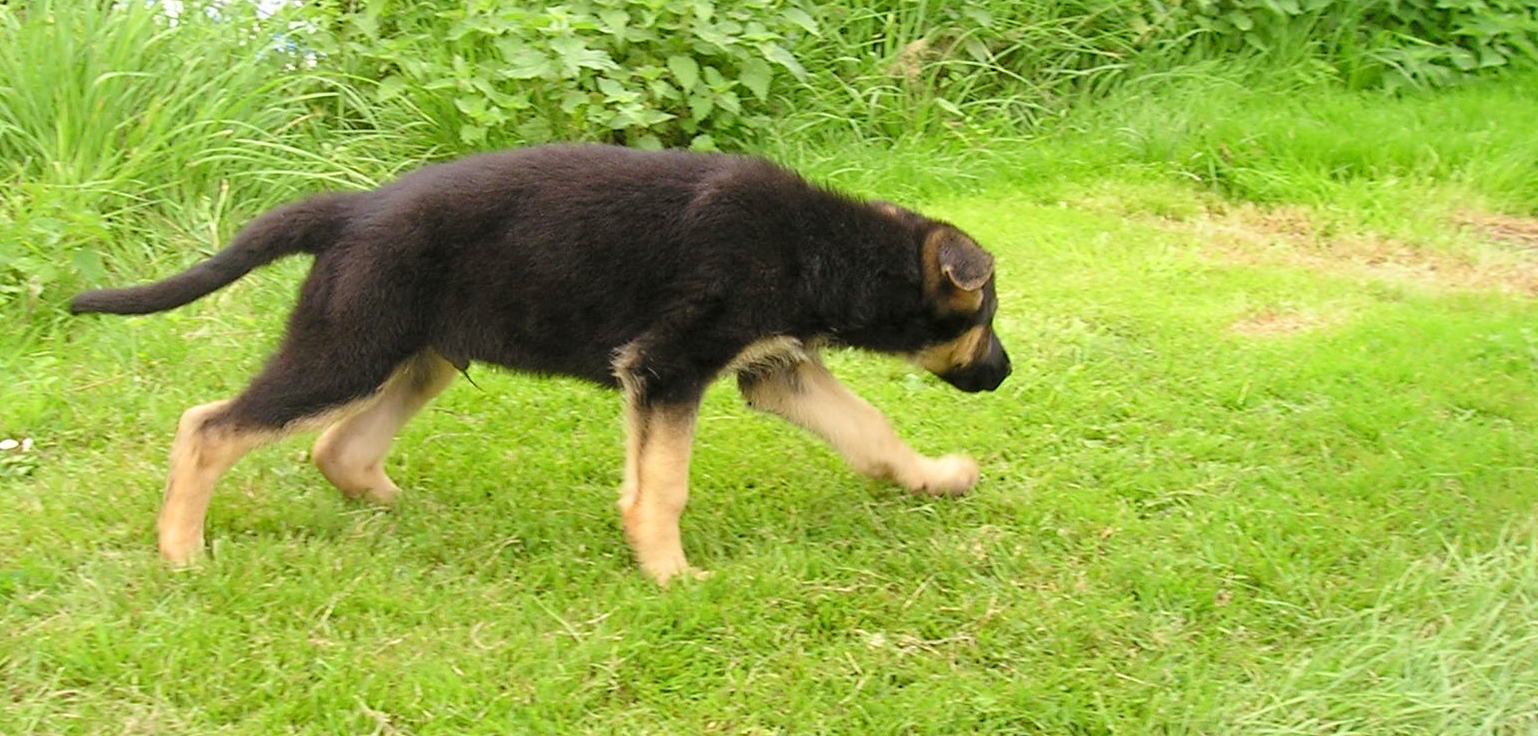
Going to leave you for today with three photographs of Pharaoh taken the day I first saw Pharaoh as a puppy, back on the 12th August 2003.  The woman holding Pharaoh is Sandra Tucker who runs Jutone Kennels in Devon, England., where Pharaoh was born 10 years ago this day!

OLYMPUS DIGITAL CAMERA

oooOOOooo

OLYMPUS DIGITAL CAMERA

oooOOOooo

OLYMPUS DIGITAL CAMERA

oooOOOooo

More pictures tomorrow.

Wonderful British humour!

A trip down memory lane with the BBC That’s Life programme.

Sent to me by Neil Kelly from South Hams in Devon.

That’s Life was a BBC television programme that ran for over 20 years.  Difficult to attach a precise lable to the format but this is how the programme is described on WikiPedia.

That’s Life! was a magazine-style television series on BBC1 between 26 May 1973 and 19 June 1994, presented by Esther Rantzen throughout the entire run, with various changes of co-presenters. The show was generally recorded about an hour prior to transmission, which was originally on Saturday nights for many years and then on Sunday nights. In its latter days, in an attempt to win back falling ratings, it was moved back to Saturday nights.

Anyway, the following video from That’s Life goes back to 1986 and involves three German Shepherd dogs and a soda syphon.  The video was ‘borrowed’ from a Dutch TV show called ‘Zomergasten’, hence the Dutch sub-titles.

If you ever find yourself in Castle Cary, Somerset, then do drop in to the George Hotel; it’s still going strong.

The George Hotel
The George Hotel

Changing that light bulb?

Apologies!

At 10:15 last night, I discovered that this Post is likely to be published with all the pictures missing.  Operator error on my part.

So rather than delete it and you, dear reader, not know what had happened, I have left it as it is and will correct it by including the pictures for tomorrow, Sunday.

Dear friend Dan Gomez sent this to me on the 9th but I have split it into two parts, the concluding part will be tomorrow.

oooOOOooo

How many dogs does it take to change a light bulb?

Description:                                         cid:1.2287114833@web110304.mail.gq1.yahoo.com
1. Golden Retriever: The sun is shining, the day is young, we’ve got our whole lives ahead of us, and you’re inside worrying about a stupid burned out bulb?
Description:                                         cid:2.2287114833@web110304.mail.gq1.yahoo.com
2. Border Collie: Just one. And then I’ll replace any wiring that’s not up to code.
Description:                                         cid:3.2287114834@web110304.mail.gq1.yahoo.com
3. Dachshund: You know I can’t reach that stupid lamp!
Description:                                         cid:4.2287114834@web110304.mail.gq1.yahoo.com
4. Rottweiler: Make me.
Description:                                         cid:5.2287114834@web110304.mail.gq1.yahoo.com
5. Boxer: Who cares? I can still play with my squeaky toys in the dark.
Description:                                         cid:6.2287114834@web110304.mail.gq1.yahoo.com
6. Lab: Oh, me, me!!!!! Pleeeeeeeeeze let me change the light bulb! Can I? Can I? Huh? Huh? Huh? Can I? Pleeeeeeeeeze, please, please, please!
Description:                                         cid:7.2287114834@web110304.mail.gq1.yahoo.com
7. German Shepherd: I’ll change it as soon as I’ve led these people from the dark, check to make sure I haven’t missed any, and make just one more perimeter patrol to see that no one has tried to take advantage of the situation
Description:                                         cid:8.2287114834@web110304.mail.gq1.yahoo.com
8. Jack Russell Terrier: I’ll just pop it in while I’m bouncing off the walls and furniture.
Description:                                         cid:9.2287114834@web110304.mail.gq1.yahoo.com
9. Old English Sheep Dog: Light bulb? I’m sorry, but I don’t see a light bulb!
Description:                                         cid:10.2287114834@web110304.mail.gq1.yahoo.com
10. Cocker Spaniel: Why change it? I can still pee on the carpet in the dark.
Description:                                         cid:11.2287114834@web110304.mail.gq1.yahoo.com
11. Chihuahua : Yo quiero Taco Bulb. Or “We don’t need no stinking light bulb.”
Description:                                         cid:12.2287114834@web110304.mail.gq1.yahoo.com
12. Greyhound: It isn’t moving. Who cares?
Description:                                         cid:13.2287114834@web110304.mail.gq1.yahoo.com
13. Australian Cattle Dog:First, I’ll put all the light bulbs in a little circle…
Description:                                         cid:14.2287114834@web110304.mail.gq1.yahoo.com
14. Poodle: I’ll just blow in the Border Collie’s ear and he’ll do it. By the time he finishes rewiring the house, my nails will be dry.

How many cats does it take to change a light bulb?
Cats do not change light bulbs. People change light bulbs. So, the real question is:
Description:                                         cid:15.2287114834@web110304.mail.gq1.yahoo.com
“How long will it be before I can expect some light, some dinner, and a massage?”
ALL OF WHICH PROVES, ONCE AGAIN, THAT WHILE DOGS HAVE MASTERS, CATS HAVE STAFF!

Part Two tomorrow.

Story time – Paloma

Something new for the New Year – stories about dogs!

Preface.

Before I met Jean in December 2007, she had been rescuing feral dogs in the Mexican beach town of San Carlos for many, many years. Over those years, Jean must have rescued and found homes for 60 dogs or more.  In the month that I met Jean, she had 12 dogs and 6 cats at her home.  Ten months later, September 2008, I flew out to be permanently with Jean with my German Shepherd, Pharaoh – that’s him on the home page of Learning from Dogs – taking the total up to 13 dogs.

When we moved up to Payson, Arizona in February, 2010 we brought all 13 dogs and 6 cats with us, much to the amazement of the US Immigration officers at the US-Mexican border town of Nogales!  Indeed, our particular officer left his booth excitedly to explain to his colleagues that our dogs and cats represented a border crossing record!

So many of the dogs that have passed through Jean’s loving arms have stories to tell.  Thus over the coming months, Jean and I will offer you, dear reader, those stories.

Here’s the first, written by ‘Dog Lady’ Jean about gorgeous, sweet Paloma who, despite her age (Paloma that is!), is alive and well here in Payson.

* * * * * * * * * * *

Paloma, December 29th 2011

Paloma

The old white dog padded down the dusty pavement. Sway-backed and dull-eyed, her teats, heavy with milk, grazed the ground. An anonymous creature in a cruel world. The pavement sizzled in the afternoon Mexican summer sun blistering her tired feet, but she could not hurry. She had to conserve her energy. Her pups were soon coming and finding a safe place to give birth to them was her priority. The beach that had been her home was not a good place. .. needed cool shelter. She would find it.

She was alone among a sea of human legs in this scruffy Mexican beach town. No-one noticed her plight. No-one cared. She was used to it. She had long been adept at finding dried fish, discarded tortillas, sometimes a tasty morsel thrown by a tourist sunning in front of the big hotel.

This would be her eighth litter and she was very tired. As a puppy she belonged to a family with small children. There were plenty of leftovers. But when she became pregnant they drove her to the beach, threw her out and left her to fend for herself.

Her babies were always beautiful. She had Labrador in her genes donating a coat that was pure white. Humans always took her pups; she could only ever hope their fate was always a better one than hers.

Anonymity. She had perfected the art; never make eye contact, move low to the ground, escape the stray kick with a quick sideways leap.

She remembered at the very end of the long beach there was a house with a pool. Plenty of water. Onward she padded.

The lawn surrounding the pool was moist with sprinklers and the hibiscus hedge close to the house made a safe nest. Soon she had dug into the damp earth a big enough hole to curl into; it was cool under the canopy of red flowers.

A human voiced shouted, “Carlos, get that dog out of the hedge.” Then the long hose filling that tempting pool was turned on her and a burst of water hit her in the face. She uttered a low growl. Carlos, the gardener, backed away, “Señor, the dog, she is having babies.”

The owner of the house turned abruptly and went inside. He picked up his phone, made a call to the local English lady who over the years had acquired the nickname ‘Dog Lady’. He practically shouted down the phone, “I have a dog in my hedge having pups. You had better do something about it or I shall dispose of them, and I won’t be pretty about it!”

‘Dog Lady’ was used to this. Had been many years since she took on the practically impossible task of rescuing Mexican feral dogs and she was well-known for never turning a dog away. In less than 15 minutes, she had walked to the fine house overlooking the beach and quietly looked under the hedge. As anticipated, the dog was incapable of being moved, her focus entirely now on the safe birth of her pups. With appropriate feminine wiles, the white dog’s human saviour persuaded the disgruntled owner to allow the mother dog a stay of a few days. ‘Dog Lady’ promised that she would take them away as soon as possible.

“She’s a mean and wild dog, you’ll never tame her,” came the angry response from the house owner.

‘Dog Lady’ just smiled and said nothing.

But every day she took food to the white dog then sat quietly close by on the grass reading her book. The white dog had just the one pup, which ‘Dog Lady’ called Solovino, the Spanish for ‘comes alone’. The mother dog she called Paloma, Spanish for ‘Dove’. Many white dogs in Mexico were called Paloma and maybe years earlier that was what the children named her as the name did seem to resonate with this gentle dog.

Patiently, ‘Dog Lady’ moved closer and closer until Paloma would take meat from her hand, rapidly followed by allowing her ears to be caressed. Ten days later, while Paloma was eating, ‘Dog Lady’ picked up the little Solovino and put him into her car. Paloma’s response was immediate; she frantically ran to her child, her mothering instinct so great that she leapt without hesitation into this strange vehicle. Paloma and Solovino were safe.

The house owner graciously admitted that he had been taught a lesson in empathy and how sorry he was for being so rude and cruel.

Back at ‘Dog Lady’s’ home, a quiet sanctuary for so many dogs over the past years, Paloma and Solovino were quickly settled into a cool room. Paloma soon utterly trusted her ‘Dog Lady’ human companion and became the tame and loving dog she always wanted to be. Her shining eyes embraced her new world and she even regained her figure! Solovino grew quickly and found a wonderful family home in Tucson, Arizona.

Now some 6 years after ‘Dog Lady’ rescued Paloma from under that hedge, she is a beloved part of the Handover family. Indeed, she travelled in peace in February 2009 with her twelve dog friends from her sanctuary in San Carlos, Mexico to this dog paradise in the Arizonan forest just outside Payson.

Paloma will never want again.

Copyright © 2011, Jean Handover

Faith!

Learning from Dogs big time!

This Blog came about because of a conversation with fellow Blog founder, Jon Lavin. Jon was talking about integrity and how it applies to us in the sense of Truth and Falsehood: that leading truthful and integrous lives is much more than the rather warm and patronising way that the phrase might come over.

Pharaoh

Indeed, understanding the power that comes from leading truthful lives and how an individual’s power and level of consciousness can be enhanced through greater integrity, understanding, and compassion could be the most remarkable discovery that any one person could make.  Dr David Hawkins, who has written extensively on this subject, has said;

A science of consciousness developed which revealed that degrees of truth reflect concordant calibratable levels of consciousness on a scale of 1 to 1,000. When this verifiable test of truth was applied to multiple aspects of society (movies, art, politics, music, sociology, religion, scientific theories, spirituality, philosophy, everyday Americana, and all the countries of the world), the results were startling.

Returning to that conversation with Jon, it was pointed out that dogs have been calibrated as having a level of consciousness of 210. As a score of 200 is the boundary between truth and falsehood, according to Hawkins, this made dogs integrous, hence the inspiration for starting this Blog.  My German Shepherd, Pharaoh, sleeping on the floor close to Jon and me, made the point.  Despite being a difficult dog at times, he had always demonstrated a consistency of integrity that was impressive.

Anyway, to the point of this Post – a dog called Faith.

Read more about Faith

Dogs really are smarter!

Fascinating research coming out of Duke University

This Post was stimulated by a link sent to me by Chris Snuggs, who will be joining the author’s team at Learning from Dogs in due course.

The link was to an article published in Time Magazine on September 21st and is available in their online version.

Brian Hare of Duke
Brian Hare of Duke

The article is about the extraordinary social skills that have been developed by dogs over the millennia that they have been associated with man.  It featured Brain Hare (sort of seems an appropriate name!) Assistant Professor, Evolutionary Anthropology at Duke.

The article is also rather timely as only a few days ago, there was a Post on this Blog about the befriending of a man with a wild wolf, or was it the other way around!

Back to the Time magazine article,

“Understanding a pointed finger may seem easy, but consider this: while humans and canines can do it naturally, no other known species in the animal kingdom can. Consider too all the mental work that goes into figuring out what a pointed finger means: paying close attention to a person, recognizing that a gesture reflects a thought, that another animal can even have a thought.”

Read more about Dogs

Postscript to Luna, the wolf.

The story of Luna has some interesting connections.

The person taking the picture in the Post about Tim Woods was Willie Prescott.  He just happens to be the grandson of William H. Prescott from whom the town of Prescott is named.  Here’s that picture again.

Luna, the wild wolf, taken in 2006.

Read more this postscript

A Dog Story!

This has been doing the rounds and may be seen on numerous web sites and Blogs.  It may be fiction but, nonetheless, it’s a good message.

Strangely, for a Blog called Learning from Dogs, there have been precious few dog stories.  Maybe the integrity of a dog is so flippin’ obvious that we don’t need to wrap the species up in all sorts of romantic twaddle.  This in no way, however, reduces the power of the message that dogs, along with many other species of warm-blooded animals (e.g. horses) are capable of reminding mankind of the importance of integrity.

Pair GSDs

Read The Dog Story