Who do the Earth’s raw materials really “belong” to?
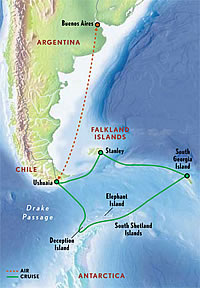 So once again the Falkland Islands have hit the headlines, and as usual for the wrong reasons. The British have given the green light for oil exploration around the islands and Argentina has resisted by imposing restrictions on shipping movements, if not (yet) an all-out blockade.
Who knows where this one will end? It could either fizzle out or erupt into another full-scale confrontation, since big issues are involved, and none bigger than nationalism, for Argentina claims the islands as “its own”.
The history of the Falkland Islands is long and complex, but the idea that Argentina has any fundamental right to these islands is surreally silly. Argentina is owned and ruled by descendants of the Spanish, who took over the land that now forms Argentina (a state in its own right only since the early 19th c) as part of the European colonisation of the world. By all means let us return the Falklands to their original owners, except that the first people to settle there were French for a start. And if you are going to adopt the principle of returning land to its original owners, then we can look forward to most of the population of Argentina returning to Spain and returning the land to the Indians, can we?
 The other argument often advanced is that “the islands are near Argentina”. Well, I don’t know when these people last looked at a map but 300 miles isn’t exactly “near”. But in any case, if we are to adopt nearness as a criteria for the reapportioning of land then I look forward to England once again reclaiming France, a mere 21 miles away. And what on earth is Corsica doing as part of France? But of course France must have the Channel Islands, as they are very near – and so on. “Continental shelf”? “We own the land under the sea?” Go down this route and we’ll need a whole new generation of map-makers.
When all the idiotic, overblown, childish and nationalistic guff (which sadly led to many hundreds of dead in the 1972 war) is stripped away from this debate, we are left with two fundamentals:
- the right of self-determination
- the way the Earth’s resources are used
As for the first, there have been British people living on the islands since at least 1833. They have – as I believe all people have – the right to determine their own fate. This is called self-determination. Unfortunately, it is a noble principle to which the world all too often pays only lip-service. The nation state has become an entrenched, solidified system, mostly because it confers great power on the leaders of each state, who – especially when democracy has not taken root – use the statehood to advance their own power and megalomania. Statism has for centuries run roughshod over people’s fundamental rights. Iraq was a “state”, but one where the Kurds (denied their own state by British cynicism) suffered cruelly under the jackboot of a fascist psychopath. That the British eventually helped to remove this monster (suffering enormous criticism from in particular the country that inspired the world with its own Revolution in 1789) is only a tiny compensation for the original injustice done to the Kurds. They are by no means alone; minorities all over the world suffer in different degrees from arrogant statism: Tibetans; Basques,; American Indians and Australian aborigines among many others. Yes, injustices were done centuries ago, but you cannot wind back history, or where would it end? How would Europe cope with all those Yanks for a start if they gave the USA back to Sitting Bull’s descendants? Apparently, we all came originally from Africa. Should we all return there and leave our countries empty?
Well, on the Falklands are Brits, and Britain did them the honour of allowing them freely to choose whether they want to be annexed to Argentina. This would in fact give them innumerable advantages, plus of course potentially-disastrous disadvantages. As trust is in short supply, these people prefer not to take the risk and so remain British. That is their right. In refusing to discuss “sovereignty”, Britian is doing no more than strike a blow for self-determination. To give Britain its due, it has pursued the same policy – albeit modestly – towards the (in the eyes of some of them) oppressed Welch, Scots and Irish.
So much for fundamental 1. The Argentinian case is pathetic.
What about the RESOURCES question?
Well, resources are another area where the state jackboot falls with great weight. We all breathe the same air, share the same sun, the same water; but where the stuff under the ground is concerned, it’s every state for itself. Yet casting aside state arrogance, isn’t it ridiculous that state A can derive vast wealth from “its” oil, gold or whatever, while state B alongside it is mired in poverty and misery? So much for “share-and-share” alike. Even belonging to the same race is no help; while some Arabs built extraordinary palaces and Audi Quattros made of solid silver, poor Somalis, Yemenis, and even Egyptians are mired in abject poverty. (Check out this Arab Palace in Dubai, and Mugabe’s presidential palace in Zimbabwe, which is by no means untypical of poverty-stricken Africa)
One day, in a joined-up world which recognizes that we are all brothers, we will share resources “fairly”. Britain could show the way by offering to share any oil resources with – not only Argentina – but all of Latin America (though we could leave out Venezuela …) What a blow for brotherhood that would be!
By Chris Snuggs
 Learning from Dogs