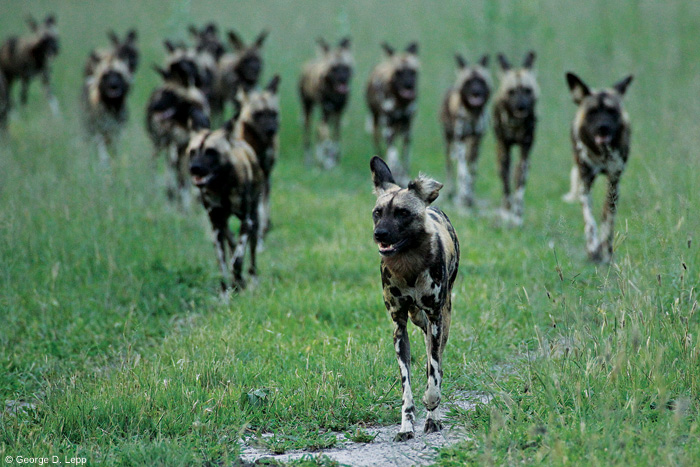
Dogs offer many beautiful examples of the benefits of community. For the powerful reason that their genes, from the days of wild dogs, still guide their behaviours. When dogs lived in the wild, their natural pack size was around fifty animals. As was explained in more detail in the chapter Understanding the dog’s world, only three dogs held positions of status. The leader of the pack, the female alpha dog, the ‘second-in-command’, the male beta or teaching dog, and the ‘omega’ dog, a dog of either gender whose role was to be the clown dog, keeping the pack happy and playful. It should be added that all three dogs of status were born into their respective roles. Their position in the pack was instinctive.
All the other dogs in that natural grouping would be equal participants with no ambitions to be anything else. There was no such thing as competition for a role, as how a dog fitted into his or her pack was a product of birth.
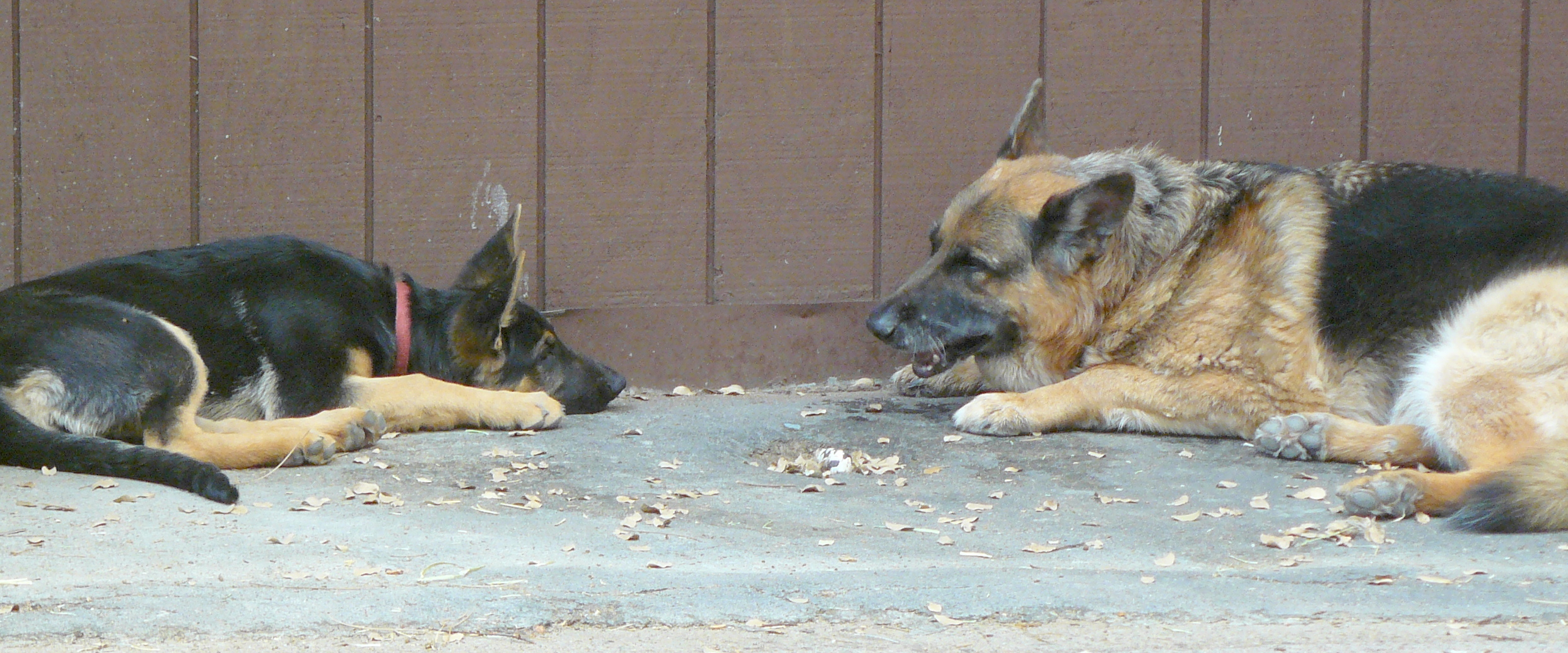
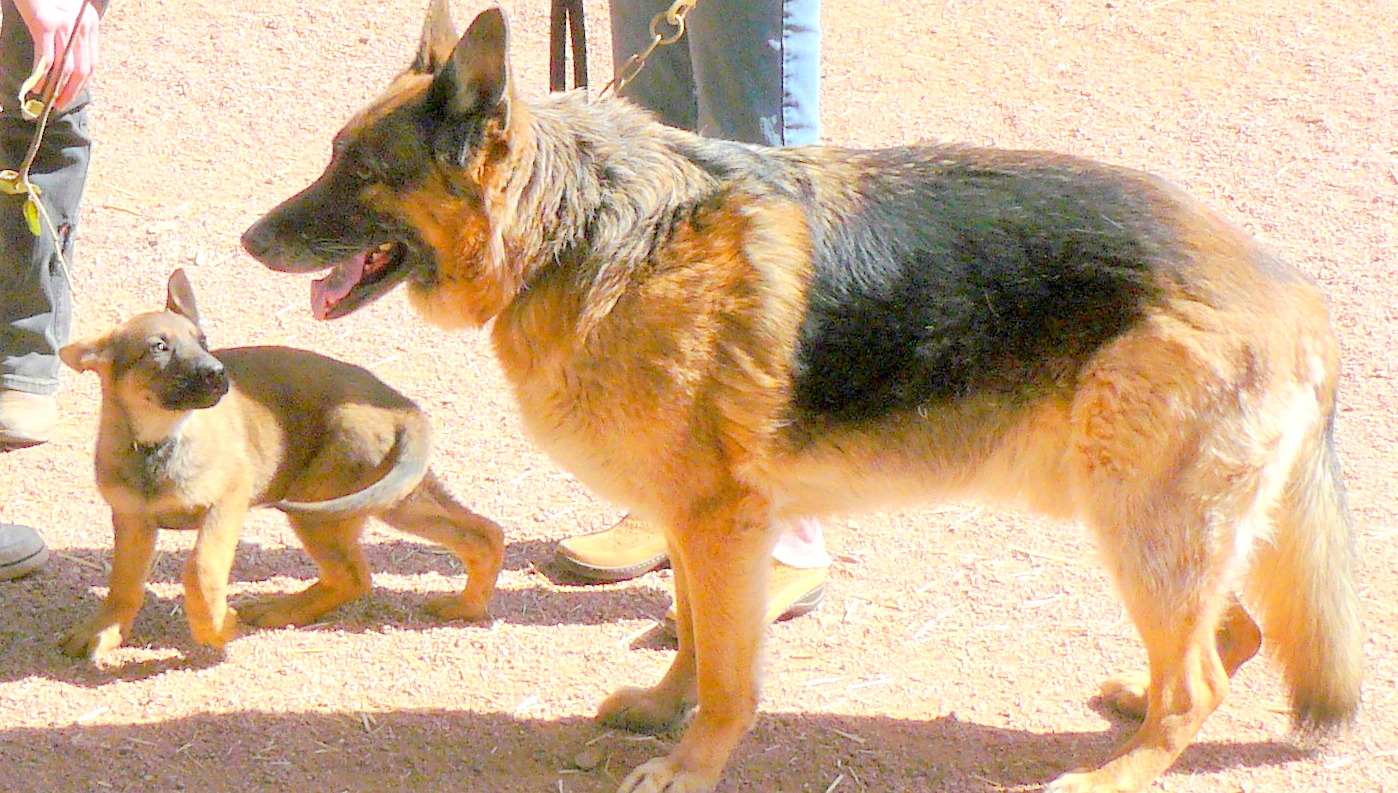
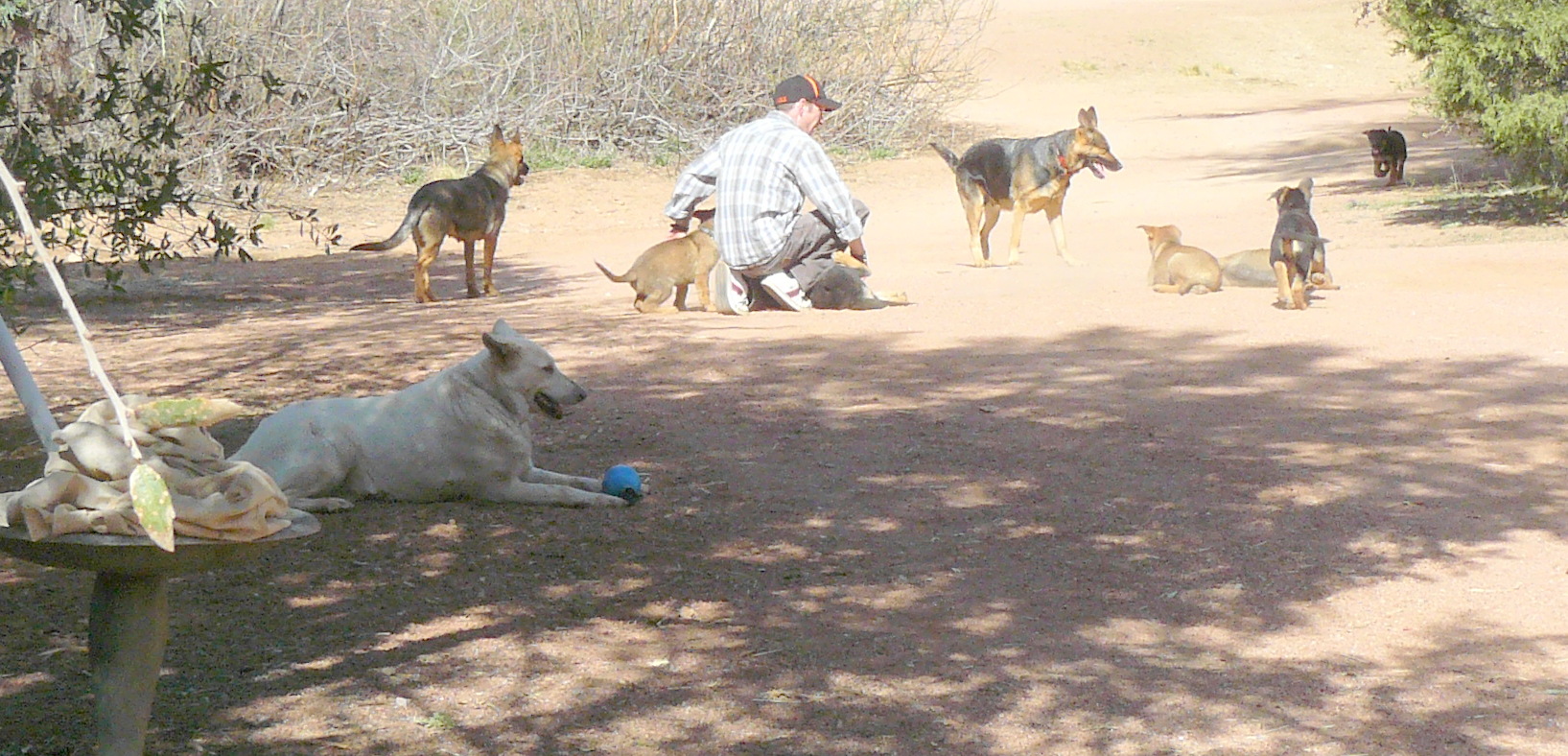
When we see how dogs are as the domesticated animals we humans know and love, we still come across, from time to time, a dog that is an alpha, beta or omega role dog. At the time of writing this, we have nine dogs in the house. Of those nine, two have an instinctive status. Lilly, a very old female dog, was born an alpha dog, and Pharaoh, was born a beta dog.
Let me explain more about Pharaoh and him being a beta or teaching dog.
In my early days of having Pharaoh in my life, I wondered if Pharaoh was an aggressive dog. My uncertainty with regard to Pharaoh followed a number of occasions when walking him in a public area, with other dogs around, and he had been very threatening, both in voice and posture, towards some of those other dogs.
I was put in contact with an Angela Stockdale who for years had helped owners with aggressive dogs. Helped them by retraining their dogs. This is what she arranged. I took Pharaoh up to her place at Wheddon Cross, near Minehead in Somerset. When we arrived, Angela was standing just by a gate that led into a fenced paddock, maybe a half-acre in size. In the far corner of the paddock were two dogs.
Angela asked me to bring Pharaoh to the gate and let him off the leash. It was clear that the intention was to let Pharaoh into the paddock. I cautioned that Pharaoh could be quite a handful with other dogs and, perhaps, it would be better that I walked him into the area still on his lead. Angela replied that it wouldn’t be necessary. So, as she held the gate open sufficient for Pharaoh to enter the paddock, I unclipped the lead from his neck chain and backed away, as requested.
Pharaoh had hardly taken two or three paces into the grassy paddock when Angela called out, “Paul, there’s nothing wrong with him!”
I was astounded and stammered, “Er, er, how can you tell so quickly?”
“Because my two dogs haven’t taken any notice!”, came Angela’s immediate reply.
As we both watched the interaction taking place, Angela explained that in the paddock were her female Alpha dog, Leda, and her male Beta dog, whose name now escapes me. In other words, these two dogs were number one and two in terms of status, so far as dogs see other dogs.
In fact, Pharaoh was utterly subservient to these dogs, in a way that I had never witnessed before. Later on, as Pharaoh relaxed and started playing, Angela said that she thought that Pharaoh was a Beta dog and later was able to confirm that.
Anyone who has the privilege of owning a group of dogs will know without doubt that they develop a community strength that is an incredible model for us humans.
So now to turn to how we can learn from this aspect of dogs.
Many people think more and more that nations, governments, call it what you will, are less and less effective at understanding the needs of their people. I’m not even going to go down the road of the corruption of our leaders, both big ‘C’ and little ‘c’, in terms of power and money. No, I’m thinking of the top echelons in many societies being very disconnected from the needs and aspirations of their people. The widespread sense that representative democracy, as a process, is broken. As a quick aside, I must add an amusing comment that came from a neighbour: If one can bank online, we can certainly vote online! Does make one think about new ways of governing ourselves in this online world of ours.
Yet it would be very wrong to imagine that mankind has no experience of community living. Erik D. Kennedy wrote an essay: On the Social Lives of Cavemen[1]. Under the sub-heading of The Tribe, he offers:
Human beings are no strangers to group living. Call it a family trait. Our closest animal relatives spend a good bulk of their time eating bugs off their friends’ backs. While I’m overjoyed we’re not social in that manner, I’m less pleased that we’re not social more to that degree. In study after study, having and spending time with close friends is consistently correlated with happiness and well-being. And yet, the last few decades in America have seen a remarkable decline in many things associated with being in a tight-knit social circle — things like family and household size, club participation, and number of close friends. Conversely, we’ve seen an increase in things associated with being alone — TV, commutes, and the internet, for example.
This trend is quite unhealthy. It’s no surprise that humans are social animals — but it may be surprising that we’re such social animals that merely joining a club halves your chance of death in the next year — or that living in a close-knit town of three-generation homes can almost singlehandedly keep you safe from heart disease.
Thus, a sharing, community life is not just some cosy idea, it could be core to the sort of healthy society we need to return to. Erik’s essay continues to expand this idea by quoting the particular case of Roseto in Pennsylvania[2]:
In 1950’s Roseto, the incidence of heart disease in men over sixty-five was half the national average (and suicide, alcoholism, drug addiction, and serious crime were also basically unheard of [ii[3]]). Bewildered doctors searched for solutions in genetics, diet, exercise, and geography, but finding nothing, reached the conclusion that it was the close-knit social life of the community that kept its residents so healthy. Dinners with grandma, friendly chats between neighbors, and a precocious level of civic involvement were the driving factors in the health of a town that nothing but old age could kill.
The circumstances behind the remarkable and uncharacteristic happiness and health for the residents of Roseto came down to one fact: “The whole reason Roseto was an outlier is because it was a town whose inhabitants more or less collectively moved from rural Italy to the middle of Pennsylvania over a few decades.”
That, essentially, Roseto became “an Italian village in the American countryside.”
One doesn’t need to reflect for very long before the obvious question arises: If fifty dogs is the optimum number for a pack of dogs, is there a limit to the number of people we can have in the human equivalent of our pack?
Well, says anthropologist Robin Dunbar, that number is about 150 persons. Robin Dunbar achieved fame by drawing a graph that plotted primates’ social group size as a function of their brain sizes. He inputted the average human brain size into his model, and up came the number 150. Beyond that number is past the upper bounds for both hunter-gatherer tribes and Palaeolithic farming villages. More than that, it appears that everything from startup employee counts to online social networks show this number as a fairly consistent maximum for the number of close social ties.
Back to Erik Kennedy:
Regardless of the specific implementation, the point is this: we stand to gain a lot from living in larger, closer groups. That’s how we were kicking it in the monkey days; that’s how we should be kicking it now. I say that not because of a romantic attachment to our Palaeolithic forbearers, but because of the fact that a good deal of health and happiness is ripe for our picking.
Erik Kennedy offers advice as to how to translate that into practical actions. Such as watch less television, live in a bigger group, for example, dine with the same people more often, and always resolve any disputes that you have with close friends. Also, have your children spend more time with trusted adults and, in turn, spend time with the kids of adults who trust you. Not forgetting to mix up age groups and stay close to your parents and grand-parents.
In essence, adopting such a lifestyle is not without precedent; paleo-social lives are common all over the world. In fact, paleo-social lives may not only be common but an age-old wisdom in many other parts of the globe. However, in many parts of the ‘Western’ world chances are good that we have seen very few people living in anything vaguely resembling a tribe; to use the more common vernacular for the term paleo-social.
For one thing is clear: isolation and loneliness is taxing on our mental health. Humans are not designed to be alone.
Just another important way of living to learn from our dogs: the power of sharing, of living a local community life, may just possibly be the difference between failure and survival of us humans.
1,642 words Copyright © 2014 Paul Handover
[1] http://www.erikdkennedy.com/essays/social-lives-cavemen.php
[2] Referred to by Malcolm Gladwell in his book Outliers.
[3] I believe one of the surest signs that your lifestyle is aligned with your physiology in some way is that the benefits come in clumps. Just as the paleo diet helps people with weight, energy levels, digestion, complexion, resistance to illness, and other areas of health, it’s no surprise that a proper paleo social life would be a holistic boon to health.
 Learning from Dogs