The debate about the Christmas Day Bomber continues. The pundits continue to define “success” in this case as finding him guilty in a court of law. They go on and on, repeating over and over again, how the evidence is so strong, how the civilian court system is so reliable, how the shoe bomber was tried in civilian court, and how a guilty verdict is virtually certain.
This is so wrong. The definition of success is not whether we find the Christmas Day Bomber guilty in a civilian court. This man intended to blow himself up on Christmas Day, and take hundreds of innocent Americans with him. The fact that he is alive today, facing a jury or a judge and possible jail time or, at the worst, the death penalty, is a mere footnote to him.
Has it occurred to anyone that if the military had interrogated the shoe bomber as the failed terrorist that he was, that the odds of the Christmas Day Bomber getting on that plane with those explosives would have been diminished? And interrogating the Christmas Day terrorist instead of shipping him off to the local prosecutor — for reasons Eric Holder, the U.S. Attorney General, has yet to articulate– diminishes the odds of some future terrorist act?
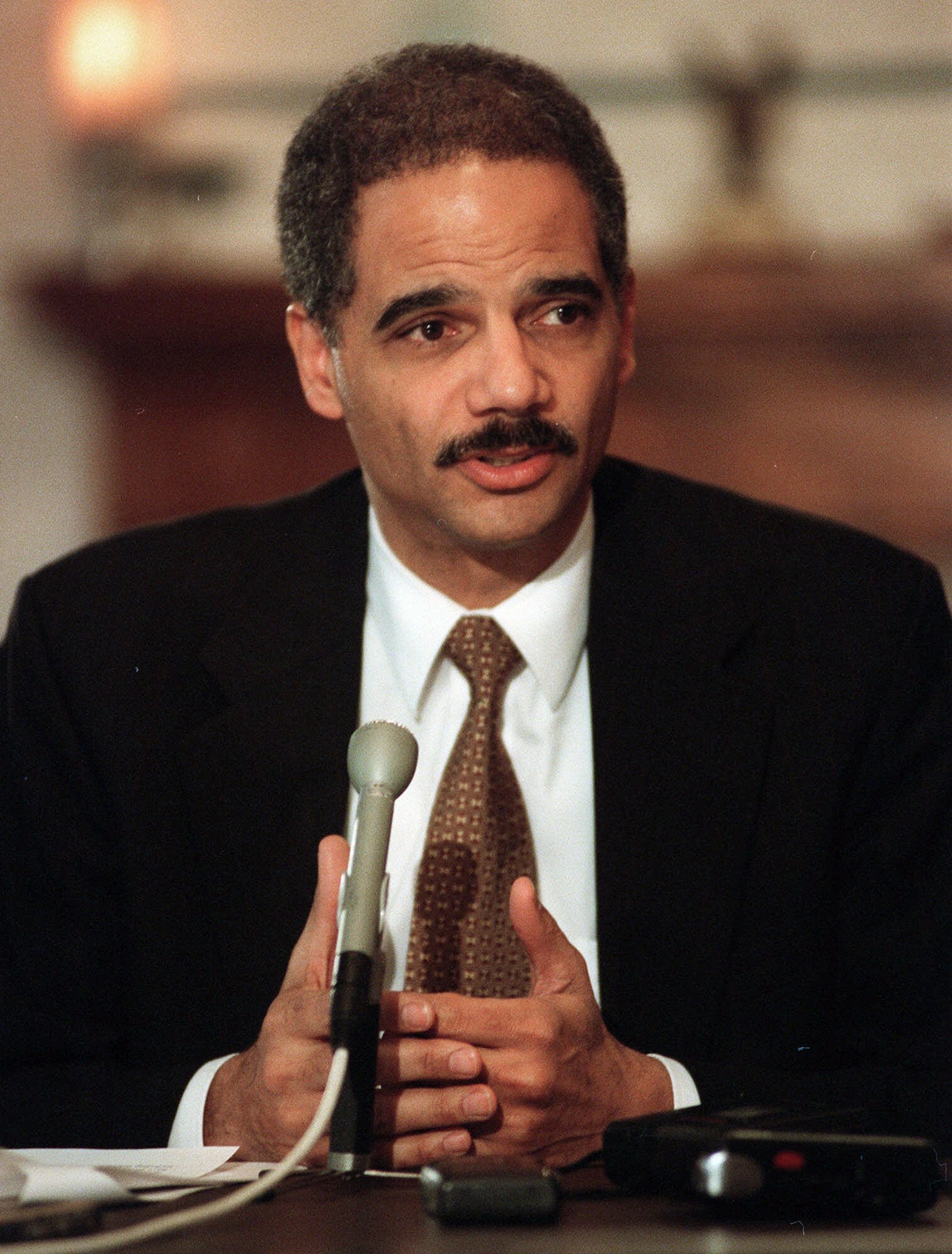
Eric Holder
We are at war!
These people attacked us as part of the ongoing war with terrorists. No one should “rest easy” because some lawyer is going to sleepwalk through a trial that may or may not successfully reach the painfully obvious conclusion that the Christmas Day Bomber is guilty! On the contrary, it makes me very uneasy that he is in the civilian court system at this point in time at all, because every moment spent reading this man his rights is a moment that could have been spent gathering intelligence from a terrorist. His punishment will come in due time. In the meanwhile, we have to extract as much information from his as we can in order to defend ourselves.
This is not the correct way to defend a great Nation in a fair and just manner.
In an earlier post, my colleague Paul Handover left us with an important question: Does the public’s lack of clarity about the “underwear bomber’s” status as an enemy combatant or a criminal undermine the appearance of impartiality of the U.S. judicial system?
US Attorney General Eric Holder
Paul reviewed the legal development of the “enemy combatant” designation, ending with a March 2009 pronouncement from Eric Holder, the current U.S. Attorney General, that the U.S. had abandoned the Bush administration’s use of the term. Mr. Holder continued, “As we work toward developing a new policy to govern detainees, it is essential that we operate in a manner that strengthens our national security, is consistent with our values, and is governed by law.”
A new policy that “strengthens national security?” I think it is blatantly clear that an intense and timely interrogation of the bomber does more to protect our national security than lawyering him up and giving him the right to not speak. As you read this, Michael Marinaccio, an attorney for Zarein Ahmedzay, who is suspected of plotting a terror attack on NYC, is seeking to have all the information gathered by officials after his client was represented by counsel thrown out as illegal, under the civil and criminal law of the U.S. We can likely expect the same in the underwear bomber case.
A new policy that is “consistent with our values?” Treating terrorists as terrorists is perfectly consistent with my values. I am not sure what he is trying to say here. Then again, maybe I do know what he is trying to say: that it is “wrong” to treat a terrorist as an enemy combatant, and “right” to give that person all the rights of a U.S. citizen, including the right to an attorney and the right to remain silent? Those may be Mr. Holder’s values, but they aren’t mine and, as you’ll see below, they are not those of the former U.S. Attorney General either.
A new, as yet undetermined, policy that is “governed by law?” This coming from the same legal mind that decided to try the five 9/11 terrorists in New York City federal court? A decision based on what legal precedent? There is no legal precedence. On what existing, well-formulated policy? There is no such policy.
Mukasey, US Attorney General 2007-2009
But on the legal subtleties surrounding this issue, I defer to Mr. Michael Mukasey, a former federal judge who oversaw cases relating to the 1993 World Trade Center attacks. Mr. Mukasey was the U.S. Attorney General from 2007 to 2009 before retiring and being replaced by Eric Holder. His analysis is as follows:
Had Abdulmutallab [the alleged underwear bomber. Ed.] been turned over immediately to interrogators intent on gathering intelligence, valuable facts could have been gathered and perhaps acted upon. Indeed, a White House spokesman has confirmed that Abdulmutallab did disclose some actionable intelligence before he fell silent on advice of counsel. Nor is it any comfort to be told, as we were, by the senior intelligence adviser …that we can learn facts from Abdulmutallab as part of a plea bargaining process in connection with his prosecution…Holding Abdulmutallab for a time in military custody, regardless of where he is ultimately to be charged, would have been entirely lawful—even in the view of the current administration, which has taken the position that it needs no further legislative authority to hold dangerous detainees even for a lengthy period in the United States … What the gaffes, the almost comically strained avoidance of such direct terms as “war” and “Islamist terrorism,” and the failure to think of Abdulmutallab as a potential source of intelligence rather than simply as a criminal defendant seem to reflect is that some in the executive branch are focused more on not sounding like their predecessors than they are on finding and neutralizing people who believe it is their religious duty to kill us. That’s too bad, because the Constitution vests “the executive power”—not some of it, all of it—in the president. He, and those acting at his direction, are responsible for protecting us.



 Learning from Dogs