I’m talking about the film Fuel which Jean and I watched on Monday night.
Here’s the trailer,
This movie trailer gives insight into the impeding oil dependency problem and hints at the biofuel solution. The Fuel Film raises awareness of 9/11, global warming, and moreover, how we can switch to an alternative fuel called biofuel. It is based on renewable sources such as algae or ethanol, costs less, and combats the impeding destruction of the environment.
But Top Documentary Films has the full film available, the link is here. (And see below) TDF describe the film, thus,
Eleven years in the making, FUEL is the in-depth personal journey of filmmaker and eco-evangelist Josh Tickell, who takes us on a hip, fast-paced road trip into America’s dependence on foreign oil.
Combining a history lesson of the US auto and petroleum industries and interviews with a wide range of policy makers, educators, and activists such as Woody Harrelson, Sheryl Crow, Neil Young and Willie Nelson.
Animated by powerful graphics, FUEL looks into our future offering hope via a wide-range of renewable energy and bio-fuels. Winner of the Sundance Audience Award.
The events of Sept. 11 and Hurricane Katrina factor in both visually and thematically, providing provocative anchors for the movie’s indictment of what Tickell believes is the Big Oil-cozy, ecologically indifferent Bush administration.
Johnny O’Hara’s WGA Award-nominated script doesn’t dwell on muckraking, however; it’s more focused on broadly inspiring viewers than preaching to the converted.
Interviews with a wide range of environmentalists, policy makers and educators, along with such “green” celebrities as Woody Harrelson, Sheryl Crow and Larry Hagman offer serious fuel for thought – as well as for action.
Smartly animated interstitials, memorable archival material and a lively soundtrack round out the fast-paced proceedings.
Have to say that the film was powerful and compelling and a great reminder that a sustainable way of life for all of us doesn’t mean the end of the world as we know it. Far from it; the word ‘sustainable’ is the clue here!
Here’s the full film,
Director Josh Tickell takes us along for his 11 year journey around the world to find solutions to America’s addiction to oil. A shrinking economy, a failing auto industry, rampant unemployment, an out-of-control national debt, and an insatiable demand for energy weigh heavily on all of us. Fuel shows us the way out of the mess we’re in by explaining how to replace every drop of oil we now use, while creating green jobs and keeping our money here at home. The film never dwells on the negative, but instead shows us the easy solutions already within our reach.
Finally, a little footnote for all you Planet watchers out there. Summer starts, as in the summer solstice, today (the 20th) in North America at 7:09 P.M. EDT (UTC -4 hours) or 4:09 P.M. MST (UTC -7 hours) and in the UK at 23:09 UTC.
Possibly the start of the end of traditional means of generating electricity
A recent item by David Roberts on the Grist website/Blog caught my eye,
Solar is getting cheap fast—pay attention, Very Serious People
That was the headline to the opening, thus,
I hope everyone has read Kees Van Der Leun’s post about the rapidly falling cost of solar PV. I want to draw out one quick point that Kees leaves implicit.
He argues that PV will be the cheapest source of electricity for most of the world some time around 2018, and for the rest of the world soon after. That could be off by a few years in either direction. It depends on whether the cost curve for silicon solar cells continues as it has the past and, as Alan says in his comment, whether the cost curve for “balance of system” costs (steel, glass, installation, etc.) declines as well. Let’s say it could be off by five years either way. Let’s just assume it’s 2023 before solar PV crosses grid parity and becomes cheaper than coal.
The Kees Van Der Leun post, referred to, points out that,
For a long time, the holy grail of solar photovoltaics (PV) has been “grid parity,” the point at which it would be as cheap to generate one’s own solar electricity as it is to buy electricity from the grid. And that is indeed an important market milestone, being achieved now in many places around the world. But recently it has become clear that PV is set to go beyond grid parity and become the cheapest way to generate electricity.
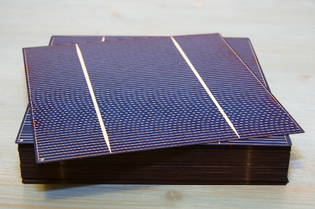
A hundred solar cells, good for 380 watts of solar PV power. Photo: Ariane van Dijk
Whenever I say this I encounter incredulity, even vehement opposition, from friends and foes of renewable energy alike. Apparently, knowledge of the rapid developments of the last few years has not been widely disseminated. But it’s happening, right under our noses! It is essential to understand this so that we can leverage it to rapidly switch to a global energy system fully based on renewable energy.
Working on solar PV energy at Ecofys since 1986, I have seen steady progression: efficiency goes up, cost goes down. But it was only on a 2004 visit to Q-Cells‘ solar cell factory in Thalheim, Germany, that it dawned on me that PV could become very cheap indeed. They gave me a stack of 100 silicon solar cells, each capable of producing 3.8 watts of power in full sunshine. I still have it in the office; it’s only an inch high!
That’s when I realized how little silicon was needed to supply the annual electricity consumption of an average European family (4,000 kWh). Under European solar radiation, it would take 1,400 cells, totaling less than 30 pounds of silicon.
Of course, you need to cover the cells with some glass and add a frame, a support structure, some cables, and an inverter. But the fact that 30 pounds of silicon, an amount that costs $700 to produce, is enough to generate a lifetime of household electricity baffled me. Over 25 years, the family would pay at least $25,000 for the same 100,000 kilowatt-hours (kWh) of electricity from fossil fuels — and its generation cost alone would total over $6,000!
He argues that PV will be the cheapest source of electricity for most of the world some time around 2018, and for the rest of the world soon after. That could be off by a few years in either direction. It depends on whether the cost curve for silicon solar cells continues as it has the past and, as Alan says in his comment, whether the cost curve for “balance of system” costs (steel, glass, installation, etc.) declines as well. Let’s say it could be off by five years either way. Let’s just assume it’s 2023 before solar PV crosses grid parity and becomes cheaper than coal.
Here’s the thing: 2023 isn’t that far off. It feels distant to us in a lot of ways. My kids will be out of college. Fifty versions of the iPhone will have come and gone. We might finally have the jetpacks we were promised.
But in terms of energy infrastructure, 12 years is nothing. It can take half that long or longer to permit and build big coal and nuclear plants, and they are meant to last a long-ass time. The Perry K Steam Plant, which serves downtown Indianapolis, was built in 1938. They didn’t have color TV then. Thirty-six coal plants in the U.S. were built before 1950. If a coal plant built today lasts that long, it will still be belching all over the atmosphere in 2072. My kids will be in their 60s.
This is also true of nuclear plants (the oldest is 42 years) and to a lesser extent natural-gas plants. It’s even true of transmission lines. These are large, long-term investments.
So if solar PV is going to be cheaper than coal in the next decade or so, that seems like the kind of thing utilities, regulators, investors, and political leaders would want to, I don’t know, talk over. Grapple with. Mull. It certainly seems relevant to the investment thesis for large, centralized power infrastructure. Yet it’s all but invisible in the elite U.S. energy conversation, outside of a few voices like FERC Chair Jon Wellinghoff. Very Serious People still see solar PV as an affectation, a kind of charity project.
Hope you are still with me, because this is really an incredibly positive message. By the time children born today are becoming teenagers, the means of harnessing the sun to deliver clean energy cheaper than carbon-based and nuclear generation will be a reality. In a little over a decade from now!
It is so easy to see doom and gloom wherever we look. For good reasons; these are very difficult times as societies pull back from the greed and materialism of recent times to a better, sustainable relationship with our planet, the only one we have. But technology and innovation are quietly creating the opportunities for a new future for humanity.
Let me finish with an email received recently from good friend, John H., up here in Payson, Arizona.
Greetings from a Mountain Top,
It has been another bright and peaceful day of Indian summer in the Ponderosa pine forests of the Arizona Rocky Mountains. Our annual state-wide church convention last weekend was a metaphorical breath of fresh air. It was an opportunity to realize where we’ve been and consider how far we have to go.
From the early evening vantage point of an upper porch with a vista of forest, mountains and sky, it appears that we’re facing spiritual, environmental, human and economic bankruptcy caused by top down idolatry, arrogance and ignorance.
It’s deeply disturbing to watch our human heritage destroyed by a corporate-government-military-industrial-intelligence complex with a clear plan to control the world through oppression. This systemic machine continues to increase the drain on the earth’s severely depleted resources.
Our present energy sources can no longer sustain exponential human population growth. The industrial use of fossil fuels is destroying the earth which sustains us. It’s time for us to wake up and read the book of life. It’s time to lighten the human footprint upon the earth while we still have a choice. Nature doesn’t care about human ambition.
“In a world dependent on fossil energies, Solar Impulse is a paradox, almost a provocation.”
Press release gobbledygook? Absolutely. But you’ve got to give it up for any company with the guts to try designing and building a true solar airplane.
We’ve written about Solar Impulse — it’s a consortium of European financial and technology parters led by the Federal Institute of Technology in Lausanne, Switzerland. The group is working on a solar-powered plane that can take off under its own power without generating any emissions at all. The general idea is that sunlight would not only power the plane during the day but would also charge its lithium batteries, allowing it to fly around the clock pollution free.
That was written May 12th, 2008. This is now! Landing at Brussels International Airport, May 2011.
This is sure to outrage not only those against carbon emissions but others who don’t like nuclear fission, thus scoring a double whammy for the Russians. Putin must be pleased.
I can’t really see the point of trying to reduce emissions on a personal level; on a macro scale countries are not taking it seriously and are still extracting oil and gas as fast as they can. I believe only a dramatic breakthrough will actually achieve anything. Why they are not putting up giant mirrors into space or if you like in slowly desertifying Southern Spain is a mystery to me.
It’s all nothing if not ironic. Global warming caused most probably by emissions is opening up the Northeast passage which makes it much easier for the Russians to send MORE oil and gas to China. A perfect vicious circle indeed …..
And if WWIII doesn’t start in the China Sea maybe it’ll be up in the frozen North as nations squabble over “their” territory.
Look on the bright side; when there is no ice left at all it will be even better; ships will be able to go direct by straight line from any country to another. Mind you, when they arrive they’ll have to deliver the oil by submarine. No doubt they’re already working on that.
What does a (I hope) fairly sane private citizen do about all this nonsense? I’d like to save the planet for my children, but I am feeling rather helpless ……
By Chris Snuggs
P.S. One way to do something is to support those organisations that are doing all they can. See:
And recognise that this is something else we can learn from dogs – not to foul one’s own bed.
Energy contradictions underline some very strange attitudes. I went for a bike ride this afternoon ….. there is a super 6km circuit that goes from our village Unterthingau along a country road, up past a farm with magnificent views over the Allgäu countryside then along to Oberthingau and back home ….. On the way there are horses and cows munching happily in fields and of course the snow-capped Alps in the background …. The exercise and the fresh air were great, but during the ride I was struck by a couple of things. On the skyline in the direction of Kempten was – as usual – a line of a dozen wind turbines. All were – as usual – immobile, save one which was doing its best to turn languidly, and hardly succeeding.
A private house in the village
Now the Germans do things properly, as we know. This area is pristine, hardly a blade of grass or a stone out of place; it is stunning. So when it comes to energy-saving, they do it seriously (up to a point).
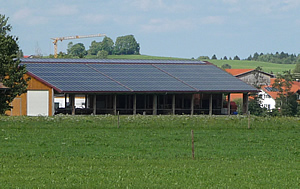
For a start, there are solar panels covering many roofs; the farmers get a subsidy for the installations and sell any surplus to the German National Grid. And then there are those windmills …. but the point is, they are usually motionless. There may be plenty of winter snow in this area, but there isn’t much wind.
Solar panels on cowshed ...
This confirmed my view that windmills in most places in Europe are never going to solve the energy shortage. They are contributing almost nothing now, and of course only produce anything at all when there’s wind. Full marks to the Germans for trying, but it’ll never be enough.
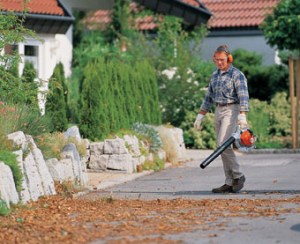
leaf-blower ....
Then as I rode through Oberthingau I saw a local resident blowing leaves off his forecourt with one of those “leaf-blower” machines …. This struck me as bizarre.
In truth, I’ve NEVER understood those things. What is the point? You blow the leaves from one place to another and later on when there is a little wind it’ll blow them straight back again. If he had been hoovering UP the leaves, fine, but blowing them from one place to another? Why not use a broom? And what have they got against leaves, anyway?
And I thought, on the one hand we are rushing around like headless chickens trying to think of ways of generating energy and on the other we are totally wasting it on ludicrous non-essentials.
As has been claimed and to my mind proven for Africa, what is needed is not giant, national and international projects (though more nuclear power-stations would help) but micro-projects for the masses, and especially a cosmic change in the mindset. You only have to look around to see examples of humungous waste of energy. Get rid for a start of most traffic lights! Dangerous? Errrmmm, no actually … experiments have shown that when there are no lights people drive more cautiously …. Get rid of those barriers on motorways that go up and down thousands of times every day. How many people actually drive through a toll barrier without paying? And even if they do, the operator can take their number and report them; why on earth do we need an energy-consuming barrier?
It’s individual mindsets that need to change … Do people really have to fire up their car to drive 300 metres to the baker’s on Saturday mornings? What happened to walking? The British “school run” is a classic example; kids are driven to school, don’t get enough exercise and so get fat, the roads are clogged up (and dangerous) and loads of CO2 is produced. Insane …..



 And if WWIII doesn’t start in the China Sea maybe it’ll be up in the frozen North as nations squabble over “their” territory.
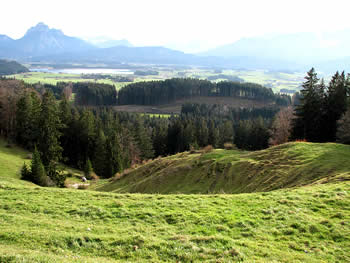 I went for a bike ride this afternoon ….. there is a super 6km circuit that goes from our village Unterthingau along a country road, up past a farm with magnificent views over the Allgäu countryside then along to Oberthingau and back home ….. On the way there are horses and cows munching happily in fields and of course the snow-capped Alps in the background …. The exercise and the fresh air were great, but during the ride I was struck by a couple of things. On the skyline in the direction of Kempten was – as usual – a line of a dozen wind turbines. All were – as usual – immobile, save one which was doing its best to turn languidly, and hardly succeeding.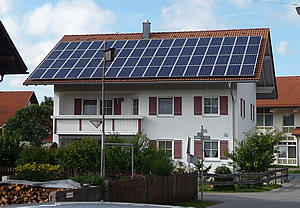
 Learning from Dogs