Tag: Economics

Consumer ‘safety’ for financial products

Are we missing a lesson that has been applied for years?

I have resisted any temptation to comment on the economic situation on Learning from Dogs. The contributions from others are based on far more knowledge and understanding of the subject then I will ever have.

However, I feel obliged to ask humbly for some clarification about something that bothers me. Are we putting the cart before the horse? Are we ignoring the relationship between provider and consumer in finance?

The regulatory regime applied to the vast majority of products which are allowed to be sold to the public is such that toasterthere are probably more stringent safety standards for an electric toaster than for most, if not all, financial products!

Much of the talk of regulation and restraint, in the current climate, seems to relate to remuneration of people working for financial organisations. But, why does it matter what they receive? In other fields, success is rewarded and the shareholders, admittedly fairly indirectly, have some say on the policy in that area. Why should they not pay what they wish?

On the other hand (to coin an economic phrase!),  the minimum standards of the products are set by regulators.

In other fields, if a supplier cannot demonstrate, to the satisfaction of the regulators, that its product meets specified safety standards, then that product is not allowed to be offered.

It is very simple! I am not referring to contracts, customer service, compensation and so on; I am referring to a threshold level of safety below which the product is not allowed to be sold or operated. Think: “cars”, “aeroplanes”, “electrical appliances”, “children’s toys”, and … well anything else!

To be even clearer, this is not about “perfect safety” which is, of course, not available at any price. This is not about blame. This is not about guarantees. It IS about inspection, testing, certification, regulation … oh and policing!

Can anyone explain why this approach cannot be applied to financial products? (Sherry attempts to here.)

By John Lewis

p.s. as chance would have it the image of the toaster at the head of this Post was taken from an article talking about a recall of the Viking Toaster – point made rather well, don’t you think?

Cash for Clunkers program a failure

The law of unintended consequences

It should come as no surprise to anyone that U.S. car companies are slumping once again.  The Cash for Clunkers program was a wasteful, inefficient publicity stunt or, worse, an actual attempt by the US Federal Government to stimulate the economy.  The worse part is that the program cost the economy jobs: many healthy, profitable dealerships had their company taken away from them by government edict under this program, never to return.  It’s almost criminal.

By Sherry Jarrell

A tax is a tax is a ….COST !

The role of taxes.

We’ve talked a lot about taxes as revenue to the Government and the inefficiency of government spending on this Learning from Dogs, but a far more important issue is the impact of taxes on the costs and output of businesses.

Any imposed cost to business is a “tax,” whether it’s called that or not.  And any tax is an additional cost to that business, which lowers its output, reduces employment, and raises prices of goods and services to you and me.

Read more about taxes

Sunflowers in the desert

Stop doing what you are doing and watch Jacqueline Novogratz!

Small things add up to make larger things! This concept of “integration” is seen everywhere that we look.

The subject and content of this presentation are fundamental to the future of the world. And the presenter is showing what can be done.

I found this presentation particularly poignant.

By John Lewis

The Plain Truth about Government Spending

Core differences about how society spends that really need to be understood.

Government spending is fundamentally a different animal than private spending!

Private spending is the essence of the freedom of choice.  When you mull over the decision to purchase an item, you are making a very personal decision based on your current income or resources, the prices of the other goods and services you currently purchase or may purchase, and your personal tastes, risk preferences, needs, and wants.

You make so many mental comparisons and tradeoffs when you consider a purchase that they truly cannot be listed.  And then you live with the consequences of your choice, for better or worse.  If bad, you learn.  If good, you enjoy.  And the process repeats itself every time you make a buying or investing decision, updated with new personal, private information on the circumstances, choices, and preferences of the individual.

Read more about spending

Health Care vs. Health Insurance

Being clear about the terms Care and Insurance when it comes to US health.

The issue for the day is the distinction between health CARE and health INSURANCE.

As we all know, they are not the same thing.  But, as we all have noticed, the two are often confused and the distinctions ignored by many, if not most, in the media, Congress, and the White House.

Health Care and Health Insurance are certainly interdependent. But it helps first to separate the two and take each in turn.

Let’s start with health insurance.  And let’s think of it first as just any “insurance,” like a policy on your house or car.

What is insurance?  It’s a contract that you buy to limit your losses if a bad event happens, even though the likelihood of the bad event occurring is usually very low.

Read more about this important issue

Rationing by Government or the Market?

Rationing.  First of all, what does rationing mean?

It means that there is a finite or limited supply of a good or service, and that not everyone will get all of it that they want.  Rationing can occur through the price that is charged for the good, or through limiting the quantity of the good by some centralized authority.

Yes, it is true that regardless of whether we get our health insurance from private insurers or from a government program, there is rationing.   But there is a huge difference between the type and scope of rationing by the market through price, and rationing by the federal government through control. When the service is rationed by an insurance company, a doctor, or a hospital, if we don’t like the decision, we have a recourse.  We have options. We have choices.  We can go to a different doctor, a different insurer, a different plan; we can report the company, sue the company, fire the company.

When your health care is rationed by government-sponsored single-payer health insurance, that’s it. If you don’t like the rationing decision, you can’t get “another government,” you can’t sue the government, you can’t fire the government, you can’t pay a higher price to get more services out of the government (not legally anyway).  You have no recourse.  The government decision is the end of the road.
So rationing in and of itself is not the point, is not the problem.  Government rationing is the problem.

By Sherry Jarrell

“What does economics mean?” by an economist

Keynes, macro economics and other terms need to be more widely understood.

Macroeconomics as a field is not very impressive, frankly.

In my view, it is more glorified accounting and policy than anything remotely related to testable economic theory!

Keynesian economics — the stuff that most macro courses are made of — smacks of a model created to justify a pre-conceived belief that government can run businesses better than private industry can.  Keynes spoke strictly of demand-side policies, namely fiscal and monetary policies, which create a large role for government intervention, as opposed to supply side policies, which basically get government out of the way by lowering taxes, fees, paperwork, and restrictions, and allow private industry to take risks and create value and manifest economic freedom.

Read more about economics

Another one of the few who saw the crisis coming.

Steve Keen – Associate Professor of Economics & Finance at the University of Western Sydney.

I know didly squat about economics.  I know a lot about the effect of economics in the sense of government policies, of inflation and debt, international trade and much more only in how they have impacted me over a lifetime of working, buying homes, raising a family, running a couple of businesses and now contemplating retirement.  I can sum up my personal strategy – LUCK!  I have been lucky.  The other Post out today shows an example of that luck.

Frankly, economists haven’t figured widely in my role call of people that I admired, probably because I don’t really understand what they are talking about.  (That’s why this Blog has a real live economist as part of the team, to help educate me and all the rest of the readers who come to this Blog!)

The other Post on this subject spoke of David Kauders, who clearly saw it coming.  Now here’s an economist who also saw it coming, Steve Keen.

Read more about Steve Keen

Unemployment, Part Three

How much is “too much” Unemployment?

How much unemployment “should” our economy have?  How much unemployment is too much, and how much is just right?  How high does the unemployment rate have to go before significant changes are made in government policy and approaches?

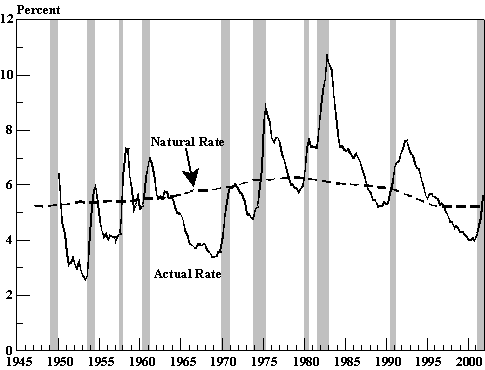
The question of the optimal level of unemployment has generally been answered by reference to the so-called “natural rate” of unemployment.  The natural rate of unemployment is measured as the long-run average rate of actual unemployment in an economy over time; it is a “trend line,” as seen in this graph below:

unemployment3

Read more of this Essay