Tag: Economic crisis

Lehman – 1 year on.

Exactly a year ago, Lehman Brothers filed for bankruptcy.

I shall avoid the temptation of pontificating on the subject as many, many others, far better qualified, will be doing so!Leyman

But two published articles seem to me to be worth visiting, one from October of 2008 from The Economist, and one from The New York Times.

Lastly, a personal comment from friend Dan that shows powerfully how the last year has affected him.

Read more of this Post

Now this makes sense, not!

US Government Policy encourages next round of foreclosures!

Call me crazy but I thought that the sudden rise in single-family home mortgage foreclosures that began a year or so back was one of the main causes of the current financial crisis.

And that many of these foreclosures resulted from families over-extending themselves, taking on too much debt given debttheir income and other financial obligations, in part because of incentive programs designed to reduce the upfront cost of the home and the monthly mortgage payments during the first several years of home ownership.
So why is Washington pushing to expand and extend the first-time home buyer tax credit?

Read more of this Post

Patrice Ayme and truth

Intelligence at the core of humanism

A while ago a comment on Baseline Scenario jumped off the screen at me.  I was intrigued because the author of this comment used words with power and insightfulness.  That author was Patrice Ayme.  It’s a nom de plume. [NB. Not it isn’t, see comments below] The sub-heading at the top of this Post is from his Blog.  Here’s an extract from the About section of that Blog.

This is a site that tries to find out what is really happening, and what is not, what is right and what is wrong, on many important questions, and in all sorts of ways. In other words thinking is applied relentlessly, the way evolution made it, as the ultimate instrument of domination of anything in sight (be it domination of oneself, of one’s own ideas and emotions, or domination of the universe). Thinking evolved to predict effectively and ambitiously, not to cower in a corner, modest and dazed. Prometheus’ punishment was a regrettable misunderstanding: we did not steal fire from someone, we created our mastery of fire, and fire made us what we are, as we wished. Mastering fire was not a sin, the Greco-Romans were wrong on that one. Fire was part of what we have evolved to be; masters of the universe, for better or worse.

Read more about Patrice

The Fed’s Bond Purchases and Inflation

Fed’s Kohn on Lessons from Buying Government Bonds….in Britain

Preface:

Recently Dr Jarrell, now a fellow author of this Blog as well as her own, debated the meaning of inflation.  That essay, in three parts, may be found in the list of Essays on the right hand side of this Blog.  This Post is an extract from a recent Post that Dr Jarrell presented on her own site and is presented here with the hope that, following the essay on inflation, this Post is more widely accessible to you, the reader.  Paul Handover.

Do read on

Well that’s clear then!

Conflicting views about the economic outlook

Here are two extracts:

The first from Prof. Nouriel Roubini in his RGE Monitor of today’s date:

A number of economic and financial variables have exhibited signs of improvement recently even if macro indicators are still mixed. The pace of economic deterioration has slowed significantly, and after four quarters of severe contraction in economic activity, RGE Monitor now forecasts that the U.S. will display positive real GDP growth in the second half of 2009. As discussed below, however, that does not mean that the recession in the U.S. is already over, as many analysts have argued. Indeed, all the variables used by the National Bureau of Economic Research (NBER) to date recessionary periods will continue to contract or display sub-par growth. However, RGE Monitor now anticipates that policy measures and other factors will boost real GDP growth, albeit in a temporary manner, in the second half of 2009. Yet the shape of the recovery (will it be V, U or W?) and other challenges will influence the U.S. economic outlook going forward. According to RGE Monitor, growth will remain well below potential in 2010, while the shape of the recovery will be closer to a U.

The second is from David Rosenberg in yesterday’s Breakfast with Dave:

Read more of this Post

UK employment figures.

No sign of green shoots here.

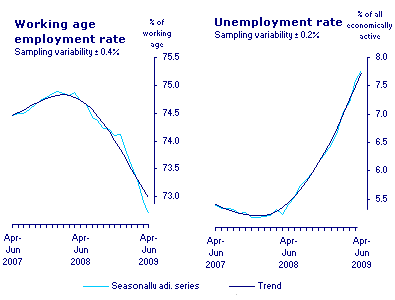
While these figures were published by the UK Office for National Statistics last Wednesday, first opportunity to comment on this Blog was today.  It’s not a pretty sight!

Employment figures, as reported Aug 2009

These trends look really nasty and not a hint of an upturn in employment or a lessening of the rate of increase in unemployment.

Read more of this Post

The sub-prime crisis

British humour

One aspect of British culture is their dry sense of humour.  In terms of satire, for over a decade three people have held pole positions: Rory Bremner, John Bird and John Fortune.  WikiPedia has a very good summary.

Bird and Fortune have also recorded a series of ‘interviews’ focusing on some of the idiocies of life.

Here’s a classic about the sub-prime crisis.  Slightly dated but no less funny for that.

More from these incredibly, clever guys from time to time.

By Paul Handover

The lessons in Chrysler?

Chrysler, investing, entrepreneurism and common sense.

Many, many years ago I went on a course on starting your own business.  It was held in London and caught my eye because just a few months previously I had resigned my sales job with IBM UK Ltd and commenced a journey of being self-employed, in the sense of being responsible for my own income. A 31-year journey that has provided so many riches in a non-financial sense.

Since we are talking about an event so long ago, it is not surprising that few memories are intact about that single day in a smart hotel in the centre of London.

BUT, one thing has stayed with me, and served me well.

Never get involved in a business where you don’t really know the marketplace.

So a recent article in the New York Times (Saturday, 8th August) about Cerebus, the private capital investment company that purchased Chrysler two years ago wasn’t short on lessons for us more down-to-earth guys.  Here’s a extract from the interview that Louise Story with the NYT (cool surname, by the way, for a journalist!) did with Steve Feinberg, co-founder of Cerebus, in his smart office on Park Avenue.

Continue reading “The lessons in Chrysler?”

California – not so free anymore!

It now costs more to insure California’s debt than Russia’s

There’s a rather technical piece published recently on Bloomberg.com about the cost of insuring debt in a number of countries.

Eleven years after Russia defaulted, investors want less to insure its debt than California’s. “This would have been impossible to imagine a year ago,” said Dimitry Sentchoukov, an emerging-market credit strategist at Dresdner Kleinwort in London.

Will the last person leaving the sunshine State, please close the door!

By Paul Handover

Economics ought to make sense?

Why economists seems just as confused as me.

We live in a world where finance and money play a hugely more important role in our everyday lives than, say, 25 years ago.  Well that’s how it seems.  Our energy costs don’t seem to be connected to supply and demand but more in the hands of the speculators.  Our house values have been greatly influenced, perhaps misaligned is a better word, by the availability of too easy money, resulting from exotic financial leveraging. Commodities are, like energy, traded for their own sake rather than to provide an efficient process of linking the grower with the consumer.  And more.

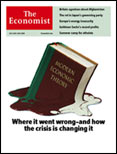
So it comes as a bit of a shock to read in a recent copy of The Economist that most of the theories and economic models are being ‘re-examined’ in the light of the current global crisis.  These theories and models are not esoteric ideas kept

The Economist July 18th 2009

within the scholarly walls of universities but used by Governments, investment institutions and banks so they affect you and I in the real world, big time!

They ought to work a great deal better than they do because they have the capability to harm, as millions have found out in the last 2 years.

Read more of this Post