Tag: Economic crisis

We may need a new term for Fed “Profits”

It’s more than semantics to understand what we mean by The Fed’s profits.

The Federal Reserve, it has been reported, earned record “profits” of over $46 billion in the year ending December 31, 2009.  The previous record profit was $34.6 billion in 2007. The Fed earned $31.7 billion in 2008. The financial crisis has apparently been very good for the Fed, although, as a non-profit entity, all its profits are turned over to the Treasury.  As an aside, I wonder what the Treasury plans to do with its windfall?Reduce taxes? Hmmm.

Be careful, however.  “Profits” are a bit of a misnomer for the Fed’s activities, because they pay for what they do by creating money out of thin air.  To buy a financial instrument such a treasury bill or mortgage-backed security, which is added to the left-hand-side of their balance sheet as an asset valued at cost, they create (and I do mean “create,” in the true sense of the word) an equivalent amount of deposits on the right-hand-side of their balance sheet. It does not “cost” them resources as it would you, or me, or a business.  The “expense” is deducts from revenues to arrive at this period’s profits consist mainly of employee salaries.  Fed BS Dec 2009

So if the Fed purchased a bunch of assets with reserves that they created, where do the “profits” come from?  Keep in mind, there are two major drivers of profits.  One is efficiency, or doing more with your resources. The second is pricing power, being able to charge an above-competitive price for a good or service either because you own something scarce or you make up the rules of the game.

First, two minor sources of income to the Fed are the interest and fees it charges for operating the financial system, such as check clearing and interbank electronic payments, and those it charged participants in the emergency loan programs it undertook to support credit cards and auto loans.

By far the largest source of revenue to the fed, however, came from its open market operations and the purchase of toxic assets.  The Fed had about $1.8 trillion in U.S. government debt and mortgage-related securities on its books by the end of 2009, four times the level in 2008, and the interest payments it collected on this huge pile of assets generated much of their (so-called) profits.  But interest payments are only one source of returns on financial assets. The other is “capital gains” or “price appreciation.”  If and when the Fed sells these assets, some of them considered “toxic,” there is a real risk that they will incur significant capital losses.   For example, the central bank recorded a $3.8 billion decline in the value of loans it made in bailing out Bear Stearns and AIG.

So the Fed’s profits are this period’s interest income minus the Fed’s minimal operating expenses; the capital base on which it earns income is basically “free.”  And all of these figures focus on one-period accounting entries, ignoring the huge potential negative stock of value the Fed’s activities are generating.

Don’t misunderstand. The Fed provides an invaluable service to the national and world economies, and they generally execute those services very well.  But when they begin to try to act like a business, replacing existing investment banking with their own activities, and parade around profit figures as if they meant the same thing as private industry profits, we must step back and take a moment to understand that Fed profits mean something entirely different from corporate profits.

By Sherry Jarrell
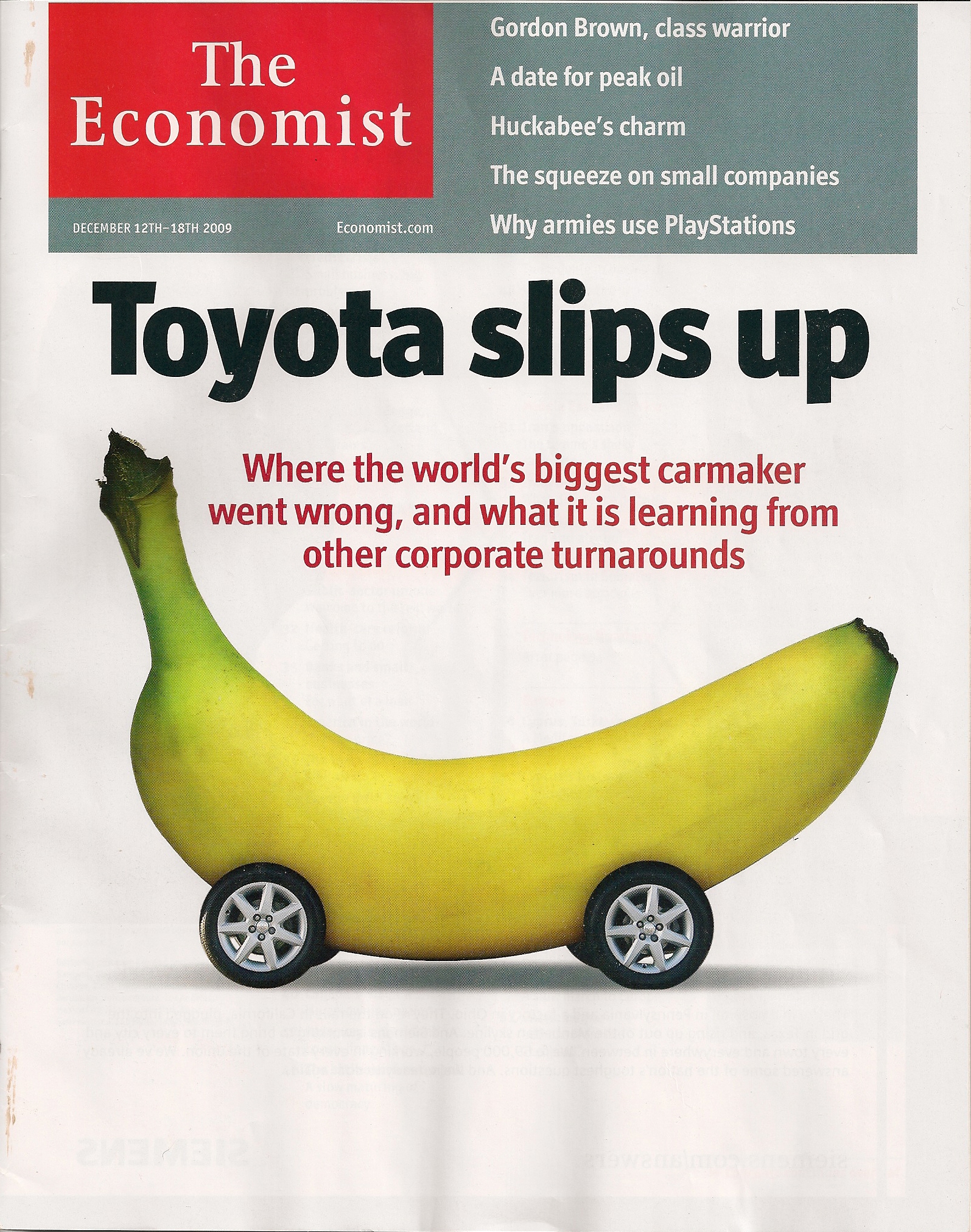
Bananas and common sense!

This is more than about the problems with Toyota.

The Economist is a newspaper.  It was first published in September 1843 which, of itself, makes it a notable newspaper.  Many years ago, more than I can recall just now, I became a subscriber to the newsprint version of this weekly paper.  It has become such a companion, so to speak, that when I left the UK in September 2008 to come to Mexico I made arrangements to continue receiving The Economist each week.

However, the Mexican postal system, despite being thoroughly reliable, is rather slow and, rather logically if you muse on it, the postman always only delivers when there is more than one item.  Thus the particular copy of The Economist that carried the story about Toyota arrived late and with three other editions!

Let me turn to the point of this article.

Read more of this Post

Establishing “cause and effect”

In this second of two posts on John Bougearel’s guest post at Naked Capitalism, Sherry Jarrell provides an economist’s response.

Response to “2010: Foreseeable and Unforeseeable Risks …”

In this wide-ranging and comprehensive piece, John Bougearel warns of the repercussions on the world economy of the steps taken to remedy the financial crisis.  He warns of the impact of the Federal Reserve absorbing the toxic assets and shaky collateral on its balance sheet, and of the unsustainability of Social Security and Medicare in an aging demographic.   On these basic facts, I agree.

One of the most difficult things for any writer to do when talking about economics and finance is to establish cause and effect.  In trying to analyze past policy decisions and recommend future actions, however, it is absolutely imperative to distinguish cause and effect.  In my view, Mr. Bougearel’s overview is either silent on this issue or implicitly assigns blame to the markets, when it belongs squarely on the doorstep of misguided government regulations. Continue reading “Establishing “cause and effect””

The Room For Policy Error is Enormous

In this first of two posts on John Bougearel’s guest post at Naked Capitalism, Paul Handover suggests that we read it and think about the implications.

A rather sobering reminder of the potential challenges for 2010

I am a subscriber to Naked Capitalism, thoroughly recommended by the way, and recently Yves published a guest post

John Bougearel

by John Bougearel, author of Riding the Storm Out and Director of Financial and Equity Research for Structural Logic.

I wrote to both Yves and John asking for permission to reproduce the article in full but, so far, no replies have been received.  Therefore the following are some important quotes from the article which I recommend you read in full by going to Naked Capitalism.

Read the rest of this Post

Speechless!

Maybe it’s me but at any level this appears to be very wrong!

Haldeman - Freddie Mac
Williams - Fannie Mae

The US Government put huge amounts of taxpayer’s money into the two huge US Mortgage companies Fannie Mae (Federal National Mortgage Association) and Freddie Mac (Federal Home Loan Mortgage Corporation).

Now the BBC has reported that:

The heads of US mortgage giants Fannie Mae and Freddie Mac may each receive pay packages of up to $6m (£3.7m) for 2009, depending on company performance.

Now I’m not an American nor do I really understand the issues BUT when taxpayers put in $111,000,000,000 of THEIR money into these organisations (that’s $365 for every man, woman and child on the US Census!) and so many of those same US taxpayers are up the proverbial financial creek without a paddle, there has to be a better way of rewarding top bosses (of US publicly owned corporations) than the option of $6,000,000 each!

But the regulator which decided the pay levels said the awards were 40% lower than before the government bailout.

The sums involved reflected the need to attract and retain talent, it argued.

Frankly, I just don’t believe that there aren’t many other incredibly capable business leaders who would do these jobs for a fraction of six million dollars.  (The present incumbents are Michael Williams at Fannie Mae and Charles E. Haldeman Jr. at Freddie Mac who will receive a base of $900,000 in 2010 with the opportunity to earn $5.1 more if “certain targets are met“.)

Read the article here – I’m going to lay down in a dark, quiet room for a while!

By Paul Handover

The Insanity of Medicare 2.0

US still struggling to find a proper health care solution

We’ve all heard this definition of insanity: doing the same thing over and over again but expecting a different result.

Here, in a nutshell, is the insanity of the current U.S. health care debate:

  1. Medicare, the government’s single-payer wealth redistribution health care program, is quickly going bankrupt.  No one disputes this fact.
  2. When President Obama refers to “cutting costs of healthcare,” he is referring to cutting the Medicare budget. Period.  No increased efficiencies, no improved services, no reduced market-clearing prices. No, cutting costs refers to reducing the fraction of the U.S. government’s tax collections devoted to Medicare.
  3. The new Health Care Plan is fundamentally a new Medicare program. Let’s call is Medicare 2.0.
  4. Medicare 2.0 is being funded in large part by cutting the current Medicare budget item. We are supposed to ignore the fact that the funds cut from the current Medicare program will be spent on Medicare 2.0.
  5. The Medicare 2.0 plan shifts as much as 25% of its (under)estimated costs (e.g. payments to physicians) to other accounts.  The costs are still there; these obligations would still need to be paid by the government under the proposed legislation, but Congress is hoping the public won’t “count” the shifted costs if they slap another name on them, further fostering the illusion of “lowering costs of health care.”
  6. Medicare 2.0 will also go bankrupt but, as a larger, more far-reaching entitlement program, the impact on the U.S. budget will be larger and more far-reaching.

By Sherry Jarrell

Forwards to bygone times!

Sign of the times?

Woodstove

We have been looking for ways of cutting down our energy requirements and coupled with trying to grow as many of our own veggies as possible, 2 small flocks of chickens for eggs, we have now acquired a reconditioned, wood-burning cooker.

It arrived last Wednesday and weighs in at just under a third of a ton. It was manoeuvred into place by 2 men, some planks of wood and a few rollers made from off-cut, scaffolding poles.

Our youngest son and I fitted the flue and fired it up on Thursday evening. What a transformation!

The quality of heat and ambience it creates in the kitchen/dining room is amazing. It is like being transported back to a bygone era where everything seemed less stressed and slower. Whoever gets up in the morning lights it first and it seems to be able to rise from cold to a useful temperature in 20 minutes. It uses a very small amount of wood to keep it in all day and we have switched off all the heating in the adjoining rooms. We cooked a roast dinner in it on Sunday and a load of mince pies plus bread over the weekend.

It’s not instant and it has its own foibles but we love it – a bit like most of us, I expect!

By Jon Lavin

Commercial Real Estate and the U.S. Financial System

This is not over yet, folks

The U.S. banking system remains vulnerable to sizeable potential losses as the housing market struggles to recover.

Estimates of these losses range from $500 billion to $1 trillion (£312 bn – £625 bn). The Federal Reserve Board is especially concerned about the impact of commercial real estate on many regional and small banks across the country.  Occupancy and rental rates continue to decline dramatically as 2009 draws to a close, and the worst seems yet to come.

Commercial real estate loans on banks’ balance sheets total almost $1.1 trillion dollars.  With near-term commercial real estate losses topping $100 billion, the Wall Street Journal estimates that as many as one-third of small and mid-size U.S. banks could experience financial distress.


Troubled banks restrict lending until they can raise more capital.  In this illiquid market, expect banks to fight for survival by raising lending rates, shortening maturities, and lowering loan amounts.  Credit will continue to shrink in the U.S., which spells big trouble for any economic recovery.

By Sherry Jarrell

Let’s Introduce Obama’s Left Hand to his Right

To post or … what to post?

As I was perusing the business press this morning, an article caught my eye:  “That would make a great post!” I thought to myself.  I continued reading through the rest of the articles, intending to go back to the one that piqued my interest to compose a comment.  Of course, when I went back, I could not find it!

Trouble internally

But in the process of looking for that particular paragraph, I noticed something troubling. Something that, should my students’ papers include the same, would bring their score down by a full letter grade, if not more.

Read more of this Post

Paul Krugman’s Endless Ego

A small challenge to a Nobel prize winner in Economics!

In a recent New York Times op-ed, Paul Krugman continues his boundless quest to become the “it” guy in the world of economics.  I have taken issue with his command of basic economic facts in the past — a gutsy, if not insane thing to do given the man was awarded a Nobel Prize in Economics.

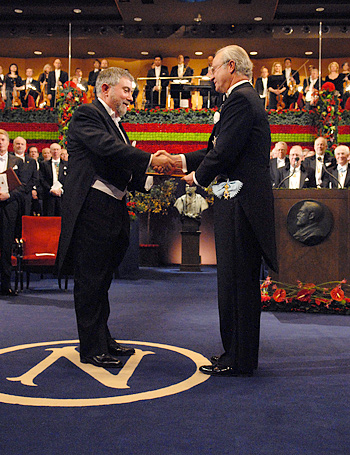
Krugman accepting the Nobel Prize

This post is more about ego than economics, however.

In this op-ed, Mr. Krugman says (and I kid you not),

But after the debacle of the past two years, there’s broad agreement — I’m tempted to say, agreement on the part of almost everyone not on the financial industry’s payroll — with Mr. Turner’s assertion that a lot of what Wall Street and the City do is “socially useless.” And a transactions tax could generate substantial revenue, helping alleviate fears about government deficits. What’s not to like?

Well, I disagree with the idea that what Wall Street does is socially useless.  And I am not on the financial industry’s payroll.

Nope, I’m just a simple economist, using my head, training, and experience to consider this idea, map out the pros and cons, and analyze the logical end-game of such a tax.  I conclude that it is a really bad idea.

Why?  There are lots of reasons, but I will mention only two.

  • One, raising taxes reduces private economic activity, which will curtail growth, reduce tax revenues and increase the deficit.
  • Two, taxes distort the price signal between suppliers and demanders of goods and services, including financial capital, reducing economic efficiency.

His reasons?  Other than citing one academic study (while ignoring the many others that reach a different conclusion), he gives no economic reasons for his views.  Instead, he make claims. He claims, for example, that “socially damaging behavior … caused our current crisis.”  He says that the financial services industry is “bloated” and needs to be cut down to size.   He says that the new tax is okay because it raises revenues for the government which, he claims, should make us all feel better about the deficit and, apparently, the size and nature of government spending under Obama. And, the lamest of all, for no other reason than to hide behind their skirt, he claims the existence of some phantom majority, apparently to create the impression that anyone with a different view is clearly in the minority.   A tactic that should be beneath a Noble Prize winner, but one that runs through his work with increasing frequency over time.

But, Mr. Krugman, I so disagree with you.  And even in an op-ed piece — perhaps especially in an op-ed piece – I believe that one needs to reign in an ego that would parade claims as facts, especially when each of those claims is disputed by your fellow economists, none of whom stooped so low as to imply that you were paid for your views.

By Sherry Jarrell