Tag: Drexel University

What makes us happy?

It is seemingly a simple question but in practice not so.

Listening to danger or telling others of a danger is a very ancient practice. For it is better to share a potential danger than not to. It was easy to look this up:

Modern sense of “risk, peril, exposure to injury, loss, pain, etc.” (from being in the control of someone or something else) evolved first in French and was in English by late 14c. For this, Old English had pleoh; in early Middle English this sense is found in peril. For sound changes, compare dungeon, which is from the same source.

Thus a post on The Conversation that was about happiness caught my eye.

I am delighted to share it with you.

ooOOoo

Philly psychology students map out local landmarks and hidden destinations where they feel happiest

Rittenhouse Square Park in Center City made it onto the Philly Happiness Map. Matthew Lovette/Jumping Rocks/Universal Images Group via Getty Images

Eric Zillmer, Drexel University

What makes you happy? Perhaps a good night’s sleep, or a wonderful meal with friends?

I am the director of the Happiness Lab at Drexel University, where I also teach a course on happiness. The Happiness Lab is a think tank that investigates the ingredients that contribute to people’s happiness.

Often, my students ask me something along the lines of, “Dr. Z, tell us one thing that will make us happier.”

As a first step, I advise them to spend more time outside.

Achieving lasting and sustainable happiness is more complicated. Research on the happiest countries in the world and the places where people live the longest, known as Blue Zones, shows a common thread: Residents feel they are part of something larger than themselves, such as a community or a city.

So if you’re living in a metropolis like Philadelphia, where, incidentally, the iconic pursuit of happiness charge was ratified in the Declaration of Independence, I believe urban citizenship – that is, forming an identity with your urban surroundings – should also be on your list.

A small boat floats in blue-green waters in front of a picturesque village.
The Greek island of Ikaria in the Aegean Sea is a Blue Zone famous for its residents’ longevity. Nicolas Economou/NurPhoto via Getty Images

Safety, social connection, beauty

Carl Jung, the renowned Swiss psychoanalyst, wrote extensively about the relationship between our internal world and our external environment.

He believed that this relationship was crucial to our psychological well-being.

More recent research in neuroscience and functional imaging has revealed a vast, intricate and complex neurological architecture underlying our psychological perception of a place. Numerous neurological pathways and functional loops transform a complex neuropsychological process into a simple realization: I am happy here!

For example, a happy place should feel safe.

The country of Croatia, a tourist haven for its beauty and culinary delights, is also one of the top 20 safest countries globally, according to the 2025 Global Peace Index.

The U.S. ranks 128th.

The availability of good food and drink can also be a significant factor in creating a happy place.

However, according to American psychologist Abraham Maslow, a pioneer in the field of positive psychology, the opportunity for social connectivity, experiencing something meaningful and having a sense of belonging is more crucial.

Furthermore, research on happy places suggests that they are beautiful. It should not come as a surprise that the happiest places in the world are also drop-dead gorgeous, such as the Indian Ocean archipelago of Mauritius, which is the happiest country in Africa, according to the 2025 World Happiness Report from the University of Oxford and others.

Happy places often provide access to nature and promote active lifestyles, which can help relieve stress. The residents of the island of Ikaria in Greece, for example, one of the original Blue Zones, demonstrate high levels of physical activity and social interaction.
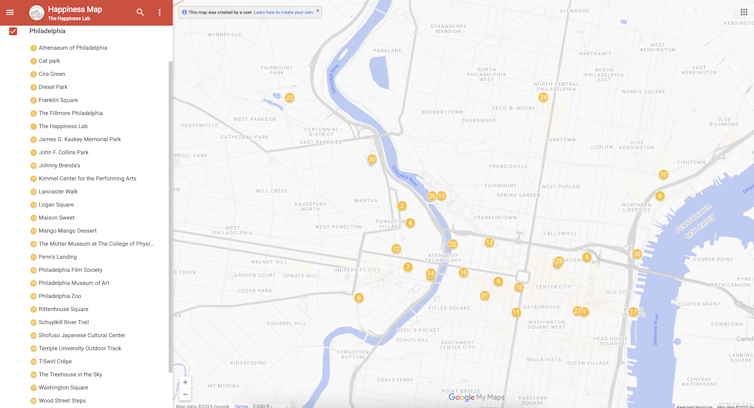
A Google map display on right with a list of mapped locations on the left.
A map of 28 happy places in Philadelphia, based on 243 survey responses from Drexel students. The Happiness Lab at Drexel University

Philly Happiness Map

I asked my undergraduate psychology students at Drexel, many of whom come from other cities, states and countries, to pick one place in Philadelphia where they feel happy.

From the 243 student responses, the Happiness Lab curated 28 Philly happy places, based on how frequently the places were endorsed and their accessibility.

Philadelphia’s founder, William Penn, would likely approve that Rittenhouse Square Park and three other public squares – Logan, Franklin and Washington – were included. These squares were vital to Penn’s vision of landscaped public parks to promote the health of the mind and body by providing “salubrious spaces similar to the private garden.” They are beautiful and approachable, serving as “places to rest, take a pause, work, or read a book,” one student told us.

Places such as the Philadelphia Zoo, Penn’s Landing and the Philadelphia Museum of Art are “joyful spots that are fun to explore, and one can also take your parents along if need be,” as another student described.

The Athenaeum of Philadelphia, a historic library with eclectic programming, feels to one student like “coming home, a perfect third place.”

Some students mentioned happy places that are less known. These include tucked-away gardens such as the John F. Collings Park at 1707 Chestnut St., the rooftop Cira Green at 129 S. 30th St. and the James G. Kaskey Memorial Park and BioPond at 433 S. University Ave.
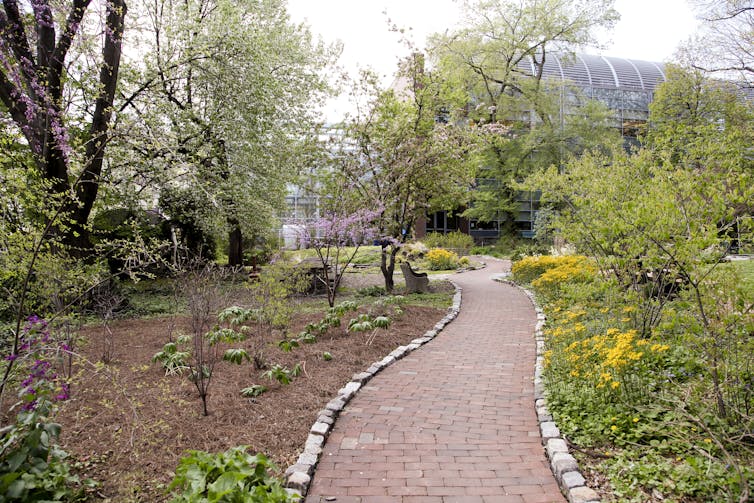
A stone-lined brick path extends through a nicely landscaped outdoor garden area.
The James G. Kaskey Memorial Park and BioPond in West Philadelphia is an urban oasis. M. Fischetti for Visit Philadelphia

My students said these are small, unexpected spots that provide an excellent opportunity for a quiet, peaceful break, to be present, whether enjoyed alone or with a friend. I checked them out and I agree.

The students also mentioned places I had never heard of even though I’ve lived in the city for over 30 years.

The “cat park” at 526 N. Natrona St. in Mantua is a quiet little park with an eclectic personality and lots of friendly cats.

Mango Mango Dessert at 1013 Cherry St. in Chinatown, which is a frequently endorsed happiness spot among the students because of its “bustling streets, lively atmosphere and delicious food,” is a perfect pit stop for mango lovers. And Maison Sweet, at 2930 Chestnut St. in University City, is a casual bakery and cafe “where you may end up staying longer than planned,” one student shared.

I find that Philly’s happy places, as seen through the eyes of college students, tend to offer a space for residents to take time out from their day to pause, reset, relax and feel more connected and in touch with the city.

Happiness principals are universal, yet our own journeys are very personal. Philadelphians across the city may have their own list of happy places. There are really no right or wrong answers. If you don’t have a personal happy space, just start exploring and you may be surprised what you will find, including a new sense of happiness.

See the full Philly Happiness Map list here, and visit the exhibit at the W.W. Hagerty Library at Drexel University to learn more.

Read more of our stories about Philadelphia.

Eric Zillmer, Professor of Neuropsychology, Drexel University

This article is republished from The Conversation under a Creative Commons license. Read the original article.

ooOOoo

For me, an Englishman living in Oregon, feeding the wild deer each morning gives me untold joy and happiness. It is my ‘personal happy space’.

So thank you, Prof. Zillmer, for writing this.

Chew on this!

Why it’s impossible to actually be a vegetarian!

Jean and I are both vegetarians. Indeed, Jean has been a ‘veggie’ for decades and I swung inline with her when we started being together in 2008.

So it was natural (pun unintended!) for my eyes to notice a recent item that was published over on The Conversation.

Not only is it an interesting article but it also saved my bacon (pun intended!) when I was running out of time and wondering what to post for today.

The article is republished here within the generous terms of The Conversation.

ooOOoo

Why it’s impossible to actually be a vegetarian

April 26, 2016

In a sense, aren’t they one and the same? 'Heads' via www.shutterstock.com
In a sense, aren’t they one and the same? ‘Heads’ via http://www.shutterstock.com

In case you’ve forgotten the section on the food web from high school biology, here’s a quick refresher.

Plants make up the base of every food chain of the food web (also called the food cycle). Plants use available sunlight to convert water from the soil and carbon dioxide from the air into glucose, which gives them the energy they need to live. Unlike plants, animals can’t synthesize their own food. They survive by eating plants or other animals.

Clearly, animals eat plants. What’s not so clear from this picture is that plants also eat animals. They thrive on them, in fact (just Google “fish emulsion”). In my new book, “A Critique of the Moral Defense of Vegetarianism,” I call it the transitivity of eating. And I argue that this means one can’t be a vegetarian.

Chew on this

I’ll pause to let the collective yowls of both biologists and (erstwhile) vegetarians subside.

A transitive property says that if one element in a sequence relates in a certain way to a second element, and the second element relates in the same way to a third, then the first and third elements relate in the same way as well.

Take the well-worn trope “you are what you eat.” Let’s say instead that we are “who” we eat. This makes the claim more personal and also implies that the beings who we make our food aren’t just things.

How our food lives and dies matters. If we are who we eat, our food is who our food eats, too. This means that we are who our food eats in equal measure.

Plants acquire nutrients from the soil, which is composed, among other things, of decayed plant and animal remains. So even those who assume they subsist solely on a plant-based diet actually eat animal remains as well.

This is why it’s impossible to be a vegetarian.

For the record, I’ve been a “vegetarian” for about 20 years and nearly “vegan” for six. I’m not opposed to these eating practices. That isn’t my point. But I do think that many “vegetarians” and “vegans” could stand to pay closer attention to the experiences of the beings who we make our food.

For example, many vegetarians cite the sentience of animals as a reason to abstain from eating them. But there’s good reason to believe that plants are sentient, too. In other words, they’re acutely aware of and responsive to their surroundings, and they respond, in kind, to both pleasant and unpleasant experiences.

Check out the work of plant scientists Anthony Trewavas, Stefano Mancuso, Daniel Chamowitz and František Baluška if you don’t believe me. They’ve shown that plants share our five senses – and have something like 20 more. They have a hormonal information-processing system that’s homologous to animals’ neural network. They exhibit clear signs of self-awareness and intentionality. And they can even learn and teach.

It’s also important to be aware that “vegetarianism” and “veganism” aren’t always eco-friendly. Look no further than the carbon footprint of your morning coffee, or how much water is required to produce the almonds you enjoy as an afternoon snack.

A word for the skeptics

I suspect how some biologists may respond: first, plants don’t actually eat since eating involves the ingestion – via chewing and swallowing – of other life forms. Second, while it’s true that plants absorb nutrients from the soil and that these nutrients could have come from animals, they’re strictly inorganic: nitrogen, potassium, phosphorus and trace amounts of other elements. They’re the constituents of recycled minerals, devoid of any vestiges of animality.

As for the first concern, maybe it would help if I said that both plants and animals take in, consume or make use of, rather than using the word “eat.” I guess I’m just not picky about how I conceptualize what eating entails. The point is that plants ingest carbon dioxide, sunlight, water and minerals that are then used to build and sustain their bodies. Plants consume inasmuch as they produce, and they aren’t the least bit particular about the origins of the minerals they acquire.

With respect to the second concern, why should it matter that the nutrients drawn by plants from animals are inorganic? The point is that they once played in essential role in facilitating animals’ lives. Are we who we eat only if we take in organic matter from the beings who become our food? I confess that I don’t understand why this should be. Privileging organic matter strikes me as a biologist’s bias.

Then there’s the argument that mineral recycling cleanses the nutrients of their animality. This is a contentious claim, and I don’t think this is a fact of the matter. It goes to the core of the way we view our relationship with our food. You could say that there are spiritual issues at stake here, not just matters of biochemistry.

Changing how we view our food

Let’s view our relationship with our food in a different way: by taking into account the fact that we’re part of a community of living beings – plant and animal – who inhabit the place that we make our home.

We’re eaters, yes, and we’re also eaten. That’s right, we’re part of the food web, too! And the well-being of each is dependent on the well-being of all.

From this perspective, what the self-proclaimed “farmosopher” Glenn Albrecht calls sumbiotarianism (from the Greek word sumbioun, to live together) has clear advantages.

Sumbioculture is a form of permaculture, or sustainable agriculture. It’s an organic and biodynamic way of farming that’s consistent with the health of entire ecosystems.

Sumbiotarians eat in harmony with their ecosystem. So they embody, literally, the idea that the well-being of our food – hence, our own well-being – is a function of the health of the land.

In order for our needs to be met, the needs and interests of the land must come first. And in areas where it’s prohibitively difficult to acquire the essential fats that we need from pressed oils alone, this may include forms of animal use – for meat, manure and so forth.

Simply put, living sustainably in such an area – whether it’s New England or the Australian Outback – may well entail relying on animals for food, at least in a limited way.

All life is bound together in a complex web of interdependent relationships among individuals, species and entire ecosystems. Each of us borrows, uses and returns nutrients. This cycle is what permits life to continue. Rich, black soil is so fertile because it’s chock full of the composted remains of the dead along with the waste of the living.

Indeed, it’s not uncommon for indigenous peoples to identify veneration of their ancestors and of their ancestral land with the celebration of the life-giving character of the earth. Consider this from cultural ecologist and Indigenous scholar-activist Melissa Nelson:

The bones of our ancestors have become the soil, the soil grows our food, the food nourishes our bodies, and we become one, literally and metaphorically, with our homelands and territories.

You’re welcome to disagree with me, of course. But it’s worth noting that what I propose has conceptual roots that may be as old as humanity itself. It’s probably worth taking some time to digest this.

ooOOoo

In reflecting on how to close this post I couldn’t help thinking that “The bones of our ancestors have become the soil, ” presumably includes the bones of our dogs! Leading me to ponder that maybe our dogs from old are nourishing our bodies; I would like to think that is the case.