Tag: Dog

Why we have cats and dogs!

Author Sue Miller perfectly articulates our relationship with dogs and cats.

As a rest to the number of non-fiction books that I have been reading over the past few months, Jean recommended a novel she recently finished, While I Was Gone, by Sue Miller.  It’s featured on Oprah’s Book Club, from which I quote,

About the Book

A decade ago she put a face on every mother’s worst nightmare with her phenomenal best-seller The Good Mother. Now, Sue Miller delivers a spellbinding novel of love and betrayal that explores what it means to be a good wife.

In the summer of 1968, Jo Becker ran out on the marriage and the life her parents wanted for her, and escaped–for one beautiful, idyllic year–into a life that was bohemian and romantic, living under an assumed name in a rambling group house in Cambridge. It was a time of limitless possibility, but it ended in a single instant when Jo returned home one night to find her best friend lying dead in a pool of blood on the living room floor.

Now Jo has everything she’s ever wanted: a veterinary practice she loves, a devoted husband, three grown daughters, a beautiful Massachusetts farmhouse. And if occasionally she feels a stranger to herself and wonders what happened to the freedom she once felt, or how she came to be the wife, mother, and doctor her neighbors know and trust–if at times she feels as if her whole life is vanishing behind her as she’s living it–she need only look at her daughters or her husband, Daniel, to recall the satisfactions of family and community and marriage.

But when an old housemate settles in her small town, the fabric of Jo’s life begins to unravel: seduced again by the enticing possibility of another self and another life, she begins a dangerous flirtation that returns her to the darkest moment of her past and imperils all she loves.

While I Was Gone is an exquisitely suspenseful novel about how quickly and casually a marriage can be destroyed, how a good wife can find herself placing all she holds dear at risk. In expert strokes, Sue Miller captures the precariousness of even the strongest ties, the ease with which we abandon each other, and our need to be forgiven. An extraordinary book, her best, from a beloved American writer.

Have to say that even though there’s an obvious gender difference between me, the heroine and the author, I found the book tough reading , as in emotional, from time to time.  Especially, the euthanasia of Arthur the dog towards the end of Chapter 7 – Jo is a vet.  A few paragraphs I just couldn’t read .  But then on page 137 in Chapter 8, comes this,

Pure bliss.

I stood in the center of the yard for a moment and tilted my head back to let the soft snow touch my face.  The dogs pranced and rolled for pure joy in the pale, gray-brown light.  They chased each other wildly.  I made snowballs and threw them; the dogs leapt and bit at where they’d disappeared.  As they played, their muzzles whitened, their paws pilled up.

I left them reluctantly and came back in.  Watson trailed me around as I did my chores, watching me soberly.  I shut him out of the cat room, where we had only two boarders.  I let one of them out to roam and use the litter pan while I checked its cage.  I put more food down.  Then I went back out and worked my way through the dogs’ cages.  Two of them had had accidents, so I cleaned up and changed their bedding.  Several of them had their own food, in cans – those dishes needed to be washed.  Water refreshed, kibbles set out for the others.

I went to the cat room, put the first cat back and let the other one out.  Then I called the reluctant dogs in.  Watson greeted each one like a tiny worried mother, licking at their snow, fussing about how they smelled.  Slowly I recaged them.  I released Lucky and let him go outside for his solitary run while I refilled his food and water dishes.  Three dogs needed medications.  I put the last cat back in, called Lucky inside, locked up.

And while I did all this, I thought only of them, of the dogs and cats, of their requests for affection, of their comical or passionate relationships to one another, of the performance of their bodily functions.  I was taken up by them and their life and energy, by what they needed and asked of me.  I let go of everything difficult or complex in my life.

It reminded me of my days at Dr. Moran’s, caring for the dogs and cats he boarded and treated.  It reminded me of what a comfort it had been to me, even just physical escape into the lives of animals.  As I was driving home, I thought of all this, and it seemed to me that I’d chosen work which offered me daily the presence of pure innocence, a forgiveness for all my human flaws.

the presence of pure innocence, a forgiveness for all my human flaws Impossible to add anything; so I won’t!
Paws of love

They are such wonderful, amazing creatures – man’s longest and best friend, the dog.

A couple of events caused me to be reminded about the preciousness of our relationship with the dog.  The first was coming across this article in The Boston Globe.  It is entitled, A friendly paw to a veteran and is all about how therapy dogs bring relief and joy to veterans.  Incidentally, the story was written by good friend to Learning from Dogs, Daniela Caride who has her own blog, The Daily Tail.  Here’s how that article opens,

NORTHAMPTON — Carter the Chesapeake Bay retriever, Sassy the Pomeranian, and Spyder the German shepherd spend most of their time playing, begging for treats, and getting belly rubs just like other pet dogs. But their unconditional love gains a purpose every time their owners take them to the hospital to visit veterans.

They are therapy dogs — canines trained to give affection to strangers — and they are becoming more popular in veteran facilities. An increasing number of dog owners are willing to volunteer at VA homes and hospices, where 6 million veterans get treated for acute and chronic health conditions. The service they provide is invaluable, health care specialists say.

Read the rest of it here.

The second event was coming across something that I wrote nearly three years ago.  Here it is in full.

The knowing eyes of your best friend

Pharaoh

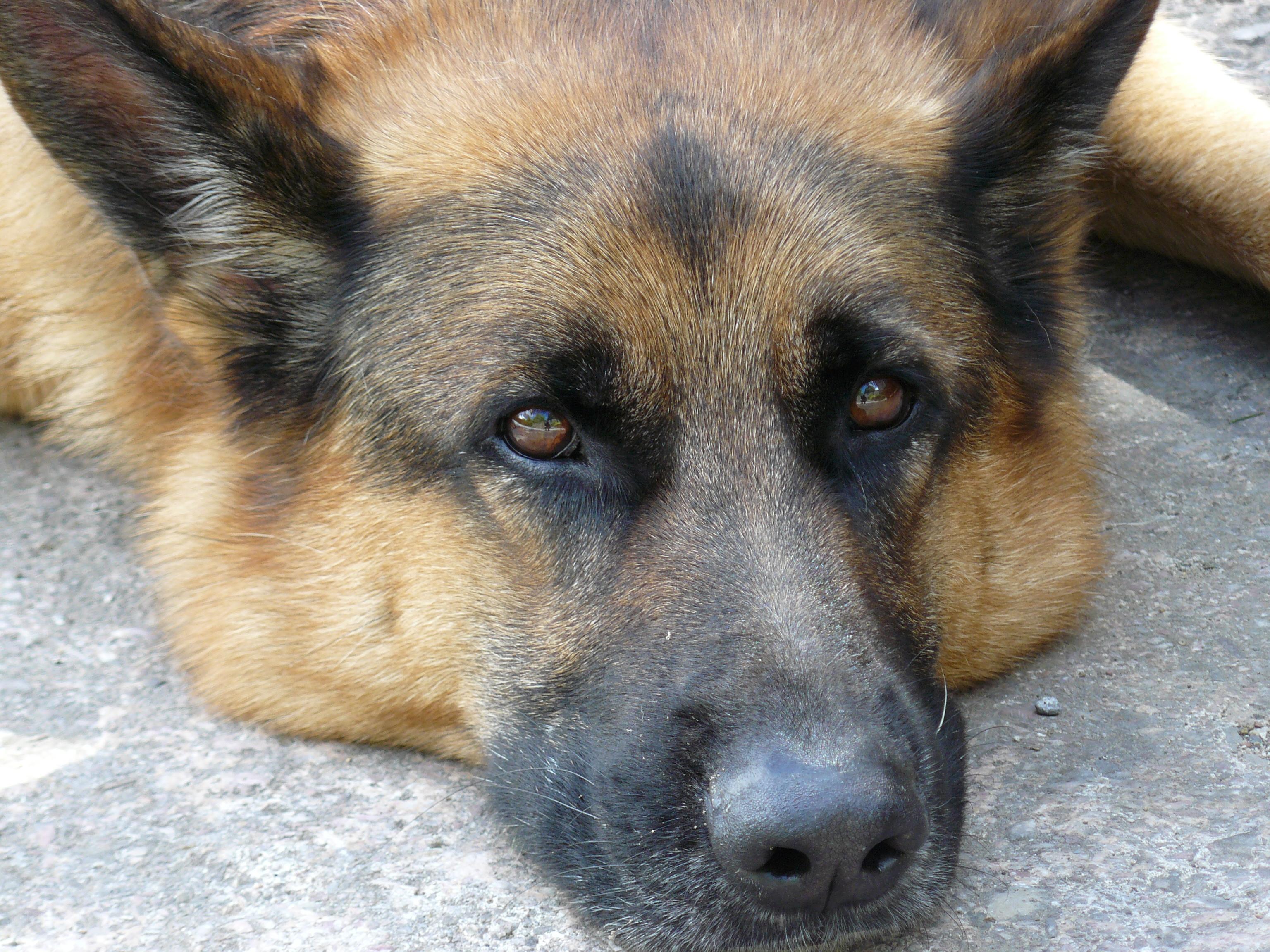
(Based on an article sent to me, unfortunately from an unknown author, and modified to reflect the special relationship that I have with my 4 year old German Shepherd, Pharaoh. Paul Handover, 14 September, 2007.)

I am your dog and have something I would love to whisper in your ear. I know that you humans lead very busy lives. Some have to work, some have children to raise, some have to do this alone. It always seems like you are running here and there, often too fast, never noticing the truly grand things in life.

Look down at me now. While you sit at your computer. See the way my dark, brown eyes look at yours.

You smile at me. I see love in your eyes. What do you see in mine? Do you see a spirit? A soul inside who loves you as no other could in the world? A spirit that would forgive all trespasses of prior wrong doing for just a single moment of your time?  That is all I ask.  To slow down, if even for a few minutes, to be with me.

So many times you are saddened by others of my kind passing on. Sometimes we die young and oh so quickly, so suddenly that it wrenches your heart out of your throat. Sometimes, we age slowly before your eyes that you may not even seem to know until the very end, when we look at you with grizzled muzzles and cataract-clouded eyes. Still the love is always there even when we must take that last, long sleep dreaming of running free in a distant, open land.

I may not be here tomorrow. I may not be here next week. Someday you will shed the water from your eyes, that humans have when grief fills their souls, and you will mourn the loss of just ‘one more day’ with me. Because I love you so, this future sorrow even now touches my spirit and grieves me. I read you in so many ways that you cannot even start to contemplate.

We have now together. So come and sit next to me here on the floor and look deep into my eyes. What do you see? Do you see how if you look deeply at me we can talk, you and I, heart to heart. Come not to me as my owner but as a living soul. Stroke my fur and let us look deep into the other’s eyes and talk with our hearts.

I may tell you something about the fun of working the scents in the woods where you and I go. Or I may tell you something profound about myself or how we dogs see life in general. I know you decided to have me in your life because you wanted a soul to share things with. I know how much you have cared for me and always stood up for me even when others have been against me. I know how hard you have worked to help me be the teacher that I was born to be. That gift from you has been very precious to me. I know too that you have been through troubled times and I have been there to guard you, to protect you and to be there always for you. I am very different to you but here I am. I am a dog but just as alive as you.

I feel emotion. I feel physical senses. I can revel in the differences of our spirits and souls. I do not think of you as a dog on two feet; I know what you are. You are human, in all your quirkiness, and I love you still.

So, come and sit with me. Enter my world and let time slow down if only for a few minutes. Look deep into my eyes and whisper in my ears. Speak with your heart and I will know your true self. We may not have tomorrow but we do have now.

There is no question that one of the important aspects of life that we can surely learn from dogs is the ability to stay in the present as much as we can.  Easier to write than accomplish, of course.  But letting go of the past (because it’s gone) and making the best of today as opposed to worrying about the future (because that interferes in the joy of today) is still a powerful reminder of that we would do well to keep close to our heart.

Racing in the Rain

A dog story for a man.

Thanks to Steve D. from the congregation here in Payson for mentioning this book.  Certainly one for my next Amazon order.

There’s a trailer on YouTube concerning the book, which is summarised as follows,

A heart-wrenching but deeply funny and ultimately uplifting story of family, love, loyalty, and hope, The Art of Racing in the Rain is a beautifully crafted and captivating look at the wonders and absurdities of human life . . . as only a dog could tell it.

So who is Garth Stein?  Well, of course, he has his own website, from which may be read,

Garth Stein is the author of the New York Times best selling literary novel, The Art of Racing in the Rain (Harper, 2008). Now published in 23 languages, The Art of Racing in the Rainwas the #1 BookSense selection for June, 2008, the Starbucks spring/summer 2008 book selection, and has been on the IndieBound™ bestseller list since its publication. Stein’s previous novel, How Evan Broke His Head and Other Secrets (Soho Press, 2005) won a Pacific Northwest Booksellers Association Award, and was a BookSense Pick in both hardcover and paperback. Raven Stole the Moon (Harper, 2010) was Stein’s first novel. He has also written a full-length play, Brother Jones, and produced a number of award-winning documentaries.

With an M.F.A. in film from Columbia University (1990), Garth worked as a documentary film maker for several years, and directed, produced, or co-produced several award winning films.

Born in Los Angeles and raised in Seattle, Garth’s ancestry is diverse: his mother, a native of Alaska, is of Tlingit Indian and Irish descent; his father, a Brooklyn native, is the child of Jewish emigrants from Austria. After spending his childhood in Seattle and then living in New York City for 18 years, Garth returned to Seattle, where he currently lives with his wife, three sons, and their dog, Comet.

There is also an adaptation for young persons,

Have you ever wondered what your dog is thinking?

Meet one funny dog—-Enzo, the lovable mutt who tells this story. Enzo knows he is different from other dogs. Every dog loves to chase cars, but Enzo longs to race them. He learns by watching TV and by listening to his best friend, Denny, an up-and-coming race-car driver, and his daughter, Zoe, his constant companion. Enzo finds that life just like being on the racetrack. For he sees that life, like racing, isn’t simply about going fast. And, by learning the tricks of racing against all odds, he takes on his family’s challenges and emerges a hero. Enzo holds in his heart the dream that Denny will go on to be a racing champion with his daughter right by his side. For theirs is an extraordinary friendship—one that reminds us all to celebrate the triumph of the human (and canine) spirit.

“The race is long. It is better to drive within oneself and finish the race behind the other than it is to drive too hard and crash.”

That’s the wisdom of Enzo, a dog with a lot to say about cars and life. When THE ART OF RACING IN THE RAIN — Garth Stein’s novel about Enzo and his owners — was published in 2008, readers immediately fell in love with Enzo, and the book has been a New York Times bestseller ever since. That’s because, once people finish reading the novel, they want to tell everybody about it.

Here’s a video of about 3 minutes where Garth Stein explains how he came to write the book.

Plus if you want a longer version, then the following is an  interview of Garth with Stacey Cochran on “The Artist’s Craft” on Raleigh Television Network Channel 10.

Dogs That Know When Their Owners Are Coming Home

What an amazing book this is.

Amazing!

I have written about Dr Rupert Sheldrake a few times on Learning from Dogs for pretty obvious reasons!  You can do a search on the Blog under ‘sheldrake’ but here are a couple of links.  Serious Learning from Dogs on January 10th, 2011 and Time for a rethink on the 14th April, 2011.

Anyway, I am now well towards the end of Sheldrake’s revised book, Dogs That Know When Their Owners Are Coming Home and it is more than fascinating.  Bit short of time just now so please forgive me if I do no more than show this video which sets out some of the background to the book.  Sheldrake’s website is here, by the way.

Dog love

The great gift that dogs grant us.

That is the ability to feel in our hearts and souls what unconditional love really is.  Both the giving and receiving of that unconditional love.

As regular readers know there has been a number of articles on Learning from Dogs in recent times about the relationship that we humans have with this genetic off-shoot of wolves with an origin literally in the mists of time.  So it is an honour to share with you all, a poem about a very special dog, written by the grandniece of a good friend of ours here in Payson.

That grandniece is Meg and her dog’s name is Siku.  Here is Meg’s love poem.

SIKU

My best friend in the whole world is Siku.

Siku is a smelly, thick-fur, cute type of dog.

Siku has a wet nose, round eyes and pointy ears like shark teeth.

She is a happy-go-lucky free-minded smart dog and I am so lucky to have her in my life.

She also is a fun-funny, hip-happy type of dog.

Siku is a run-running, camp-camping, playing games type of dog.

Siku loves to train with me, go sledding with me, and she loves to catch the squirrels and torture our poor little stressed-out cats.

When I am with Siku I feel like the whole world loves me.

I feel smart, cool, funny and loved.


SIKU and Meg.


This most beautiful of relationships

That of man and dog.

A number of items have crossed my screen that, together, present the most wonderful story of the intensity and length of the time that mankind has shared his life with the dog.

First is this piece from Anthropology.net from 2008 when this was big news.

A Possible Domestication Of Dogs During The Aurignacian: 31,700 Years Ago

Both Dienkes and John Hawks have shared news about the latest research on the domestication of dogs. The researchers analyze 117 skulls of prehistoric canids from sites in Belgium, Ukraine and Russia. They conclude that a 31,700 year old canid from Belgium is ‘clearly different from the recent wolves, resembling most closely the prehistoric dogs.’

The draft can be found in the Journal of Archaeological Science under the title, “Fossil dogs and wolves from Palaeolithic sites in Belgium, the Ukraine and Russia: osteometry, ancient DNA and stable isotopes.” If the dating, and phylogenetic analysis is correct, these remains makes them the oldest known remains of domesticated dog, pushing back domestication time by 17,700 years, since the second oldest known dog, found in Russia, dates to 14,000 years ago as explained by Carl Feagans.

Doral View of the Goyet Cave Dog (a) and wolf skulls (b & c)Doral View of the Goyet Cave Dog (a) and wolf skulls (b & c)

Prehistoric dogs are distinguished from both prehistoric and extant wolves in having a shorter and broader snout, relatively wider brain cases, and a general reduction in skull size. Palaeolithic dogs in the study conform to this pattern. The researchers extended their anatomical analysis to mtDNA and stable isotopes on the Belgian samples. All fossil samples yielded unique DNA sequences.

This is a fascinating article, read the rest of it here.

Next a further explanation of the history of the dog from About.com Archaeology:

Dog history is really the history of the partnership between dogs (Canis lupus familiaris) and humans. That partnership is based on human needs for help with herding and hunting, an early alarm system, and a source of food in addition to the companionship many of us today know and love. Dogs get companionship, protection and shelter, and a reliable food source out of the deal. But when this partnership first occurred is at the moment under some controversy.

Dog history has been studied recently using mitochondrial DNA, which suggests that wolves and dogs split into different species around 100,000 years ago; but whether humans had anything to do with that, no one really knows.

Just think about that – 100,000 years ago!  But even if one assumes that early man wasn’t linked to this species divergence, the hard evidence of dogs being special to man still goes back a very long way.  Continuing the piece above:

The oldest dog skull discovered to date is from Goyet Cave, Belgium. The Goyet cave collections (the site was excavated in the mid-19th century) were examined recently (Germonpré and colleagues, cited below) and a fossil canid skull was discovered among them. Although there is some confusion as to which level the skull came from, it has been direct-dated by AMS at 31,700 BP. The skull most closely represents prehistoric dogs, rather than wolves. The study examining the Goyet cave also identified what appears to be prehistoric dogs at Chauvet Cave (~26,000 bp) and Mezhirich in the Ukraine (ca 15,000 years BP), among others.

However, I am told that what the Goyet Cave skull represents is not a “domesticated dog” but rather a wolf in transition to a dog, and that the physical changes seen in the skulls (consisting primarily of the shortening of the snout) may have been driven by changes in diet, rather than specific selection of traits by humans. That transition in diet could well have been partly due to the beginnings of a relationship between humans and dogs, although the relationship might have been as tenuous as animals following human hunters to scavenge, rather like the behavior that is believed to have existed between humans and cats. You could argue that cats never have been domesticated, they just take advantage of the mice we attract

As they say, dogs have masters, cats have slaves! Millions of dog owners have a relationship with their dog that is close to spiritual, and that also isn’t new. Let’s read on:

A burial site in Germany called Bonn-Oberkassel has joint human and dog interments dated to 14,000 years ago. The earliest domesticated dog found in China is at the early Neolithic (7000-5800 BC) Jiahu site in Henan Province. European Mesolithic sites like Skateholm(5250-3700 BC) in Sweden have dog burials, proving the value of the furry beasts to hunter-gatherer settlements. Danger Cave in Utah is the earliest case of dog burial in the Americas, at about 11,000 years ago.

Haplotypes and Grey Wolves

A recent study led by Robert Wayne (vonHoldt et al., below) at UCLA and appearing in Nature in March 2010 reported that dogs appear to have a higher proportion of wolf haplotypes from grey wolves native to the Middle East. That suggests, contrary to earlier studies, that the middle east was the original location of domestication. What also showed up in this report was evidence for either a second Asian domestication or a later admixture with Chinese wolves.

Dog History: When Were Dogs Domesticated?

It seems clear that dog domestication was a long process, which started far longer ago than was believed even as recently as 2008. Based on evidence from Goyet and Chauvetcaves in Europe, the dog domestication process probably began as long ago as 30,000 years, although the oldest evidence for a broader relationship, a working relationship, is at the Bonn-Oberkassel site, 14,000 years ago. The story of dog domestication is still in transition itself.

14,000 years ago people buried a dog with a human!  That is so beautiful.

Finally, National Geographic have been showing a series on this wonderful relationship between man and dog.  Enjoy this introduction video.

What is the dog?

Time to attempt an answer to this fundamental, well for this Blog, question!


Like wolves, the Dingo is smarter than pet dogs.

(The above photograph comes from an article on ImpactLab – see foot of Post for more details.)

When putting together the Blog ahead of the publication of the very first Post on July 15th, 2009, some 820 Posts ago, I prepared some additional material that set out to justify the Raison d’être for the venture.  Included was a piece regarding Dogs and integrity.  There I wrote:

Dogs are part of the Canidae, a family including wolves, coyotes and foxes, thought to have evolved 60 million years ago.  There is no hard evidence about when dogs and man came together but dogs were certainly around when man developed speech and set out from Africa, about 50,000 years ago.  See an interesting article by Dr. George Johnson.

Anyway, I revisited the article written by Dr Johnson and thought it worthy of being published in full, as a separate article in Learning from Dogs.  I requested permission to reproduce the article in full and Dr. George Johnson was very gracious in quickly coming back to me giving his agreement.  Thank you.  The original article can be read here, the ONSCIENCE home page is here and Dr. Johnson’s details are here.

Evolution of the family dog

I first suspected that Boswell would have a short life when he bit my wife on our nuptial bed.

Boswell was my dog, a feisty Toto-like terrier who shared my bachelor bed and resented the intrusion of a woman where he felt a dog — Boswell — ought to be. As it turns out, my suspicion was correct, and he did not live out the year, which was 1982. Staying with others while I and my bride were overseas, Boswell resented being denied chicken bones, ate them anyway, and died of the consequences. To this day I miss him.

This week I found myself wondering about Boswell’s origins. From what creature did the domestic dog arise? Darwin suggested that wolves, coyotes, and jackals — all of which can interbreed and produce fertile offspring– may all have played a role, producing a complex dog ancestry that would be impossible to unravel. In the 1950s, Nobel Prize-winning behaviorist Konrad Lorenz suggested some dog breeds derive from jackals, others from wolves.

Based on anatomy, most biologists have put their money on the wolf, but until recently there was little hard evidence, and, as you might expect if you know scientists, lots of opinions.

The issue was finally settled in 1997 by an international team of scientists led by Robert Wayne of the University of California, Los Angeles. To sort out the evolutionary origin of the family dog, Wayne and his colleagues used the techniques of molecular biology to compare the genes of dogs with those of wolves, coyotes and jackals.

Wayne’s team collected blood, tissue, or hair from 140 dogs of sixty-seven breeds, and 162 wolves from North America, Europe, Asia, and Arabia. From each sample they extracted DNA from the tiny organelles within cells called mitochondria.

While the chromosome DNA of an animal cell derives from both parents, the mitochondrial DNA comes entirely from the mother. Biologists love to study mitochondrial DNA because of this simple line of descent, female-to-female-to-female. As changes called mutations occur due to copying mistakes or DNA damage, the mitochondrial DNA of two diverging lines becomes more and more different. Ancestors can be clearly identified when you are studying mitochondrial DNA, because clusters of mutations are not shuffled into new combinations like the genes on chromosomes are. They remain together as a particular sequence, a signature of that line of descent.

When Wayne looked at his canine mitochondrial DNA samples, he found that wolves and coyotes differ by about 6% in their mitochondrial DNA, while wolves and dogs differ by only 1%. Already it smelled like the wolf was the ancestor.

Wayne’s team then focused their attention on one small portion of the mitochondrial DNA called the control region, because it was known to vary a lot among mammals. Among the sixty seven breeds of dogs, Wayne’s team found a total of 26 different sequences in the control region, each differing from the others at one or a few sites. No one breed had a characteristic sequence — rather, the breeds of dogs share a common pool of genetic diversity.Wolves had 27 different sequences in the control region, none of them exactly the same as any dog sequence, but all very similar to the dog sequences, differing from them at most at 12 sites along the DNA, and usually fewer.

Coyote and jackal were a lot more different from dogs than wolves were. Every coyote and jackal sequence differed from any dog sequence by at least 20 sites, and many by far more.

That settled it. Dogs are domesticated wolves.

Using statistical methods to compare the relative similarity of the sequences, Wayne found that all the dog sequences fell into four distinct groups. The largest, containing 19 of the 26 sequences and representing 3/4 of modern dogs, resulted from a single female wolf lineage. The three smaller groups seem to represent later events when other wolves mated with the now-domesticated dogs. Domestication, it seems, didn’t happen very often, and perhaps only once.

The large number of different dog sequences, and the fact that no wolf sequences are found among them, suggests that dogs must have been separated from wolves for a long time. The oldest clear fossil evidence for dogs is 12,000 – 14,000 years ago, about when farming arose. But that’s not enough time to accumulate such a large amount of mitochondrial DNA difference. Perhaps dogs before then just didn’t look much different from wolves, and so didn’t leave dog-like fossils. Our species first developed speech and left Africa about 50,000 years ago. I bet that’s when dogs came aboard, when our hunter-gatherer ancestors first encountered them. They would have been great hunting companions.

I think Boswell would be happy to know his ancestor was a wolf. I doubt, however, I will ever be able to get my wife to overlook the biting as “wolf genetic baggage” inherited from nobel ancestors. In my house, science only stretches so far. © Txtwriter Inc

As so often happens, for reasons quite beyond me, when I am pursuing an article idea something else crops up that is highly relevant to my musings.  This was no exception.

A recent article in the Christian Science Monitor describes finding a fragment of dog bone in North America dating back some 9,400 years.  Here’s a flavour of that article.

By Associated Press / January 19, 2011

PORTLAND, MaineNearly 10,000 years ago, man’s best friend provided protection and companionship — and an occasional meal.

That’s what researchers are saying after finding a bone fragment from what they are calling the earliest confirmed domesticated dog in the Americas.

University of Maine graduate student Samuel Belknap III came across the fragment while analyzing a dried-out sample of human waste unearthed in southwest Texas in the 1970s. A carbon-dating test put the age of the bone at 9,400 years, and a DNA analysis confirmed it came from a dog — not a wolf, coyote or fox, Belknap said.

Because it was found deep inside a pile of human excrement and was the characteristic orange-brown color that bone turns when it has passed through the digestive tract, the fragment provides the earliest direct evidence that dogs — besides being used for company, security and hunting — were eaten by humans and may even have been bred as a food source, he said.

Belknap wasn’t researching dogs when he found the bone. Rather, he was looking into the diet and nutrition of the people who lived in the Lower Pecos region of Texas between 1,000 and 10,000 years ago.

The article then, a little later, goes on to say:

Dogs have played an important role in human culture for thousands of years.

There are archaeological records of dogs going back 31,000 years from a site in Belgium, 26,000 years in the Czech Republic and 15,000 years in Siberia, said Robert Wayne, a professor of evolutionary biology at UCLA and a dog evolution expert. But canine records in the New World aren’t as detailed or go back nearly as far.

Darcy Morey, a faculty member at Radford University who has studied dog evolution for decades, said a study from the 1980s dated a dog found at Danger Cave, Utah, at between 9,000 and 10,000 years old. Those dates were based not on carbon-dating or DNA tests, but on an analysis of the surrounding rock layers.

“So 9,400 years old may be the oldest, but maybe not,” Morey said in an e-mail.

Morey, whose 2010 book, “Dogs: Domestication and the Development of a Social Bond,” traces the evolution of dogs, said he is skeptical about DNA testing on a single bone fragment because dogs and wolves are so similar genetically.

My last extract is as follows:

Darcy Morey, a faculty member at Radford University who has studied dog evolution for decades, said a study from the 1980s dated a dog found at Danger Cave, Utah, at between 9,000 and 10,000 years old. Those dates were based not on carbon-dating or DNA tests, but on an analysis of the surrounding rock layers.

“So 9,400 years old may be the oldest, but maybe not,” Morey said in an e-mail.

Morey, whose 2010 book, “Dogs: Domestication and the Development of a Social Bond,” traces the evolution of dogs, said he is skeptical about DNA testing on a single bone fragment because dogs and wolves are so similar genetically.

Fascinating.

Finally, going back to the photograph at the top of the page, this came from an article here in ImpactLab.  It’s well worth a read.

Nature can be very cruel

This is a guest Post from Chris Snuggs, a good friend of Learning from Dogs.

Dog Pack Attacks Alligator In Florida

At times nature can be cruel, but there is also a raw beauty, and even a certain justice manifested within that cruelty. The alligator, one of the oldest and ultimate predators, normally considered the “apex predator”, can still fall victim to implemented ‘team work’ strategy, made possible due to the tight knit social structure and “survival of the pack mentality” bred into the canines.

See the remarkable photograph below courtesy of Nature Magazine.

Note that the Alpha dog has a muzzle hold on the gator preventing it from breathing, while another dog has a hold on the tail to keep it from thrashing.  The third dog attacks the soft underbelly of the gator.


This is pretty gruesome, so I have made a link to it instead
of showing it at once in case you would prefer not to see it.

More about Chris here.

Everything revolves around love.

This is not corny, this is at the heart of everything in life.

Nearly a month ago, I wrote a piece called The Power of Love.  It was offered as a logical argument in favour of love – read it if you want to see what was written.

In line with the general Blog theme on here that we have much to learn from dogs and unconditional love is the BIG lesson we should take from these noble animals, here’s a lovely story that was sent to me by a dear friend.

WHOEVER DID THIS IS A VERY BEAUTIFUL PERSON

The ‘whoever’ being someone at a dead letter office within the US Postal System.

Here’s how it goes.

Our 14 year old dog, Abbey, died last month. The day after she died, my 4 year old daughter Meredith was crying and talking about how much she missed Abbey.. She asked if we could write a letter to God so that when Abbey got to heaven, God would recognize her. I told her that I thought we could so she dictated these words:

Abbey and Meredith

Dear God,
Will you please take care of my dog? She died yesterday and is with you in heaven. I miss her very much. I am happy that you let me have her as my dog even though she got sick.
I hope you will play with her.. She likes to play with balls and to swim. I am sending a picture of her so when you see her You will know that she is my dog. I really miss her.
Love, Meredith

We put the letter in an envelope with a picture of Abbey and Meredith and addressed it to God/Heaven. We put our return address on it.. Then Meredith pasted several stamps on the front of the envelope because she said it would take lots of stamps to get the letter all the way to heaven. That afternoon she dropped it into the letter box at the post office. A few days later, she asked if God had gotten the letter yet. I told her that I thought He had.

Yesterday, there was a package wrapped in gold paper on our front porch addressed, ‘To Meredith’ in an unfamiliar hand.. Meredith opened it. Inside was a book by Mr. Rogers called, ‘When a Pet Dies..’ Taped to the inside front cover was the letter we had written to God in its opened envelope. On the opposite page was the picture of Abbey &Meredith and this note:

Dear Meredith,
Abbey arrived safely in heaven.
Having the picture was a big help. I recognized Abbey right away.
Abbey isn’t sick anymore. Her spirit is here with me just like it stays in your heart. Abbey loved being your dog. Since we don’t need our bodies in heaven, I don’t have any pockets to keep your picture in, so I am sending it back to you in this little book for you to keep and have something to remember Abbey by..

Thank you for the beautiful letter and thank your mother for helping you write it and sending it to me. What a wonderful mother you have. I picked her especially for you.
I send my blessings every day and remember that I love you very much.
By the way, I’m easy to find, I am wherever there is love.

Love,
God

[The book is available on Amazon here. I have no financial interest in providing you with the link. Ed.]

Thanks Julie for sending that in – it’s a very moving example of unconditional love and generosity.

By Paul Handover