Something new for the New Year – stories about dogs!
Preface.
Before I met Jean in December 2007, she had been rescuing feral dogs in the Mexican beach town of San Carlos for many, many years. Over those years, Jean must have rescued and found homes for 60 dogs or more. In the month that I met Jean, she had 12 dogs and 6 cats at her home. Ten months later, September 2008, I flew out to be permanently with Jean with my German Shepherd, Pharaoh – that’s him on the home page of Learning from Dogs – taking the total up to 13 dogs.
When we moved up to Payson, Arizona in February, 2010 we brought all 13 dogs and 6 cats with us, much to the amazement of the US Immigration officers at the US-Mexican border town of Nogales! Indeed, our particular officer left his booth excitedly to explain to his colleagues that our dogs and cats represented a border crossing record!
So many of the dogs that have passed through Jean’s loving arms have stories to tell. Thus over the coming months, Jean and I will offer you, dear reader, those stories.
Here’s the first, written by ‘Dog Lady’ Jean about gorgeous, sweet Paloma who, despite her age (Paloma that is!), is alive and well here in Payson.
* * * * * * * * * * *
Paloma, December 29th 2011
Paloma
The old white dog padded down the dusty pavement. Sway-backed and dull-eyed, her teats, heavy with milk, grazed the ground. An anonymous creature in a cruel world. The pavement sizzled in the afternoon Mexican summer sun blistering her tired feet, but she could not hurry. She had to conserve her energy. Her pups were soon coming and finding a safe place to give birth to them was her priority. The beach that had been her home was not a good place. .. needed cool shelter. She would find it.
She was alone among a sea of human legs in this scruffy Mexican beach town. No-one noticed her plight. No-one cared. She was used to it. She had long been adept at finding dried fish, discarded tortillas, sometimes a tasty morsel thrown by a tourist sunning in front of the big hotel.
This would be her eighth litter and she was very tired. As a puppy she belonged to a family with small children. There were plenty of leftovers. But when she became pregnant they drove her to the beach, threw her out and left her to fend for herself.
Her babies were always beautiful. She had Labrador in her genes donating a coat that was pure white. Humans always took her pups; she could only ever hope their fate was always a better one than hers.
Anonymity. She had perfected the art; never make eye contact, move low to the ground, escape the stray kick with a quick sideways leap.
She remembered at the very end of the long beach there was a house with a pool. Plenty of water. Onward she padded.
The lawn surrounding the pool was moist with sprinklers and the hibiscus hedge close to the house made a safe nest. Soon she had dug into the damp earth a big enough hole to curl into; it was cool under the canopy of red flowers.
A human voiced shouted, “Carlos, get that dog out of the hedge.” Then the long hose filling that tempting pool was turned on her and a burst of water hit her in the face. She uttered a low growl. Carlos, the gardener, backed away, “Señor, the dog, she is having babies.”
The owner of the house turned abruptly and went inside. He picked up his phone, made a call to the local English lady who over the years had acquired the nickname ‘Dog Lady’. He practically shouted down the phone, “I have a dog in my hedge having pups. You had better do something about it or I shall dispose of them, and I won’t be pretty about it!”
‘Dog Lady’ was used to this. Had been many years since she took on the practically impossible task of rescuing Mexican feral dogs and she was well-known for never turning a dog away. In less than 15 minutes, she had walked to the fine house overlooking the beach and quietly looked under the hedge. As anticipated, the dog was incapable of being moved, her focus entirely now on the safe birth of her pups. With appropriate feminine wiles, the white dog’s human saviour persuaded the disgruntled owner to allow the mother dog a stay of a few days. ‘Dog Lady’ promised that she would take them away as soon as possible.
“She’s a mean and wild dog, you’ll never tame her,” came the angry response from the house owner.
‘Dog Lady’ just smiled and said nothing.
But every day she took food to the white dog then sat quietly close by on the grass reading her book. The white dog had just the one pup, which ‘Dog Lady’ called Solovino, the Spanish for ‘comes alone’. The mother dog she called Paloma, Spanish for ‘Dove’. Many white dogs in Mexico were called Paloma and maybe years earlier that was what the children named her as the name did seem to resonate with this gentle dog.
Patiently, ‘Dog Lady’ moved closer and closer until Paloma would take meat from her hand, rapidly followed by allowing her ears to be caressed. Ten days later, while Paloma was eating, ‘Dog Lady’ picked up the little Solovino and put him into her car. Paloma’s response was immediate; she frantically ran to her child, her mothering instinct so great that she leapt without hesitation into this strange vehicle. Paloma and Solovino were safe.
The house owner graciously admitted that he had been taught a lesson in empathy and how sorry he was for being so rude and cruel.
Back at ‘Dog Lady’s’ home, a quiet sanctuary for so many dogs over the past years, Paloma and Solovino were quickly settled into a cool room. Paloma soon utterly trusted her ‘Dog Lady’ human companion and became the tame and loving dog she always wanted to be. Her shining eyes embraced her new world and she even regained her figure! Solovino grew quickly and found a wonderful family home in Tucson, Arizona.
Now some 6 years after ‘Dog Lady’ rescued Paloma from under that hedge, she is a beloved part of the Handover family. Indeed, she travelled in peace in February 2009 with her twelve dog friends from her sanctuary in San Carlos, Mexico to this dog paradise in the Arizonan forest just outside Payson.
When I was living back in South-West England, in the Totnes area, I had plenty of time to get to know Neil K. Neil has the most wonderful sense of humour and an ability to look at the world rather differently than the rest of us. I offer this tribute in acknowledgement of the great items that Neil passes to me for inclusion in Learning from Dogs. This one is no exception.
——————–
The Story of Adam & Eve’s Pets
Adam and Eve said, ‘Lord, when we were in the garden, you walked with us every day. Now we do not see you any more. We are lonesome here, and it is difficult for us to remember how much you love us.’
And God said, I will create a companion for you that will be with you and who will be a reflection of my love for you, so that you will love me even when you cannot see me.
Regardless of how selfish or childish or unlovable you may be, this new companion will accept you as you are and will love you as I do, in spite of yourselves.’
And God created a new animal to be a companion for Adam and Eve.
And it was a good animal and God was pleased.
And the new animal was pleased to be with Adam and Eve and he wagged his tail.
And Adam said, ‘Lord, I have already named all the animals in the Kingdom and I cannot think of a name for this new animal.’
And God said, ‘I have created this new animal to be a reflection of my love for you, his name will be a reflection of my own name, and you will call him DOG.’
And Dog lived with Adam and Eve and was a companion to them and loved them.
And they were comforted.
And God was pleased.
And Dog was content and wagged his tail.
After a while, it came to pass that an angel came to the Lord and said, ‘Lord, Adam and Eve have become filled with pride. They strut and preen like peacocks and they believe they are worthy of adoration. Dog has indeed taught them that they are loved, but perhaps too well.’
And God said, I will create for them a companion who will be with them and who will see them as they are. The companion will remind them of their limitations, so they will know that they are not always worthy of adoration.’
And God created CAT to be a companion to Adam and Eve.
And Cat would not obey them. And when Adam and Eve gazed into Cat’s eyes, they were reminded that they were not the supreme beings.
This is a guest post from Joelle Jordan. Let me broadcast my gratitude for this lovely story. For two reasons. The first is that Joelle is very generous in sharing her fine work and the second is that at the time of me putting this Blog post together, 4pm yesterday, I really needed a helping hand – have been short of time all week-end. So thank-you Joelle. Here’s her story.
————————-
Joy is a difficult commodity to come by these days. I don’t mean entertainment, I don’t mean a good laugh, I mean pure joy, where, even just for a single moment, all worries and doubts, frustration and anger are lifted as though by Atlas.
Like so many other humans in our world, I often find myself in a constant state of stress. There always seems to be something to worry about, whether it’s money, job fulfilment, the state of my relationships, getting the house cleaned, finding time to get to the market, and more. If given the chance, I know we all could spend nearly all of our waking hours (and some of our sleeping hours, too) worrying about something. We spend so much time on the many things that inevitably work themselves out, and so little time on things that will create a memory and a crystal moment of joy.
Jordan and Charlie
My little dog Charlie spends his time in the completely opposite fashion; spending his waking hours seeking joy, and committing less time to things that worry him.
Charlie seems to exist normally in three states of being; content, happy and utterly joyful. When I see him in an emotional state other than these, it nearly breaks my heart. I wonder why this little carefree being who brings such happiness to my life should be anything less than blissful at all times.
I notice something about how Charlie handles his stressful moments, however few and far between they may be. A recent example just occurred. My partner and I are teaching him how to behave on a leash. He has generally not given us any problems on a leash and took to the activity rather quickly. My partner can easily walk him to the corner and back, and he happily accompanies her, listening to her commands and responding, exploring his world in the safe company of his mama, creating a nice outing for them both.
However, his behavior closer to the house is less than stellar, barking at people (especially children who are frenetic and loud) and other dogs, generally forgetting that he is neither a big dog nor in charge of everyone, and just acting rather rude. A change in behavior from his human friend and he learned quickly that running after something and barking while on the leash earns him a very sudden and not so gentle stop, all powered by his own momentum, his harness jerking him off his paws and backwards. After the first incident or two, he ran back to me, the little boy that he is, placing his paws on my leg as I squatted down to him, burying his head in my chest. I assured him that he was fine and stroked him, and told him, “You can’t do that, buddy, see what happens?”
Here is where the story could turn into his utter contempt of the harness and leash. Rather, though, after a little stroking and encouragement, he became ready to try again. This time, instead of running and barking after the children at play in the neighbor’s yard, he calmly walked with me to the end of our driveway and then sat quietly and watched them shoot hoops. When it was time to go in, we walked back to the front door, accompanied by the cheering compliments of “Good job!” and pats from my partner. I saw him begin to walk a little taller and prouder, somehow understanding about a job well done and lesson learned. He trotted through the front door in search of his brother, our Chihuahua Jordan. His happy tongue dangled in wait for the promised treat. The stress he’d been seemingly engulfed in was simply released, gone. It was experienced and then just let go.
Perhaps I’m slightly jaded; after all, it was just a simple leash lesson. In truth, this little animal has no responsibilities except to be cute, not to pee in the dining room and not to chew on things. He has no bills to pay; his only worry is probably something vague about his supper. Sometimes, when letting them out of their crates, Charlie is less happy to see me (master, mama, food giver, spoiler) but is nearly bursting to get at and play with his big brother Jordan. Personal feelings (hurt and otherwise) aside, isn’t there a lesson to be learned here? He continues to teach me.
I watch his eyes. I have since I’ve known my little guy; I find them to be fascinating. In Merle’s Door, Ted Kerasote describes Merle as a “four eyed” dog; a dog that seems to have eyebrows (darker fur over his eyes ) that help express his feelings. Charlie is also a four-eyed dog.
Stanley Coren, the astute canine psychologist from the University of British Columbia, has also noted that these “four-eyed” dogs obtained their reputation for psychic powers “because their expressions were easier to read than those of other dogs. The contrasting-colored spots make the movement of the muscles over the eye much more visible.”
Case in point: the other morning Jordan had burrowed under an Indian blanket for it was a little chilly. Charlie, on the other hand, was in simple need of something: play. Jordan, however, was warming and had no interest. Charlie looked up at me, and held a conversation with me with only his eyes: Mom, make him play!
“He doesn’t want to play, bud, I’m sorry.”
He’s under the blanket! That’s the best time to play!
“But he doesn’t want to play right now, Charlie.”
Distraught. His eyebrows were high but off to the side, the classic cartoon expression of distress. If his lip could’ve quivered from holding back tears, it would have. A soft whimper.
How can that be?
It was a less than joyful moment for Charlie, but it was something out of my power to control. All I could do was redirect him. I enlisted him to come help me with the laundry. This is a favorite past-time of his because there are dryer sheets to be rooted out and torn to shreds. As I moved the clothes from the washer to the dryer, I saw that my boy had found his joy again but not in search of dryer sheets: he had jumped into the basket of dirty laundry and discovered a plethora of good and interesting smells, one of my t-shirts now covering his head like a scarf.
He was in heaven for probably the fourth or fifth time that morning.
————————-
Joelle in speaking about joy echoes a part of yesterday’s sermon that I hope to write a little about before the end of the week.
A couple of days ago, out of the blue, in came an email with this article attached. Was sure that Joelle and I didn’t know each other but so what! One of the lovely aspects of this wired-up world is the ease with which like-minded people can communicate. It’s a pleasure to publish Joelle’s story.
Charlie's first day!
I had been resistant to getting a new dog. We couldn’t afford one; we couldn’t afford the time to train a pup, the sleep deprivation, the continual puppy proofing the areas he would reside in, the contingent poop and pee cleanup. We couldn’t financially afford the shots, the toys, the food, the new crate. It was just too much stuff all at once, and we were just getting established as a couple and as a family.
That wasn’t the true reason I didn’t want a dog. I had been resistant because of a dog I’d had before, the dog I left behind. I loved this dog with all my heart, he was my “first.” I did not want to disrespect that dog by replacing him. I always questioned if my decision to leave him behind with my ex was right. My head always said yes, but my heart always said no. This left a war inside of me of enormous proportions that I could only allow to play out as it would, a sort of inner-Vietnam that ended only with withdrawal, but not with surrender.
So I put my foot down for a long time. “No, no dogs.” I would add the caveat the sake of mollification: “Not yet.” Maybe someday. Maybe someday I would be ready. Maybe someday our home situation would be perfect for a puppy. That would be when we could get a puppy: when we were independently wealthy and didn’t have to work and had all the time in the world to train a pup the proper way. Yeah, then.
I added another caveat to my “no dogs” edict: “I’ll know my dog when I see him.” I knew I would know the right dog for us when I saw him. It would be a chemical thing, like falling in love. I would not be swayed by cute fluff balls and wide expressive eyes. I would not be swayed by the tug of puppy teeth and the scent of puppy breath through a cage as we wandered through the aisles of a rescue. I would not be swayed; I would not be swayed until the perfect time when we were independently wealthy. In this way, I could save our money, our time, and my heart. I would just use my intuition (which I heretofore had never had) to know the when and the which one.
My partner continued to try to bend me, showing me pictures on the internet of homeless pups and rescue pups. She tried every breed; I saw terriers and shih tzus, Pomeranians and Pekinese, Maltese and min-pins. I saw every mutt with a happy, drooly, grinning face, and heard every sad story about why the owners could not keep said dog. And my response was always the same: “Oh, yes, he’s so cute, but no, not yet.”
What it came down to was that I was not ready to forgive myself. It’s not as though the dog I left behind wasn’t loved; I knew my ex loved him as much as I did. I didn’t leave him in some rat hole; it’s a two bedroom, one bath with a fenced back yard. But circumstances dictated that I leave, and leave my boy behind. Did that kind of behavior even warrant the luxury of having another dog again? I wondered in silence but responded with “No, not yet.”
Until one day, while trolling the internet for that love match for me yet again, my partner turned the screen towards me and said, “Baby, look.” Two males, pug crossed with dachshund, both auburn with black muzzles. Their mother had died shortly after birth and their father had gone missing.
I looked.
“Wow, they’re really cute,” I said.
I’m sure my partner was shocked that she didn’t receive my standard, “Oh, yes, they’re so cute, but no, not yet.” She could only pause and let me look at the picture.
“They’re only two hours away, and they don’t want a lot of money, just to cover the shots,” she offered.
“Yeah, they’re really cute,” I responded again.
Something in me said that’s your dog. I knew in theory that it would happen like that, but I was surprised that it actually did happen.
Two days later my partner and I were in the very nice home of some very nice people trying to rehome the last two of the surprise litter of their two lost but beloved house dogs. I sat cross-legged on the floor, and the daughter put the pups down about three feet from me. They were barely bigger than hamsters, just eight weeks old to the day. One of them walked right to me, as though he knew me, crawled in my lap, as though my lap were his home. The other had nothing to do with me, had nothing to do with either my partner or me. The first pup explored me, my fingers, tasting, smelling, intent. I looked up at my partner as I cuddled the warm ball of fur to my neck, and our eyes met. She smiled at me and fished through her purse for the nominal rehoming fee.
That little guy rode home most of the way with me, on my chest, staring into my eyes as I stared back into his. He studied me hard, calmly, gazing, as though memorizing. I thought perhaps that he was imprinting me (as I was him) but I think it was more than that, now that I think back on it. I think he was singing The Byrds, as sometimes he still sings, even now, softly, as he lays against my leg as I write this about him, “To everything, turn, turn, turn, there is a season, turn, turn, turn, and a time for every purpose under heaven.”
I’m sure all you lovely readers will agree that is a very moving story. Thank you Joelle.
Today, delighted to offer a guest post from author Garth Stein
Garth Stein and dog!
But first to how this came about. Way back in June, I was contacted by Wiley Saichek who signed off his email, Marketing Director, Authors On The Web. To be frank, I hadn’t heard of the organisation before. Wiley invited me to participate in something he called a Blog Tour on behalf of Garth Stein. It was connected with Garth’s latest book, The Art of Racing in the Rain.
Jeannie had read it some time ago and thoroughly enjoyed it. The book had been next to my side of the bed for weeks but, ironically, the demands of my own writing had just got in the way of me reading it.
Anyway, back to the Blog Tour!
Apparently, the ideal was to have the guest post published on Learning from Dogs during the period July 18th to August 1st but I dragged my heels waiting and hoping that the story from Garth could include a picture of Comet. The picture has not been forthcoming so here it is anyway. I shall be reviewing Garth’s book The Art of Racing in the Rain as soon as I can get around to reading it.
A Game Called Fetch, by Garth Stein
People often ask me about my dog, Comet. They want to know if she was the inspiration for Enzo, the dog narrator in my book, The Art of Racing in the Rain (and the young reader version, Racing in the Rain: My Life as a Dog). And the answer is, flatly, no. Enzo is a singular character, I tell them, and has no predecessor. Comet is goofy and silly, and is very much not Enzo. But she’s still very smart–in her own Comet way–and has taught me much about the world.
When Comet was just a pup, she hated being left at home; she didn’t like the responsibility of having the house to herself. She would always get into some mischief: eat an entire bunch of bananas, for instance (having peeled them first!). Or claw her way into the pantry looking for cookies. But one day, she communicated her anxiety in a way that was so clear, so unmistakable, there was no doubt at all as to her feelings. We went out for a couple of hours, confining her to the kitchen/dining area of our house. And when we came home, there was a perfectly round, undisturbed puddle of urine on the dining room table.
Now that is a statement. Message received. Since that day, whenever we get ready to leave her alone in the house, she willingly–one might saygratefully–finds her crate, curls up, and waits for us to secure the door.
While Comet may not be able to wax eloquently about philosophy and popular culture as Enzo does, she did teach me an important lesson this summer.
Comet loves playing fetch with a tennis ball. She always has. And she will run herself into the ground chasing balls, so that my arm gets sore throwing a ball for her with my Chuck-It, and I find myself neglecting my cooking duties, my lawn mowing, my reading, my writing, and even my children…all to throw a tennis ball for Comet.
This summer I purchased a GoDogGo. It’s a ball launcher with a bucket of tennis balls and a delayed feed, so one can teach one’s dog to play fetch with herself. A brilliant idea! The machine spits the ball, the dog fetches it, drops it in the bucket, the machine spits it again. Ad infinitum.
And so one weekend this summer, I decided to teach Comet how to use this machine so I could do other things that needed doing, like cleaning gutters and grilling chickens.
Well, she got the idea right away. Launch, fetch, drop. She was really quite good. And then I taught her launch, fetch, drop-in-the-bucket, prepare for re-launch. And she got that, too.
“I have the smartest tennis-ball-dog on the planet,” I thought. “She picked this up in ten minutes! Now I can go have an iced tea while she plays fetch with a ball throwing machine.”
But it didn’t work. As soon as I stepped away, she lost the thread. Ball launch, ball fetch, ball dropped in the bucket. Instead, she dropped it next to the bucket and stared at it while the machine ground its ball-throwing wheels in anticipation.
“Come on, Comet,” I said. “Drop it in the bucket!”
I dropped the ball in the bucket, the launcher launched, Comet fetched, and dropped the ball at my feet.
“In the bucket,” I said. She wagged, sat and barked and waited for me to drop the ball in the bucket.
I spent two days teaching her how to drop the ball in the bucket by herself. Sometimes she’d do it for me–so I knew it was possible!–but the moment I stepped away to attend to some other business, she lost her ability to drop the ball in the bucket. She’d stand over the ball and bark until I came to help her. It was a miserable time.
As Sunday evening arrived, my wife came outside to see how our training was going. I expressed to her my frustration. “She knows what to do,” I said. “She just won’t do it.”
My wife watched as I put the ball in the bucket and the launcher clicked, ratcheting up its gears. Comet had gotten to recognize the clicks that meant the ball would soon be launched, and she sunk to her haunches, tail wagging, staring at the launch tube. And then with a thwack! the ball sailed across the yard and she took off after it, recovered it, dropped it at my feet and barked happily.
“She won’t drop it in the bucket,” I said, bewildered. “She wants me to drop it in the bucket.”
My wife smiled at me my sympathetically. “Comet doesn’t want to play fetch with a machine,” she said. “She wants to play fetch withyou.”
And I realized, in my effort to make my life more efficient, in order to multi-task one more thing during a busy day, that playing fetch is not about economy and efficiency. It’s about playing fetch.
The ball launcher sits in the shed gathering dust these days, but the Chuck-It is always in use. And while Comet might like to spend every waking hour of every day playing fetch, she realizes that I have to put the ball down at some point to cook dinner or play with my family or write a book. But she’s okay with that. Because when we do play fetch together, that’s the only thing we’re doing–we are focused on each other, and that’s what the game is all about.
A recent item on the BBC website provides a welcome reminder of the power of the relationship between dogs and mankind.
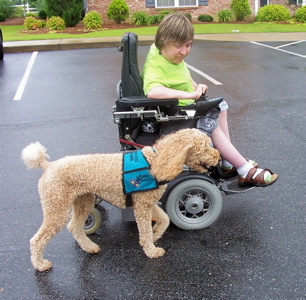
Practically no-one is unaware of the role that dogs provide, for example, as guides for humans with sight impairment. But there’s much more to the ‘service’ dog than that.
A service dog might be described as,
“any guide dog, signal dog, or other animal individually trained to do work or perform tasks for the benefit of an individual with a disability, including, but not limited to, guiding individuals with impaired vision, alerting individuals with impaired hearing to intruders or sounds, providing minimal protection or rescue work, pulling a wheelchair, or fetching dropped items.”
That definition is taken from the United States Code of Federal Regulations for the Americans with Disabilities Act of 1990!
Carrie and Lilly
But then cast your eye over this, as I mentioned, from the BBC on the 26th May, 2011.
Dogs can help reduce stress in parents of children with lifelong developmental disability autism, a study suggests.
The University of Lincoln compared 20 families with dogs with 20 without.
Daniel Mills told a Royal Society of Medicine conference early results suggested any breed could improve communication and relationships.
The veterinary behavioural medicine professor hopes to use video footage to show how dogs can improve child eating, sleeping and tantrum behaviour.
At a three-day Parents’ Autism Workshops and Support course, the families listed more than a thousand ways their dog had helped – from developing language and establishing a routine to using the pet to request action in a non-confrontational way.
Full story is here in which is included Professor Mills saying: “While there is no shortage of opinion on how dogs can help, there has been little money given to scientifically look into this.”
Autism is a challenging condition and anything that can establish a scientific underpinning for the role that dogs can have is to be welcomed whole-heartedly.
Finally, there are quite a few videos online that provide more information about the special, almost magical relationship between dogs and autistic people. Here’s one that is the first part of a series of five.
Stray dogs demonstrate remarkable skills at staying alive.
Before I start, a big word of thanks to Paul Gilding who passed this story to me. Apart from reading Paul’s powerful book, The Great Disruption, and exchanging a couple of emails, he doesn’t know me from Adam. But the fact that this undoubtedly busy man (his book has been a great success) not only responded to an earlier email from me and then dropped me a note to say that I might enjoy the following article, says a great deal about the integrity of the person.
The article, from the website The Dog Files, is about Moscow’s stray dogs. I’m taking the liberty of reproducing it in full.
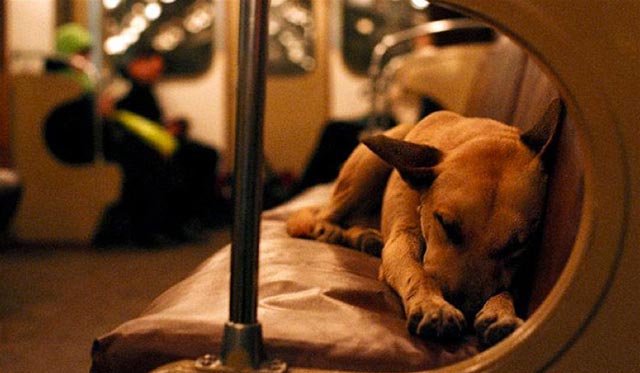
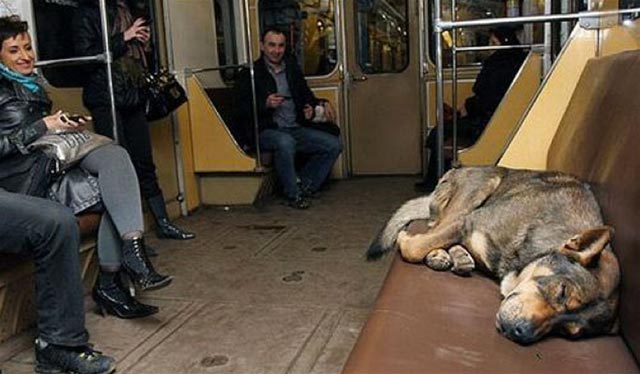
Each morning, like clockwork, they board the subway, off to begin their daily routine amidst the hustle and bustle of the city.
But these aren’t just any daily commuters. These are stray dogs who live in the outskirts of Moscow Russia and commute on the underground trains to and from the city centre in search of food scraps.
Then after a hard day scavenging and begging on the streets, they hop back on the train and return to the suburbs where they spend the night.
Experts studying the dogs, who usually choose the quietest carriages at the front and back of the train, say they even work together to make sure they get off at the right stop – after learning to judge the length of time they need to spend on the train.
Scientists believe this phenomenon began after the Soviet Union collapsed in the 1990s, and Russia’s new capitalists moved industrial complexes from the city centre to the suburbs.
Dr Andrei Poiarkov, of the Moscow Ecology and Evolution Institute, said: “These complexes were used by homeless dogs as shelters, so the dogs had to move together with their houses. Because the best scavenging for food is in the city centre, the dogs had to learn how to travel on the subway – to get to the centre in the morning, then back home in the evening, just like people.”
Dr Poiarkov told how the dogs like to play during their daily commute. He said: “They jump on the train seconds before the doors shut, risking their tails getting jammed. They do it for fun. And sometimes they fall asleep and get off at the wrong stop.”
The dogs have also amazingly learned to use traffic lights to cross the road safely, said Dr Poiarkov. And they use cunning tactics to obtain tasty morsels of shawarma, a kebab-like snack popular in Moscow.
With children the dogs “play cute” by putting their heads on youngsters’ knees and staring pleadingly into their eyes to win sympathy – and scraps.
Dr Poiarkov added: “Dogs are surprisingly good psychologists.”
Now had this been a normal day then I would have had the time to complete this story about the tenacity of dogs. But a failed wireless modem earlier today (Thursday) meant the loss of too many hours fighting technology. It was all sorted just a little before 5pm. It is now 6.15 pm and dinner is ready and, frankly, my brain is too tired to continue.
So stay with this fascinating story about stray dogs as I continue it tomorrow (Saturday, 20th.).
Over a couple of months ago, Tess was diagnosed with bone cancer, in the shoulder joint of her right front leg. The vet thought that she might have only a very few weeks to live, this particular form of cancer being aggressive.
As it happened, Tess kept going for much, much longer. But this morning (Wednesday at the time of writing) Jean made the agonising decision to end the pain for Tess. Despite a daily dose of strong pain-killer tablets, this morning Tess was breathing more laboriously and showing clear signs of tiring. It was time.
For me it was the first time that I had been with a loved animal that had to be euthanised and it was hard.
A few pictures to keep her memory alive.
Tess, far left (next to the plant pot), and friendsJean & Tess, a few moments before leaving.Dear Tess, you are out of pain and at peace.
Let me close with the same poem that was published when we lost our little Poppy,
“There is one best place to bury a dog.
“If you bury him in this spot, he will
come to you when you call – come to you
over the grim, dim frontier of death,
and down the well-remembered path,
and to your side again.
“And though you call a dozen living
dogs to heel, they shall not growl at
him, nor resent his coming,
for he belongs there.
“People may scoff at you, who see
no lightest blade of grass bent by his
footfall, who hear no whimper, people
who may never really have had a dog.
Smile at them, for you shall know
something that is hidden from them,
and which is well worth the knowing.
“The one best place to bury a good
dog is in the heart of his master.”
Ben Hur Lampman —
from the Portland Oregonian Sept. 11, 1925
A new book about dogs by John Bradshaw offers a theme for today.
Yesterday, I mentioned an article from the current issue of The Economist. Also in that issue was a review of a new book from John Bradshaw, called Dog Sense: How the New Science of Dog Behaviour Can Make You a Better Friend to Your Pet. You can read the review here. But in terms of the theme of today’s post, read this paragraph from that review,
Dogs are not like nicely brought-up wolves, says the author, nor are they much like people despite their extraordinary ability to enter our lives and our hearts. This is not to deny that some dogs are very clever or that they are capable of feeling emotion deeply. But their intelligence is different from ours. The idea that some dogs can understand as many words as a two-year-old child is simply wrong and an inappropriate way of trying to measure canine intellect. Rather, their emotional range is more limited than ours, partly because, with little sense of time, they are trapped almost entirely in the present. Dogs can experience joy, anxiety and anger. But emotions that demand a capacity for self-reflection, such as guilt or jealousy, are almost certainly beyond them, contrary to the convictions of many dog owners.
That last sentence is key, “But emotions that demand a capacity for self-reflection, such as guilt or jealousy, are almost certainly beyond them, contrary to the convictions of many dog owners.”
So in yesterday’s post, when I wrote about the terrible uncertainty that millions and millions of humans must be experiencing, there is no useful metaphor available to link this human idea to how the dogs feel; as John Bradshaw writes, this level of reflection is just beyond them.
We hug a dog (or any animal) to escape from matters complex. As Sue Miller wrote so beautifully, “I was taken up by them [pets] and their life and energy, by what they needed and asked of me. I let go of everything difficult or complex in my life. As I was driving home, I thought of all this, and it seemed to me that I’d chosen work which offered me daily the presence of pure innocence, a forgiveness for all my human flaws.”
So accept the gift of pure innocence that our pets give us.
But what ‘gift’ can we humans accept that relates to the very complex world that we humans see all around us?
What about hope? Let’s accept the gift of hope. As I wrote recently in an email to a friend (before the London riots burst upon our consciousness),
‘Hope’ is going to be the key message over the coming weeks and months because the feeling that the ‘end of the world is nigh’ is incredibly strong, well it is to me!
Of course, the ‘end of the world’ feeling is, as you well know from me, really the end of an era. But an era where for decades money has equalled power; ergo money has equalled control.
Now the speed of change must be terrifying to millions across the world. So out of that terror must come a new order, a new way of understanding that how we have treated our planet is a busted model and that it is time, indeed the 11th hour as it were, to find that new order, of love and sustainability with our planet, both in earthly and spiritual ways.
We must have faith in the hope that we are living through the chaotic transition from an era of greed and destruction to one where we have a future that goes on for thousands of years.







 Learning from Dogs