Is it me or does there seem to be a shift in overall awareness of our ‘new world’?
On the 30th May, I mentioned the concept of a new Anthropocene era for the second time, based on The Economist of the 28th May having it as a lead story. (The first mention was on the 16th May.)
Then a couple of days later, friend John H. here in Payson, drops off his copy of Newsweek for June 6th. Here’s the cover page.
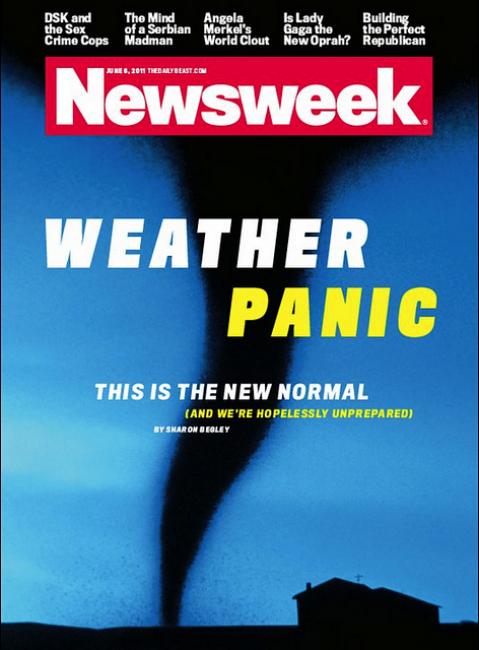
This is how the article runs, written by Sharon Begley,
Are You Ready for More?
In a world of climate change, freak storms are the new normal. Why we’re unprepared for the harrowing future.
Joplin, Mo., was prepared. The tornado warning system gave residents 24 minutes’ notice that a twister was bearing down on them. Doctors and nurses at St. John’s Regional Medical Center, who had practiced tornado drills for years, moved fast, getting patients away from windows, closing blinds, and activating emergency generators. And yet more than 130 people died in Joplin, including four people at St. John’s, where the tornado sucked up the roof and left the building in ruins, like much of the shattered city.
Then just a couple of paragraphs later, this pretty blunt summary,
From these and other extreme-weather events, one lesson is sinking in with terrifying certainty. The stable climate of the last 12,000 years is gone. Which means you haven’t seen anything yet. And we are not prepared.
Just read that again very carefully, “The stable climate of the last 12,000 years is gone.” Do take a few moments off and go here and read the full article. The last paragraph of which reads,
So what lies behind America’s resistance to action? Economist Sachs points to the lobbying power of industries that resist acknowledgment of climate change’s impact. “The country is two decades behind in taking action because both parties are in thrall to Big Oil and Big Coal,” says Sachs. “The airwaves are filled with corporate-financed climate misinformation.” But the vanguard of action isn’t waiting any longer. This week, representatives from an estimated 100 cities are meeting in Bonn, Germany, for the 2nd World Congress on Cities and Adaptation to Climate Change. The theme is “Resilient Cities.” As Joplin, Mo., learned in the most tragic way possible, against some impacts of climate change, man’s puny efforts are futile. But time is getting short, and the stakes are high. Says Daniel Sarewitz, a professor of science and society at Arizona State University: “Not to adapt is to consign millions of people to death and disruption.”
It’s a powerful article that can be read in full on the Newsweek website.
So, perhaps one might say at last, the notion that mankind’s impact on the Planet is real and capable of affecting practically all of us living on this beautiful Planet is becoming a ‘mainstream’ accepted idea.
More musings about this next Tuesday, 14th.
 Learning from Dogs