Personal musings on what ‘live for the day’ means.
Jeannie wakes early on in the morning; it’s one of the characteristics of Parkinson’s Disease (PD). So last Sunday morning I was washed and dressed by 5am (PST), and listening to the BBC’s World at One. (No connection with today’s post.)
Later on I started writing this post with a first look at what ‘live for the day’ means in the eyes of others. At first I wanted to research the phrase; imagine my surprise when I found out there wasn’t a consistent meaning.
Dictionary.com came up with Concentrate on the present, with little or no concern for the future.
Merriam-Webster gave live for meaning one of three things: lived for; living for; lives for.
The English-Collins dictionary, according to Wikipedia: The dictionary uses language research based on the Collins Corpus, which is continually updated and has over 4.5 billion words. But it did not easily give me any answer to my question.
Quora was too complicated for me to easily search for this phrase.
Thus I abandoned that approach.
I also did not reach out to friends and ask them what they thought of the saying. But, to me, that meaning from Dictionary.com seemed the closest to what I had in mind. So let me settle on that.
Concentrate on the present, with little or no concern for the future.
But how can Jeannie and me live without ‘concern for the future‘?
The list of things that we think about that involve the future is enormous. Many of the things are relatively minor, such as do we have enough food in the house, or petrol in the car, going on to do have I enough COB (Corn, Oats, Barley) to feed the deer that come here each morning, etc., etc.
Then there are future plans such as keeping next Tuesday clear (that is today, in fact) for Jeannie and Dordie to be out together for a few hours. Plus, in a few months time, my son is coming over to stay with us in April, and Richard coming in May. (Richard is a great British friend who was diagnosed with PD the same time as Jean.)
Then there is the task of keeping the trees within fifty feet of the house safe. That involves cutting down the trees that are getting old and trimming off the lower branches in the others. This is part of our desire to stay safe if a forest fire comes through this part of Merlin. We would be evacuated if that happened and part of our preparation is to have an ‘exit pack’ at the ready. Something else that affects our ‘concern for the future‘.
Finally in this list of introspections comes the ultimate end! I am in my 80th year and Jean and I find ourselves talking about death more often than we did at a younger age. Is that normal? I do not know. We are both humanists; I hope I will outlive Jean because I love her to pieces and want to be the last person she sees and embraces. It is one of the reasons that I go bike riding on a regular basis and staying as healthy as we can embraces the fact that we are both pescatarian and attend the local Club Northwest two days a week. Jeannie goes to the Rock Steady Class held at the Club.
So that is a pretty good set of reasons why living for the day is not viable.
ooOOoo
Footnote
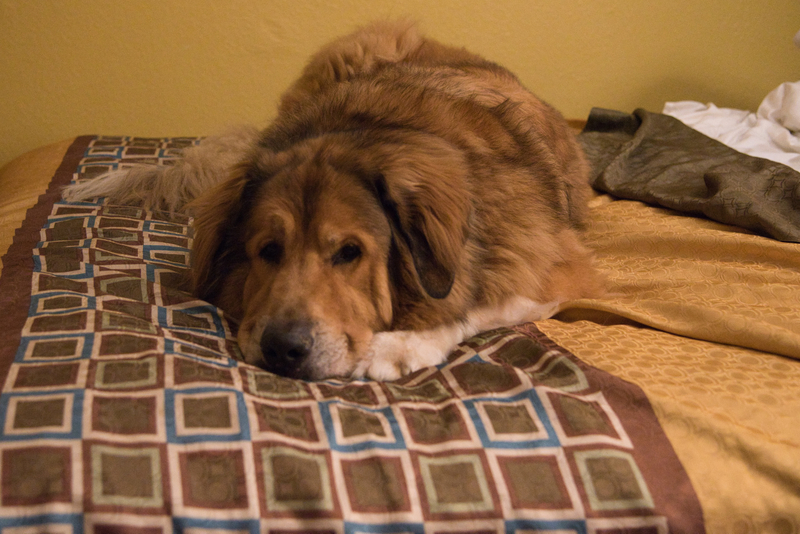
We lost our Brandy yesterday morning. He went out for his usual ‘whatever’ at a little after 5am and after he had been back in the house for no more than a minute, he shook his head and went to the front door to be let out again! I thought he had gone out for a poo.
After I was washed and dressed, but it was still dark, I started to look for him aided by my big torch. I could not see him anywhere. To cut a long story short here we are at 4pm and he hasn’t surfaced. My speculation was that his head shake was a brain problem and then he lost all sense of where he was. To continue that speculation, I believe he ended up being swept away in Bummer Creek, that crosses our property just in from the main gate, and was drowned.
For most of us these days old age is part of the scene (and I am classifying old age as being over 70 years). Here are a few facts from the website of the World Health Organization.
Key facts
Worldwide obesity has nearly tripled since 1975.
In 2016, more than 1.9 billion adults, 18 years and older, were overweight. Of these over 650 million were obese.
39% of adults aged 18 years and over were overweight in 2016, and 13% were obese.
Most of the world’s population live in countries where overweight and obesity kills more people than underweight.
39 million children under the age of 5 were overweight or obese in 2020.
Over 340 million children and adolescents aged 5-19 were overweight or obese in 2016.
Obesity is preventable.
What are obesity and overweight Overweight and obesity are defined as abnormal or excessive fat accumulation that may impair health.
Body mass index (BMI) is a simple index of weight-for-height that is commonly used to classify overweight and obesity in adults. It is defined as a person’s weight in kilograms divided by the square of his height in meters (kg/m2).
Adults
For adults, WHO defines overweight and obesity as follows:
overweight is a BMI greater than or equal to 25; and
obesity is a BMI greater than or equal to 30.
BMI provides the most useful population-level measure of overweight and obesity as it is the same for both sexes and for all ages of adults. However, it should be considered a rough guide because it may not correspond to the same degree of fatness in different individuals.
World Health Organisation
This is the link for anyone who wants to use the BMI Calculator.
Now this is not a post about obesity or being overweight. It is a post taken from The Conversation about staying as healthy as one can in one’s older years.
ooOOoo
Steep physical decline with age is not inevitable – here’s how strength training can change the trajectory
Raise your hand if you regularly find yourself walking up a flight of stairs. What about carrying heavy bags of groceries? How about picking up your child or grandchild? Most of us would raise our hands to doing at least one of those weekly, or even daily.
As people age, it can become more and more difficult to perform some physical tasks, even those that are normal activities of daily living. However, prioritizing physical fitness and health as you get older can help you go through your normal day-to-day routine without feeling physically exhausted at the end of the day.
It can also help you continue to have special memories with your family and loved ones that you might not have been able to have if you weren’t physically active. For example, I ran two half-marathons with my dad when he was in his 60s!
I am an exercise physiologist who studies how people can use resistance training to improve human performance, whether it be in sports and other recreational settings, in everyday life, or both. I am also a certified strength and conditioning specialist. My career has given me the opportunity to design exercise programs for kids, college athletes and elderly adults.
Staying physically active as you get older doesn’t need to include running a half-marathon or trying to be a bodybuilder; it could be as simple as trying to get through the day without feeling winded after you go up a flight of stairs. Although our muscles naturally get weaker as we age, there are ways we can combat that to help improve quality of life as we get older.
From left are the author’s father, who was age 61 at the time, the author’s wife and the author after completing the Lincoln Half Marathon. Zachary Gillen, CC BY-NC-ND
Muscle loss and chronic disease
One of the most important parts of exercise programming, no matter who I am working with, is proper resistance training to build muscle strength. Some amount of age-related loss of muscle function is normal and inevitable. But by incorporating resistance training that is appropriate and safe at any ability level, you can slow down the rate of decline and even prevent some loss of muscle function.
In one of our team’s previous studies, we saw that otherwise healthy individuals with sarcopenia had issues delivering vital nutrients to muscle. This could lead to greater likelihood of various diseases, such as Type 2 diabetes, and slow down recovery from exercise.
Recent estimates suggest that sarcopenia affects 10% to 16% of the elderly population worldwide. But even if a person doesn’t have clinically diagnosed sarcopenia, they may still have some of the underlying symptoms that, if not dealt with, could lead to sarcopenia.
Strength training is key
So the question is, what can be done to reverse this decline?
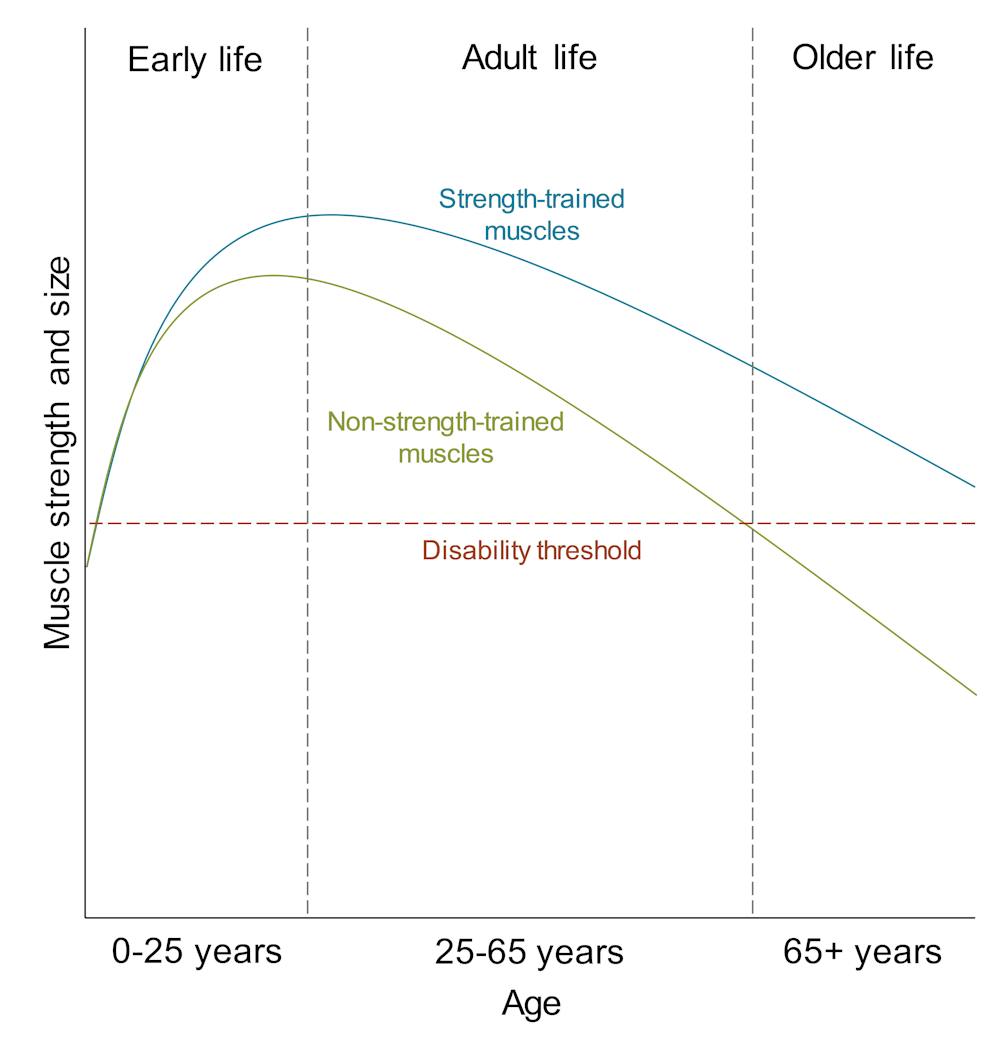
Recent evidence suggests that one of the key factors leading to sarcopenia is low muscle strength. In other words, combating or reversing sarcopenia, or both, may be best done with a proper resistance-training program that prioritizes improving strength. In fact, the decline in muscle strength seems to occur at a much faster rate than the decline in muscle size, underscoring the importance of proper strength training as people age.
Typical age-related changes in muscle strength and size with and without strength training. Zachary Gillen
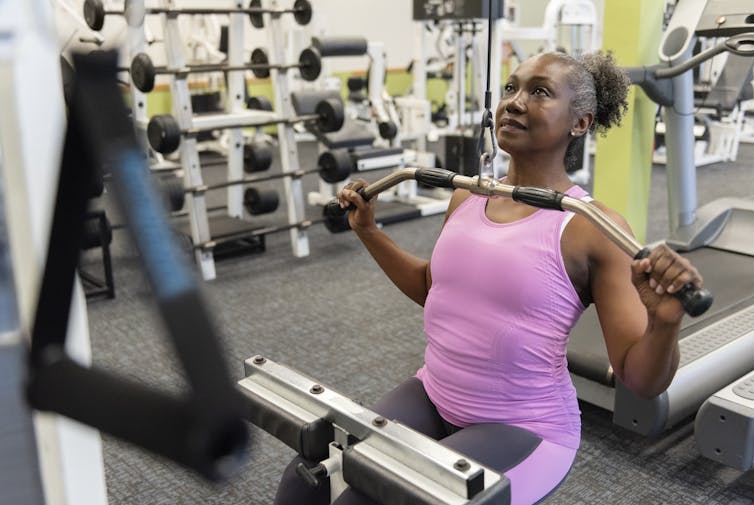
Continuing to regularly strength train with moderate to heavy weights has been shown to be not only effective at combating the symptoms of sarcopenia but also very safe when done properly. The best way to make sure you are strength training properly is to seek out guidance from a qualified individual such as a personal trainer or strength and conditioning specialist.
Despite the clear benefits of strength training, it’s been shown that only about 13% of Americans age 50 and older do some form of strength training at least twice a week.
Finding what works for you
So how does a person properly strength train as they age?
The National Strength and Conditioning Association, a leading organization in advancing strength and conditioning around the world, states that for older adults, two to three days per week of strength training can be incredibly helpful for maintaining healthy muscle and bone and combating a number of chronic conditions.
The organization recommends that these workouts involve one to two exercises involving multiple joints per major muscle group, with six to 12 repetitions per set. These are done at an intensity of 50% to 85% of what’s known as one-repetition maximum – the most weight you could handle for a single repetition – with the exception of body weight exercises that use one’s own body weight as the resistance, such as pushups.
I would also recommend resting for about two to three minutes between sets, or even up to five minutes if the set was challenging. For older adults, particularly those age 60 and older, the National Strength and Conditioning Association guidelines suggest that a program like this be performed two to three days per week, with 24 to 48 hours between sessions.
An example of a strength training routine for older adults based on the National Strength and Conditioning Association guidelines
There are a great variety of exercises that could be done interchangeably in a strength training program like this.
The guidelines above are only one example out of many options, but they provide a framework that you can use to build your own program. However, I would highly recommend seeking out a professional in the field to give specific exercise programming advice that can be tailored to your own needs and goals as you age.
Following such a program would give your muscles an excellent stimulus to enhance strength, while also allowing enough recovery, a very important consideration as people age. You might think it looks like a huge time commitment, but an exercise routine like this can be done in less than an hour. This means that in less than three hours of strength training per week you can help improve your muscle health and reduce the risk of getting sarcopenia and associated health issues.
It’s also important to note that there is no one right way to do resistance training, and it needn’t involve traditional weight equipment. Group classes like Pilates and yoga or those that involve circuit training and work with resistance bands can all produce similar results. The key is to get out and exercise regularly, whatever that entails.
My wife, Jean, was diagnosed with Parkinson’s Disease (PD) in December, 2015. Many of you know that.
Fortunately at our local Club Northwest there was a group of PD sufferers who twice a week held a ‘Rock Steady Class’ under the instruction of a professional coach; Jean joined the group. It was a brilliant move for Jean and she gets a huge amount of care from being with them.
Luckily for me having to drive Jean into Club Northwest it made sense for me to sign up to a fitness class at the same time so I am put through a regular fitness routine under the coaching of Bruce. Plus I try and go bike riding three times a week.
In other words, we both try and stay as fit as we can.
We go to the local Club Northwest. Jean attends the Rock Steady class and I work for an hour with Bruce Pilgreen, one of the staff. Bruce is very knowledgeable of human bodies and, indeed, trained as a Coach some years ago.
About a month ago Bruce showed me how to lay on my back, with my legs pulled back and my head slightly raised on a small cushion. My hands were palm upwards and about forty degrees either side of my body. The point of this position was to feel my spine, particularly my lower spine, flat against the ground and practice deep breathing at the same time. It was all to do with posture and Bruce remarked how common bad posture was to be seen out in the streets.
Well I came across a MedlinePlus item on Posture and wanted to share it with you all.
ooOOoo
Guide to Good Posture
Summary
Good posture is about more than standing up straight so you can look your best. It is an important part of your long-term health. Making sure that you hold your body the right way, whether you are moving or still, can prevent pain, injuries, and other health problems.
What is posture?
Posture is how you hold your body. There are two types:
Dynamic posture is how you hold yourself when you are moving, like when you are walking, running, or bending over to pick up something.
Static posture is how you hold yourself when you are not moving, like when you are sitting, standing, or sleeping.
It is important to make sure that you have good dynamic and static posture.
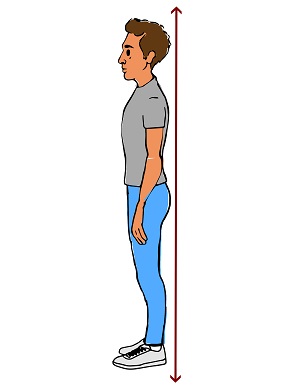
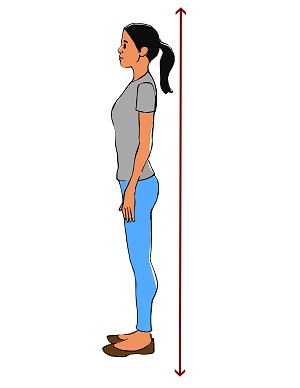
The key to good posture is the position of your spine. Your spine has three natural curves – at your neck, mid back, and low back. Correct posture should maintain these curves, but not increase them. Your head should be above your shoulders, and the top of your shoulder should be over the hips.
How can posture affect my health?
Poor posture can be bad for your health. Slouching or slumping over can:
Misalign your musculoskeletal system
Wear away at your spine, making it more fragile and prone to injury
Be mindful of your posture during everyday activities, like watching television, washing dishes, or walking
Stay active. Any kind of exercise may help improve your posture, but certain types of exercises can be especially helpful. They include yoga, tai chi, and other classes that focuses on body awareness. It is also a good idea to do exercises that strengthen your core (muscles around your back, abdomen, and pelvis).
Maintain a healthy weight. Extra weight can weaken your abdominal muscles, cause problems for your pelvis and spine, and contribute to low back pain. All of these can hurt your posture.
Wear comfortable, low-heeled shoes. High heels, for example, can throw off your balance and force you to walk differently. This puts more stress on your muscles and harms your posture.
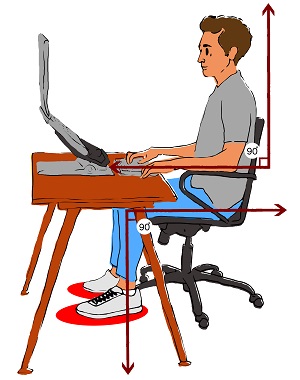
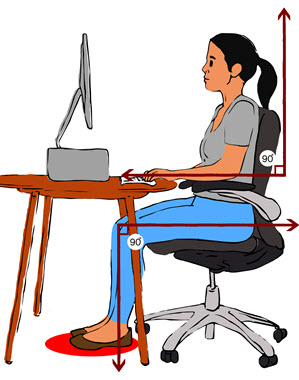
Make sure work surfaces are at a comfortable height for you, whether you’re sitting in front of a computer, making dinner, or eating a meal.
How can I improve my posture when sitting?
Many Americans spend a lot of their time sitting – either at work, at school, or at home. It is important to sit properly, and to take frequent breaks:
Switch sitting positions often
Take brief walks around your office or home
Gently stretch your muscles every so often to help relieve muscle tension
Don’t cross your legs; keep your feet on the floor, with your ankles in front of your knees
Make sure that your feet touch the floor, or if that’s not possible, use a footrest
Relax your shoulders; they should not be rounded or pulled backwards
Keep your elbows in close to your body. They should be bent between 90 and 120 degrees.
Make sure that your back is fully supported. Use a back pillow or other back support if your chair does not have a backrest that can support your lower back’s curve.
Make sure that your thighs and hips are supported. You should have a well-padded seat, and your thighs and hips should be parallel to the floor.
How can I improve my posture when standing?
Stand up straight and tall
Keep your shoulders back
Pull your stomach in
Put your weight mostly on the balls of your feet
Keep your head level
Let your arms hang down naturally at your sides
Keep your feet about shoulder-width apart
With practice, you can improve your posture; you will look and feel better.
ooOOoo
There you are! I am sure that many, many people do not have good posture and the guidance above may just inspire you to aim for better posture.
I am writing another book; my third. It is about the changing planet.
But first I want to tell you a story.
I know Scott Draper. He is the founder and CEO of the Club Northwest. It is the club that Jean goes for her Rock Steady class, and she has been going there for some time.
Indeed Scott and I have struck up a friendship and we now meet up at Scott’s home.
At our first meeting at Scott’s home he lent me the National Geographic’s Earth Day, 50th Anniversary Special Issue printed in April, 2020. It is a magazine that may be flipped and read from either end. On one side there is “A Pessimist’s Guide to Life on Earth in 2070”. On the flip side there is “An Optimist’s Guide to Life on Earth in 2070”. It was a very powerful read.
For on one hand the pessimist’s opinion was speaking of now, of current trends, of the fact that if we don’t change, and change relatively soon, say within the next five years, “our reckless consumption and abuse of resources have made the world a deadlier place for us and for the rest of life on Earth”. It conveys despair!
On the other hand the optimist’s opinion is that life will be different in 2070 and also warmer, “but we will find ways to limit carbon emissions, embrace nature, and thrive”. It conveys hope!
I asked Scott which opinion he supported. Scott told me the following:
There is a legend of two people; a grandfather and his grandson. The grandfather explains to his grandson that there are two wolves fighting inside of him, that they will always be there as he grows up and becomes an adult.
“I have a fight going on in me, even at the age I am,” the wise old man says. “It is taking place between these two wolves. One is evil; he is anger, envy, sorrow, regret, greed, arrogance, self-pity, guilt, resentment, inferiority, lies, false pride, superiority, and ego.”
The grandfather paused and looked at his grandson, and then continued; “The other wolf embodies the best of our emotions. He is joy, peace, love, hope, serenity, humility, kindness, benevolence, empathy, generosity, truth, compassion, and faith. Both wolves are fighting to the death. It is a fight that is going on inside you and indeed every other person, too.”
The grandson thought for some time about what his grandfather had just said. Then he looked up at his grandfather and quietly asked, “Which wolf will win?”
The grandfather gave his reply: “The one we feed”
Now this is an image that serves as a metaphor for our inner sense of conflict. This parable is a powerful reminder of the fight that every human being must face. Regardless of the type of person you are or what kind of life you lead, you will find yourself battling two conflicting emotions at many points in your life. Whether the fight is between anger and peace or resentment and compassion, it is important to recognise the conflicting feelings inside you and to feed the values and choices that matter most to you.
Now I am of an age where I won’t be alive in 2070.
But I am interested in the opinions of others who will be.
I want to ask the following questions:
First Name: Surname: DOB:
Email Address:
Do You Support An Optimist’s Guide to Life on Earth in 2070: Yes / No (please circle one)
Do You Support A Pessimist’s Guide to Life on Earth in 2070: Yes / No (please circle one)
How Many Years Before It Is Too Late To Demand Change: (Please tick your answer.)
Less than 5 years
Between 6 and 10 years
Between 11 and 20 years
Between 21 and 50 years
More than 50 years
How concerned are you? (5 is highest, as in very) 1, 2, 3, 4, 5 (Please circle one.)
Please leave a message if you want to:
Please will you consider helping me.
I am not going to present another post this week. In other words, I will leave this up until the end of Saturday, 26th June.
If you are happy to help me then send me your email address (to paulhandover ‘at’ gmail ‘dot’ com) and I will send out the above survey on the 28th June, 2021. All the recipients will be a bcc.
The survey feedback will be required by a week later; July 5th, 2021.
I will publish the results just as soon as they have been collated.
It was a gift from Jean for a fellow Rock Steady attendee. The Rock Steady class is held Monday and Wednesday at our local Club Northwest for Parkinson’s sufferers.
Still continuing with another dog-free day because this is a supremely important topic: Dementia.
I’m well into my 75th year and have poor recall. I do everything to fight the loss of memory. We are vegan, or technically pescatarian, we both go to the nearby Club Northwest twice a week and I ride my bike every other day.
The number of cases of dementia in the U.S. is rising as baby boomers age, raising questions for boomers themselves and also for their families, caregivers and society. Dementia, which is not technically a disease but a term for impaired ability to think, remember or make decisions, is one of the most feared impairments of old age.
Incidence increases dramatically as people move into their 90s. About 5% of those age 71 to 79 have dementia, and about 37% of those about 90 years old live with it.
Older people may worry about their own loss of function as well as the cost and toll of caregiving for someone with dementia. A 2018 study estimated that the lifetime cost of care for a person with Alzheimer’s, the most common form of dementia, to be US$329,360. That figure, too, will no doubt rise, putting even more burdens on family, Medicare and Medicaid.
There’s also been a good deal of talk and reporting about dementia in recent months because of the U.S. presidential election. Some voters have asked whether one or both candidates might have dementia. But, is this even a fair question to ask? When these types of questions are posed – adding further stigma to people with dementia – it can unfairly further isolate them and those caring for them. We need to understand dementia and the impact it has on more than 5 million people in the U.S. who now live with dementia and their caregivers. That number is expected to triple by 2060.
First, it is important to know that dementia cannot be diagnosed from afar or by someone who is not a doctor. A person needs a detailed doctor’s exam for a diagnosis. Sometimes, brain imaging is required. And, forgetting an occasional word – or even where you put your keys – does not mean a person has dementia. There are different types of memory loss and they can have different causes, such as other medical conditions, falls or even medication, including herbals, supplements and anything over-the-counter.
Older people wonder and worry about so-called senior moments and the memory loss they perceive in themselves and others. I see patients like this every week in my geriatric clinic, where they tell me their stories. They forget a word, get lost in a story, lose keys or can’t remember a name. Details vary, but the underlying concern is the same: Is this dementia?
As we age, we experience many physical and cognitive changes. Older people often have a decrease in recall memory. This is normal. Ever have trouble fetching a fact from the deep back part of your “mind’s Rolodex”? Suppose you spot someone at the grocery store you haven’t seen in years. Maybe you recognize the face, but don’t remember their name until later that night. This is normal, part of the expected changes with aging.
What’s more of a potential problem is forgetting the name of someone you see every day; forgetting how to get to a place you visit frequently; or having problems with your activities of daily living, like eating, dressing and hygiene.
When you have troubles with memory – but they don’t interfere with your daily activities – this is called mild cognitive impairment. Your primary care doctor can diagnose it. But sometimes it gets worse, so your doctor should follow you closely if you have mild cognitive impairment.
You want to note the timing of any impairment. Was there a gradual decline? Or did it happen all of a sudden? This too you should discuss with your doctor, who might recommend the MoCA, or Montreal Cognitive Assessment test, which screens for memory problems and helps determine if more evaluation is needed.
Also, the Centers for Disease Control and Prevention lists problems in these areas as possible signs of dementia:
Memory
Attention
Communication
Reasoning, judgment and problem solving
Visual perception beyond typical age-related changes in vision
When memory loss interferes with daily activities, see your doctor about what to do and how to make sure you’re safe at home.
There are numerous types of severe memory loss. Dementia tends to be a slow-moving progression that occurs over months or years. Delirium is more sudden and can occur over hours or days, usually when you have an acute illness. Depression can also cause memory changes, particularly as we get older.
Alzheimer’s dementia is the most common type of dementia, followed by vascular dementia. They have similar symptoms: confusion, getting lost, forgetting close friends or family, or an inability to do calculations like balance the checkbook. Certain medical conditions – thyroid disorders, syphilis – can lead to dementia symptoms, and less common types of dementia can have different kinds of symptoms. Alzheimer’s has a distinct set of symptoms often associated with certain changes in the brain.
Focusing on safety and appropriate supervision, particularly in the home, is critical for all people with dementia. Your doctor or a social worker can help you find support.
It’s also important to be aware of two other things that can lead to decreased mental functioning – delirium and depression.
Delirium, a rapid change in cognition or mental functioning, can occur in people with an acute medical illness, like pneumonia or even COVID-19 infection. Delirium can occur in patients in the hospital or at home. Risk for delirium increases with age or previous brain injuries; symptoms include decreased attention span and memory issues.
Depression can happen at any time, but it’s more common with aging. How can you tell if you’re depressed? Here’s one simple definition: when your mood remains low and you’ve lost interest or joy in activities you once loved.
Sometimes people have recurring episodes of depression; sometimes, it’s prolonged grieving that becomes depression. Symptoms include anxiety, hopelessness, low energy and problems with memory. If you notice signs of depression in yourself or a loved one, see your doctor. If you have any thoughts of harming yourself, call 911 to get help instantly.
Any of these conditions can be frightening. But even more frightening is unrecognized or unacknowledged dementia. You must, openly and honestly, discuss changes you notice in your memory or thinking with your doctor. It’s the first step toward figuring out what is happening and making sure your health is the best it can be.
And, as with any disease or disease group, dementia is not a “character flaw,” and the term should not be used to criticize a person. Dementia is a serious medical diagnosis – ask those who have it, the loved ones who care for them or any of us who treat them. Having dementia is challenging. Learn what you can do to support those with dementia in your own community.
Please, if you are of the age where this is more than an academic interest then read the article carefully and especially that piece of advice towards the end:
But even more frightening is unrecognized or unacknowledged dementia. You must, openly and honestly, discuss changes you notice in your memory or thinking with your doctor. It’s the first step toward figuring out what is happening and making sure your health is the best it can be.
As is said growing old is not for cissies.
None of us can put off the fateful day when we will die and in our case we do not believe in any form of afterlife, in other words we are confirmed atheists, so all we can do is to live out our remaining years as healthily as possible and loving each other and our precious animals.
But having said that I know that all of us want to live out our lives with healthy, active brains and it’s clear that we can’t leave it to chance.
In closing, I recently purchased the book Outsmart Your Brain written by Dr. Ginger Schechter (and others). It was just $9.99 and contains much advice regarding the best foods and exercise for a healthy brain. I recommend it!







 Learning from Dogs