Tag: Carnegie Mellon University

Technology, and Scamming

The title says it all!

We live in a world that is rapidly becoming more and more digital. But we also live in a world where the criminals are becoming better at carrying out their crimes. So a recent article in The Conversation seemed appropriate to republish.

ooOOoo

Scams and frauds: Here are the tactics criminals use on you in the age of AI and cryptocurrencies
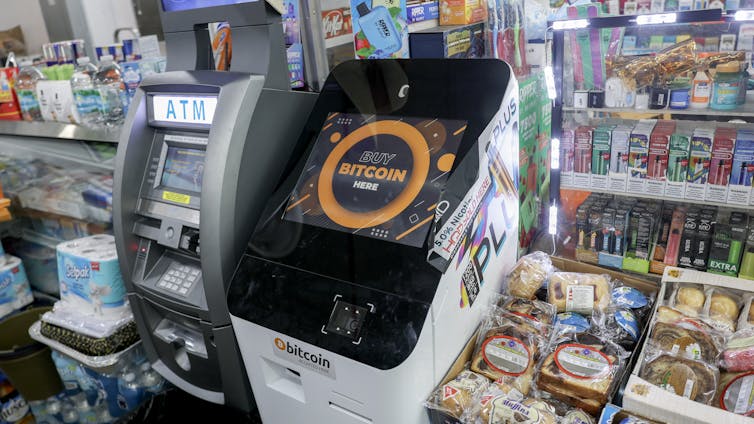
Scammers often direct victims to convert cash to untraceable cryptocurrency and send it to them. Joe Raedle/Getty Images

Rahul Telang, Carnegie Mellon University

Scams are nothing new – fraud has existed as long as human greed. What changes are the tools.

Scammers thrive on exploiting vulnerable, uninformed users, and they adapt to whatever technologies or trends dominate the moment. In 2025, that means AI, cryptocurrencies and stolen personal data are their weapons of choice.

And, as always, the duty, fear and hope of their targets provide openings. Today, duty often means following instructions from bosses or co-workers, who scammers can impersonate. Fear is that a loved one, who scammers also can impersonate, is in danger. And hope is often for an investment scheme or job opportunity to pay off.

AI-powered scams and deepfakes

Artificial intelligence is no longer niche – it’s cheap, accessible and effective. While businesses use AI for advertising and customer support, scammers exploit the same tools to mimic reality, with disturbing precision.

Deepfake scams use high-tech tools and old-fashioned emotional manipulation.

Criminals are using AI-generated audio or video to impersonate CEOs, managers or even family members in distress. Employees have been tricked into transferring money or leaking sensitive data. Over 105,000 such deepfake attacks were recorded in the U.S. in 2024, costing more than US$200 million in the first quarter of 2025 alone. Victims often cannot distinguish synthetic voices or faces from real ones.

Fraudsters are also using emotional manipulation. The scammers make phone calls or send convincing AI-written texts posing as relatives or friends in distress. Elderly victims in particular fall prey when they believe a grandchild or other family member is in urgent trouble. The Federal Trade Commission has outlined how scammers use fake emergencies to pose as relatives.

Cryptocurrency scams

Crypto remains the Wild West of finance — fast, unregulated and ripe for exploitation.

Pump-and-dump scammers artificially inflate the price of a cryptocurrency through hype on social media to lure investors with promises of huge returns – the pump – and then sell off their holdings – the dump – leaving victims with worthless tokens.

Pig butchering is a hybrid of romance scams and crypto fraud. Scammers build trust over weeks or months before persuading victims to invest in fake crypto platforms. Once the scammers have extracted enough money from the victim, they vanish.

Pig-butchering scams lure people into fake online relationships, often with devastating consequences.

Scammers also use cryptocurrencies as a means of extracting money from people in impersonation scams and other forms of fraud. For example, scammers direct victims to bitcoin ATMs to deposit large sums of cash and convert it to the untraceable cryptocurrency as payment for fictitious fines.

Phishing, smishing, tech support and jobs

Old scams don’t die; they evolve.

Phishing and smishing have been around for years. Victims are tricked into clicking links in emails or text messages, leading to malware downloads, credential theft or ransomware attacks. AI has made these lures eerily realistic, mimicking corporate tone, grammar and even video content.

Tech support scams often start with pop-ups on computer screens that warn of viruses or identity theft, urging users to call a number. Sometimes they begin with a direct cold call to the victim. Once the victim is on a call with the fake tech support, the scammers convince victims to grant remote access to their supposedly compromised computers. Once inside, scammers install malware, steal data, demand payment or all three.

Fake websites and listings are another current type of scam. Fraudulent sites impersonating universities or ticket sellers trick victims into paying for fake admissions, concerts or goods.

One example is when a website for “Southeastern Michigan University” came online and started offering details about admission. There is no such university. Eastern Michigan University filed a complaint that Southeastern Michigan University was copying its website and defrauding unsuspecting victims.

The rise of remote and gig work has opened new fraud avenues.

Victims are offered fake jobs with promises of high pay and flexible hours. In reality, scammers extract “placement fees” or harvest sensitive personal data such as Social Security numbers and bank details, which are later used for identity theft.

How you can protect yourself

Technology has changed, but the basic principles remain the same: Never click on suspicious links or download attachments from unknown senders, and enter personal information only if you are sure that the website is legitimate. Avoid using third-party apps or links. Legitimate businesses have apps or real websites of their own.

Enable two-factor authentication wherever possible. It provides security against stolen passwords. Keep software updated to patch security holes. Most software allows for automatic update or warns about applying a patch.

Remember that a legitimate business will never ask for personal information or a money transfer. Such requests are a red flag.

Relationships are a trickier matter. The state of California provides details on how people can avoid being victims of pig butchering.

Technology has supercharged age-old fraud. AI makes deception virtually indistinguishable from reality, crypto enables anonymous theft, and the remote-work era expands opportunities to trick people. The constant: Scammers prey on trust, urgency and ignorance. Awareness and skepticism remain your best defense.

Rahul Telang, Professor of Information Systems, Carnegie Mellon University

This article is republished from The Conversation under a Creative Commons license. Read the original article.

ooOOoo

That last paragraph really spells out how it is in the modern world. I repeat that last sentence: “Awareness and skepticism remain your best defense.

Down here, from up there!

The power of mankind’s footprint on Planet Earth.

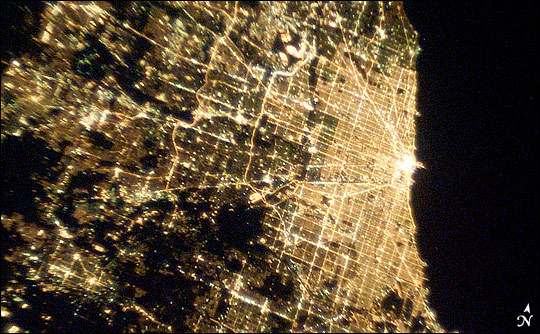
Last Friday, I published a post under the title of People, people, everywhere! Coincidentally, that same day over on Transition Town Payson‘s blog a post was published Urban Sprawl, a Vision from Space! It seemed like a fitting follow-on to that post on Learning from Dogs and is reproduced with the kind permission of the TTP team (thanks Rob).

oooOOOooo

Urban Sprawl, a Vision From Space!

Posted on by

Urban Sprawl has a major impact on all our Resources!

Urban Sprawl can be tracked

In the Sun Belt Areas of our country, phenomenal growth has occurred over the past 30 years.  Satellite images from 1984 through 2012 show the impacts on the Landscape in a time lapse image that is a scary picture of what the next 30 years may bring.

A blog article from the Atlantic Cities website forwarded to me by my friend Dave H. It is a geographic time lapse of satellite images provided by Google.  Their article titled  “The Devastating Impact of 30 Years of Sprawl, as Seen From Space.” gives startling images of how our cities have grown.

“These GIFs were recorded from Google’s “Landsat Annual Time Lapse” tool by Samuel Aston Williams, a young Texas architect. Williams wanted to contribute something new to a startling series of showing three decades of human-landscape intervention recently produced by a collaboration of Google, NASA, TIME and others.”

Read the full article.

The Atlantic Cities also published a blog titled “A Terrifying, Fascinating Time lapse of 30 Years Impact on Earth.”  The images in this blog shows development in other places on the earth in a scary 30 year blink of an eye.

“Since the 1970s, NASA and the U.S. Geological Survey have been amassing satellite images of every inch of our planet as part of the Landsat program. Over time, the images reveal a record of change: of cities expanding, lakes and forests disappearing, new islands emerging from the sea off the coast of rising Middle East metropolises like Dubai.

If you could thumb through these historic pictures as if in a flip book, they would show stunning change across the earth’s surface, in both our natural environments and our man-made ones. Now, the digital equivalent of that experience is possible – three decades of global change as GIF – in a project unveiled today between NASA, the USGS, TIME, Google, and the CREATE Lab at Carnegie Mellon University.

Landsat images taken between 1984 and 2012 have been converted into a seamless, navigable animation built from millions of satellite photos. As Google wrote this morning on its blog: “We believe this is the most comprehensive picture of our changing planet ever made available to the public.”

See the time lapse images here.

Here’s the Problem!

World Population Growth.

Our Population is only going to Grow Larger!

World population details here.

NASA has also been Following Urban Sprawl

This is how Baltimore has grown in 200 Years!

October 11, 2002:  While space technology was undergoing its spectacular birth during the 1950s and ’60s, and visionaries were predicting the spread of human colonies into space, another kind of human colony was spreading rapidly–right here on Earth!

It was the dawn of the modern suburb, a time of post-war prosperity when housing developments popped up across the landscape like mushrooms after a rain.

A half-century later, we now understand that many environmental problems accompany the outward spread of cities: fragmenting and destroying wildlife habitat, for example, and discharging polluted runoff water into streams and lakes.”

More information here.

Urban Sprawl in the United States is covered in Photos by Christoph Gielen

The photo below was taken by Christoph Gielen.  There is a symmetrical beauty to his aerial photos of Urban Areas.  Please go to his Twisted Sifter website for phenomenal aerial photos of our Urban Centers.

A Great Aerial photo by Christoph Gielen of an Arizona Neighborhood

Urban Sprawl is defined in detail at the Wiki website;

An interesting phenomena is that Sprawl is a term only used in America for Urban Growth,  “The term “sprawl” is most often associated with US land use; outside the US (and especially outside the Anglosphere), the term “peri-urbanisation” is often used to denote similar dynamics and phenomena.”

More on Urban Sprawl.

Urban Sprawl and Public Health?

Smart Growth is the alternative to Urban Sprawl,  unfortunately many people argue against high density living and it is still a contentious point.  Do we continue to grow outward or upward.  Will we feel more like rats trapped in a cage or free range rats. Read the following National Institute of Health article for their take on the impacts of Urban Sprawl vs. Smart Growth.

Urban Sprawl

“Urban sprawl in the United States has its origins in the flight to the suburbs that began in the 1950s. People wanted to live outside of city centers to avoid traffic, noise, crime, and other problems, and to have homes with more square footage and yard space. As suburban areas developed, cities expanded in geographic size faster than they grew in population. This trend has produced large metropolitan areas with low population densities, interconnected by roads. Residents of sprawling cities tend to live in single-family homes and commute to work, school, or other activities by automobile.”

“Although there is considerable evidence that urban sprawl has adverse environmental impacts and contributes to a variety of health problems—including obesity, diabetes, cardiovascular disease, and respiratory disease implementation of policies designed to combat sprawl, such as smart growth, has proven to be difficult.”

Smart Growth

“Smart growth can be defined as a policy framework that promotes an urban development pattern characterized by high population density, walkable and bikeable neighborhoods, preserved green spaces, mixed-use development (i.e., development projects that include both residential and commercial uses), available mass transit, and limited road construction.”

Urban Sprawl, Smart Growth, and Deliberative Democracy

From Wiki these are the Advantages and Disadvantages of Urban Sprawl

Advantages

– More single family residences on larger lots.
– Lower land prices.
– Less experience of noise and pollution.
– Suburban areas generally associated with “sprawl” tend to have lower crime and higher-quality schools.
– Perceived overwhelming consumer preference for sprawl-type developments.

Disadvantages

– High car dependence.
– Inadequate facilities e.g.: cultural, emergency, health, etc.
– Higher per-person infrastructure costs.
– Inefficient street layouts.
– Low diversity of housing and business types.
– Higher per-capita use of energy, land, and water.
– Perceived low aesthetic value

Source: Wikipedia

Our Human Colonies seem to be spreading about as fast as our ice caps are melting.  I wonder if there is any correlation?

Is it time for mankind to adapt to a new future?  No, it’s past time.  We have a lot of catching up to do in implementing new technologies to provide sustainable growth options in all areas; industry, transportation, energy production, carbon footprints, food supply, to taking care of our precious fresh water supplies.

How do we make our cities more sustainable and resilient?  Start with telling your national, state and local politicians that you want a sustainable future.  Let’s work together and make this happen.

Urban Sprawl or Smart Growth, your choice!

Make your world Sustainable!

oooOOOooo