Tag: Care2

Spreading love and kindness

The huge gift we receive from therapy animals.

Our Brandy is a Pyrenean Mastiff!

I know there are times when giving Brandy a big hug feeds something very deep inside me. That unconditional affection Brandy shows me has a very strong healing sense.

I know that Jean shares my sense of being loved by Brandy, and by all our other dear dogs.

I am without doubt that hundreds of thousands of other people experience this.

Yet there must always be room for more therapy dogs which is why an item on Care2 just a few days ago is being shared with you today.

(P.S. When a photo of me hugging Brandy was sought his nibs did not comply!)

ooOOoo

Could Your Pet Become a Therapy Animal?

3187027.large

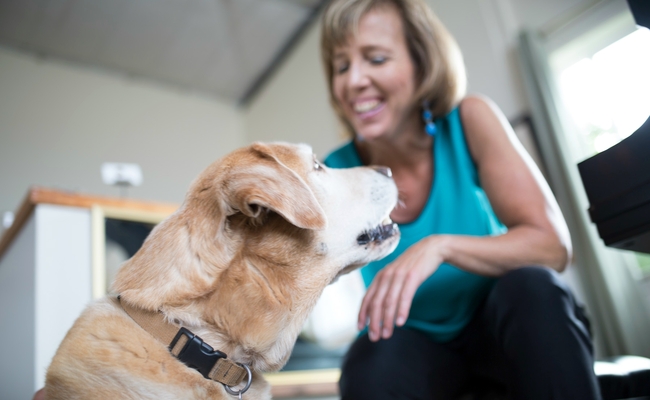
If you have a pet who’s mellow and loves being around people, and the idea of helping your pet bring joy to others appeals to you, you might just have a therapy animal in the making.

Accompanied by their owners, therapeutic visitation animals – which are most commonly dogs, but can also be cats, rabbits, pot-bellied pigs, horses, etc. – regularly visit people in hospitals, nursing homes, schools and other facilities, providing furry comfort and compassion.

“Four-footed therapists give something special to enhance the health and well-being of others,” says the website of  Therapy Dogs International (TDI), a nonprofit organization that regulates, tests and registers therapy dogs and their handlers. “It has been clinically proven that through petting, touching and talking with animals, patients’ blood pressure is lowered, stress is relieved and depression is eased.”

What It Takes to Be a Therapy Animal

Therapy animals are “born, not made,” according to TDI. They must have an outstanding temperament, and be outgoing and friendly to people of all ages. They must also behave well with other animals.

 In general, therapy animals must also be at least one year old; current on all vaccines required by local laws; and be clean and well groomed when visiting people.

As for dogs, along with the ability to obey basic commands like “Sit,” “Stay,” “Come” and “Leave it,” they are tested by therapy dog certification organizations to ensure they can do the following, according to TDI (most of these requirements apply to other species of potential therapy animals as well):

  • Listen to their handlers
  • Allow strangers to touch them all over
  • Not jump on people when interacting
  • Not mind strange noises and smells
  • Be calm for petting
  • Not be afraid of people walking unsteadily

Getting Your Pet Certified as a Therapy Animal

Think your pet has the right stuff to be a therapy animal? To get an idea of the type of testing involved, this TDI brochure describes each of the 13 tests a dog must pass in order to be certified. The tests are similar for other animals.

Some therapy animal organizations, including Pet Partners, offer workshops so you and your pet can practice the required skills before being tested for certification.

The AKC website has a list of therapy animal organizations all across the U.S. from which your pet can receive certification. Contact the one nearest you for further information.

The Difference Between Therapy and Service Animals

Although the two are often confused, therapy animals are not the same as service animals, which “have been individually trained to do work or perform tasks for the benefit of a person with a disability,” according to the Americans with Disabilities Act (ADA).

“An example of a service dog is a dog who guides an owner who is blind or assists someone who has a physical disability,” the American Kennel Club (AKC) explains. “Service dogs stay with their person and have special access privileges in public places such as planes, restaurants, etc.”

Therapy dogs, on the other hand, are privately owned. Unlike service animals and their handlers, in most U.S. states, therapy animals and their owners don’t have protections under federal law (ADA, the Fair Housing Act, etc.), reports the National Service Animal Registry.

Additional Resources

You can find out more about therapy animals and getting your pet certified from these organizations:

Photo credit: Thinkstock

ooOOoo

Closing this post with some photographs Jean took yesterday afternoon. Me with Pharaoh and Cleo.

(OK, they were staged for this post as the look on Cleo’s face rather suggests!)

P1160423oooo

P1160414oooo

P1160419Have a very huggable weekend!

The season for keeping cool!

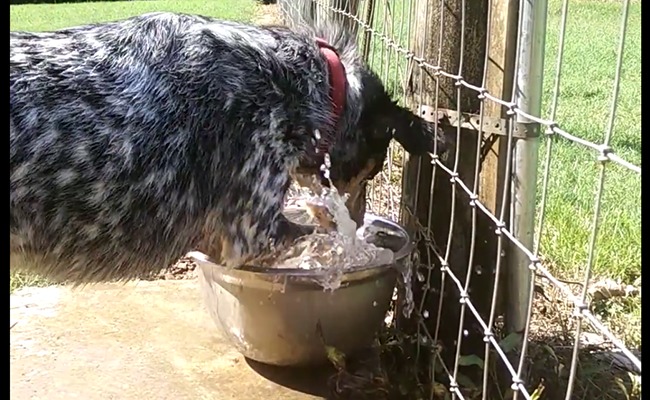
At the dog park, Syd decides to utilize the drinking water for another purpose.

(As seen over on the Care2 blogsite.)

Daily Cute: Dog Finds a Way to Cool Down

1385904.large

Not just your dogs but all you good folks stay cool out there!

Strangely normal!

Reading the behaviours of our dogs.

Apologies, going straight into this republication of an article that appeared on the Care2 blogsite back in June. Didn’t get to sit down in front of my computer until 4pm.

ooOOoo

7 Totally Normal (But Kind of Weird) Dog Behaviors

1384665.largeBy: Katie Waldeck June 19, 2016

About Katie

It’s not surprising that our beloved canine companions’ behavior is sometimes confusing to us. After all, it’s not like they can tell us why they do certain things! But is your pooch’s behavior normal, or a sign of something more troubling?

And, for that matter, are common dog behaviors totally fine, or something we should be working to stop? Oftentimes, the answer is the former. Read on to discover some of the strangest dog behaviors that are actually totally normal.

1. Barking at Mirrors

If you show a human baby a mirror, they don’t always recognize themselves— young infants lack the self-awareness needed to do that — and dog babies are no exception. Most of the time, dogs grow out of it as they age, losing interest in their own reflections. Dogs are much less affected by visual events than humans, relying far more on their sense of smell to gather information. Since the dog in the mirror doesn’t have its own smell, most dogs tend to lose interest pretty quickly.

2. Being Scared of Thunderstorms

Dogs have far more sensitive hearing than humans, so it’s understandable that the loud noises accompanying storms don’t exactly delight our canine companions. But there may actually be more behind this fear — some scientists believe that dogs can actually detect changes in barometric pressure leading up to a storm. Thunderstorms can send even the best-behaved dogs into anxious fits, and unfortunately, it can be difficult to break even the healthiest dog of this habit. There are strategies to cope, however, such as providing a safe place for dogs to go during storms or dressing them in snug-fitting shirts that function similarly to swaddling a baby.

3. Eating Poop

Though it’s certainly not appetizing to us humans, many dogs eat poop. Eating feces is actually a fairly typical behavior for canine mothers, because it cleans the area where they are caring for their puppies. Some evidence also suggests that dogs eat feces when they’re lacking in certain nutrients. Eating poop can even be a way to get your attention and alleviate anxiety. This is not exactly a GOOD behavior for dogs, however, and solutions for it are mostly simple. Supervision and simple commands like “Leave it” and “Come” are often enough to curb most dogs’ fecal fascination, and vitamin and enzyme supplementation can work for dogs whose diets are missing nutrients.

4. Spinning Around in Circles

Plenty of dogs spin around and around for what seems like forever. Some breeds, including bull terriers in particular, are especially susceptible to this behavior. While this is often normal dog behavior, it can also be a sign of stress or anxiety. Whatever the reason your pooch spins in circles, this behavior should be nipped in the bud. The best way to do that? Well, get them moving and thinking. Take them on walks. Give them toys that stimulate their mind. If that still doesn’t work, you might need a dog behavior expert to intervene.

5. Separation Anxiety.

Many dogs experience separation anxiety — they just love you THAT much! Often, this is a result of changes in routines, moving, household membership changes or after moving in with a new family. It’s totally normal, but, unsurprisingly, it isn’t the best behavior for your pet’s mental health. The key to breaking your pooch of this behavior is to identify how big of a problem it is before you go about fixing it. Click here for detailed ways to help break this habit.

6. Hating Other Dogs.

Dogs who weren’t socialized at an early age around fellow canines will understandably have some aggression towards unknown dogs. Conversely, some dogs that have been socialized around other dogs seem to pick and choose which dogs they like. Why is that? Well, dogs aren’t all that different than humans in that regard — sometimes we just don’t like certain people. Dogs perceive a massive amount of information through scent, and two dogs may find something off-putting about each other’s smells. Dogs may also be overprotective of their owners or have something in their history that makes them especially distrustful of certain other kinds of dogs. Avoiding another dog at the park isn’t much cause for concern, but if your dog is consistently aggressive, it’s time to consult a veterinary behaviorist.

7. Having Sensitive Spots.

Some dogs have areas where they just don’t like to be touched. There can be several reasons for this — everything from a recent injury to poor socialization as a puppy — but, often, this is simply because, well, dogs just don’t like to be touched in certain spots. Think about it this way: plenty of humans don’t want to be patted on the butt by people they don’t know. In fact, most don’t! This can be perfectly innocuous — or it can be a sign of trouble. Dogs that demonstrate overly aggressive behavior regardless of where they’re touched may be in need of a behavior expert. You can read more about this here.

ooOOoo

Any thoughts dear people?

Hot cars and dogs do not mix!

Another reminder not to leave dogs in hot cars.

A couple of weeks ago, back on the 14th, I posted a warning about leaving dogs in cars if there was the slightest risk of the car being left in the sun.

I feel no embarrassment whatsoever to repeat that warning. This time by republishing an item that was published on Monday on Care2 Causes.

ooOOoo

Firefighters Rescue Dogs Baking Alive in 160 Degree Car

3181946.largeBy: Laura S. June 27, 2016

About Laura

In yet another outrageous case of neglect, three Sacramento, Calif., dogs were found baking alive inside a car that had reached 160 degrees Fahrenheit (71 C).

A Sacramento Fire Department crew circled the vehicle parked at a shopping mall. Using a thermometer designed to detect the car’s internal temperature, the crew quickly determined that the dogs weren’t just hot, they were literally cooking.

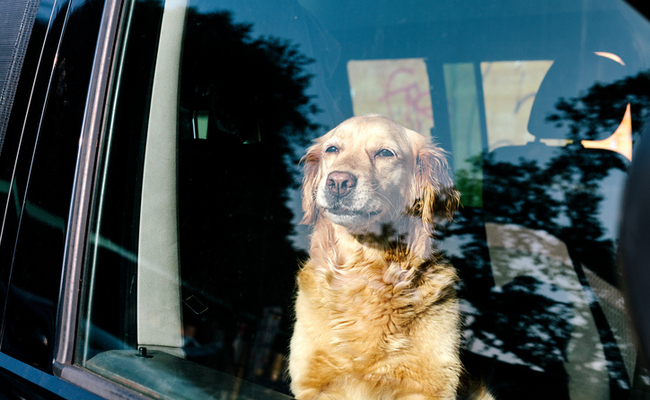
The dog seen here panting on the car’s dashboard was immediately taken from the vehicle, and the other two were removed by Animal Control because they were exhibiting aggressive behavior.

This is not the first time that firefighters in Sacramento have had to rescue dogs from a hot car. In fact, they filmed one such rescue last summer.

If you see a dog in a hot car, please take action. Remember, one phone call may not be enough. Wait and see it through to be sure authorities arrive.

Photo Credit: Sacramento Fire Department

ooOOoo

The original article includes a video that is on Facebook that I seem unable to include within this post. But please go here and view it for yourself. (It will require you to log in to your Facebook account.)

Also, please share the information on this post and the one on the 14th as far and wide as you can.

For the sake of our dogs!

Summer heat and Dogs

Hot, fine weather does carry a risk – for our dogs.

A week today will see us celebrating the Summer Solstice and for much of the Northern Hemisphere the heat of the summer days soon will be upon us. Both we and our dogs love taking a bit of sunshine but equally for both species the danger of heat stroke is not to be underestimated.

So it seemed highly appropriate to republish an article that was presented over on Care2 a couple of weeks ago.

ooOOoo

Five Factors That Put a Dog at Risk for Heatstroke

1383141.largeBy: Vetstreet.com May 30, 2016

About Vetstreet.com Follow Vetstreet.com at @vetstreet

Summer can be an incredibly fun season for dogs and their active owners. There are walks to go on, boat rides to take and beaches to explore!

But for all the fantastic opportunities summertime offers, there are also a number of seasonal dangers. A serious one that all dog owners should keep in mind is heatstroke. While all dogs are at risk of heatstroke, there are a few factors that can make your dog more vulnerable. From the genetic predisposition of certain breeds to the dangers some outdoor dogs face, here are five heatstroke risk factors to be aware of — and avoid.

ThinkstockPhotos-513469413-1-e1464380428868Congenital Defects or Underlying Respiratory Problems

Upper-airway problems, as seen in flat-faced dogs like Pugs and Boxers, are some of the most common risk factors for heatstroke in dogs exposed to higher temperatures, according to Dr. Debbie Mandell, staff veterinarian and adjunct associate professor at the University of Pennsylvania’s Matthew J. Ryan Veterinary Hospital. As dogs get hotter, they pant to cool down, and brachycephalic breeds have a difficult time breathing so hard in hot conditions.

Brachycephalic airway syndrome isn’t the only potential issue. Large and medium breeds, like Labs and Pit Bulls, can experience laryngeal paralysis, and collapsing trachea commonly affects small dogs like Pomeranians and Yorkies. With both conditions, the dogs’ airways swell as they pant, which causes them to pant harder. That in turn increases the swelling and can create a dangerous situation quite quickly.

ThinkstockPhotos-534541239-1-e1464380439891

Not Being Acclimated to Hot Weather

That sunny weather can be so inviting that it’s nearly impossible to remain indoors, especially if you — and your dog — have been stuck inside for months. But it’s important to remember that even if you’ve been hitting the gym during the cooler months, your dog might not have built up the same tolerance for activity. And if you take him out to run or play with you, he’s not going to know when to stop, even if he reaches the brink of collapse due to heat stress, Dr. Mandell says.

So what’s a responsible dog owner to do? First of all, start with a visit to your vet, so you’re sure your dog is healthy enough for increased exercise. Second, exercise restraint when it comes to, well, exercise. Start off slowly and build up your dog’s fitness very gradually. Third, make sure you know the signs of heat stress (like excessive panting and drooling, a fast pulse and gums that have changed in color from pink to bright red) and be prepared to help your dog cool down before it becomes an emergency. If your dog vomits or has bloody diarrhea, you should call your veterinarian immediately.

ThinkstockPhotos-495804298-1-e1464380444720Being Kept Outdoors Without Access to Shade and Water

It’s not only indoor dogs who aren’t used to the heat who can find themselves at heatstroke risk — dogs who live primarily outdoors can land in trouble come summertime, too, if they’re left without shade and water. Of course, it’s best for dogs to be kept primarily indoors, but if a dog must be mostly outdoors, always provide a cool area out of the sun and plenty of fresh water.

1383141.largeBeing Left In the Car

When it comes to ways to avoid heatstroke risk, never, ever leave a pet in a hot car. The temperature inside a car can reach over 120 degrees in minutes, Dr. Mandell says. And no, cracking the window doesn’t make enough of a difference to help.

Should you see an animal locked inside a hot car, there are ways to safely rescue it. The Humane Society of the United States and the ASPCA recommend that you write down the car’s make, model and license plate; attempt to locate the owner; and call animal control or your local police department for help.

ThinkstockPhotos-495739266-1-e1464380465591Obesity and Thick Fur

Obesity can make dogs more susceptible to a whole host of health issues, including heatstroke. That’s because not all heat escapes dogs through the respiratory system; in fact, some heat loss occurs through the skin. But the layer of fat in obese pets can limit their ability to cool themselves that way.

That layer of fat under the skin serves as insulation and can prevent some of that heat from getting to the skin to be released. Thick fur can create the same problem, so furry dog breeds, like Newfoundlands and Great Pyrenees are at similar risk.

By Kristen Seymour | Vetstreet.com

ooOOoo

If any reader has further advice and tips to help others then please don’t hesitate to leave a comment.

Doggy people

Only way to follow the weekend’s ‘doggy’ pictures.

I selected the following not only because it applies to me and so many others, I don’t doubt, but also because I was working outside until late afternoon and frankly neither had the time nor the energy to be very creative on my own account.

But before moving on this recent Care2 article, I just want to say a huge THANK YOU to you all for all the ‘Likes’ and Comments this last weekend – Pharaoh’s weekend.

ooOOoo

How I Did a 180 and Became a Dog Person

1382970.largeBy: Vetstreet.com May 27, 2016

About Vetstreet.com Follow Vetstreet.com at @vetstreet

It may be difficult for a dog lover to understand how anyone can dislike dogs. Those ears! Those kisses! But plenty of people don’t like dogs and even fear them.

However, for some people, all it takes is one pup to change their mind. And often, those who once held a deep dislike for dogs are the people who become the biggest doggie devotees!

The Things We Do for Love

Halli Webb, who owns an advertising firm in Columbus, Ohio, was wary around dogs from a young age. “I grew up in an uber-spotless house where no pets were allowed,” she says. “I had no idea how to be around dogs, how to take care of them and was generally afraid of them. I hated when I walked into a house and could smell a dog.”

As an adult, Webb says dogs just weren’t “on her radar” for many years. That is, until she had her daughter. “Emma worked on me from the time she could speak,” Webb recalls with a laugh. “She loved every dog that walked by; even if it was horrible looking, it was a cute doggie to her.”

Webb’s daughter was relentless and finally, Webb and her husband gave in. That’s when Shirley, a Cockapoo, entered their lives. The family fell in love with the little dog and now can’t imagine life without her.

Webb’s friends laugh about her newfound love for dogs. One friend in particular had been trying to convince Webb for years to get a dog. “Now, she can’t stop teasing me about not being a dog person. Especially when she sees Shirley on my lap, in my coat, in her little car seat or dressed with all her bling!”

Webb doesn’t mind. The teasing is well worth the joy that Shirley brings to their family.

A Great Package Deal

“From early childhood until adulthood, I would literally cross a street or walk down alternate blocks to avoid a dog,” says Barbara Warner, an author in New York City. “I got in the habit of saying I was allergic to them, just to avoid having to be near one. I was that afraid,” she explains.

But one day, a man she was dating brought his new dog over to her house and asked if Warner could watch him. “He handed me what looked like a Happy Meal box. I opened it, and a little head popped out, yawned and put his head on my shoulder. Maternal instinct took over. That was my Fritzky.”

Warner ended up marrying the man she was dating and, of course Fritzky was part of the package and in her life to stay. Although, Warner jokes, Fritzky outlasted the marriage, living until he was 13.

After Fritzky passed away, Warner thought her love for dogs might have died with him. But then she met Vinny, a friend’s 150-pound Rottweiler, during a photo shoot for her new book. At first, Warner froze up when she saw Vinny, wondering if her old fear had resurfaced. “He sniffed me from my feet to the top of my head… then he turned around and sat on my foot!” Warner was smitten.

“Fritz was like my child. He opened my eyes and helped me overcome an irrational fear, and Vinny just confirmed that big or little, fluffy or sleek, my love and admiration of these creatures is definitely in my soul.”

I Took a Chance on Love

Allergies and asthma kept Crystal Brown-Tatum from having a dog as a child, and so she avoided dogs as much as possible. “When I went over to friends’ homes with dogs, I would either ask them to put the dog away or never interact with the dog,” she remembers.

Brown-Tatum, who owns a PR firm in Dallas, was content to keep dogs at a distance until she met a 10-week-old Bichon Frise puppy named Cotton. A woman in her building needed to rehome the dog, and something told Brown-Tatum to give the dog a chance.

Cotton helped bring Brown-Tatum and her teenage daughter closer together and stayed by Brown-Tatum’s side during her battle with breast cancer. After Cotton died, Brown-Tatum continued to adopt Bichons.

Today, Brown-Tatum is well known for her love of dogs. She volunteers at her local shelter and has even worked for a pet food company. “I can’t imagine my life without a dog and it’s all because Cotton showed me unconditional love.”

My Family Thinks I’m Crazy

Kayla Pickrell, a stationery designer in Lexington, Ky. was also scared of dogs. Her fear stemmed from being bitten by a neighborhood dog when she was young. “My entire life, I was terrified of dogs. It didn’t matter the size, age, breed, etc., I was just terrified.”

But when Pickrell was 20, her boyfriend introduced her to his Great Dane puppy. While she was still scared, she discovered that as the puppy grew, he followed her lead; he knew her habits and her rules. “But, (he) still wanted to be friends with me. I grew to love the dog and got my own puppy one year later.”

Pickrell’s dog Odin cemented her love for dogs. “Not only do I love him, but every dog,” she says. “I’m that weird person at the dog park who will literally play and cuddle with every dog.” Pickrell says her family is still shocked at the change in her behavior and finds it hard to believe she has a dog of her own now.

But, Pickrell now knows the love between a dog and a person is indescribable. “Truly, it is hard to put into words the love that I have for both my dog and others,” she says.

While bad experiences with dogs, or even a lack of experience with dogs, can make someone wary or disinterested in the canine kind, dog lovers know that all it takes is one special dog to change one’s life forever.

By Caroline Golon | Vetstreet.com

ooOOoo

I can’t underestimate how in my case that one special dog, Pharaoh, changed my life and was one of the magical ingredients that led me to meeting Jean and now having a life with ten special dogs and one very, very special lady.

P1150739


And speaking of Brazil!

What a wonderful coincidence! From the country to the surname!

As many of you will know yesterday I published a delightful story of how fisherman Joao Pereira de Souza, 71, who lives in an island village just outside Rio de Janeiro, Brazil [my italics] saved a penguin that then bonded with Joao.

So imagine my surprise when yesterday morning I read over on the Care2 website a story of a policeman, Officer Joe Brazil [my italics] who rescued a dog. I was compelled to republish that in full for your pleasure.

ooOOoo

Barefoot Policeman Saves Pup From Watery Danger

By: Laura S. May 30, 2016

About Laura

13087551_10206497645741920_394354682604112285_n-11Every so often a photo shines light on a moment of heroism more than words ever could. This amazing image comes from Rhode Island resident Peggy Edwards who stayed on scene as a 911 call summoned help for a puppy trapped in a culvert.

The dog, now known to be Cece, had escaped from her Woonsocket home one day after arriving. Without her litter mates for the first time and unfamiliar with her new surroundings, Cece became frightened after slipping through a back door and being confronted by the great outdoors.

Cece ran all night and wasn’t spotted until the next afternoon. She was wandering down Alice Avenue when a passing car startled her further and she took refuge in a culvert. To further complicate the situation, Cece went quite far into the tunnel and soon found herself trying to cling to the edge as water flowing from a nearby brook lapped her body.

“She was stuck about 20-25 feet in and was clinging to the side,” Peggy Edwards explained. “We tried to help but were afraid of scaring her further in”

But when Officer Joe Brazil arrived on scene, he calmly took off his shoes and rolled up his pants. If Cece couldn’t come to him, he’d simply go to her.

“As I got closer, I could see Cece just clinging to the side and just shaking,” Brazil told NBC 10 News. “(The dog was) very, very frightened.”

Cece sniffed Brazil’s hand briefly and then allowed him to pick her up.

“It just seemed like she was almost saying thank you. Like she knew I was there to help,” Brazil said.

Cece’s owner, Michelle Perez, was deeply relieved to be reunited with her new family member.

“She’s only 5 months old. I wasn’t able to sleep,” Perez said. “All I kept doing was just driving around, calling her.”

And as for Officer Brazil, well, he is reportedly looking to adopt a dog of his own very soon.

ooOOoo

 I shall be going nuts over the next few hours trying to think of a follow-on third story about Brazil! (Apologies: just could resist that!)

What really is important.

So much to learn from our animals.

It is so easy to become disillusioned with the world around us. But then all it takes is a little story or an act of kindness to remind us of what really is important.

That was my emotional reaction when I recently read the following item over on the Care2 website. I am taking the liberty of republishing it in full.

ooOOoo

Dangerous Dog Rescues Helpless Hummingbird in Grass

3176813.largeBy: Laura S. May 10, 2016

About Laura

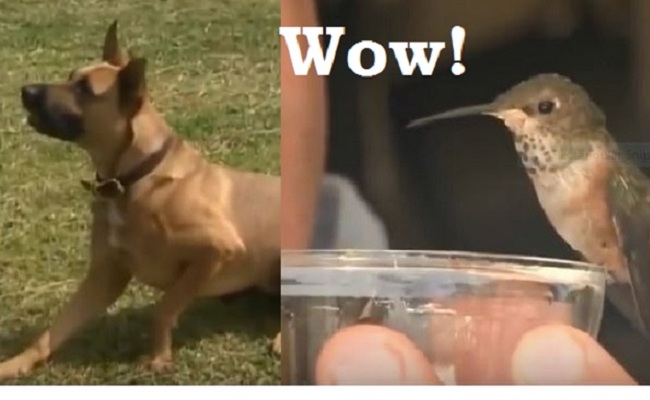
One can only speculate why a rescued dog named Rex refused to leave the side of an injured hummingbird lying in the grass. Was it compassion or simple curiosity?

According to Rex’s guardian, Ed Gernon, his German Shepherd mix was homeless for a very long time and had a reputation for getting along poorly with other animals.

“He was dangerous” told CBS News. “I mean, he fought with other dogs and he killed cats. He was an animal that had learned to live on the streets.”

During a neighborhood walk, Rex came to an abrupt halt with a laser-focus on the ground in front of him.

“He suddenly stopped and he would not move,” Gernon said of Rex’s discovery of the near-death hummingbird. “It’s tiny and it’s dead as far as I’m aware. It’s covered in ants. It’s got no feathers.”

But Rex apparently knew better. Not only did he realize that the bird was still alive, but he refused to leave it.

“He was trying to protect her, so I thought I’d go the distance.”

So, Gernon did the only thing he could think of at the moment. He scooped up the hummingbird and took it home. And there began a year-long process of rehabilitation inside Gernon’s home. That included using a hairdryer to help Hummer fly as well as regular feedings of sugar water.

Today Hummer is strong and ready for return to the wild, only she shows no interest in leaving just yet.

“It’s time for her to start mating,” Gernon said in his recent interview. “I keep leaving the doors and windows open thinking she’ll leave.”

ooOOoo

Laura closes her article by including the sensible advice:

Wildlife experts advise that licensed rehabilitation specialists should be consulted when caring for an injured wild animal.

As I said in my preamble all it takes is a little story or an act of kindness to remind us of what really is important.

You all have a wonderful weekend.

Embracing those senior years.

And I’m speaking of our dogs as well as me!

Whether we like it or not, time flows in one direction.

I find it almost as difficult to know that I shall be 72 years old in November as I know that dear Pharaoh will be 13 on June 3rd., a little over three weeks from today. Both of us most firmly now in our senior years.

This introspection was generated by something that was read recently over on the Care2 site: 7 Steps to Help Your Senior Dog Be Happy and Fulfilled

Knowing that dozens of you dear readers will have dogs that are also in their senior years was the motivation for me republishing the article; as follows:

ooOOoo

7 Steps to Help Your Senior Dog Be Happy and Fulfilled

1381516.largeBy: Lisa Spector May 8, 2016

About Lisa Follow Lisa at @throughadogsear

I can hardly believe that my yellow Labrador, Sanchez, is turning 13 next week. I count my blessings that he is in good health and still enjoys our twice daily walks. But, I’m also aware that he can’t keep up to his activity level from even a year ago, let alone in his prime. I’m always looking for ways to provide mental stimulation to his environment without physically taxing his body.

1. Alone Time Together Daily
It’s not always easy having a multi-dog household. But, it’s important to make a priority of having time alone with your pets daily. Since Sanchez was an only dog for the first seven years of his life, he particularly appreciates this. It means walks take longer (walking Gina separately), but it’s well worth the time when I see Sanchez’s smile of contentment.

2. Keep Training
Dogs love to learn, no matter their age. I still spend time training every night with Sanchez. If it gets late, he starts whining and begging for his training time with me. The bonding time is precious and it stimulates him to keep learning and being challenged. He has no complaints about his yummy rewards either.

3. Give Him Attention in Creative Ways
Gina is a high-drive dog. We spend a lot of time retrieving and tugging. While it helps alleviate her pent up energy, Sanchez used to look neglected when she was getting the extra attention. So, I started sneaking him small treats while tugging with her. At night time, I often play ball with her inside, having her run down and up the stairs, chasing and retrieving the ball. I include Sanchez in the game by discreetly tossing him small treats while she’s running back up to me to deliver the ball. It not only makes him feel included, but it also engages his senses as his nose has to search for the tossed treat.

http://www.youtube.com/watch?v=7pa3-wD5b-o

4. Reward. Reward. Reward.
In the video above, I am training both of my dogs together. Even though Gina is doing all of the physical activity, Sanchez is getting equally paid for staying calm and still while she jumps over and goes under him. Good Boy, Sanchez!

5. Pay Attention to New Behaviors
It’s not unusual for senior dogs to develop anxiety issues later in life that seemingly come out of nowhere. They can include sound phobias, separation anxiety or resource guarding. There are some that I just accept, such as tearing tissue out of the bathroom waste basket. I call it his puppy behavior returned. I just make sure that I don’t put anything in the trash that could be harmful when chewed. Other behaviors will only get worse if ignored, such as separation anxiety or food resource guarding. Tips for Separation Anxiety are here. For all anxiety issues, consult with your veterinarian and/or a positive reinforcement dog trainer. Ignored, they will only escalate.

6. Keep The Safe Physical Activity
Sanchez and I used to enjoy musical freestyle classes. He would weave between my legs, spin and jump on my arm on cue. While that would be too taxing on his body now, we have kept in what is safe for him. He still loves to “go back,” lift his left and right paw on cue, and show off his “downward dog.”  Of course, he is well paid for his behavior.

7. Engage The Senses
National Association of Canine Scent Work (NACSW™) is the official sanctioning and organizing body for the sport of K9 Nose Work. It is a growing popular sport, and it’s great for dogs of all ages. K9 Nose Work is built on scent work where dogs use their nose to search for their prize. Sanchez loved his K9 Nose Work class. Now, at home, I put pieces of liver into a mixed variety of cardboard boxes. He is told to “find” the liver. Boy, does his tail ever wag when he is searching!

Dog training should always be fun for both 4- and 2-leggeds. Get creative with your senior pup. Because you can teach an old dog new tricks.

Mark Holtuhusen

ooOOoo

This strikes me as very sound advice.

I will close today’s post with a photograph of dear Pharoah and me, both well into our senior years, taken just a few weeks ago demonstrating that both of us are old dogs learning new tricks!

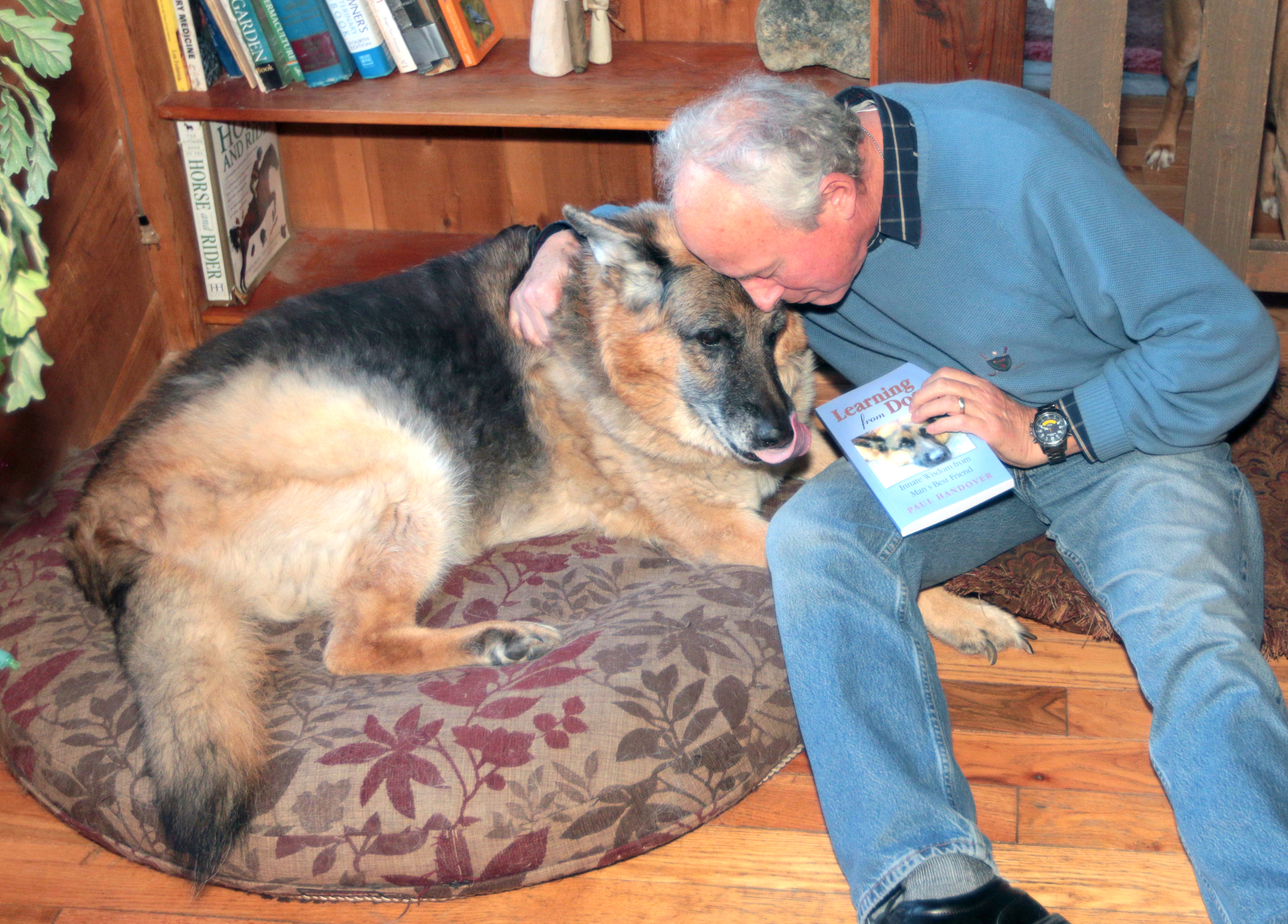
TIMOTHY BULLARD/Daily CourierPaul Handover with Pharaoh, a 12year-old German Shepard that he uses on the cover of his new book about man's best friend.
TIMOTHY BULLARD/Daily CourierPaul Handover with Pharaoh, a 12year-old German Shepard that he uses on the cover of his new book about man’s best friend.

On second thoughts there’s a much better way to close this post that reflects on those precious years before the end of our days. That is by offering you the poem by John Oldham,  A Quiet Soul.

A Quiet Soul

Thy soul within such silent pomp did keep,

As if humanity were lull’d asleep;
So gentle was thy pilgrimage beneath,
Time’s unheard feet scarce make less noise,
Or the soft journey which a planet goes:
Life seem’d all calm as its last breath.
A still tranquillity so hush’d thy breast,
As if some Halcyon were its guest,
And there had built her nest;
It hardly now enjoys a greater rest.

John Oldham

We all need rescuing from time to time!

This rescued lovebird has found a friend for life in Jackson the dog — and unlimited free rides!

Yesterday was a rather stressful day what with worrying about Hazel and arranging for her ultra-sonic scan, and one or two other goings on.

So this short little video seemed the perfect offering for all of you good people.

First seen over on the Care2 site.