Tag: Capitalism

The Poor Pay Czar

Pity the poor Czar.

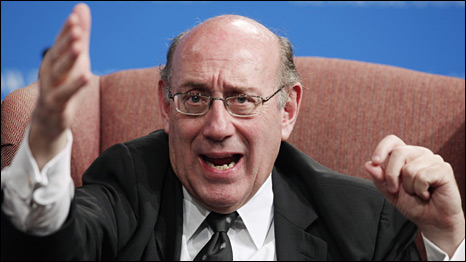
Kenneth Feinberg, pay czar

The US poor pay czar is lamenting his task: how to limit the pay of executives at companies receiving a bailout without undercutting the ability of the firm to secure talented management.  “It’s a delicate balance!  Very difficult indeed.”  Well, Mr. Czar, difficult for you, maybe, but a piece of cake for the labor market.  That’s exactly what the labor market does, day in and day out, quite naturally.

Compensation should not be the purview of an appointed administrator serving at the pleasure of the executive branch of the U.S. Government.

By Sherry Jarrell

[Market forces difficult to stamp on. Ed.]

BA flies to the Brink

British Airways

I earnestly hope that we are not about to witness the crashing disappearance of what only a few years ago was one of Britain’s relatively few major world class businesses. It is said that those whom the Gods seek to destroy they first make mad, and the intention of BA cabin staff to launch a strike over the busy Christmas period would seem to be a clear sign of insanity.

Read more about BA

The Boeing 787 Dreamliner: an impressive aircraft

What does the much delayed maiden flight of the Boeing 787 tell us about integrity?

But how difficult can it be for Boeing to make yet another new aircraft? The answer depends on how different the 787 aircraft is from anything the company has built in the past. Some initial indication that is significantly different can be taken from its being named Dreamliner.

Read more about the B787

Commercial Real Estate and the U.S. Financial System

This is not over yet, folks

The U.S. banking system remains vulnerable to sizeable potential losses as the housing market struggles to recover.

Estimates of these losses range from $500 billion to $1 trillion (£312 bn – £625 bn). The Federal Reserve Board is especially concerned about the impact of commercial real estate on many regional and small banks across the country.  Occupancy and rental rates continue to decline dramatically as 2009 draws to a close, and the worst seems yet to come.

Commercial real estate loans on banks’ balance sheets total almost $1.1 trillion dollars.  With near-term commercial real estate losses topping $100 billion, the Wall Street Journal estimates that as many as one-third of small and mid-size U.S. banks could experience financial distress.


Troubled banks restrict lending until they can raise more capital.  In this illiquid market, expect banks to fight for survival by raising lending rates, shortening maturities, and lowering loan amounts.  Credit will continue to shrink in the U.S., which spells big trouble for any economic recovery.

By Sherry Jarrell

Let’s Introduce Obama’s Left Hand to his Right

To post or … what to post?

As I was perusing the business press this morning, an article caught my eye:  “That would make a great post!” I thought to myself.  I continued reading through the rest of the articles, intending to go back to the one that piqued my interest to compose a comment.  Of course, when I went back, I could not find it!

Trouble internally

But in the process of looking for that particular paragraph, I noticed something troubling. Something that, should my students’ papers include the same, would bring their score down by a full letter grade, if not more.

Read more of this Post

Natural selection, at work?

I want to be like you!

Recently there was an event at which Bill Gates and Warren Buffett answered questions from students of the Columbia Business School in New York. I referred to the event recently when writing about Warren Buffett.

So why were these students interested in Messrs Gates and Buffett? It is, of course, because they are successful.

While different people define success in many different ways, we can be reasonably sure that, in the context of a business school, most of those business students would categorise Gates and Buffett as being among the most successful people alive.

So what did the students ask about? Well, of course, they asked about success! The questions were of two main types.

Read the rest of this Post

Beams of light in the darkness

These are very strange times: thank goodness for Blogs.

Learning from Dogs is a relatively young Blog (first Post was July 15th, 2009) but already it has opened the eyes of all the authors to the power of plain speaking.  All of us involved in bringing you a dozen Posts a week find inspiration for our creative juices from the corners, far and wide, of the virtual world of digital communications, the World Wide Web.

Because we are in the midst of huge turmoil it’s very difficult to see the underlying trends of change at work.  But see them we must if we are to be smart and work out, for the best, what needs to be done at the scale of the individual and the family.

So with that theme in mind, go to the Blog called Jesse’s Café Américain and read a recent Post about the behaviour of the price of gold.  But also read beyond the subject of gold and reflect on the deeper message.

Here’s an extract from that Post:

Read the rest of this Post

Why the Anger over U.S. Executive Compensation?

Pay and the Free Market

It came up again in conversation today:  someone was offended and upset over the level of compensation of some senior executives in the U.S. economy.   I have to admit I just do not understand the anger. And I have a fundamental lack of respect for the arguments that have been served up thus far in support of the position.

I have tried to resist drawing the conclusion that the anger is born of envy, but I am very close to throwing in the towel on that one.  Why should we begrudge anyone who earns a healthy salary, especially in an economy that provides each of us the opportunity to aspire to the same?

Even if there were reasonable ways around the practical issues and costs associated with legislative caps on salaries — how to set them, who sets them, using what measures, what value judgements — it simply makes no sense.  It is the antithesis of a competitive market economy where individuals have the incentive to learn, grow, work hard, and succeed.  It ignores the role played by capitalism in creating a strong and vibrant private economy that provides endless opportunities for all who want to put in the hours and the effort to succeed.

U.S. corporate governance rules provide the framework for determining the compensation for senior executives, and it works remarkably well.  Each shareholder, or owner of the company, gets one vote on material issues such as reorganization. The Board of Directors is responsible for hiring and firing senior management on behalf of the shareholders.  If the shareholders do not like the decisions of the board, including those that set the level and form of compensation for senior management, they have at least two, very effective choices. They can either sell their shares in the company or they can vote to replace the board members.  The board can take several steps if, after negotiating the compensation package for senior management, the executive fails to perform. The board can withhold the bonus, renegotiate the terms of the contract, or fire the executive.  Then the long, mostly objective arm of the competitive labor market will determine the market-clearing value for the skills and experience of the recently fired executive.

One thing I’ve never quite understood is why the market doesn’t seem to exact more punishment on senior executives who run their companies into the ground.  Maybe there is an old boys network that looks out for ex-executives; maybe my observations are biased; maybe I notice only those cases where failed executives rise again.  But it’s an empirical question, in any case; we can gather data on the issue and study it objectively.

Regardless of the conclusions of such an analysis, however, decisions about executive compensation must remain in the labor market where your ability to produce economic value still reigns supreme over your ability to curry votes and political favor.

By Sherry Jarrell
Working hard for others

A reminder of what parental commitment can mean.

As part of my job I often spend time in the UAE.  Many different nationals coming here on the promise of work so that they can send some of the hard-earned money back to their families, often the only means of family survival.

Thus I was touched this morning by a lovely welcome from a Filipino woman who works in a Lebanese café which I often frequent. I asked after her young daughter …

Yes, she said, she is now 7 years old, and she will see her daughter again in 8 months time, because she is leaving the job when her visa expires, which will enable her to get her passport back, and then her return airfare will be paid so that she can return home.

My daughter was 2 and a half when I last saw her.”

There are thousands of people like her in the same situation, and they still carry on with a smile knowing that others depend on them for life!

By Bob Derham

Remarkable people: Warren Buffett

What does Bill Gates admire about Warren Buffet?


On this blog about integrity, and in these difficult economic times, it is particularly poignant to note that Bill Gates cites Warren Buffett’s integrity. This was during a recent event at Columbia Business School in New York City, see below.

While many of the questions from MBA students and the answers from Gates and Buffett are not new, Buffett’s brief witty and topical comments provide considerable insight into his thinking.

It is particularly interesting to get a sense of how the world is viewed by people with their perspective. When asked about the outlook for America, both Gates and Buffett answered that it is very good. Warren Buffett even offered any of the MBA students $100,000 in return for 10% of their future earnings. Later, he increased the offer to $150,000, if they received training in personal communication skills!

Watch them together on CNBC at Columbia Business School, New York City on November 12, 2009.

Maybe you are interested in further information about Warren Buffett, if so you are not alone. The BBC, among others, have taken a strong interest in him recently.

You might like to read and view some recent stories on the “Oracle of Omaha” including:

Despite a setback in 2008, Warren Buffett’s long term investment success is without question.

By John Lewis