Loving our wilderness is another vital loving relationship
I quite deliberately named today’s post so that it would extend the theme of loving relationships posted yesterday.
So the recent announcement from the White House, “White House announced President Obama signed proclamations Friday to protect almost 2 million acres of pristine lands.” is to be welcomed with open arms. The article published in The Press Enterprise explained that those millions of acres were in California.
The Castle Mountains, shown, will be declared a national monument in the Mojave Desert, along with Sand to Snow and Mojave Trails. KURT MILLER, STAFF PHOTOGRAPHER
President Barack Obama established three national monuments today, Feb. 12, that cover almost 2 million acres in the Mojave Desert, the White House announced.
Obama used his power under the Antiquities Act to sign a proclamation designating the Mojave Trails, Sand to Snow and Castle Mountains national monuments. The move bypasses similar legislation, introduced by Sen. Dianne Feinstein, D-Calif., that has languished for years in Congress.
Feinstein asked the president in August to use his executive power to create the monuments. She praised the action in a statement: “I’m full of pride and joy knowing that future generations will be able to explore these national monuments and that the land will remain as pristine and as it is today. To a city girl like me, this expanse of desert, with its ruggedness and unique beauty, is nothing short of awe-inspiring.”
While on the subject of California, there is more good news from the Canis lupus 101 blog.
ooOOoo
Wolves get a grudging welcome from Northern California ranchers
By Tim Holt February 11, 2016
Photo: Oregon Fish And Wildlife
Wolves such as OR 25, a 3-year-old male, have crossed the Oregon border, and Northern California ranchers are preparing to accommodate them.
We are going to have a viable population of wolves in the far northern reaches of California, and it will be with the grudging cooperation of our ranchers.
That was the takeaway from a public hearing held last month in Yreka (Siskiyou County), where the state’s Department of Fish and Wildlife invited public comment on its draft plan for accommodating our new four-footed residents, and where there were as many Stetsons in the audience as you’d see at a cowboy poetry convention.
Where are the wolves?
Yes, there was some foaming at the mouth, some evidence of the government-hating libertarianism this region is known for. “We don’t want people in Sacramento telling us how to live our lives,” grumbled one rancher.
But on the whole, there was a lot of thoughtful comment by those in attendance, and the beginnings of a dialogue between those who are charged with facilitating the wolves’ re-entry, and those who will be most affected by it. There was a focus on practical, down-to-earth matters — the threat to one’s livelihood when livestock are killed by predators, and the impracticality of maintaining 24-hour surveillance on sprawling ranch lands.
There was not much discussion of the nonlethal methods that can be used to ward off wolf depredations, although a number of speakers strongly urged that radio collars be put on wolves so ranchers can be warned if they’re getting near their cattle or sheep. That idea is already in the draft wolf management plan, as well as hazing techniques that include spotlights and air horns, as well as guard dogs and mobile electric fences.
Suzanne Asha Stone was on hand as the Rocky Mountain field representative for Defenders of Wildlife. After listening to some of the ranchers’ comments, she said, “This is verbatim what we heard in Idaho 20 years ago,” when wolves were introduced in Yellowstone National Park. Ranchers in that state were naturally concerned about the impact those wolves would have on their livelihoods. Two decades later, through programs Stone and her organization have helped implement, nonlethal strategies have reduced wolf kills of livestock in Idaho to “near zero,” she said. And that’s with a wolf population than now totals 770.
According to Stone, “It takes a while living with wolves before people realize that their worst fears won’t come true.”
I think most ranchers in California’s far north respect the wildlife around them, but their relationship with it is complicated by the need to make a living. Looking closely at the strategies used in Idaho would be a good first step in helping convince them that there are ways to reconcile ranching with the presence of this new predator.
John Wayne has long been a conservative icon, the personification of rugged individualism in the Wild West. In the 1963 movie “McLintock,” made late in his career, Wayne plays a cattle rancher and land baron. At one point he tells his daughter what he plans to do with his holdings after he dies: “I’m gonna leave most of it to the nation, really, for a park, where no lumber mill (can) cut down all the trees for houses with leaky roofs, nobody’ll kill all the beavers for hats for dudes, nor murder the buffalo for robes.”
John Wayne was no tree hugger. But neither, like the ranchers up here, should he be reduced to a simple stereotype.
ooOOoo
Back to Governments or is this case the U.S. Government and a little-known unit known as Wildlife Services. Another arm reaching out to love our wilderness? H’mmm. Not according to Wolves of Douglas County blog:
PUBLISHED FEBRUARY 12, 2016
Wildlife Services—ever heard of it? No, not the U.S. Fish and Wildlife Service. That’s something different. The Fish and Wildlife Service is part of the Department of the Interior, charged with enforcing wildlife laws, restoring habitat, and protecting fish, plants, and animals. Wildlife Services isn’t your state fish and game commission, either, which issues hunting and fishing licenses and manages local wildlife.
Wildlife Services is a federal agency under the U.S. Department of Agriculture, and it specializes in killing wild animals that threaten livestock—especially predators such as coyotes, wolves, and cougars. Outside the ranching community, Few have heard of Wildlife Services.
Since 2000, the agency has killed at least two million mammals and 15 million birds. Although it’s main focus is predator control in the West, Wildlife Services also does things like bird control nationwide at airports to prevent crashes and feral pig control in the South.
So many who devote so much time and energy, and money no doubt!
Let me state quite clearly my position with regard to hunting wild animals – I abhor it! Technically speaking if someone’s only means of feeding themselves, as in staying alive, is through hunting then I guess that is acceptable. But hunting for any other purposes is beyond the pale. I know that many people, including friends, who live in this part of America would heartedly disagree with my position on hunting. So be it.
Thus when Jean and I look at those who work so hard to protect, sustain and support wild animals we are almost speachless with our admiration for them.
So what’s brought all this on today?
For a long time I have been a follower of the blogsite Canis Lupus 101. On the home page of Canis Lupus 101, on the left-hand sidebar, one can read a plea from Maggie Caldwell, Press Secretary for @Earthjustice, that, in part, says:
For centuries, wolves have been viewed with suspicion and hostility, based in humankind’s deep-rooted fear of the unknown and need to control the natural world.
The film offers an abbreviated history of the relationship between wolves and people—told from the wolf’s perspective—from a time when they coexisted to an era in which people began to fear and exterminate the wolves.
The return of wolves to the northern Rocky Mountains has been called one of America’s greatest conservation stories. But wolves are facing new attacks by members of Congress who are gunning to remove Endangered Species Act protections before the species has recovered.
Our millions of magnificient and adorable dogs owe their place in today’s world to the wolf. The fact that those who care are still fighting hard to save the wild wolf shows how disgraceful it is for those that see no harm in hunting wolves. Hunting a wolf in my book is hardly any different than going out and hunting a dog!
So with all that out of me, now read about the following glorious efforts to save the wild Mexican wolf. Originally published over on Canis Lupus 101.
ooOOoo
Thursday, January 28, 2016
Poaching slows Mexican wolf population recovery (video)
Brandon Loomis, The Republic | January 27, 2016
The annual Mexican gray wolf population survey in Alpine, Ariz., shows that poaching is slowing the species’ recovery.
After the wild Mexican wolf population tops 100 for the first time, 15 illegal shootings may slow recovery.
(Photo: Mark Henle, Mark Henle/The Republic)
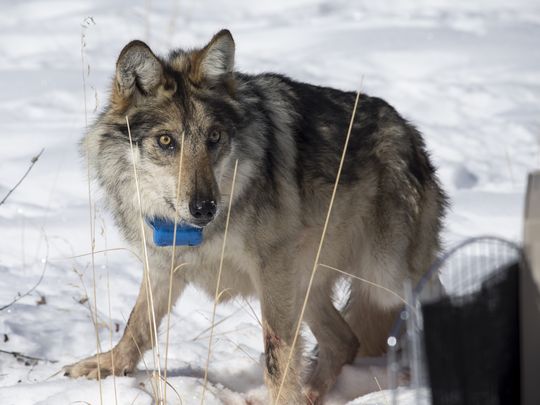
ALPINE — Biologists hauled a 60-pound Mexican gray wolf from the chopper on Monday, limp but healthy with a lush winter mane. They called it the wolf’s worst day in months — dazed from having been darted from above, still rapidly licking his nose through a blindfold muzzle — but the male wolf was one of the fortunate among a divisive and still-embattled breed that has weathered an especially perilousyear of poachings.
Unknown shooters have illegally killed at least 15 Mexican wolves since officials reported a year ago that a record 110 were roaming wild in eastern Arizona and western New Mexico, according to a lead state biologist on the recovery program.
The poaching losses tripled from 2014, and were likely unprecedented in the 18 years since the first captive-bred lobos brought their once-exiled howls back to the Blue Range spanning the Apache and Gila national forests.
Wolf-recovery specialists, like those in Alpine this week, are working to make sure the survivors flourish instead of backsliding to a more critically endangered status.
The team of federal and state biologists carried Wolf No. M1342 on a mesh sling. They brought the wolf inside their pine-ringed Alpine field station and slid him onto a slab wooden table for a checkup and shots to keep him robust for an important breeding season this spring. They injected a second sedative that would put the wolf out cold for about an hour.
The scientists gathered round the Elk Horn pack’s would-be alpha male, prodding veins for intravenous fluids and pushing an oxygen tube up his black nostrils.They were counting on the wolf to return healthy to his young mate on snowy Escudilla Mountain, and produce their first successful litter to help extend recent annual gains in a slow-recovering population.
AZCENTRAL
As recently as five years ago, there were an estimated 50 Mexican wolves in the wild, less than half of last year’s count. Whether this year’s survey finds the population continuing to grow will depend on the 40 or so pups observed since last spring. Historically, about half of pups have survived their first year.
Besides the wolves that were shot, about a dozen more adults are missing, “fate unknown.”
M1342 was lucky to have a dart dangling from his paw, and not a trail of lead fragments through his chest. Shootings have always been a key threat since the 1998 reintroduction.
The anti-wolf mentality commonly known as “shoot, shovel and shut up” is hard to combat. Bullets typically pass through a wolf’s body and leave little useful evidence, said Jeff Dolphin, Mexican wolf field supervisor for the Arizona Game and Fish Department. “You just can’t be everywhere at once,” Dolphin said.
Only a handful of what may be dozens of shooters have faced charges related to killing one of the protected wolves since 1998. Federal, state and non-governmental organizations offer a combined reward of up to $58,000 for information leading to the arrest and conviction of a wolf poacher.
A controversial task
Susan Dicks, a U.S. Fish and Wildlife veterinarian examines Wolf No. M1342. (Photo: Mark Henle/The Republic)
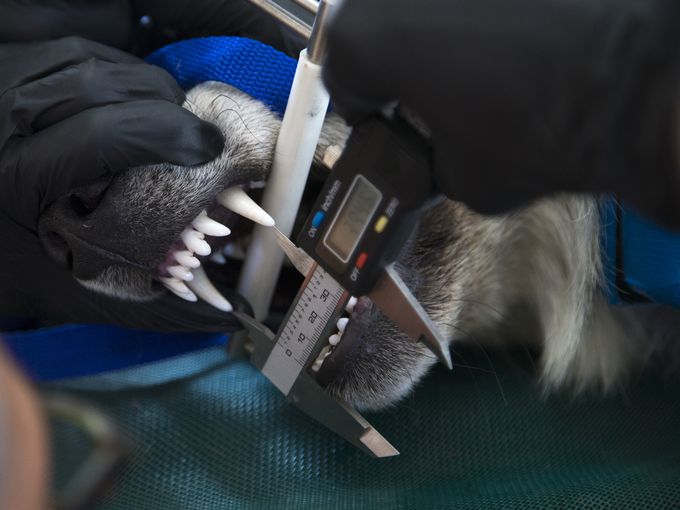
U.S. Fish and Wildlife Service veterinarian Susan Dicks coached the team of biologists and field technicians tending to M1342: how to draw blood for DNA and other tests; where to inject a rabies vaccine; how to determine age by measuring teeth; how to increase fluids or pour cooling alcohol on the paws if his temperature rises past 103 or so.
Besides the preventive medicine and data collection, the prime objective for M1342’s capture during a yearly aerial wolf survey was to fit it with a new transmitter collar. The collar he had received in a similar operation last year hadn’t functioned, so biologists only knew the wolf’s whereabouts by occasional observation. Uncollared wolves are difficult to track to ensure they’re not getting into trouble, such as by attacking livestock.
Not every wild Mexican wolf is collared, but scientists like to have them on a wolf of every generation in a pack. Last year’s survey counted 19 packs, including eight known to have a breeding pair.
AZCENTRAL
Studies show that these free-ranging wolves eat elk upward of 80 percent of the time, but cows are also occasionally on the menu. A government and non-profit fund pays for the losses. So far, the wolf program has paid out $68,000 for 50 confirmed livestock losses in 2015, and another $25,000 in claims is awaiting action by a compensation council. “It’s such a controversial program, and (people) want us to manage these animals,” Dicks explained. “The way we manage is with that collar. It communicates and tells us what they’re doing.”
The latest in a string of political struggles over the lightweight cousin of more plentiful northern gray wolves involves where they should be allowed.
Wolf advocates say they need unoccupied territory such as the forests around the Grand Canyon to sustain a population large and dispersed enough to withstand sudden die-offs. The governors of Arizona, New Mexico, Colorado and Utah recentlyco-signed a letter to the federal program opposing such a northern expansion into previously undocumented wolf territory and instead backing a push south into Mexico.
The number of wolves needed to ensure long-term survival also is in dispute. Some want to hold the line around today’s numbers, but others say at least a sevenfold increase is needed.
Mexican wolf biologist Julia Smith carries Wolf No. M1342 from the helicopter to the Alpine field station. He was darted from a helicopter to have his radio collar replaced.
Federal recovery effort
Mark Henle/The Republic Arizona is a partner in the federal recovery effort within a recovery zone that stretches from New Mexico and onto the Mogollon Rim. Officials say the state has spent $3 million since the recovery program began with captive animals in the 1980s.
This week, the team said one wolf had roamed west to within 35 miles of Payson, though it was unclear whether it was wandering alone. Others were prowling below the Rim, south of Alpine.
M1342’s gray-brown fur was thick, with no signs of mange or fleas, but Dicks squeezed an anti-parasite lotion onto the skin between the shoulders as an extra precaution. The team slid the wolf into a large dog crate and set the wolf outside to recover his senses for a truck ride back up the mountain to freedom. “We’re trying to help them out before breeding season,” Dicks said. “The population is so small.”
The subspecies had dropped to seven holdouts in Mexico during the late 20th century, survivors of private and government hunters who cleared the region of what had commonly been considered a menace. They were removed from the wild and stocked a captive breeding program that at last count fostered more than 250 wolves at 55 sites in the U.S. and Mexico.
AZCENTRAL
A few years ago, the population struggled to stay atop 50 from one year to the next, hindered not just by illegal shootings or natural causes, but by government agents shooting or removing to captivity wolves that attacked livestock. Since then, the program has focused its efforts on conflict-avoidance, said John Oakleaf, field coordinator for the U.S. Fish and Wildlife Service.
With help from partners such as Defenders of Wildlife, the government has enlisted ranchers who accept payment for the wolves’ presence but also get help from range riders protecting cattle. It may have kept the number of illegal shootings from climbing even higher. “In the end,” Oakleaf said, “the tolerance of humans for wolves is what allows them to persist or not persist in the wild. It’s what drove them to extinction, or near extinction, and it’s what’s driving them toward recovery now.”
Final numbers next month
The Fish and Wildlife Service will release the final numbers from this year’s count next month. Until then, total deaths aren’t officially tallied, but Oakleaf acknowledged the illegal shootings will be “as high as we’ve ever documented.”
Dolphin put the number at 15, and said he doubts the population estimate will remain above 100 this year. Still, he’s optimistic after years of bigger struggles to stabilize the population.
All of the wolves now in the wild were born out there, which may make them better adapted than their parents were to hunting and surviving on game. A recent experiment showed that it’s possible to drop a captive-bred pup or two in with newborn wild litters, and the wild packs will raise them as their own. “The urgent thing is to get more wolves with genetically diverse backgrounds on the ground as quickly as possible.”
Wolf advocates are also cautiously optimistic, though they believe the packs need more territory, and more of a boost from now-rare releases of captive pairs in new haunts. “If you put (captive-bred) pups in the dens of existing packs, you may be increasing the number of animals,” Center for Biological Diversity wolf specialist Michael Robinson said, “but you’re not increasing their distribution.”
A common complaint of wolf proponents is that Mexican wolves, coming from such a limited breeding stock, lack genetic diversity and pay for it with smaller litters than other wolves have. “The urgent thing is to get more wolves with genetically diverse backgrounds on the ground as quickly as possible,” Robinson said.
Returning groggily to the wild
Wolf No. M1342 is released at Escudilla Mountain. (Photo: Mark Henle/The Republic)
After M1342 had regained enough of his senses to lift his head and sit up in the crate, Arizona Game and Fish biologist Brent Wolf and two colleagues loaded the crate onto a four-wheel-drive pickup and drove him back up Escudilla Mountain.
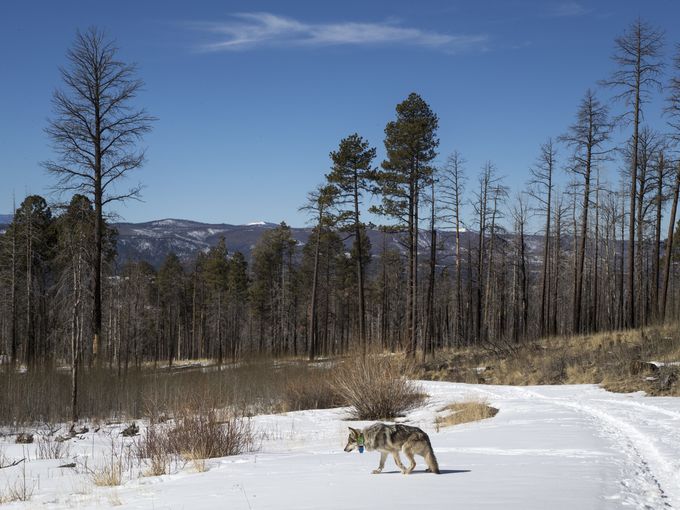
They drove as far as the truck would take them without getting stuck in the snow, getting as near as possible to the spot where the helicopter crew had darted M1342 and then set down to take the male from his mate.The return crew set the crate down at the edge of a snowy alpine meadow surrounded by scraggly willows and fat ponderosa pines, many of them torched and left bare by the massive 2011 Wallow Fire.
The groggy wolf took a few minutes to crawl out, then sat in the snow for several more. His golden-brown eyes stared toward the crew inside the pickup, and he licked the dart wound while waiting for the sedation to free his hind legs. The wolf walked slowly across the meadow, likely to be reunited with his mate once he heard a howl.
The two are believed to have mated last year, but did not produce any surviving pups, Wolf said. That’s common among first-timers, he said, and their experience should help them when they try again. “I’d be shocked if they didn’t have pups this spring,” Wolf said while reversing and turning the truck to head back down the mountain.
GALLERY
Mexican wolf biologist Julia Smith carries Wolf No. M1342 from the helicopter to the Alpine field station. He was darted from a helicopter to have his radio collar replaced. Mark Henle/The RepublicJulia Smith holds Wolf No. M1342 on his way to the Alpine field station. Mark Henle/The RepublicMexican wolf biologist Brent Wolf weighs Wolf No. M1342 in the Alpine field office. Mark Henle/The RepublicWolf No. M1342’s teeth are measured. Mark Henle/The RepublicMeasurements are taken of Wolf No. M1342’s paws. Mark Henle/The RepublicWolf No. M1342 is 3 years old and a member of the Elk Horn Pack. Mark Henle/The RepublicWolf No. M1342 got a checkup and shots to keep him robust for the important breeding season this spring. Mark Henle/The RepublicFrom left, Dr. Susan Dicks and intern Rowan Converse carry Wolf No. M1342’s kennel. Mark Henle/The RepublicFrom left, interns Hannah Manninen and Becca Thomas-Kuzilik release Wolf No. M1342 at Escudilla Mountain. Mark Henle/The RepublicWolf No. M1342 walked slowly across the meadow, likely to be reunited with his mate once he heard a howl. Mark Henle/The RepublicWolf No. M1342 and his mate are believed to have mated last year, but did not produce any surviving pups. Researchers say their experience should help the wolves when they try again. Mark Henle/The Republic
ooOOoo
Golly, I so do admire the good people who undertake this caring work on behalf of the wolves. And great photographs Mark Henle of The Republic.


 Yes, there was some foaming at the mouth, some evidence of the government-hating libertarianism this region is known for. “We don’t want people in Sacramento telling us how to live our lives,” grumbled one rancher.





 Learning from Dogs