Tag: Business

Unemployment, Part Three

How much is “too much” Unemployment?

How much unemployment “should” our economy have?  How much unemployment is too much, and how much is just right?  How high does the unemployment rate have to go before significant changes are made in government policy and approaches?

The question of the optimal level of unemployment has generally been answered by reference to the so-called “natural rate” of unemployment.  The natural rate of unemployment is measured as the long-run average rate of actual unemployment in an economy over time; it is a “trend line,” as seen in this graph below:
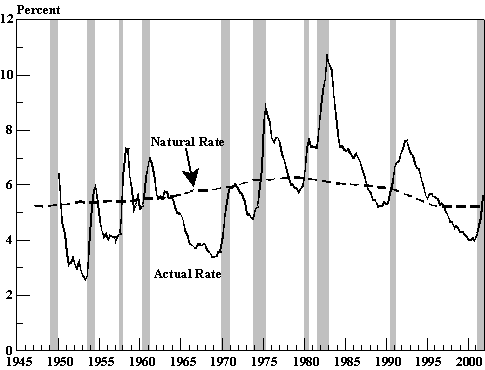

unemployment3

Read more of this Essay

More on that ‘passion’ word!

Passion may be the key to many, many areas of success.

Following John’s Post on Sunday about passion, two other items passed my virtual desk that seemed to resonate with the theme.

The first was my regular Sunday ‘newsletter’ from Philip Humbert.  Sometime it comes across as a bit too good to be true but that may be a little bit of cultural mismatch from an Englishman’s eyes. Philip describes himself as a “Personal Success Coach!” and offers a free weekly newsletter that is worth trying out.

Anyway, to the point of this Post.

Read more about Passion

Understanding unemployment, Part Two

Examining unemployment in more depth.

In an earlier post, I explained how the reported U.S. unemployment rate, which was 9.6% in August of 2009, is unemployedmeasured. This post will explore the reported unemployment rate in more depth, distinguishing between the short-term, temporary sources of unemployment and the long-term, more structural, and troubling aspects of the unemployment rate.

The 9.6% U.S. unemployment rate remains the same next month if no one changes their employment status.  But the rate also remains unchanged if the same number of people hired get fired.  In truth, the U.S. unemployment rate nets out enormous flows of people into and out of the labor force and, for those in the labor force, between being employed and unemployed.

A representative month in the unemployment statistic tells the story.

Read more about unemployment

Naked Capitalism – can you help?

Anybody out there who can offer some support?

Yves Smith is responsible for the Blog, Naked Capitalism.  It’s a great Blog and it must take a huge amount of effort to publish the volume of information that Yves does.

Yves has a problem, read here, an extract from his Post below:

Dear patient readers, this is a bit of sentence first, verdict afterwards, but it is 6:00 AM and I have spent all day and all night dealing with copy edits and am still behind the eight ball and need to sleep too, or my productivity will go from poor to non-existent.

So you get an antidote now, and if you check back later, I will fill in some links for your delectation, and hopefully at least a wee post too.

Sorry about this, I feel bad about neglecting the blog, particularly after the technical difficulties of last week, but the WordPress problems put me further behind schedule. And to be honest, they weren’t just WP.

If you can help or know someone who could, then contact details are here.

By Paul Handover

Lehman Brothers – whoops!

Wonderful article in the Financial Times about the importance of IT documentation!

Unwinding derivatives is a complex task at the best of times. In the case of Lehman, one of the biggest dealers in some of the most complex derivatives markets, this has been even more so. Lehman’s global derivatives book included contracts with a notional face value of $39,000bn and deals with 8,000 different counterparties when it went bust. The derivatives business was actually split into multiple strands, backed up by between 20 and 30 different systems.

Once it went bankrupt, the staff who supported these systems “evaporated”, according to Steven O’Hanlon, president of Numerix, a pricing and valuation company which is working with Lehman Brothers Holding Inc to unwind the derivatives portfolio.

Say no more! Full article is here.

By Paul Handover

Now you see it, now you don’t!

Bermeja (Mexican Gulf) – anyone seen my island?

There’s a wonderful story in last week-end’s The Sunday Times, a British newspaper, written by Matthew Campbell concerning the loss of an important island that has been used previously to define the limits of Mexico’s maritime

Old map with Bermeja

border (read oil!).  Here’s an extract:

The mystery has come to haunt Mexico as unrelentingly as one of its beloved soap operas: where is Bermeja, an island off the Yucatan coast that appears to have vanished without trace?

The disappearance of Bermeja is no laughing matter – it would allow Mexico to extend its maritime border some 55 miles further north, helping it to fight off what it sees as American encroachment on its claims to potentially vast oil reserves in the Mexican Gulf.

Read more of this Post

Precision engineering

Technology is so much more than bits and bytes.

Recently had the opportunity to visit a factory belonging to Horst Engineering in the nearby town of Guaymas (pronounced whymas), Sonora, Mexico.  The factor manager is an American, Andy Law, who, with his lovely wife, livesHorst 2 across the road.

It is simply ages since I have seen a precision engineering factory at work.  Not only was I impressed but it took me on a long trip down memory lane, with a couple of strands: engineering tools and the British defence industry.

But before the reminisces, a word about the calibre of the young Mexicans working for Andy.  Unlike so many of the locals who one comes across, these bright, young men and women are committed, self-motivated, multi-lingual (Sp/Eng) citizens. It was a treat to observe them and hear Andy speak so highly of them.  Mexico sorely needs up-coming generations of highly capable people.

Continue reading “Precision engineering”

Good old-fashioned service values

What a delight to come across people who care.

This is a personal story with a wider message. That great after-sales service matters and in these difficult times will make the difference between surviving and even growing, or failing.

I drive a 2005 5.7 litre Jeep.  It was bought (second-hand) when I arrived in the US about a year ago, en route to JeepMexico.

Just recently the automatic transmission failed.  There was no choice but to commit it to the local Mexican Jeep dealership for repair.  This is a sophisticated transmission system and I was seriously worried that it was going to be a nightmare.

I didn’t account for the help from AASTRO in Tucson, where the Jeep had been serviced a couple of times.

Continue reading “Good old-fashioned service values”

A little later than I would have wished!

Jon Lavin.

You will see from the Hello World post at the head of Learning from Dogs that the idea of integrity being a topic for wider discussion arose a while ago.  Busy lives (and a big misunderstanding about Blogging!) put off us doing something until Paul got the Blog under way in July, this year.

I still have, thank goodness, plenty of work demands on my time and a busy family life but, at last, will be finding time to explore the importance of integrity.

As I say in About this Blog, I had noticed that businesses that were operating largely with integrity, tended to be happier places, got better results and it was possible to develop levels of awareness within teams that enabled them to work together far more effectively. Levels of self-awareness are important because they allow people to develop closer business relationships with everyone internal and external and this leads to increased levels of trust.

By Jon Lavin

Selling Change – Concluding Part.

Understanding the process of change – key learning points.

  • Good, really good, knowledge of your products and services is essential.
  • People don’t buy anything unless they are dissatisfied with their present circumstances.Questioning
  • Selling change means getting the client to recognise that change brings real benefits.
  • Only good, client-focused questioning will uncover real needs.
  • Only excellent listening skills will allow you to hear what those needs are.
  • Don’t worry about the type of questions – just question, question, question.  Oh, and listen!
  • Understanding the potential customer’s business and where their needs are is fundamental.

Needs questioning is a sales concept.

Continue reading “Selling Change – Concluding Part.”