I stuck this in my drafts folder and then promptly forgot about it!
But despite the aurora taking place nearly two months ago, the pictures are stunning and I wanted still to share them with you. They came to my attention thanks to the EarthSky blogsite.
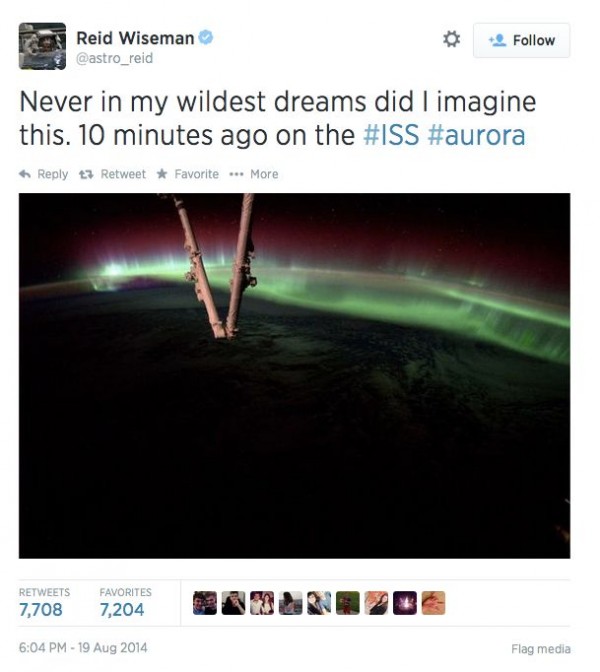
One of the first auroras of the 2014 autumn season appeared last night at northerly latitudes. Astronaut Reid Wiseman caught it from space. Photographer Göran Strand caught it from Sweden.
oooo
Astronaut Reid Wiseman captured these images from the window of the International Space Station last night (August 19, 2014). SpaceWeather.com says:
A moderate (G2-class) geomagnetic storm that erupted following a CME strike on August 19th is subsiding now. At its peak, the storm sparked auroras around both poles visible from the ground and from space.
Last night I got to see my first Aurora for the season, two days earlier than last year but five days later than my personal record from 2011 (August 14th).
It was a faint aurora that lasted for several hours and as you can see it was quite cloudy. The orange/yellow clouds to the right are clouds that are lit up by the street lights from the city of Östersund and Frösön.
Finally the dark nights are here so we can enjoy the auroras ahead and let us hope that there will be lots of them during the coming season.
Don’t you think Göran Strand’s photograph is just wonderful!
Last November, I published a Post on Learning from Dogs under the title of This is rocket science! It included the film Walking on Air shot from the International Space Station.
Anyway, a few days ago, Ginger I. here in Payson, sent me an email with the YouTube version of the film and I decided to include it as the only item in today’s post.
Enjoy.
Time lapse sequences of photographs taken with a 4K-camera by Ron Garan fragileoasis.org/bloggernauts/Astro_Ron and the crew of expedition 28 & 29 onboard the International Space Station from August to October, 2011. All credit goes to them, who to my knowledge shot these pictures at an altitude of around 350 km. I intend to upload a FullHD-version presently.
HD, refurbished, smoothed, retimed, denoised, deflickered, cut, etc. All in all I tried to keep the looks of the material as original as possible, avoided adjusting the colors and the like, since in my opinion the original footage itself already has an almost surreal and aestethical visual nature.
Music: Jan Jelinek | Do Dekor, faitiche back2001 w+p by Jan Jelinek, published by Betke Edition janjelinek.com | faitiche.de
Image Courtesy of the Image Science & Analysis Laboratory, NASA Johnson Space Center, The Gateway to Astronaut Photography of Earth eol.jsc.nasa.gov
1. Aurora Borealis Pass over the United States at Night
2. Aurora Borealis and eastern United States at Night
3. Aurora Australis from Madagascar to southwest of Australia
4. Aurora Australis south of Australia
5. Northwest coast of United States to Central South America at Night
6. Aurora Australis from the Southern to the Northern Pacific Ocean
7. Halfway around the World
8. Night Pass over Central Africa and the Middle East
9. Evening Pass over the Sahara Desert and the Middle East
10. Pass over Canada and Central United States at Night
11. Pass over Southern California to Hudson Bay
12. Islands in the Philippine Sea at Night
13. Pass over Eastern Asia to Philippine Sea and Guam
14. Views of the Mideast at Night
15. Night Pass over Mediterranean Sea
16. Aurora Borealis and the United States at Night
17. Aurora Australis over Indian Ocean
18. Eastern Europe to Southeastern Asia at Night
A timely video from the International Space Station (ISS)
Little did I realise when I posted yesterday’s item that a couple of subsequent actions would make today’s article easy to write (trust me it isn’t always this easy!).
Mike T., a flying buddy from my old days in England, sent me this link to a 5-minute video made up of a series of films shot from the ISS. DO WATCH THE VIDEO IN FULL SCREEN MODE!
The details of how the film was taken and much more interesting information is at the very end of this article.
Then Martin Lack who writes the blog, Lack of Environment, submitted a comment with a link to a piece that he had written on the 19th August that I would like to re-publish in full.
Why are we still waiting for the EU to act?
What can we learn from the fact that the EU has still not stopped buying over 90% of Syria’s oil exports? If nothing else, it tells me that we need fossil fuel too much!
But I think the problem of wrong priorities goes much deeper than that… This is because the Limits to Growth argument (which underlies my concern over AGW) is, even though the protestor-in-the-street may not realise it, the root cause of all the problems we are now seeing in Afghanistan, Bahrain, Cairo, Damascus etc., etc… right through to Zimbabwe: Treating the symptoms of food shortages or corruption (or whatever they may be) will not succeed unless we address the root cause, which is the inevitable consequences of perpetual growth in consumption of resources and/or waste production on a finite planet [see E.F. Schumacher’s Small is Beautiful (1973)].
This 5 minute videomakes sobering viewing, but it also perfectly summarises everything I have learnt in the last 12 months; and all I have posted on my oldMyTelegraph blog in the last 5 months!
It may not be rocket science, but can we reach Escape Velocity?
This stuff is not rocket science, but it is very unwelcome news to people with a vested interest in the continuance of “business as usual”. Unfortunately, we literally cannot go on the way we are; something has got to change…
Extract of paper presented by Dr Myles Allen at 4 Degrees and Beyond Conference (2009)
So a big thank you to Mike T. and Martin Lack for a number of lessons:
how clever man is in terms of space technology besides much more
the beauty of our planet – it’s all we have to live on
the amount of electric light that shines into outer space, as seen by the ISS.
how much of that lighting might be generated by coal and oil!
if we don’t learn to live in harmony, as in sustainably, with this planet of ours, the implications are going to be very serious.
Finally, as mentioned earlier the details of that video on Vimeo.
Time lapse sequences of photographs taken with a 4K-camera by Ron Garan fragileoasis.org/bloggernauts/Astro_Ron and the crew of expedition 28 & 29 onboard the International Space Station from August to October, 2011. All credit goes to them, who to my knowledge shot these pictures at an altitude of around 350 km. I intend to upload a FullHD-version presently.
HD, refurbished, smoothed, retimed, denoised, deflickered, cut, etc. All in all I tried to keep the looks of the material as original as possible, avoided adjusting the colors and the like, since in my opinion the original footage itself already has an almost surreal and aestethical visual nature.
Music: Jan Jelinek | Do Dekor, faitiche back2001 w+p by Jan Jelinek, published by Betke Edition janjelinek.com | faitiche.de
Image Courtesy of the Image Science & Analysis Laboratory, NASA Johnson Space Center, The Gateway to Astronaut Photography of Earth eol.jsc.nasa.gov
1. Aurora Borealis Pass over the United States at Night
2. Aurora Borealis and eastern United States at Night
3. Aurora Australis from Madagascar to southwest of Australia
4. Aurora Australis south of Australia
5. Northwest coast of United States to Central South America at Night
6. Aurora Australis from the Southern to the Northern Pacific Ocean
7. Halfway around the World
8. Night Pass over Central Africa and the Middle East
9. Evening Pass over the Sahara Desert and the Middle East
10. Pass over Canada and Central United States at Night
11. Pass over Southern California to Hudson Bay
12. Islands in the Philippine Sea at Night
13. Pass over Eastern Asia to Philippine Sea and Guam
14. Views of the Mideast at Night
15. Night Pass over Mediterranean Sea
16. Aurora Borealis and the United States at Night
17. Aurora Australis over Indian Ocean
18. Eastern Europe to Southeastern Asia at Night


 Learning from Dogs