Your journey will be much lighter and easier if you don’t carry your past with you!
So said some unknown scribe. Well I have to say the move from Arizona to Oregon seemed to have quite a bit of ‘past’ travelling with us! But we made it!
Before I mention a few highlights of the last twelve days, first let me say a very big ‘thank you’ to Martin Lack for his fabulous role in looking after things while we were engaged in the moving process. Indeed, Martin’s involvement was so valuable that it made sense to retain his status as author on Learning from Dogs. I hope Martin shares posts with you all on a regular basis.
So to the recap.
As many of you saw, Neil Kelly sent us on our way to Oregon with that wonderful cartoon on the 23rd. October. The previous day had seen a transformation of belongings everywhere …
Ready for loading, except the dog!
…. to an eerily empty home.
Ready for the off in the morning.
The journey up to Merlin, Oregon of 1,176 miles over three days was a blur of hours and hours of driving, walking dogs around strange Motels evenings and mornings and keeping fingers and toes crossed that something didn’t go wrong!
Luckily fate was on our side and a little before 11am on Thursday, 25th October, our mini-convoy of a U-Haul truck towing Jean’s Dodge laden with one group of dogs and our Jeep with other dogs on board, towing a trailer with our five cats inside, pulled up outside the local store in Merlin, some three miles from our new home, so we could purchase basic necessities for the next 24 hours.
Nearly there!
Then at precisely eleven minutes past eleven a.m. we turned into our drive,
closely followed by the truck.
And here we are!
Nature was on hand to greet us as we nosed up to the edge of the paddock; a mother deer and her two babes. A treasured moment.
Welcome, you humans!
The rest of the day was absorbed with the unloading of all our belongings and making arrangements for bedding both humans and animals down, for the first night in Oregon.
Then the morning of Friday, 26th gave us a taste of what Autumn mornings here were like – stunning.
The reason we came here!
So there we are! It’s going to be weeks before we are properly settled in but there’s no question that we have ended up in a beautiful part of the world.
Happy dogs and happy people.
oooOOOooo
Now some thoughts regarding this Blog. The list of jobs and tasks that are ahead of us as we turn a house that has been empty for some years into a fully functioning home is ‘interesting’! Inevitably I will have to cut back a little on the 2 to 3 hours a day I used to spend writing for Learning from Dogs when back in Arizona. I am fully committed to publishing something every day but for a while I will lean more heavily than usual on finding material previously published elsewhere. Please let me have your feedback, good or bad!
Finally, the move made it impossible for me to reply individually to a number of readers who decided to subscribe, as I like to do.
So a blanket thank you to all who in the last 10 days decided to follow Learning from Dogs.
Just a wonderful set of very heart-warming pictures.
Note: These were sent to me by John H. back on the 13th October, our penultimate Saturday in Arizona. I thought they would make a perfect start to our first November week-end in Merlin, Oregon.
There are twenty-two in total; eleven today and the rest tomorrow.
oooOOOooo
oooOOOooo
The concluding glorious eleven photographs tomorrow.
Southwest forests are already in the early stages of a mega drought brought on by climate change.
Southwest forests are already in the early stages of a mega drought brought on by climate change that will result in massive tree die-offs and sweeping changes in Rim Country forests, according to an analysis published in the scientific journal Climate Change.
Severe drought will dominate much of this century, creating stresses on forests not seen for more than 1,000 years, according to the research that used tree ring samples from 13,000 trees, historical rainfall records and computer projections of future climate change.
The shifts will likely dramatically shrink the world’s largest ponderosa pine forest in northern Arizona, replacing pines with junipers at elevations like Payson and replacing junipers with chaparral and cactus at lower elevations.
The article concludes,
Unfortunately, the team’s climate prediction models suggest that within the next 40 years the region will fall deep into mega drought conditions. The models predict that even the wettest, coolest years in the late 21st century will exceed mega drought levels. In that case, the drought conditions of the past decade will prove the new normal rather than a bad stretch.
Williams noted that while winters in the past decade haven’t been exceptionally dry, summer temperatures have soared. As a result, the stress on the trees in the past 13 years has exceeded mega drought levels about 30 percent of the time — conditions not matched for the previous 1,000 years.
One of the clean little secrets about dealing with climate change, is that if we make our cities more efficient, and reduce their carbon footprint, we will also make them more resilient, quieter, more comfortable, more human scaled, more inviting, and more fun.
As global temperatures rise, urban areas are facing challenges in keeping their infrastructure and their residents cool. Chicago is tackling that problem with a green design makeover. This report is part of our Coping with Climate Change series.
Today, Jean and I together with our 11 dogs and 5 cats start the 1,200 mile journey to Merlin, Oregon. While we have only lived in Payson since February, 2010, it has been a time of fantastic experiences. I had to work through the long process of getting a fiancee visa from the American Embassy in London. Until that was issued my ‘residence’ in Payson was that of a British tourist with me having to leave the USA every 90 days.
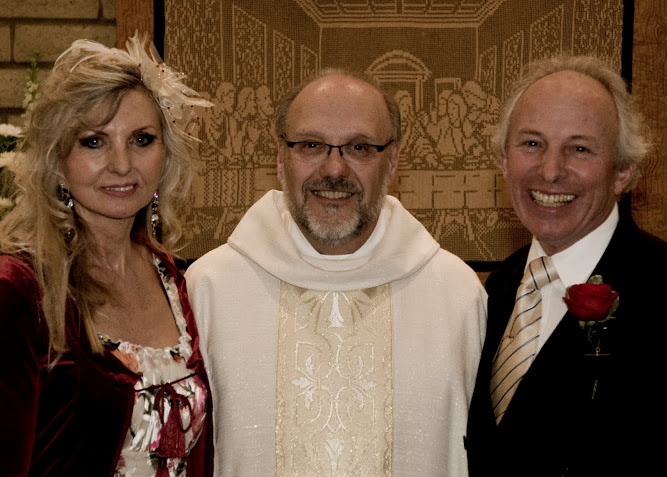
The visa was issued in October, 2010 and I flew immediately to Arizona. On the 8th November, 2010 Jean and I were issued with a Marriage License Certificate and we were married on the 20th November at St. Paul’s Episcopal Church in Payson.
Fr. Dan Tantimonaco with the newly weds!
We have made many very dear friends here in Payson but Oregon feels like the start of our home in every sense of the word, not just because it is the first home that Jean and I have bought jointly.
One of those dear friends here in Payson has been John Hurlburt, a devoutly spiritual man. A little over a week ago, he sent me a very thoughtful essay and I wanted to include it today as a guest post in recognition of the way that John and many, many others have embraced these couple of Brits over the last 32 months. Thank you all.
oooOOOooo
Unity
Everything fits together
The species of animals we know as human beings is a part of everything that exists. We are a very young consciously-aware species that does not begin to know all the answers. What little we do know has a Natural pattern. It would seem that there’s a lamplighter and a navigator in all of us. The lamplighter is our fundamental awareness of being and provides nature’s guidance along life’s pathways.
Our natural navigator is designed for evolutionary competition. There’s a biological survival kit in our DNA. Extreme demand for limited resources generates deadly combat; both within and between species. As a result of competition taken to wretched excess, our global economy is leveraged 22 times beyond any earthly foundation. The unspoken intent to destroy each other over what remains of our planet is becoming increasingly evident.
The human species is engaged in a global war over money, ideals and disappearing finite resources. Ninety-seven percent of the world scientific community has confirmed that the natural effects of heat and discharges generated by human machines and related human activities are the primary cause of recent rapid climate change.
These dedicated scientists are opposed in the media by three percent of their corporate energy-financed peers. An oppressive worldwide network of often offensive politicians is similarly supported and managed accordingly. Nature couldn’t care less about politics, emotions or idealistic arguments.
Human squabbles mean very little in the totality of universal life. The drumbeat of local natural disasters increases steadily. There are no two ways about it. No amount of human ifs or buts can or will change reality. Our human species is in deep serious trouble.
It has been six million years since the first humanoids emerged and two million years since the rise of human civilization. What a sorrow it is to realize what we have done to the earth in just the past two hundred and fifty years. We’ve reached the moon and are exploring Mars. It’s well past time to clean house and re-grow our local garden.
As an old navigator, there’s a sense of urgency regarding the course life on earth has taken. For those who continue to care about facts, the prognosis is not encouraging. We have the know-how for an alternative. We can avoid the perfect storm of going over the edge of an economic cliff and the crush of an environmental crisis in the midst of a war-fuelled, profit-driven, global, corporate fight to the end. The alternative is that we have the know-how to transition rapidly to a reality-based economy and a way of living that’s gentle to the earth. The solution is global, it’s industrial, it’s natural and it’s our best hope. It may well be our only hope. It’s time to light some lamps.
Conscious human awareness emerges as we relax, contemplate, meditate, and communicate openly. These are levels of awareness beyond the limits of our daily human musings. The wisdom which flows from enlightened awareness embraces humility, experience, knowledge, understanding, and faith. Life has never been easy. We’re fragile biological beings. Our mutual growth is the result of sustained efforts over millions of years.
Yet despite attaining a higher level of conscious awareness our human culture continues to operate on a material basis rather than a moral basis. We have become confused by our own importance or the apparent lack thereof. We all too often retreat into a rut, furnish it and turn on the electronics.
By definition, natural processes support species growth in harmony with all natural life. Those natural processes are indistinguishable from the planetary support systems within which all life interacts. Human interaction is local. We spend much of our lives unaware that we are unaware; initially as infants and throughout our lives in deep sleep. When caught up in the pressures of our daily lives, it’s easy to be unaware of being unaware.
It’s time to wake up. Cosmology is an eternal spring from which the waters of the earth still flow. When we turn ourselves inside-out and achieve higher awareness, we discover who, what and where we really and truly are. In a trinity of spirituality, nature and science, we’re cosmically energized beings; spiritual beings sharing a transitory human existence.
Ninety-eight percent of the human population believes in a power beyond species and self. The simplest understanding of this belief is that we humans did not originally create ourselves. All human wisdom and understanding leads to the conclusion that human beings don’t own the earth. We’re caretakers and we’re only passing through. Given that we have a systemic crisis, what do we have to work with?
We have a species that’s squabbling over diminishing resources, an environment and an infrastructure which both desperately require attention, a sustaining objective of equitable global employment, a world economy that’s about to collapse for lack of any real foundation, a burgeoning population which further strains the system and the clear need for a unifying purpose.
Put it all together and what do we have? The navigator is our guide to growth. The navigator shares our wholeness. The lamplighter is our guide to unity. Everything fits together. Each of us is a part of the unity of life. Unity has a natural purpose. It’s time to build a life boat.
John Hurlburt is a former U.S. Navy aviator and successful corporate executive who presently serves as a senior Christian educator and a founding member of an international Transition Town in Payson, Arizona.
oooOOOooo
Don’t know about you, dear reader, but I find those incredibly powerful words. Words that provide the truth. A truth the whole world needs. John set out in a personal email to me the three simple fundamentals of our lives. Just a few more words to sum up the truth.
“There’s an environmental crisis. There’s an inevitable global economic abyss touching us all on a daily basis. The need for a green economic transformation is obvious.“
On the 23rd, next Tuesday, Jean and I plus our eleven dogs and five cats together with the contents of our Arizonan house move the 1,200 miles to SW Oregon! Moving to a beautiful home with 13 fabulous acres just outside the small community of Merlin, near Grants Pass.
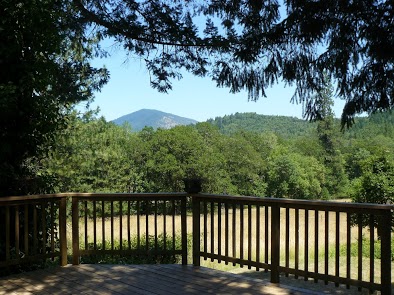
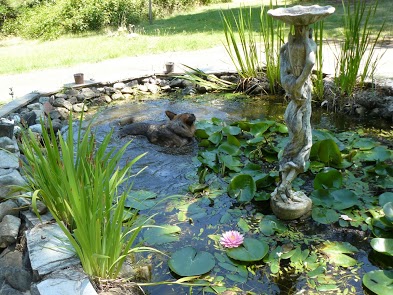
The view from the rear deck!The lily pool gets checked out by Pharaoh!
But managing Learning from Dogs for the next couple of weeks or so is going to be a challenge.
So I shall be re-running posts from time to time concentrating on posts that were published during the early months of Learning from Dogs on the assumption that many of today’s readers will not have seen them.
It’s likely that internet access won’t be available to me until the early days of November, so, between now and then Martin Lack of Lack of Environment has very kindly offered to monitor goings on and respond to comments. Thank you, Martin!
As British Rail have been known to say, ‘Normal service will be resumed just as soon as possible!‘
This was sent to me recently. It has been doing the rounds big time, and rightly so!
oooOOOooo
Before going on to today’s post, I feel the need to explain something. That is that over the last week or so I have been republishing many more items rather than writing my own creative stuff. This is an unfortunate consequence of us having our house here in Payson up for sale, which is generating more work than usual. Plus we are packing. All this to do with us moving from Arizona to Oregon in the first week of November.
oooOOOooo
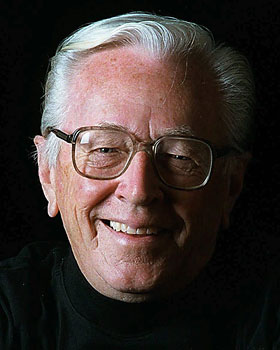
Charles Schulz
The following is the philosophy of Charles Schulz, the creator of the ‘Peanuts’ comic strip.
You don’t have to actually answer the questions. Just ponder on them. It will make very good sense!
Here’s A Little Quiz
You don’t have to actually answer the questions. Just read them straight through, ponder a tad, and you’ll get the point.
Name the five wealthiest people in the world.
Name the last five Heisman trophy winners.
Name the last five winners of the Miss America pageant.
Name ten people who have won the Nobel or Pulitzer Prize.
Name the last half dozen Academy Award winners for best actor and actress.
Name the last decade’s worth of World Series Winners.
How did you do?
The point is, none of us remember the headliners of yesterday. These are no second-rate achievers. They were the best in their fields.
But the applause dies. Awards tarnish over time. Achievements are forgotten and accolades and certificates are buried with their owners.
Here’s another quiz. See how you do on this one:
List a few teachers who aided your journey through school.
Name three friends who have helped you through a difficult time.
Name five people who have taught you something worthwhile.
Think of a few people who have made you feel appreciated and special!
Think of five people you enjoy spending time with.
Did you find that Easier? Of course you did!
So here’s the lesson!
The people who make a difference in your life are not the ones with the most credentials, or the most money…or the most awards…they simply are the ones who care the most.
A small tribute from two of Her Majesty’s subjects!
Best wishes for many years ahead as our Queen!
Jean and I managed to watch the hour-long tribute by Prince Charles to his mother’s wonderful Diamond Jubilee week-end.
Here’s a small extract of that programme that appeared on ITN News.
Then thanks to Martin Lack’s latest Post, I discovered that You Tube have the full programme as well. Here it is – do watch it if you can, it is a lovely, personal and intimate reflection by Prince Charles.
At the end of the programme, both Jean and I felt very nostalgic about the long reign of Her Majesty Queen Elizabeth II. However much we appreciate the life that we have here in Payson, Arizona, these two old Londoners still feel proud to be British.
There’s a great website here full of all the details of this very special time for Britain.
Finally, the extreme dry conditions of our forest mean that lighting a Jubilee Beacon here at home is out of the question. The following is our alternative:
Beltane Fire Ritual, Edinburgh, Scotland
It’s what Jean and I do most Sunday evenings anyway!
There are a number of news stories about this extra-special full moon but I’ve chosen to republish some of what appeared on the Mother Nature Network website.
In terms of the timing of this full moon, rather than give you times for various places around the world, as this website does, I will simply offer the UTC/GMT time:
Sunday 6th May 2012 at 03:35:06 am
If you want to covert that to your local time wherever you are on this beautiful planet The World Time Server is as good a website as any.
BIGGER THAN YOUR AVERAGE MOON: Skywatcher Tim McCord of Entiat, Washington caught this amazing view of the March 19, 2011 supermoon. (Photo: Tim McCord)
Skywatchers take note: The biggest full moon of the year is due to arrive this weekend. And because this month’s full moon coincides with the moon’s perigee — its closest approach to Earth — it will also be the year’s biggest.
The moon will swing in 221,802 miles (356,955 kilometers) from our planet, offering skywatchers a spectacular view of an extra-big, extra-bright moon, nicknamed a supermoon.
And not only does the moon’s perigee coincide with full moon this month, but this perigee will be the nearest to Earth of any this year, as the distance of the moon’s close approach varies by about 3 percent, according to meteorologist Joe Rao, SPACE.com’s skywatching columnist. This happens because the moon’s orbit is not perfectly circular.
The full Moon will be up to 14% larger and 30% brighter than others during the year. The reason for this phenomenon is that the Moon becomes full on its closest approach to Earth on May 5, 2012, also known as the perigee full Moon.
So enjoy this most beautiful sight if you are somewhere on this planet where the moon will be visible at night. And double-check the time and the day so you don’t miss it! Finally, let me close by ‘spoiling’ my many readers in Arizona, and to serve as a good reminder for yours truly by saying that anyone on US Mountain Standard Time will see this moon at:
Saturday, 5th May 2012 at 20:35:06
“Aim for the moon. If you miss, you may hit a star.” W. Clement Stone.
First, an apology for presenting something that isn’t from my own pen, so to speak. But for much of yesterday I was immersed in other writings and when I turned to ‘today’s’ Post for Learning from Dogs, around 5pm my time, my creative juices had well and truly dried up! So a very big ‘thank you’ to Diane M., from here in Payson, for recently sending me this wonderful dog story! It’s been widely circulated, not that I had seen it before, but I’m told that not necessarily with the full story, as this version includes.
ALittle Something Just For You!
Meet George the Great Dane
The first time we saw George, our beloved Great Dane, he was no more than a tiny, cowering ball of fuzzy fur. As my wife Christie opened the door of the crate he’d travelled in, he teetered to a standing position and looked out at us, moving his head slowly from side to side, taking in the wonder of it all. Finally, as if weighing us up and deciding we were acceptable, he tentatively pushed his little nose forward and gave Christie her first lick.
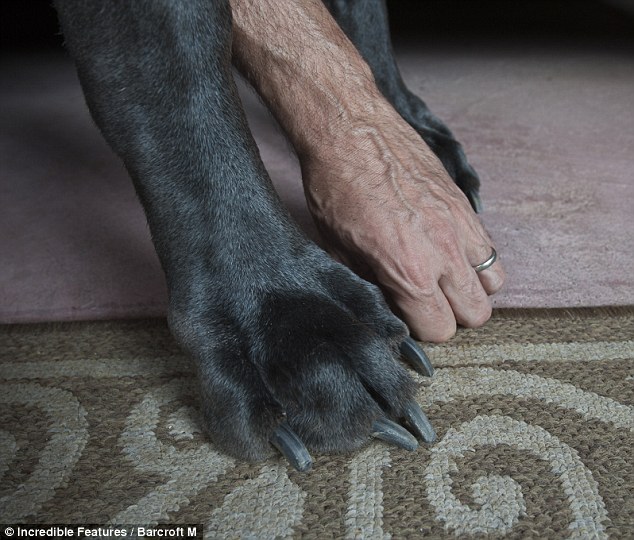
Puppy love: A young George with Dave's wife Christie. Even as a pup he had comically large paws.
He came into our lives in January 2006, just a few months after we had married and set up home in Arizona . We both had busy jobs, Christie selling medical equipment while I was a property developer, but she had always planned that, once she had a house of her own, she would also have a dog.
She wanted a Great Dane as they make great family pets, so we tracked down a litter of 13, born 1,000 miles away in Oregon. Their owner emailed us a photo showing a chaotic jumble of paws, snouts and tails.Twelve were entangled with one another, but our eyes were drawn to one pup standing apart from the rest. He was clearly the runt, endearing him to Christie immediately.
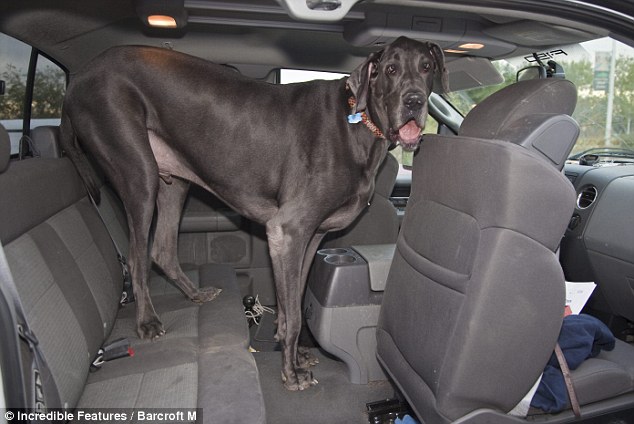
Though it didn’t really register, George’s paws were comically large even then. But all we saw was this cute puppy. We certainly never dreamed he would one day become the biggest dog in the world, standing nearly 4ft high at the shoulder, 7ft long and weighing nearly 250 pounds. Right now, he just looked bewildered.
George made the long journey from Oregon to Phoenix by plane and we picked him up from the freight area, tired but unshaken. As soon as George settled into our home, we discovered our plans to be fair but firm parents were wishful thinking. All the things that make Great Danes wonderful pets — their lack of aggression and their attachment to humans — make them more emotionally sensitive than other dogs.They need to be with their ‘pack’ at all times and at night the cute pup with intensely blue eyes turned into a caterwauling banshee whenever we tried to leave him alone in the kitchen.
No matter how much we reminded ourselves that he had every home comfort (warm dog bed, warm blanket, warm kitchen, squeaky bone), each whimper created a picture in our heads of a tragic, abandoned pup, desperate for his mother. Eventually, we gave in and shunted George’s dog bed into our bedroom.
George measures more than 7 ft from nose to tail and weighs 250 pounds and is the world's biggest dog, but he's terrified of Chihuahuas...
In the coming months, Christie really threw herself into being a mum to George. As well as a photo album, he had a growth chart — we were soon reading it in awe.At five months he still acted like a puppy, chasing his tail and playing games of fetch and tug-of-war with his favorite bit of rope. But he was already the size of a fully-grown Labrador .He was putting on more than a pound a day and he bounded around like Bambi, skittering on our wooden floors and hurling himself at everything he fancied, including us humans. His displays of affection could leave you pinned temporarily against a wall or a piece of furniture.
His size did not go unnoticed in the outside world. Our local park had a section for puppies but we were bullied out of it by other owners, who were scared George would hurt their pups — but the opposite was true.
The smaller dogs ran around and under him, and he’d be constantly sidestepping them, obviously anxious and jittery. Slowly we realized that our enormous puppy was a big softie. Besides his terror of being left alone, he had a fear of water. He’d growl anxiously at the side of our swimming pool, alarmed that his ‘pack’ members would so willingly place themselves in danger of drowning.
If the pool was his most-hated place, his favorite was our bedroom. Eventually he outgrew the single mattress we placed there for him and preferred instead the comfort of our king-sized bed — sprawling between us like some over-indulged prince while we spent half the night clinging onto the edges.
Paws for thought: George's giant feet dwarf Dave's hand.
In the summer of 2006, we solved this problem by buying him his own queen-sized mattress, which he still sleeps on today at the bottom of our bed. But soon we encountered another challenge as George reached doggie puberty. Once he had grabbed life by the lapels, now he was grabbing onto legs — table legs, chair legs, human legs, he wasn’t picky — and doing what all male dogs do with the vigor of a canine giant.
He calmed down in the furniture department after we had him neutered, but then he took up a new hobby, eating as if it were an Olympic sport.A sausage on the barbecue was like a siren to a passing sailor. You couldn’t turn your back for a minute. And he was so tall that he actually had to bend down to pinch food off kitchen counters.
He could reach the high shelves as well, so we had to hide everything away in cupboards. Soon, he was getting through around 100lb of dry dog food every month.
As he approached his first birthday in November 2006, weighing about 196 pounds, it was getting physically impossible to make him go anywhere he didn’t want to — including the vet’s surgery. He had not forgotten the time he went there in possession of his manhood — and came out less than whole. As soon as he recognized the entrance, he refused to move. So I had to take him around to the less familiar back door instead.
For all these troubles, George gave us plenty in return, not least the following year when Christie lost the baby she was carrying. Evidently tuned in to her grief, George was a constant presence at her side. When she sat, he sat too. When she stood, he stood and padded alongside her to wherever she was going.
His personality grew more delightful the bigger he got. A male Great Dane typically weighs from nine to 11 stone, but by Christmas 2007 George weighed 210 pounds — bigger than most men. At this point, he loved being chauffeured around in my golf cart and would sit in it, his haunches on the seat and front legs on the floor. By Christmas 2008, our canine colossus weighed 252 pounds. A friend suggested he might be a contender for the Guinness Book of Records, but we had other things to think about: Christie had discovered that she was pregnant again.
With size comes problems: George the giant barely fits in the back of his owner's SUV
The trouble was, when our daughter Annabel arrived that September George made it clear he wanted nothing to do with this interloper. He was used to spending nights in delightful oblivion at the foot of our bed. Annabel’s high-decibel presence simply wasn’t on. When she cried, he’d wake, harrumph and then turn over in annoyance. Once it was clear the racket was going to continue, he’d exhale heavily again, till one of us finished that mysterious feeding thing we did with the noisy intruder.
But while he might not have cared much for Annabel, George loved her dolls, especially a stuffed green one that played a nursery rhyme when squeezed. Whenever he could, he placed it between his paws and pressed it so he could hear the tune. It was like a security blanket. It was a period of such big adjustment for him that if it made him happy, then it was fine by us and our patience was rewarded.
Slowly, George understood that Annabel was our pack’s youngest member and in need of his affection and protection. And on Christmas morning, he ended his three-month sulk, acknowledging her presence with a lick of her hand. It was the best present we could have had — although the beginning of 2010 brought more good news.
A doggone miracle: George the Great Dane with the Nasser's daughter Annabel at home in Arizona.
Over the previous weeks, while Annabel slept, Christie had applied to the Guinness World Records people on George’s behalf. That February, one of their adjudicators came to watch George being measured in the presence of a vet. He was officially declared not just the world’s tallest living dog (43 inches from paw to shoulder) but the tallest dog ever.
The following week we flew to Chicago to appear on the Oprah Winfrey Show and were put up in one of the city’s most luxurious hotels. We had a huge sitting room, dining area and even a bar — but there was just one problem. There was nowhere for George to sleep.
As we enjoyed a gourmet meal and a bottle of red wine that night, he struggled to settle on two roll-out divans provided for him. Infuriatingly, they wouldn’t stay together. So he had his head on one and back end on the other, but his stomach was sagging onto the carpet.
‘You know what we need to do,’ I joked. ‘Give George our bed to sleep on and have the divans in this room ourselves.’
Christie looked at me with a telltale gleam in her eye and I knew immediately my joke had been a fatal error. An hour later, our boy was sprawled in splendor in our huge, fluffy king-size bed.
‘Well,’ whispered Christie, ‘George is the star here, after all.’ She was right, of course, and since his appearance on TV, Giant George has built a following around the world, with his own fan club, website and 70,000 fans on Facebook.
None of this, of course, means anything to George. He still spends his days doing what he has always liked best: eating, playing and sleeping. Our cherished pet may have become a global celebrity — but really, he’s just one of the family.
Man's biggest friend: Devoted owner Dave Nasser with George.
Powerful prose, stunning pictures and an insight into the last 1.8 billion years of our planet.
The Payson Roundup is the local newspaper for Payson. To be frank, most weeks it’s a fairly quick read. That’s not a reflection of the quality of the newspaper, just an acknowledgement that Payson is a small American city some 80 miles NE of Phoenix up in the high desert. Indeed, the Roundup has a good record of winning awards.
However on the 6th January, there was a stunning article about the Grand Canyon, less than 4 hours driving from Payson. It was written by Pete Aleshire, a Staff Reporter with the Roundup. I can vouch for Pete’s literary skills as he teaches the creative writing course at the local college that Jean and I attended last term (semester) and will be restarting tomorrow.
I am very grateful to the Payson Roundup for their permission to republish this wonderful work. So here it is.
Woe and beauty on an ancient edge
by Pete Aleshire
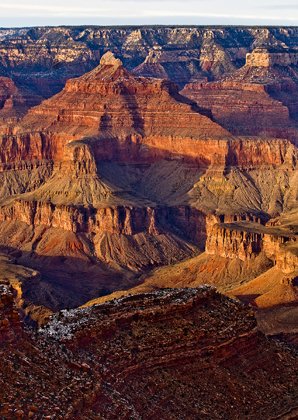
This view of the canyon reveals the layers of limestones and sandstones that testify to vanished seas and deserts. Note the strong, narrow white layer of Coconino Sandstone near the top, composed of 260-million year-old sand dunes. Also note in the center of the photo the 500-foot-tall cliff of Redwall Limestone formed on a seabottom 300-400 million years ago. Photo Tom Brossart/Roundup
I took a step — a long step — a million years step. Then I stopped, turned and faced north. Perched on the jagged edge of my life, I looked down deep into the shadowed layers of lost worlds — terrible deaths, fractured continents, vanished seas, mass extinctions.
Taking a breath, I took another step — a long step — another million years.
Curiously, I felt better — my troubles for the moment shrunk to no more than a ledge of Tapeats Sandstone in the wall of the Grand Canyon opposite. A layer of fossilized beach sand laid down 570 million years ago, the Tapeats Sandstone lies atop a mystery of missing stone — dubbed the “Great Unconformity.”
I studied that light, crumbling layer of sandstone in the canyon wall just across the way, knowing that all the great, riotous thrust of life that took us from pond scum to troubled writers has taken place since the lapping waves of a vanished sea left that layer of crumbling gray stone on a barren beach.
Perched on the wind-tormented branch of a twisted juniper nearby, a glossy black raven croaked at me.
“Nevermore,” he gurgled in my mind’s ear.
“You raise a good point,” I said to the raven and the wind that rose up out of the canyon’s 1.8-billion-year gash of time. I let loose a breath, a sigh, a puff of steam — frail and fleeting as life in the shadow of so much time. It should have depressed me, to stand so mite-like on the edge of such immensity. All I had dreamed or hoped or failed to do would not amount to a swirl of dust on this crumbling edge. I ought to have felt insignificant. Instead, I felt obscurely better.
So I took another step. A long step — a million years.
They had not built the Trail Through Time along the edge of the Grand Canyon between the El Tovar and Yaqui Point the last time I lingered on this edge. Now, it offers the most exciting crash course in geology I’ve ever encountered, although I’ve sought after rocks and unconformities all my life — and have even written geology books for confused people.
The 1.2-mile-long trail presents sliced and polished rocks representing almost all of the 24 major rock layers laid bare in the canyon wall from the 240-million-year-old limestone, siltstone, gypsum and chert layers of the Kaibab Formation to the 1.8-billion-year-old Vishnu Schist in the canyon bottom, among the oldest exposed rock’s on the planet’s surface.
Each step along the 1.2-mile path represents a million years, starting in the present and ending up at the 1.8-billion-year-old start of everything.
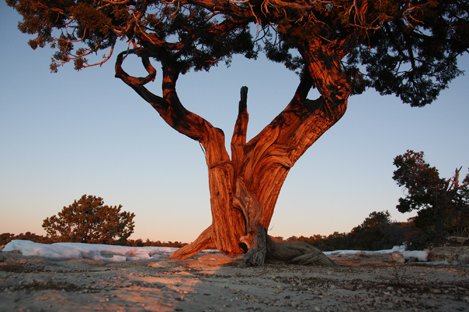
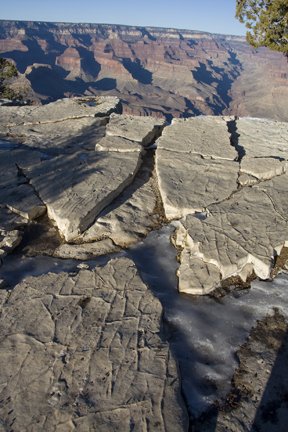
The Grand Canyon reveals a 1.8-billion year glimpse into Earth’s past from views like these along the 1.2-mile-long Trail of Time, with displays of rocks from each of the two dozen rock layers in the mile-deep canyon. A juniper catches the last light. Photo by Pete Aleshire
The Grand Canyon represents the most vividly revealed slice of Earth’s history anywhere on the planet. That makes the canyon one of the few places a person can grasp both the astonishing violence and the tormented timescale of the planet that sustains us all. This unique cross-section of time comes as a result of the relatively level uplift of the Colorado Plateau in the past 5 million to 8 million years. In most places, such a vast uplift would jumble the buried rock layers. But much of the 130,000 square miles of the Colorado Plateau rose at the rate your fingernails grow without deforming the miles-deep layers of sandstones, limestones and shales laid down on the bottoms of long-vanished seas and deserts.
As the Colorado Plateau rose, the northern edge crumpled into the Rocky Mountains. The southern edge dropped away along a 200-mile-long chain of 1,500-foot cliffs — which north of Payson forms the Mogollon Rim. Oak Creek cut back into that rising edge of the plateau to uncover the striking red rock formations of Sedona.
The Colorado River did the same thing, but on a grand scale. Many geologists believe the Colorado River originally ran north into a vast, interior sea. But as the Colorado Plateau rose, another river that ran south cut backward until it captured the north-flowing ancestral Colorado River, reversing the flow so that it now ran south into the Gulf of California.
This capture some 6 million years ago began the process of carving out the Grand Canyon. As the plateau rose, the flood-prone Colorado River cut down through it, like pressing a log up against a chain saw. Meanwhile, the steep tributaries widened the canyon by carrying those soft layers of sedimentary rock down to the main stem of the Colorado.
A layer of 230-million year old Kaibab Limestone caps the rim. The Grand Canyon reveals a 1.8-billion year glimpse into Earth’s past from views like these along the 1.2-mile-long Trail of Time, with displays of rocks from each of the two dozen rock layers in the mile-deep canyon. Photo by Pete Aleshire
That process started at about the time the genetic evidence suggests humans, chimps and gorillas last shared a common ancestor and continues to this day.
As a result of this vast uplift, the relatively young Colorado River has revealed in the walls of the Grand Canyon the long buried history of the Earth going back nearly halfway to its creation. That encompassed the entire period in which life progressed from single celled organisms in the ocean to its present, dazzling complexity.
The meander down that Trail Through Time reveals much of that history, preserved in the rock layers and the fossils they contain. Of course, erosion has already removed more than 200 million years of that history, so that the youngest rocks on the rim of the canyon are older than the dinosaurs.
A few dominant layers stand out.
Near the top, the fossilized desert sand dunes of the light Coconino Sandstone bear witness to a vast desert that covered the Southwest some 260 million years ago. At that time, what would become North America was part of a “supercontinent” that gathered almost all the dry land on the planet into a single mass.
In the middle of the canyon, lies the great, blood-red wall of Redwall Limestone, formed on the bottom of a shallow sea between 300 million and 400 million years ago. Today, the fused layers of microscopic skeletons of ancient sea creatures forms a sheer 500-foot-tall band of cliffs that pose the greatest single barrier to reaching the canyon bottom from the rim. All of the trails to the bottom must pass through fault lines in the Redwall Limestone, stained red by iron oxides leaching out of the layers above.
Farther down, the easily eroded Bright Angel Shale forms the shelf above the 1,800-foot-deep inner gorge. Shales form on shallow sea bottoms, compared to the deeper marine environments that create limestones. Most of the trails in the canyon run along its wide shelf. Formed 530 million years ago, the Bright Angel Shale represents the era when trilobites ruled the world.
Just below the Bright Angel Shale lies the Great Unconformity, where erosion in the inconceivably distant past removed 1.2 billion years worth of rock. This records another period of uplift, when erosion carried off layers of rock many times higher than Mt. Everest.
Below that unconformity, the story continues — down through a dozen more layers in the inner gorge, each one mounted alongside the trail and polished smooth. The Grand Canyon Supergroup spans the period between 570 million and 1.2 billion years ago, again recording the meanderings of the continents and the ebb and flow of oceans, as the planet breathes in, breathes out.
After another, smaller unconformity, the river finally reveals the inconceivably ancient Vishnu Schist and Zoraster Granite. The schists started as sandstone, limestone and shale, before they were buried, reheated and fused into this dense, primordial rock. The Zoraster Granite ooze up from the molten depths of the Earth, forming veins revealed finally by the relentlessly downcutting river.
I could not see the metamorphosed Vishnu Schist from my perch atop the rim, but I have seen it on raft trips in the dark heart of the canyon where it has been fluted and carved and sandblasted by eons of floods.
Finally I stood stock still, my breath coming still in moist, warm, puffs as the planet spun so that the dust of the atmosphere gave the sun’s long light a warm red glow, reflected off the ancient worlds across the way.
My raven friend — or one of his kin — flew past with an audible whoosh of his wings, then banked to consider the possibilities. He croaked, that guttural warble that only ravens dare.
Odds are, he noted my proximity to the edge and so paused to ponder my potential as carrion.
But I prefer to think that he felt our shared pulse of life and caught the updraft of my yearning.
In either case, he settled on the branch of a weirdly stunted ponderosa pine nearby and we shared the sunset.
The shadows rose up out of the canyon, swallowing continents and oceans.
I kept my gaze on the glow of the Redwall Limestone until the shadow took it, then shifted to the luminous yellow of the Coconino Sandstone.
For I came to the canyon full of woe holding my life in my fingernails, my heart in the shadows. But now my troubles seemed fleeting, the world full of marvels, my life aglow like that desert turned to sandstone in the last light of day.
My breath came in a puff, transparent but warm in the still, cold air.
“Nevermore,” quoth the raven, “nevermore.”
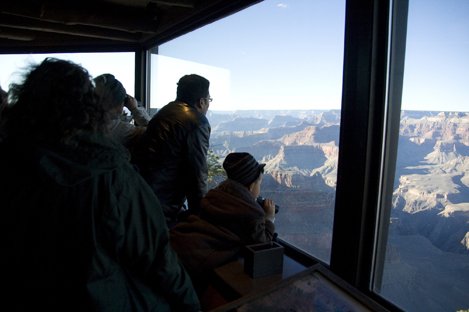
Visitors study the colorful layers of the Grand Canyon from the observation window in the geology museum at Yaqui Point. Photo by Pete Aleshire
oooOOOooo
Such beautiful words. Any additional thoughts from yours truly are utterly superfluous.






 Learning from Dogs