I was born in London in November, 1944. Exactly six months before the Second World War ended in April, 1945.
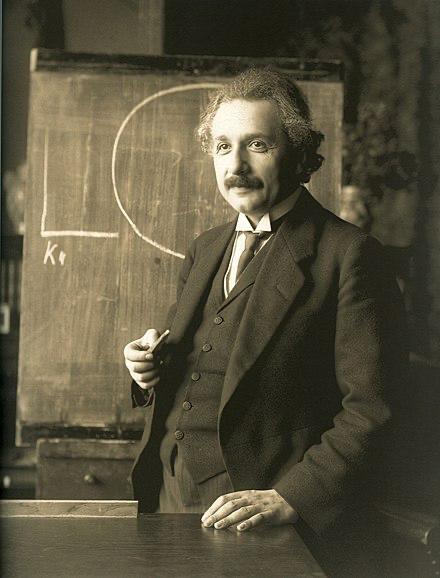
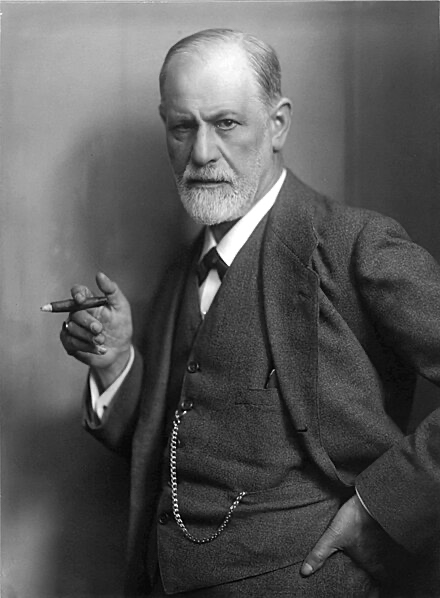
Thus it was of great interest to me that yesterday Jean and I listened to a BBC Radio 4 programme about the letters that were exchanged between two great Jewish men: Einstein and Freud, in 1932. The programme was called Why War? The Einstein-Freud Letters.
The programme ends with offering the listener a fundamental choice, which I won’t spoil for you now. But to me it is an extension of my post (or Patrice’s post) that I published recently on March 19th.
I believe, and hope, you can listen to it by clicking on this link. Here also is the text that is at that link:
In 1932 the world-famous physicist Albert Einstein wrote a public letter to the founder of psychoanalysis, Sigmund Freud. Einstein, a keen advocate of the League of Nations and peace campaigner, asked Freud if he thought war and aggression was forever tied to human psychology and the course of international relations: could we ever secure a lasting world peace?
Einstein’s letter is deeply prescient, as is Freud’s extraordinary response. The exchange was titled ‘Why War?’. The two thinkers explore the nature of war and peace in politics and in all human life; they think about human nature, the history of warfare and human aggression and the hope represented by the foundation of the League of Nations (precursor to the UN) and its promise of global security and a new architecture of international law.
At the time of their exchange, Freud is in the last great phase of his career and has already introduced psychoanalysis into the field of politics and society. Einstein, the younger of the two, is using his huge international profile as a physicist for political and pacifist intervention.
For Einstein, future world security means a shared moral understanding across the global order – that humankind rise above the ‘state of nature’ never to devolve into total war again. He wrote to Freud, as ‘a citizen of the world…immune to nationalist bias…I greatly admire your passion to ascertain the truth. You have shown how the aggressive and destructive instincts are bound up in the human psyche with those of love and the lust for life. At the same time, you make manifest your devotion to the goal of liberation from the evils of war…’ Is it possible, Einstein asks Freud, to make us ‘proof against the psychoses of hate and destructiveness?’. Freud’s answer is fascinating and quite unexpected.
The exchange of letters was sponsored by the International Institute of Intellectual Cooperation, an organisation promoting global security by using prominent thinkers, drawing on multiple fields of knowledge (from science to psychology, politics and law) to achieve a new language for international peace, following the lessons learned from the Great War of 1914-18.
But even as Einstein wrote to Freud in the summer of 1932, the Nazi party became the largest political party in the German Reichstag. Both men felt a sense of apprehension about what was coming; both were pacifist, both Jewish, both would be driven into exile (both Einsteinian physics and Freudian psychoanalysis were denounced by the new regime). The letters were finally published in 1933 when Hitler came to power, suppressed in Germany, and as a result never achieved the circulation intended for them.
Featuring readings from the Einstein–Freud letters and contributions from historians of warfare and psychoanalysis, war journalism and global security, this feature showcases the little-known exchange between two of the 20th century’s greatest thinkers, ‘Why War?’ – a question just as relevant in today’s world.
Contributors include historian of war and peace Margaret MacMillan, BBC chief international correspondent Lyse Doucet, defence and security expert Mark Galeotti, historian of international relations Patrick O Cohrs, author Lisa Appignanesi, who has written on Freud and the history of psychoanalysis, and Faisal Devji, historian of conflict and political violence in India and the Middle East.
Readings are by Elliot Levey (Einstein) and Henry Goodman (Freud)
Many years ago I found myself teaching at a unit attached to Exeter University. I was teaching sales and marketing. I can’t remember clearly the events that produced the meeting between myself and Chris Snuggs. But I recall the outcome.
Chris was the director of studies at a French institute named ISUGA. Let me borrow from their website:
The ISUGA Europe-Asia International BBA Bachelor’s degree is a 4-year cursus following the Baccalaureate or High School diploma which combines studying International Business and Marketing with learning an Asian or English language and comprising university exchange stays, as well as internships in French and International businesses.
ISUGA is located in Quimper, Western Brittany relatively close to Devon in England where I was living.
In Chris’ words: “It must have been through them that we got your name when we needed someone to teach Selling. Now I come to think of it, we HAD someone lined up for a whole week and he CANCELLED on us, so you were a last-minute replacement.”
For quite a few years I went across to Quimper to teach for Chris. Mainly by ferry from Plymouth to Roscoff. During the summer months I flew to Quimper from Exeter in our group-owned TB20. (The picture below is of the type only not our aircraft.)
A Socata TB20
Since that day we have remained in reasonable contact and I regard Chris as good friend.
A few days ago Chris published on his blog his account of his journey from Quimper back to Ramsgate, in east Kent. It was hilarious and I asked Chris if I could publish it and share with everyone.
Chris not only said yes but insisted on improving it (his words) including expanding it to what it is below.
So with no further ado, here is Chris’ post.
ooOOoo
“A DOG’s Travel Across Northern France” … as in “Doddering Old Git”
I am officially a “Senior Citizen”, but as such prefer much of what passes for “The Good Old Days” when in this case we were called “Old Age Pensioners” – MUCH less PC and wokeish AND more realistic – but DOGS sounds much better (and more informative) than OAPs.
A simple trip to Blighty to see the family for XMAS was not supposed to be a saga, but it turned out to be one:
Like ET, I was going home, though not quite as far – though it probably seemed like it.
I got about 3 hours sleep max Thursday night/Friday morning; worried about oversleeping even though I had THREE electronic wake-up devices.
I got up at 04:30 to finalize packing and clean up (the worst of) my mess.
I went out into the street in front of the house at 06:45 to await the taxi – it was raining, albeit not heavily.
The taxi was 5 minutes late, but the driver didn’t apologize. (I was going to say “woman driver” but I believe that sex differentiation is no longer allowed.)
I tried to help her (it, hir, shim?) load my heavy suitcase into *** boot (car, not footwear).
I lightly touched the car with the suitcase, and shim said: “Mind my car. Your suitcase is too heavy.”
I nearly said: “So are you, but it’s probably your hormones or your genes.” but decided that discretion was the better part of insult as I had to catch a train ……
We got to the station in plenty of time, only for me then to find that the train was due to go from platform C (usually it’s A as you leave the entrance hall).
I then found out/remembered that there is no lift at Quimper station. “This is not going to be my day,” I thought …
As I approached the stairs down to the access tunnel, I pretended to be a Doddery Old Git on the point of collapse (no comments please) and a nice young man helped me with the case.
Same procedure with a different bloke to go up to platform C. I actually tried this ploy with a pretty young lady first, but just got a funny look ….
Eventually got onto the right and very crowded train; my “This is not a gasmask” COVID mask was very reassuring as the virus probably had a field day circulating the carriage. I got some more funny looks, but two people asked me where I got my mask, so I am thinking of merchandising them ….
Got to Paris 4 hours later – showed a railway worker my little map where the taxi was supposed to be waiting and he pointed me in direction X saying authoritatively: “Tout au bout.” (“right at the end” for those who left school at 14).
Seemed a bit iffy to me (I vaguely remembered having gone somewhere else the last time I had done the journey, but couldn’t remember where. Does that happen to you?), but I followed his directions in the obviously-idiotic belief that someone actually working in a place would know where the taxis would be.
Of course, there was no sign of a taxi area at the distant far end of the HUGE Montparnasse Station, so I asked another railway bod.
He pointed in the 180° opposite direction and said the same as the first bloke, so I had to retrace my steps and go another 200 metres past where I had started to one of the no doubt multiple exits.
On exiting I was surrounded by some Middle Eastern gentlemen (without beards as it happens) who were desperate to take me somewhere.
I told them I had booked a taxi already and they suddenly lost interest.
I then got a call on my posh new mobile, but as with every other mobile I have ever owned it is specifically designed so that one cannot easily answer a call – first there is always some other leftover screen on the thing which by the time you have got rid of the caller has given up, and second you have to SWIPE to even see a green button which you then press – and I don’t know who invented SWIPE but hanging, drawing and quartering while being burned alive in oil over a period of several hours would be a suitable punishment.
This was all way beyond me, so I missed the call.
Miraculously, however, I did manage to call back and it was in fact the driver.
After two or three calls in each direction we managed to find each other physically as well as phonally.
We set off for La Gare du Nord, which should be about 15 minutes max by road – but it took us an hour and a quarter … (This was Paris in the rain on Friday at lunchtime – but I did learn a few new French swearwords from the driver.)
Fortunately, I had plenty of time between trains and so managed to find and embark on my TER to Calais.
This was an uneventful trip except that I was opposite a young mother with an inquisitive baby who kept looking at me for some reason (the baby not the woman ….).
I thought about playing with the baby but did not want to be arrested as a paedophile. I did plonk a small orange on the little table between us thinking she might want to play with it, but I got a funny look from her mother …. so I picked it up (the orange not the baby) and ate it – getting more funny looks. Strange … I get that all the time.
There was no internet on the TER so I tried to doze, but dozing with a high-decibel baby one metre away is a skill I have not yet mastered – and probably never will.
Arrived at Calais station – it took me 10 minutes to find the lift to get to the exit: in fact, one has to be led across an actual line by a railway bod and then take the lift – which is conveniently hidden.
But once outside the station I got a taxi right away. (a rare plus chalked up!)
I was dropped at the port outside a little hut marked “Billets”: (“tickets” for the linguistically-challenged).
This was weird – there used to be a big hall full of foot-passengers, but it has all changed – there IS a big hall, but it is empty except for two WWI biplanes. “Perhaps they want to fly us over?” I thought.
Went into the ticket office to be told my boat was cancelled (no explanation was offered) and they would try to get me on the next one. I never did understand why they would “try” (there was hardly anyone else there), but it seems they had to wait for a phone call.
It was a very small cabin with four guichets (Would you like a French dictionary for XMAS?) and three simple chairs, on one of which – after having my particulars scrutinized and recorded – I was invited to sit – which I did, not sure whether I should show appreciation or keep going with the scowl I could feel coming on ….
Behind the desks several women came and went, but spent all the time yacking to one another about women stuff while three of us sat waiting in stony and in my case exhausted silence (it was by now 18:00 and I had been up since 04:30).
I eventually got up and complained, something that comes naturally to we DOGs. I said I did not understand the delay, that I needed a coffee and a toilet break and that the least they could do was install some beds in their little office for those in my situation (and condition) who had to wait overnight for information about getting on a replacement ferry. I wanted to add a question about whether they had been trained in defibrillation techniques but by then I had run out of breath.
The charming young lady smiled and said they had none of the things that might alleviate my stress (adding the word “understandable” would have been nice) but that the large hall opposite might be open, and if not she could lend me a key to open it and visit the convenience.
I couldn’t be bothered to try to work out why she wouldn’t know whether the hall was open or not and that what I in fact most urgently needed was to get out of there without bothering with keys I would probably lose – which I did.
I then walked round the large hall three or four times admiring the WWI planes and wondering if the Red Baron had ever flown one of them. The fresh air and exercise refill renewed the oxygen supply to my needy brain.
I eventually staggered back to the ticket office and sat down on my hard chair again. I was tempted to feign a loud snore but as with the taxi driver in the morning decided that discretion was the better part of valour.
15 minutes later a phone call came and I was summoned to the guichet and given my ticket.
“Great,” I thought. “At last we can get outta here.”
THEN she told us that in 40 minutes someone would come to drive us to the boat.
I was fast losing the will to live, but thought that another dose of circling the large airplane hall might at least get my blood circulating again.
I told her where I was going and mentioned the hall and the planes (to be fair she did laugh at my joke about flying us across the Channel), but said: “That’s all run by the Chamber of Commerce.”, and of course we all know that no lunacy is beyond THAT organization.
I left after asking if she could send out a rescue party if I did not return – and she smiled again …. Smiles don’t of course achieve anything practical but they do at least make the pain somewhat more tolerable.
I came back half an hour later, having admired the bi-planes once again and wondered whether the Red Baron had ever flown one – and indeed a lady driver soon turned up as predicted to drive us to the boat. (another rare plus chalked up …)
We had to go up and down two or three kerbs (nowhere lowered for people to wheel their too-heavy suitcases) and eventually got onto a bus.
Had to go up a multiply-zig-zagged ramp to get onto the boat, but I played the Doddery Old Git card again and someone helped with my case.
I had thought of taking my walking-stick on this trip to boost the DOG sympathy factor, but could not work out how I could possibly carry it simultaneously with the rest of my baggage.
I asked a boatbod what time we would be leaving and then arrive in Dover, and he said: “in 15 minutes and 20:00.”
40 minutes later we still had not left, so I asked someone else when we would be leaving and was told in 15 minutes.
We actually left 30 minutes later, and I decided that being 100% wrong in a prediction was not actually that bad as these things go.
When I asked yet anOTHER bod WHY there had been another delay he just rolled his eyes and said something about the Captain which I didn’t understand – but was past caring.
Ten minutes later I asked the next available bod what time we would arrive in Dover and was told 20:30.
This was well past the time my taxi was booked, so I called to inform Eddy, the driver.
Fortunately, making calls on mobiles is easier than receiving them, so that was OK.
On the boat I got talking to a foot-passenger couple (there were only EIGHT of us!).
They were very nice and I gave them Taxi Supremo Andy’s phone number as they had nothing arranged for their arrival.
When we eventually got to Dover, there were no more checks (even though they made us walk through a maze of corridors in the totally empty border-control and customs instead of going straight to the taxi area – maybe they were filming us secretly?) and we eventually got to where I hoped to find Eddy the Driver.
However, there are huge roadworks going on just inside the port entrance and all the usual roads are blocked off and/or rerouted.
There was of course no sign of Eddy – OR any other taxis. Foot-passengers have a VERY low priority …..
Grateful for my phone once again, I called Eddy who said he was ALREADY in the port but had got lost.
Taxi-drivers getting lost is a bit ominous, so I assumed he was even more of a DOG than I am. Still, we DOGs have to stick together …..
I told him where we were ….. right near the entrance just past the roundabout at the bottom of the long clifftop descent to the port. For those who know Dover this is the easiest part of the entire port (or indeed of England) to find …..
Three exchanged calls later we finally met up physically as well as phonally – which was a reminder of Paris. In future, I am going to fix a GPS signal to myself and ensure my driver has military-standard tracking equipment. Perhaps Nathalie can arrange that?
Eddy was as suspected a bit of a DOG – but like me, very nice …… I asked if he could drop off my friends from the boat at Dover railway station before taking me back to Ramsgate – which he agreed to.
So we took them up the road to the station, where they unloaded their stuff from the boot.
I did think about getting out to check they didn’t take any of my four bits of luggage, but I was very tired and also thought that it would be impossible to confuse the grotty things I was carrying with any of their posh stuff from Parisian shops.
They gave Eddy an extra £8 for the slight detour. As I said they were very nice even if the lady’s perception and memory banks were highly undeveloped.
We then at last set off for Ramsgate, but Eddy took a wrong turn and we ended up driving towards Canterbury.
It takes a really advanced stage of dodderation to get lost driving from Dover to Ramsgate, so I will be contacting “The Guinness Book of Records”.
I decided against advising Eddy to do a U-turn in the pitch dark, and after driving four miles up a dual-carriageway we eventually got to a roundabout, retraced our wheels and made our way back to Dover.
Miraculously finding the right road to Ramsgate this time, we set off on the last lap. By now I was desperately hanging onto life by a thread.
Halfway to Ramsgate Eddy got a call from Taxiboss Andy’s Missus:
“The couple you dropped off at the station just rang; it seems they have got a package belonging to one of the other passengers.” ME! NO, I AM NOT MAKING THIS UP …..
…. but they were nice people and apparently said they would wait at the station for us to come and pick up the bag.
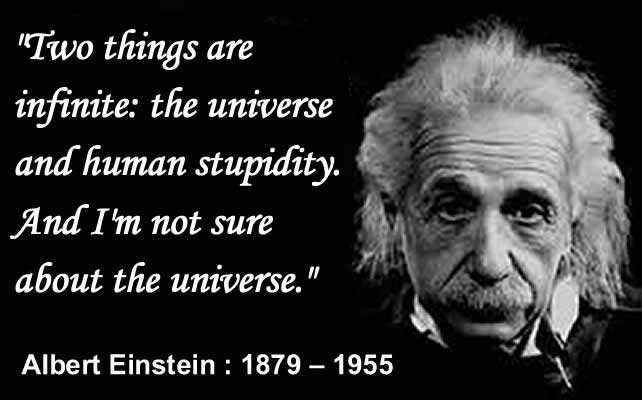
I tried to keep calm, but remembered Einstein’s famous dictum. (SEE BELOW)
We stopped to check the boot and I saw that they had taken a plastic bag with two boxes of wine for my sister Maggie and another box of boiled eggs and fishsticks essential for my diet.
I asked Eddy if he minded going back, and he agreed to instantly – even without being promised any more dosh.
So back we went to the station, picked up the bag and Eddy collected another £10 for his trouble. (As I said, nice people …)
Off we set for Ramsgate again, and this time Eddy did not get lost ……. even we DOGs are capable of learning.
I eventually got to Ramsgate around 22:30 instead of the anticipated 20:00 – and of course I felt obliged to give Eddy a generous tip even though he DID get lost twice. Actually, everything in France had gone pretty smoothly as planned; it only went really tits-up when we got to Dover. I of course blame BREXIT ……
How was your day?
PS No insult to real dogs is intended in this account. As we know, if the world were ruled by dogs we would all be safer and happier, though the absence of tv and the internet would be a shame.
PPS I was fortunate to be able to employ Paul for brief periods over a number of years to teach business students about Selling and Marketing during my time as Director of Studies of a business school in France. His teaching was highly impressive, but even more so his habit of flying his own plane to Quimper. In this and many other ways he was and remains unique. As I told the students: “Listen to Paul’s advice and one day you will fly your own plane.”
I wasn’t going to publish a post for today but then yesterday I read this article on The Conversation and wanted to share it with you. In fact it shares much of what I posted on the 1st, The Big Question. Because time and infinity are beautifully connected.
Imagine time running backwards. People would grow younger instead of older and, after a long life of gradual rejuvenation – unlearning everything they know – they would end as a twinkle in their parents’ eyes. That’s time as represented in a novel by science fiction writer Philip K Dick but, surprisingly, time’s direction is also an issue that cosmologists are grappling with.
While we take for granted that time has a given direction, physicists don’t: most natural laws are “time reversible” which means they would work just as well if time was defined as running backwards. So why does time always move forward? And will it always do so?
Does time have a beginning?
Any universal concept of time must ultimately be based on the evolution of the cosmos itself. When you look up at the universe you’re seeing events that happened in the past – it takes light time to reach us. In fact, even the simplest observation can help us understand cosmological time: for example the fact that the night sky is dark. If the universe had an infinite past and was infinite in extent, the night sky would be completely bright – filled with the light from an infinite number of stars in a cosmos that had always existed.
For a long time scientists, including Albert Einstein, thought that the universe was static and infinite. Observations have since shown that it is in fact expanding, and at an accelerating rate. This means that it must have originated from a more compact state that we call the Big Bang, implying that time does have a beginning. In fact, if we look for light that is old enough we can even see the relic radiation from Big Bang – the cosmic microwave background. Realising this was a first step in determining the age of the universe (see below).
But there is a snag, Einstein’s special theory of relativity, shows that time is … relative: the faster you move relative to me, the slower time will pass for you relative to my perception of time. So in our universe of expanding galaxies, spinning stars and swirling planets, experiences of time vary: everything’s past, present and future is relative.
So is there a universal time that we could all agree on?
The universe’s timeline. Design Alex Mittelmann, Coldcreation/wikimedia, CC BY-SA
It turns out that because the universe is on average the same everywhere, and on average looks the same in every direction, there does exist a “cosmic time”. To measure it, all we have to do is measure the properties of the cosmic microwave background. Cosmologists have used this to determine the age of the universe; its cosmic age. It turns out that the universe is 13.799 billion years old.
Time’s arrow
So we know time most likely started during the Big Bang. But there is one nagging question that remains: what exactly is time?
To unpack this question, we have to look at the basic properties of space and time. In the dimension of space, you can move forwards and backwards; commuters experience this everyday. But time is different, it has a direction, you always move forward, never in reverse. So why is the dimension of time irreversible? This is one of the major unsolved problems in physics.
To explain why time itself is irreversible, we need to find processes in nature that are also irreversible. One of the few such concepts in physics (and life!) is that things tend to become less “tidy” as time passes. We describe this using a physical property called entropy that encodes how ordered something is.
Imagine a box of gas in which all the particles were initially placed in one corner (an ordered state). Over time they would naturally seek to fill the entire box (a disordered state) – and to put the particles back into an ordered state would require energy. This is irreversible. It’s like cracking an egg to make an omelette – once it spreads out and fills the frying pan, it will never go back to being egg-shaped. It’s the same with the universe: as it evolves, the overall entropy increases.
It turns out entropy is a pretty good way to explain time’s arrow. And while it may seem like the universe is becoming more ordered rather than less – going from a wild sea of relatively uniformly spread out hot gas in its early stages to stars, planets, humans and articles about time – it’s nevertheless possible that it is increasing in disorder. That’s because the gravity associated with large masses may be pulling matter into seemingly ordered states – with the increase in disorder that we think must have taken place being somehow hidden away in the gravitational fields. So disorder could be increasing even though we don’t see it.
But given nature’s tendency to prefer disorder, why did the universe start off in such an ordered state in the first place? This is still considered a mystery. Some researchers argue that the Big Bang may not even have been the beginning, there may in fact be “parallel universes” where time runs in different directions.
Will time end?
Time had a beginning but whether it will have an end depends on the nature of the dark energy that is causing it to expand at an accelerating rate. The rate of this expansion may eventually tear the universe apart, forcing it to end in a Big Rip; alternatively dark energy may decay, reversing the Big Bang and ending the Universe in a Big Crunch; or the Universe may simply expand forever.
But would any of these future scenarios end time? Well, according to the strange rules of quantum mechanics, tiny random particles can momentarily pop out of a vacuum – something seen constantly in particle physics experiments. Some have argued that dark energy could cause such “quantum fluctuations” giving rise to a new Big Bang, ending our time line and starting a new one. While this is extremely speculative and highly unlikely, what we do know is that only when we understand dark energy will we know the fate of the universe.
So what is the most likely outcome? Only time will tell.
ooOOoo
Let me explain, in part, entropy. Because while I and many others sort of understand it, the principle behind entropy is much more detailed.
It is explained pretty well on WikiPedia, from which I reproduce the first paragraph.
But then I saw another version of the same story on the BBC News site, from which I republish it in its entirety.
ooOOoo
First ever black hole image released
By Pallab Ghosh
Science correspondent, BBC News
The first ever picture of a black hole: It’s surrounded by a halo of bright gas.
Astronomers have taken the first ever image of a black hole, which is located in a distant galaxy.
It measures 40 billion km across – three million times the size of the Earth – and has been described by scientists as “a monster”.
The black hole is 500 million trillion km away and was photographed by a network of eight telescopes across the world.
Details have been published today in Astrophysical Journal Letters.
Prof Heino Falcke, of Radboud University in the Netherlands, who proposed the experiment, told BBC News that the black hole was found in a galaxy called M87.
“What we see is larger than the size of our entire Solar System,” he said.
“It has a mass 6.5 billion times that of the Sun. And it is one of the heaviest black holes that we think exists. It is an absolute monster, the heavyweight champion of black holes in the Universe.”
The image shows an intensely bright “ring of fire”, as Prof Falcke describes it, surrounding a perfectly circular dark hole. The bright halo is caused by superheated gas falling into the hole. The light is brighter than all the billions of other stars in the galaxy combined – which is why it can be seen at such distance from Earth.
The edge of the dark circle at the centre is the point at which the gas enters the black hole, which is an object that has such a large gravitational pull, not even light can escape.
DR JEAN LORRE/SCIENCE PHOTO LIBRARY I have suspected that the M87 galaxy has a supermassive black hole at its heart from false colour images such as this one. The dark centre is not a black hole but indicates that stars are densely packed and fast moving.
The image matches what theoretical physicists and indeed, Hollywood directors, imagined black holes would look like, according to Dr Ziri Younsi, of University College London – who is part of the collaboration.
“Although they are relatively simple objects, black holes raise some of the most complex questions about the nature of space and time, and ultimately of our existence,” he said.
“It is remarkable that the image we observe is so similar to that which we obtain from our theoretical calculations. So far, it looks like Einstein is correct once again.”
But having the first image will enable researchers to learn more about these mysterious objects. They will be keen to look out for ways in which the black hole departs from what’s expected in physics. No-one really knows how the bright ring around the hole is created. Even more intriguing is the question of what happens when an object falls into a black hole.
What is a black hole?
A black hole is a region of space from which nothing, not even light, can escape
Despite the name, they are not empty but instead consist of a huge amount of matter packed densely into a small area, giving it an immense gravitational pull
There is a region of space beyond the black hole called the event horizon. This is a “point of no return”, beyond which it is impossible to escape the gravitational effects of the black hole
Prof Falcke had the idea for the project when he was a PhD student in 1993. At the time, no-one thought it was possible. But he was the first to realise that a certain type of radio emission would be generated close to and all around the black hole, which would be powerful enough to be detected by telescopes on Earth.
He also recalled reading a scientific paper from 1973 that suggested that because of their enormous gravity, black holes appear 2.5 times larger than they actually are.
These two previously unknown factors suddenly made the seemingly impossible, possible. After arguing his case for 20 years, Prof Falcke persuaded the European Research Council to fund the project. The National Science Foundation and agencies in East Asia then joined in to bankroll the project to the tune of more than £40m.
The eventual EHT array will have 12 widely spaced participating radio facilities
It is an investment that has been vindicated with the publication of the image. Prof Falcke told me that he felt that “it’s mission accomplished”.
He said: “It has been a long journey, but this is what I wanted to see with my own eyes. I wanted to know is this real?”
No single telescope is powerful enough to image the black hole. So, in the biggest experiment of its kind, Prof Sheperd Doeleman of the Harvard-Smithsonian Centre for Astrophysics, led a project to set up a network of eight linked telescopes. Together, they form the Event Horizon Telescope and can be thought of as a planet-sized array of dishes.
KATIE BOUMAN Information gathered is too much to be sent across the internet. Instead the data was stored on hundreds of hard drives which were flown to a central processing centre.
JASON GALLICCHIO
Each is located high up at a variety of exotic sites, including on volcanoes in Hawaii and Mexico, mountains in Arizona and the Spanish Sierra Nevada, in the Atacama Desert of Chile, and in Antarctica.
A team of 200 scientists pointed the networked telescopes towards M87 and scanned its heart over a period of 10 days.
The information they gathered was too much to be sent across the internet. Instead, the data was stored on hundreds of hard drives that were flown to a central processing centres in Boston, US, and Bonn, Germany, to assemble the information. Prof Doeleman described the achievement as “an extraordinary scientific feat”.
“We have achieved something presumed to be impossible just a generation ago,” he said.
“Breakthroughs in technology, connections between the world’s best radio observatories, and innovative algorithms all came together to open an entirely new window on black holes.”
The team is also imaging the supermassive black hole at the centre of our own galaxy, the Milky Way.
Odd though it may sound, that is harder than getting an image from a distant galaxy 55 million light-years away. This is because, for some unknown reason, the “ring of fire” around the black hole at the heart of the Milky Way is smaller and dimmer.
One of the most remarkable things about this story is that it continues to validate the theories of Albert Einstein (1879-1955). That is doubly impressive.
I am, of course, referring to the recent death of Stephen Hawking.
There’s no way that I can add anything to the widespread reporting of the very sad death of the theoretical physicist, cosmologist and author Professor Stephen Hawking.
Except, possibly, this interesting quirk of fate.
For this great man died yesterday: March 14th.
The very same day that another very famous man, the German-born Albert Einstein, was born. As in March 14th. Albeit, Stephen Hawking’s death being 139 years after the birth of the 1921 winner of the Nobel Prize in Physics.
Did you also know that Professor Hawking was a great dog lover!
I was very pleased that The Conversation blog site released a wonderful tribute to Stephen Hawking. The item opens, thus:
ooOOoo
Acclaimed British theoretical physicist, cosmologist and author Stephen Hawking has died aged 76. Hawking is best known for his work on black holes, which revolutionised our understanding of the universe.
Hawking passed away today peacefully at his home in Cambridge, his family confirmed in a statement:
We are deeply saddened that our beloved father passed away today. He was a great scientist and an extraordinary man whose work and legacy will live on for many years.
His courage and persistence with his brilliance and humour inspired people across the world. He once said, “It would not be much of a universe if it wasn’t home to the people you love.” We will miss him forever.
Hawking was born on January 8, 1942, in Oxford, England. In 1963 he was diagnosed with ALS, a form of Motor Neurone Disease, and later confined to a wheelchair and forced to communicate via a computerised voice. But he continued his theoretical work and was outspoken on many things over much of his life.
Tributes have been pouring in on social media for the scientist, who made complex science accessible to everyone in his 1988 bestselling book A Brief History of Time.
ooOOoo
Do read the rest of that article. I will take the tribute from Alice Gorman that closes The Conversation article to close today’s post.
ooOOoo
Alice Gorman, Senior Lecturer in archaeology and space studies, Flinders University
There are few scientists who reach as far into popular culture as Stephen Hawking did. His research tackled the biggest of big questions – the nature of time, space and the universe we live in.
Sometimes it feels like science is losing ground in the modern world, but people still look to the stars for answers about who we are and how we come to be here.
Hawking’s bestselling A Brief History of Time made cosmology accessible to people and brought black holes out of the shadows and into the public imagination.
Personally I’ll miss his appearances on The Big Bang Theory, where he could out-nerd the nerds, and also provide some often necessary common sense. It was always great to see a world-class scientist just having fun.
Humanity’s safe and viable future depends on seeing things very differently.
Next Tuesday is the 62nd anniversary of the death of Albert Einstein, the famous German theoretical physicist who died on the 18th April, 1955. He delivered many innovative ways of seeing our world way beyond his theory of relativity, one of the two pillars of modern physics (alongside quantum mechanics) (Ref: Wikipedia)
Why do I introduce today’s post with that reference to Mr. Einstein?
Because I wanted to share with you a recent essay from George Monbiot and an Einstein quotation seemed so apt an introduction.
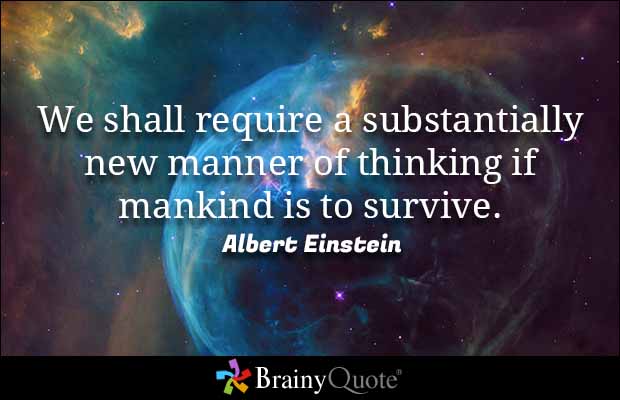
We shall require a substantially new manner of thinking if mankind is to survive.
That essay from George Monbiot was published yesterday and is shared with you all with Mr. Monbiot’s full permission.
It is an essay that deserves being read slowly and carefully. Please take time aside to so do because it really does offer a new manner of thinking.
ooOOoo
Circle of Life
13th April 2017
By reframing the economy, Kate Raworth’s Doughnut Economics changes our view of who we are and where we stand.
By George Monbiot, published in the Guardian 12th April 2017
So what are we going to do about it? This is the only question worth asking. But the answers appear elusive. Faced with a multifaceted crisis – the capture of governments by billionaires and their lobbyists, extreme inequality, the rise of demagogues, above all the collapse of the living world – those to whom we look for leadership appear stunned, voiceless, clueless. Even if they had the courage to act, they have no idea what to do.
The most they tend to offer is more economic growth: the fairy dust supposed to make all the bad stuff disappear. Never mind that it drives ecological destruction, that it has failed to relieve structural unemployment or soaring inequality, that, in some recent years, almost all the increment in incomes has been harvested by the top 1%. As values, principles and moral purpose are lost, the promise of growth is all that’s left.
You can see the effects in a leaked memo from the UK’s foreign office: “Trade and growth are now priorities for all posts … work like climate change and illegal wildlife trade will be scaled down.” All that counts is the rate at which we turn natural wealth into cash. If this destroys our prosperity and the wonders that surround us, who cares?
We cannot hope to address our predicament without a new worldview. We cannot use the models that caused our crises to solve them. We need to reframe the problem. This is what the most inspiring book published so far this year has done.
In Doughnut Economics: seven ways to think like a 21st-century economist, Kate Raworth reminds us that economic growth was not, at first, intended as a measurement of well-being. Simon Kuznets, who standardised the measurement of growth, warned: “the welfare of a nation can scarcely be inferred from a measure of national income.” Economic growth, he pointed out, measures only annual flow, rather than stocks of wealth and their distribution.
Raworth points out that economics in the 20th Century “lost the desire to articulate its goals.” It aspired to be a science of human behaviour: a science based on a deeply flawed portrait of humanity. The dominant model – “rational economic man”, self-interested, isolated, calculating – says more about the nature of economists than it does about other humans. The loss of an explicit objective allowed the discipline to be captured by a proxy goal: endless growth.
The aim of economic activity, she argues, should be “meeting the needs of all within the means of the planet.” Instead of economies that need to grow, whether or not they make us thrive, we need economies that “make us thrive, whether or not they grow.” This means changing our picture of what the economy is and how it works.
The central image in mainstream economics is the circular flow diagram. It depicts a closed flow of income cycling between households, businesses, banks, government and trade, operating in a social and ecological vacuum. Energy, materials, the natural world, human society, power, the wealth we hold in common: all are missing from the model. The unpaid work of carers – principally women – is ignored, though no economy could function without them. Like rational economic man, this representation of economic activity bears little relationship to reality.
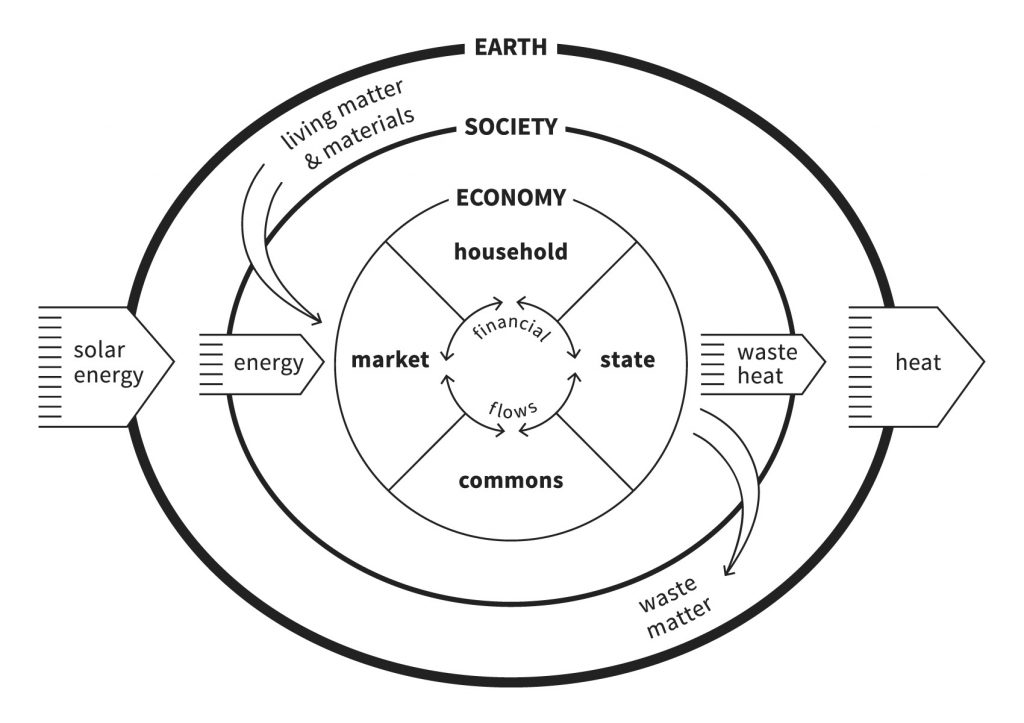
So Raworth begins by redrawing the economy. She embeds it in the Earth’s systems and in society, showing how it depends on the flow of materials and energy, and reminding us that we are more than just workers, consumers and owners of capital.
The Embedded Economy. Graphic by Kate Raworth and Marcia Mihotich
This recognition of inconvenient realities then leads to her breakthrough: a graphic representation of the world we want to create. Like all the best ideas, her Doughnut model seems so simple and obvious that you wonder why you didn’t think of it yourself. But achieving this clarity and concision requires years of thought: a great decluttering of the myths and misrepresentations in which we have been schooled.
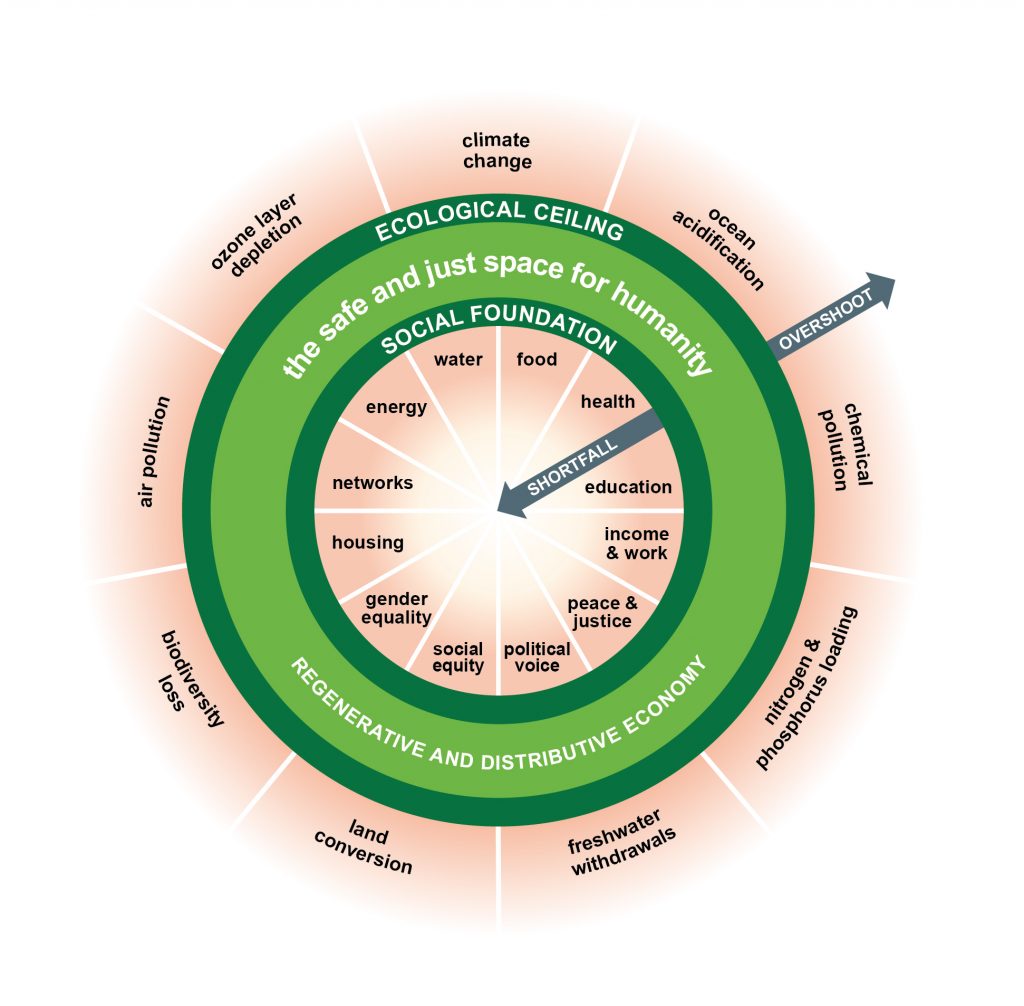
The diagram consists of two rings. The inner ring of the doughnut represents a sufficiency of the resources we need to lead a good life: food, clean water, housing, sanitation, energy, education, healthcare, democracy … . Anyone living below that line, in the hole in the middle of the doughnut, is in a state of deprivation.
The Doughnut. Graphic by Kate Raworth and Christian Guthier/The Lancet Planetary Health
The outer ring of the doughnut consists of the Earth’s environmental limits, beyond which we inflict dangerous levels of climate change, ozone depletion, water pollution, loss of species and other assaults on the living world. The area between the two rings – the doughnut – is the “ecologically safe and socially just space” in which humanity should strive to live. The purpose of economics should be to help us enter that space and stay there.
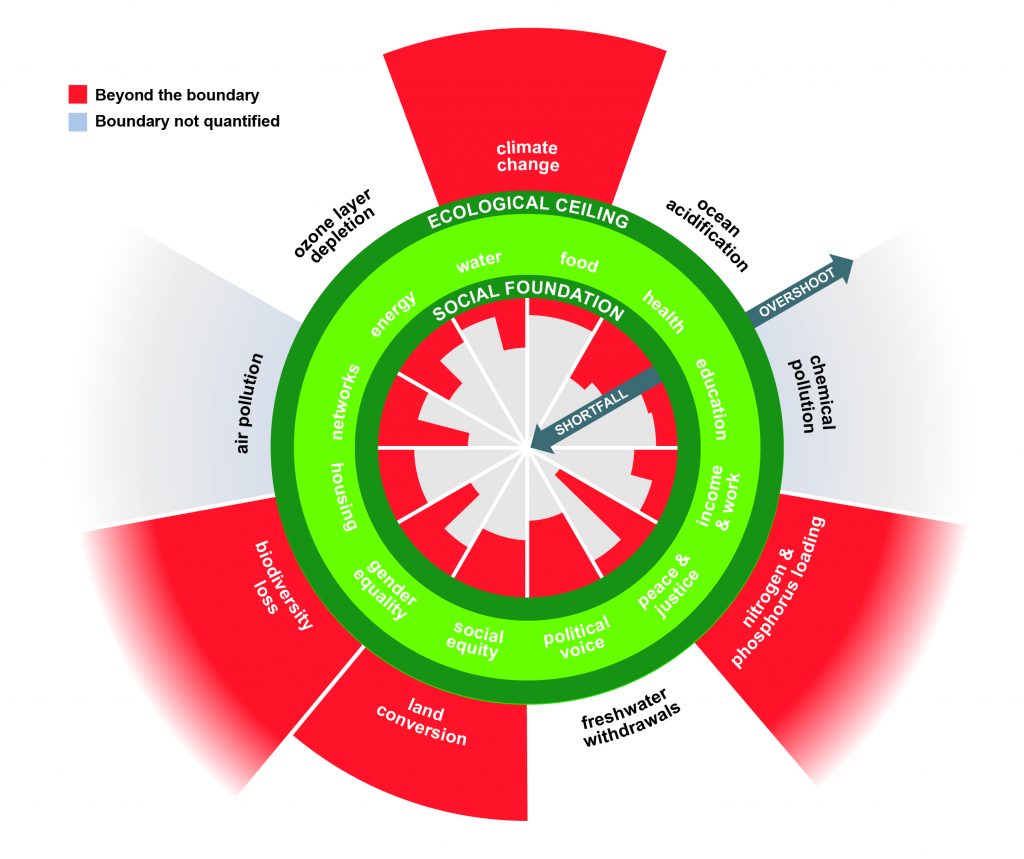
As well as describing a better world, the doughnut model allows us to see, in immediate and comprehensible terms, the state in which we now find ourselves. At the moment we transgress both lines. Billions of people still live in the hole in the middle. We have breached the outer boundary in several places.
Where we are now. Graphic by Kate Raworth and Christian Guthier/The Lancet Planetary Health
An economics that helps us to live within the doughnut would seek to reduce inequalities in wealth and income. Wealth arising from the gifts of nature would be widely shared. Money, markets, taxation and public investment would be designed to conserve and regenerate resources rather than squander them. State-owned banks would invest in projects that transform our relationship with the living world, such as zero-carbon public transport and community energy schemes. New metrics would measure genuine prosperity, rather than the speed with which we degrade our long-term prospects.
Such proposals are familiar, but without a new framework of thought, piecemeal solutions are unlikely to succeed. By rethinking economics from first principles, Raworth allows us to integrate our specific propositions into a coherent programme, and then to measure the extent to which it is realised. I see her as the John Maynard Keynes of the 21st-Century: by reframing the economy, she allows us to change our view of who we are, where we stand, and what we want to be.
Now we need to turn her ideas into policy. Read her book, then demand that those who wield power start working towards its objectives: human prosperity within a thriving living world.
One of the many things that we adore about living here in Merlin, Southern Oregon is the closeness of nature. Not just the nature of the slopes and mountains but the nature of the trees, creeks, grasses and wild plants.
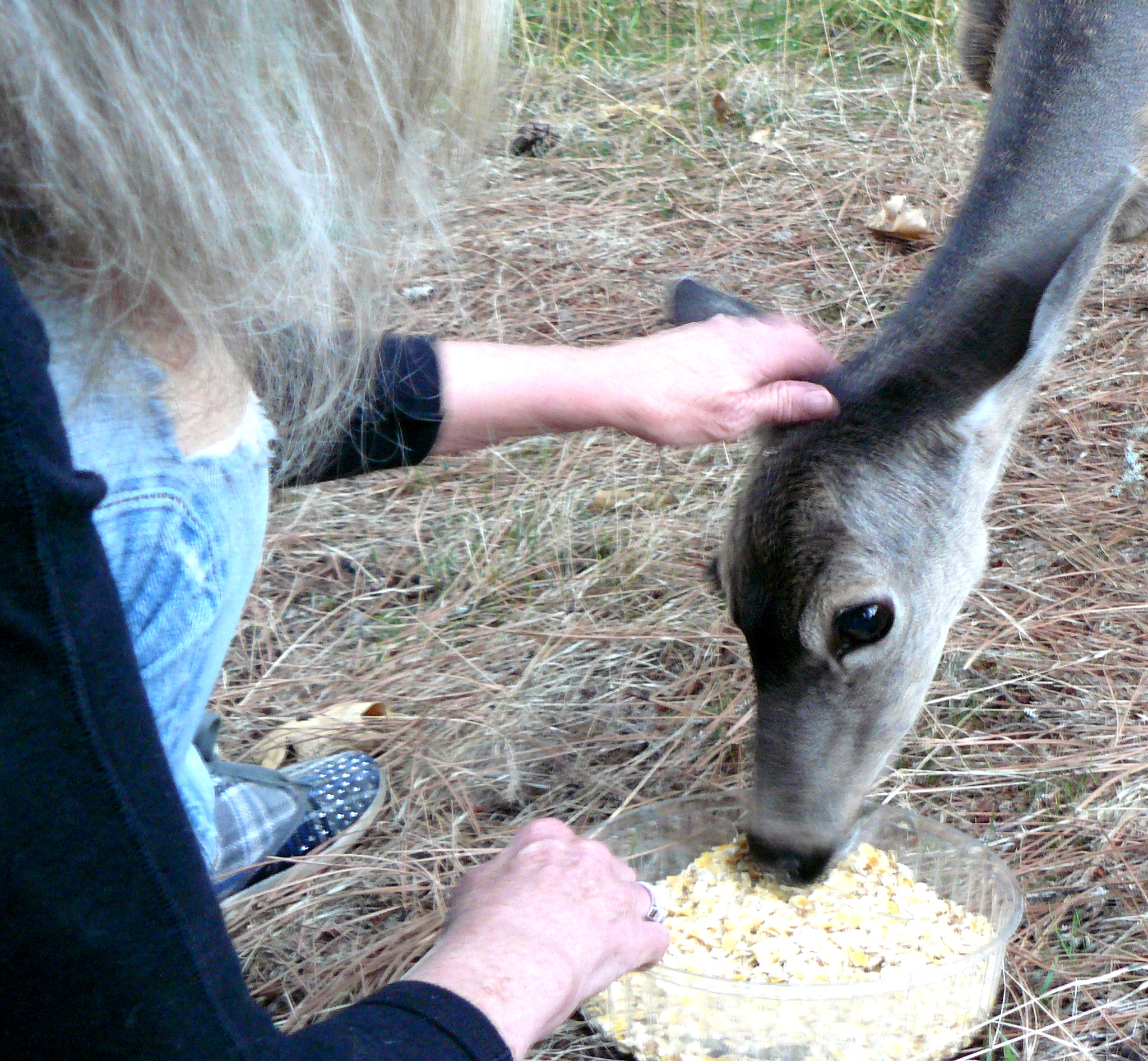
Plus the awareness over the 4+ years that we have been here of how easy it is to gain the trust of wild animals. I will go to my grave holding on to the sweet sensation of a wild deer trusting me and Jean to the point where we could stroke the deer’s neck when we were feeding her.
The trust between the deer and Jean then enabled the deer to feed from Jean’s hand.
Then, unbelievably, the wild deer continues feeding as Jean fondles the deer’s ear.
(Both photographs taken in October, 2014 in the area of grassland near to our stables.)
The measure of how we, as in humanity, really feel about the only home we have, as in Planet Earth, is how we regard our planet.
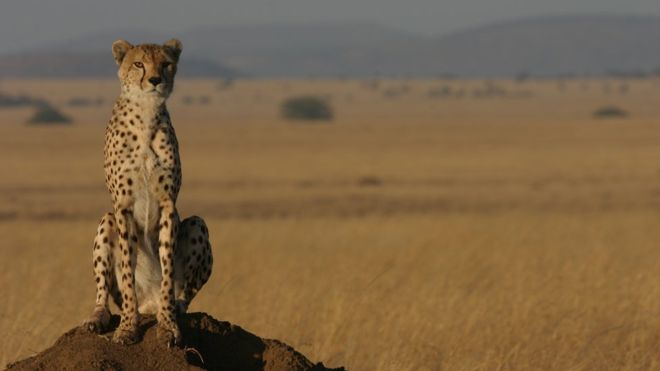
The pain that we feel when we read, as I did yesterday, about another animal species possibly heading towards extinction. In this case, an item on the BBC News website about Cheetahs.
Cheetahs heading towards extinction as population crashes
By Matt McGrath Environment correspondent
Protected parks and reserves for cheetahs are not sufficient as the animal ranges far beyond these areas.
The sleek, speedy cheetah is rapidly heading towards extinction according to a new study into declining numbers.
The report estimates that there are just 7,100 of the world’s fastest mammals now left in the wild.
Cheetahs are in trouble because they range far beyond protected areas and are coming increasingly into conflict with humans.
The authors are calling for an urgent re-categorisation of the species from vulnerable to endangered.
It’s no good tut-tutting; something different has to be done. For otherwise nature will have the last word to say about the future of vast numbers of species especially homo sapiens!
All of which leads me to the main theme of today’s post: holding nature in higher esteem as in higher legal esteem.
Read the following that was published on The Conversation blogsite on October 10th, 2016 and is republished here within their terms. The author is Chip Colwell , Lecturer on Anthropology, University of Colorado, Denver.
ooOOoo
What if nature, like corporations, had the rights and protections of a person?
October 10, 2016 8.16am EDT
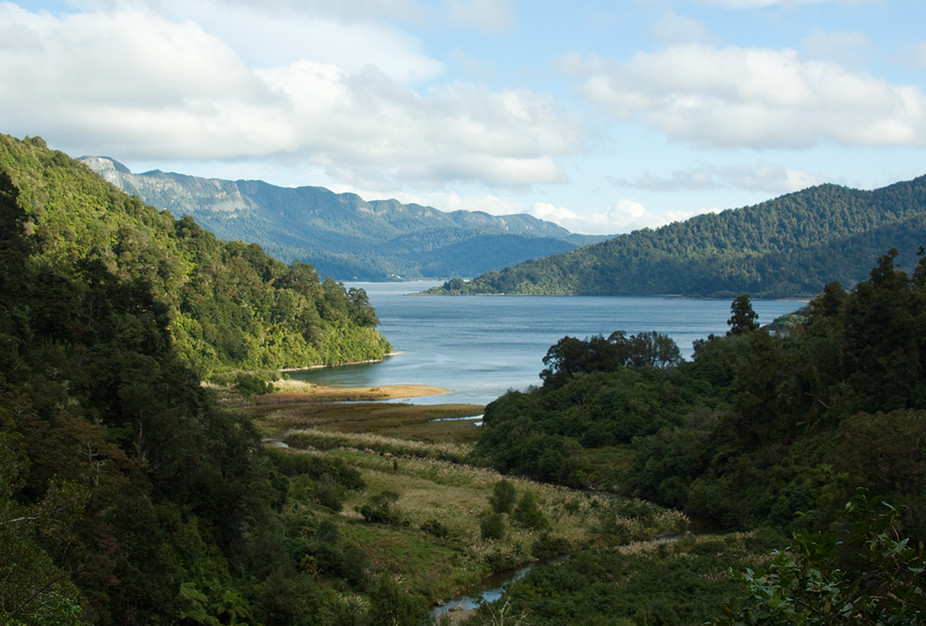
The forest around Lake Waikaremoana in New Zealand has been given legal status of a person because of its cultural significance. Paul Nelhams/flickr, CC BY-SA
In recent years, the U.S. Supreme Court has solidified the concept of corporate personhood. Following rulings in such cases as Hobby Lobby and Citizens United, U.S. law has established that companies are, like people, entitled to certain rights and protections.
But that’s not the only instance of extending legal rights to nonhuman entities. New Zealand took a radically different approach in 2014 with the Te Urewera Act which granted an 821-square-mile forest the legal status of a person. The forest is sacred to the Tūhoe people, an indigenous group of the Maori. For them Te Urewera is an ancient and ancestral homeland that breathes life into their culture. The forest is also a living ancestor. The Te Urewera Act concludes that “Te Urewera has an identity in and of itself,” and thus must be its own entity with “all the rights, powers, duties, and liabilities of a legal person.” Te Urewera holds title to itself.
Although this legal approach is unique to New Zealand, the underlying reason for it is not. Over the last 15 years I have documented similar cultural expressions by Native Americans about their traditional, sacred places. As an anthropologist, this research has often pushed me to search for an answer to the profound question: What does it mean for nature to be a person?
The snow-capped mountain
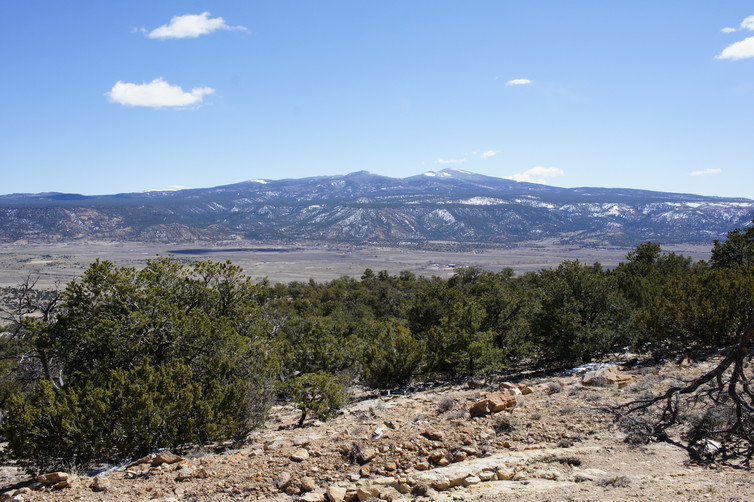
A majestic mountain sits not far northwest of Albuquerque, New Mexico. Like a low triangle, with long gentle slopes, Mount Taylor is clothed in rich forests that appear a velvety charcoal-blue from the distance. Its bald summit, more than 11,000 feet high, is often blanketed in snow – a reminder of the blessing of water, when seen from the blazing desert below.
The Zuni tribe lives about 40 miles west of Mount Taylor. In 2012, I worked with a team to interview 24 tribal members about the values they hold for Dewankwin K’yaba:chu Yalanne (“In the East Snow-capped Mountain”), as Mount Taylor is called in the Zuni language. We were told that their most ancient ancestors began an epic migration in the Grand Canyon.
Mount Taylor in New Mexico, a sacred site to the Zuni who believe it is a living being. Chip Colwell, Author provided.
Over millennia they migrated across the Southwest, with important medicine societies and clans living around Mount Taylor. After settling in their current pueblo homes, Zunis returned to this sacred mountain to hunt animals like deer and bear, harvest wild plants like acorns and cattails, and gather minerals used in sacrosanct rituals that keep the universe in order. Across the generations Dewankwin Kyaba:chu Yalanne has come to shape Zuni history, life, and identity no less than the Vatican has for Catholics.
But unlike holy places in the Western world, Zunis believe Mount Taylor is a living being. Zuni elders told me that the mountain was created within the Earth’s womb. As a mountain formed by volcanic activity, it has always grown and aged. The mountain can give life as people do. The mountain’s snow melts in spring and nourishes plants and wildlife for miles. Water is the mountain’s blood; buried minerals are the mountain’s meat. Because it lives, deep below is its beating heart. Zunis consider Mount Taylor to be their kin.
There is a stereotype that Native American peoples have a singular connection to nature. And yet in my experience, they do see the world in a fundamentally different way from most people I know. Whether it is mountains, rivers, rocks, animals, plants, stars or weather, they see the natural world as living and breathing, deeply relational, even at times all-knowing and transcendent.
In my work with Arizona’s Hopi tribe, I have traveled with cultural leaders to study sacred places. They often stop to listen to the wind, or search the sky for an eagle, or smile when it begins to rain, which they believe is a blessing the ancestors bestow upon them.
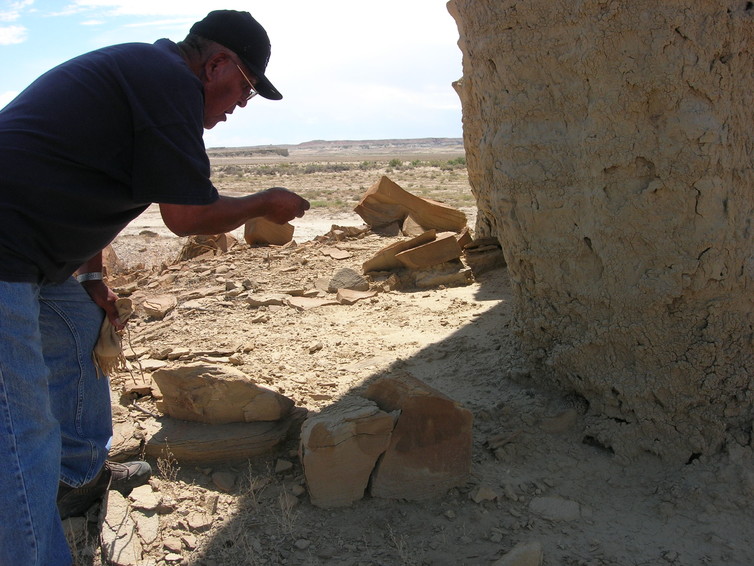
During one project with the Hopi tribe, we came across a rattlesnake coiled near an ancient fallen pueblo. “Long ago, one of them ancestors lived here and turned into a rattlesnake,” the elder Raleigh H. Puhuyaoma Sr. shared with me, pointing to the nearby archaeological site. “It’s now protecting the place.” The elders left an offering of corn meal to the snake. An elder later told me that it soon rained on his cornfield, a result from this spiritual exchange.
Violent disputes
Understanding these cultural worldviews matters greatly in discussions over protecting places in nature. The American West has a long history of battles over the control of land. We’ve seen this recently from the Bundy family’s takeover of the federal wildlife refuge in Oregon to the current fight over turning Bears Ears – 1.9 million acres of wilderness – into a national monument in Utah.
Yet often these battles are less about the struggle between private and public interests, and more about basic questions of nature’s purpose. Do wild places have intrinsic worth? Or is the land a mere tool for human uses?
A Hopi elder making an offering to a snake to protect a sacred space. Chip Colwell, Author provided.
Much of my research has involved documenting sacred places because they are being threatened by development projects on public land. The Zuni’s sacred Mount Taylor, much of it managed by the U.S. National Forest Service, has been extensively mined for uranium, and is the cause of violent disputes over whether it should be developed or protected.
Even though the U.S. does not legally recognize natural places as people, some legal protections exist for sacred places. Under the National Historic Preservation Act, for example, the U.S. government must take into consideration the potential impacts of certain development projects on “traditional cultural properties.”
This and other federal heritage laws, however, provide tribes a small voice in the process, little power, and rarely lead to preservation. More to the point, these laws reduce what tribes see as living places to “properties,” obscuring their inherent spiritual value.
In New Zealand, the Te Urewera Act offers a higher level of protection, empowering a board to be the land’s guardian. The Te Urewera Act, though, does not remove its connection to humans. With a permit, people can hunt, fish, farm and more. The public still has access to the forest. One section of the law even allows Te Urewera to be mined.
Te Urewera teaches us that acknowledging cultural views of places as living does not mean ending the relationship between humans and nature, but reordering it – recognizing nature’s intrinsic worth and respecting indigenous philosophies.
In the U.S. and elsewhere, I believe we can do better to align our legal system with the cultural expressions of the people it serves. For instance, the U.S. Congress could amend the NHPA or the American Indian Religious Freedom Act to acknowledge the deep cultural connection between tribes and natural places, and afford better protections for sacred landscapes like New Mexico’s Mount Taylor.
Until then, it says much about us when companies are considered people before nature is.
Today’s post was inspired by something yesterday I read, not for the first time, over on The People Workshop site. (As an aside, I know that many regulars of this place are familiar with the history of my friendship with Jon.) On the page that explains more of Jon Lavin’s approach to his work with clients, he writes:
“We can’t solve problems by using the same kind of thinking we used when we created them.”
Thus said Albert Einstein (1879-1955).
Intuitively, it strikes one as correct. However, reflect for a few moments on how you think and very quickly it becomes clear that how you think is based on deep-seated experiences and the learnings that flow from those experiences.
As it is for all of us.
Just as relevantly, perhaps more so, is that how we behave is based on those same deep-seated experiences and subsequent learnings. This offers a clue as to why bringing about lasting, behavioural change can often feel like pushing water uphill!
That prompted me to look up a previous time when I had written a post about feelings. It was last December when in a post called Feelings – Of Both Humans and Animals, I wrote this:
There couldn’t have been a better answer to that ponder than a recent video that was presented by TED Talks. It was a talk by Carl Safina about what is going on inside the brains of animals: What are animals thinking and feeling? Or in the fuller words of that TED Talk page:
What’s going on inside the brains of animals? Can we know what, or if, they’re thinking and feeling? Carl Safina thinks we can. Using discoveries and anecdotes that span ecology, biology and behavioral science, he weaves together stories of whales, wolves, elephants and albatrosses to argue that just as we think, feel, use tools and express emotions, so too do the other creatures – and minds – that share the Earth with us.
So back to what inspired today’s post. It was the challenge of really knowing why we behave the way we do, both humans and dogs. With dogs, however, we accept they cannot speak to us clearly. Or as Esme put it in a recent reply to an update on Hazel: “Well you’re getting there, half the battle is diagnosis with dogs because they can’t actually tell us how they feel.” (My emphasis.)
Back to humans. When Jon wrote on his site, “…. how you think …… is based on deep-seated experiences ….”, what I heard is that for us humans there are many times when we cannot actually tell ourselves what we are feeling. That is why we need the counselling of someone who has the professional training and experience to expose those deep emotional and psychological drivers within us; those drivers that are normally out of sight from us.
In my own case, how my father’s death was managed by my mother back in December, 1956 left an emotional wound that was totally out of sight from my conscious mind for 50 years. The emotional crisis that I went through back then was discovered by Jon to have its roots back in December, 1956. By a massive stroke of fortune Jon gave me the insight into that mental place of old and a year later I met Jean down in Mexico.
In other words, to return to Albert Einstein:
“We can’t solve problems by using the same kind of thinking we used when we created them.”
The challenge is having sufficient self-awareness to know when an aspect of our behaviour requires the support of the Jon Lavins of this world.
So what would we require from a counsellor, from a therapist, who was working with us to uncover those hidden aspects? In other words, in terms of assessing that therapist what’s the difference that would make the difference?
Naturally, I don’t have the skills to answer that question in any direct, professional manner. But if I look down at our dogs then a form of answer does ‘speak’ to me. Dogs are creatures of integrity, openness and trust. They relate to us humans and other known dogs around them through friendship and love; frequently unconditional love.
A therapist who embraces those values; nay, lives those values, would display that very quickly after meeting with the ‘client’. Any person seeing that in a therapist would be seeing the difference that makes the difference.
Good people, I’m not asking any of you who read this to divulge any personal stuff but, nonetheless, I would love to hear your thoughts on what I have written today!
Celebrating the life and times of Albert Einstein.
Yesterday was the centenary of the birth of Albert Einstein (14 March 1879 – 18 April 1955). It has been widely reported. For example, a piece on the EarthSky blog:
March 14, 1879. This is the anniversary of the birth of Albert Einstein, undoubtedly the most famous scientist of the modern era.
Einstein was born in Ulm, Germany, where an uncle – Jakob Einstein, an engineer – introduced him to science and math. At age 17, he enrolled in the Swiss Polytechnic Institute after failing the entrance exam the previous year. He graduated in 1900, and in 1902 he became a junior patent examiner in the Swiss Patent Office in Bern, Switzerland, where he specialized in electrical devices.
The year 1905 came to be known as Einstein’s Miracle Year. He was 26 years old, and in that year he published four papers that reshaped physics.
Now before you read on let me proclaim that today’s post has absolutely nothing to do with dogs! (Unless dogs exist in parallel universes!)
But a recent documentary that was published on Top Documentary Films was really fascinating and incredibly well presented. Thus, in terms of the likes of you and I better understanding what Einstein revealed about our universe, I couldn’t resist sharing it with you all today. It is just 29 minutes long.
STORYLINE
One hundred years have passed since Albert Einstein first unleashed his highly influential Theory of General Relativity unto the world. These revelations charted a future course of scientific pursuit, and never cease to inform our understanding of the universe today. In celebration of that impressive legacy, the documentary short Einstein’s Extraordinary Universe travels to three research facilities in different regions across the globe, and shows us how Einstein’s work continues to challenge, shape and inspire the scientific discoveries of tomorrow.
The film opens in Tuscany. Under the shadows of Galileo’s groundbreaking work on gravity research, a group of astrophysicists are exploring Einstein’s theories related to the occurrence of gravitational waves through space and time. Can modern technologies and advanced scientific intellect result in actual proof of such waves?
Viewers are then taken to the world’s largest underground laboratory. Hidden far beneath Italy’s Gran Sasso mountains, the lab serves as a home to researchers who work tirelessly to prove another of Einstein’s grandiose theories: the existence of dark matter. The vast majority of our universe is made up of materials that we have not yet been able to detect through forces of light and energy. The dedicated team who toil away in this impressive underground lair hope they can lay the groundwork in changing that.
The filmmakers’ next stop is Switzerland, where they are given a tour of one of the most impressive displays of scientific testing technology on the planet. Housed by the European Organization for Nuclear Research, or CERN, the Large Hadron Collider is the most powerful particle accelerator on the planet, and is being used to question and examine the substance of all matter in our universe.
Through each destination on this incredible journey, what amazes most is how prescient Einstein’s theories have proven even after a century has passed. His work continues to test the limits of our scientific understanding, and sets a groundwork from which researchers still strive for answers. Featuring a plethora of illuminating interviews with many top figures in the fields of scientific study, Einstein’s Extraordinary Universe is certain to delight seasoned science geeks and novices alike.
It really is about good people refusing to let evil dominate our world.
The response to yesterday’s post was incredible and very gratifying.
For I was conscious that many would simply reject the proposition that I saw in John Zande’s book, namely that, “there was an evil origin to the universe and, more directly, that the deep, and growing, suffering of the pinnacle of evolution, us humans, can be traced back to that evil origin.”
The emotional challenge, of which I am acutely aware, is recognising that core proposition, that as we humans evolve so too does the capacity for human suffering, yet not wanting to give up on my personal core belief that better times ahead are possible, given sufficient people sharing that power of hope. Echoing what Sue wrote as a response to yesterday’s post that motivated me to reply, in part, thus:
If there was one sentence of yours that struck me as spot on, it was your declaration that what we think is what we create. Or as I often reflect, we are what we think.
Jean and I last night watched the latest BBC Panorama report about the migrant/refugee crisis in Europe. It was profoundly upsetting for reasons that many will understand.
George Monbiot’s essay that follows shortly is also profoundly upsetting.
But if hope is to be translated into a determination to make a difference, then it demands that we don’t ignore the pain but use our anger to fuel our passion to behave appropriately: We are what we think! Or in the much more eloquent words of Albert Einstein:
Learn from yesterday, live for today, hope for tomorrow. The important thing is not to stop questioning.
George Monbiot is to be saluted for his commitment to questioning and I am privileged to have his permission to republish the following.
There may be water on Mars. But is there intelligent life on Earth?
By George Monbiot, published in the Guardian 30th September 2015
Evidence for flowing water on Mars – this opens up the possibility of life; of wonders we cannot begin to imagine. Its discovery is an astonishing achievement. Meanwhile, Martian scientists continue their search for intelligent life on Earth.
We might be captivated by the thought of organisms on another planet, but we seem to have lost interest in our own. The Oxford Junior Dictionary has been excising the waymarks of the living world. Adders, blackberries, bluebells, conkers, holly, magpies, minnows, otters, primroses, thrushes, weasels and wrens are now surplus to requirements.
In the past four decades, the world has lost 50% of its vertebrate wildlife. But across the latter half of this period, there has been a steep decline in coverage. In 2014, according to a study at Cardiff University, there were as many news stories broadcast by the BBC and ITV about Madeline McCann (who went missing in 2007) as there were about the entire range of environmental issues.
Think of what would change if we valued terrestrial water as much as we value the possibility of water on Mars. Only three percent of the water on this planet is fresh, and of that two-thirds is frozen. Yet we lay waste to the accessible portion. Sixty percent of the water used in farming is needlessly piddled away by careless irrigation. Rivers, lakes and aquifers are sucked dry, while what remains is often so contaminated that it threatens the lives of those who drink it. In the UK, domestic demand is such that the upper reaches of many rivers disappear during the summer. Yet still we install clunky old toilets and showers that gush like waterfalls.
As for salty water of the kind that enthralls us when apparently detected on Mars, on Earth we express our appreciation with a frenzy of destruction. A new report suggests that fish numbers have halved since 1970. Pacific bluefin tuna, that once roamed the seas in untold millions, have been reduced to an estimated 40,000, yet still they are pursued. Coral reefs are under such pressure that most could be gone by 2050. And in our own deep space, our desire for exotic fish rips through a world scarcely better known to us than the red planet’s surface. Trawlers are now working at depths of 2000 metres. We can only guess at what they might be destroying.
A few hours before the Martian discovery was announced, Shell terminated its Arctic oil prospecting in the Chukchi Sea. For the company’s shareholders, it’s a minor disaster: the loss of $4 billion. For those who love the planet and the life it sustains, it is a stroke of great fortune: it happened only because the company failed to find sufficient reserves. Had Shell succeeded, it would have exposed one of the most vulnerable places on Earth to spills that are almost inevitable, where containment is almost impossible. Are we to leave such matters to chance?
At the beginning of September, two weeks after he granted Shell permission to drill in the Chukchi Sea, Barack Obama travelled to Alaska to warn Americans about the devastating effects that climate change, caused by the burning of fossil fuels, might catalyse in the Arctic. “It’s not enough just to talk the talk”, he told them. “We’ve got to walk the walk.” We should “embrace the human ingenuity that can do something about it.” Human ingenuity is on abundant display at Nasa, which released those astounding images. But when it comes to policy, the search for intelligent life goes on.
Let the market decide: this is the way in which governments seek to resolve planetary destruction. Leave it to the conscience of consumers, while that conscience is muted and confused by advertising and corporate lies. In a near-vacuum of information, we are each left to decide what we should take from other species and other people; what we should allocate to ourselves or leave to succeeding generations. Surely there are some resources and some places – such as the Arctic and the deep sea – whose exploitation should simply stop?
All this drilling and digging and trawling and dumping and poisoning – what is it for anyway? Does it enrich human experience, or stifle it? A couple of weeks ago, I launched the hashtag #extremecivilisation, and invited suggestions. They have flooded in. Here are just a few of the products my correspondents have found. All of them, as far as I can tell, are real.
An egg tray for your fridge, that syncs with your phone to let you know how many eggs are left. A gadget for scrambling them – inside the shell. Wigs for babies, to allow “baby girls with little or no hair at all the opportunity to have a beautifully realistic hair style”. The iPotty, that permits toddlers to keep playing on their iPads while toilet training. A £2000 spider-proof shed. A snow sauna, on sale in the United Arab Emirates, in which you can create a winter wonderland with the flick of a switch. A refrigerated watermelon case on wheels: indispensable for picnics. Or perhaps not, as it weighs more than the melon. Anal bleaching cream, for … to be honest, I don’t want to know. An “automatic watch rotator” that saves you the bother of winding your luxury wrist candy. A smart phone for dogs, with which they can take pictures of themselves. Pre-peeled bananas, in polystyrene trays covered in clingfilm. Just peel back the packaging …
Every year, clever new ways of wasting stuff are devised, and every year we become more inured to the pointless consumption of the world’s precious resources. With each subtle intensification, the baseline of normality shifts. It should not be surprising to discover that the richer a country becomes, the less its people care about their impacts on the living planet.
Our alienation from the world of wonders with which we evolved has only intensified since David Bowie described a girl stumbling through a “sunken dream”, on her way to be “hooked to the silver screen”, where a long series of distractions diverts her from life’s great questions. The song, of course, was Life on Mars.







 Learning from Dogs
