Tag: 10 Downing Street

Adam & Eve’s Pets

Suitable follow-on to last Saturday’s post.

A week ago, I published an item about Larry the cat at 10 Downing Street.

Thus it seemed entirely appropriate to republish this lovely item that first appeared on Learning from Dogs in October, 2011.

ooOOoo

When I was living back in South-West England, in the Totnes area, I had plenty of time to get to know Neil K. Neil has the most wonderful sense of humour and an ability to look at the world rather differently than the rest of us. I offer this tribute in acknowledgement of the great items that Neil passes to me for inclusion in Learning from Dogs. This one is no exception.

——————–

The Story of Adam & Eve’s Pets

Adam and Eve said, ‘Lord, when we were in the garden, you walked with us every day. Now we do not see you any more. We are lonesome here, and it is difficult for us to remember how much you love us.’

And God said, I will create a companion for you that will be with you and who will be a reflection of my love for you, so that you will love me even when you cannot see me.

Regardless of how selfish or childish or unlovable you may be, this new companion will accept you as you are and will love you as I do, in spite of yourselves.’

And God created a new animal to be a companion for Adam and Eve.

And it was a good animal and God was pleased.

And the new animal was pleased to be with Adam and Eve and he wagged his tail.

And Adam said, ‘Lord, I have already named all the animals in the Kingdom and I cannot think of a name for this new animal.’

And God said, ‘I have created this new animal to be a reflection of my love for you, his name will be a reflection of my own name, and you will call him DOG.’

And Dog lived with Adam and Eve and was a companion to them and loved them.

And they were comforted.

And God was pleased.

And Dog was content and wagged his tail.

After a while, it came to pass that an angel came to the Lord and said, ‘Lord, Adam and Eve have become filled with pride. They strut and preen like peacocks and they believe they are worthy of adoration. Dog has indeed taught them that they are loved, but perhaps too well.’

And God said, I will create for them a companion who will be with them and who will see them as they are. The companion will remind them of their limitations, so they will know that they are not always worthy of adoration.’

And God created CAT to be a companion to Adam and Eve.

And Cat would not obey them. And when Adam and Eve gazed into Cat’s eyes, they were reminded that they were not the supreme beings.

And Adam and Eve learned humility.

And they were greatly improved.

And God was pleased.

And Dog was happy.

And Cat . . .

didn’t give a shit one way or the other.

ooOOoo

So there you go!

All change at 10 Downing Street!

Well, perhaps not completely all change!

There will be few who can’t have heard of the enormous changes going on in my old country, with Teresa May now Britain’s second female Prime Minister. Talk about out with the old and in with the new!

But as this lovely story recently published over on the Smithsonian Magazine website illustrates, it’s not total change.

ooOOoo

10 Downing Street’s “Chief Mouser” Is Keeping His Job Despite Brexit

Larry the Cat will outlast David Cameron at the Prime Minister’s residence
Larry, Chief Mouser to the Cabinet Office (Her Majesty's Government)
Larry, Chief Mouser to the Cabinet Office (Her Majesty’s Government)
By Danny Lewis  smithsonian.com
July 14, 2016

In the weeks since British citizens voted to leave the European Union in a national referendum, the government of the United Kingdom has seen its share of political turmoil. Following the results of the vote, then-Prime Minister and “Remain” supporter David Cameron announced that he would be stepping down, and has now been replaced by his successor, Theresa May. But while Cameron has officially left the Prime Minister’s residence and offices at 10 Downing Street in London, at least one of his appointees will remain in May’s service: a brown and white tabby cat named Larry.

“It’s a civil servant’s cat and does not belong to the Camerons—he will be staying,” a government official tells the BBC.

Larry first came to 10 Downing Street in 2011, when Cameron adopted him from a rescue home in hopes that the feline would help handle a mouse infestation plaguing the Prime Minister’s residence. As the first cat to hold the title of Chief Mouser to the Cabinet Office, Larry has become a familiar face in and around the building over the years.

“Larry spends his days greeting guests to the house, inspecting security defenses and testing antique furniture for napping quality,” an official government website detailing the history of 10 Downing Street writes. “His day-to-day responsibilities also include contemplating a solution to the mouse occupancy of the house. Larry says this is still ‘in tactical planning stage.’”

However, despite being touted as a “good ratter” with “a high chase-drive and hunting instinct,” some reports suggest that Larry is not as good at his job as official statements might lead one to believe. Indeed, Larry has faced harsh scrutiny for slacking on the job, as his love of long naps often gets in the way of his hunting duties, Jack Goodman reports for Atlas Obscura. In one incident, Cameron reportedly was forced to throw a silver fork at a mouse to shoo it away during a meeting with other government officials, even after Larry was brought on board to handle the problem. However, despite his lack of progress on the mouse problem, Larry has managed to continue to retain his position.

While Larry may be the first cat to hold this particular title, he isn’t the first cat to make his home at 10 Downing Street. During the 1920s, Prime Minister Ramsay MacDonald brought along his cat, Rufus of England, and, in the 1930s and ’40s, the so-called “Munich Mouser” ran rampant throughout the residence, the BBC reports. In the 1970s, a cat named Wilberforce took up guard. Upon retirement, he was replaced by a stray who wandered into the offices during Margaret Thatcher’s premiership (he was called Humphrey). The last cat before Larry to hold court at 10 Downing Street was Sybil, who belonged to former Chancellor Alastair Darling. However, she reportedly did not care for city life, and later retired with Darling to his home in the Scottish countryside.

Whatever other effects the decision to leave the European Union will have on the United Kingdom’s government in the coming weeks, Larry’s position as “top cat,” at least, remains assured.

ooOOoo

 Well done, Larry!

That little old word ‘truth’.

Truth: the true or actual state of a matter.

Well nothing complicated about the definition, is there!  If only society was equally motivated by getting to the truth of climate change.  Yes, I know I’m being naive!

Why my mini-rant?

I’m well in to James Hansen’s book Storms of my Grandchildren and it’s confirming my fears about the issues that are facing mankind now!  But more of that later.

What triggered me putting ‘pen to paper’ was a recent report from the Yale forum on climate change and the media.  Here’s how it opened,

Scientific Consensus Stronger than Scientists Thought?

Bruce Lieberman   May 2, 2012

More than two decades after the Intergovernmental Panel on Climate Change (IPCC) began publishing the latest scientific consensus on the globe’s changing climate, widespread doubts persist in the U.S. over whether there really is widespread agreement among scientists. It’s the primary argument of those who deny basic scientific foundations of warming.

But new and innovative survey results suggest the consensus among scientists might actually be stronger than the scientists themselves had thought.

The battles to define and debunk scientific consensus over climate change science have been fought for years. In 2004, University of California San Diego science historian Naomi Oreskes wrote about a broad consensus she found after studying 928 scientific papers published between 1993 and 2003.

But what I found deeply fascinating was that later on Bruce Lieberman, the report’s author, lists in detail the actual levels of agreement compared to the perceived levels.  To make it easier to take in, I have amended the telling differences to italic.

In sum, the newly released poll results identified surprisingly common points of agreement among climate scientists; and yet for each point, those scientists underestimated the amount of agreement among their colleagues. The results:

  • Human activity has been the primary cause of increases in global average air and ocean temperatures in the last 250 years. (About 90 percent of respondents agreed with this characterization, but those respondents estimated that less than 80 percent of their scientist colleagues held that view.)
  • If governmental policies do not change, the CO2 concentration in the atmosphere will exceed 550 parts per million between 2050 and 2059. (More than 30 percent agreed, but those respondents estimated that just over 20 percent of their peers held that view.)
  • If and when atmospheric CO2 concentrations reach 550 ppm, the increase in global average surface temperature relative to the year 2000 will be 2-3 degrees Celsius, or 3.2-4.8 F. (More than 40 percent agreed, but those respondents estimated that less than 30 percent held that view.)
  • If governmental policies do not change, in the year 2050, the increase in global average surface temperature relative to the year 2000 will be 1.5-2 degrees Celsius, or 2.4-3.2 F). (More than 35 percent agreed, but those respondents estimated that just over 30 percent held that view.)
  • The likelihood that global average sea level will rise more during this century than the highest level given in the 2007 assessment of the IPCC (0.59 meters, 23.2 inches) is more than 90 percent. (More than 30 percent agreed, but those respondents estimated that less than 20 percent held that view.)
  • Since 1851, the U.S. has experienced an average of six major hurricane landfalls (> 111 mph) per decade. The total number of major hurricane landfalls in the U.S. from 2011-2020 will be seven to eight. (Nearly 60 percent agreed, but those respondents estimated that just over 30 percent held that view.)
  • The total number of major hurricane landfalls in the U.S. from 2041 to 2050 will be seven to eight. (About 35 percent agreed, but those respondents estimated that less than 30 percent held that view.)
  • Given increasing levels of human activity, the concentration of CO2 in the atmosphere can be kept below 550 ppm with current technology — but only with changes in government policy. (Nearly 70 percent agreed, but those respondents estimated that just over 50 percent held that view.)

Now back to Hansen’s book.  Here’s what Hansen writes starting on p.144,

Getting to the truth!

Sea level rise is one of the two climate impacts that I believe should be at the top of the list that defines what is “dangerous,” on any time scale that humanity can imagine.  Ice sheets take thousands of years to build up from snowfall.  Reasonable “adaptation” to a large sea level rise is nearly impossible, because once ice sheets begin to rapidly disintegrate, sea level would be continually changing for centuries.  Coastal cities would become impractical to maintain.

The other climate change impact at the top of my “dangerous” list is extermination of species.  Human activities already have increased the rate of species extinctions far above the natural level.  Extinctions are occurring as humans take over more and more of the habitat of animal and plant species.  We deforest large regions, replace biologically diverse grasslands and forests with monoculture crops, and introduce foreign, invasive animal and plant species that sometimes wipe out the native ones.

Hansen points out that about a billion people live at elevations less than 25 metres (81 feet).

I included a short video of James Hansen in a Learning from Dogs Post just a few days ago.  You’ll find it here – go and watch it – and think about the truth!

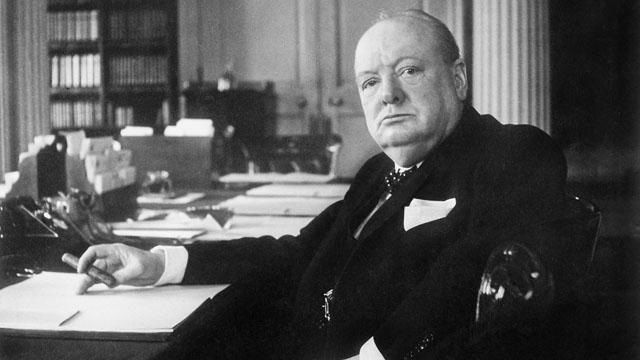
Photo: Winston Churchill, photographed by Cecil Beaton, at 10 Downing Street, London, in 1940.

Men stumble over the truth from time to time, but most pick themselves up and hurry off as if nothing happened.– Winston Churchill