Category: Writing

Introspection.

A recent article by George Monbiot gets me thinking.

George Monbiot is 61; his birthday is on January 27th. Thus he is 14 years younger than me. He is an experienced writer for The Guardian newspaper. Plus he has authored quite a few books and founded a charity, and given TED Talks, and I am sure more than this.

I read all of the articles that are published by him. His website is widely read. Please read his biography. Some of his many articles really get me thinking.

Some time ago I asked Mr. Monbiot for permission to republish his articles and that was granted. A small number of them have been republished on Learning from Dogs.

Today I want to republish an article that was presented on July 3rd.

ooOOoo

The Fight Against Oligarchy

Oligarchy is the default state of politics, and it is surging back. How do we stop it?

By George Monbiot, published in the Guardian  27th June 2024

We are about to return to normal politics. After 14 years of Tory corruption and misrule, a Labour government will put this country back on track. Justice and decency will resume, public services will be rebuilt, our global standing will be restored, we will revert to a familiar state. Or so the story goes.

What is the “normal” envisaged by pundits and politicians of the left and centre? It is the most anomalous politics in the history of the world. Consciously or otherwise, they hark back to a remarkable period, roughly 1945 to 1975, in which, in certain rich nations, wealth and power were distributed, almost everyone could aspire to decent housing, wages and conditions, public services were ambitious and well-funded and a robust economic safety net prevented destitution. There had never been a period like it in the prior history of the world, and there has not been one since. Even during that period, general prosperity in the rich nations was supported by extreme exploitation, coups and violence imposed on the poor nations. We lived in a bubble, limited in time and space, in which extraordinary things happened. Yet somehow we think of it as normal.

Those “normal” politics were the result of something known to economic historians as the “great compression”: a drastic reduction in inequality caused by two world wars. In many powerful countries, a combination of the physical destruction of assets, the loss of colonial and overseas possessions, inflation, very high taxes, wage and price controls, requisitioning and nationalisation required by the wartime economy, as well as the effects of rising democracy and labour organisation, greatly reduced the income and assets of the rich. It also greatly improved, once the wars had ended, the position of the poor. For several decades, we benefited from the aftermath of these great shocks. Now the effect has faded. We are returning to true “normality”.

The history of many centuries, including our own, shows that the default state of politics is not redistribution and general welfare, but a spiral of accumulation by the very rich, the extreme exploitation of labour, the seizure of common resources and exaction of rent for their use, extortion, coercion and violence. Normal is a society in which might is right. Normal is oligarchy.

In his magisterial book The Great Leveler, published in 2017, the historian Walter Scheidel explains that only four forces have ever significantly reversed inequality: mass-mobilisation warfare (such as the two world wars), total and violent revolution, state collapse and devastating plagues. Decisions, decisions.

He shows how warfare economies were turned into welfare economies, sometimes by force. For example, following the defeat of Japan, the US occupation government, led by General Douglas MacArthur, sought what it called “the democratization of Japanese economic institutions” to ensure “a wide distribution of income and ownership of the means of production and trade”. To this end, it imposed high property taxes, with a top marginal rate of 90%; broke up business conglomerates; demanded a labour union law enabling the right to organise and strike, and higher wages for workers; organised comprehensive land reform, which dissolved large holdings and distributed them to peasants; and introduced fiscal reform that led eventually to taxes on the highest incomes of 75% and an inheritance tax on the largest estates of 70%. These programmes resulted in the near-total destruction of income from capital and the creation in Japan of a political and economic democracy, almost from scratch.

All the major combatants were similarly transformed. In the US, the top rate of estate (inheritance) tax rose to 71% in 1941, and income tax to 94% in 1944. The National War Labor Board raised workers’ pay while holding down executive pay. Union membership soared. In the UK, the top rate of income tax was held at 98% from 1941 to 1952. It took decades to decline to current levels. A purchase tax on luxury goods was introduced in 1940, with rates that later rose to 100%. The share of incomes captured by the richest 0.1% fell from 7% in 1937 to just over 1% in 1975.

In the absence of one of the four great catastrophes, income and capital inexorably accumulate in the hands of the few, and oligarchy returns. Oligarchs are people who translate their inordinate economic power into inordinate political power. They build a politics that suits them. Scheidel shows that as inequality rises, so does polarisation and political dysfunction, both of which favour the very rich, as a competent, proactive state is a threat to their interests. Dysfunction is what the Tories delivered and Donald Trump promises.

Oligarchs seek the destruction of oversight, which is why UK bodies such as the Environment Agency and the Health and Safety Executive have been comprehensively gutted. The same desire was the driving force behind Brexit. They want the cessation of protest. They want a failing NHS, to justify privatisation. They want malleable politiciansand a tame BBC. They get what they want, distorting every aspect of national life. They pour money into neoliberal and far-right political movements, which help capital to solve its perennial problem: democracy. The arc of history bends towards injustice. But every so often it is broken over the knee of catastrophe.

If you want a return to the rich nations’ “normality” of 1945 to 1975 – in other words, to redistribution, a shared sense of national purpose, robust public services and a strong economic safety net, high employment and good wages – and I think most people would, you need a politics that is not just abnormal, but unprecedented. Snapping the arc of injustice would mean going way beyond Jeremy Corbyn’s 2019 manifesto, let alone Keir Starmer’s limp offering, which treads so carefully around the interests of the rich. We would need to do what the world wars did, without the violence and physical destruction: a peacetime MacArthur programme for overthrowing the oligarchs.

Political parties would need to overcome their fear of economic power: of the newspaper barons, the property developers, the fossil fuel companies, hedge funds, private equity bosses and assorted oligarchs who now fund and influence our politics. The longer we leave this confrontation, the more extreme and entrenched oligarchic power becomes. If we want even a modicum of democracy, equality, fairness and a functioning state, we need not the accommodation with economic power that Starmer seeks, but the mother of all battles with it.

ooOOoo

Let me repeat a sentence from the article: “Oligarchs are people who translate their inordinate economic power into inordinate political power.”

I am towards the end of my life. Whether or not things will change politically, as Monbiot suggests above, I do not know. But if asked to guess I would say probably not.

I would love to see a different, as in a better way, of us humans running things. I can’t put it better than how George Monbiot expressed it in that last sentence: “If we want even a modicum of democracy, equality, fairness and a functioning state, we need not the accommodation with economic power that Starmer seeks, but the mother of all battles with it.”

Finally, George Monbiot has a saying on his website: “I love not man the less, but Nature more.” I wish that were not the case, I wish oligarchy was a dead word, but Nature is so beautiful.

Photo by Daniel Beilinson on Unsplash
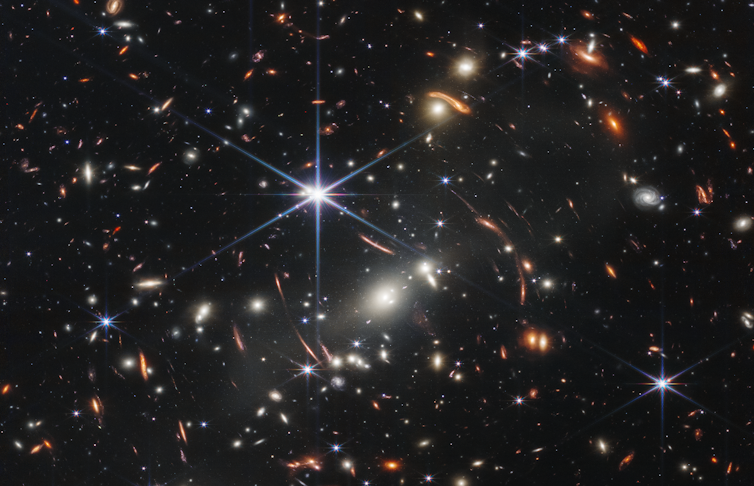
Do we understand our cosmos?

A recent article from The Conversation suggests not.

As much as I am interested in the cosmos my brain cannot tackle the subject with any form of intelligence.

Thus I really want to share this with you all, in the hope that some of you will appreciate the article.

ooOOoo

Scientists can’t agree on how fast the universe is expanding – why this matters so much for our understanding of the cosmos

Gemma Ware, The Conversation

It’s one of the biggest puzzles in cosmology. Why two different methods used to calculate the rate at which the universe is expanding don’t produce the same result. Known as the Hubble tension, the enigma suggests that there could be something wrong with the standard model of cosmology used to explain the forces in the universe.

Now, recent observations using the new James Webb Space Telescope (JWST) are shaking up the debate on how close the mystery is to being resolved.

In this episode of The Conversation Weekly podcast, two professors of astronomy explain why the Hubble tension matters so much for our understanding of the universe.

(The Conversation included two files that one could listen to but they could not be played directly. But I have left them in the post just in case.)

https://embed.acast.com/60087127b9687759d637bade/6669a6f9efa053001194ed11

https://shows.acast.com/60087127b9687759d637bade/6669a6f9efa053001194ed11

In February, the Nobel prize-winning physicist Adam Reiss, published a new paper. It said that new observations of far-away stars using the JWST matched those obtained by the Hubble Space Telescope.

These stars, called Cepheids, are commonly used in one method of calculating the rate at which the universe is expanding. Known as the local distance ladder, or cosmic distance ladder, this method has been around since observations first made by Edwin Hubble himself in 1929. And it generally produces a rate of expansion of around 73km per second per mega parsec.

But a second method, using predictions of the cosmic microwave background radiation left over by the Big Bang, has constantly arrived at a different number for the rate of expansion of the universe: 67km per second per mega parsec.

Reiss said that when the new data confirmed the earlier observations from the Hubble Space Telescope, the gap between the numbers remains unresolved. “What remains is the real and exciting possibility that we have misunderstood the universe,” he said.

A few months later, however, more data from the JWST, presented by Wendy Freedman, a physicist at the University of Chicago, using observations from a different set of stars, arrived at 69km per second per mega parsec, a number closer to the cosmic microwave background figure of 67. Freedman is excited that the numbers seem to be converging.

Vicent Martínez and Bernard Jones are fascinated by the Hubble tension. Jones is an emeritus professor of astronomy at the University of Groningen in the Netherlands. Martínez, his former student, is now a professor of astronomy and astrophysics at the University of València in Spain.

“The fundamental basis of science, what distinguishes science from science fiction, is our ability to verify the information we are getting,” explains Jones.

That’s why Martinez says the mystery of the Hubble tension is still driving people to:

Research and imagine experiments and organise huge projects with the complicated observation of the cosmos in order to understand what’s going on. At the end, this will affect your idea of the whole universe and probably you will need to change some fundamental ingredient of your cosmological model.

Martinez and Jones have just written a book, along with their co-author Virginia Trimble, about moments in history when scientists realised they’d got something very wrong, and had to readjust their way of thinking. Martínez thinks this could happen again with the Hubble tension:

It could happen that, for example, a new theory of gravity could solve the problem of dark energy or dark matter. We have to be open to those ideas.

Listen to Bernard Jones and Vicent Martínez talk more about the Hubble tension, and how it fits in the wider history of science, on The Conversation Weekly podcast. The episode also features an introduction from Lorena Sánchez, science editor at The Conversation in Spain.

Gemma Ware, Editor and Co-Host, The Conversation Weekly Podcast, The Conversation

This article is republished from The Conversation under a Creative Commons license. Read the original article.

ooOOoo

Fascinating, albeit much of this article a little beyond me. But still fascinating.

A Story of a Remarkable Rescue

Thanks to the Dodo for this.

I just love articles about dogs being rescued. Such as this one:

ooOOoo

Tiny Dog Trapped In Canal For Days Almost Loses Hope Of Being Found

“[T]here was no way in except to climb down …”

By Ashley Ortiz, Published on May 28, 2024.

It was a sunny spring day in Compton, California, when a group of residents spotted something white bolt across an unused canal. It’s not uncommon to find discarded items strewn along the canal, known as Compton Creek, but this was the first time they’d seen a dog trapped inside.

Situated tens of feet below ground level, the worried onlookers were unsure how a tiny pup made it into the canal in the first place.

“[T]here was no way in except to climb down,” Suzette Hall, founder of Logan’s Legacy 29 dog rescue, wrote on Facebook.

Instagram – La Fine Street Repair

The Good Samaritans rushed to help the pup, later named Sammy, but he was too scared to let anyone get close.

“There were people who went to try to get the dog, but they were unable to secure [him],” Kristina Ross, one of Sammy’s original helpers, wrote in a Facebook comment.

Facebook – Kristina Ross

Ross posted footage of Sammy sprinting down the canal on Facebook and pleaded for someone to save him. After three days of failed attempts, they contacted Logan’s Legacy, and Hall was eager to help.

Hall soon arrived with a humane dog trap in hand. As she figured out a way to lower herself into the canal to set up the trap, another pair of Good Samaritans descended.

“I [saw] the post today and jumped down the sewer with a rope,” one of the Good Samaritans wrote on Instagram. “[I] felt the need to rescue this poor baby.”

Instagram – La Fine Street Repair

The pair trudged through muddy sewer water and trash to reach Sammy. As dangerous and uncomfortable as wading through the canal was, they knew that Sammy’s experience was even worse.

Hall watched as the men tried to catch Sammy multiple times. On their final attempt, one of the guys, Nelson, successfully cornered Sammy and threw a net around him to stop him from bolting again.

Nelson then carefully gathered up the net with Sammy still in it, and his partner lifted the pup out of the canal. They handed Sammy over to Hall, who gave the dog a big, triumphant hug before loading him up in her car.

“He literally melted in my arms,” Hall wrote. “He knew he was finally safe.”

Suzette Hall

Ross, the woman who had originally posted about Sammy, offered to foster him for the night. The grateful pup slept through the night in a cozy bed before heading to the veterinary clinic the next day, where he was immediately treated for a rotten tooth and an injured paw.

The tiny dog was soon on the mend, but his rescuers still couldn’t believe what he’d been through.

“I can’t imagine how scared he was down here in that big, huge canal, all by himself,” Hall wrote on Facebook. “He’s in recovery and doing just fine.”

Suzette Hall

While Sammy recovered at the vet clinic, he stole the heart of one of the vet techs caring for him. Instantly smitten with the pup, the loving vet tech decided to give him the best forever home he could’ve ever dreamed of.

“She said, ‘We have fallen in love … can we please adopt him?’” Hall wrote on Facebook. “[It’s] just so meant to be. He is beyond loved and getting spoiled.”

Suzette Hall

Over a month after his rescue, Sammy is thriving in his new home alongside his equally tiny Chihuahua sibling. His days are filled with cozy beds, walks with his family and play sessions with his doting sibling — and he wouldn’t have it any other way.

For his rescuers, it seems like Sammy’s journey through the canal was just yesterday. But for Sammy, his days of feeling alone and scared are far in the past. Now, he only knows love.

To help pups like Sammy get the care they need, you can donate to Logan’s Legacy 29 here.

ooOOoo

I have included the link to Logan’s Legacy 29 just in case you wanted to help Sammy as well. We have made a small donation.

This is the most perfect outcome one can imagine. Beautiful Sammy!

An amazing dog story

This dog runs for help!

This story has been widely reported. For instance, the OregonLive website introduced the story as follows:

“After a car crash landed 61-year-old Brandon Garrett and his four dogs at the bottom of an 85-foot-ravine in eastern Oregon last Sunday, Garrett found an unexpected hero in his dog Blue.

Blue, a whippet and pit bull mix, traveled four miles to find help — and then captured the hearts of people in Baker County and beyond.”

But I am going to continue this with a YouTube video.

Dogs are truly amazing! (And I know I have said this many times before!)

A post on Heat

Not the first and I’m sure it won’t be the last on this topic!

We are experiencing the first week of Summer’s heat.

Where it is going, temperature-wise, who knows but the consensus is that it is becoming warmer year on year.

So this seemed like a great post to republish. It was on The Conversation.

ooOOoo

Heat index warnings can save lives on dangerously hot days − if people understand what they mean

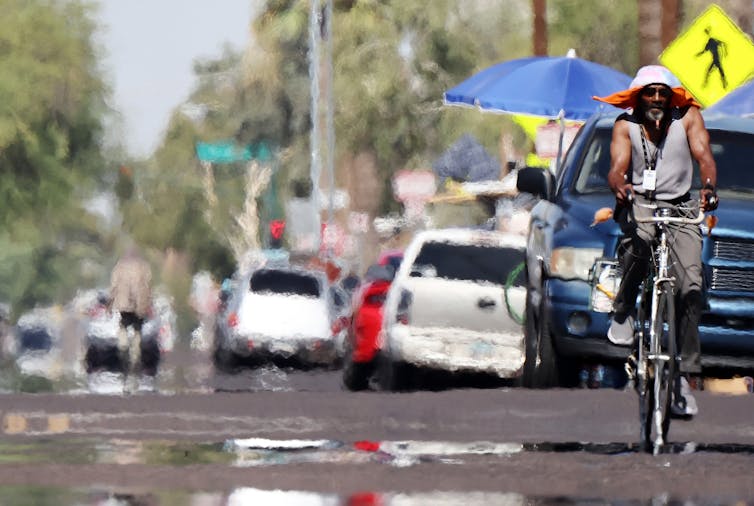
The sticky combination of heat and high humidity can be more than uncomfortable – it can be deadly. Mario Tama/Getty Images

Micki Olson, University at Albany, State University of New York

You’ve probably heard people say, “It’s not the heat, it’s the humidity.” There’s a lot of truth to that phrase, and it’s important to understand it as summer temperatures rise.

Humidity doesn’t just make you feel sticky and uncomfortable – it also creates extra dangerous conditions on hot days. Together, too much heat and humidity can make you sick. And in severe cases, it can cause your body to shut down.

Meteorologists talk about the risk of heat and humidity using the heat index, but it can be confusing.

I’m a risk communication researcher. Here’s what you need to know about the heat index and some better ways meteorologists can talk about the risks of extreme heat.

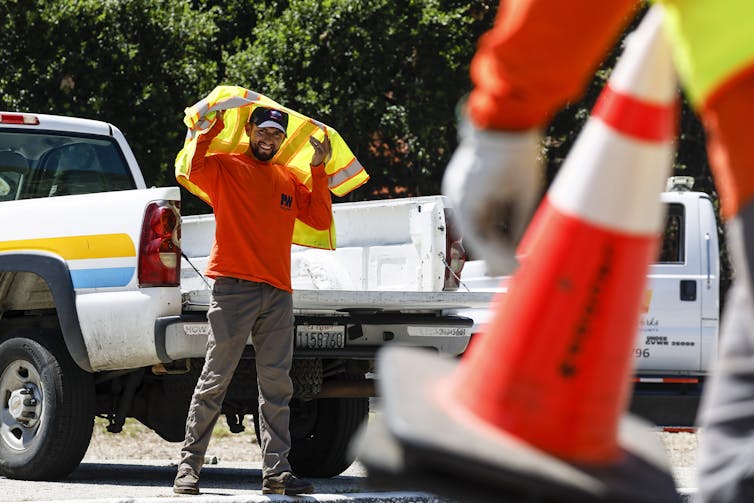
A construction worker in reflective gear holds a jacket over his head against the sun.
Outdoor workers can be at high risk of heat illnesses. Robert Gauthier/Los Angeles Times via Getty Images

What is the heat index, and how is it measured?

Heat index is the combination of the actual air temperature and relative humidity:

  • Air temperature is how hot or cold the air is, which depends on factors such as the time of day, season of the year and local weather conditions. It is what your thermometer reads in degrees Celsius or Fahrenheit.
  • Relative humidity compares how much water vapor is in the air with how much water vapor the air could hold at that temperature. It’s expressed as a percentage.

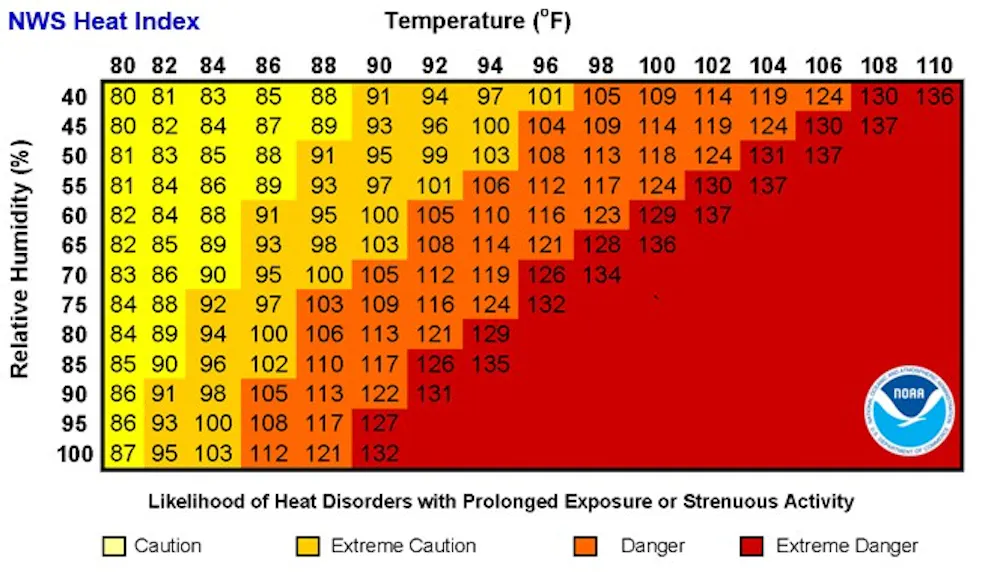
The heat index tells you what it “feels like” outside when you factor in the humidity. For example, if it’s 98 degrees Fahrenheit (36.7 Celsius) with 55% relative humidity, it might feel more like a scorching 117 F (47.2 C).

A chart with a grid showing heat and humidity risks.
NOAA’s heat index chart shows how heat and humidity combine for dangerous temperatures. NOAA

But there’s a catch: Heat index is measured in shady conditions to prevent the sun’s angle from affecting its calculation. This means if you’re in direct sunlight, it will feel even hotter.

Apparent temperature, alerts and wet bulb

“Apparent temperature” is another term you might hear this summer.

Apparent temperature is the “feels like” temperature. It considers not only temperature and humidity but also wind speed. This means it can tell us both the heat index and wind chill – or the combination of the temperature and wind speed. When conditions are humid, it feels hotter, and when it’s windy, it feels colder.

We found that apparent temperature is even less well understood than the heat index, possibly due to the word apparent having various interpretations.

There are a few other ways you may hear meteorologists talk about heat.

Wet bulb globe temperature considers temperature, humidity, wind and sunlight. It’s especially useful for those who spend time outdoors, such as workers and athletes, because it reflects conditions in direct sunlight.

HeatRisk is a new tool developed by the National Weather Service that uses colors and numbers to indicate heat risks for various groups. More research is needed, however, to know whether this type of information helps people make decisions.

In many places, the National Weather Service also issues alerts such as excessive heat watches, warnings and advisories.

The risk is getting lost in translation

Knowing about heat and humidity is important, but my colleagues and I have found that the term heat index is not well understood.

We recently conducted 16 focus groups across the United States, including areas with dry heat, like Phoenix, and more humid areas, like Houston. Many of the people involved didn’t know what the heat index was. Some confused it with the actual air temperature. Most also didn’t understand what the alerts meant, how serious they were or when they should protect themselves.

In our discussions with these groups, we found that meteorologists could get across the risk more clearly if, instead of using terms like heat index, they focus on explaining what it feels like outside and why those conditions are dangerous.

Watches, warnings and advisories could be improved by telling people what temperatures to expect, when and steps they can take to stay safe.

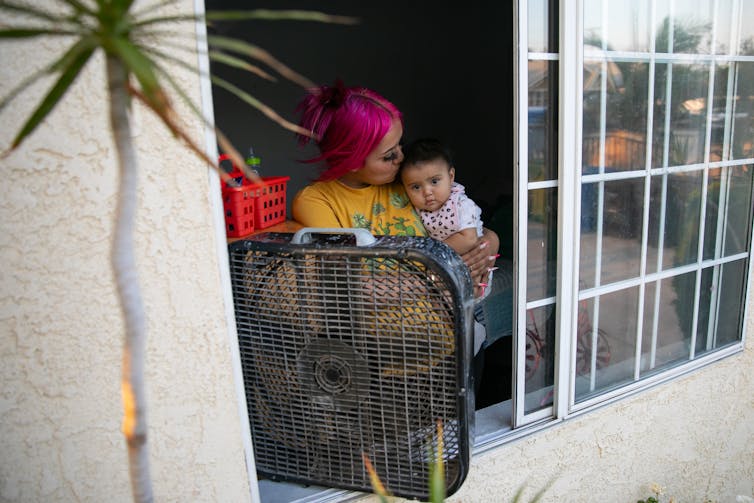
A woman holds a baby at an open window with a fan blowing in.
Clear warnings can help residents understand their risk and protect themselves, which is especially important for small children and older adults, who are at greater risk of heat illness. Jason Armond/Los Angeles Times via Getty Images

Climate change is exacerbating heat risks by making extreme heat more common, intense and long-lasting. This means clear communication is necessary to help people understand their risk and how they can protect themselves.

What you can do to protect yourself

With both hot and humid conditions, extra precautions are necessary to protect your health. When you get hot, you sweat. When sweat evaporates, this helps the body cool down. But humidity prevents the sweat from evaporating. If sweat cannot evaporate, the body has trouble lowering or regulating its temperature.

Although everyone is at risk of health issues in high heat, people over 65, pregnant women, infants and young children can have trouble cooling their bodies down or may run a higher risk of becoming dehydrated. Certain health conditions or medications can also increase a person’s risk of heat-related illness, so it’s important to talk to your doctor about your risk.

Heat illnesses, such as heat exhaustion and heat stroke, are preventable if you take the right steps. The U.S. Centers for Disease Control and Prevention focuses on staying cool, hydrated and informed.

  • Stay cool: Use air conditioning in your home, or spend time in air-conditioned spaces, such as a shopping mall or public library. Limit or reschedule your exercise and other outdoor plans that occur in the middle of the day when it is hottest.
  • Stay hydrated: Drink more water than you might otherwise, even if you don’t feel thirsty, so your body can regulate its temperature by sweating. But avoid sugary drinks, caffeine or drinks with alcohol, because these can cause you to become dehydrated.
  • Stay informed: Know the signs of heat illness and symptoms that can occur, such as dizziness, weakness, thirst, heavy sweating and nausea. Know what to do and when to get help, because heat illnesses can be deadly.
Heat exaustion includes dizziness, thirst, heavy sweating, nausea and weakness. Move to cooler area, loosen clothing, sip cool water and get medical help if no improvement. If heat stroke, including confusion, dizziness and unconsciousness, also call 911.
The difference between heat exhaustion and heat stroke and the CDC’s advice on how to respond. NOAA, CDC

Micki Olson, Senior Researcher in Emergency and Risk Communication, University at Albany, State University of New York

This article is republished from The Conversation under a Creative Commons license. Read the original article.

ooOOoo

That last diagram on staying cool, staying hydrated, and staying informed is one element in me choosing this article for publication. Further, if one looks up the website for the Centers for Disease Control and Prevention then immediately one comes across:

Stay cool indoors.Stay in an air-conditioned place as much as possible. If your home does not have air conditioning, go to the shopping mall or public library—even a few hours spent in air conditioning can help your body stay cooler when you go back into the heat.

Please take care!

The Same Language, but …

We are so close yet in some ways so separate!

George Bernard Shaw once quoted that: “England and America are two countries separated by the same language.”

It seems a most apt way of introducing an article published by The Conversation.

ooOOoo

UK and US elections: 2 very different systems united by a common political language

Long, drawn-out campaigns just aren’t Rishi Sunak’s cup of tea. Chris J Ratcliffe/WPA Pool/Getty Images.

Garret Martin, American University School of International Service

Voters in the United Kingdom on May 22 learned the date they would be joining the many, many people casting ballots around the world in 2024.

In a surprise move, Prime Minister Rishi Sunak announced a snap election to be held on July 4 – six months earlier than many had expected. An early election is certainly a major gamble for the prime minister but one he felt was worth taking. With the ruling Conservative Party more than 20 percentage points behind opposition Labour in the latest polls, Sunak faces an uphill battle to stay in office.

The Labour Party, led by Keir Starmer, is heavily favored to return to power for the first time since 2010.

To a U.S. audience, many of the top issues in the election campaign will sound familiar: the economy, immigration, health care, Ukraine and Gaza. The choice of date, too, may ring a bell – and political soothsayers are already trying to read into what it means for the U.K. election to fall on Independence Day.

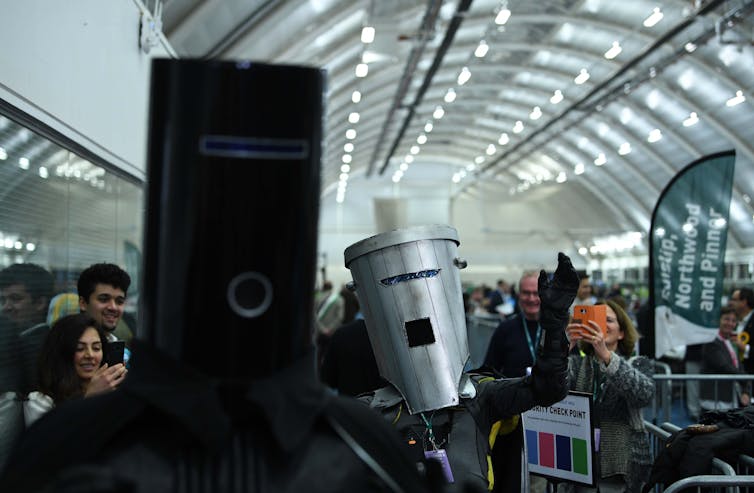
A person with a trash bin head gestures with his thumbs down to a person with a bucket as a head.
U.K. elections can be an odd affair in which mainstream politicians can rub shoulders with the likes of rival candidates Count Binface and Lord Buckethead. Oli Scarff/AFP via Getty Images

But as to the campaign itself – well, they do things a bit different on the other side of the pond. While Americans may be used to set terms and lengthy campaigns filled with endless advertising, in the U.K. such things are, to use a Britishism, “just not cricket.” Here are three main ways in which the British conduct their elections.

1. Election timeline

U.S. elections follow a predictable schedule. In 1845, Congress passed a law establishing a single day for federal elections to take place on “the Tuesday next after the first Monday in November.” Further, presidents are elected for a fixed four-year term, making the dates for upcoming votes knowable for the foreseeable future.

That isn’t the case in the United Kingdom. By convention, elections have been held on a Thursday since 1935. But the month of the vote has varied considerably. For the most part, they take place in late spring or early summer – but fall and winter elections are not unheard of.

The U.K. Parliament does have a fixed term of five years, with elections automatically scheduled once that time has lapsed. In practice, however, parliaments have rarely gone the full five years.

Indeed, prime ministers in the United Kingdom have the authority to request the dissolution of Parliament at any time. They can do so without the approval of the cabinet, and so prime ministers have taken liberal advantage of their ability to control the timing of the election to try and gain an advantage.

Many thought that Sunak may have been eyeing an election later in the year, but a number of factors, including economic forecasts and not wanting the distraction of a U.S. election, may have factored in to him calling an earlier-than-expected vote.

2. Campaign rules

Besides the shifting timing, the nature and rules of the campaign are also very different in the United Kingdom. This starts with the sheer brevity of the campaign. Once Parliament is dissolved, the election must take place 25 working days later. This means the parties have a mere six weeks to make their case to the public.

And unlike in a presidential system, voters in the United Kingdom do not cast a ballot for the person they want to see lead the country. Instead, the U.K. is divided into 650 distinct constituencies; voters pick their preferred candidate to represent their local constituency in Parliament. The party with the most seats typically wins the election, and the leader of that party has the opportunity to become prime minister and govern as a single-party government or as part of a coalition.

U.K. election campaigns are also subject to strict rules to maintain neutrality. Once the campaign starts, the period of “purdah” kicks in, which imposes certain restrictions on government activities. This involves, for instance, strict prohibitions on government ministers announcing new initiatives to affect the election or using public funds for political purposes.

In the same manner, civil servants – employees of the crown who work for the government but are not political appointees – are required to maintain strict impartiality and not become involved in partisan debates.

Moreover, the Office of Communications, the United Kingdom’s independent media regulatory authority, also enforces strict rules for broadcast media, including television and radio. The 2003 Communications Act requires that all broadcast media must cover the elections in an impartial manner, providing coverage of all parties, even if they do not assign equal time.

A man in a white shirt chats to a man in a blazer. Bith hold cups.
Opposition leader Keir Starmer, left, poses on the campaign trail with what the photographer says is a cup of coffee … but which I strongly suspect is actually tea. Leon Neal/Getty Images

Broadcast media is also not allowed, on polling day, to suggest the outcome of the vote before polls are closed.

In a huge departure from the U.S., U.K. political parties are banned from buying television ads, but this rule does not apply to streaming television.

3. The role of money

The limited role of money is another distinct feature in U.K. elections. Even factoring in the different population sizes, U.K. elections are significantly cheaper than their counterparts in the United States.

Indeed, total campaign spending in the 2020 U.S. elections, covering presidential and congressional races, hit more than US$14 billion. That scale completely dwarfs how much parties and candidates will be able to spend in the 2024 United Kingdom election.

Through regulations established by the Electoral Commission, an independent government agency, a British party that competes in all constituencies in the United Kingdom will be allowed to spend just over £34 million (around $43 million) in total to support all candidates.

That figure in itself marks an 80% increase from the allowance at the last election in 2019, so to factor for inflation since limits were set in 2000.

Individual candidates can spend funds to support their campaign. But the amount, defined partly by the size of the constituency, is low and in the scale of tens of thousands of pounds. This is again a far cry from some of the more expensive congressional races in the United States, where even primary elections could attract close to $30 million in spending.

Challenging times ahead

As a result, both Sunak and Starmer will have only a short time – and limited funds – to make their case to voters. Whoever wins will face a very challenging situation at home and abroad, with little to no respite. According to the think tank Institute for Fiscal Studies, the state of public finances is “a dark cloud that hangs over the election.” And then there is the delicate matter of maintaining a special relationship with the U.S. – a country that may itself have a very different political landscape after it goes to the polls later in the year.

Garret Martin, Senior Professorial Lecturer, Co-Director Transatlantic Policy Center, American University School of International Service

This article is republished from The Conversation under a Creative Commons license. Read the original article.

ooOOoo

As I have frequently said, I feel English and love the fact that I speak with an English accent. Yet I adore, along with Jean, where we live just outside Merlin in Southern Oregon. I wouldn’t want to live anywhere else in the world.

Politically we are in very strange times, as was said right at the end of this article.

Picture Parade Four Hundred and Thirty-Four

A change from our dear dogs.

I really hope you enjoy these as much as we have!

There is quite a long introduction but it helps enormously in explaining the background to the photographs.

ooOOoo

This image is released as part of the Early Release Observations from ESA’s Euclid space mission. All data from these initial observations are made public on 23 May 2024 – including a handful of unprecedented new views of the nearby Universe.

The Dorado Group of galaxies is one of the richest galaxy groups in the southern hemisphere. Here, Euclid captures signs of galaxies evolving and merging ‘in action’, with beautiful tidal tails and shells visible as a result of ongoing interactions. As Dorado is a lot younger than other clusters (like Fornax), several of its constituent galaxies are still forming stars and remain in the stage of interacting with one another, while others show signs of having merged relatively recently. In size, it sits between larger galaxy clusters and smaller galaxy groups, making it a useful and fascinating object to study with Euclid.

This dataset is enabling scientists to study how galaxies evolve and collide over time in order to improve our models of cosmic history and understand how galaxies form within halos of dark matter, with this new image being a true testament to Euclid’s immense versatility. A wide array of galaxies is visible here, from very bright to very faint. Thanks to Euclid’s unique combination of large field-of-view and high spatial resolution, for the first time we can use the same instrument and observations to deeply study tiny (small objects the size of star clusters), wider (the central parts of a galaxy) and extended (tidal merger tails) features over a large part of the sky.

Scientists are also using Euclid observations of the Dorado Group to answer questions that previously could only be explored using painstakingly small snippets of data. This includes compiling a full list of the individual clusters of stars (globular clusters) around the galaxies seen here. Once we know where these clusters are, we can use them to trace how the galaxies formed and study their history and contents. Scientists will also use these data to hunt for new dwarf galaxies around the Group, as it did previously with the Perseus cluster.

The Dorado Group lies 62 million light-years away in the constellation of Dorado.

All images are: ESA/Euclid/Euclid Consortium/NASA, image processing by J.-C. Cuillandre (CEA Paris-Saclay), G. Anselmi

Composite image of five astronomical views, three at the top, two at the bottom. All are dotted with stars and galaxies against a black background. Striking features are three bright glowing structures in the first image. The second image has an orange veil-like structure spanning across. In the third we see a stunning spiral galaxy with many arms. The fourth image features light from galaxies lying behind a bright cluster distorted into arcs. And the fifth image shows a variety of galaxies in all shapes and sizes

An elongated bright cloudy ellipse, tilted at a 45-degree angle in front a black background dotted with small white stars and galaxies. Above the ellipse floats a smaller, cloudy ellipsoid.

A dark orange filamentary structure seems to enclose stars. Centrally, three bright star-forming regions shine brightly through the orange veil in a traffic-light like formation.

The image shows hundreds of stars, some brighter than others. The stars seem to light up their cloud-like surroundings in purple. A darker structure spans the image in an arch from upper left to bottom right. The bottom of this arch runs into dense clouds forming the darkest part of the image.

This breathtaking image features Messier 78 (the central and brightest region), a vibrant nursery of star formation enveloped in a shroud of interstellar dust. This image is unprecedented – it is the first shot of this young star-forming region at this width and depth.

Today, (May 23rd, 2024) ESA’s Euclid space mission releases five unprecedented new views of the Universe. The never-before-seen images demonstrate Euclid’s ability to unravel the secrets of the cosmos and enable scientists to hunt for rogue planets, use lensed galaxies to study mysterious matter, and explore the evolution of the Universe.

ooOOoo

Fabulous. It is an example of just how clever the science is getting!

I can only look at these images in awe. For example, Messier 78 is part of the Orion constellation, has a radius of five light-years, and is only 1,600 light-years from Planet Earth. (Using the figure from below of the distance of a single light-year, that puts Messier 78 as 1,600 times 6 trillion miles from our planet or 9,600 trillion miles.)

And in case you forgot it, one light year is:

The light-year is a measure of distance, not time. It is the total distance that a beam of light, moving in a straight line, travels in one year. To obtain an idea of the size of a light-year, take the circumference of the earth (24,900 miles), lay it out in a straight line, multiply the length of the line by 7.5 (the corresponding distance is one light-second), then place 31.6 million similar lines end to end. The resulting distance is almost 6 trillion (6,000,000,000,000) miles!

Having pets!

But primarily for companionship.

I chose this article from The Conversation simply because it is the truth about having a pet animal.

ooOOoo

Pets give companionship, cuddles and joy – and also unavoidable stresses

Pets can bring joy and companionship, as well as financial worries, loss and logistical challenges. Dann Tardif/Stone via Getty Images

Emily Hemendinger, University of Colorado Anschutz Medical Campus

Owning a pet can be a roller coaster. There are the highs, like when your dog greets you with a full-body wiggle when you return home, or when your cat purrs loudly as you cuddle next to one another. Then there are the lows, like stressful trips to urgent care, waking up to that unpleasant vomiting noise, or making the difficult choice to say goodbye because of medical problems or even intractable behavioral issues.

For those pet-owners who are struggling, it’s beneficial to their mental health to acknowledge that pets can create stress and that some animals are more work than others.

Research has shown that both cats and dogs can have equally positive impacts on mental health.

Pets may be helpful at reducing stress, anxiety and feelings of being overwhelmed, including in children. Pet ownership has also been shown to improve well-being by instilling people with a sense of purpose and responsibility.

As a licensed clinical social worker, animal lover and proud dog mom, I have both professionally and personally seen the mental health impacts of having animal companions.

Media stories commonly cover the positives of pet ownership. But the hardships and downsides of owning a pet are not discussed as often. For instance, while there are many positive aspects to pet ownership, some research is showing that pets may lead to exacerbated mental health concerns or even sleep issues.

Whether you’re adopting or shopping, pets can bring a full range of emotions into our lives. Research has even shown that pets may benefit non-pet owners around them as well.

How pets can enrich our lives

A pet owner may easily be able to tick off an infinite number of positive effects their fuzzy companion has had on their life. Research backs them up.

Pets can provide constant companionship for individuals and families. This is particularly true for older adults. There was an uptick in adoptions of pets during the early days of the COVID-19 pandemic. Many people benefited from pets during periods of stay-at-home mandates and quarantines.

Pet adoptions soared during the early days of the COVID-19 pandemic. But many owners then found themselves struggling with the rising costs of care.

Research shows that dogs can reduce loneliness in their owners. In fact, being accompanied by a dog may even make you seem more approachable.

Pets, especially dogs, may help improve one’s ability to socialize and feel connected with others, as well as increasing the prospects for social interactions. People may bond over the experience of having pets, socialize at the dog park, or even meet up at the local cat café.

Animals and pets have also been used to assist in detecting the onset symptoms of medical episodes, including seizures. Animal-assisted therapy and pet therapy have shown promise in improving symptom management and overall quality of life in a number of conditions, including trauma and stressor-related disorders, anxiety disorders, eating disorders, autism, traumatic brain injuries, neurological disorders and more.

There are ample benefits to pet ownership.

The inherent stressors

Despite the many positive impacts of pet ownership, it also can have negative impacts. For example, one survey found that 47% of Americans felt separation anxiety when leaving their dogs at home.

The survey also found that 41% of pet owners declined social invitations because they did not want to leave their dog at home, and that 70% of pet owners would prefer to work remotely so they could stay at home with their pet. Pet owners have also identified feeling anxious about their pet getting sick or running away, or the risk that they might harm the animal unintentionally.

Stress from pet ownership is common. There’s the stress of house-training and making sure the pet is getting enough enrichment – both physically and mentally. Then there are the challenges associated with vet appointments and navigating illness, as well as financial stressors and finding pet sitters.

Another element of pet ownership that people often don’t talk about is the stress, and often shame, that owners with reactive dogs experience from walking their dog, having people over to the house or having their dog around children.

Finally, there’s the reality that our pet companions live shorter lives than we do, leading to end-of-life planning, expensive treatments for older-age ailments, and, of course, the grief that will be felt from the loss of a pet. For some people, the loss of a pet may feel worse than human loss.

People may judge or criticize pet owners for an “overblown” grief reaction. The common experience of invalidation and lack of acknowledgment related to grief around pet loss – similar to the grief felt from divorce and miscarriage – is categorized as disenfranchised grief. This term refers to grief that is not acknowledged, validated or accepted socially.

Young man sits in front of his laptop and puts his nose up to the nose of his cat.
Society often fails to recognize the significance of pets in people’s lives. Thomas Northcut/DigitalVision via Getty Images

Strings attached

Pet owners, especially post-pandemic, have reported high levels of guilt related to leaving their pets at home while at work or social events. Some of this guilt may be related to concerns about providing insufficient attention to the pet or about the pet’s health. This guilt has even been shown to be similar to the feeling human parents have concerning their human children.

As someone who adores their dog, I can relate to the guilt of leaving him alone. To complicate things, my dog has joint issues, anxiety and discoid lupus, a type of lupus that affects the skin on his nose. He can also be reactive. All of these aspects require me to provide extra care. When friends invalidate my worries and guilt, it can feel isolating and shaming.

And I’m not alone in these feelings. Overall, when there is a lack of consideration for the complex feelings pet owners experience, the invalidation and disenfranchised feelings can lead to depression, anxiety, feelings of being isolated and worsened quality of life.

Woman sits on a dock with her arm around her dog, which looks backward over her shoulder into the camera.
Many pet owners report feeling unsupported and invalidated when it comes to the grief around illness, loss and other complicated issues that come with pet ownership. LWA/DigitalVision via Getty Images

Finding support

The human-animal bond is unique, with humans receiving unconditional love and full acceptance from their animal companion. When society can honor and respect this bond through validation, patience and compassion, it not only helps pet owners but also the clinicians who treat the animals.

Employers can be supportive by continuing to provide remote and hybrid work options, flexibility in scheduling and opportunities for employees to feel validated and receive support. If a loved one is experiencing guilt around leaving their dog at home or a friend is having anxiety about their cat’s health, instead of minimizing their experience, try talking to them and asking how best to support them through their distress.

Another support tool is encouraging pet owners to practice self-compassion and mindfulness, being present and focusing on the time they do have with their pet.

Pets can bring infinite joy and companionship to our lives, whether that’s through pet ownership, fostering, volunteering or engaging in animal-assisted therapy.

It remains important, however, to acknowledge the stressors and difficulties pet owners face. After all, the ups and downs of pet ownership, just like the ups and downs of the human experience, are what make life and relationships that much more meaningful.

Emily Hemendinger, Assistant Professor of Psychiatry, University of Colorado Anschutz Medical Campus

This article is republished from The Conversation under a Creative Commons license. Read the original article.

ooOOoo

This is such a good article both for the general readership and for Jeannie and me specifically. For when I met Jean in December, 2007 Jean had 23 dogs and 7 cats. Jean’s passionate interest was in rescuing the many street dogs that roamed San Carlos in Mexico.

My great love of dogs came from the loving companionship that the animals offered me, including my Pharaoh that I brought with me from England. Now we are down to just two dogs: Oliver and Cleopatra.

The Quantum Field Theory

This is on the edge of my understanding!

Patrice Ayme recently posted an essay called Relativistic Length Contraction Busts Helium3! As I said in my comment to that post:

“This is far ahead of my knowledge of science. I applaud you for writing this despite me not understanding it”

So it may seem a little strange that I now publish the following. It was published originally on Skeptic. It is quite a long video but, please, settle down and watch it.

ooOOoo

Sean Carroll is creating a profoundly new approach to sharing physics with a broad audience, one that goes beyond analogies to show how physicists really think. He cuts to the bare mathematical essence of our most profound theories, explaining every step in a uniquely accessible way.

Quantum field theory is how modern physics describes nature at its most profound level. Starting with the basics of quantum mechanics itself, Sean Carroll explains measurement and entanglement before explaining how the world is really made of fields. You will finally understand why matter is solid, why there is antimatter, where the sizes of atoms come from, and why the predictions of quantum field theory are so spectacularly successful. Fundamental ideas like spin, symmetry, Feynman diagrams, and the Higgs mechanism are explained for real, not just through amusing stories. Beyond Newton, beyond Einstein, and all the intuitive notions that have guided homo sapiens for millennia, this book is a journey to a once unimaginable truth about what our universe is.

Sean Carroll

Sean Carroll is Homewood Professor of Natural Philosophy at Johns Hopkins University, and Fractal Faculty at the Santa Fe Institute. He is host of the Mindscape podcast, and author of From Eternity to HereThe Particle at the End of the UniverseThe Big Picture, and Something Deeply Hidden. He has been awarded prizes and fellowships by the National Science Foundation, NASA, the American Institute of Physics, the Royal Society of London, and many others. He lives in Baltimore with his wife, writer Jennifer Ouellette. His new book series, The Biggest Ideas in the Universe, includes one volume on Space, Time, and Motion, and this new volume on Quanta and Fields.

Shermer and Carroll discuss:

  • the measurement problem in physics
  • wave functions
  • entanglement
  • fields
  • interactions
  • scale
  • symmetry
  • gauge theory
  • phases
  • matter
  • atoms
  • What is time?
  • Is math all there is? Is math universal?
  • double-slit experiment
  • superposition
  • metaphors in science
  • limitations of models and theories of reality
  • What banged the Big Bang?
  • Why is there something rather than nothing?
  • Second Laws of Thermodynamics and directionality in nature
  • Is there a place for God in scientific epistemology?
  • many interpretations of quantum mechanics
  • multiple dimensions and the multiverse
  • string theory and the multiverse
  • known unknowables: Are there things we can never know, even in principle?
    • God
    • hard problem of consciousness
    • free will/determinism.

ooOOoo

I’m assuming you have watched the video because in a world that is pre-occupied with the trivial this is just the opposite. Sean shares his physics in a profoundly different and powerful way!

A story about a small dog

A dog that begs workers to save her.

There is no shortage of glorious stories about dogs, and thank goodness for that! Recently I saw an article on The Dodo about a dog and I wanted to share it with you.

ooOOoo

Dog Dumped In Desert Finds Construction Site — Then Begs Workers To Save Her

“She wanted to be noticed, she wanted help …”

By Ashley Ortiz, Published on May 17, 2024

When Jeanean Gillespie clocked into work at a construction site earlier this month, she expected to see the usual handful of people around. Her office, located on an uninhabited stretch of desert, managed the new housing developments being built — and no one, other than her team of workers, was authorized to be there.

So when she saw two tiny eyes peering at her through her office doorway that morning, she jumped. The tiny pup had seemingly shown up out of nowhere, and she was desperate for someone to see her.

Suzette Hall

“She wanted to be noticed, she wanted help,” Suzette Hall, founder of Logan’s Legacy 29, wrote on Facebook. “Thank goodness my dear, dear friend, Jeanean Gillespie, worked there.”

Gillespie’s heart dropped when she realized the little dog, later named Sage, was all alone in the dangerous desert. With bobcats and coyotes lurking nearby, Gillespie knew time was of the essence to save Sage.

The compassionate worker tried repeatedly to capture Sage, but the scared pup ran away every time. After a few failed attempts, Gillespie called Hall for backup and placed food and water by the door for her in the meantime.

Suzette Hall

Sage was frightened by her new friends, but she still felt safe in their care. As they came up with a rescue plan, Sage figured out how to get as close as possible to them while still keeping her distance.

“She would sleep outside the office doors at night,” Hall wrote. “They all tried to help her, but she wouldn’t let anyone get close.”

Suzette Hall

Gillespie tried gaining Sage’s trust each day and eventually lured her inside the office. Hall arrived soon after, and the experienced rescuer recognized Sage’s demeanor instantly.

“When I got there, she was so scared, but she wanted to surrender so bad,” Hall said. “She was exhausted.”

Suzette Hall

Hall calmed the skittish dog and successfully scooped her up shortly after arriving. As scared as Sage was, she instantly felt comforted in Hall’s arms.

“[W]ithin minutes, she melted safely into my arms,” Hall wrote. “She knew she was safe from loneliness …”

Suzette Hall

Gillespie waved goodbye to the resilient pup as Hall loaded her into the car and drove off to Camino Pet Hospital. After days of surviving on her own in the desert, Sage got some much-needed rest.

“She fell fast asleep on the drive back,” Hall said. “She closed both eyes for the first time in days. She was rescued and she knew it.”

Suzette Hall

It’s been a couple of weeks since Sage’s rescue, and the survivor pup is still recovering from the ordeal. Aside from needing a growth removed, a dental cleaning and a spay, Sage is overall healthy. But her spirit is still broken.

“Poor Sage is not feeling well … her blood work came back normal, but she is just so sad,” Hall told The Dodo. “She needs love. She is just longing for it.”

Suzette Hall

Sage is scheduled for surgery soon, and Hall hopes to find her an amazing family once she’s feeling better. Until then, she’ll keep showering Sage with the love she’s always deserved.

“She’s such a sweet baby,” Hall said.

ooOOoo

I just love stories like this one. Sweet, sweet Sage!

Dogs in many ways are just like us humans. Scared of being alone and rejected but always deserving of love. Perfect!