Now here’s a truism. One cannot feel bad about the world, at whatever scale, when one pets a dog. I have observed my wife, Jean, kissing and cuddling anyone of our three dogs and she is in a beautiful mental place. Same for me
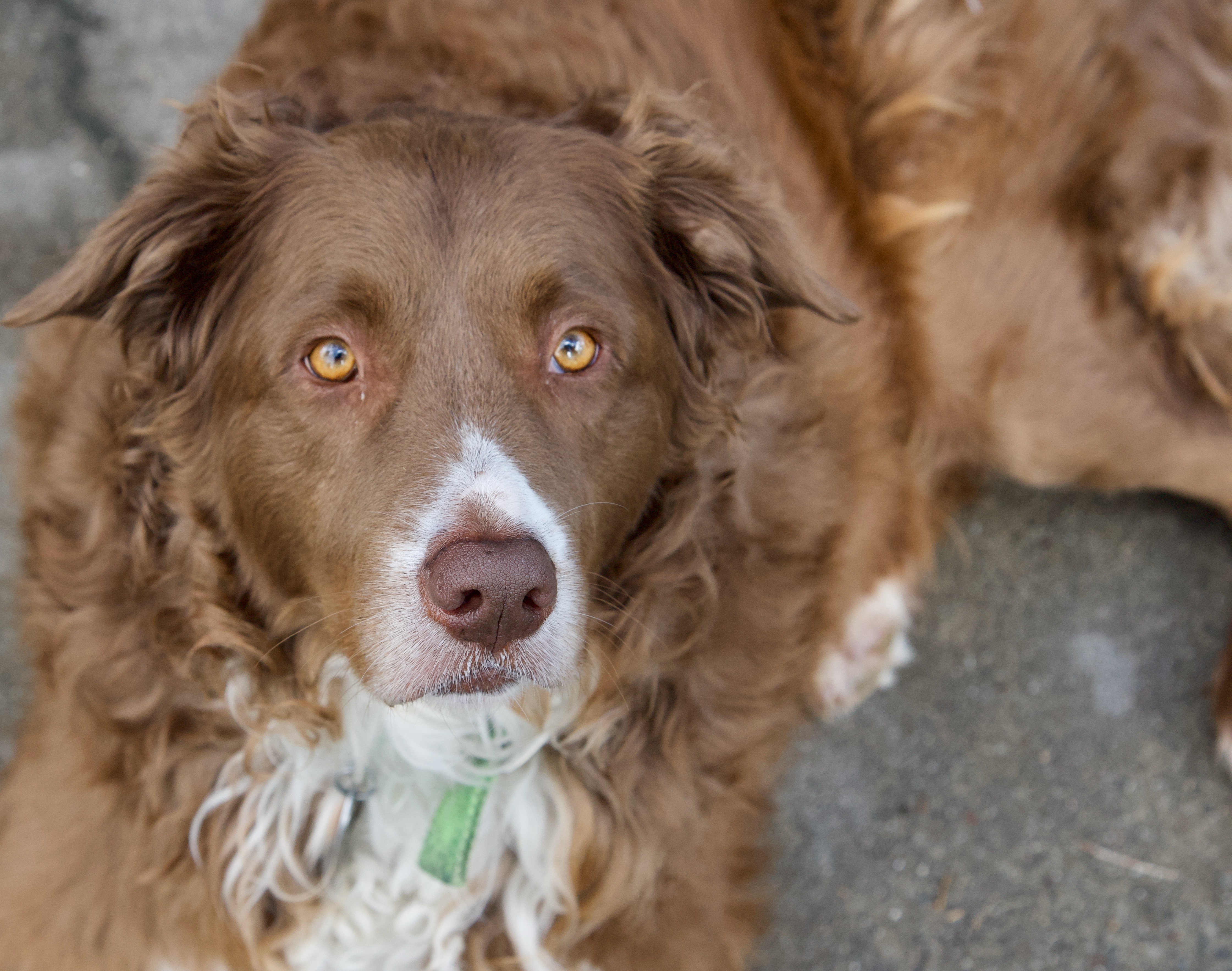
I love all our three dogs but Oliver, below, is so in tune with me that I swear he practically understands what I say!
So when recently I read a post about the positive effects on mental health that owning a dog provides I just had to share it with you. It was first published in The Dodo.
ooOOoo
Petting A Dog Is Good For Your Brain
As if we needed another reason to love them more ❤️
Dog parents already know that petting a dog is one of the best things ever.
And as it turns out, science agrees. While some studies have shown that petting a dog can both lower your stress and release the “feel good” hormone, oxytocin, new research suggests that petting a dog is good for your brain in other ways, too.
Scientists in Switzerland claim in a new study that when you pet a dog, you can get a boost of brain activity in the frontal cortex — a crucial part of the brain that controls attention, working memory, problem-solving, thinking and emotional reactions.
During the study, participants hung around a pup while fitted with a scanner. They started out just watching the dog from across the room, gradually getting closer until they could pet him. Then they did the same thing with a stuffed animal.
And when comparing both scenarios, researchers discovered there was a stronger boost of brain activity when the real dog was nearby and available for a few pets.
This study just goes to show how great therapy animals truly are, since they can boost the cognitive and emotional activity in the brain of their human in ways a stuffed animal can’t.
“If patients with deficits in motivation, attention and socioemotional functioning show higher emotional involvement in activities connected to a dog, then such activities could increase the chance of learning and of achieving therapeutic aims,” study lead author, Rahel Marti, told CNN.
While pet parents already know just how awesome petting a dog is, it’s good to know the positives of bonding with a pup are endless — just like their love for us.
ooOOoo
I am at the age where I am very anxious to do all that is good for my brain. This “... frontal cortex — a crucial part of the brain that controls attention, working memory, problem-solving, thinking and emotional reactions.” hits the target.
This is a great article as I said at the head of this piece.
Dogs are the perfect companions for us humans; body and mind!
A rather gloomy analysis about the next few years!
One makes decisions all one’s life. But too few of us are making decisions that will prevent our planet from over-heating.
Patrice Ayme wrote a comment in a recent post that said (in part): “However we are tracking to a much higher temperature: + 7 (seven) Celsius in some now temperate parts… imminently. That is going to be catastrophic.”
There is a terrible change going on right now. From the deforestation in the Amazon rainforest to the unseasonable heat in Europe, as reported in the Guardian newspaper: “The result of this advection has been anomalously warm temperatures across large parts of Europe – in particular across France and Spain, where temperatures soared to over 10C above normal. Maximum temperatures widely exceeded 30C in parts of Spain on Thursday, with 35.2C measured at Morón de la Frontera, south-east of Seville.“
One would think that our governments would be pulling together in order to have a co-ordinated global plan. But there’s no sight of that yet. What we do have is a sort of craziness of Governments that causes me to lament over our, as in a global ‘our’, distractions. We are running out of time!
To this end I am republishing in full the latest George Monbiot essay. I hasten to add with Mr Monbiot’s permission.
ooOOoo
The Oligarch’s Oligarch
Published 30th October 2022.
Just as we need to get the money out of politics, we have been gifted a Prime Minister who represents the ultra-rich.
By George Monbiot, published in the Guardian 26th October 2022
Before we decide what needs to change, let’s take stock of what we have lost. I want to begin with what happened last week. I don’t mean the resignation of the prime minister. This is more important.
Almost all the media reported a scripted comment by the newly reinstated home secretary, Suella Braverman, about the “Guardian-reading, tofu-eating wokerati”. Astonishingly, scarcely any of them reported what she was doing at the time. She was pushing through the House of Commons the most repressive legislation of the modern era.
Under the public order bill, anyone who has protested in the previous five years, or has encouraged other people to protest, can be forced to “submit to … being fitted with, or the installation of, any necessary apparatus” to monitor their movements. In other words, if you attend or support any protest in which “serious disruption to two or more individuals or to an organisation” occurs, you can be forced to wear an electronic tag. “Serious disruption” was redefined by the 2022 Police Act to include noise.
This is just one of a series of astounding measures in the bill, which has been hardly remarked upon in public life as it passes through Britain’s legislature. What we see here is two losses in one moment: the final erasure of the right to protest, and political journalism’s mutation from reporting substance to reporting spectacle. These are just the latest of our losses.
So extreme has inequality become, and so dangerous is the combination of frozen wages, lagging benefits, rising rents and mortgage repayments, soaring bills and food inflation, that millions of people are being pushed towards destitution. Unless something changes, many will soon lose their homes. In the midst of this crisis, we have been gifted a prime minister who owns four luxury “homes”. One of them is an empty flat in Kensington that he reserves for visiting relatives.
While Rishi Sunak was chancellor, the government repeatedly delayed its manifesto promise to ban no-fault evictions. Landlords are ruthlessly exploiting this power to throw their tenants on to the street or use the threat to force them to accept outrageous rent rises and dismal conditions. Had Sunak’s “help to buy” mortgage scheme succeeded (it was a dismal flop), it would have raised house prices, increasing rents and making ownership less accessible: the opposite of its stated aim. But this, as with all such schemes, was surely its true purpose: to inflate the assets of existing owners, the Conservative party’s base.
Public services are collapsing at breathtaking speed. Headteachers warn that 90% of schools in England could run out of money next year. NHS dentistry is on the verge of extinction. Untold numbers are now living in constant pain and, in some cases, extracting their own teeth. The suspicion that the NHS is being deliberately dismembered, its core services allowed to fail so that we cease to defend it against privatisation, rises ever higher in the mind.
But Sunak appears determined only to hack ever further. Sitting on a family fortune of £730m, he seems unmoved by the plight of people so far removed from him in wealth that they must seem to exist on another planet. He is the oligarch’s oligarch, ever responsive to the demands of big capitaland the three offshore plutocrats who own the country’s biggest newspapers, oblivious of the needs of the 67 million people who live here.
After 12 years of Conservative austerity and chaos, the very rich have taken almost everything. They have even captured virtue. They now appropriate the outward signs of an ethical life while continuing – despite or because of their organic cotton jackets and second homes, their electric cars and pasture-fed meat, their carbon offsets and ayahuasca retreats, philanthropy and holidays in quiet resorts whose palm-thatched cabins mimic the vernacular of the people evicted to make way for them – to grasp the lion’s share of everything.
Corruption is embedded in public life. Fraud is scarcely prosecuted. Organised crime has been so widely facilitated, through the destruction of the state’s capacity to regulate everything from money laundering to waste dumping, that you could almost believe it was deliberate. Our rivers have been reduced to sewers, our soil is washing off the land, the planning system is being dismantled, and hundreds of environmental laws are now under threat. We hurtle towards Earth systems oblivion, while frenetically talking about anything but.
In other words, it’s not just a general election we need, it’s a complete rethink of who we are and where we stand. It’s not just proportional representation we need, but radical devolution to the lowest possible levels at which decisions can be made, accompanied by deliberative, participatory democracy. It’s not just new lobbying laws we require, but a comprehensive programme to get the money out of politics, ending all private political donations, breaking up the billionaire press and demanding full financial transparency for everyone in public life. We should seek not only the repeal of repressive legislation, but – as civil disobedience is the bedrock of democracy – positive rights to protest.
All this now feels far away. Jeremy Corbyn offered some (though by no means all) of these reforms. Keir Starmer offers none. Though Labour MPs voted against the public order bill, his only public comment so far has been to endorse its headline policy: longer sentences for people who glue themselves to roads. But if the Labour party or its future coalition partners can persuade him to agree to just one aspect of this programme, proportional representation, we can start work on the rest, building the political alliances that could transform the life of this nation. Without PR, we’re stuck with a dysfunctional duopoly, in hock to the billionaire press and the millionaires it appoints to govern us. We cannot carry on like this.
So much is really telling but I just want to draw your attention to this sentence: In other words, it’s not just a general election we need, it’s a complete rethink of who we are and where we stand.
It is not just in England and Wales but also in the USA. Indeed, most of the countries in the world.
Here is an excerpt from the latest email from The Economist. It presages the COP27 to be held in Egypt next week.
By burning fossil fuels, humans have altered Earth’s atmosphere, which has consequences for almost everything on the planet. It is reshaping weather systems and coastlines, transforming where crops can be grown, which diseases thrive, and how armies fight . Rising temperatures affect geopolitics, migration, ecosystems and the economy. Over the next century and beyond, climate change—and the responses to it—will remake societies and the world.
And a paragraph later:
This week I wrote about the seven texts I recommend as an introduction to the climate crisis—and explained why each is worth turning to—as a part of our “Economist reads” series. They range from Bill Gates’s assessment of technological solutions to a discussion of international justice by the former UN High Commissioner on Human Rights. One book I find myself recommending over and over again is “What We Know About Climate Change” by Kerry Emanuel, an atmospheric scientist at MIT. At 88 pages, it is a blessedly short, readable primer on the science, history and economics of climate change. The climate crisis touches everything. Understanding it, even a little, is essential for anyone who is engaged with the world and its future. This is a good place to start.
Please follow this advice because it is an excellent place to start.
I wish with all my heart that I am wrong and maybe, just maybe, I am having a ‘down in the dumps’ day. Whatever, my judgement is that we have a few more years at most to find out.
People fear this more than climate change. Halfpoint/ Getty Images
Treehugger was founded by Graham Hill as “a green lifestyle website dedicated to driving sustainability mainstream.” Sustainability is often defined as “meeting our own needs without compromising the ability of future generations to meet their own needs,” and doesn’t seem to be much more mainstream now than it was then. Here we are, 18 years later, and key sustainability issues like climate change are not top of mind for most people, and Treehugger is not the world’s biggest website.
One reason might be because of people’s perception of risk. The Lloyd’s Register Foundation is a charity that “helps to protect life and property at sea, on land, and in the air.” It hired Gallup to do a World Risk Poll in 2020, using 2019 data, and just published its latest 2022 poll with 2021 data, after polling 125,911 people in 121 countries, mostly by telephone. One poll was pre-pandemic, and the other during it.1Chief executive Dr. Ruth Boumphrey compares the two:
“Looking at this first report of the 2021 World Risk Poll, what strikes me most about the findings is what hasn’t changed, as much as what has. People globally still worry about perennial threats such as road crashes, crime, and violence more than any other risks, including Covid-19, and this has important implications for how policymakers work with communities to manage emerging public health challenges in the context of their everyday lives.”
Perhaps the most surprising statistic is that North Americans believe that their greatest daily source of risk is from road-related accidents and injuries at 29%, followed by crime and violence at 11%. Australia and New Zealand put road risk at 33%, weirdly followed by cooking and household accidents at 11%.1
At first, I thought this is terrible; we have been writing about road safety for years, and nothing gets fixed, and yet it is North Americans’ biggest worry! And what’s wrong with Australian kitchens? But when you look at the numbers, you realize that this is a result of rich countries not suffering as much from many of the things other countries worry about, such as Latin America with crime and violence at 43%, Africa worrying about not having money, and North Africa worried about disease.1
Covid-19 was considered a major risk in some parts of the world, but “its impact was moderate overall, and day-to-day risks such as road-related injuries, crime and violence, and economic concerns remained top-of-mind for most people.”
This has been the perennial sustainability story; day-to-day issues and worries have higher priority. Climate change gets its own special section of the risk report and it comes to much the same conclusion. The authors start by noting that “the global risk posed by climate change is widely recognised, and warnings about its effects are increasingly dire. A recent joint statement by more than 200 medical journals called the rapidly warming climate the ‘greatest threat to global public health.'”
But then they dig into the data and find that, while 67% of respondents consider climate change a threat, only 41% deem it serious.1 It varies by education:
“The likelihood of people viewing climate change as a very serious threat to their country was much lower among those with primary education or less (32%) than among those with secondary (47%) or post-secondary (50%) education. More than a quarter of people in the lowest education group (28%) said they ‘don’t know,’ compared to 13% among those with secondary education and 7% with at least some post-secondary education.”
Logically, people who had experienced severe weather events were more likely to consider climate change to be a serious threat, although even then, there is a correlation with education. So university grads in Fort Myers are probably pretty convinced that climate change is a problem right now. The conclusion:
“As in 2019, the 2021 World Risk Poll findings demonstrate the powerful influence of education on global perceptions of climate change. The data highlight the challenge of reaching people who may be vulnerable to risk from extreme weather but have low average education levels, such as agricultural communities in low- and middle-income countries and territories… Spreading awareness of how climate change may directly impact people’s lives may be crucial in broadening local efforts to reduce carbon emissions and build resilience to the effects of rising temperatures.”
Education has always been a problem because, as climate journalist Amy Westervelt noted after the latest IPCC report, there are powerful forces interested in downplaying the importance of climate change. She wrote, “The report made one thing abundantly clear: the technologies and policies necessary to adequately address climate change exist, and the only real obstacles are politics and fossil fuel interests.” Education would have a lot to do with how susceptible people are to their stories.
In many ways, we have seen this movie before, in the Great Recession of 2008. When people are worrying about whether they can heat or they can eat, or apparently whether they will survive crossing the street, then climate change is something they can worry about later.
This is the reason why we need leaders, as in country leaders, because only these people are sufficiently committed to plan and to legislate for the most important tasks facing that country. In the case of climate change it requires even more co-ordination across all the countries in the world; we do have a way to go before that is achieved.
I have said it many times before and, knowing me, will undoubtedly say it many times again. That is that this blog wouldn’t still have in excess of 4,000 followers if all these good people had only me to read.
I know you will enjoy Jackie’s post and it is a most important post looking at the history of the dog. Jackie and her husband look at the dog back in Roman times. You will love this!
ooOOoo
Pup Pompeii – Discovering the Dogs of Ancient Rome
Research has now proven that dogs have been companions to humans for 40,000 years. DNA analysis of a 35,000-year-old bone fragment from an ancient wolf, discovered on the Taimyr peninsula in Siberia, presented evidence that dogs diverged from the wolf species much earlier than previously thought. The findings, published in the journal Current Biology, state that Siberian Huskies and Greenland Sled Dogs share many genes with the Taimyr Wolf.
As such, it is no surprise to learn that, a mere two thousand years ago, the ancient Romans kept dogs. However, on a recent road trip to the ruined city of Pompeii with The Fab Four, our four Cavapoos, my husband Mark and I discovered some fascinating facts about the relationship between ancient Romans and Man’s Best Friend.
Pompeii in southern Italy is the most extraordinary time capsule. It grants the onlooker a fascinating and sometimes painfully intimate window into an ancient civilisation. Snuffed out almost instantly by the eruption of Mount Vesuvius, metres of volcanic ash preserved the entire city for two millennia, exactly how it was on those two fateful days in 79 AD.
My husband, Mark, and I visited in April this year with The Fab Four, our four Cavapoos (Cavalier/Poodle cross.) Within thirty minutes of leaving our campsite, I had bought my first Pompeii souvenir – a coaster portraying the striking black-and-white mosaic of a dog wearing a spiked collar crouched and ready to pounce, along with the words Cave Canem – Beware of the Dog.
Cave has nothing to do with underground chasms. It comes from the same Latin root as caveat, as in caveat emptor – buyer beware. The original mosaic is in the entrance to the House of the Tragic Poet. Since we were investigating Pup Pompeii, we had to find the real thing and when we got there, The Fab Four thrilled me by lining up in front of it, unasked!
If you think about it, Rome’s canine connections go right back to the beginning. According to the legend, a she-wolf suckled the twins, Romulus and Remus. Although Remus was killed, Romulus went on to found Rome.
Many objects and artefacts confirm Romans kept dogs. It is no surprise to find pooches employed as guardians, hunters, soldiers, and entertainers; both on the racetrack and as gladiators in the arena. Sculptures, paintings, and mosaics often depict these large and muscular dogs wearing spiked collars to make them look fierce, or protect them from the dangerous predators that were their prey, such as wolves, bears, and boar.
They also protected against the supernatural. Trivia, the Roman goddess of sorcery and witchcraft, held sway over places of transition, such as graveyards and crossroads. Also known as ‘The Queen of Ghosts’, she wandered during the night and, like her Greek counterpart, Hecate, was silent and invisible. Yet, the Romans believed dogs could see and hear her, so a dog seemingly barking at nothing was warning its owner that Trivia or her ghosts were approaching.
I was touched to discover a softer side of dog ownership, too. Romans also kept dogs as companions, status symbols, used them as hot water bottles, and revered them as an emblem of loyalty and devotion. Infrared analysis of a dog’s collar discovered in Pompeii carries praise for it saving its master’s life in a wolf attack. The archetypal mutt’s name, ‘Fido’, is the Latin word for ‘trust’ or ‘fidelity’, which explains why dogs were popular gifts between lovers.
There was no Kennel Club in ancient Rome, so dog breeds, as we know them today, did not exist. Ever practical, the Romans classified dogs according to their function, or place of origin.
In 2020, archaeologists in Pompeii discovered the skeleton of a tiny adult dog, about 10 inches (25 cm) at the shoulder – the size of a Yorkshire Terrier or Maltese. Malta is just 60 miles south of Sicily, and the “Roman Ladies’ Dog”, Canis Melitae or Melitan, was an expensive status symbol, affordable only to the upper classes. Besides providing companionship and warmth, the Romans believed they drew fleas away from their owners.
The Cave Canem mosaic of a black-and-white dog wearing a spiked collar possibly depicts a Molossian, forbear of the Roman Canis Pugnaces. In modern English, pugnacious means ‘ready to fight’, so there are no prizes for guessing the purpose of CanisPugnaces!
The legions imported Molossians from Epirus, a mountainous region in the southern part of modern-day Albania. The name Molossian derives from the ruling dynasty of Epirus at the time. Alexander the Great’s ‘terrible mother’, Olympias, was a Molossian princess. Historian Plutarch suggested she slept with snakes in her bed!
Molossians may also have found their way to Britain with the Phoenicians, where they founded the Pugnaces Britanniae, which the Romans not only faced in battle, but subsequently captured, imported, and selectively bred with their own Pugnaces, because the British version was “inflamed with the spirit of Mars, the god of war.”
Roman classical poet Virgil praised the Molossian’s abilities as a guard dog. “Never, with them on guard, need you fear for your stalls a midnight thief, or onslaught of wolves, or Iberian brigands at your back.”
The Molossian and Pugnaces Britanniae are the ancestors ofthe Neapolitan Mastiff and the lighter Cane Corso. The Romans used both types in war, notably as piriferi (fire bearers).Greek writer Polybius notes thesefearless canine warriors charging towards enemy lines with containers of flaming oil strapped to their backs.
In 300 AD, the Greco-Syrian poet, Oppiano, described the Molossian as,
“A dog of large size, snub nosed, truculent with its frowning brows, not speedy but impetuous, a fighter of great courage and incredible strength, to be employed against bulls and wild boar, undaunted even when confronted with a lion.”
Alexander the Great’s favourite dog, Peritas, is believed to have been a Molossian. It reputedly changed the course of history by saving Alexander’s life twice; protecting him from a war elephant at the Battle of Gaugamela, and holding off Malian troops until reinforcements arrived, even though it was mortally wounded. The legend says it died with its head in Alexander’s lap.
Among the fabulous mosaics that adorn the floors of the house of Paquius Proculus in Pompeii, a rather regal lurcher-type dog guards the door – perhaps a Vertragus – ancestor of the modern Greyhound. The Romans prized this sighthound as a hunter as well as guarding, and, like the smaller lapdogs, also cuddled them for warmth.
Poet, Grattius, who lived from 63 BC to 14 AD, during the time of Emperor Augustus, praised the Vertragus for its speed and refined features, noting rather splendidly that it runs “swifter than thought or a winged bird.”
The Celtic people originated in the upper Danube basin and expanded their culture across great swathes of continental Europe, including France, Spain, Belgium, the Netherlands, the Balkans, as well as in the east in places such as Asia Minor and Anatolia (part of Turkey) – and took their dogs with them.
Curiously, despite its Celtic connections, studies in the 1970s and 2000 confirm that prior to Roman occupation, Greyhound-type dogs did not exist in Britain. The wooden Vindolanda tablets, the oldest handwritten account of life in the north of Roman Britain, do mention that Imperial troops either knew of the Vertragus, or had them with them.
Julius Caesar allegedly castigated Roman citizens for caring more for their dogs than their children. As is so often the case, funerary goods shed light on ancient civilisations. Many inscriptions on Roman tombs highlight the high regard in which the Romans held their dogs. They also suggest that in the past, dogs may have lived longer than in modern times, perhaps because of the interbreeding required to create pedigree strains.
These heartrending inscriptions will strike a chord with any modern dog owner. The first two could easily refer to Canis Melitae:
“Behold the tomb of Aeolis, the cheerful little dog, whose loss to fleeting fate pained me beyond measure.”
“Bedewed with tears I have carried you, our little dog, as in happier circumstances, I did fifteen years ago. So now, Patrice, you will no longer give me a thousand kisses nor will you be able to lie affectionately ’round my neck. You were a good dog and, in sorrow, I have placed you in a marble tomb and I have united you forever to myself when I die. You readily matched a human with your clever ways; alas, what a pet we have lost! You, sweet Patrice, were in the habit of joining us at table and fawningly asking for food in our lap, you were accustomed to lick with your greedy tongue the cup which my hands often held for you and regularly to welcome your tired master with wagging tail.”
Yet it wasn’t just lap dogs who earned tributes from their owners. Here is a truly beautiful and touching dedication on a Roman marble tablet from the first century AD in the British Museum, contemporary with Pompeii. It is written in verse, from the point of view of a prized hunting dog, Margarita (Pearl), from Gaul, who died giving birth. With allusions to the poetry of Virgil, who stated “Mantua gave birth to me”, the care taken over this memorial proves Margarita was clearly a very beloved family member.
“Gaul gave me my birth and the pearl-oyster from the seas full of treasure my name, an honour fitting to my beauty.
I was trained to run boldly through strange forests and to hunt out furry wild beasts in the hills, never accustomed to be held by heavy chains nor endure cruel beatings on my snow-white body.
I used to lie on the soft lap of my master and mistress and knew to go to bed when tired on my spread mattress and I did not speak more than allowed as a dog, given a silent mouth
No-one was scared by my barking but now I have been overcome by death from an ill-fated birth and earth has covered me beneath this small piece of marble.
Margarita (‘Pearl’)”
In the Monty Python film, The Life of Brian, an anti-Roman revolutionary famously asks, “What have the Romans ever done for us?”
Yet, besides roads, aqueducts, plumbing, sanitation, and fast food, they have clearly passed on a deep love and appreciation of dogs!
Attributions:
Photo of Romulus and Remus with the she-wolf courtesy of Benutzer:Wolpertinger on WP de, Public domain, via Wikimedia Commons
FREE Tickets – these are available for visits on the first Sunday of every month. They must be downloaded online and the gates close once a mere 15,000 have been admitted
Self-Guided Walking Tour App – there are few interpretive signs on the site. ‘These two expert-designed self-guided walking tours to explore Pompei, Italy on foot at your own pace. You can also create your own self-guided walk to visit the city attractions which interest you the most.’
Author Bio:
Jacqueline Lambert is an award-winning author and blogger, who gave up work in 2016 to tour Europe full-time with her husband and four dogs. “Laugh out loud funny and a great travel guide.” is just one of many five-star reviews of Jackie’s ‘Adventure Caravanning with Dogs’ series of light-hearted road trip memoirs.
Follow her blog www.WorldWideWalkies.com to keep up to date with their latest expedition, get travel tips and advice, or find out how they live their dream without a lottery win.
ooOOoo
The photograph below is from a collection of photos on the tombstones of ancient Roman dogs. More images may be seen here!
It just goes to show how long these incredible animals have been associated with humans.
The promotion for this TED Talk appeared in my ‘in box’ last week and I was curious as to its contents. So I watched the talk on Sunday afternoon and was amazed. This is so much more significant to all of us than the title suggests.
First watch the talk.
Then some background to Jane, who is a ecosystem scientist:
Dr. Tamara Jane Zelikova works at the intersection of climate science and policy. Her work focuses on advancing the science of carbon removal and she has published in scientific journals like Nature and Proceedings of the National Academy of Sciences, written and contributed to climate policy reports and published articles in popular media outlets like Scientific American. She is currently the executive director of the Soil Carbon Solutions Center at Colorado State University, where she works with leading scientists to build the tools and approaches needed to accelerate the deployment of credible soil-based climate solutions, measure their impacts and bring them to scale.
That then led me to the Soil Carbon Solutions Center website and this is a site you should visit. A little piece from their About section:
Unlocking the potential of soil for a more sustainable planet
Soil is one of the largest natural carbon reservoirs and an important climate mitigation tool that is ready to deploy today. Accelerating the adoption of regenerative agricultural practices that build soil carbon on working lands offers the potential to substantially draw down atmospheric carbon while improving the environmental, economic and social sustainability of food, fiber and bioenergy production.
This is another guest post from Indiana Lee. She writes with a compassionate and loving style and I am so pleased to be able to offer this post to you.
ooOOoo
How To Create a Healthy, Eco-Friendly Environment for Your Dog
As a dog owner, it’s perfectly normal to want an environment for your canine companion that is fun, happy, and healthy. That includes making sure they have a clean and secure place that’s comfortable and safe, as well as free from hazardous materials and harmful pests.
Creating a healthy environment for your dog is easier than you might think. By dedicating a specific space to your pooch and making some simple swaps, you can be an eco-friendly pet parent, doing something good for the planet and your pup all at once.
Create a Safe Space
First and foremost, try to create a safe space in your home for your dog. You can always consider a pet room, but even just an area in your living room or a comfy crate can do the trick.
Having a designated area for your dog in your home can make a big difference. Dogs are den animals and like having their own safe space to go to. While you don’t necessarily need to dedicate a whole room to your four-legged friend, your space should be pet-proofed to keep them safe.
That includes keeping things organized and clearing up clutter, so your dog doesn’t get into or chew on things they shouldn’t. You can also use baby gates to keep your dog in their space or to prevent them from going into areas of your home that haven’t been pet-proofed.
Use Eco-friendly Cleaning Products
Once you have set up that space, it’s important to keep it clean for your dog. Between rest and play and dinner time, it’s all too easy for your home to get dirty quickly. This means you have to keep your home clean, regularly pick up after your dog, and sanitize their space.
However, you must keep them away from potentially toxic substances — including the supplies you use to clean their area. Make sure your dog can’t get to any of the following:
Bleach
Aerosols
Ammonia
Phenol
Formaldehyde
You’ll quickly learn to become a “label reader” when it comes to the cleaning products you choose. Not only are the above ingredients bad for your pet, but they can also damage the environment.
When shopping for cleaning supplies, choose all-natural products as often as possible. Alternatively, consider making your own so you know exactly which ingredients are used. Vinegar, baking soda, and lemon juice are all common household items that you can use in cleaners — and they’re better for your pet and the planet.
Keep Pests Away
Creating a safe environment for your pet also means protecting your pooch from pests. You might not be able to control what comes into your house — especially since many pests can sneak in through tiny cracks — but you can discourage them from bothering your dog. You can do so while still making your yard a fun place for your dog.
You can reduce the risk of certain bugs and rodents entering your home by keeping your yard clean and trimmed. Don’t give wild animals a space to “hang out” and enjoy. The more time they spend in your yard, the more likely it is that they’ll get inside.
Additionally, the more wildlife you have in your yard, the more likely it is that your dog will bring in fleas or ticks that have “jumped” from raccoons, possums, or mice. Pests like fleas and ticks can be especially harmful to dogs, and they’re quick to get into rugs, carpets, and furniture, which can end up putting everyone’s health at risk. You can vacuum frequently if you’ve seen your dog with a tick or fleas and utilize some of the cleaning supplies listed earlier to deter them from sticking around.
If you see a bug on your dog, give them a thorough brushing and use natural shampooing solutions to get rid of the fleas quickly. Keep their fur trimmed back neatly and make sure they’re as clean as possible. Regular baths and grooming can also help keep pests away from your pet and ensure your dog doesn’t bring any extra visitors into your home.
Are you sensing a pattern?
A clean, healthy home typically means a happier, safer space for dogs. Whether you’re trying to live more sustainably or just focus on more natural ways of doing things, these suggestions will get you on the right track. Not only will your dog have a secure and pet-friendly environment to enjoy, but you can feel good knowing you’re doing something to improve the health of your entire family, as well as the future of the planet.
ooOOoo
This really hits the spot. For we live in the country in Southern Oregon and have more than our fair share of flies and fruit flies, and who knows what else!
Next, a few words from her website that explain a little more about Jill.
I started working in a photo studio in 1985 (yikes!). I’ve worked in studios in Maine and California, and started Lasting Image in 1997. I have photographed literally thousands of people of all ages.
I was a Grand Imaging Award finalist in 2019 (crazy hard to do!) and a PPA Silver Medalist in 2020. I regularly enter my work in Professional Photographers of America’s image competitions for judging and critique. It’s brutal. But it has made me a better photographer.
Here is Ziggy’s owner describing what it takes for Ziggy to become a service dog.
ooOOoo
Thank you to my friend Anne Marie Shumate from Lasting Image Photography for doing such a great job photographing Ziggy and me.
Ziggy is a SDIT or otherwise known as a Service Dog in Training. He has passed two of the three major test and four of the ten outings. Once he completes his other test he’ll get his final certificate from Soldiers Best Friend, a non-profit 501c3. Jamie Barilla is my trainer. She works with the two of us for two days a week. Sometimes Ziggy catches on quicker than I do, so I think Jamie is training me!
Jamie Barilla works with Soldiers Best Friend, a non-profit 501c3. Besides working on Photography with my own non-profit 501c3, I spend a great deal of time training Ziggy. Not counting the 2 1/2 hours of training Ziggy receives a day, I also have to write a daily report of what we do everyday.
I now can understand the complexities involved in training a service dog. He already knows over 64 commands, with a lot more coming down the road. A lot of the commands Ziggy first learned, even though they were OK at the beginning, had to be tweaked to make them even better.
So if you see a service dog now you know it takes a lot of work. Some 50 to 70 percent of dogs that enter a service dog program don’t make the grade; either because the dog doesn’t have the proper temperament or the person involved doesn’t have the time or energy to put into the dog.
ooOOoo
Well we hope that Ziggy gets the final certificate and I can see no reason why that doesn’t come about. And, finally, coming back to Jill to note that she is a great lover of dogs. Have a look at the page on her website that shows the awards that she has won. Please, take a peep and see the wonderful photos of dogs!
Showing that droughts have been in evidence for 1,000 years or more!
It is very easy, well it is for me, to think that the changes we are seeing in the climate are purely recent. There is no question that we are experiencing changes in the global climate. But it would be too easy to think that these changes are only the result of recent times.
1,000-year-old stalagmites from a cave in India show the monsoon isn’t so reliable – their rings reveal a history of long, deadly droughts.
Published on the 19th September, 2022 by:
Gayatri Kathayat Associate Professor of Global Environmental Change, Xi’an Jiaotong University
Ashish Sinha Professor of Earth and Climate Sciences, California State University, Dominguez Hills
In a remote cave in northeast India, rainwater has slowly dripped from the ceiling in the same spots for over 1,000 years. With each drop, minerals in the water accumulate on the floor below, slowly growing into calcium carbonate towers known as stalagmites.
These stalagmites are more than geological wonders – like tree rings, their layers record the region’s rainfall history. They also carry a warning about the potential for catastrophic multiyear droughts in the future.
By analyzing the geochemistry of these stalagmites in a new study published Sept. 19, 2022, in the Proceedings of the National Academy of Sciences, we were able to create the most precise chronology yet of the summer Indian monsoon over the past millennium. It documents how the Indian subcontinent frequently experienced long, severe droughts unlike any observed in the last 150 years of reliable monsoon rainfall measurements.
They show how the decline of the Mughal Empire and India’s textile industries in the 1780s and 1790s coincided with the most severe 30-year period of drought over the millennium. The depth and duration of the drought would have caused widespread crop failures and the level of famine discussed in written documentsat the time.
Another long drought encompasses the 1630-1632 Deccan famine, one of the most devastating droughts in India’s history. Millions of people died as crops failed. Around the same time, the elaborate Mughal capital of Fatehpur Sikri was abandoned and the Guge Kingdom collapsed in western Tibet.
Buland Darwaza (Door of Victory) at Fatehpur Sikri, India.
Our findings have important implications today for water planning in a warming world, particularly for India, which, with its vast monsoon-reliant agriculture industry, is on pace to soon be the most populous country on the planet.
Why the monsoon’s history matters
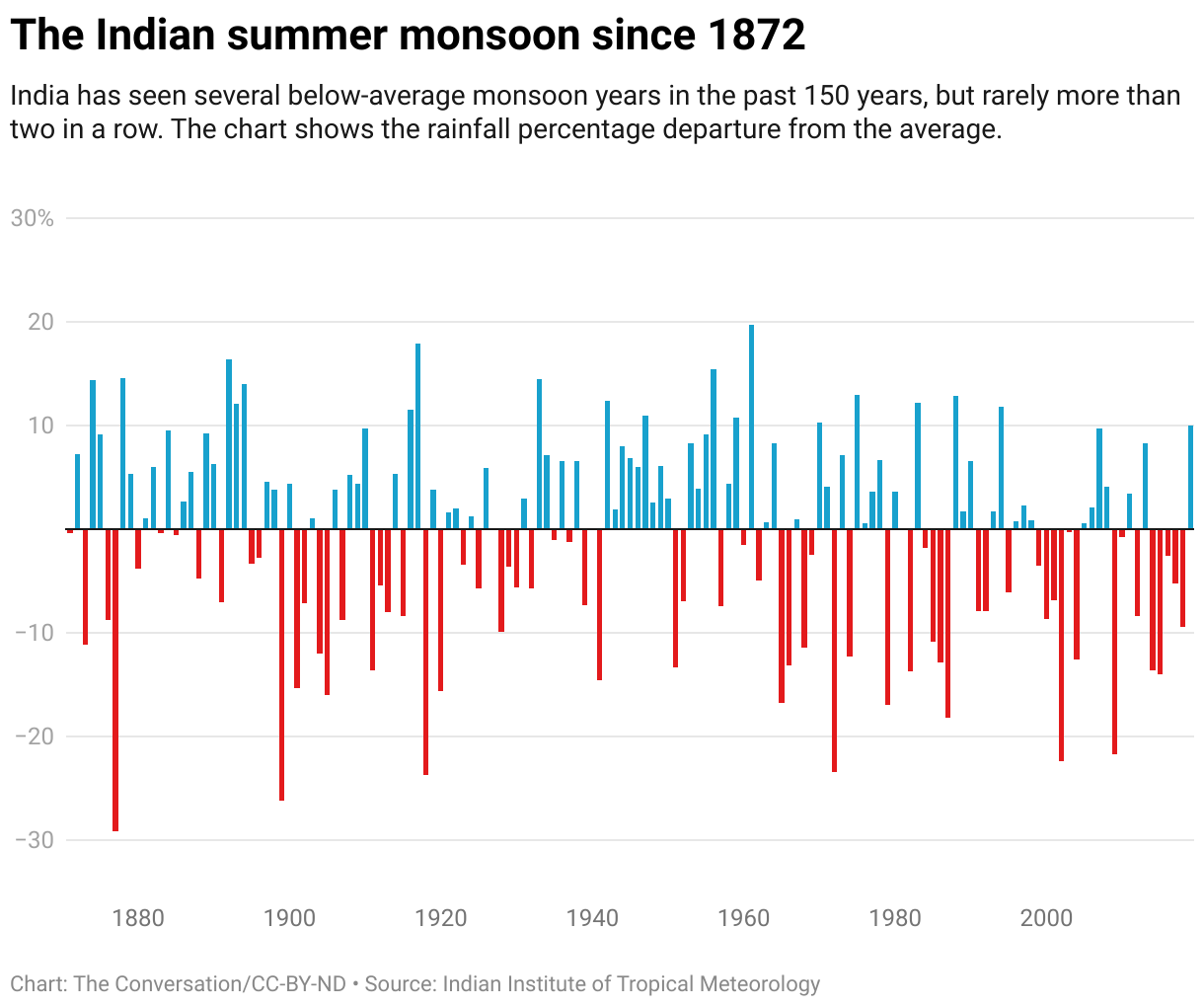
Scientists began systematically measuring India’s monsoon rainfall with instruments around the 1870s. Since then, India has experienced about 27 regionally widespread droughts. Among them, only one – 1985 to 1987 – was a three-year consecutive drought or worse.
The apparent stability of the Indian monsoon in that data might lead one to surmise that neither protracted droughts lasting multiple years nor frequent droughts are intrinsic aspects of its variability. This seemingly reassuring view currently informs the region’s present-day water resource infrastructure.
However, the stalagmite evidence of prolonged, severe droughts over the past 1,000 years paints a different picture.
It indicates that the short instrumental period does not capture the full range of Indian monsoon variability. It also raises questions about the region’s current water resources, sustainability and mitigation policies that discount the possibility of protracted droughts in the future.
Timeline of major societal and geopolitical changes in India and the oxygen isotope record from Mawmluh cave. Gayatri Kathayat
How do stalagmites capture a region’s monsoon history?
To reconstruct past variations in rainfall, we analyzed stalagmites from Mawmluh cave, near the town of Cherrapunji in the state of Meghalaya – one of the wettest locations in the world.
Stalagmites are conelike structures that grow slowly from the ground up, typically at a rate of about one millimeter every 10 years. Trapped within their growth layers are minute amounts of uranium and other elements that were acquired as rainwater infiltrated the rocks and soil above the cave. Over time, uranium trapped in stalagmites decays into thorium at a predictable pace, so we can figure out the age of each stalagmite growth layer by measuring the ratio of uranium to thorium.
The oxygen in rainwater molecules comes in two primary types of isotopes – heavy and light. As stalagmites grow, they lock into their structure the oxygen isotope ratios of the percolating rainwater that seeps into the cave. Subtle variations in this ratio can arise from a range of climatic conditions at the time the rainwater originally fell.
Stalagmite formation are marked inside Mawmluh Cave, where the new study was based. Gayatri Kathayat
A cross-section of a stalagmite shows differences in its ring formation as climate conditions changed. Gayatri Kathayat
Our previous research in this area showed that variations in oxygen isotope ratios in rainwater, and consequently, in stalagmites, track changes in the relative abundance of different moisture sources that contribute to summer monsoon rainfall.
During years when monsoon circulation is weak, rainfall here is primarily derived from the moisture that evaporated from the nearby Arabian Sea. During strong monsoon years, however, atmospheric circulation brings copious amounts of moisture to this area all the way from the southern Indian Ocean.
The two moisture sources have quite different oxygen isotope signatures, and this ratio is faithfully preserved in the stalagmites. We can use this clue to learn about the overall strength of the monsoon intensity at the time the stalagmite formed. We pieced together the monsoon rainfall history by extracting minute amounts of calcium carbonate from its growth rings and then measuring the oxygen isotope ratios. To anchor our climate record to precise calendar years, we measured the uranium and thorium ratio.
Stalagmites grow from the ground, and stalactites grow from above. These are in Mawmluh Cave, where the authors conducted their research. Gayatri Kathayat.
Next steps
The paleoclimate records can usually tell what, where and when something happened. But often, they alone cannot answer why or how something happened.
Our new study shows that protracted droughts frequently occurred during the past millennia, but we do not have a good understanding of why the monsoon failed in those years. Similar studies using Himalayan ice cores, tree rings and other caves have also detected protracted droughts but face the same challenge.
In the next phase of our study, we are teaming up with climate modelers to conduct coordinated proxy-modeling studies that we hope will offer more insight into the climate dynamics that triggered and sustained such extended periods of drought during the past millennium.
ooOOoo
So there we are. Droughts are a thing of the ancient past. But only a partial understanding for why the monsoons failed is known. Despite these modern times with so much general access to knowledge there are still things that we do not know!
Finally, one hopes that the next phase of their study will be along in reasonable time! I would love to report on it.
This article was written by Professor Shuang-Ye Wu. It is very good.
Professor Wu is the Professor of Geology and Environmental Geosciences at the University of Dayton, USA.
Looking back on America’s summer of heat, floods and climate change: Welcome to the new abnormal!
Much of the South and Southern Plains faced a dangerous heat wave in July 2022, with highs well over 100 degrees for several days. Brandon Bell/Getty Images
The summer of 2022 started with a historic flood in Montana, brought on by heavy rain and melting snow, that tore up roads and caused large areas of Yellowstone National Park to be evacuated.
In between, wildfires raged through California, Arizona and New Mexico on the background of a megadrought in Southwestern U.S. that has been more severe than anything the region has experienced in at least 1,200 years. Near Albuquerque, New Mexico, a five-mile stretch of the Rio Grande ran dry for the first time in 40 years. Persistent heat waves lingered over many parts of the country, setting temperature records.
The United States is hardly alone in its share of climate disasters.
In Pakistan, record monsoon rains inundated more than one-third of the country, killing over 1,500 people. In India and China, prolonged heat waves and droughts dried up rivers, disrupted power grids and threatened food security for billions of people.
In Europe, heat waves set record temperatures in Britain and other places, leading to severe droughts and wildfires in many parts of the continent. In South Africa, torrential rains brought flooding and mudslides that killed more than 400 people. The summer may have come to an end on the calendar, but climate disasters will surely continue.
This isn’t just a freak summer: Over the years, such extreme events are occurring in increasing frequency and intensity.
Climate change is intensifying these disasters
The most recent international climate assessment from the United Nations’ Intergovernmental Panel on Climate Change found significant increases in both the frequency and intensity of extreme temperature and precipitation events, leading to more droughts and floods.
A recent study published in the scientific journal Nature found that extreme flooding and droughts are also getting deadlier and more expensive, despite an improving capacity to manage climate risks. This is because these extreme events, enhanced by climate change, often exceed the designed levels of such management strategies.
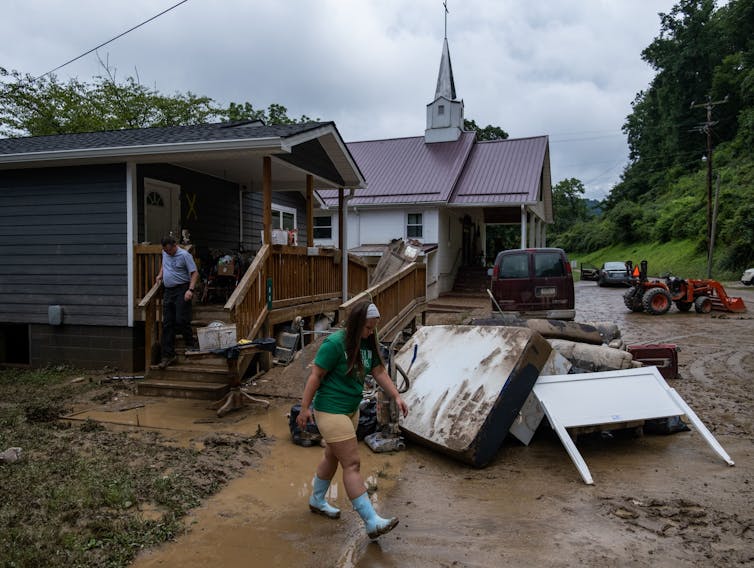
Flash flooding swept through mountain valleys in eastern Kentucky in July 2022, killing more than three dozen people. It was one of several destructive flash floods. Seth Herald/AFP via Getty Images
Extreme events, by definition, occur rarely. A 100-year flood has a 1% chance of happening in any given year. So, when such events occur with increasing frequency and intensity, they are a clear indication of a changing climate state.
The term “global warming” can sometimes be misleading, as it seems to suggest that as humans put more heat-trapping greenhouse gases into the atmosphere, the world is going to get a bit warmer everywhere. What it fails to convey is that warming temperatures also lead to a more violent world with more extreme climate disasters, as we saw this past summer.
Climate models showed these risks were coming
Much of this is well-understood and consistently reproduced by climate models.
As the climate warms, a shift in temperature distribution leads to more extremes. The magnitudes of changes in extreme temperature are often larger than changes in the mean. For example, globally, a 1 degree Celsius increase in annual average temperature is associated with 1.2 C to 1.9 C (2.1 Fahrenheit to 3.4 F) of increase in the annual maximum temperature.
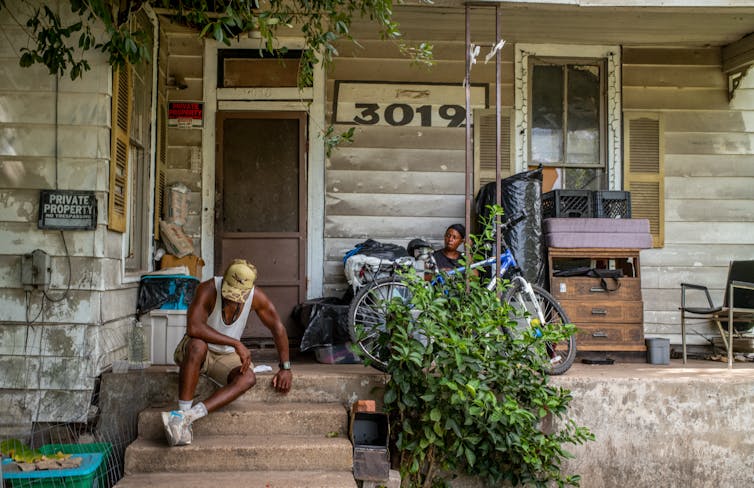
Heat waves, like the heat dome over the South in July 2022, can hit outdoor workers especially hard. Brandon Bell/Getty Images
In addition, global warming causes changes in the vertical profile of the atmosphere and equator-to-pole temperature gradients, leading to changes in how the atmosphere and ocean move. The temperature difference between equator and the poles is the driving force for global wind. As the polar regions warm at much higher rates then the equator, the reduced temperature difference causes a weakening of global winds and leads to a more meandering jet stream.
Some of these changes can create conditions such as persistent high-pressure systems and atmosphere blocking that favor more frequent and more intense heat waves. The heat domes over the Southern Plains and South in June and the West in September are examples.
The initial warming can be further amplified by positive feedbacks. For example, warming increases snow melt, exposing dark soil underneath, which absorbs more heat than snow, further enhancing the warming.
Warming of the atmosphere also increases its capacity to hold water vapor, which is a strong greenhouse gas. Therefore, more water vapor in the air leads to more warming. Higher temperatures tend to dry out the soil, and less soil moisture reduces the land’s heat capacity, making it easier to heat up.
These positive feedbacks further intensify the initial warming, leading to more heat extremes. More frequent and persistent heat waves lead to excessive evaporation, combined with decreased precipitation in some regions, causing more severe droughts and more frequent wildfires.
This increased humidity leads to heavier rainfall events. In addition, storm systems are fueled by latent heat, or the large amount of energy released when water vapor condenses to liquid water. Increased moisture content in the atmosphere also enhances latent heat in storm systems, increasing their intensity. Extreme heavy or persistent rainfall leads to increased flooding and landslides, with devastating social and economic consequences.
Even though it’s difficult to link specific extreme events directly to climate change, when these supposedly rare events occur with increasing frequency in a warming world, it is hard to ignore the changing state of our climate.
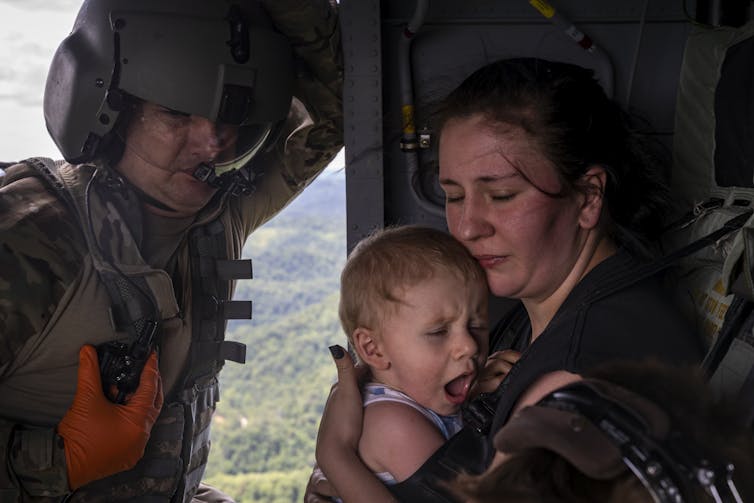
A family had to be airlifted from their home in eastern Kentucky after it was surrounded by floodwater in July 2022. Michael Swensen/Getty Images
The new abnormal
So this past summer might just provide a glimpse of our near future, as these extreme climate events become more frequent.
To say this is the new “normal,” though, is misleading. It suggests that we have reached a new stable state, and that is far from the truth.
Without serious effort to curb greenhouse gas emissions, this trend toward more extreme events will continue. Things will keep getting worse, and this past summer will become the norm a few years or decades down the road – and eventually, it will seem mild, like one of those “nice summers” we look back on fondly with nostalgia.
There is growing evidence that things are really changing globally. I used to say that I would be dead before the impacts of climate change really hit home. As in, it would be a good twenty years before things really took a hold. But it is now much more likely that the next five years are going to see a continuation of the changes and that there isn’t time to hang around.
I may not be as sharp as I used to be but the changing climate will affect me and Jean and all those in our area. Will our leaders grasp this nettle now? I wish I knew.
On this occasion it was the loss of our Pedi that had hearts ‘speaking’.
When it comes to dogs millions of people open their hearts to the love that exists between a dog and a dog’s close human. And I am not sure that I have cracked it yet; I know what is felt but putting it into words is more difficult.
So I shall turn to Jess and the guest post she sent to me. But just before sending me the story of Scruffy Jess sent me this email: “Sorry for the loss. Dogs have always been an important part of my life. I’ve cried like a baby every time I lost one. Truly man’s best friend. “
ooOOoo
Scruffy is getting up there in years and it breaks my heart to even think of losing him. He’s been my best friend for the past twelve years. He does everything that I do.
I never paint in my studio that he isn’t there beside me.
He will be 13 in February. I only hope that I can get a couple more years out of him. He is one of those special dogs. If someone said, “If there was one thing you would change about Scruffy, what would it be?” The only thing in this world I would change about him is to give him a longer life.
He minds me better than my kids ever minded and I’ve never laid an angry hand on him. I talk to him like I would a human, and he seems to understand everything that I say. I just bought another Schnauzer puppy, only four months old, hoping that some of Scruffy will rub off on him as he grows up. So far Scruffy is not too happy about sharing me with another dog, but hopefully time will change that.
So this is Scruffy at age 12. He still is full of life.
oooo
And this is Tux below, because of the Tuxedo that he always wears. He’s also a Miniature Schnauzer, but in an exotic color, and he has one blue eye that I love!
Yes, you should get another puppy to fill the hole in your heart. It seems, you are never sorry about it! You guys have a wonderful day! JESS










 Learning from Dogs