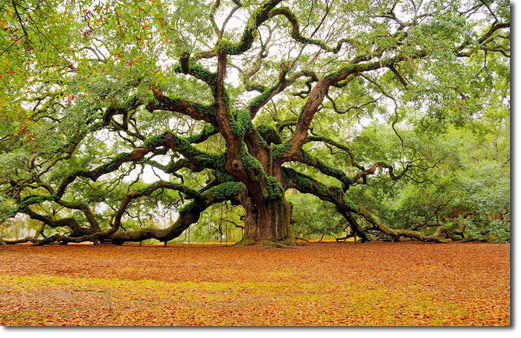
Our truths, our home, our serenity; all flow from stillness.
Soon silence will have passed into legend. Man has turned his back on silence. Day after day he invents machines and devices that increase noise and distract humanity from the essence of life, contemplation, meditation.
As is often the way, a number of disparate items came together for today’s post in a way of lovely connectivity.
A few weeks ago when meeting our local doctor for the first time since we moved to Oregon, I had grumbled about bouts of terrible short-term memory recall and more or less had shrugged my shoulders in resignation that there was nothing one could do: it was just part of getting older, I guessed!
“On the contrary”, responded Dr. Hurd, continuing, “There’s growing evidence that our information-crowded lives: cell phones; email; constant TV; constant news, is pumping too much for our brains to manage.”
Dr. Hurd continued, “Think about it! Our brains have to process every single sensory stimulus. The research is suggesting that our brains are being over-loaded and then the brain just dumps the excess data. If that is the case, and the evidence is pointing in that direction, then try thirty minutes of meditation each day; give your brain a chance to rest.”
So that was the first revelation.
The second was a recent science programme on the BBC under the Horizon series. The programme was called, The Truth About Personality.
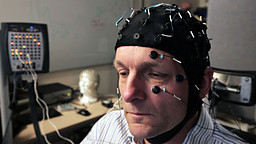
Michael Mosley’s brain being measured.
Michael Mosley explores the latest science about how our personalities are created – and whether they can be changed.
Despite appearances, Mosley is a pessimist who constantly frets about the future. He wants to worry less and become more of an optimist.
He tries out two techniques to change this aspect of his personality – with surprising results.
And he travels to the frontiers of genetics and neuroscience to find out about the forces that shape all our personalities.
Within the programme came the astounding fact that even ten minutes a day meditation can help the brain achieve a more balanced personality (balance in terms of not being overly negative in one’s thoughts).
The third revelation came from Jean and me watching a TED Talk last night. Just 14 minutes long, please watch it – you will be transformed!
Published on Jul 17, 2013
More and more people worldwide are living in countries not considered their own. Writer Pico Iyer — who himself has three or four “origins” — meditates on the meaning of home, the joy of traveling and the serenity of standing still.
Then, just three days ago, John Hurlburt, a long-time supporter and regular contributor to Learning from Dogs, emailed me his reflection on meditation. John quickly gave permission for it to be published here.
oooOOOooo
The stillness of evening.
Evening Meditation
Our world is increasingly spiritually, morally, mentally, physically and economically bankrupt. Many people would like to change the world one way or another. Most don’t really know why. Some folks simply don’t care. The idea is to leave life a bit better than we found it when we were born.
The fact is we’re all intrinsically sacred in a universe we didn’t create. We tend to prioritize illusion and delusion above reality. Playing God is a precursor of evil. A supreme faith in Money is self contradictory and ultimately fatal. Arrogance compounds the problem.
We connect in unified awareness through serene meditation. We experience harmony within an emerging celestial symphony. Answers flow from the inside out as we surrender to the eternal energy flow.
Be still and know…
an old lamplighter
oooOOOooo
Finally, after having a real struggle to find the place, both psychologically and physically, where I could start my own relationship with meditation, on Wednesday afternoon, when walking the quarter-mile up to our mail-box, it struck me as obvious.
Embraced by nature.
This quiet place on our creek where the water trickles down from an old flood irrigation dam. Somewhere to sit under the shade of a tree, somewhere to be still, somewhere as perfect a home as anyone could ever find.
Meditation is the dissolution of thoughts in Eternal awareness or Pure consciousness without objectification, knowing without thinking, merging finitude in infinity.
A beautifully written, soul-stirring account of strife, darkness, hope and, above all, love shared between dog and human.
Gracious, I don’t know where to start! Guess at the beginning.
Which was that a little over a month ago, I received this email:
Dear Paul:
I hope this note finds you well. We were in touch several years about Racing in the Rain, and I wanted to get in touch about another dog-related novel that may be of interest to you and your readers.
I am working with Forge Books to set up a blog tour for Andrea Thalasinos, whose novel Traveling Light hits bookshelves and e-readers on July 16th. Traveling Light is an inspiring story about fate, family, and healing; it also explores the special bond that exists between humans and canines.
Now I well remembered the book Racing in the Rain, writing about it in May 2011 and then a guest post from the author, Garth Stein, in September under the title of A game called Fetch.
Wiley included in his email a “flavour” of Andrea Thalasinos’ novel, as in:
Paula Makaikis is ashamed of her marriage. Driven out of their bedroom by Roger’s compulsive hoarding, she has spent the past ten years sleeping downstairs on her husband’s ratty couch. Distant and uninspired, Paula is more concerned with the robins landing on her office window ledge than her hard-earned position at the university. Until a phone call changes everything.
A homeless Greek man is dying in a Queens hospital and Paula is asked to come and translate. The old man tells her of his beloved dog, Fotis, who bit a police officer when they were separated. Paula has never considered adopting a dog, but she promises the man that she will rescue Fotis and find him a good home. But when Fotis enters her life she finds a companion she can’t live without. Suddenly Paula has a dog, a brand-new Ford Escape, an eight-week leave of absence, and a plan.
So Fotis and Paula begin the longest drive of their lives. In northern Minnesota, something compels her to answer a help-wanted ad for a wildlife rehabilitation center. Soon Paula is holding an eagle in her hands, and the experience leaves her changed forever.
Traveling Light explores what is possible when we cut the ties that hold us down and the heart is free to soar.
Of course, I wanted to read and review Andrea’s book. Wiley and I agreed that a review published on the 18th July, i.e. today, would be perfect. However, for reasons not entirely clear, the review copy of the book didn’t arrive until July 10th; just 8 days ago. That made it too tight for me to read in that time, so I gave the book to Jean for her to read first.
If I tell you that Jean devoured the book and had it finished in three days, you won’t get a better idea than that of how moving and captivating she found it. At the time of writing this post (9am yesterday) I was already up to page 160. So the review that follows a little later in today’s post is the combined feelings of Jean and me.
One of the other things that Wiley offered was for Andrea to write a guest post for Learning from Dogs. That now follows! I checked with Wiley: This is a true account from Andrea. (Trust me, you will be entranced!)
oooOOOooo
Andrea and Panda.
We’d come up to the edge of a wooden bridge that had almost as much space between the boards as the width of the boards themselves. Snow ordinarily covered the iffy-looking surfaces of such bridges, but the strength March’s early sun had melted clear down to the wood, leaving a full view of the snowy rocks in the creek bed below.
At the time, I didn’t know what my lead dog, Gorky, a red Siberian yearling (tiny in stature by Siberian standards) would do. From a puppy, she’d had more confidence in her furry little toe than I had in my whole body.
The dog positioned the team at the edge of the bridge and paused. She looked around, sniffing the wind, looking to the other side and then down through the slats into the creek bed below. I could tell she was thinking, calculating risks, odds and whether or not she had the moxie to cross. The other six dogs (including her father), were hooked up to the gangline behind her and by the set of their shoulders, their hedging and shirking back in their harnesses I could tell they were nervous.
It was a narrow trail, just wide enough for one dog team. Two more experienced teams were closing in from behind and I wondered what we would do. Rock walls butted up to either side of the trail, making it impossible to either turn around or move off the trail to let the others pass. I’d considered leading my dog team down into the gully, but the drop-off looked steep and as a rookie musher, I didn’t trust my skills to do so safely.
“Fifty bucks says she won’t take it,” the approaching musher called out from behind.
Thinking I’d be out the fifty before I could say boo, Gorky stepped up to the edge. Her body language changed. She’d committed to taking the bridge. As the red dog leaned into her harness, she gave the forward cue. The others fell in line, following her calm, forward gait with no signs of wavering.
After her first step I noticed that not once did Gorky look down, but rather kept her eye on the other side of the bridge as if she were already there.
Whenever I have to make difficult decisions, I think back to this moment. Sometimes I don’t have enough information or am waiting for some cosmic gut-affirmation that never seems to arrive when I need it. But one thing is clear. Like Gorky, once I set my mind on a course of action, I think of her and act.
Who knows if she was scared or not—she never said. The red dog lived to be 15 ½ and taught me more about not second-guessing than any person, place or thing I’ve come across since. Being brave doesn’t mean you’re not scared, it just means you do it anyway.
oooOOOooo
Traveling Light, a novel by Andrea Thalasinos
The opening of the book, In The Beginning, more of a prologue than anything else, firmly sets the context. For we read that the heroine of the story, Paula Makaikis, is tipped out of what is a highly unsatisfactory marriage into “the longest drive of her life” by a phone call from Celeste, Paula’s best friend.
The drive comes out of the tragic death of an old Greek man who pleads, in his last few breaths, that Paula takes his dog, Fotis, before the pound puts the dog to sleep.
If I tell you that by page 71, I had been brought to tears on two occasions then you will understand the depth of feeling that Andrea conveys: about life; about love; and the precious nature of a dog called Fotis .
This book, even as a work of fiction, seems to reach out to the reader, well to this reader anyway, with many messages of what life is all about. Take this for example, from page 104:
Paula few out of the Holland Tunnel into the early colors of the morning. Gas pedal depressed, windows open, her hair blowing, the faster she accelerated the better she felt. Getting up to eighty, then ninety, she thought maybe the wind would whisk her thoughts away.
Jersey was a blur except for periodic traffic congestion; Pennsylvania went on like a past life. The faster she drove, the clearer the sense that there was somewhere she needed to be. It wasn’t California or New York. It wasn’t a place. The map was nothing but lines, numbers, destinations. Wherever she was meant to be, she’d know it when she got there.
How many of us have shaken off our troubles as a dog shakes off water from its coat and ended up coming to a place and knowing that we were at the place we were meant to be!
In many ways, the book is a lovely fairy-tale, right up to the perfect ending. But in so many other ways the book is a reminder that we only have one life. Easy to say but less easy to embrace fully with heart and head. In fact, the book reinforces something that I wrote as a private letter to a family member in consequence of my sister’s recent death. I will share just a portion of that letter because I sense Andrea Thalasinos would love to see how her book reaches out to her readers.
Be clear about the purpose of life: your life. Do not put off what brings meaning, truth and happiness. Not even for a day. Live your beautiful life now; live it this day.
Thus for both Jean and me, this was the most beautiful of books and both of us have no hesitation in strongly recommending it.
Big thanks to Wiley Saichek for giving Jean and me the opportunity to read Traveling Light.
oooOOOooo
Now here’s an offer.
Wiley has offered a free copy of Andrea’s book as a ‘give-away’ from Learning from Dogs. Here’s the plan.
Would you like to write a story about any aspect of the relationship that dogs can have with humans?
Any length, truth or fiction; it doesn’t matter. Email your story to me (learningfromdogs (at) gmail (dot) com) to be received by the end of Wednesday, 31st July 2013, Pacific Daylight Time.
Then during the early part of August, I will publish every one received with some mechanism for readers to ‘score’ the stories and the winning author will be sent a free copy of the book.
*** If you are not into introspection, then look away and come back tomorrow! 😉 ***
Regular readers will know that quite frequently I write under a topic heading that could be regarded as within the classification of key subjects of our time. You know, such subjects as big government, big money, big power, and even climate change! 😉
Why has this been the case?
Well, because, a) most of my life I’ve tried to stay abreast of ‘current affairs’ and, b) within the broad label of ‘integrity’ it’s relevant to this blog. The sub-heading of the blog is after all: “Dogs are integrous animals. We have much to learn from them.” (Yes, I do know ‘integrous’ isn’t grammatically accurate! – Any suggestions for an alternative word?)
Stay with that while I go elsewhere.
Yesterday (Tuesday) a number of events ended up having a profound effect on me. On the face of it, utterly disconnected events.
The first was a post from Alex Jones on his blog The Liberated Way. The only common ground between Alex and me is that we both know Colchester in Essex, England. Alex because he lives there today, me because I used to have a business in Colchester in previous times. Other than that just a couple of bloggers separated by thousands of miles.
Anyway, the post was this one: Cycle of Life. Alex wrote:
Life seems like a cycle of birth, living and death.
I have the honour of following awesome bloggers on WordPress. I learn inspirational teachings from their intimate life experiences that they share with their readers. The cycle, for in my belief everything moves in cycles, of birth, life and death is if we are attentive to living life something we will often be reminded of in our interactions with others and nature.
Then later, adding:
Lijiun is a Buddhist who shares daily experiences from their own life with a Buddhist theme running through their blog. Lijiun has a cat called Little White who often acts as a teacher to them about the meaning of life and a reminder of Buddhist teachings. Little White two weeks ago brought home a stray kitten, which it adopted as like a surrogate parent. Yesterday Adik the kitten died, and a beautiful blog post by Lijiun in memory of Adik reminds us life is impermanent.
Almost absent-mindedly, I clicked on the link about the death of Adik and …… was shaken to my core; shaken by the power of the truth. I want to give you more than a link to the post – want to share some of the beautiful words.
IN MEMORY OF “ADIK”…
In memory of our little Kitten, “adik”….
Every moment in life is full of changes, this is a law of nature.
However, sometimes we might assume that everything unchanged.
“Adik”- Our stray kitten, so far, she was not showing a sign of sickness. Yesterday, in the evening, I discovered she was laid down under my neighbor car, not moving at all and look severe sick. We checked through her little body, no physical injuries and we tried our best to feed her water and Cat food. She refuse to take.
We need to send her to Veterinarian immediately as her condition was critical, however during Sunday, especially evening time. Most of the Veterinarian clinic is closed. We did our best to check through internet, we were able to locate one of the Vet and we rushed over.
In the journey, we played Mantra Chanting to our little kitten, We reached to the vet clinic, “Adik” was alive but in agony…. she was struggling for life. The only thing we can help was to keep chanting mantra, our only aspiration are for her to relieve from suffering, not to reborn in 3 lower realm, able to follow spiritual practice and attain enlightenment in the coming life.
“Adik” passed away in peace even before the Veterinarian came to treat her.
Then Lijiun went on to write that “This incident gave me a very clear insight on “death” and offered more of that insight: (These are extracts: Please read the full post.)
1. Impermanence Of life
Nothing is permanence , we need to live at now, not past or future.
When Death approached, no bargain time at all whether you are rich or poor, you are ready or not, you are healthy or sick, …
Do all good deeds when you are still alive, Follow spiritual path whenever you can, don’t give excuses that “I’ve plenty of time, I’ll do it when I am “FREE”? When You are Free, you might not able to do it…
2. Young or old…
Some of us, might assume that people died in old age. As such, we’ve a long journey in life.
Is It true???
I learned from “Adik” Sudden death – that death will happen in any age.
“Coffin is not meant for elderly people….” This is so profound.
Spend time with your family members, be filial piety to your parent, Pursuit your dream, Don’t wait until later day…. We are unsure we can survive until later day!
3. Breathing in & Out
Treasure every breath in & breath out…
Life is just in between Breath in & out.
Be Mindfulness in life!
4. What Can you bring???
What can you bring after death, “NOTHING”.
No matter, how much wealth, how much money, how many cars, how many bungalow, how high is your position, how lovely is your family… you can’t bring anything..
Ask yourself, “What is the purpose of life?”, “What do you want?”
5. Alone..
You, yourself need to face the death moment…
Nobody can help you… Don’t avoid the topic and say, “It’ll not happen to me so soon”..
Just get ready.
6. Love
“Adik” passed away at 8:30 pm.. according to my mom, Little White, Our lovely cat was “Meowing” loudly at home. He can sense that “Adik” was not longer around. Animals are just like us, they are loving. Please treat all beings well, no differentiation on form.
We are so touched that “Adik” came home before her death and spend her last moment with us.
Before we sent “Adik” to Vet, She “Meow” loudly to my mom as a good-bye & gratitude to my mom for taking care of her. It’s so touching!
Thank you to “Adik” for celebrating 16 happy day with us and leave behind a great lesson to us.
May “Adik” be relieved from suffering, not reborn in 3 lower realm and find the lasting happiness!
May all beings be Well and Happy!
Then also yesterday, I was chatting to someone who lives close to us; he and his partner-lady have become good friends. He was bemoaning the corruption of so much of his fine country and went on to say that the only way that he could function was to turn away from the big stuff, have no TV, ignore the constant news of this and that, the endless trials and tribulations in this world of ours. I listened in silence, only to find later that the words must have left a mark on me.
My dear friend, Dan Gomez, has known me for over 40 years. He was my Best Man at my wedding to Jean in November, 2010. He and I have been exchanging emails about the truth of the role of man in the raising of the temperature of the planet. I sent Dan the link to the death of Adik, the kitten. It seemed so much more important than the emails we had been exchanging about the ‘big’ subjects in life.
Then something happened overnight (Tuesday/Wednesday) because not long after I got to my PC this morning, I sent this email to Dan.
Dear Dan,
Yesterday was one of those days, one of those rare days I should have said, where my view of life was radically changed.
Partly because I’m still adjusting to Corinne’s death [my sister], partly because of something I read elsewhere, and other stuff best left for a phone call.
In essence, despite my anger at what is going on around us (big government, big money, big power, even climate change!) I want to retreat from these areas and focus on what is most valuable to me.
Aspects of my life such as love, friendship with ‘old’ travelers, the natural world, being in the present, community, our animals (especially Pharaoh who is over 10), my writings, my book, our small world here at 4000 Hugo; you get my drift!
I’m 70 in November, 2014. Corinne died in her 80th year. Time goes so quickly. No, life goes so quickly. Jean and I met 6 years ago this next December. I must turn away from the things over which I have little or no control and embrace the present. Just what dogs do so well. Live in the present.
It’s all about endeavouring to come to the end of one’s life hearing those immortal words of Edith Piaf, “Je regret rien.”
So dear reader of Learning from Dogs, if you are still ‘on frequency’ – Well done! You have stuck with my very long ramble!
Back to what gets written about in this place. If integrity means anything, it means I’m going to drop all the ‘big’ topics and focus entirely on what man can learn, nay, has to learn from dogs. Indeed, will close by republishing the full ‘home’ page below.
Pharaoh – just being a dog!
Dogs live in the present – they just are! Dogs make the best of each moment uncluttered by the sorts of complex fears and feelings that we humans have. They don’t judge, they simply take the world around them at face value. Yet they have been part of man’s world for an unimaginable time, at least 30,000 years. That makes the domesticated dog the longest animal companion to man, by far!
As man’s companion, protector and helper, history suggests that dogs were critically important in man achieving success as a hunter-gatherer. Dogs ‘teaching’ man to be so successful a hunter enabled evolution, some 20,000 years later, to farming, thence the long journey to modern man. But in the last, say 100 years, that farming spirit has become corrupted to the point where we see the planet’s plant and mineral resources as infinite. Mankind is close to the edge of extinction, literally and spiritually.
Dogs know better, much better! Time again for man to learn from dogs!
I first met Chris many years ago when he was working for a French educational college with the name of ISUGA, based in Quimper, France. As a result of being introduced to Chris, I had the very good fortune of becoming a guest teacher at ISUGA.
Classroom picture taken at ISUGA.
Anyway, Chris has his own blog Nemo Insular Est. If the title doesn’t immediately say very much to you, try Chris’ sub-title: Truth, Justice, Sanity & Brotherhood.
Thus it is with great pleasure I offer this guest post from Chris.
oooOOOooo
In Defence of “Politics”
by Chris Snuggs.
The most depressing thing I ever heard at school was: “I’m not interested in politics.” Even at the age of 10, this seemed to me bizarre, for politics is at the heart of everything. It decides what we can eat, how much money we have, what sort of shelter we have, health, education, defence, what it takes to get locked up, EVERYTHING – including in the USA of course gun control …….
“Politics” completely arranges the environment of our existence, within which we can be individuals and lead some kind of “private life”, but nothing can function in a civilised manner without politics.
There is only one circumstance I can imagine when the statement: “I’m not interested in politics.” might possibly be justified, and that is if you lived in a society where everything was perfect: no injustice, hunger, or discomfort; excellent health, education, shelter and sustenance in a peaceful environment with nothing to worry about ….
There remains a niggling doubt about whether such a society would be just a teensy bit boring. However, the point is, has there ever been one? Does anyone KNOW one? Are they accepting immigrants?
If we accept that politics decides everything, then there are certain conclusions to be drawn. If it is so fundamentally important, is it not then legitimate to oblige everyone to vote, as they do in Australia for example? Then again, is it acceptable that we so easily tolerate as “democracy” elections where only 30% of eligible voters actually vote? And is it acceptable that the teaching of “politics” and all it involves holds such little place in our schools?
I would say “NO!!” And in fact, the study of politics involves so many branches of knowledge. You can’t (or shouldn’t) be taught “politics” without teaching psychology. Why is X saying that? What are his motivations? What is the psychology of voting groups. Or without studying logic, so as to recognize false arguments, of which there is no lack. You need to study what evidence is, since a political policy should be based on evidence, not fantasy or demagoguery.
In fact, just as politics decides everything then a study of politics involves just about every branch of knowledge, too. You cannot vote sensibly for party X which wants to build zillions of windfarms or go full-steam ahead on shale-fracking if you don’t have a reasonable understanding of the science, and of course environmental consequences. You can’t sensibly vote for or against grammar schools without a sound knowledge of the social and psychological rationale behind them or indeed of their history. The same applies to religion of course, and almost any other area you care to mention.
No, politics as a subject of study, discussion and involvement is vastly undervalued in our society. And the fact that politicians are often venal and incompetent liars is not a reason to be LESS interested in politics but a compelling reason to be MORE involved!! If you don’t get informed and involved, the politicians will do it THEIR way, and you have to ask yourself one final question: Do you REALLY trust them to do it in YOUR interests?
Back last November, not long after Jean and I had moved up to Oregon, I saw this on the PRI website: The Sufficiency Economy – Envisioning a Prosperous Way Down. Very quickly I realised the importance of the essay and contacted the author requesting permission to republish on Learning from Dogs. That author was Dr. Samuel Alexander and permission was quickly given, leading to two essays: The simpler life and Where less is so much more.
Now fast forward to nearly a month ago and in came this email:
Samuel Alexander here, from the Simplicity Institute. I’ve recently published a new book, Entropia: Life Beyond Industrial Civilisation. Was wondering whether you were interested in posting either a review or an excerpt on your website?
I was flattered to have been asked and delighted to review the book.
First, some background. Dr. Alexander is a part-time lecturer with the Office for Environmental Programs, University of Melbourne, Australia. He teaches a course called ‘Consumerism and the Growth Paradigm: Interdisciplinary Perspectives’ in the Masters of Environment.
After the review was completed, I forwarded it to Sam just to check that I hadn’t made any technical errors. Within Sam’s reply to that email was his acknowledgement that his book fell into a genre that was not easily classified. Ergo, the book being fiction yet not a novel. Sam went on to muse that perhaps he should have been clearer about what the reader was going to get. He wondered if my review should mention that aspect. I said that I wouldn’t amend my review but would include an introduction to that effect, as now witnessed!
So to the review. (Note: For some reason, I was unable to prevent the paragraph spacing from being deleted in the published version. Hence the insertion of a single ‘-‘ after each paragraph.)
oooOOOooo
Entropia – Life Beyond Industrial Civilisation by Samuel Alexander
–
A review by Paul Handover
–
The title of the book didn’t offer this reader any clue about what might be coming. Nevertheless, very soon an experience of an ‘ah-ha’ moment arrived. Right on page one of the Acknowledgements when this sentence jumped off the page: “Henry Thoreau has been by far the greatest influence on my worldview, for it was he who awakened me to the insight that ‘superfluous wealth can buy superfluities only’.” [my emphasis] Wow, what an intriguing turn of phrase about wealth.
–
I plunged into the Prologue:
After the poets were banished from Plato’s Republic it is said that they set sail into unknown horizons in search of a new place to call home.
–
Shortly later reading:
But life proceeds in twists and turns, not straight lines. After losing consciousness in the midst of this perfect storm, the lost poets found themselves washed ashore on a small,fertile island, which was uninhabited and isolated entirely from the rest of civilisation. The boundless opportunities presented by this merciful twist of fate were immediately clear to all.
–
Some people believe this simple living community flourishes peacefully to this day, lost to the world in its own harmonious, aesthetic existence. But like Atlantis, the Isle of Furor Poeticus, as it has come to be known, has never been found.
* * *
The Isle of Furor Poeticus is a utopian romance of course – a myth. But we should remember that human existence has always been shaped and guided by myths and stories, so let us not dismiss the story of the lost poets too quickly or proudly. After all, we may not be so free from superstitions of our own. Modernity’s ‘myth of progress’ might itself just be a story we have been telling ourselves in recent centuries, one in fact that could soon be dismissed as a story no longer worth telling. Indeed, perhaps that book is closing before our very eyes – has already closed – leaving us to reflect on its themes from beyond as we step forth into unknown pages. And yet, it seems we have not found a new story by which to live. We are the generation in-between stories, desperately clinging to yesterday’s story but uncertain of tomorrow’s. Adrift in the cosmos, without a narrative in which to lay down new roots, humanity marches on – lost and directionless. But then again, perhaps the new words we need are already with us. Perhaps we just need to live them into existence.
–
Beautiful, magical writing right up to the closing sentences of the Prologue:
By choosing to do so we could again become the poets of our own lives and of a new generation, instead of merely reading out a pre-written script to an audience that is no longer listening. So open your mind, gentle reader, for the future is but clay in the hands of our imaginations.
–
We are being called to make things new. [again, my emphasis]
–
The novel, for it is a work of fiction, opens in substance with the account of Mortimer Flynn, a wealthy Texas oil magnate and son and only child of a Welsh coal industrialist, who having achieved “everything of which he had ever dreamed” comes to the realisation that he has no idea at all as to the purpose of his life. From this life-changing reassessment of his journey, his profound crisis of conscious, comes the purpose of the book. A story of a group of people who settle down in a remote South Pacific island, the island of Entropia. A “story about a community that became isolated on its small island in the wake of industrial civilisation’s collapse, during the third decade of the twenty-first century.”
–
Now, it’s fair to say that at this point I was truly hooked on the book. This was going to be the read of my life. Because it reflected my own belief that humanity was at the point, perhaps beyond the point, where the growing threats to our natural world threatened our moral obligations to the generations that follow.
–
However, somewhere during the second chapter, the style of writing started to intrude into my absorption of the story. At first the intrusion was more like a fly buzzing around; a minor irritation. Then it got to the stage where I had to stop reading and ponder on why I felt so uncomfortable with this reading experience. I was by now well into the third chapter.
–
Still couldn’t put my finger on what the problem was. Returned to the book but noticed that I was skim reading and had forcibly to focus on fully reading each page. After all, I was reading the book for review purposes!
–
Then it struck me. There were no characters coming to life off the page. Consequently, there was no dialogue. It didn’t read like a novel, much more like a report. That was the key to me re-establishing my relationship with the story; the book. Because despite the unusual style for a work of fiction, the value inherent in the pages was beyond measure. Here was a book that described in great detail the way a community discovered the reality of a sustainable way of life. How this group of a couple of thousand souls reinvented a society, a sustainable society, out of the ashes of a failed industrial civilisation.
–
I read on.
–
Later on the book described how the community looked at the way they governed themselves, how they set up representative systems and then, on page 119, came something that really punched me in the face, figuratively speaking. It was introduced, thus:
Eventually a short constitutional document was drafted by the Advisory Council and put to a referendum by the People’s Council, and this document received 94 per cent support. It is reproduced in its entirety below, as it serves as the best summary of our social, economic and political vision.
–
And proceeded:
Charter of the Deep Future
ENOUGH, FOR EVERYONE, FOREVER
.
We affirm that providing ‘enough, for everyone, forever’ is
the defining objective of our economy, which we seek to
achieve by working together in free association.
.
We affirm that everyone is free to create as an aesthetic
project the meaning of their own lives, while acknowledging
that this freedom legitimately extends only so far as others
can have the same freedom. Freedom thus implies restraint.
.
We affirm that our inclusive democracy does not
discriminate on such grounds as race, ethnicity, gender,
age, sexuality, politics, or faith.
.
We affirm that generations into the deep future are entitled
to the same freedoms as present generations.
.
We affirm that respecting the deep future requires maintaining
a healthy environment.
.
We affirm that technology can help to protect our
environment only if it is governed by an ethics of sufficiency,
not an ethics of growth. Efficiency without sufficiency is lost.
.
We affirm that maintaining a healthy environment requires
creating a stationary state economy that operates within
environmental and energy limits.
.
We affirm that a stationary state means stabilising
consumption and population, transitioning to renewable
sources of energy, and adapting to reduced energy supply.
.
We affirm that strict limits on material accumulation are
required if a stationary state is to maintain a just distribution
of resources and avoid corrosive inequalities.
.
We affirm that property rights are justifiable only to the
extent they serve the common good, including the overriding
interests of humanitarian and ecological justice.
.
We affirm that a stationary state economy depends on a
culture that embraces lifestyles of material sufficiency and
rejects lifestyles of material affluence.
.
We affirm that material sufficiency in a free society provides
the conditions for an infinite variety of meaningful, happy,
and fulfilling lives.
___________________________
–
Well that had such an impact on this reader. For this reason. The contrast between the reality of our present 21st Century life and the lives of those souls on Entropia was like night versus day. Enough, For everyone, Forever. If ever we needed a new cry from the heart, a new cry of hope and purpose, it was now and those are the words of that cry.
–
Entropia is a book you should read. It is a book that offers much hope, much guidance and much direction. As Samuel Alexander wrote on page 148, “Tranquillity and angst are both contagious, so it matters which of them we feed.”
Why the choice of this sub-heading? Well, just because a number of quite separate articles and essays have come together to offer a powerful, cohesive argument for reconsidering the role of Nature in the future of mankind.
Of course, my use of words in that preceding sentence is completely ludicrous; the suggestion that ‘Nature’ is disconnected from ‘mankind’. Yet millions of us, to a greater or lesser degree, do behave as if we are the masters of the world.
So let me dip into what has been ‘crossing my desk’ in recent times.
On May 28th, George Monbiot published in The Guardian newspaper an essay entitled A Manifesto for Rewilding the World. (The link takes you to the article on the Monbiot blogsite.) Here’s how that essay opened,
Until modern humans arrived, every continent except Antarctica possessed a megafauna. In the Americas, alongside mastodons, mammoths, four-tusked and spiral-tusked elephants, there was a beaver the size of a black bear: eight feet from nose to tail(1). There were giant bison weighing two tonnes, which carried horns seven feet across(2).
The short-faced bear stood thirteen feet in its hind socks(3). One hypothesis maintains that its astonishing size and shocking armoury of teeth and claws are the hallmarks of a specialist scavenger: it specialised in driving giant lions and sabretooth cats off their prey(4). The Argentine roc (Argentavis magnificens) had a wingspan of 26 feet(5). Sabretooth salmon nine feet long migrated up Pacific coast rivers(6).
During the previous interglacial period, Britain and Europe contained much of the megafauna we now associate with the tropics: forest elephants, rhinos, hippos, lions and hyaenas. The elephants, rhinos and hippos were driven into southern Europe by the ice, then exterminated around 40,000 years ago when modern humans arrived(7,8,9). Lions and hyaenas persisted: lions hunted reindeer across the frozen wastes of Britain until 11,000 years ago(10, 11). The distribution of these animals has little to do with temperature: only where they co-evolved with humans and learnt to fear them did they survive.
I’m not going to reproduce the bulk of the article; just hoped that I have tickled your curiousity sufficient for you to read it in full here. But will just show you how it closed:
Despite the best efforts of governments, farmers and conservationists, nature is already beginning to return. One estimate suggests that two thirds of the previously-forested parts of the US have reforested, as farming and logging have retreated, especially from the eastern half of the country(23). Another proposes that by 2030 farmers on the European Continent (though not in Britain, where no major shift is expected) will vacate around 30 million hectares (75 million acres), roughly the size of Poland(24). While the mesofauna is already beginning to spread back across Europe, land areas of this size could perhaps permit the reintroduction of some of our lost megafauna. Why should Europe not have a Serengeti or two?
Above all, rewilding offers a positive environmentalism. Environmentalists have long known what they are against; now we can explain what we are for. It introduces hope where hope seemed absent. It offers us a chance to replace our silent spring with a raucous summer.
Then further research for this post brought to light an interview with David Suzuki in February. Widely reported, I picked the version published on Straight.com, from which comes:
In December, Canadian specialty TV channel Business News Network interviewed me about the climate summit in Copenhagen. My six-minute interview followed a five-minute live report from Copenhagen, about poor countries demanding more money to address climate change and rich countries pleading a lack of resources. Before and after those spots were all kinds of reports on the Dow Jones Industrial Average, the price of gold and the loonie, and the implications of some new phone technology.
For me, this brought into sharp focus the inevitable failure of our negotiating efforts on climate change. BNN, like the New York-based Bloomberg channel, is a 24-hour-a-day network focused completely on business. These networks indicate that the economy is our top priority. And at Copenhagen, money dominated the discussions and the outcome.
But where is the 24-hour network dealing with the biosphere? As biological creatures, we depend on clean air, clean water, clean soil, clean energy, and biodiversity for our well-being and survival. Surely protecting those fundamental needs should be our top priority and should dominate our thinking and the way we live. After all, we are animals and our biological dependence on the biosphere for our most basic needs should be obvious.
The economy is a human construct, not a force of nature like entropy, gravity, or the speed of light or our biological makeup. It makes no sense to elevate the economy above the things that keep us alive. But that’s what our prime minister does when he claims we can’t even try to meet the Kyoto targets because that might have a detrimental effect on the economy.
This economic system is built on exploiting raw materials from the biosphere and dumping the waste back into the biosphere. And conventional economics dismisses all the “services” that nature performs to keep the planet habitable for animals like us as “externalities”. As long as economic considerations trump all other factors in our decisions, we will never work our way out of the problems we’ve created.
Concluding:
Nature is our home. Nature provides our most fundamental needs. Nature dictates limits. If we are striving for a truly sustainable future, we have to subordinate our activities to the limits that come from nature. We know how much carbon dioxide can be reabsorbed by all the green things in the oceans and on land, and we know we are exceeding those limits. That’s why carbon is building up in the atmosphere. So our goal is clear. All of humanity must find a way to keep emissions below the limits imposed by the biosphere.
The only equitable course is to determine the acceptable level of emissions on a global per capita basis. Those who fall below the line should be compensated for their small carbon footprint while those who are far above should be assessed accordingly. But the economy must be aligned with the limits imposed by the biosphere, not above them.
Quite clearly, if we continue to turn our backs on Nature, the consequences won’t be long in tapping us on the shoulder.
So, going to close it today with this, seen nearly a month ago on the PRI website:
Imagine the type of world we could see
If instead of saying ‘pray,’ we said, ‘plant a tree’.
With this one little change so much more could be done
To protect all living things found under the sun.
We could ‘plant a tree’ for our troops sent away into war
So when they return they’d come home to find more.
We could ‘plant a tree’ at our churches with our husband or wife
To praise the Creator through a celebration of life.
We could ‘plant a tree’ for the needy and for those with no food
We could even plant in public without seeming rude.
The government would not have to introduce rules,
And most likely we could ‘plant a tree’ at our schools.
If we took it to task to ‘plant trees’ for the poorest,
We would all soon be reaping the wealth of a forest.
We could plant freely with those of all religions and creeds,
The improvement of earth would be based on these deeds.
We could plant with our neighbours, our family, and friends,
And ‘plant a tree’ with our enemies to help make amends.
If we ‘plant a tree’ for the sick to show them we care,
We would also be healing the soil, water, and air.
We could ‘plant a tree’ to observe when two people wed,
And plant one with our kids each night before bed.
Throughout the history of the whole human race
We find respect for the ‘tree’ has always had a place.
The great Ash of the Norse was their tree of the World,
And on a tree in the Garden is where the serpent once curled.
It was in groves of Oaks that the Druid priests wandered,
And under the Bodhi where the great Buddha pondered.
In the Bible it’s clear that we have all that we need:
‘All the trees with their fruits and plants yielding seed’.
Despite all these lessons that the past has taught
Now days, it seems, we cut our trees without thought.
This is confirmed by the Koran, for in it we read:
‘Many are the marvels of earth, yet we pay them no heed’.
We all have a duty, no matter what nation
To perform our part in protecting Creation.
Just think what we’d have if we had picked up a spade
Every time each one of us bowed our heads and prayed.
Professor Mark Cochrane’s perspective on ‘certainty’!
I’m an avid follower of Mike Stasse’s blog Damn the Matrix. So it was rather fortuitous that two days ago there was a guest post on Mike’s blog from Mark Cochrane. Dr. Mark Cochrane is a Senior Scientist and Professor at South Dakota State University where one can read:
Dr. Mark Cochrane conducts interdisciplinary work combining ecology , remote sensing, and other fields of study to provide a landscape perspective of the dynamic processes involved in land-cover change. He is an expert on wildfire, documenting the characteristics, behavior and severe effects of fire in tropical and temperate forests that are inherent to current systems of human land-use and management. His research focuses on understanding spatial patterns, interactions and synergisms between the multiple physical and biological factors that affect ecosystems. Recently published work has emphasized the climate change, human dimensions of land-cover change and the potential for sustainable development.
Another guest post by Mark Cochrane…… and I hope Guy reads this, I’d like his feedback, no pun intended!
Mark Cochrane
I’ve been asked by several people to address the take of climate ‘doomists’ like McPherson and indicate how my views on what the science indicates differ. First, let me just say that my differences with the doomist views are similar to my differences with the ‘denialist’ views, namely one of actually examining the scientific findings and concluding what they signify versus beginning with a conclusion and looking for evidence to support a pre-concluded viewpoint.
Appropriate use of science (or any information), requires weighing anything being newly reported against the rest of the accumulated evidence on a subject (e.g. climate change) that we have amassed, to date, and using this knowledge to infer the most probable meaning and significance. How credible is the source, how relevant are the results to the larger question, do the new results substantially change our previous understanding? If someone is presenting new ideas that claim to massively shift what we think we know about the world, have they been vetted (e.g. peer-reviewed), do they adequately explain how their new claims better explain observed phenomena than previous studies did and also detail why previous explanations were somehow erroneous? If the results are truly stunning, can they be replicated by others? Although some may find it hard to believe, there is a lot of space between climate denial and climate doom.
I’ve only seen the one talk now by McPherson but where the ‘we are doomed and soon’ meme falls apart is on general logic. You cannot say, there are positive feedbacks A, B and C, therefore life on Earth is suddenly going to end without considering:
what are the current rates of those feedbacks,
what is the rate of change for the feedback,
what is the area affected by the feedback,
what natural limits exist for the feedback,
what negative feedbacks might occur in response?
If you listen to McPherson’s talk, what you get is a litany of disturbing findings, especially feedbacks, and then an expectation that you must reach the same conclusion that we are doomed, and soon. If someone would like to outline the chain of logic used, I’d be happy to discuss it. Even if you accept the chain of logic though, where, in any of it, is there evidence for the timeline being suggested?
Guy McPherson
There is considerable amount of concern about the feedbacks in the Arctic, with good reason, but people do things like linking the large amount of carbon stocks in the Arctic with rapid warming, with increased rates of release, with increased rates of warming……with the obvious end of all life on Earth – near-term extinction!
As anyone who has followed this thread knows, I am usually the one pointing out feedbacks and how most are not even included in current climate projections, in contradiction to those who claim such dire projections are all because of such feedbacks (which ‘skeptics’ claim don’t exist). This does not mean though that the existence of feedbacks means that we can then make the leap to a runaway greenhouse that will soon lead us to having the climate of Venus (atmospheric acid bath at temperatures that would melt lead). Perhaps providing some perspective on the recent material posted about the NASA CARVE project and what it means for all of that carbon in the (not so) permafrost will help.
“Over hundreds of millennia, Arctic permafrost soils have accumulated vast stores of organic carbon – an estimated 1,400 to 1,850 petagrams of it (a petagram is 2.2 trillion pounds, or 1 billion metric tons). That’s about half of all the estimated organic carbon stored in Earth’s soils. In comparison, about 350 petagrams of carbon have been emitted from all fossil-fuel combustion and human activities since 1850. Most of this carbon is located in thaw-vulnerable topsoils within 10 feet (3 meters) of the surface.”
“Permafrost soils are warming even faster than Arctic air temperatures – as much as 2.7 to 4.5 degrees Fahrenheit (1.5 to 2.5 degrees Celsius) in just the past 30 years,” Miller said. “As heat from Earth’s surface penetrates into permafrost, it threatens to mobilize these organic carbon reservoirs and release them into the atmosphere as carbon dioxide and methane, upsetting the Arctic’s carbon balance and greatly exacerbating global warming.”
In other words, there is 4-5 times as much carbon sitting around in those frozen soils as we have already emitted that are becoming increasingly vulnerable to being thawed out for a portion of each year.
Once those soils thaw they become accessible to microorganisms that feed on the incompletely decomposed plant materials that they contain. If there is sufficient oxygen (warm relatively dry Arctic) the process is faster and the product is CO2, if the process is anaerobic (warm relatively wet Arctic), then the product is methane.
So warming leads to thawing, thawing leads to microbial decomposition, and microbial activity leads to carbon emissions. These emissions are a positive feedback that makes the current process of greenhouse gas warming worse since each degree of warming yields more greenhouse gases that speed up the warming process further. This is where the message of doom goes off the tracks and extrapolates erroneously that this somehow means that all of that carbon is going to suddenly find itself in the atmosphere.
Three meters (10ft) of soil carbon doesn’t just suddenly evaporate into the atmosphere in the next few years. Thawing permafrost is not synonymous with melting carbon. Even once permafrost melts, it is still very cold. However, bacteria can start digesting it – until it freezes again. Melted permafrost does not mean permanently melted. The surface layer of the Arctic lands are already in the active layer that temporarily thaws each year and then refreezes. Now, we are making more of the Arctic soil active to greater depths and at higher latitudes. This means that there will be more emissions from those soils.
Taken out of context snippets like this (below) from that NASA press piece can be made to sound catastrophic.
“Some of the methane and carbon dioxide concentrations we’ve measured have been large, and we’re seeing very different patterns from what models suggest,” Miller said. “We saw large, regional-scale episodic bursts of higher-than-normal carbon dioxide and methane in interior Alaska and across the North Slope during the spring thaw, and they lasted until after the fall refreeze. To cite another example, in July 2012 we saw methane levels over swamps in the Innoko Wilderness that were 650 parts per billion higher than normal background levels. That’s similar to what you might find in a large city.”
Parsing the quote, please note that “episodic bursts of higher-than-normal carbon dioxide and methane” in two locations (regions) does not mean the end is nigh. Higher-than-normal is just that, but how much higher and how long did it last? The scientists are saying that the observations do not match existing ‘models’ (models are wrong, a favorite meme), it doesn’t mean that such events haven’t been happening up until now (only that we didn’t know about them). As for the 650ppb increase over a swamp, that equates to being 1/3 higher than the background level. Methane and swamps go together so some higher level is to be expected. The question is if and by how much 650ppb is higher than it would have been back around 1980 or so? If it used to be 10ppb higher than background then you have a big change (640ppb), however, if it used to be 640ppb, then not so much (10ppb difference). Even if that is all new carbon being emitted, the local change becomes very small when diluted globally. The point here is not to poo-poo the findings or the scientist’s work, they are doing very important stuff (!), it is to provide context.
Just how bad could things be? I do not work in the high Arctic but I do work in similar organic soils in the tropics (peat swamps) where, because of intentional draining, the several meter thick peat layer that is ‘active’ is increased in an analogous manner to the effects of melting permafrost. Microbial degradation is occurring, with the difference that the temperature is very warm instead of being very cold. Think of how fast fruit spoils in your refrigerator versus on a hot window sill. In these tropical peat soils we see large amounts of CO2 coming off into the atmosphere each year now, but even with such large rates of loss, this equates to taking about 20-25 years to lose 1 meter of organic soil. In the Arctic the microbial degradation will be much slower due to the relatively low temperatures. This doesn’t mean that it is not important. Slow rates of emissions over a large area is still a lot of extra carbon going into atmosphere but this is a problem that is going to take centuries to play out, not less than a decade. It makes things worse but it doesn’t suddenly end life on Earth.
Incidentally, all of that soil carbon in the Arctic isn’t a uniform petri dish either. Some of that carbon is easier to access by bacteria than other portions. Emissions will rise quickly as the bacteria chew through the cellulose, for example, but things like lignin get left behind. The point being that even for a given mass of carbon in the ‘active’ layer, there will be a dampening of the emissions growth rate as the quality of the bacteria buffet goes down when it gets picked over.
I do not pretend to know what the motivations of ‘doomists’ are, whether it be honest despair or simple misunderstanding but they are conveying the same message of do nothing as those who deny the existence or importance of climate change. Denial = don’t worry be happy, while Doom = don’t worry, you can’t do anything about it anyway. Both viewpoints are wrong in trying to turn climate change into a false dichotomy of either fantasy or inevitability. Both the science and our choices are much more complicated. It’s uncomfortable but your choices do matter now and for generations to come. There is no ‘fixing’ things at this point but you still have the ability to choose how you react to the predicament we have created. Doom and denial are respectively trying to tell you that you either have no choice or no need to choose. But, as Philip K. Dick wrote:
“Reality is that which, when you stop believing in it, doesn’t go away.”
I read a recent article posted by Rob Hopkins on the Transition Culture blogsite, a blog that I subscribe to. Those who are unfamiliar with Rob, the Transition Culture site has his background, from which I quote this snippet:
Rob Hopkins, with a familiar Totnes building in the background.
“Rob Hopkins brings humour, imagination and vision to the great challenges of our time, and argues that what is needed, above all else, at this time in history, is “engaged optimism”. The rapidly-spreading Transition movement which he was pivotal in establishing, is an embodiment of that. Nicholas Crane, presenter of BBC2’s recent ‘Town’ series, recently referred to Transition as “the biggest urban brainwave of the century”.
Anyway, back to the article. It struck me as so absurd that I tried my hand at asking Rob for permission to republish. Back, almost immediately, came his positive reply. Thank you, Rob.
Oh, and before going to Rob’s article, for those that, like me, are a bit rusty on the composition of the G8, here’s a Wikipedia extract:
The Group of Eight (G8) is a forum for the governments of the world’s eight wealthiest countries. The forum originated with a 1975 summit hosted by France that brought together representatives of six governments: France, West Germany, Italy, Japan, the United Kingdom, and the United States, thus leading to the name Group of Six or G6. The summit became known as the Group of Seven or G7 the following year with the addition of Canada. The G7, that is active even after the creation of the G8, is composed by 7 of 8 of the wealthiest countries on Earth (as net wealth and not GDP). In 1997, Russia was added to the group which then became known as the G8. The European Union is represented within the G8 but cannot host or chair summits.
Now without any further ado, here is that article.
oooOOOooo
12 Jun 2013
Why even the G8 prefer vibrant, diverse local economies really …
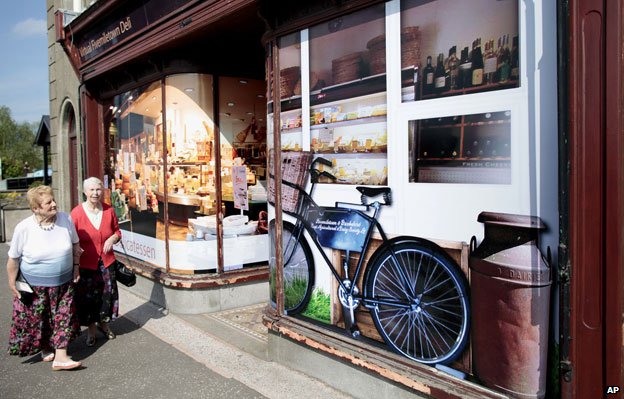
If there was one picture that captured the times we are living through it is this. It appeared on the BBC website recently with the following caption:
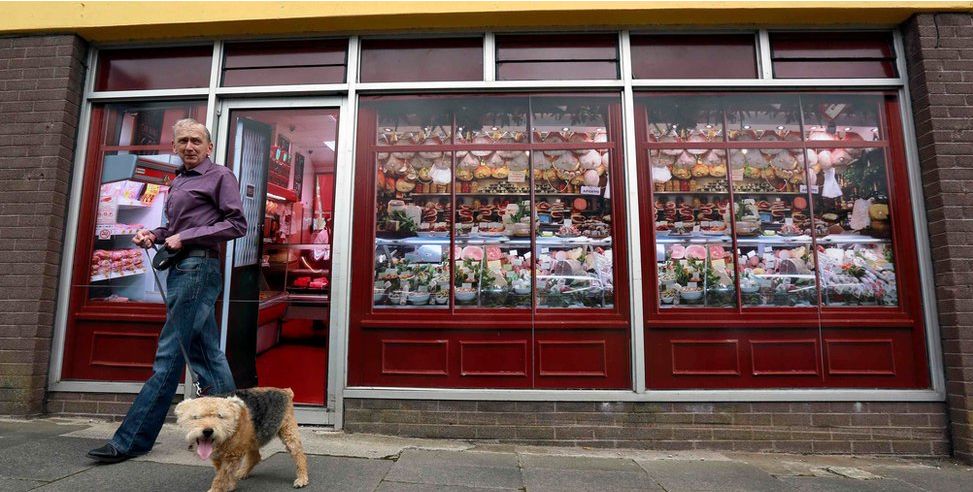
Kevin McGuire walks his dog past a vacant shop in Belcoo, Northern Ireland. The empty shop is one of a number that have had graphics placed on the windows to make them look like working shops ahead of the G8 summit which takes place nearby later this month.
Let’s take that a bit more slowly. Here is a shop, one of many that has gone out of business due, among other things, to the growth-fixated policies of the G8, situated in a place G8 ministers will be driven past en route to their summit. Rather than their being able to see how things are actually unfolding in the real world, the division and misery being caused by their approach to the economy, the windows have been plastered with stickers that present it as a fully-stocked, thriving shop. As singer/comic Mitch Benn put it on BBC Radio 4′s The Now Show on Friday, ”the last thing you’d want would be for a bunch of people meeting to fix the economy to see how bad the economy’s got”.
County Fermanagh’s district council sanctioned the fake retail units as part of a £1m makeover before it hosts the G8 summit. The event takes place on 17 and 18 June at the Lough Erne golf resort near Enniskillen. The chief executive of Fermanagh District Council has defended the optical illusion.
“It was aimed at undeveloped sites at the entrance to the town and then right throughout the county in terms of the other towns and villages, looking at those vacant properties and really just trying to make them look better and more aesthetically pleasing,” says Brendan Hegarty
Here’s the thing that fascinated me most though. It’s the kind of shop they chose to portray it as. They didn’t print up large stickers that would present the shop as being a Tesco Metro, a Sainsbury’s Local, an Aldi perhaps, or even branch of one of the banks that contributed significantly to our getting into this mess in the first place. They didn’t make one huge sticker, one false façade, that showed a new shopping precinct, glittering with all the usual chain stores that dominate every such precinct. Or a Travelodge perhaps. Rather they set out deliberately and in considerable detail to portray the kind of vibrant, local, independent business that has either become extinct, or which survives in spite of, rather than because of, the policies of the G8. Here’s another one…
The windows are hung with delicious-looking hams, the display features meats and a whole range of delicious local produce, beautifully arranged. Although the cut-and-paste nature of the graphic design rather gives the game away (the same arrangements of hams appear two or three times), what they are trying to portray here is that most endangered of species, the local, independent butcher.
In the mid-1990s there were 22,000 butchers in the UK, by 2010 there were just 6,553. The independent butcher is making something of a spirited fightback though, although certainly not aided, in any sense, by the G8. The butcher that would have occupied that shop no longer exists, most likely because a supermarket opened nearby and completely shifted the balance of the Belcoo economy (any readers from Belcoo who might like to write in and tell us what led to this shop’s demise would be most welcome).
The other day I spoke to Nick Sherwood of REconomy Herefordshire, who has co-ordinated the Herefordshire Economic Evaluation (the second such piece of work, the Totnes one already being published, and Brixton’s coming soon). Our conversation will be published here soon, but one of the things that really struck me was the following:
We estimate that the top five major supermarkets in Herefordshire account for between 71% – 83% of all household expenditure on ‘brought home’ food and drink, or up to £180m annually. In addition, around £30m per year is spent in the smaller ‘chain’ supermarkets.
Their conclusion is that the true ‘local spend’ figure, i.e through local, independent businesses in Herefordshire, could be around 16% of the total. In terms of a national version of that figure, the best I can find is the figure from the Portas Review that states that 8,000 supermarkets now account for over 97% of all UK grocery sales. Although clearly other smaller supermarkets account for some of the remaining sales, let’s assume, for argument’s sake, that nationally, 3% of what we spend on groceries goes out through local and independent businesses.
I would imagine that everyone seeks an economy that is able to provide jobs, economic activity, stronger and happier communities and community resilience, while also skilfully reducing its carbon emissions on the scale required. The question of our times though, as far as I’m concerned, is whether that is best achieved by expanding the 97% of our economy currently dominated by huge supermarkets, the kinds of enterprise that the UK government and the G8 see as leading the push for growth, or protecting and enhancing the 3%?
It’s a vital question, because at the moment the push to eradicate the 3% altogether, or at least squeeze it a lot harder, continues apace. Yet that 3% is better suited to meeting those core needs of ours. As the recent report by Localise West Midlands on ‘community economic development’ states:
Our research has found strong evidence that local economies with higher levels of SMEs and local ownership perform better in terms of employment growth (especially disadvantaged and peripheral areas), the local multiplier effect, social and economic inclusion, income redistribution, health, civic engagement and well-being than places heavily reliant on inward investment where there are fewer, larger, remotely owned employers.
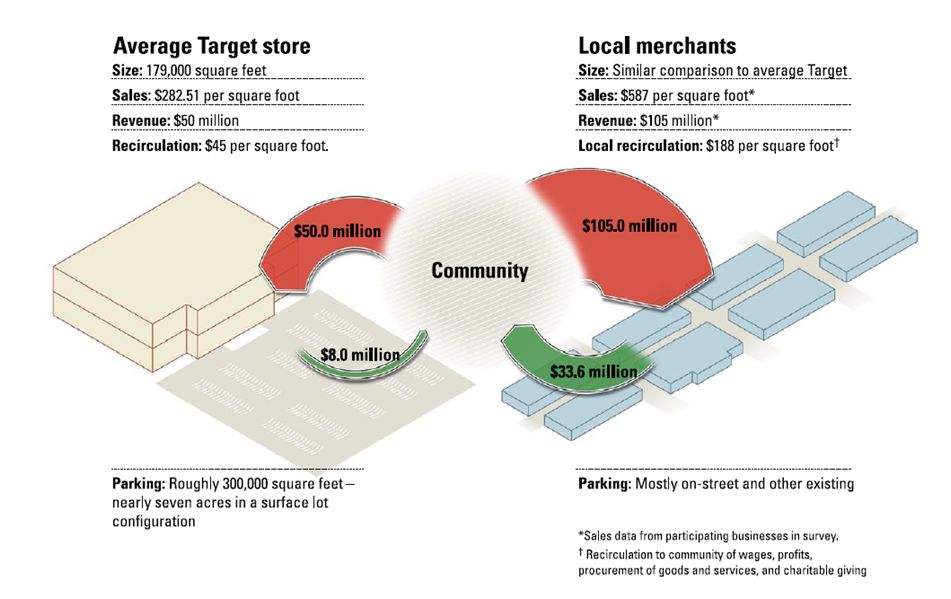
A study focusing on New Orleans compared 179,000 square feet of retail space that is home to 100 independent businesses to the same-sized space that is home to a single supermarket. The former generated $105 million in sales with $34 million staying in the local economy, while the latter generated $50 million in sales with just $8 million staying locally, and necessitated 300,000 square feet of parking space (see graphic below).
Santander’s ‘Market of Hope’ which I wrote about here last year is a great example of how a city can be fed by looking at large retail spaces in such a way that they boost and support the local independent economy rather than undermine it. When Sir Terry Leahy, CEO of Tesco, was asked whether there was any alternative to supermarkets, replied:
“… queueing at one store than trudging down Watford High Street in the rain to another shop … is this what people actually want to go back to?”
But no, it’s not about “going back”, rather about going forward in a way that meets our needs rather than those of the City of London. What we now know is that even G8 ministers would rather pass through High Streets populated with small, independent butchers, bakers, grocers, would rather see shop windows overflowing with delicious food, trusting that the relationship they have built up with the shopkeeper over many years will mean that he/she stocks the best produce they can find. It feels right. It’s human scale. It makes sense. It’s an economy that is ours, it belongs to local people, to the local economy. Even G8 ministers would now appear to prefer a shopping experience that actually involves interacting with other human beings rather than wandering anonymously around a superstore and then cashing yourself out at the end.
The core argument of The Power of Just Doing Stuff, published on Friday, is that if we really want to achieve our goals of jobs, economic activity, stronger and happier communities and community resilience, while also skilfully reducing our carbon emissions on the scale required, we’d be better off focusing on growing the 3% rather than the 97%. It’s a pretty simple idea, and, to me at least, a blindingly obvious one, but that doesn’t mean it’s easy.
However, the experience is that this fightback has already begun. The explosion of new bakeries, pop-up shops, community renewable energy projects, craft breweries, independent record shops, complementary currencies and communities acquiring their own assets is already happening around us, but it needs us to get behind it, to put our shoulders, our spending power, our sheer bloody will, to making it 10%, 30% 70%. If we want a stable climate, reduced energy vulnerability, economic stability, and a healthy human culture, we really have no choice. As Maria van der Hoeven of the IEA said recently at the launch of a World Energy OutlookSpecial Report, Redrawing the Energy-Climate Map, ”the path we are currently on is more likely to result in a temperature increase of between 3.6 °C and 5.3 °C”.
Fortunately, it’s a push that is life-enhancing, thrill-generating and in which we discover a resourcefulness, a kindness and a passion in ourselves that we may have forgotten was there. I’ll leave you with a quote from the book, from Helen Cunningham of DE4 Food, a social enterprise food hub in Derbyshire that grew out of Transition Matlock. The project grew from helping a local farmer with lambing and has grown into an innovative new business:
“Never in my life did I imagine that I’d be able to bring lambs into the world! It wasn’t a skill I ever expected to have. It was such a different thing from what we were doing in the rest of our lives, and I think from then we’ve all thought “OK, we can learn these new skills, we can learn how to lamb, we can learn how to grow vegetables and learn how to do Excel Profit and Loss sheets and whatever.” I think we all just really wanted to change the way we live, and change our own personal lives and to change things and live different lives ourselves as well as a different life in our community”.
You can pre-order your copy of The Power of Just Doing Stuff here.
oooOOOooo
As has been said before, and undoubtedly will be said many times more, it really is a very strange world we live in!
Like thousands of others I have been supporting the efforts to ensure that the US Government did not proceed with the proposal to remove wolves from endangered species protection.
Wolves are the animals that enabled early man to ‘progress’ from hunter-gatherer to the life of farming, and thence to our modern world. As I write elsewhere on Learning from Dogs,
There is no hard evidence about when dogs and man came together but dogs were certainly around when man developed speech and set out from Africa, about 50,000 years ago.
So it utterly breaks my heart to republish a recent post on The Sand County, Jeremy Nathan Marks wonderful and evocative blog. Here it is, republished with Jeremy’s kind permission.
oooOOOooo
I used to believe
As some of you may have heard, late last week the Obama Administration officially delisted gray wolves from endangered species protection. This means that 40 years of wolf recovery efforts have come to an end. Wolves only occupy a tiny fraction of their former habitat and with anti-wolf governments occupying the state houses in the few places that still have wolf populations, states like Montana, Wyoming, Idaho and Wisconsin, it is hard to imagine that wolves have a bright future in the lower 48 states.
I am deeply, profoundly saddened by this decision. I have learned over time how wolves -like so many other species- just don’t register on the list of national concerns and priorities. A great many people oppose the delisting, in fact one gets the impression that the effort to remove these protections has consistently been guided by political pressures and a political agenda and not by a true commitment to a sustainable and enduring wolf recovery. I know that I am hardly alone in registering my disappointment and voice of protest.
I cannot let this sad milestone pass without acknowledging it here on this blog. If you do not like wolves -if you feel hatred or resentment towards them or are pleased at what has recently transpired, I respectfully request that you refrain from sharing your feelings here. I seldom offer any “directives” like this, but if you are a reader of this blog then you know how strongly I feel about this issue. I am sharing these thoughts because I want to not only draw attention to what has happened, but also because I feel the need to mourn it. I tremble at the thought of a United States -or a North America- without wolves. Defenders of the administration and the Department of Interior’s position will say that the United States Government is committed to protecting wolves and ensuring their future but I am afraid I see things quite differently. This is not a partisan political issue: Democratic and Republican administrations alike are behind this stance towards wolves.
I would like to share a poem which I feel is very incomplete and does not begin to adequately draw upon the well of feelings, concerns and thoughts I have on this subject. But I would be remiss I think if I did not mark what has just happened.
I used to believe
I used to believe that one day
I might live carefully, cooperatively
beside the wolves
I would go to them but respect their
space; wait for their return and tend
my garden with local mind, open my windows
When they moved off I would wait
and make a space; I would lock my guns
in bolted cabinets to honor and not to intrude
I used to believe that there was a chance
of this because there were others who saw
in wolves the same uncertainties and histories
And we, a new community, would redraw
the map, eradicate “the frontier” and perhaps
expunge that word altogether from our plans
It is ironic really how a word, a concept,
one invisible line can have more tendrils
and seeds than a weed, more pups than a pack.
–Jeremy Nathan Marks
oooOOOooo
The Center for Biological Diversity has been incredibly active in fighting for the continued protection of the wolf. The Press Release about the loss of protection is here. Do read it and do everything you can to help. PLEASE!
Let me share some of my special feelings about wolves.
Luna, the wild wolf, with Tim and Tim’s dog; taken in 2006.
Then in February this year, I wrote about Oregon and the wolf. The following picture was in that Post.
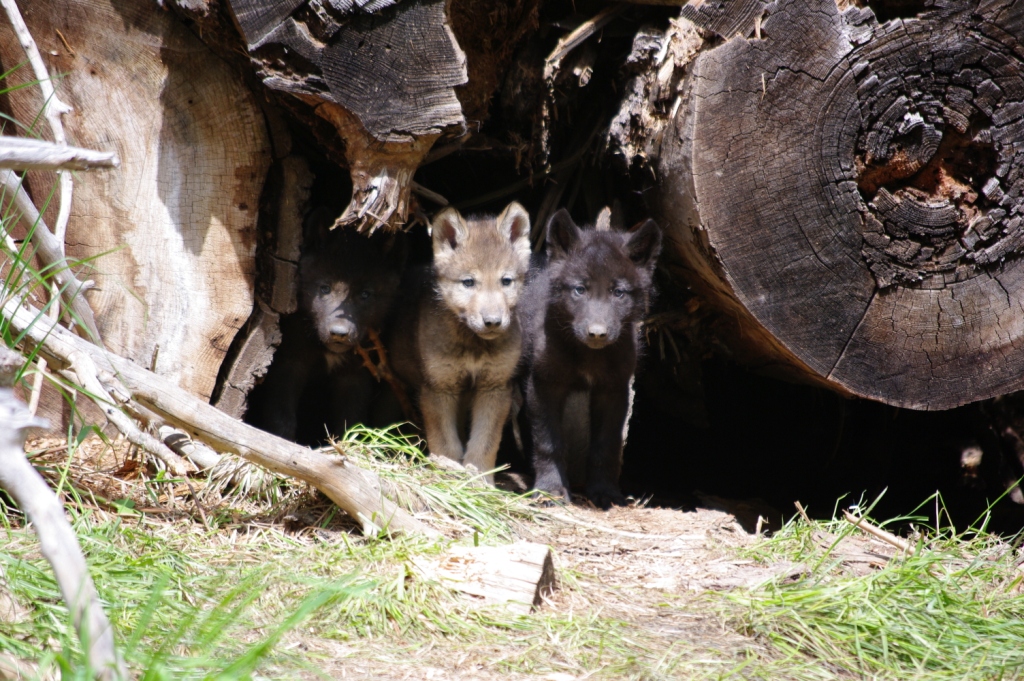
These wolf pups born to the Wenaha Pack in 2012 helped get recovery back on track. But their future remains tenuous (photo courtesy ODFW)
Please now listen to this:
So you can see that I have written frequently about wolves; indeed just a few days ago did so and included this photograph.
Wolf greets man.
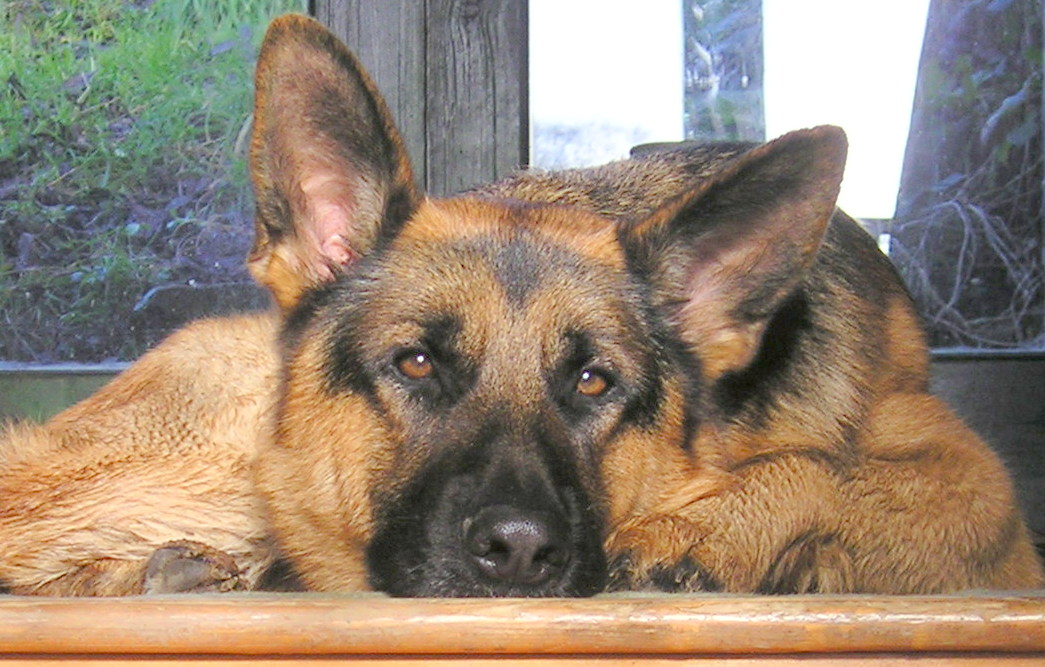
Now just look at those eyes of the Grey Wolf above and compare them to the eyes of the German Shepherd dog below and tell me that wolves aren’t as close to man as dogs.
Finally, feel free to share this post as far and wide as you can. Learning from Dogs is published under a Creative Commons License. This link covers how to share my material.
Please do something to help these ancient animals who, more than any other creature, helped put mankind ‘on the map’.
Reflections on the launch of George Monbiot’s new book Feral.
In my recent post, Dealing with Madness, where I referred to the launch of this new book there were comments from Jules that included him saying:
George is appearing at the Hay Festival to sell his book and do a talk this Saturday and it is only a few miles away so may be I will pop in and buy the book.
all the best
Jules
Jules, who has his own blog Bollocks2012, did go across to the Hay Festival and most generously agreed to write up his visit as a guest post.
So I am delighted to offer you Jules’ report today.
oooOOOooo
George at Hay
by Jules Bywater-Lees, 1st June, 2013
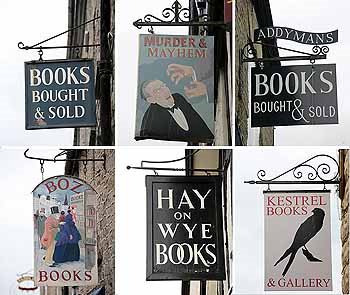
The small Welsh border town of Hay-on-Wye in Powys is just a few miles from where I live. It went from a little backwater with a failing rural economy to become, in the words of Bill Clinton, ‘the Woodstock of the mind’. All through the vision of eccentrics!
Hay-on-Wye
The town of Hay-on-Wye is pretty. It is set in the most beautiful Welsh countryside and even has its own tumble-down castle. However, back in the 70’s, like so many other small market centres, the town was in decline. That was until an eccentric bibliophile moved into the castle. The name of that eccentric was Richard Booth.
Richard Booth established a second-hand bookshop in town and, as a publicity stunt, on 1st April 1977 proclaimed himself King of Hay and Head of this new Independent Kingdom! Hay-on-Wye subsequently became a magnet for the second-hand book lover and trader, and now every other shop is a bookshop giving the town a healthy economy serving the many visitors.
Books, books and more books!
The Hay Literary Festival was devised by Norman and Peter Florence in 1988 and had become sufficiently established internationally for the highlight of Bill Clinton being a speaking guest in 2001. It is rather a corporate festival now attracting big names but the town has developed fringe events, that are both cheaper and more fun.
The reason this back story is relevant is that Hay-on-Wye has always been a gateway town between the urban English and rural Welsh. It is only a few hours drive from London and the nearest ‘wilderness’ for day trippers and holiday makers. A few miles further west and the uplands, or mountains as we call them (few are higher than 1000 feet), are considered by most people to be wild.
George Monbiot lives another 60 miles away to the West on the coast in what is considered deepest Wales where the hills have a barren beauty and the locals speak Britain’s ancient first language. But it is not all that it seems; the moors and hilltops are not natural they are a product of over-grazing. They are the degraded shells of a natural ecosystem. A shadowland; a ghostly memory of a former landscape.
View from Hay Bluff, just a few miles from Hay-on-Wye, and a powerful example of a bald hill.
Back to this year’s Festival. I coughed up the £8 ticket price and went with friends to have a day of culture. Those friends who came to hear George Monbiot speak were sceptical; for them the hills are beautiful and it is the denuded ‘wildness’ and prancing Spring lambs that gives the landscape so much value.
George makes frequent appearances on television and is very much a leading commentator on the environment and climate change, and his Guardian articles, see postscript, cover his views well so I wasn’t expecting any surprises. If anything I felt sceptical! You see while in principle I agreed with Monbiot’s message of rewilding and supportive of his views on the wide range of subjects he covers, the concept of rewilding appeared to be woolly and vague and lacking the practicalities of how this vision would be achieved. I even prepared a question for the session after his presentation.
Britain is a little country and our national parks are not the same as those elsewhere in the world, a better description would be regulated areas of private ownership. There are a few parks in Wales notable Snowdonia, which amounts to 2,200 square Kilometres (850 square miles), Brecon Beacons, 1,300 Km2 (502 SqM) and larger ones in Scotland such as the Cairngorms of 4,500 Km2 (1,737 SqM). But all of these are tiny compared to Yellowstone National Park with its 9,000 km2 (3,475 SqM and about 100 wolves!). Is it possible to have viable populations of wild animals in such a small area?
My concern is that Britain actually does have a wild landscape of both international importance and scale, with mega fauna, diversity and rare ecosystems that put it on par with the rainforest. It is truly huge with a conservative estimate of 50 to 100 thousand Km2 in area (19,305 to 38,610 square miles) but it is hidden: It is the 31,000 Km (19,260 miles) of coastline and the waters that extend from it. Surely we should be concentrating on its protection rather than allowing the hill tops to grow pretty common native woodland that could support a few hundred wolves, Lynx and beavers at best?
George live, as it were, was a lot more engaging than his appearance on telly and his spoken words a lot more passionate than his written words. I was surprised, and interested. Like all good story tellers he started off with a mystery. Why do British native trees appear to thrive when they are hacked about into hedges, why do blackthorn trees have thorns so tough and sharp they spike industrial leather gloves and why does the yew and holly have roots so extensive they could hold up a tree twice as big? The answer: Elephants!
Much of what he spoke about is found in his last three Guardian articles so I will spare you the detail but what struck me was his passion. Initially the cynic within wondered if George was just another celebrity seeking a cause. But such thoughts were dispelled as soon as George started to speak. What was communicated resonated strongly with this idealistic former self who was sufficiently passionate about nature enough to have studied zoology and yearned a human desire for wilderness and, indeed, danger but whose life has otherwise been engaged in more civilised necessities.
Such was the passion expressed by Mr. Monbiot that even I could overlook the practicalities and details; they can be sorted out when they need to be. My friends were impressed and even they were able to see that letting the hills go wild or a least a few of them would enhance their appreciation of our countryside.
But I didn’t buy a signed copy of the book! At £20 for the hardback version I thought it best to order one from my local library or at least wait for the paperback edition on Amazon.
Until modern humans arrived, every continent except Antarctica possessed a megafauna. In the Americas, alongside mastodons, mammoths, four-tusked and spiral-tusked elephants, there was a beaver the size of a black bear: eight feet from nose to tail. There were giant bison weighing two tonnes, which carried horns seven feet across.
Even before you start reading the devastating State of Nature report, published today, you get an inkling of where the problem lies. It’s illustrated in the opening pages with two dramatic photographs of upland Britain (p6). They are supposed to represent the natural glories we’re losing. In neither of them (with the exception of some distant specks of scrub and leylandii in the second) is there a tree to be seen. The many square miles they cover contain nothing but grass and dead bracken. They could scarcely provide a better illustration of our uncanny ability to miss the big picture.
The dam is beginning to crack, faster than I would have believed possible. Britain, one of the world’s most zoophobic nations, is at last considering the return of some of its extinct and charismatic mammal species.
While wolves, lynx, bears, bison, moose, boar and beavers have been spreading across the continent for decades, into countries as developed and populous as ours, and while they have been widely welcomed in those places, here we have responded to this prospect with unjustified horror.
As Edinburgh Zoo’s panda freakshow continues to captivate the witless and the infantile, a real Scottish animal has been allowed to die. Under the noses of Scottish Natural Heritage, which likes to be known as the nation’s leading conservation body, the Scottish wildcat has all but been extinguished from the Highlands. The importance of this news may be deemed worthy of a mere footnote on the schedule of important issues with which Scotland is grappling but it ought to rank much higher. For the wildcat’s demise seems to be part of the neutering and emasculating of our wildest places. That which was previously held to be a quintessential part of what Scotland was originally meant to look like and smell like and sound like is now, it seems, unimportant.
I never imagined being 52. As I grew up catching lizards and newts, rummaging through hedges to find birds’ nests, or prodding flattened hedgehogs with my scuffed Clarks lace-ups, the world was ripe with natural riches. Every scrap of wasteland revealed yet more gems: tadpoles, fox cubs and a confetti of butterflies. And when at the weekends the family Ford Anglia trundled off to the countryside, I strode in shorts into a wildlife nirvana, a utopia, and I explored what I imagined would be a never-ending world of beautiful and exotic creatures.
oooOOOooo
Finally, back to me and all I want to add is that the blogsite for more information on the book Feralis here.
So how to close? Well having given this post the title of a well-known saying, let me close with one perhaps less familiar but, boy oh boy, so relevant.
“When the oak is felled the whole forest echoes with it fall, but a hundred acorns