I do not believe that civilizations have to die because civilization is not an organism. It is a product of wills. Arnold J Toynbee
Yesterday, I explored a number of ideas around the proposition that the USA is in decline. The case is by no means clear but there does seem to be a preponderance of support for the notion that, as with all great empires, this could be an ‘end time’ for the USA.
One needs to go no further than A. J. Toynbee himself to reflect on that idea. Who was Arnold J Toynbee? Here’s his biography as presented on the Gifford Lectures website, ( Note: A fabulous series of lectures available on YouTube!)
Arnold J Toynbee
The British historian Arnold Joseph Toynbee was born in London on 14 April 1889 and died on 22 October 1975 in York, North Yorkshire, England. He was educated at Winchester College and Balliol College, Oxford. He was the nephew of economic historian Arnold Toynbee, with whom he is sometimes confused. His first marriage to Rosalind Murray, with whom he had three sons, ended in divorce in 1946. Professor Toynbee then married Veronica M. Boulter, his research assistant.
From 1919 to 1924 Arnold J. Toynbee was professor of modern Greek and Byzantine history at King’s College, London. From 1925 until 1955 Professor Toynbee served as research professor and Director of Studies at the Royal Institute of International Affairs. During both world wars he worked for the British Foreign Office. He was a delegate to the Paris Peace Conference in 1919.
While Professor Toynbee’s Gifford Lectures were published as An Historian’s Approach to Religion (1956) he is best known for his 12-volume A Study of History (1934-1961). This massive work examined the growth, development and decay of civilizations. He presented history as the rise and fall of civilizations rather than nation-states or ethnic groups. According to his analysis of civilizations the well-being of a civilization depends on its ability to deal successfully with challenges.
Professor Toynbee oversaw the publication of The Survey of International Affairs published by Oxford University Press under the auspices of the Royal Institute of International Affairs from 1925 to 1977.
A Study of History is the longest book in the English language, described in Wikipedia as, “the 12-volume magnum opus of British historian Arnold J. Toynbee, finished in 1961, in which the author traces the development and decay of all of the major world civilizations in the historical record. Toynbee applies his model to each of these civilizations, detailing the stages through which they all pass: genesis, growth, time of troubles, universal state, and disintegration.”
Back to the theme of the essay. One might propose, therefore, that a decline in the USA could be the ‘leading edge’ of a decline not only of the empire of the USA but of the whole of our present civilisation; the ‘universal rhythm of rise, flowering and decline‘.
It is axiomatic among most of our Washington elite that the United States cannot lose its preeminent global role, at least not in the foreseeable future. This assumption is implicit in all our economic policy discussions, including how politicians on both sides regard the leading international role of the United States dollar. In this view, the United States is likely to remain the world’s financial safe haven for international investors, irrespective of what we say and do.
Expressing concerns about the trajectory of our federal government debt has of course become fashionable during this election cycle; this is a signature item for both the Tea Party movement in general and vice presidential candidate Paul D. Ryan in particular.
Then later, in a reference to my own British history, writes,
Threatening to shut down the government or refusing to budge on taxes is seen by many Republicans as a legitimate maneuver in their campaign to shrink the state, rather than as something that could undermine the United States’ economic recovery and destabilize the world. This approach is more than unfortunate, because the perception of our indefinite preeminence – irrespective of how we act – is completely at odds with the historical record. In his widely acclaimed book, “Eclipse: Living in the Shadow of China’s Economic Dominance,” Arvind Subramanian places the rise of the dollar in its historical context and documents how economic policy mistakes, World War II and the collapse of empire undermined the British pound and created space for the United States dollar to take over as the world’s leading currency.
Then Simon endorses the key point made by Arvind Subramanian, namely,
But Dr. Subramanian also asserts that two other factors were important: the sheer size of the American economy, which overtook Britain’s, probably at some point in the late 19th century, and the United States current account surplus. In particular, American exports were far larger than imports during World War I and by the end of World War II the United States had amassed almost half the gold in the world (gold at that time was used to settle payments between countries.)
In effect, the United States dollar pushed aside the British pound in part because the United States became the world’s largest creditor.
Simon’s essay closes thus, (and you do need to read the full essay, by the way, many important ideas are expressed)
The dollar became strong because American politicians were responsible, careful and willing to compromise. Fiscal extremism, confrontation and a refusal to consider tax increases over any time horizon will undermine the international role of the dollar, destabilize the world and make it much harder for all of us to achieve any kind of widely shared prosperity.
Finally, in a call with my son, Alex, just 30 minutes ago (I’m writing this on the morning of the 4th October), he mentioned an item he had read in today’s Guardian newspaper No recovery until 2018, IMF warns.
The International Monetary Fund’s chief economist has warned that the global economy will take a decade to recover from the financial crisis as the latest snapshot of the UK economy suggested that growth in the third quarter will be at best anaemic.
Olivier Blanchard said he feared the eurozone crisis, debt problems in Japan and the US, and a slowdown in China meant that the world economy would not be in good shape until at least 2018. “It’s not yet a lost decade,” he said. “But it will surely take at least a decade from the beginning of the crisis for the world economy to get back to decent shape.
2018! That leaves plenty of time for any number of global ‘surprises’ geopolitical and environmental alike! But my final message is one of caution. I am as vulnerable as the next person in seeing ‘doom and gloom’ ahead. However, drop in to Learning from Dogs next Tuesday and watch something that may surprise you.
So on that note, the closing quote is going be one that I have loved for a long time:
“Prediction is very difficult, especially if it’s about the future. “ Niels Bohr
I have a post coming out in 21.5 hours time and rather have you all wondering why nothing came out today, here’s an image that will make sense when that post comes out.
“Earthrise” photograph taken on December 24, 1968 by William Anders, NASA
Thirty-five years ago this Christmas, a turbulent world looked to the heavens for a unique view of our home planet. This photo of “Earthrise” over the lunar horizon was taken by the Apollo 8 crew in December 1968, showing Earth for the first time as it appears from deep space.
Astronauts Frank Borman, Jim Lovell and William Anders had become the first humans to leave Earth orbit, entering lunar orbit on Christmas Eve. In a historic live broadcast that night, the crew took turns reading from the Book of Genesis, closing with a holiday wish from Commander Borman: “We close with good night, good luck, a Merry Christmas, and God bless all of you — all of you on the good Earth.”
Regarded as one of the 100 photographs that changed the world, the late adventure photographer Galen Rowell called it “the most influential environmental photograph ever taken.” Captured on Christmas Eve, 1968, near the end of one of the most tumultuous years the U.S. had ever known, the Earthrise photograph inspired contemplation of our fragile existence and our place in the cosmos. For years, Frank Borman and Bill Anders of the Apollo 8 mission each thought that he was the one who took the picture. An investigation of two rolls of film seemed to prove Borman had taken an earlier, black-and-white frame, and the iconic color photograph, which later graced a U.S. postage stamp and several book covers, was by Anders. Reference from here.
Or should that be ‘quacks’? A delightful duck story from San Antonia, Texas.
With big thanks to Merci O. for sending me the story.
A True Duck Storyfrom San Antonio , Texas
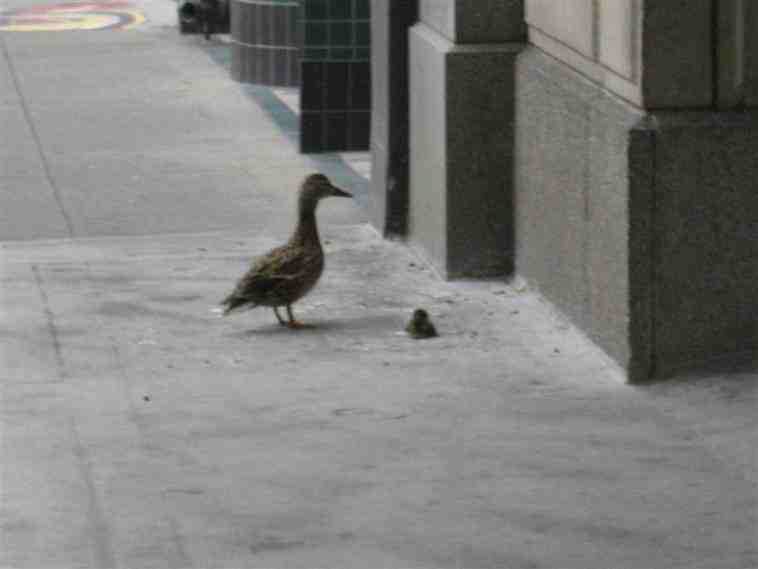
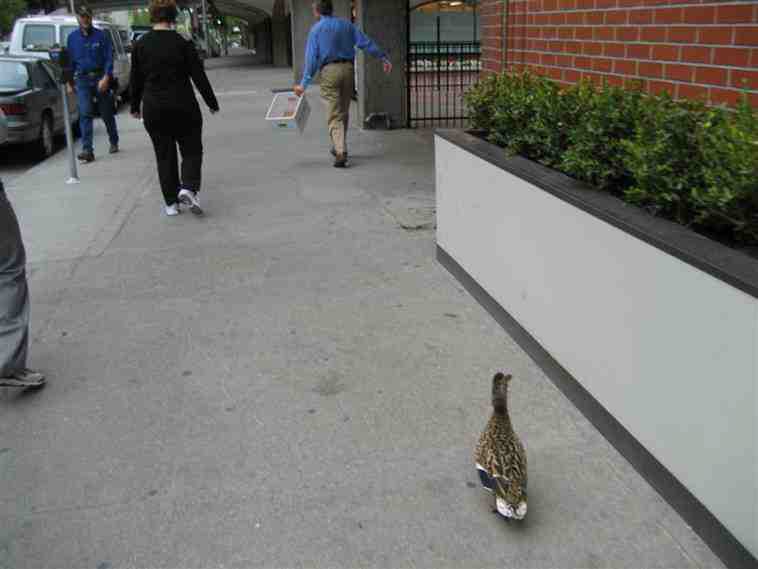
Something really cute happened in downtown San Antonio this week. Michael R. is an accounting clerk at Frost Bank and works there in a second story office. Several weeks ago, he watched a mother duck choose the concrete awning outside his window as the unlikely place to build a nest above the sidewalk. The mallard laid ten eggs in a nest in the corner of the planter that is perched over 10 feet in the air. She dutifully kept the eggs warm for weeks, and Monday afternoon all of her ten ducklings hatched.
Michael worried all night how the momma duck was going to get those babies safely off their perch in a busy, downtown, urban environment to take them to water, which typically happens in the first 48 hours of a duck hatching.
Tuesday morning, Michael watched the mother duck encourage her babies to the edge of the perch with the intent to show them how to jump off. Office work came to a standstill as everyone gathered to watch.
The mother flew down below and started quacking to her babies above. In disbelief Michael watched as the first fuzzy newborn trustingly toddled to the edge and astonishingly leapt into thin air, crashing onto the cement below. Michael couldn’t stand to watch this risky effort nine more times! He dashed out of his office and ran down the stairs to the sidewalk where the first obedient duckling, near its mother, was resting in a stupor after the near-fatal fall. Michael stood out of sight under the awning-planter, ready to help.
As the second one took the plunge, Michael jumped forward and caught it with his bare hands before it hit the concrete. Safe and sound, he set it down it by its momma and the other stunned sibling, still recovering from that painful leap. (The momma must have sensed that Michael was trying to help her babies.)
One by one the babies continued to jump.. Each time Michael hid under the awning just to reach out in the nick of time as the duckling made its free fall. At the scene the busy downtown sidewalk traffic came to a standstill. Time after time, Michael was able to catch the remaining eight and set them by their approving mother.
At this point Michael realized the duck family had only made part of its dangerous journey. They had two full blocks to walk across traffic, crosswalks, curbs and past pedestrians to get to the closest open water, the San Antonio River, site of the famed “RiverWalk.”
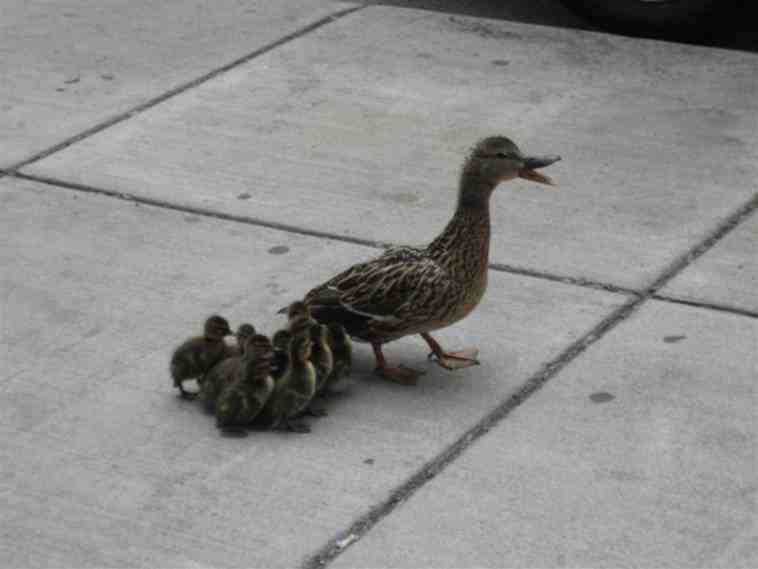
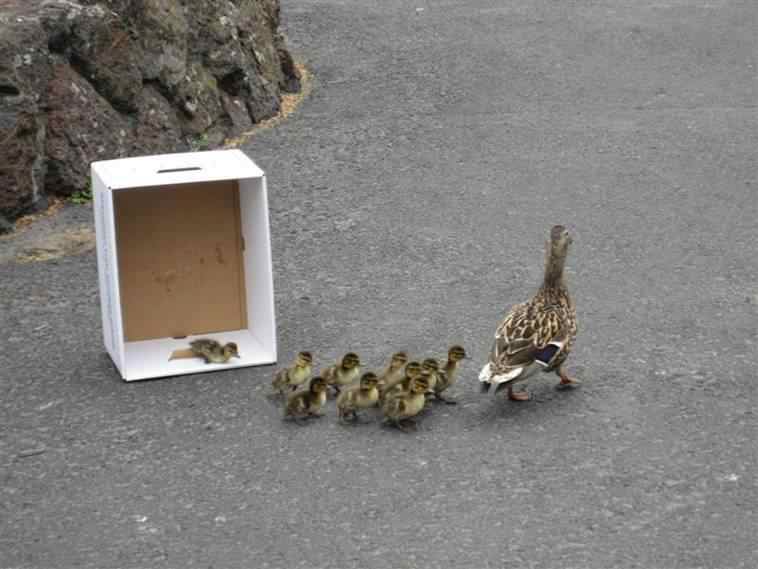
The on-looking office secretaries and several San Antonio police officers joined in. An empty copy-paper box was brought to collect the babies. They carefully corralled them, with the mother’s approval, and loaded them in to the container. Michael held the box low enough for the mom to see her brood. He then slowly navigated through the downtown streets toward the San Antonio River. The mother waddled behind and kept her babies in sight, all the way.
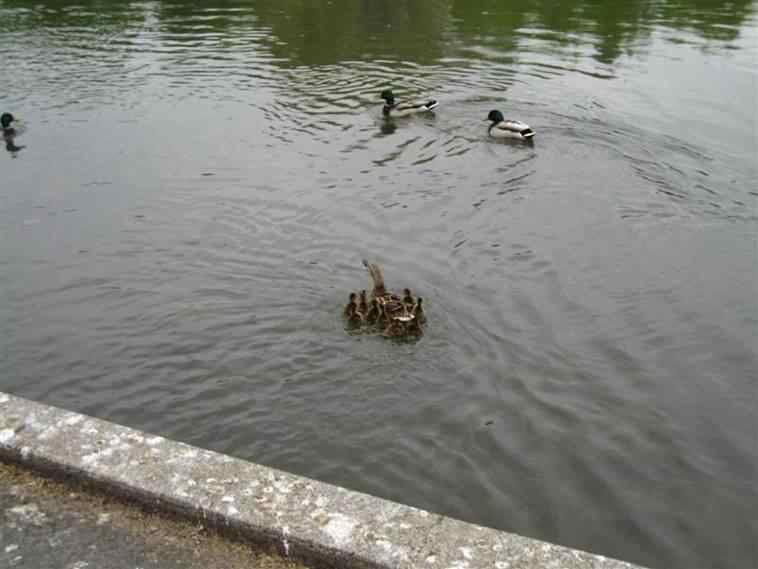
As they reached the river, the mother took over and passed him, jumping in the river and quacking loudly. At the water’s edge, Michael tipped the box and helped shepherd the babies toward the water and to the waiting mother after their adventurous ride.
All ten darling ducklings safely made it into the water and paddled up snugly to momma. Michael said the mom swam in circles, looking back toward the beaming bank book-keeper, and proudly quacking.
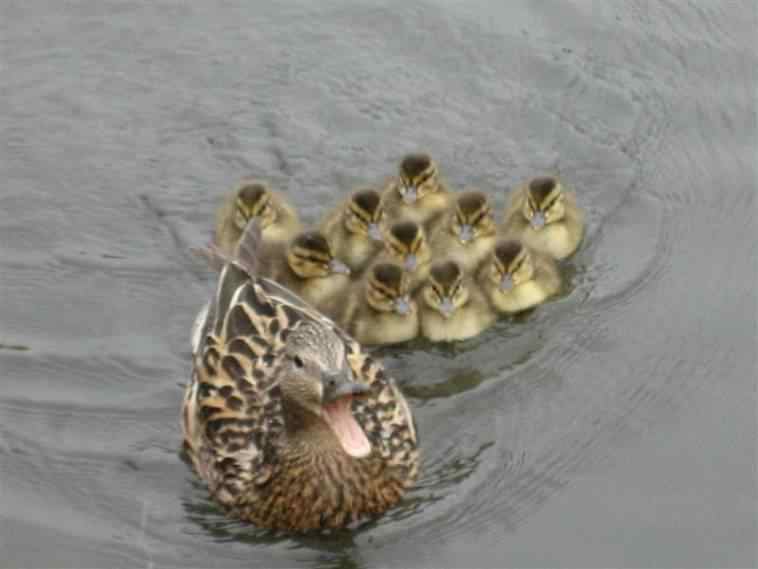
At last, all present and accounted for: “We’re all together again. We’re here! We’re here!”
And here’s a family portrait before they head outward to further adventures….
Like all of us in the big times of our life, they never could have made it alone without lots of helping hands. I think it gives the name of San Antonio ‘s famous “River Walk” a whole new meaning! Maybe you will want to share this story with others.
And even if you enjoyed the story, do settle down for 3 minutes and watch the YouTube version – it’s something you will treasure, I promise you!
Both versions end with this thought:
Live honestly, Love generously, Care deeply and Speak kindly
Learning from Dogs would not be anything without you, dear reader. So what follows is an accolade to you. This Blog first saw the light of day on July 15th, 2009.
By the end of 2009 there had been a total of 15,800 viewers.
In comparison, by the end of 2010 there had been a total of 85,200 viewers, a growth of 439%!
Today, the last day of 2011, the total number of viewers for the year will be in excess of 243,000, a breathtaking increase over 2010 of nearly 158,000 viewers (184%).
So from Pharaoh and me, thank you all so very, very much and a Very Happy New Year to you all.
Wow, this seems an odd-ball topic for Learning from Dogs. But, as all you regular readers know, Learning from Dogs is about understanding the importance, the critical importance of integrity, and having dogs, who are integrous, act as an example and metaphor for humankind.
OK, to the point of the article.
Somewhere (probably Naked Capitalism but not sure) I came across a link to a piece in PC Mag entitled, Are Amazon Reviews Corrupt? Here’s a flavour of the article written by John Dvorak.
It’s a known fact that PR agencies and corporations have been burrowing into the community of online, “public” reviewers and obscure bloggers and easily corrupting them with trinkets. It’s like a lost tribe being bribed with a pretty necklace of cheap polished rocks. Now there is some proof that there is a problem.
I received a press release titled, “Buyer beware: study reveals hidden motives behind Amazon reviews.” Here is the gist in a nutshell:
In the first academic study of its kind, Trevor Pinch, Cornell University professor of sociology and of science and technology studies, independently surveyed 166 of Amazon’s top 1,000 reviewers, examining everything from demographics to motives. What he discovered was 85 percent of those surveyed had been approached with free merchandise from authors, agents or publishers.
Pinch, who also found the median age range of the reviewers he surveyed was 51 to 60, a surprise said Pinch, because the image of the internet is more of a young person’s thing. Amazon is encouraging reviewers to receive free products through Amazon Vine, an invitation-only program in which the top 1,000 reviewers are offered a catalog of free products to review.
John later linked to the website set up by Trevor Pinch, called Freelunch, where the full details of what is going on are contained in a report, available for all to download and read. The web page from where the report may be downloaded is here, and below is what you will read if you go to that weblink.
They tell us what to buy, but who are Amazon’s elite product reviewers and why do they do it?
They are the familiar faces of the world’s largest online retailer, the voices of reason we rely upon to make sense of everything from Shakespeare to sleeping bags.
But who are Amazon’s top reviewers, why do they invest the massive effort required to review tens of thousands of products, and how are changes at Amazon changing the way these reviewers help us decide what to buy?
In the first academic study of its kind, we examine the elite class of top-thousand Amazon reviewers by conducting a detailed survey with a subset of 166 of these top reviewers. The study, examines everything from age, gender and education (typically middle-aged, male and master’s degree), to the motives and concerns of this volunteer corps who’ve helped drive Amazon’s growth from quaint virtual bookstore to the planet’s most valuable retail brand.
The study was carried out just as Amazon introduced a new way of ranking its reviewers causing much consternation as some fell dramatically in the rankings. We ask why it is that Amazon has changed its ranking system at this time and we elicit the top reviewers responses to this change.
Our study holds an assumption and asks a question: the assumption is that there are no free lunches. So how come Amazon has managed to persuade so many people to give them the morsels from which they have built one of the biggest free lunches ever? That is the question.
Speaking as someone who probably spends a couple of hundred dollars a year with Amazon, particular on books, and who does get tipped into buying an unknown book by the reviews, this report is not without consequence.
Hyman Minsky
Indeed, as you read this there will be winging it’s way to me two books ordered last week. The first was Hyman Minsky’s book, Stabilizing an Unstable Economy, cost $21.14 and a book that I had no doubts about wanting to read.
But the second, The Great Disruption by Paul Gilding, was bought a) to take me over $25 and provide me with free shipping and b) because it looked like a book I would enjoy and all six reviews were strong recommendations!
“Life is not a success-only journey. Even the best-laid plans sometimes must be altered and changed. Be open to input and consider any potentially viable alternative. Be willing to be wrong and be willing to start over.” Dr. Phil.
Kathryn Schulz
I am indebted to Daniela Caride of The Daily Tail for passing me details of Kathryn Schulz someone, I must admit, that I had not heard of before. But Kathryn is the author of the book, Being Wrong. Here’s how she is described on the TED Talks website,
Kathryn Schulz is a journalist, author, and public speaker with a credible (if not necessarily enviable) claim to being the world’s leading wrongologist. Her freelance writing has appeared in the New York Times Magazine, Rolling Stone, TIME Magazine, the Boston Globe, the “Freakonomics” blog of The New York Times, The Nation, Foreign Policy, and the New York Times Book Review, among other publications. She is the former editor of the online environmental magazine Grist, and a former reporter and editor for The Santiago Times, of Santiago, Chile, where she covered environmental, labor, and human rights issues. She was a 2004 recipient of the Pew Fellowship in International Journalism (now the International Reporting Project), and has reported from throughout Central and South America, Japan, and, most recently, the Middle East. A graduate of Brown University and a former Ohioan, Oregonian and Brooklynite, she currently lives in New York’s Hudson Valley.
Just had a call from my son-in-law to let Jean and me know the fabulous news.
That around 8.30pm London time, just about an hour ago, a son, my first grandchild, was born to my daughter and her husband. Baby Morten is fine. Morten’s Mum is recovering from a fairly tough labour but also is well.
Mixed emotions about those other worlds out there.
In recent times, Learning from Dogs has been reflecting on the magic, and fragility, of the planet we all live on.
There was the photograph of the Earthrise that attracted quite a few comments. That was followed up by the amazing photograph of the Earth from Voyager 1 taken in 1990 from 3,762,136,324 miles away! Then the lovely poem from Sue.
So it was interesting to note my mixed emotions to a piece on the BBC News website yesterday. Here’s a flavour.
Worlds away
Astronomers have identified some 54 new planets where conditions may be suitable for life.
Five of the candidates are Earth-sized.
The announcement from the Kepler space telescope team brings the total number of exoplanet candidates they have identified to more than 1,200.
The data release also confirmed a unique sextet of planets around a single star and 170 further solar systems that include more than one planet circling far-flung stars.
Read the rest of the item here. (and there’s a fuller version on NetworkWorld)
So here are those mixed emotions.
Man has been, and still continues to be, wonderfully curious to the point of spending huge sums of money on projects that appear to do nothing more than satisfy that curiosity. (The (Kepler) mission‘s life-cycle cost is estimated at US$600 million, including funding for 3.5 years of operation, from here.) That’s a beautiful trait, in my humble opinion.
Homo Sapiens is a wonderfully innovative and creative species, as so wonderfully presented by Alan Alda on a recent PBS Programme called The Human Spark. (See the YouTube intro at the end of this Post.)
Look at all the inventions and incredible advances to our species that are all around us – including the PC I am using and the World Wide Web that is aiding this message!
For such an intelligent species as us, why is it that we are treating Planet Earth in such a suicidal manner through greed, pollution and over-consumption!
As was reported yesterday, we could be on the verge of total and utter chaos in terms of food. Then also yesterday was a small item about food prices reaching a new global record.
It always struck me as absurd to conclude that this planet is the only habitable planet in the universe – ‘Astronomers estimate there are 1021 stars in the universe. With a conservative estimate of three planets per star (some could have many more, some would have none at all) this puts the estimated number of planets into millions of billions.‘ From here.
So the data coming in from Kepler is truly astounding and, personally, underlines this era as a great time to be alive.
But there simply is no choice in that for decades ahead, if not centuries ahead, Planet Earth is all there is for us. So why do we do it so much harm!
Our civilisation is likely to go to the very limits of survivability before the message that the existing ‘model’ is broken is picked up by every major political party in the world. That is very, very scary to contemplate.
So it looks as though, soon, mankind will face the ultimate decision of all time. Give up and let the chaos overwhelm us all, or … or what? In other words millions of us will have to live with the consequences of our greed.
The ‘or what?’ can only be a faith that it will be OK.
A faith that mankind will use the power of dreams, imagination and energy to create a new future that will, at long last, be a new dawn of democratic and just, integrous existence.
And maybe, just maybe, that could be the Second Coming and maybe, just maybe, the world’s Churches and religions will be our saving grace.
But of that day and hour knoweth no man, no, not the angels of heaven, but my Father only. Matthew 24:36
Fascinating times – a Chinese proverb, ‘It’s better to be a dog in a peaceful time than be a man in a chaotic period.’
Finally, here’s that video of the series preview to The Human Spark.