“All that evil needs to succeed is for good people to do nothing.”
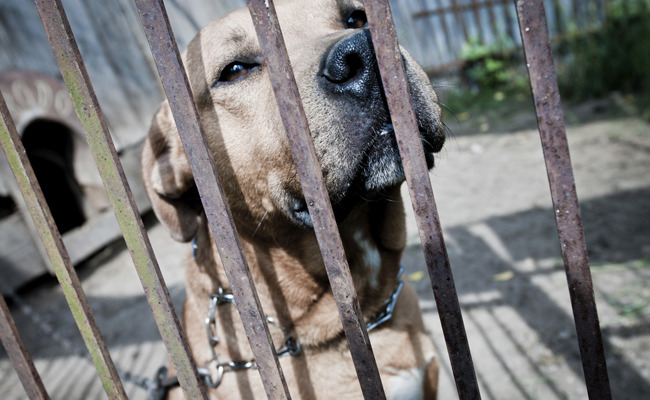
You will recall that on the 8th March I published a post called Anger Alert. It was about raising awareness for “Stella has spent the last two years locked in a 3-by-9 foot cage in a kennel in Devon, England. She has never been let out to exercise or play.”
I included a link to a Care2 Petition that as of now has been signed by nearly 38,000 persons including many who read this blog. Thank you. Keep Stella in your thoughts.
Regretably, Stella’s imprisonment has not yet come to an end but here is a good news story that underlines why we must always keep fighting for the things we believe need to be changed.
ooOOoo
Over 61,000 Care2 Activists Want To Save These Dogs From Euthanasia
When Kirstyn Smith heard that 31 pit bulls had been rescued from a dog-fighting ring in her native Ontario, Canada, she was thrilled, but then she learned there was a catch: Officials had plans to euthanize the dogs, rather than free them. That’s when she jumped into action and decided to create a Care2 petition.
That petition now has over 61,000 signatures, as people around the world react to the horrifying and deeply unfair death sentence.
Here’s what Smith wrote in her petition:
“My name is Kirstyn Smith and I have been following a very heart-breaking story since October 2015. The town of Chatham-Kent, ON fell victim to a horrible and cruel act where 31 pitbull-type dogs were seized from an alleged dog fighting-ring.
These animals need our help.
Please sign and share this petition to demand that these dogs are treated humanely, medically taken care of and rehabilitated in order to live out their lives away from torture and neglect.”
Close To Victory
On March 10, she issued this update to her petition:
“We are so close! The accused have agreed to hand over ownership to Dog Tales Sanctuary in King City, ON. This is incredible news, but we still need the Ministry of Community Safety & Correctional Services to give proper designation which will allow the dogs to legally reside in Ontario. Thank you to each and every one of you for your support on this long journey!!”
Smith is referring to the fact that pit bulls are banned in the province of Ontario, and only a pound can take in pit bull-type dogs. However, Dog Tales is not a pound, so the sanctuary must make a special application in an effort to get the designation that will allow them to take in the pit bulls.
This of course is not unique to Ontario. Pit bulls are banned or restricted in most Canadian provinces; in the U.S., over 700 cities have enacted breed-specific legislationwhich is any ordinance, or dog law, that relates to specific dog breeds but does not affect any others.
The next court date will be March 18, and there will likely be another one after that, but things are moving forward in a positive way, thanks largely to Smith’s persistence and the awesome support of those 61,000 Care2 activists.
An Awesome Sanctuary
If justice prevails, these dogs will move to their new home, which CTV News London describes as an “opulent sanctuary in King City, Ontario, which is owned by one of Canada’s richest families.”
“The issues present are nothing that we haven’t seen before, and nothing that we feel cannot be changed with time, patience, and the proper technique,” says Clare Forndran, a spokesperson at Dog Tales Rescue and Sanctuary.
“At Dog Tales we are fortunate enough to have the facilities and the resources to provide for our dogs in ways that many other shelters cannot,” owner Danielle Eden said in an email.
While this story has come a long way and is very close to a happy ending, it’s not quite there yet.
You can help rescue these dogs from a death sentence by signing Smith’s petition, asking the authorities to treat these animals humanely, and take care of them so that they can live out their lives away from torture and neglect.
And if you have a cause that you care deeply about, and want to make a difference in the world, you can create your own petition, just as Kirstyn Smith did. You’ll soon find the Care2 community of activists ready to join you in your cause. And if you’d like to read more about petitions, you can check out this handy guide.
ooOOoo
So, please, if you are not one of those 61,000 who have already signed this petition then, without delay, go here and add your support to this wonderful cause.
Loving our wilderness is another vital loving relationship
I quite deliberately named today’s post so that it would extend the theme of loving relationships posted yesterday.
So the recent announcement from the White House, “White House announced President Obama signed proclamations Friday to protect almost 2 million acres of pristine lands.” is to be welcomed with open arms. The article published in The Press Enterprise explained that those millions of acres were in California.
The Castle Mountains, shown, will be declared a national monument in the Mojave Desert, along with Sand to Snow and Mojave Trails. KURT MILLER, STAFF PHOTOGRAPHER
President Barack Obama established three national monuments today, Feb. 12, that cover almost 2 million acres in the Mojave Desert, the White House announced.
Obama used his power under the Antiquities Act to sign a proclamation designating the Mojave Trails, Sand to Snow and Castle Mountains national monuments. The move bypasses similar legislation, introduced by Sen. Dianne Feinstein, D-Calif., that has languished for years in Congress.
Feinstein asked the president in August to use his executive power to create the monuments. She praised the action in a statement: “I’m full of pride and joy knowing that future generations will be able to explore these national monuments and that the land will remain as pristine and as it is today. To a city girl like me, this expanse of desert, with its ruggedness and unique beauty, is nothing short of awe-inspiring.”
While on the subject of California, there is more good news from the Canis lupus 101 blog.
ooOOoo
Wolves get a grudging welcome from Northern California ranchers
By Tim Holt February 11, 2016
Photo: Oregon Fish And Wildlife
Wolves such as OR 25, a 3-year-old male, have crossed the Oregon border, and Northern California ranchers are preparing to accommodate them.
We are going to have a viable population of wolves in the far northern reaches of California, and it will be with the grudging cooperation of our ranchers.
That was the takeaway from a public hearing held last month in Yreka (Siskiyou County), where the state’s Department of Fish and Wildlife invited public comment on its draft plan for accommodating our new four-footed residents, and where there were as many Stetsons in the audience as you’d see at a cowboy poetry convention.
Where are the wolves?
Yes, there was some foaming at the mouth, some evidence of the government-hating libertarianism this region is known for. “We don’t want people in Sacramento telling us how to live our lives,” grumbled one rancher.
But on the whole, there was a lot of thoughtful comment by those in attendance, and the beginnings of a dialogue between those who are charged with facilitating the wolves’ re-entry, and those who will be most affected by it. There was a focus on practical, down-to-earth matters — the threat to one’s livelihood when livestock are killed by predators, and the impracticality of maintaining 24-hour surveillance on sprawling ranch lands.
There was not much discussion of the nonlethal methods that can be used to ward off wolf depredations, although a number of speakers strongly urged that radio collars be put on wolves so ranchers can be warned if they’re getting near their cattle or sheep. That idea is already in the draft wolf management plan, as well as hazing techniques that include spotlights and air horns, as well as guard dogs and mobile electric fences.
Suzanne Asha Stone was on hand as the Rocky Mountain field representative for Defenders of Wildlife. After listening to some of the ranchers’ comments, she said, “This is verbatim what we heard in Idaho 20 years ago,” when wolves were introduced in Yellowstone National Park. Ranchers in that state were naturally concerned about the impact those wolves would have on their livelihoods. Two decades later, through programs Stone and her organization have helped implement, nonlethal strategies have reduced wolf kills of livestock in Idaho to “near zero,” she said. And that’s with a wolf population than now totals 770.
According to Stone, “It takes a while living with wolves before people realize that their worst fears won’t come true.”
I think most ranchers in California’s far north respect the wildlife around them, but their relationship with it is complicated by the need to make a living. Looking closely at the strategies used in Idaho would be a good first step in helping convince them that there are ways to reconcile ranching with the presence of this new predator.
John Wayne has long been a conservative icon, the personification of rugged individualism in the Wild West. In the 1963 movie “McLintock,” made late in his career, Wayne plays a cattle rancher and land baron. At one point he tells his daughter what he plans to do with his holdings after he dies: “I’m gonna leave most of it to the nation, really, for a park, where no lumber mill (can) cut down all the trees for houses with leaky roofs, nobody’ll kill all the beavers for hats for dudes, nor murder the buffalo for robes.”
John Wayne was no tree hugger. But neither, like the ranchers up here, should he be reduced to a simple stereotype.
ooOOoo
Back to Governments or is this case the U.S. Government and a little-known unit known as Wildlife Services. Another arm reaching out to love our wilderness? H’mmm. Not according to Wolves of Douglas County blog:
PUBLISHED FEBRUARY 12, 2016
Wildlife Services—ever heard of it? No, not the U.S. Fish and Wildlife Service. That’s something different. The Fish and Wildlife Service is part of the Department of the Interior, charged with enforcing wildlife laws, restoring habitat, and protecting fish, plants, and animals. Wildlife Services isn’t your state fish and game commission, either, which issues hunting and fishing licenses and manages local wildlife.
Wildlife Services is a federal agency under the U.S. Department of Agriculture, and it specializes in killing wild animals that threaten livestock—especially predators such as coyotes, wolves, and cougars. Outside the ranching community, Few have heard of Wildlife Services.
Since 2000, the agency has killed at least two million mammals and 15 million birds. Although it’s main focus is predator control in the West, Wildlife Services also does things like bird control nationwide at airports to prevent crashes and feral pig control in the South.
Ice caves are temporary structures that appear at the edge of glaciers. They look amazingly beautiful from the inside. This particular cave is located on the frozen lagoon of the Svínafellsjökull glacier in Skaftafell, Iceland. The centuries old ice coming down the slopes of Öræfajökull via Svínafellsjökull glacier has metamorphosed into highly pressurized glacier ice that contains almost no air bubbles. The lack of air means that it absorbs almost all visible light, apart from the blue fraction which is then visible to the naked eye. However, this blue ice can be seen only under certain circumstances. It can be seen in winter after long periods of rain when the surface layer of the glacier has been washed away. It can be seen in ice-caves like this one and on floating icebergs that have recently rolled over.
This cave in the glacier ice is the result of glacial mill, or Moulin where rain and melt water on the glacier surface are channeled into streams that enter the glacier at crevices. The waterfall melts a hole into the glacier while the ponded water drains towards lower elevations by forming long ice caves with an outlet at the terminus of the glacier. The fine grained sediments in the water along with wind blown sediments cause the frozen meltwater stream to appear in a muddy colour while the top of the cave exhibits the deep blue colour. Due to the fast movement of the glacier of about 1 m per day over uneven terrain, this ice cave cracked up at its end into a deep vertical crevice, called cerrac. This causes the indirect daylight to enter the ice cave from both ends resulting in homogeneous lighting of the ice tunnel.
There are many beautiful photographs available if you conduct a web search. Here are some examples.
We crawl slowly on hands & knees into a long frozen chamber, under a brilliant cathedral of crystal blue waves. Superman would feel right at home in this ice cave.
When the Man of Steel wants to get away from the hustle & bustle of Metropolis, he flies to his “Fortress of Solitude” hidden in the Arctic. A magnificent crystal castle built using Krypton alien technology.
What if I told you Superman’s crystal fortress is real?
Deep under Iceland’s massive Vatnajökull Glacier, beautiful caves of ice are formed by rivers of meltwater.
Too dangerous to visit in the spring & summer due to a threat of collapse, cold winter temperatures strengthen the ice and make exploration possible.
A fellow photographer convinced me to go during my Iceland road trip.
So many who devote so much time and energy, and money no doubt!
Let me state quite clearly my position with regard to hunting wild animals – I abhor it! Technically speaking if someone’s only means of feeding themselves, as in staying alive, is through hunting then I guess that is acceptable. But hunting for any other purposes is beyond the pale. I know that many people, including friends, who live in this part of America would heartedly disagree with my position on hunting. So be it.
Thus when Jean and I look at those who work so hard to protect, sustain and support wild animals we are almost speachless with our admiration for them.
So what’s brought all this on today?
For a long time I have been a follower of the blogsite Canis Lupus 101. On the home page of Canis Lupus 101, on the left-hand sidebar, one can read a plea from Maggie Caldwell, Press Secretary for @Earthjustice, that, in part, says:
For centuries, wolves have been viewed with suspicion and hostility, based in humankind’s deep-rooted fear of the unknown and need to control the natural world.
The film offers an abbreviated history of the relationship between wolves and people—told from the wolf’s perspective—from a time when they coexisted to an era in which people began to fear and exterminate the wolves.
The return of wolves to the northern Rocky Mountains has been called one of America’s greatest conservation stories. But wolves are facing new attacks by members of Congress who are gunning to remove Endangered Species Act protections before the species has recovered.
Our millions of magnificient and adorable dogs owe their place in today’s world to the wolf. The fact that those who care are still fighting hard to save the wild wolf shows how disgraceful it is for those that see no harm in hunting wolves. Hunting a wolf in my book is hardly any different than going out and hunting a dog!
So with all that out of me, now read about the following glorious efforts to save the wild Mexican wolf. Originally published over on Canis Lupus 101.
ooOOoo
Thursday, January 28, 2016
Poaching slows Mexican wolf population recovery (video)
Brandon Loomis, The Republic | January 27, 2016
The annual Mexican gray wolf population survey in Alpine, Ariz., shows that poaching is slowing the species’ recovery.
After the wild Mexican wolf population tops 100 for the first time, 15 illegal shootings may slow recovery.
(Photo: Mark Henle, Mark Henle/The Republic)
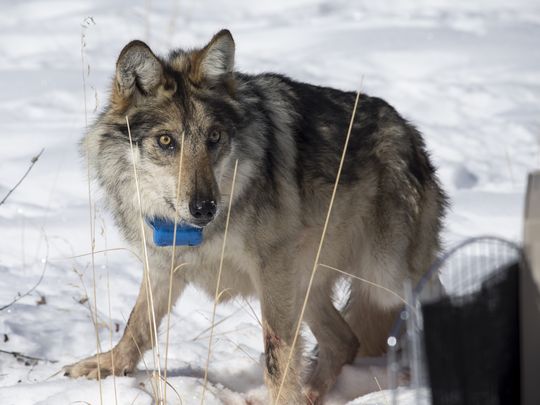
ALPINE — Biologists hauled a 60-pound Mexican gray wolf from the chopper on Monday, limp but healthy with a lush winter mane. They called it the wolf’s worst day in months — dazed from having been darted from above, still rapidly licking his nose through a blindfold muzzle — but the male wolf was one of the fortunate among a divisive and still-embattled breed that has weathered an especially perilousyear of poachings.
Unknown shooters have illegally killed at least 15 Mexican wolves since officials reported a year ago that a record 110 were roaming wild in eastern Arizona and western New Mexico, according to a lead state biologist on the recovery program.
The poaching losses tripled from 2014, and were likely unprecedented in the 18 years since the first captive-bred lobos brought their once-exiled howls back to the Blue Range spanning the Apache and Gila national forests.
Wolf-recovery specialists, like those in Alpine this week, are working to make sure the survivors flourish instead of backsliding to a more critically endangered status.
The team of federal and state biologists carried Wolf No. M1342 on a mesh sling. They brought the wolf inside their pine-ringed Alpine field station and slid him onto a slab wooden table for a checkup and shots to keep him robust for an important breeding season this spring. They injected a second sedative that would put the wolf out cold for about an hour.
The scientists gathered round the Elk Horn pack’s would-be alpha male, prodding veins for intravenous fluids and pushing an oxygen tube up his black nostrils.They were counting on the wolf to return healthy to his young mate on snowy Escudilla Mountain, and produce their first successful litter to help extend recent annual gains in a slow-recovering population.
AZCENTRAL
As recently as five years ago, there were an estimated 50 Mexican wolves in the wild, less than half of last year’s count. Whether this year’s survey finds the population continuing to grow will depend on the 40 or so pups observed since last spring. Historically, about half of pups have survived their first year.
Besides the wolves that were shot, about a dozen more adults are missing, “fate unknown.”
M1342 was lucky to have a dart dangling from his paw, and not a trail of lead fragments through his chest. Shootings have always been a key threat since the 1998 reintroduction.
The anti-wolf mentality commonly known as “shoot, shovel and shut up” is hard to combat. Bullets typically pass through a wolf’s body and leave little useful evidence, said Jeff Dolphin, Mexican wolf field supervisor for the Arizona Game and Fish Department. “You just can’t be everywhere at once,” Dolphin said.
Only a handful of what may be dozens of shooters have faced charges related to killing one of the protected wolves since 1998. Federal, state and non-governmental organizations offer a combined reward of up to $58,000 for information leading to the arrest and conviction of a wolf poacher.
A controversial task
Susan Dicks, a U.S. Fish and Wildlife veterinarian examines Wolf No. M1342. (Photo: Mark Henle/The Republic)
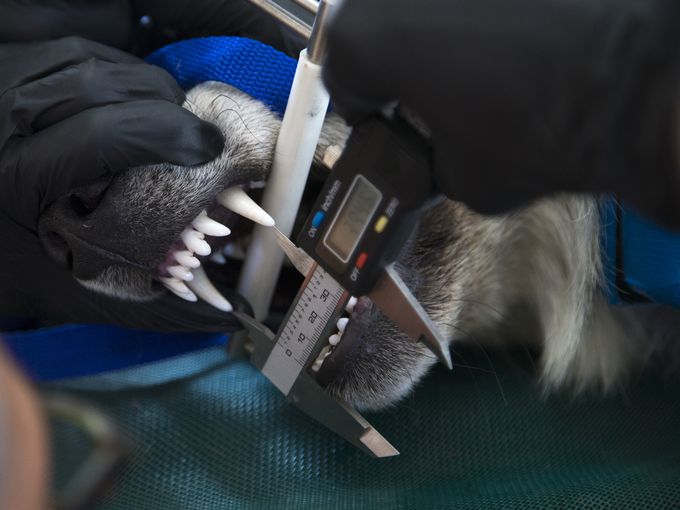
U.S. Fish and Wildlife Service veterinarian Susan Dicks coached the team of biologists and field technicians tending to M1342: how to draw blood for DNA and other tests; where to inject a rabies vaccine; how to determine age by measuring teeth; how to increase fluids or pour cooling alcohol on the paws if his temperature rises past 103 or so.
Besides the preventive medicine and data collection, the prime objective for M1342’s capture during a yearly aerial wolf survey was to fit it with a new transmitter collar. The collar he had received in a similar operation last year hadn’t functioned, so biologists only knew the wolf’s whereabouts by occasional observation. Uncollared wolves are difficult to track to ensure they’re not getting into trouble, such as by attacking livestock.
Not every wild Mexican wolf is collared, but scientists like to have them on a wolf of every generation in a pack. Last year’s survey counted 19 packs, including eight known to have a breeding pair.
AZCENTRAL
Studies show that these free-ranging wolves eat elk upward of 80 percent of the time, but cows are also occasionally on the menu. A government and non-profit fund pays for the losses. So far, the wolf program has paid out $68,000 for 50 confirmed livestock losses in 2015, and another $25,000 in claims is awaiting action by a compensation council. “It’s such a controversial program, and (people) want us to manage these animals,” Dicks explained. “The way we manage is with that collar. It communicates and tells us what they’re doing.”
The latest in a string of political struggles over the lightweight cousin of more plentiful northern gray wolves involves where they should be allowed.
Wolf advocates say they need unoccupied territory such as the forests around the Grand Canyon to sustain a population large and dispersed enough to withstand sudden die-offs. The governors of Arizona, New Mexico, Colorado and Utah recentlyco-signed a letter to the federal program opposing such a northern expansion into previously undocumented wolf territory and instead backing a push south into Mexico.
The number of wolves needed to ensure long-term survival also is in dispute. Some want to hold the line around today’s numbers, but others say at least a sevenfold increase is needed.
Mexican wolf biologist Julia Smith carries Wolf No. M1342 from the helicopter to the Alpine field station. He was darted from a helicopter to have his radio collar replaced.
Federal recovery effort
Mark Henle/The Republic Arizona is a partner in the federal recovery effort within a recovery zone that stretches from New Mexico and onto the Mogollon Rim. Officials say the state has spent $3 million since the recovery program began with captive animals in the 1980s.
This week, the team said one wolf had roamed west to within 35 miles of Payson, though it was unclear whether it was wandering alone. Others were prowling below the Rim, south of Alpine.
M1342’s gray-brown fur was thick, with no signs of mange or fleas, but Dicks squeezed an anti-parasite lotion onto the skin between the shoulders as an extra precaution. The team slid the wolf into a large dog crate and set the wolf outside to recover his senses for a truck ride back up the mountain to freedom. “We’re trying to help them out before breeding season,” Dicks said. “The population is so small.”
The subspecies had dropped to seven holdouts in Mexico during the late 20th century, survivors of private and government hunters who cleared the region of what had commonly been considered a menace. They were removed from the wild and stocked a captive breeding program that at last count fostered more than 250 wolves at 55 sites in the U.S. and Mexico.
AZCENTRAL
A few years ago, the population struggled to stay atop 50 from one year to the next, hindered not just by illegal shootings or natural causes, but by government agents shooting or removing to captivity wolves that attacked livestock. Since then, the program has focused its efforts on conflict-avoidance, said John Oakleaf, field coordinator for the U.S. Fish and Wildlife Service.
With help from partners such as Defenders of Wildlife, the government has enlisted ranchers who accept payment for the wolves’ presence but also get help from range riders protecting cattle. It may have kept the number of illegal shootings from climbing even higher. “In the end,” Oakleaf said, “the tolerance of humans for wolves is what allows them to persist or not persist in the wild. It’s what drove them to extinction, or near extinction, and it’s what’s driving them toward recovery now.”
Final numbers next month
The Fish and Wildlife Service will release the final numbers from this year’s count next month. Until then, total deaths aren’t officially tallied, but Oakleaf acknowledged the illegal shootings will be “as high as we’ve ever documented.”
Dolphin put the number at 15, and said he doubts the population estimate will remain above 100 this year. Still, he’s optimistic after years of bigger struggles to stabilize the population.
All of the wolves now in the wild were born out there, which may make them better adapted than their parents were to hunting and surviving on game. A recent experiment showed that it’s possible to drop a captive-bred pup or two in with newborn wild litters, and the wild packs will raise them as their own. “The urgent thing is to get more wolves with genetically diverse backgrounds on the ground as quickly as possible.”
Wolf advocates are also cautiously optimistic, though they believe the packs need more territory, and more of a boost from now-rare releases of captive pairs in new haunts. “If you put (captive-bred) pups in the dens of existing packs, you may be increasing the number of animals,” Center for Biological Diversity wolf specialist Michael Robinson said, “but you’re not increasing their distribution.”
A common complaint of wolf proponents is that Mexican wolves, coming from such a limited breeding stock, lack genetic diversity and pay for it with smaller litters than other wolves have. “The urgent thing is to get more wolves with genetically diverse backgrounds on the ground as quickly as possible,” Robinson said.
Returning groggily to the wild
Wolf No. M1342 is released at Escudilla Mountain. (Photo: Mark Henle/The Republic)
After M1342 had regained enough of his senses to lift his head and sit up in the crate, Arizona Game and Fish biologist Brent Wolf and two colleagues loaded the crate onto a four-wheel-drive pickup and drove him back up Escudilla Mountain.
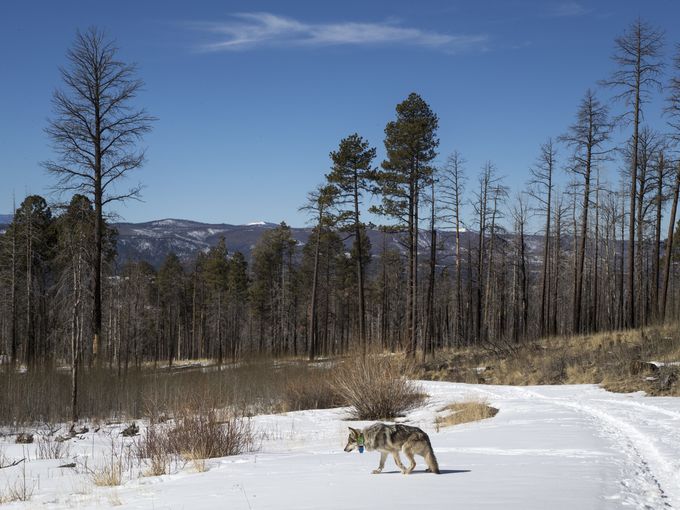
They drove as far as the truck would take them without getting stuck in the snow, getting as near as possible to the spot where the helicopter crew had darted M1342 and then set down to take the male from his mate.The return crew set the crate down at the edge of a snowy alpine meadow surrounded by scraggly willows and fat ponderosa pines, many of them torched and left bare by the massive 2011 Wallow Fire.
The groggy wolf took a few minutes to crawl out, then sat in the snow for several more. His golden-brown eyes stared toward the crew inside the pickup, and he licked the dart wound while waiting for the sedation to free his hind legs. The wolf walked slowly across the meadow, likely to be reunited with his mate once he heard a howl.
The two are believed to have mated last year, but did not produce any surviving pups, Wolf said. That’s common among first-timers, he said, and their experience should help them when they try again. “I’d be shocked if they didn’t have pups this spring,” Wolf said while reversing and turning the truck to head back down the mountain.
GALLERY
Mexican wolf biologist Julia Smith carries Wolf No. M1342 from the helicopter to the Alpine field station. He was darted from a helicopter to have his radio collar replaced. Mark Henle/The RepublicJulia Smith holds Wolf No. M1342 on his way to the Alpine field station. Mark Henle/The RepublicMexican wolf biologist Brent Wolf weighs Wolf No. M1342 in the Alpine field office. Mark Henle/The RepublicWolf No. M1342’s teeth are measured. Mark Henle/The RepublicMeasurements are taken of Wolf No. M1342’s paws. Mark Henle/The RepublicWolf No. M1342 is 3 years old and a member of the Elk Horn Pack. Mark Henle/The RepublicWolf No. M1342 got a checkup and shots to keep him robust for the important breeding season this spring. Mark Henle/The RepublicFrom left, Dr. Susan Dicks and intern Rowan Converse carry Wolf No. M1342’s kennel. Mark Henle/The RepublicFrom left, interns Hannah Manninen and Becca Thomas-Kuzilik release Wolf No. M1342 at Escudilla Mountain. Mark Henle/The RepublicWolf No. M1342 walked slowly across the meadow, likely to be reunited with his mate once he heard a howl. Mark Henle/The RepublicWolf No. M1342 and his mate are believed to have mated last year, but did not produce any surviving pups. Researchers say their experience should help the wolves when they try again. Mark Henle/The Republic
ooOOoo
Golly, I so do admire the good people who undertake this caring work on behalf of the wolves. And great photographs Mark Henle of The Republic.
The way we can reach out to others in these modern times.
A fellow local author, Constance Frankland, who has been mentioned previously here on Learning from Dogs followed up last Sunday’s Picture Parade with a comment on my Facebook page:
You might enjoy the site of Dr. Charles Bergman. I was privileged to take writing classes from him when his features were just breaking into Audubon and National Geographic. He was researching the thought-to-be-extinct Trumpeter Swan when survivors were found. (“Wild Echoes: Encounters With the Most Endangered Animals”) http://www.charlesbergman.com/
It was then the matter of a moment to hop across to that website address and read this on the home page:
Charles Bergman
A writer, photographer and speaker who lives in the beautiful Pacific Northwest and is a prof at Pacific Lutheran University in Tacoma, Washington.
He’s twice been a Fulbright Scholar in Latin America–Mexico and Ecuador–traveled extensively around the world, especially in Latin America from Mexico to Tierra del Fuego. He writes and publishes extensively on animals, nature, and sustainability–with many cover stories in such magazines as Smithsonian, Audubon, All Animals (Humane Society),, Defenders, and many more. His photographs accompany his articles. He has written three books, and has won the Washington State Book Award, Southwest Book Award, and the Benjamin Franklin Book Award. He was a finalist for the PEN USA Literary Award.
He loves animals and wildlife of all kinds, and has developed a new-found love for Antarctica and Africa.
There seemed to be many interesting articles & essays on his site and despite the fact that Mr. Bergman is currently in Uganda, his reply to my request for permission to republish some of his posts came through promptly:
Greetings from Uganda! I’m here working in the Uganda Wildlife Education Center, back shortly. Yes, you may certainly republish my materials. I’ll be very interested to follow the process.
Warmly,
Charles Bergman
You can count on me picking out some of Professor Bergman’s writings to share with you soon.
This reaching to others, friends and strangers, is a wonderful aspect of present times.
(Apologies for such a short post – I got badly squeezed timewise yesterday – it doesn’t detract from this delightful video.)
Dog sees Dolphins from boat; What happens next will touch your heart forever.
Published on Aug 10, 2015
http://www.DolphinWhisperer.org : Sandy meets the dolphins!
I’ve been bringing people to swim with wild dolphins for years, this was the first time I brought a dog. Sandy was a stray taken in by friends here in Bimini. Sandy is a strong swimmer (she can swim over a kilometer). Last week she came out on the ocean with me, it was her first time ever on a boat. The next time I went out, she wanted to come, even jumped off the dock and swam after me, so I scooped her up and off we went.
Sandy was very curious about the dolphins, it was clear she wanted to go in. The following footage is of her first wild dolphin swim!
Special thanks to Jwala, Amlas, Atmo, Sukhama and of course Sandy!
Joebaby aka Joe Noonan is a shamanic nature guide, author and dolphin whisperer who leads private custom ocean adventures swimming with wild dolphins for small groups and families in Hawaii and the Bahamas. Visit his website at http://www.DolphinWhisperer.org
I thought it would make a nice change to publish tomorrow’s post a little earlier than usual. To be precise to publish it on Dec. 22, at 04:48, Coordinated Universal Time (UTC). Or in our local Pacific Standard Time (PST) UTC-8 hrs or 20:48 Dec. 21., i.e. 20:48 on the evening of the 21st December. (I am seeing the exact time being declared as 04:48 or 04:49 UTC depending on what you read.)
Granted that the Northern Hemisphere tends to deliver the worst of the Winter weather after the shortest day, it still is good to know that for the next six months, the hours of daylight, in the Northern Hemisphere, will be increasing.
My inclination to write a post on the topic was greatly influenced by a most beautiful post over on Val Boyco’s blogsite. It was called And Winter Came. Here’s the video that Val included in her post.
Isn’t that a most beautiful few minutes!
Impossible to top that!
But I can continue including an informative item that was published over on Mother Nature News, and is republished here within the terms of MNN.
ooOOoo
8 things to know about the winter solstice
From when it happens to why, here’s your crash course on the shortest day of the year.
“A day without sunshine is like, you know, night,” quipped Steve Martin – and indeed, even a day with less sunshine can feel a bit dark. Our world depends on the light radiating from that big star we traipse around, and when it’s in short supply, we feel it. But if you count yourself amongst those who don’t love waking up before the sun rises and getting off work after it has set, things are about to lighten up. Hello, winter solstice!
Although winter is really just beginning, we can at least say goodbye to these short little days we’ve been suffering (and don’t let the door hit you on the way out). With that in mind, here’s a collection of curious facts to celebrate the long-awaited return to longer days.
1. There are actually two winter solstices every year
It’s sometimes easy to be hemisphere-o-centric, but the other side of the planet gets a winter solstice too. With the planet’s orbit tilted on its axis, Earth’s hemispheres swap who gets direct sun over the course of a year. Even though the Northern Hemisphere is closer to the sun during the winter, it’s the tilt away from the sun that causes cold temperatures and less light — which is when the Southern Hemisphere is toasty. So while our winter solstice is on Dec. 21 or 22, the Southern Hemisphere celebrates the same on June 21 or 22.
Here’s how that looks from space (kind of):
2. The winter solstice happens in the blink of an eye
Although the solstice is marked by a whole day on the calendar, it’s actually just the brief moment when the sun is exactly over the Tropic of Capricorn that the event occurs.
3. Which is why it happens on different days in the same year
What? Yes! In 2015, the solstice happens on Dec. 22, at 04:49 on the Coordinated Universal Time (UTC) time clock, the time standard that the world regulates its hours by. Which means any location that is at least five hours behind UTC should break out the party hats on Dec. 21. For example, in the United States the winter solstice happens on Dec. 21 at 11:49 p.m. Eastern Standard Time. The rest of the time zones can welcome longer days beginning on the 22nd.
4. It’s the first day of winter … or it’s not, depending on whom you ask
Meteorologists consider the first day of winter to be Dec. 1, but ask an astronomer — or just about anyone else — and they’ll likely answer that the winter solstice marks the start of the season. There are two ways to look at it: meteorological seasons and astronomical seasons. Meteorological seasons are based on the annual temperature cycle, explains NOAA, while astronomical seasons are based on the position of the Earth in relation to the sun.
5. It’s a time of gloriously long shadows
Shadows are at their playful best on the solstice. (Photo: Mike Page/flickr)
If you’re inclined to take pleasure in the little things, like shadows that seem cast from a funhouse mirror, then the winter solstice is the time for you. It’s now that the sun is at its lowest arc across the sky and thus, shadows from its light are at their longest. (Imagine a flashlight directly above your head and one hitting you from the side, and picture the respective shadows.) And in fact, your noontime shadow on the solstice is the longest it will be all year. Relish those long legs while you can.
Since 1793, the full moon has only occurred on the winter solstice 10 times, according to the Farmer’s Almanac. The last one was in 2010, which was also a lunar eclipse! The next full moon on a winter solstice won’t be until 2094.
7. There’s a Christmas connection
Since Christ wasn’t issued a birth certificate, there’s no record of the date when he was supposed to have been born. Meanwhile, humans have been celebrating the winter solstice throughout history — the Romans had their feast of Saturnalia, early German and Nordic pagans had their yuletide celebrations. Even Stonehenge has connections to the solstice. But eventually Christian leaders, endeavoring to attract pagans to their faith, added Christian meaning to these traditional festivals. Many Christmas customs, like the Christmas tree, can be directly traced to solstice celebrations.
8. It’s a reminder to thank Copernicus
Will the real Saint Nick please step forward? (Photo: Wikimedia Commons)
The word “solstice” comes from the Latin solstitium, meaning “point at which the sun stands still.” Since when has the sun ever moved?! Of course, before Renaissance astronomer Nicolaus Copernicus (aka “super smartypants”) came up with the ‘ol heliocentric model, we all figured that everything revolved around the Earth, sun included. Our continued use of the word “solstice” is a beautiful reminder of just how far we’ve come and provides a nice opportunity to give a tip of the hat to great thinkers who challenged the status quo.
Only one way to close. That is with this picture of the sun perfectly aligned with the stones at Stonehenge in Wiltshire, UK at the moment of the Winter Solstice.
The December solstice happens at the same instant for all of us, everywhere on Earth. This year the solstice occurs on Tuesday December 22nd at 04:49 GMT (Universal time) with the sun rising over Stonehenge in Wiltshire at 08:04.
Stay safe and warm wherever you are.
The next post from Learning from Dogs will be published at 00:00 PST Wednesday, 23rd December.
Sometimes, one just has to hold one’s head in shame ….
… at the madness that we humans are capable of.
I included this sub-heading in the draft of this post last Thursday intending to make it Friday’s post then changed my mind. Hence the reason behind me writing in Friday’s post:
I was looking at a recent George Monbiot essay and getting myself all wound up about it, thinking that it should be today’s post. Then I thought, “Come on, Paul, end the week on a gentle tone.”
In the light of events in Paris last Friday, I had no idea how pertinent my sub-heading was!
What wound me up, so to speak, was a recent essay from George Monbiot about the damage being done to a Devon river; the River Culm. This river was known to me in the days that I lived in South Devon and had my Piper Super Cub based at Dunkeswell Airfield that was not far from the Culm.
Dunkeswell Airfield
So with no further ado, here is George Monbiot’s essay republished with Mr. Monbiot’s kind permission.
ooOOoo
Strategic Incompetence
12th November 2015
The agencies supposed to protect the living world have been neutered, and polluters and wildlife destroyers now have a free hand.
By George Monbiot, published on the Guardian’s website 12th November 2015
It could scarcely have been a starker case. The river I came across in Devon six weeks ago, and described in the Guardian, was so polluted that I could smell it from 50 metres away. Farm slurry pouring into the water, from a pipe that I traced back to a dairy farm, had wiped out almost all the life in the stretch of River Culm I explored.
All that now grew on the riverbed were long, feathery growths of sewage fungus. An expert on freshwater pollution I consulted told me that the extent of these growths showed the poisoning of the river was “chronic and severe”.
Here, as a reminder of what I saw, are some of the pictures I took:
Sewage fungus covering the river bed.
Slurry pouring from a pipe cut into the riverbank:
Slurry outfall just above the river.
And mingling with the clear water of the river:
The slurry entering the river.
I reported the pollution to the Environment Agency’s hotline. It told me it was taking the matter seriously. So when I received its report on the outcome of its investigation, I nearly fell off my chair.
It had decided to take no action against the farmer, as “the long term ecological impacts on the environment were fortunately low”. How did it know? Because there was “no evidence of a fish kill”.
Why in the name of all that’s holy should there be evidence of a fish kill? This is a chronic pollution case, not an acute one. Fish kills are what you see when a sudden poisoning occurs, as pollutants are flushed into a healthy living system. Chronic pollution deprives fish of their habitats and prey, but no investigator in their right mind would expect to see them floating belly up in the river as a result. They are simply absent from places where you would otherwise have found them.
And if a riverbed covered in nothing but sewage fungus suggests a “low” ecological impact, I dread to think what a high one looks like.
The same inability to distinguish between an acute event and a chronic one was revealed by another of the agency’s statements: the pollution “had a short term impact”. The slurry had plainly been pouring out of the pipe for months, as the luxuriant growths of sewage fungus show. It would doubtless have continued, had I not reported it.
The Environment Agency also told me that it had inspected the farm, and found no problems with the infrastructure, as there was plenty of space for slurry storage under the floor of the barn where the cows were kept. But, the problem, as I had explained to them, had nothing to do with slurry storage in the barn. It was caused by leakage from the outdoor slurry lagoons, where I found cow manure pouring down the hill.
They could scarcely have made a bigger mess of their investigation if they had tried. The mistakes the agency made are so fundamental and so obvious that it makes me wonder whether they are mistakes at all. What does a farmer have to do to get prosecuted these days, detonate an atom bomb?
If this were an isolated case, you could put it down to ineptitude, albeit ineptitude raised to the status of an Olympic sport. But responses like this are now the norm at the Environment Agency. It has been so brutally disciplined by cuts and by ministers’ demands that it leave farms and other businesses alone that it is now almost incapable of enforcement.
Even when the fish kills it appears to see as the only real proof of pollution do occur, in the great majority of cases it doesn’t even bother to assess them, let alone investigate and prosecute. Freedom of information requests by the environmental group Fish Legal reveal that the agency sent its investigators to visit just 16% of reported fish kills.
There was massive regional variation. While in the Anglian Central region, covering parts of Norfolk, Cambridgeshire and surrounding counties, the agency inspected 61% of these events, in Devon they investigated only 3%. (I suspect that it was only because I’m a journalist for a national newspaper that they came out at all in the case I reported). In the fishery areas on either side of it – Cornwall and Wessex – the inspection rate was, er, 0%. If you want to pollute rivers in these regions, there’s nothing stopping you.
The Environment Agency no longer prosecutes even some of the most extreme pollution events. In 2013, a farmer in Somerset released what the agency called a “tsunami of slurry” into the Wellow Brook. One inspector said it was the worst pollution she had seen in 17 years. But the agency dithered for a year before striking a private agreement with the farmer, allowing him to avoid prosecution, a criminal record, a massive fine and court costs, by giving £5000 to a local charity.
New rules imposed by the government means that such under-the-counter deals, which now have a name of their own – enforcement undertakings – are likely to become more common. They are a parody of justice: arbitrary, opaque and wide open to influence-peddling, special pleading and corruption.
I see the agency’s farcical investigation of the pollution incident I reported as strategic incompetence, designed to avoid conflict with powerful landowners. Were it to follow any other strategy, it would run into trouble with the government.
These problems are likely to become even more severe, when the new cuts the environment department (Defra) has just agreed with the Treasury take effect. An analysis by the RSPB and the Wildlife Trusts reveals that, once the new reductions bite, the government’s spending on wildlife conservation, air quality and water pollution will have declined by nearly 80% in real terms since 2009/10.
It’s all up for grabs now: if you want to wreck the living world, the government is not going to stop you. Those who have power, agency, money or land can – metaphorically and literally – dump their crap on the rest of us.
Never mind that the government is now breaking European law left right and centre, spectacularly failing, for example, to ensure that all aquatic ecosystems are in good health by the end of this year, as it is supposed to do under the water framework directive. It no longer seems to care. It would rather use your tax money to pay fines to the European Commission than enforce the law against polluters.
I’ve heard the same description of Liz Truss, the secretary of state for environment, who oversees the work of the Environment Agency, from several people over the past few months. “Worse than Owen Paterson”. At first, I refused to take it seriously. It’s the kind of statement that is usually employed as hyperbole, such as “somewhere to the right of Genghis Khan”, or “more deluded than Tony Blair”. But in this case, they aren’t joking. Preposterous as the notion of any environment secretary being worse than Mr Paterson might seem, they mean it.
Nowhere, as far as I can discover, in Liz Truss’s speeches or writing before she was appointed, is there any sign of prior interest in the natural world or its protection. What we see instead is perhaps the most extreme manifestation of market fundamentalism on this side of the Atlantic. She founded the Conservative Free Enterprise Group, and was co-author of the book Britannia Unchained, that laid out a terrifying vision of a nation run by raw economic power, without effective social or environmental protection. Now she has a chance to put that vision into practice.
Those who have tried to engage with her describe her as indissolubly wedded to a set of theories about how the world should be, that are impervious to argument, facts or experience. She was among the first ministers to put her own department on the block in the latest spending review, volunteering massive cuts. She seems determined to dismantle the protections that secure our quality of life: the rules and agencies defending the places and wildlife we love.
Bureaucracy and regulation are concepts we have been taught to hate, through relentless propaganda in the media. But they are essential pillars of civilisation. They make the difference between a decent society and a barbarous one.
While this essay from Monbiot clearly concerns a river in the South-West of England and may therefore not relate to readers in other parts of the UK or the world, those closing sentences [my emphasis] do relate to all of us wherever we are on this planet.
Bureaucracy and regulation are concepts we have been taught to hate, through relentless propaganda in the media. But they are essential pillars of civilisation. They make the difference between a decent society and a barbarous one.
Tomorrow, I will return to Piper Cubs flying out of Dunkeswell!
Nothing to do with dogs but, nonetheless, a neat way to finish the week.
I was looking at a recent George Monbiot essay and getting myself all wound up about it, thinking that it should be today’s post. Then I thought, “Come on, Paul, end the week on a gentle tone.”
So with that in mind, let me offer you an item on British history that Su sent me a week ago. I can’t authenticate the details but my instinct is that everything mentioned is correct.
ooOOoo
There is an old Pub in Marble Arch, London, which used to have a gallows adjacent to it. Prisoners were taken to the gallows (after a “fair” trial of course) to be hanged. The horse-drawn dray, carting the prisoner, was accompanied by an armed guard, who would stop the dray outside the pub and ask the prisoner if he would like ”ONE LAST DRINK.” If he said YES, it was referred to as ONE FOR THE ROAD. If he declined, that prisoner was ON THE WAGON.
So there you go … On with some more history.
They used to use urine to tan animal skins, so families used to all pee in a pot and then once a day the pot was taken and sold to the tannery. If you had to do this to survive you were “piss poor”, but worse than that were the really poor folk, who couldn’t even afford to buy a pot, they “didn’t have a pot to piss in” and were the lowest of the low. The next time you are washing your hands and complain because the water temperature isn’t just how you like it, think about how things used to be.
Here are some more facts about the 1500s:
Most people got married in June, because they took their yearly bath in May and they still smelled pretty good by June. However, since they were starting to smell, brides carried a bouquet of flowers to hide the body odor. Hence the custom today of carrying a bridal bouquet when getting married.
Baths consisted of a big tub filled with hot water. The man of the house had the privilege of the nice clean water, then all the other sons and men, then the women and finally the children. Last of all came the babies. By then the water was so dirty you could actually lose someone in it. Hence the saying, “Don’t throw the baby out with the bath water!”
Houses had thatched roofs, thick straw piled high on the rafters, with no wood underneath. It was the only place for animals to get warm, so all the cats and other small animals (mice, bugs) lived in the roof. When it rained it became slippery and sometimes the animals would slip and fall off the roof. Hence the saying “It’s raining cats and dogs.” There was nothing to stop things from falling into the house.
This posed a real problem in the bedroom, where bugs and other droppings could mess up your nice clean bed. Hence, a bed with four big posts and a sheet hung over the top afforded some protection. That’s how canopy beds came into existence.
The floor was dirt. Only the wealthy had something other than a dirt floor. Hence the saying, “dirt poor.” The wealthy had slate floors that would get slippery in winter when wet, so they spread thresh (straw) on floor to help keep their footing. As the winter wore on they added more thresh until, when you opened the door, it would all start slipping outside. A piece of wood was placed in the entrance. Hence: a threshold.
In those old days, they cooked in the kitchen with a big kettle that always hung over the fire. Every day they lit the fire and added things to the pot. They ate mostly vegetables and did not get much meat. They would eat the stew for dinner, leaving leftovers in the pot to get cold overnight, then start over the next day. Sometimes stew had food in it that had been there for quite a while. Hence the rhyme: ”Peas porridge hot, peas porridge cold, peas porridge in the pot, nine days old.” Sometimes they could get pork, which made them feel quite special. When visitors came over they would hang up their bacon, to show off.
It was a sign of wealth that a man could, “Bring home the bacon.” They would cut off a little to share with their guests and would all sit around talking and ”chew the fat.”
Those with money had plates made of pewter. Food with high acid content caused some of the lead to leach onto the food, causing lead poisoning and death. This happened most often with tomatoes, so for the next 400 years or so, tomatoes were considered poisonous.
Bread was divided according to status. Workers got the burnt bottom of the loaf, the family got the middle, and guests got the top, or ”The Upper Crust.”
Lead cups were used to drink ale or whisky. The combination would sometimes knock the imbibers out for a couple of days. Someone walking along the road would take them for dead and prepare them for burial. They were laid out on the kitchen table for a couple of days and the family would gather around and eat and drink and wait and see if they would wake up. Hence the custom of ”Holding a Wake.”
England is old and small and the local folks started running out of places to bury people, so they would dig up coffins and would take the bones to a bone-house and reuse the grave site. When reopening these coffins, 1 out of 25 coffins were found to have scratch marks on the inside and they realised they had been burying people alive. So they would tie a string on the wrist of the corpse, thread it out through the coffin and up through the ground and tie it to a bell. Someone would have to sit out in the graveyard all night (the graveyard shift) to listen for the a bell; thus someone could be, ”Saved by the Bell ”or was considered a ”Dead Ringer.” And that’s the truth.
Now, whoever said history was boring ! ! !
So ….. get out there and educate someone!
ooOOoo
Just out of curiosity, I did a web search on that Pub in Marble Arch. Quickly came across this, from which I quote, in part:
The site of the Tyburn Tree is said to be at what is now Marble Arch, at the north-east corner of Hyde Park. Some historians give a more precise location as slightly to the north-west at Connaught Square. In fact, many bodies were found there when the square was being built in the 1820s, so it’s possible that some Tyburn victims were buried right where they died.
Mass executions took place on Mondays, when prisoners were transported from Newgate Prison to Tyburn in an open wagon, often in their finest clothes. The procession, which was watched by a large and enthusiastic crowd, wound down Snow Hill, across Holborn Bridge into Holborn, down Broad St Giles into Oxford Street and on to Tyburn.
And it was but a moment to find a photograph of the place.
You all have a wonderful, relaxing week-end and don’t lose your head over anything!
There was an item on the BBC News website that I saw over the weekend that prompted me to do a YouTube search for the film clip. This is what I read on the BBC website:
Until the 1970s, it was impossible to travel around Canada’s Yellowknife region in the winter if you weren’t travelling by dogsled.
Even though transportation options have increased, sled dogs are still prized and prominent in this Arctic region.
Matt Danzico of BBC Pop Up was invited to visit with some sled dogs during the team’s trip to Canada.
Film by Matt Danzico.
Unsurprisingly, that BBC video wasn’t available on YouTube. But I did find this:
 By: Judy M. March 14, 2016


![Skaftafell-ice-cave-1[2]](https://learningfromdogs.com/wp-content/uploads/2016/02/skaftafell-ice-cave-12.jpg)










 Learning from Dogs