Category: Technology

Dark Matter

Not really understanding but knowing it’s important!

I recently read a glowing review of the latest book by Sir Roger Penrose, the eminent mathematical physicist, called The Road To Reality. Having previously read his book The Emperors’ New Mind and just understanding it, I thought
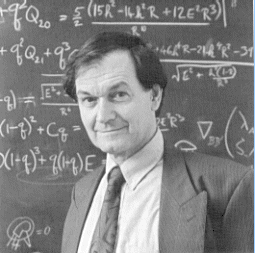
Roger Penrose

his next one would be a welcome companion for long winter evenings.  Wrong!

I managed to the bottom of the third page of the preface before “According to the mathematician’s “equivalence class” notion …..” had me grasping for meaning.  Well over a 1,000 pages of content was destined to gather dust on the bookshelf.

But wrong again!

The idea of matter out there in the universe that is essential to the universe as we know it but is unseen has been sufficiently fascinating for the popular media to refer to it from time to time.  Most people are familiar with the term even if like me don’t really have a clue as to what dark matter is all about.

So a recent press release in a popular English newspaper suggesting that dark matter has been ‘discovered’, if discover is the appropriate term, had me reaching out for Penrose’s book again.  There under the chapter headed Speculative theories of the early universe was, on page 773, a few sentences that almost made sense.  Let me quote them:

For many years, it had become clear that the dynamics of stars within galaxies does not make sense, according to standard theory unless there is a good deal of more material in the neighbourhood of the galaxy than is directly seen in stars.  A similar comment applies to the dynamics of individual galaxies within clusters.  Overall, there seems to be about 10 times more matter than is perceived in ordinary baryonic form.  This is the mysterious dark matter whose actual nature is still not agreed upon by astronomers, and which may even be of some material different from any that is definitely known to particle physicists – though there is much speculation about this at the present time.

Read more about Dark Matter

The Boeing 787 Dreamliner: an impressive aircraft

What does the much delayed maiden flight of the Boeing 787 tell us about integrity?

But how difficult can it be for Boeing to make yet another new aircraft? The answer depends on how different the 787 aircraft is from anything the company has built in the past. Some initial indication that is significantly different can be taken from its being named Dreamliner.

Read more about the B787

Greg Craven and the power of social media

There’s a new power on the streets and it may make politicians feel very uncomfortable!

The Rt Hon Gordon Brown

Like me, you probably haven’t heard of Greg Craven.  I hadn’t until about 24 hours before starting to write this Post (that would be Friday afternoon, Mountain Time, on the 11th December).

I was doing some research for an earlier Post about Copenhagen and came across a YouTube video created by Greg.  More details and links later after making a more fundamental point.

This video of Greg’s has had 2,704,000 viewings! The information on that YouTube ‘page’ has had over 7,500,000 viewings. Greg has now written a book and so on, and so on.

In other words, the personal message that Greg is conveying has reached an unbelievable number of people.  That would have been impossible without the power and reach of modern social media software systems: YouTube, Facebook, Linked-In, Twitter, MySpace, Digg, at al.

In the past, information has flowed outwards in a much more ‘top down’ way.  Hierarchical, as it is called.   That has suited those that wish, in some way, to control the message.  While individuals would always chatter and gossip with their peers, there was a finite limit to that before “Send reinforcements, we are going to advance” morphed into “Send three and fourpence, we are going to a dance”!

The example of Greg Craven shows only too well how information can now flow.  Out of anyone’s control, spreading virally.

Having made my point, I want to return to the subject matter that Greg is championing – but will include that in a separate Post.

Politicians!  Be very careful what you say.  We are all listening now, in one way or another, and ready to pounce if we don’t trust your words!

By Paul Handover

There are graveyards, and graveyards!

The almost surreal area where aircraft are ‘laid to rest’.

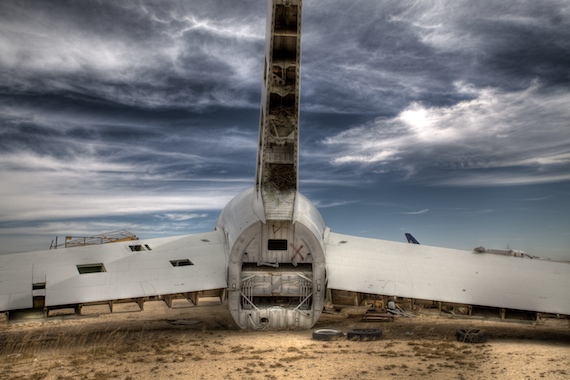
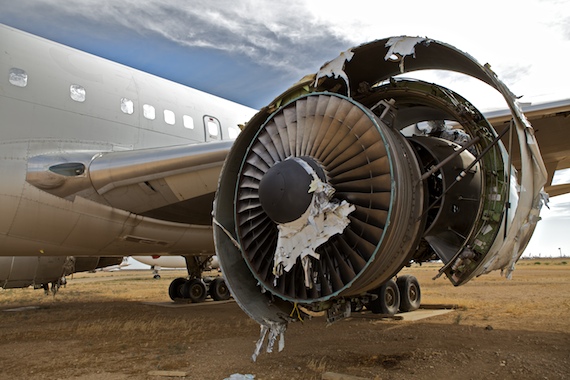
The Mojave Desert is one of the places in the world where aircraft, both military and civil, are placed when they are at the end of their life, whatever that means.

Anyway, came across some nice material and wanted to share it.

In an earlier copy of Mental Floss Magazine (seriously) there’s a very good article about this area.  Fabulous pictures, by the way. (Both pics in this Post are from that article.)

Next this is a YouTube video using Google Earth in flyover mode:

Finally, a reminder that it’s not all about dead aircraft.  The Mojave Air & Space Port is also the site of the privately backed SpaceShip enterprise.

All in all, not your average place.

By Paul Handover

Remarkable people: Tim Smit

The Eden Project in Cornwall, England

To lead the project which took an old clay pit in a remote corner of the UK and converted it into a world class environmental visitor attraction is a tremendous achievement.

Homo sapiens? A game show!

Tim Smit had some fun with the business community at the 2009 Annual Convention of the UK Institute of Directors. Everyone, including he, was in their best business attire, but very few people could get away with crumpled shirt and jeans!

However, he has a serious message about the environment (1:55) and he knows a thing or two about people as well!

Monty Python: is there intelligent life on earth?

For fun, and on an Australian tack, Eric Idle is not so sure.

By John Lewis

Black holes, colliders and paradoxes

This is a very strange world that we live in.

It would be fair to say that my knowledge about what I am writing in this Post is minimal to the point of total ignorance.  So why open my mouth and prove it!  Because the conquest of fundamental questions about our world is not only an example of mankind at its greatest but also something of broad appeal.

That is proved by the continuing popularity of the BBC Television Series – Horizon.  In that series there have recently been two fascinating programmes: Who’s afraid of a big Black Hole? and How long is a piece of string? (Readers outside the UK will not be able to view these programmes.)

Here are the programme summaries:

Black holes are one of the most destructive forces in the universe, capable of tearing a planet apart and swallowing an entire star. Yet scientists now believe they could hold the key to answering the ultimate question – what was there before the Big Bang?

The trouble is that researching them is next to impossible. Black holes are by definition invisible and there’s no scientific theory able to explain them. Despite these obvious obstacles, Horizon meets the astronomers attempting to image a black hole for the very first time and the theoretical physicists getting ever closer to unlocking their mysteries. It’s a story that takes us into the heart of a black hole and to the very edge of what we think we know about the universe.

and

Alan Davies attempts to answer the proverbial question: how long is a piece of string? But what appears to be a simple task soon turns into a mind-bending voyage of discovery where nothing is as it seems.

An encounter with leading mathematician Marcus du Sautoy reveals that Alan’s short length of string may in fact be infinitely long. When Alan attempts to measure his string at the atomic scale, events take an even stranger turn. Not only do objects appear in many places at once, but reality itself seems to be an illusion.

Ultimately, Alan finds that measuring his piece of string could – in theory at least – create a black hole, bringing about the end of the world.

Read more of this strange world

The Moon and water!

NASA reveals that there is a significant amount of water on the Moon.

In a rather awful pun, NASA published update on the LCROSS Mission starts with the words, “The argument that the moon is a dry, desolate place no longer holds water.

LCROSS
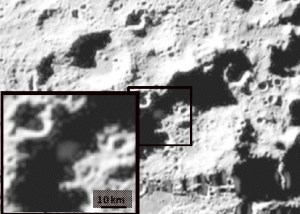
The visible camera image showing the ejecta plume at about 20 seconds after impact.

Anyway, the significance of the update is enormous.  As the NASA release goes on to say,

Scientists have long speculated about the source of vast quantities of hydrogen that have been observed at the lunar poles. The LCROSS findings are shedding new light on the question of water, which could be more widespread and in greater quantity than previously suspected.

Permanently shadowed regions could hold a key to the history and evolution of the solar system, much as an ice core sample taken on Earth reveals ancient data. In addition, water, and other compounds represent potential resources that could sustain future lunar exploration.

The BBC also reports the NASA data but, I am bound to say, in a rather more reader-friendly format.

By Paul Handover

Things aviation and the ‘wow’ effect.

Some stunning pictures.

Of the six active authors on this Blog, four have been or still are pilots.  Of course, only young Bob Derham is a ‘real’ pilot having been an Air Transport pilot for almost as long as Pontious Pilate (sorry, that’s an awful pun!).

Anyway, there has been a growing collection of some incredible photographs from odd sources around the Web and it seemed time to share a few.

Here’s a wonderful picture of an F-15C Eagle Fighter circling over the Kennedy Space Centre in Florida with Shuttle Mission STS 108 on the launch pad.

011129-F-1279W-025

See more aviation pictures

Against “Daylight Saving”!

An ancient idea may have run it’s course?

What is the purpose of “Daylight Saving”? [Interesting history of Daylight Saving on Wikipedia. Ed.]

clock faceThis week we are in a particularly interesting situation as we are in the middle of a one week separation between the dates when Europe and US change their clocks back to “normal” winter time. I.e. Europe changed their clocks back at 2am last Sunday and most, but not all, US States change their clocks back at 2am this coming Sunday.

This is even more confusing than normal. But why are we doing this at all?

Is it to save fuel, to save lives, to save time or to save something else?

In my humble opinion it is all nonsense!

“Time management” is a myth

Time is time! People say that they do not have enough time to do this or that, as if they have ways to make some more; and, of course, there is much talk about “time management”. Yet we all have the same amount of time and no amount of management will change that!

We are certainly able to manage the things that we try to fit into the available time.  That is, we can manage tasks, effort and so on. But, in everyday (Newtonian rather than Einsteinian) regimes, time is an inelastic independent variable. Fiddling about with the clocks and trying to “manage time” have no effect on the stuff whatsoever. Let it be!

There must be a better way!

Yes, I know! Some people make claims of wasted daylight or of the dangers to schoolchildren walking to or from school in the dark. These are valid areas of concern. If adjusting the times of business operations or schooling helps to deal with them, then by all means do so. But, for goodness, let’s not pretend the time is different.

By John Lewis

Lost for words!

Sent to me by Neil Kelly, a long-standing friend in Devon, England.

Wish I could add something witty to this, but I can’t!  But it does remind me of the saying, there’s no such thing as error-free software!

plane

P.S. the image is too small to read the copyright notice – anyone help out?  It would be good to credit it properly.

By Paul Handover