Category: Technology

A very simple notion.

Our beautiful planet.

As is the way of things, two completely disconnected events rang out yesterday, as if in harmony.

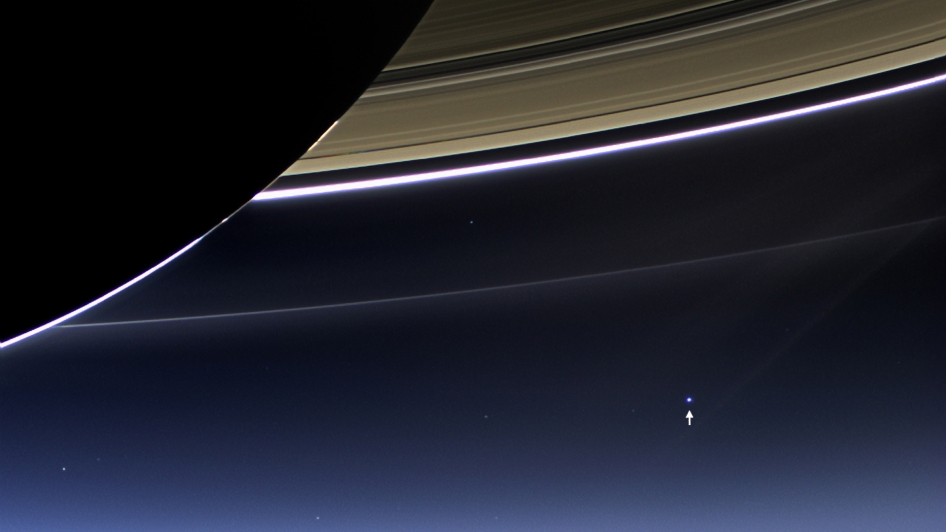
The first was this stunning picture released by NASA.

A distant view of home!

The full description may be read here, but I have taken the liberty of republishing this extract:

Earth, which is 898 million miles (1.44 billion kilometers) away in this image, appears as a blue dot at center right; the moon can be seen as a fainter protrusion off its right side. An arrow indicates their location in the annotated version. The other bright dots nearby are stars.

Now it doesn’t take too much imagination to put that minute speck of light, our Planet Earth, into its scale of meaning and importance vis-a-vis the universe.  You get my message, I’m sure.

The second event was a comment left by long-term reader and supporter of Learning from Dogs, Patrice Ayme.  The comment was on yesterday’s post, The meaning of wildness, and I quote:

Excellent article. Clearly primary temperate rain forest, nearly gone everywhere except in the American North west, has to be reintroduced.

Sheep ought not to be removed by man, but be removed by wolf, bear, felids. Cows would feel whole, having to fight off lions. And man’s sense of what nature means, vital to insure our survival, would blossom in this hour of need, when we have arisen as the planet’s gods. gods of evil, or gods of wisdom? That is the most important question.

“gods of evil, or gods of wisdom?”

To everybody I say this.  (And I am most certainly not excluding me.) When you next look at yourself in the mirror will you make a decision?  Will you be a god of evil or a god of wisdom?

Very, very long odds!

Looks like being a Dan Gomez weekend.

Dan sent me an email with a link to a most astounding video.  But before we get to that, just take a look at these images.  Here are the first three from the set of eight.

Eight breathtaking images of baby stars

MNN1

1. Beautiful newborns

In a universe of fantastic images, a newborn star is a mystical masterpiece. Cradled within the dusty arms of a nebula, a baby star seems to blink its way to a new life. The lifespan of a star is a series of sequences. A star may spend most of its life in a “main sequence phase” where nuclear fusion of hydrogen into helium is happening in its core. But before this happens, it lives as a protostar, or baby star.

Thanks to NASA’s advanced infrared space telescopes such as Hubble and Spitzer, we are able to view these star births as never before. Pictured here are newborn stars peeking out “from beneath their natal blanket of dust” in the Rho Ophiuchi dark cloud as seen by the Spitzer Space Telescope. (Text: Katherine Butler)

MNN2

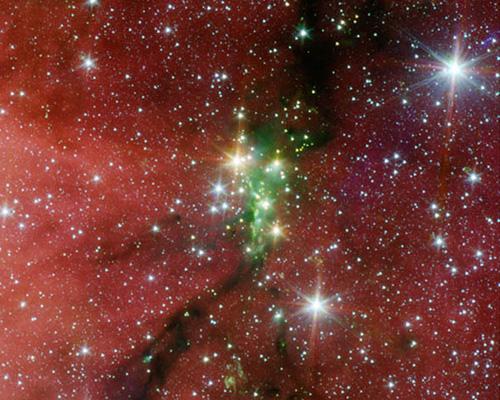
2. Young stars in Serpens

Here the Spitzer Space Telescope reveals the Serpens South star cluster, in which 50 or so young stars exist. They are seen as the “green, yellow, and orange-tinted specks sitting atop the black dust lane.” A supernova or galaxy collision can cause a star to form when huge clouds of hydrogen and helium collapse under mutual gravity. As the cloud collapses, it heats up and starts to spin. Since protostars are covered in dust, they can be seen only through infrared telescopes like Hubble and Spitzer. As Universe Today writes, “After about 100,000 years or so, the protostar stops growing and the disk of material surrounding it is destroyed by radiation.” Then this star, now called a T Tauri or pre-main sequence star, is visible from Earth.

MNN3

3. Bubbly little star

We are used to images of babies blowing bubbles, and it looks like the infants of the cosmos do the same. This image, taken by the Spitzer Space Telescope, shows the HH 46/47 baby star blowing bubbles into space via powerful jets of gas. Located about 1,140 light-years from Earth, HH 46/47 is the bright white star at the middle of the image. Two bubbles reach out in opposite directions and are formed when the jets collide with the dust and gas surrounding the star. As Universe Today reports, “Astronomers think that young stars accumulate material by gravitationally pulling in gas and dust. This process ends when the star gets large enough to create these jets. Any further material is just blown away into space.”

Go and view the remaining five stunning images here.

Now to what was sent by Dan.

Check out this mind-bending video that talks about the “Hubble Ultra Deep Field” image captured by NASA astronomers nearly a decade ago — a photograph that some call “the most important image ever taken.”

It all started back in 1996 when a group of astronomers pointed the Hubble Space Telescope at an empty patch in the sky close to the Big Dipper in hopes of seeing something, anything. At the time, it was considered to be a risky move, given that demand for use of the telescope was so high. What if the experiment yielded no results? What if nothing but an empty image was the final result?

After ten full days of exposing the telescope’s CCD camera sensor to this seemingly vacuous patch of sky, a breathtaking image was produced. Over three thousand galaxies appeared in one image — some as dots, others as spirals. It was a visual reminder of just how big our universe really is. The photo is called the “Hubble Deep Field“:

A Mind Bending Look at the Hubble Ultra Deep Field Photo of the Universe hdf

In 2004, astronomers pointed Hubble near constellation Orion and opened the shutter for a whopping 11 days. Using sensitive detectors and specialized filters, the telescope was able to capture an image with over 10,000 galaxies. This image became known as the “Hubble Ultra Deep Field.”

A Mind Bending Look at the Hubble Ultra Deep Field Photo of the Universe hudf

Scientists later used redshift calculations of the galaxies to turn the photograph into a “fly-thru” view of the photo:

It didn’t end there. Last year, NASA scientists created the Hubble Extreme Deep Field, which has an equivalent exposure time to 23 days and features. It’s the “deepest image of the sky ever obtained” that reveals “the faintest and most distant galaxies ever seen”:

A Mind Bending Look at the Hubble Ultra Deep Field Photo of the Universe deepest

And just think: scientists created these photos by pointing their mega-camera at a tiny speck of the night sky that appears to be completely devoid of visible stars!

oooOOOooo

… a tiny speck of the night sky that appears to be completely devoid of visible stars!

Dan said in his email, “Are we really here?  What are the chances?”

You really have to wonder!  Incredibly long odds.  Both to us being here and to us being the only conscious, intelligent species in the universe.

The power of the atmosphere.

Now I did say this was going to be an odd assortment of posts for a few days!

Back in my ‘previous’ life in SW England and together with a group of friends we formed an online aviation briefing company, called AvBrief rather unimaginatively!  The UK Met Office have their headquarters in Exeter, Devon and AvBrief had a commercial relationship with the Met Office.

UKMO

Although no longer resident in the UK, I still subscribe to the UK Met Office blog and find many of their posts interesting.  Such as this one that came in yesterday.

oooOOOooo

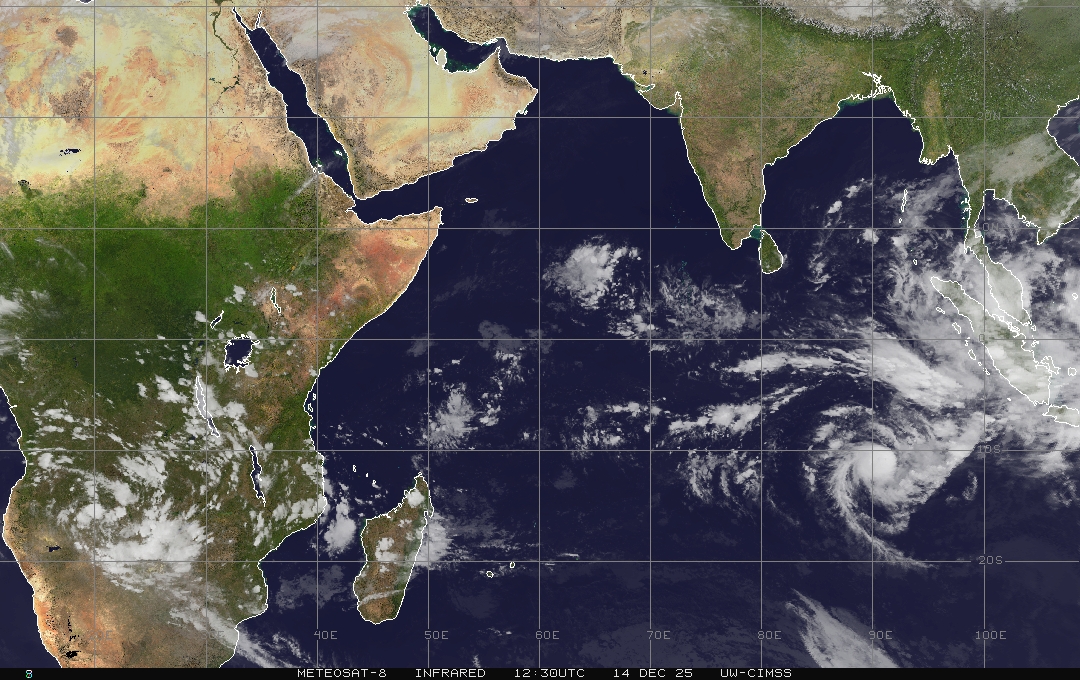
Cyclone twins form in the Indian Ocean by Dave Britton

11th May, 2013

April to June each year usually sees the transition from the southern to the northern hemisphere tropical cyclone season.

During this time it is possible to see cyclones in both hemispheres simultaneously. Furthermore, cyclone ‘twins’ sometimes develop at approximately the same longitude either side of the equator.

For the first time since 2009 cyclone twins have developed in the Indian Ocean.

This was caused by a strong burst of westerly winds along the equator about a week ago. A large mass of clouds located in the same area initially moved eastwards with the wind.

The clouds furthest from the equator then started to curl northwards in the northern hemisphere and southwards in the southern hemisphere due to the earth’s rotation. Over time these cloud masses have consolidated and started to rotate to produce twin tropical storms.

The southern hemisphere storm has been named Jamala and is currently not expected to affect any land areas.

The northern hemisphere storm has been named Mahasen and there is a stronger likelihood of this making landfall next week on one of the Bay of Bengal’s coastal regions.

Regional warnings for Tropical Storm Jamala are produced by the Tropical Cyclone warning Centre at La Réunion in the South Indian Ocean.

Regional warnings for Tropical Storm Mahasen are produced by the Tropical Cyclone Warning Centre at New Delhi, India.

The Met Office routinely supplies predictions of cyclone tracks from its global forecast model to regional meteorological centres worldwide, which are used along with guidance from other models in the production of forecasts and guidance.

You can keep up to date with tropical cyclones around the world on our website or follow us on Twitter.

You can see the latest image of Tropical Storms Jamala and Mahasen at:

http://tropic.ssec.wisc.edu/real-time/indian/images/xxirm5bbm.jpg

oooOOOooo

Fascinating.  Well, it is this far from the Indian Ocean.

Beyond our beautiful planet.

Lifting one’s eyes to the far heavens.

Yesterday, I reposted 12 stunning photographs of the world we live on that had been published on Mother Nature Network on the 19th.

Coincidentally, I also saw something on the 19th that was just as breathtaking as those pictures of Planet Earth.  Here’s the picture that took my breath away.

HERSCHEL’S VIEW OF THE HORSEHEAD NEBULA

That image comes from the ESA Space in Images website, from which one learns:

  • Copyright: ESA/Herschel/PACS, SPIRE/N. Schneider, Ph. André, V. Könyves (CEA Saclay, France) for the “Gould Belt survey” Key Programme
  • Description: Stunning new view from ESA’s Herschel space observatory of the iconic Horsehead Nebula in the context of its surroundings. The image is a composite of the wavelengths of 70 microns (blue), 160 microns (green) and 250 microns (red), and covers 4.5×1.5 degrees. The image is oriented with northeast towards the left of the image and southwest towards the right.The Horsehead Nebula resides in the constellation Orion, about 1300 light-years away, and is part of the vast Orion Molecular Cloud complex. The Horsehead appears to rise above the surrounding gas and dust in the far right-hand side of this scene, and points towards the bright Flame Nebula. Intense radiation streaming away from newborn stars heats up the surrounding dust and gas, making it shine brightly to Herschel’s infrared-sensitive eyes (shown in pink and white in this image).To the left, the panoramic view also covers two other prominent sites where massive stars are forming, NGC 2068 and NGC 2071.

    Extensive networks of cool gas and dust weave throughout the scene in the form of red and yellow filaments, some of which may host newly forming low-mass stars.

Don’t know about you but I found that description a little dry, so to speak.

The BBC had a much friendlier version:

By Jonathan Amos, Science correspondent, BBC News.

Europe’s Herschel space telescope has imaged one of the most popular subjects in the sky – the Horsehead Nebula – and its environs.

The distinctively shaped molecular gas cloud is sited some 1,300 light-years from Earth in the Constellation Orion.

It is in a region of space undergoing active star formation – something Herschel has been most keen to study.

The Hubble space observatory has also returned to the Horsehead scene, to celebrate 23 years in orbit.

Together, these two great facilities give scientists a much broader insight into what is taking place in this familiar patch of the heavens.

“You need images at all scales and at all wavelengths in astronomy in order to understand the big picture and the small detail,” said Prof Matt Griffin, the principal investigator on Herschel’s SPIRE instrument.

“In this new Herschel view, the Horsehead looks like a little feature – a pimple. In reality, of course, it is a very large entity in its own right, but in this great sweep of a picture from Herschel you can see that the nebula is set within an even larger, molecular-cloud complex where there is a huge amount of material and a great range of conditions,” the Cardiff University, UK, researcher told BBC News.

To provide a sense of scale, the Horsehead Nebula, also known in the catalogues as “Barnard 33”, is about five light-years “tall”.

Hubble's new view of the Horsehead Nebula, a large cloud of hydrogen laced with dust.
Hubble’s new view of the Horsehead Nebula, a large cloud of hydrogen laced with dust.

Hubble sees the Horsehead in near-infrared light. Herschel, on the other hand, goes to much longer wavelengths. This allows it to see the glow coming directly from cold gas and dust – the material that will eventually collapse under gravity to form the next generation of stars.

Scientists are particularly keen to understand the mechanisms that drive the production of the biggest stars – objects much more massive than our own Sun that form relatively fast, burn bright but brief lives, and interact strongly with their environment, influencing the next round of star formation.

Anyway, that’s more than enough to copy directly from that BBC article.  Read the rest by going here.  All I will add is Jonathan’s last sentence, “A scholarly paper describing Herschel’s investigation of the Orion Molecular Cloud Complex has been published in the journal Astrophysical Journal Letters.

Oh, and ponder on how far away from Earth is that Constellation Orion.  Remember it was stated as 1,300 light-years.

Well, one light-year is just under 10 million, million kilometres (or about 6 million, million miles).  Apparently defined by the  IAU, or to give its the full name, the International Astronomical Union, a light-year is the distance that light travels in a vacuum in one Julian year.

So brace yourself!  1,300 light-years is just under 13,000,000,000,000,000 kilometres or in old money, 7,800,000,000,000,000 miles.

Rather puts pottering to the shops in Grants Pass into perspective!

Just a small, white dot!

Does rather serve to remind us of our place in the scheme of things.

This stunning image was taken by the Cassini-Huygens probe.  Many of the images taken by NASA are available for download from the DVIDS website, which is where this one was found. (But also do visit the Ciclops website.)

The title of the photograph is:

A View of Earth from Saturn

A View of Earth from Saturn: Image of the Day

Although the Earth Observatory typically reserves ”Image of the Day” space for publishing data and images acquired by Earth-observing satellites, we are sometimes so enthralled by the spectacular images acquired by spacecraft observing other parts of the solar system that we want to share these ‘otherworldy’ views with our visitors. And if you are looking for remotely sensed images of the Earth, this view is the most remotely sensed image we have ever published!

This beautiful image of Saturn and its rings looks more like an artist’s creation than a real image, but in fact, the image is a composite (layered image) made from 165 images taken by the wide-angle camera on the Cassini spacecraft over nearly three hours on September 15, 2006.

Scientists created the color in the image by digitally compositing ultraviolet, infrared, and clear-filter images and then adjusting the final image to resemble natural color. (A clear filter is one that allows in all the wavelengths of light the sensor is capable of detecting.) The bottom image [the one above. Ed.] is a closeup view of the upper left quadrant of the rings, through which Earth is visible in the far, far distance.

On this day, Saturn interceded between the Sun and Cassini, shielding Cassini from the Sun’s glare. As the spacecraft lingered in Saturn’s shadow, it viewed the planet’s rings as never before, revealing previously unknown faint rings and even glimpsing its home world. Seen from more than a billion kilometers (almost a billion miles) away, through the ice and dust particles of Saturn’s rings, Earth appears as a tiny, bright dot to the left and slightly behind Saturn.

Although it might appear that Earth is located within Saturn’s outermost rings, that positioning is just an illusion created by the enormous distance between Cassini and Earth. When Cassini took this image, the spacecraft was looking back at Saturn from a distance of about 2.2.million kilometers (about 1.3 million miles). The Sun was millions of additional miles beyond, hidden behind Saturn. On September 15, Earth’s orbit had brought our home planet to a location slightly behind and to the left of the Sun from Cassini’s perspective. The Website of the Cassini Imaging Central Laboratory for Operations (CICLOPS) provides more detailed information about this image. The Cassini-Huygens mission is a cooperative project of NASA, the European Space Agency, and the Italian Space Agency.

Trying to find that faint image of Planet Earth in the above photograph is a challenge, even for those with much younger eyes than mine.

However, with a little bit of jiggery-pokery I was able to crop and enlarge the photograph, see below:

saturn

Planet Earth is in the ’10 o’clock’ position in the photograph, about half-way from the centre of the enlarged segment towards the top-left corner of the picture, just outside the outer white ring.

That’s us. All that we have ever been. All that we ever will be. Just that small white dot.

DA14

Not such a bizarre post title as you might think!

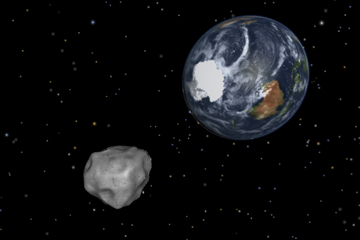
asteroid-2012-da14-art

DA14, or to give it’s full name, Asteroid 2012 DA14, is calling by Planet Earth rather soon.  To quote the item on the Planetary Society’s website,

Asteroid 2012 DA14 Discovery Enabled by Planetary Society Grant

On Friday, February 15, 2013, Asteroid 2012 DA14 will travel just 17,000 miles above the Earth – closer to our planet than the orbit of the communications satellite that broadcast the Super Bowl around the world. About half the size of a football field and with more than 100 times the energy impact of the nuclear bomb that fell on Hiroshima, DA14 will miss Earth this time around, but if it had impacted, this asteroid could have taken out any major metropolitan city on our planet.

The discovery of Asteroid DA14 was made by a small team of observers at La Sagra Observatory in Southern Spain, on February 22, 2012, enabled with a grant provided by The Planetary Society. One of the observatory’s telescopes had recently been upgraded with funds donated by The Planetary Society’s NEO Shoemaker Grant program. Its new camera enabled detection of fast moving objects like 2012 DA14 – requiring very fast imaging for discovery and determination of their paths. The upgraded instrument has far outperformed the Observatory’s other telescopes.

Now, we get to point the world’s telescopes at this 2013 close flyby and learn more about this asteroid and its orbit because of the support of our Planetary Society Members all over the world.

This asteroid won’t hit Earth, at least for many, many decades.  But it is a reminder we live in a cosmic shooting gallery.  We need to find, track, and characterize these objects and develop the technical and political capability to deflect an asteroid.  It is not a matter of whether there will be a dangerous impact, it is a matter of when.

The Planetary Society and its members are working to do our part through programs like ourShoemaker NEO Grants, like the one that made the discovery of 2012 DA14 possible, and projects like Laser Bees, exploring new ways to potentially deflect a dangerous asteroid.

NASA have recently released a video, see below, but a search on YouTube will find more, some of which are more engaging than the rather dry style of the NASA release.


Have questions?  Bet you do!  Here are some of the answers to the obvious ones.  Including these:

What is the time of closest approach

Feb. 15, 2013, 19:25 UTC (11:25 PST)

What is the closest approach altitude?

Approximate altitude above the surface of the Earth will be 27,330 km, 17,000 mi (34,100 km, 21,200 mi from center of Earth).  That is closer than the altitude of geosynchronous satellites, e.g., satellite TV satellites, at 35,786 km (22,236 mi) altitude.

Will it be visible with the naked eye, how bright will it be?

It will not be a naked eye object.  At closest approach, its brightness will be about a magnitude of 7.  It will be bright enough that it could be seen with steady binoculars or a small telescope if you are on the side of Earth it will be passing.

What parts of Earth will have a chance to observe it telescopically?

Near closest approach when it is brightest, most of Europe, Asia, and Africa.  It will pass from the southern hemisphere to northern hemisphere.  Though it will be much dimmer, it is observable by larger telescopes for days to weeks before and after closest approach.

Finally, well done those gents that first spotted DA14.

Miguel Hurtado, Jaime Nomen, and Jaume AndreuWinners of a Planetary Society Shoemaker NEO Grant in 2010
Miguel Hurtado, Jaime Nomen, and Jaume Andreu
Winners of a Planetary Society Shoemaker NEO Grant in 2010

Now where did I put my tin helmet?

Nostalgic musings

Early days in London

In my recent post Electrosensitivity, I wrote about “spending a number of years studying for a Diploma in Electrical Engineering at Faraday House, Southampton Row, London and becoming a UK Radio Amateur at the age of 17 (G3PUK)“.

In reverse order, I shall start with becoming a UK Radio Amateur, now rather back in the mists of time!

After my father died in 1956 my mother subsequently remarried.  Her new husband was Richard Mills and he was very knowledgeable about radio matters; he was a technical author in the radio-communications industry.  It was Richard, my step-dad, who showed me how to make a crystal set and I started listening to the strange world of wireless radio.  It fascinated me and motivated me to save up my pennies and buy an ex-military radio receiver known as a R1155.

r1155

I had joined the Harrow Radio Society who, amazingly, are still active today, as their website demonstrates.

Under the fabulous tutelage of many of the older ‘hams’ I went on to sit my exams and on Valentine’s Day 1962 was awarded the Postmaster-General’s Amateur Radio Certificate.  I applied for a call-sign and was allocated G3PUK.  I was just 17 years old!

G3PUK0001

oooOOOooo

Now some memories of Faraday House.  I can do no better than refer you to an article that appeared on the Electrical Review website in the UK.  As the article was published over three years ago, I think republishing it on Learning from Dogs isn’t being too naughty.

faradayhouseplaque

Faraday House Association closes after 105 years

FRIDAY, 29 JANUARY 2010

It is with sadness we report the Faraday House Old Students Association (FHOSA) is to close after operating continuously over the last 105 years. It had been host to thousands of chartered electrical engineers. The Association membership is derived from old students of Faraday House.

In 1888 the revised Electric Lighting Act encouraged many local authorities to apply for Parliamentary Powers to establish generating stations to transmit power. Faraday House was founded to train engineers in this new practice. The college started life as the Electrical Standardising, Testing and Training Institution at Charing Cross but in June 1890 used the name Faraday House. It was located in the Charing Cross area, and fees were 100 guineas per annum. The first Faraday House Dinner was held in 1895 – it was free and some 170 attended. In 1905 the FHOSA was formed and 100 old students joined. A move was then made to Southampton Row. By now the college had 110 students.

In 1909 Dr Russell was appointed principal, and pioneered the sandwich course. This meant students had a year or so of theory and then experienced work in industry, returning again to more theory. By 1914 many old students joined up and a crash course was started to aid the war effort. By 1919 some 350 had been in the services and 34 had died. In 1920 the fees had risen to 300 guineas.

By 1928 1000 students had joined the Old Students Association and in 1929 a 40th anniversary dinner was held. In 1939 a discussion with the governors resulted in a decision to evacuate the college to Thurlestone in Devon. A new principal, Dr WRC Coode-Adams, took over from Dr Russell. Faraday House took over the Links Hotel. Staff and students who were married lived in the hotel or in houses that had been taken over by the college.

In 1942 the college returned to Southampton Row. After the war Faraday House had difficulty in recruiting, students were lured to other colleges and universities by grants. In 1957 Mr GH Randolph Martin was appointed Principal. He had been a lecturer at the college since 1948. The college closed its doors in 1967 as losses were now running at £20,000 per year.

During its lifetime Faraday House produced a succession of engineers who attained the most senior positions in industry and electrical supply in many countries, and six old students have been president of the Institution of Electrical Engineers (now the IET).

The Old Students Association has a membership that is steadily growing older and shrinking as members die. The closure was inevitable without younger people coming forward to run it. The FHOSA will shut its doors finally after the Annual General Meeting in March 2010.

Here’s the front of the building.

Faraday House, London

How the years have flown by!

EMF safety

From knowledge to awareness and then to protection.

Yesterday, I dipped into the subject of electro-magnetic radiation.  As hopefully made clear, I was writing in response to the film Beings of Frequency that was presented the previous day.

If you haven’t yet watched the film, then do.  To be frank, the posts of yesterday and today are that much more valuable after the film has been watched.

Brain-Tumor-Report-Cover-Image

In terms of reducing the effects of EMF, then a quick ‘Google’ search will bring up teems of websites.  Many of them are selling filters, consultancy, EMF surveys, and more.  While in no way impugning those services, my instinct is to be drawn to those websites and blogs motivated by the desire to be informational alone.  At this stage of my research anyway.

Take EMF Damage for example, from which I quote:

There is a connection between electromagnetic fields and some cancers including leukemia

EMFDamage.com is online for these reasons:
1. To let you know there are serious health risks involved in living or working too close to power lines. I am certain the power line behind my home is the direct cause of my diagnosis of chronic lymphocytic leukemia. Electromagnetic fields (EMFs) have also been linked to other adult leukemias, childhood leukemia and brain cancer.

2. In addition to EMFs from power lines, you may also be exposed to unhealthy levels of EMFs from sources inside your home and workplace. These fields are easier to control and correct.

3. There are many ways to detect and measure the EMF levels at your home and at work.

4. You can reduce high EMF levels to reduce your risk of exposure.

We sell nothing on this web site and have no affiliations with any of the linked businesses or organizations. The purpose of this web site is purely informational.

That gets my vote.

So too does the website The EI Wellspring.  On their ‘About‘ page they write:

This website’s primary purpose is to provide practical information for people with severe multiple chemical sensitivity (MCS) and electromagnetic hypersensitivity (EHS/ES). MCS and EHS are closely related illnesses, which together are referred to as Environmental Illness (EI).

This is not a commercial site. Vendors and products are mentioned in some articles, but there are no paid product endorsements. Recommendations are based on the experiences of the authors and do not necessarily reflect the opinions of this site or its management.

The information presented reflects the experience and opinions of individuals who wish to help others. Naturally, what works for one person may not work for another. The reader should evaluate the suggestions in the context of his or her own situation, and apply good judgment and common sense before following suggestions presented.

So at this time, I don’t have the awareness of just what levels of EMF radiation we are exposed to here at home.  But I’m going to undertake an investigation and, if we have a problem, work to a ‘cleaner’ house.

I shall be writing about this journey at regular intervals and explaining clearly why we did or did not do this or that.

What I would be delighted to publish on Learning from Dogs are accounts from others who have made similar journeys or know that they have been affected by EMF radiation.  Do please drop me an email.

Electrosensitivity (EHS)

Musings on the subject of radio frequency energy.

Faraday House, London

Let me first be completely open about this.  Despite spending a number of years studying for a Diploma in Electrical Engineering at Faraday House, Southampton Row, London and becoming a UK Radio Amateur at the age of 17 (G3PUK), my memory of this subject has become less focused!  Bit like my eyesight!  (I’ll wallow in this nostalgia for Saturday’s post!)

There’s a wealth of information available if you do a web search on the subject of ‘radio frequency spectrum‘ including diagrams such as this one.

Radio Spectrum in demand

In fact, if you use the image above with this one below, you will get a quick idea of the range of frequencies and how almost every aspect of modern life is connected to ‘RF’.  (NB: I find the one below a little out of focus but hope it’s legible.)

rf spectrum

If you look at the frequency band 300 MHz to 3GHz, known as the Ultra-High Frequency or UHB band you will see that it is used by devices including mobile or cell phones as well as wireless phones and the newer DECT phones; these latest phones operating at 900 MHz.

Now I don’t understand the physics of Radio Frequency (RF) transmissions but I do know that the higher the frequency, the more energy is carried.  Living cells are not happy in the presence of RF particularly at those higher frequencies.  Just go back to that top diagram and think about being zapped by X-Rays, Gamma Rays or Cosmic Rays!  Here’s an extract from a Wikipedia article on Radiation burn.

The most common type of radiation burn is a sunburn caused by UV radiation. High exposure to X-rays during diagnostic medical imaging or radiotherapy can also result in radiation burns. As the ionizing radiation interacts with cells within the body—damaging them—the body responds to this damage, typically resulting in erythema—that is, redness around the damaged area. Radiation burns are often associated with radiation-induced cancer due to the ability of ionizing radiation to interact with and damage DNA, occasionally inducing a cell to become cancerous. Cavity magnetrons can be improperly used to create surface and internal burning. Depending on the photon energygamma radiation can cause very deep gamma burns, with 60Co internal burns are common. Beta burns tend to be shallow as beta particles are not able to penetrate deep into the person; these burns can be similar to sunburn.

Radiation burns can also occur with high power radio transmitters at any frequency where the body absorbs radio frequency energy and converts it to heat.[1] The U.S. Federal Communications Commission (FCC) considers 50 watts to be the lowest power above which radio stations must evaluate emission safety. Frequencies considered especially dangerous occur where the human body can become resonant, at 35 MHz, 70 MHz, 80-100 MHz, 400 MHz, and 1 GHz.[2] Exposure to microwaves of too high intensity can cause microwave burns.

We marvel at the efficiency of microwave ovens but possibly don’t connect those with holding a cell phone or cordless phone next to the head!  If you didn’t watch yesterday’s film Beings of Frequency then I really do recommend that you put some time to one side and watch it.

Like so many aspects of modern life, once one has been made aware of something one finds a mountain of information.  So it is with Electromagnetic hypersensitivity.

Again, Wikipedia.

Idiopathic environmental intolerance attributed to electromagnetic fields (IEI-EMF) is a descriptive term for symptoms purportedly caused by exposure to electromagnetic fields.[1] Other terms for IEI-EMF include electromagnetic hypersensitivity (EHS), electrohypersensitivityelectro-sensitivity, and electrical sensitivity (ES).

Although the thermal effects of electromagnetic fields on the body are established, self-described sufferers of electromagnetic hypersensitivity report responding to non-ionizing electromagnetic fields (or electromagnetic radiation) at intensities well below the limits permitted by international radiation safety standards. The majority of provocation trials to date have found that self-described sufferers of electromagnetic hypersensitivity are unable to distinguish between exposure to real and fake electromagnetic fields,[2][3] and it is not recognized as a medical condition by the medical or scientific communities.

The reported symptoms of EHS include headache, fatigue, stress, sleep disturbances, skin symptoms like prickling, burning sensations and rashes, pain and ache in muscles and many other health problems. Whatever their cause, EHS symptoms are a real and sometimes a disabling problem for the affected persons.

Later on that WikiPedia reference states:

A 2001 survey found that people related their symptoms most frequently to mobile phone base stations (74%), followed by mobile phones (36%), cordless phones (29%) and power lines (27%). The survey was not designed to find any causal connection between electromagnetic field exposure and ill health.[5]

A report from the UK Health Protection Agency said that self-described “electrical sensitivity” sufferers have symptoms that can be grouped into two broad categories: facial skin symptoms and more general, non-specific symptoms across a range of body systems. The facial skin symptoms and their attribution to visual display units was mostly a Nordic phenomenon. The report pointed out that it did not “imply the acceptance of a causal relationship between symptoms and attributed exposure”.[6]

Recently a smaller group of people in Europe as a whole and in the USA have reported general and severe symptoms such as headache, fatigue, tinnitus, dizziness, memory deficits, irregular heart beat, and whole-body skin symptoms.[7] A 2005 Health Protection Agency report noted the overlap in many sufferers with other syndromes known as symptom-based conditions, FSS (Functional Somatic Syndromes) and IEI (Idiopathic Environmental Intolerance).[6] Levitt proposed ties between electromagnetic fields and some of these 20th-century maladies, including Chronic Fatigue SyndromeGulf War Syndrome, and Autism.[8]

Anyone find what was described in that last paragraph touch a sore point! Go here to read the full item and the numbered references.

There’s a host of other websites on the subject.  Just picking one more or less at random reveals this:

Electromagnetic Hypersensitivity (EHS) is a “growing worldwide health concern” according to a December 2005 press release issued by the World Health Organization. EHS can be difficult to understand and even more difficult to diagnose. Many doctors and other health professionals here in North America are not yet aware of the recent scientific evidence surrounding electromagnetic energy (EMF) and its effects on human health.

Symptoms of Electrical Hypersensitivity may include skin rash, sleep disorders, muscle and joint pain (fibromyalgia), chronic fatigue, depression, headaches, dizziness, nausea, difficulty concentrating, memory loss, irritability, anxiety, weakness, muscle spasms, numbness, tingling, leg and foot pain, “flu-like” symptoms and fever.

So that’s enough for today.

Tomorrow, I will explore what we can do to lessen the effects of Electro-Magnetic Fields.

Beings of Frequency

A necessary diversion from my usual style of post.

bees

Today, I am asking you to watch a film.  A full-length film that is on YouTube.  It will open your eyes and almost certainly confirm suspicions that you may have harboured about the long-term consequences of holding a microwave transmitter close to the brain; namely a cell phone or mobile phone.

Tomorrow, I will explore what we can do to reduce the risks that so many of us are exposed to.

So settle down as soon as you can and watch.

Published on Nov 27, 2012

(Full Film) RESONANCE ➜ This James Russell film is a Sensational Eye Opening Documentary that examines 60 years of scientific research! ➜ Join the FACEBOOK page http://goo.gl/yf4Qs

➜ James Russell (Director + Producer)
http://www.FlatFrogFilms.com

➜ John Webster (Director)
http://www.PatientZeroProductions.com

This spectacular documentary uncovers for the very first time the actual mechanisms by which mobile phone technology can cause cancer. And how every single one of us is reacting to the biggest change to the environment this planet has ever seen.

Two billion years ago life first arrived on this planet; a planet which was filled with a natural frequency. As life slowly evolved, it did so surrounded by this frequency and inevitably began tuning in.

By the time mankind arrived on earth an incredible relationship had been struck, a relationship that science is just beginning to comprehend.

Research is showing that being exposed to this frequency is absolutely integral to us. It controls our mental and physical health, it synchronizes our circadian rhythms, and it aids our immune system and improves our sense of wellbeing.

Not only are we surrounded by natural frequencies, our bodies are filled with them too. Our cells communicate using electro-magnetic frequencies. Our brain emits a constant stream of frequencies and our DNA delivers instructions, using frequency waves. Without them we couldn’t exist for more than a second.

This delicate balance has taken billions of years to perfect. But over the last 25 years the harmony has been disturbed and disturbed dramatically.

Mankind has submerged itself in an ocean of artificial frequencies. They are all around us filling the air and drowning out the earth’s natural resonance.

To the naked eye the planet appears to be the same. But at a cellular level it is the biggest change that life on earth has endured; the effects of which we are just starting to see and feel.

butterfly