Category: Strategy

Transitions, pt One

Reflections on these present times.

Want a brilliant idea for tomorrow? Stay in the present!

Dogs do this wonderfully.  I am told that followers of Zen Buddhism discover peace and grace from embracing the present. But is there more to this?  Is there some deeper psychology involved?  Does our species have an intrinsic challenge in terms of staying in the present?

My musings on this arise from a couple of recent conversations.

The first was with Peter McCarthy from the Bristol area of West England.  Peter and I go back a few years (at my age, everything goes back a few years!) and at one stage I did some work for Peter’s company, Telecom Potential.  Just a quick aside, Peter’s company was based in the magnificent Clevedon Hall, a mansion built in 1853 as a family home for Conrad William Finzel, a German-born businessman.  Here’s a picture of one of the rooms,

A room at Clevedon Hall

Peter, like me, is sure that the period in which the world now appears to be, is not some cyclical downturn, not some temporary departure from the national growth and employment ambitions promoted by so many countries.  No! This one is different.

Peter is sure that a major transition is under way, as big as any of the great societal upheavals of the past.  And, for me, a fascinating comment from Peter was his belief that the key attitude required for the next years would be innovation.  Peter reminded me that we tend to think of innovation as applying to things physical, scientific and technical.  But Peter sensed that it would be in the area of social innovation where key changes would arise and, from which, these large societal changes would flow.

Then a day later I was chatting with one of the founders of a brilliant new authentication process, Pin Plus. It is a very smart solution to a major global problem, the weaknesses of traditional password user-authentication systems.

On the face of it, Pin Plus is obviously a better and more secure way of authenticating users, and a number of key test customers have borne this out.  Jonathan C was speaking of the challenges of convincing companies to have faith in this new process.  This is what he said,

More than once, indeed many times, I am told by prospects something along the lines that the IT world has been looking so hard and so long for a password solution that a solution can’t possibly exist.

Let’s ponder that for a moment.  Are we saying that a far-sighted approach to the potential for change is not an easy place for some, probably many, human brains?

Indeed, Jonathan and I mused that here we were, both speaking via Skype, an internet telephony service, both of us looking at different web sites in support of many of the points that we were discussing and totally dependent, in terms of our mentoring relationship, on the technology of the internet, a multi-node packet-switched communications system that was a direct result of the American shock of seeing the Russians launch the world’s first artificial satellite, Sputnik 1, into low earth orbit on the 4th October, 1957.

Launch of Sputnik 1

At that time, it would have seemed impossible for anyone on the planet to see that the American response to Sputnik 1 would eventually lead to the vast packet-switched network that is now the modern Internet.

But why do we regard the ability to look into the future so utterly out of reach of the common man?  Look at this, the Internet Timeline here.  Look how quickly the response to Sputnik1 gathered pace.  See how Leonard Kleinrock of MIT way back in May, 1961, presented a paper on the theory of packet-switching in large communications networks.

So maybe there’s a blindness with humans.  A blindess that creates the following bizarre characteristics,

  • Whatever is going on in our lives at present we assume will go on forever.  I.e. the boom times will never end, or the period of doom and gloom is endless.
  • Our obsession with how things are now prevents us from reflecting on those signs that indicate changes are under way, even when the likely conclusions are unmistakeable.  The ecological and climatic changes being the most obvious example of this strange blindness that mankind possesses.
  • Yet, unlike animals and some spiritual groups of humans, truly living in the present appears incredibly difficult for man.
  • However, the history of mankind shows that our species is capable of huge change, practically living in constant change for the last few millennia, and that a very small proportion of a society, see yesterday’s article, is all that is required to create a ‘tipping point’.

I want to continue with this theme but conscious that there is still much to be written.  So, dear reader, I shall pause and pick this up tomorrow.

Just stay in the present for twenty-four hours!

The Great Disruption by Paul Gilding

A book review

Unlike my recent review of Capt. Luis Montalvan’s book Until Tuesday which came about as a result of an invitation from the UK publishers, Headline Publishing, this review of Mr. Gilding’s book is totally off my own bat.  I should also declare that I have recently been in email contact with Paul Gilding with some pleasant outcomes.  To the review.

The way ahead.

Regular readers of Learning from Dogs will know that I have been making recent references to this book, which I have now finished reading.  On the 25th I quoted from the book in a post that I called The blame game.  I used a quote from Chapter 5, Addicted to Growth, namely “Growth goes to the core of the society we have built because it is the result of who we are and what we have decided to value.

Then the next day again when writing about Tim Bennett’s movie, What a Way To Go, when I reflected on Paul Gilding’s opinion that, ” the quicker that mankind recognises the massive levels of denial presently in place, the quicker that mankind will commit to the scale of change that is required“.

Now if mankind’s efforts to change to a sustainable way of life were proportional to the number of books, films and essays written about the subject then, frankly, the task would be complete.  There’s an awful lot out there!  Here’s a list of the books that I have read in the last few years:

The Human Side of Enterprise – Douglas McGregor

Motivation and Personality – Abraham Maslow

The Power of Pause – Terry Hershey

Earth in the Balance – Al Gore

The Spectrum of Consciousness – Ken Wilber

Politics Lost – Joe Klein

Why America Doesn’t Work – Chuck Colson & Jack Eckerd

The Art of Happiness – HH Dalai Lama & Howard C Cutler

Eaarth – Bill McKibben

Stabilizing an Unstable Economy – Hyman P. Minsky

The Next 100 Years – George Friedman

World of the Edge – Lester Brown

and finally

The Great Disruption – Paul Gilding

And, of course, this doesn’t even scratch the number of online journals, essays and articles that have been read in conjunction with writing hundreds of posts on this Blog.

So what’s the point?

On p.260, Chapter 20 Guess Who’s in Charge?, Paul Gilding writes,

We need to fully acknowledge the challenging times and inevitable suffering ahead but stay focused and determined to move forward and past this.  Easy to say, harder to do.

So yes, it is challenging to know how to respond to all this and what to do personally.  It is easy to see what the world should do, but what should you do?

but what should you do? Talk about a thump on the back of the head!

This is about me!

Of all the books that have influenced how I see the world and my opinions, the one book that has rammed home to me that this is about me, about my attitudes and behaviours, is The Great Disruption.  For a long time I haven’t needed convincing that man is screwing up the planet.  For ages, I’ve been sure that our greed and materialism were fundamentally incompatible with the planet. I have been so good at ‘talking the talk’ ….. but ….

But the way that Mr. Gilding has so comprehensively approached every aspect of how my past behaviours have been incompatible with the future needs of my little grandson, Morten, (and all the grandchildren in the world) is powerfully inspiring.  I now totally and utterly believe that only I am in charge of making a difference.

Why The Great Disruption touched me in this way when so many other books and articles haven’t done so isn’t clear.  Perhaps it was in the opening paragraphs?

The earth is full.

[skip one paragraph]

This means things are going to change.  Not because we will choose change out of philosophical or political preference, but because if we don’t transform our society and economy, we risk social and economic collapse and the descent into chaos.  The science on this is now clear and accepted by any rational observer.  While an initial look at the public debate may suggest controversy, any serious examination of the peer-reviewed conclusions of leading science bodies shows the core direction we are heading in is now clear.  Things do not look good.

These challenges and the facts  behind them are well-known by experts and leaders around the world, and have been for decades.  But despite this understanding, that we would at some point pass the limits to growth, it has been continually filed away to the back of our mind and the back of our drawers, with the label “Interesting – For Consideration Later” prominently attached.  Well, later has arrived.

I nodded silently in agreement when reading that.

Was it the opening paragraph to Chapter 4, Beyond the Limits – The Great Disruption?

The plans we have been making for our economies, our companies, and our lives have all been based on a key assumption that is clearly wrong.  This assumption is that our current economic model will carry on unless we choose to change it – in other words, no action means more of the same.

This resonated strongly with me because I happen to believe, without any specialist economic skills to my name – just a gut sense, that the economic situation now afflicting so many economies across the world is not cyclical but the start of a breakdown of the policies and behaviours of the last 20 years or more.  In other words, the Great Disruption was in my face already!  As is written on p. 87 in Chapter 6, Global Foreshock – The Year That Growth Stopped,

My view, firmly held at the time and since, is that 2008 was the year that growth stopped.  It was the year, as Thomas Friedman said, “when Mother Nature and Father Greed hit the wall at once”.

The Power of a New Future

But, in the end, the real power that I found in this book was the strength of Gilding’s argument that we will change, that seeing the future as hopeless is wrong, that man has the ability to commit to huge change when there is no alternative.  Ergo, p121 Chapter 9 When the Dam of Denial Breaks,

To argue we are naturally greedy and competitive and can’t change is like arguing that we engage naturally in murder and infanticide as our forebears the chimps do and therefore as we did.  We have certain tendencies in our genes, but unlike other creatures we have the proven capacity to make conscious decisions to overcome them and also the proven ability to build a society with laws and values to enshrine and, critically, to enforce such changes when these tendencies come to the surface.

So don’t underestimate how profoundly we can change.  We are still capable of evolution, including conscious evolution.  This coming crisis is perhaps the greatest opportunity in millennia for a step change in human society.

This quote is towards the end of the last chapter that spells out, as so many other books have done, that our global society Has a Very Big Problem.  Thus from page 123 onwards, slightly less than half-way through the book, Paul Gilding devotes huge detail to describing how we will change.  Frequently, the comparison used is World War II,

British poster from 1940

When Great Britain went to war in World War II, do you think they had clarity on all the details of transitioning into a war economy before they made the decision to act?  Of course they considered it, as we must, but it wasn’t a determining issue because there was no choice.  Do you think President Roosevelt calculated the United States could win the war by increasing military spending to 37 percent of U.S. GDP and producing a nuclear bomb before he decided to enter the war?  Of course not: he just knew they had to succeed and so they would.  He had confidence in human ingenuity delivering under pressure, when it’s given defined parameters and political support, and so must we.

From p. 164, Chapter 12 Creative Destruction on Steroids.

That’s what ended up being the real inspiration for me.  That it’s not about the complex problems looming large; as so many that Jean and I chat to here in Payson, AZ, readily admit to being worried.  It’s not news! The majority of the world’s citizens know the trends are not good.

No, what really socked me between the eyes was reading all the many and varied ways that we are changing (note present tense), that the Great Disruption is, in fact, mankind moving to a new era.  One where we will have less inequality, less poverty, be happier, have extended life-spans and a future that goes on for thousand of years.

The Future is Here.

The phrase ‘life-changing’ is often used but this book is truly life-changing.  The book will motivate you in ways that you can’t imagine.  It will inspire you but, above all, it will show you the way ahead.  Read it.

Well done, Mr. Gilding.  Well done, indeed!

Mr. Paul Gilding

What is it you don’t understand?

Stating the obvious.

I am about a third into Paul Gilding’s book The Great Disruption.  It’s proving to be a very-thought provoking read that I will review in more detail over the coming weeks.

However, I just wanted to quote from the start of Chapter 5, Addicted to Growth,

Indeed, as argued by economist Kenneth Boulding: “Anyone who believes exponential growth can go on forever in a finite world is either a madman or an economist.”

Very little that can be argued about that statement.  It rather puts into context a couple of items read recently. Both from the blogsite New Economic Perspectives.  The first on June 10th by Stephanie Kelton,

Earlier this week, President Obama talked about the weakening state of the economy, telling us that he’s not worried about a double-dip recession and that the nation should “not panic.” It’s hard to imagine a more alarming assessment at this juncture.

The recovery is faltering. Our economy is growing at annual rate of just 1.8 percent. Manufacturing just grew at its slowest pace in 20 months. More than 44 million Americans – one in seven – rely on food stamps. Employers hired only 54,000 new workers in May, the lowest number in eight months. Jobless claims increased to 427,000 in the week ended June 4. The unemployment rate rose to 9.1 percent. Nearly half of all unemployed Americans have been without work for more than 6 months. About 25% of all teenagers who are looking for work are unemployed. Eight-and-a-half million Americans are underemployed – i.e. working part-time because their hours have been cut or because they can’t find full-time work. There are, on average, 4.6 unemployed people for every 1 job opening. And even if all the open positions were filled, there would still be 10.7 million people looking for work.

The second on July 8th by Marshall Auerback,

Today’s unemployment data suggests that we are experiencing something far worse than a mere “bump in the road”, as our President described it last month.  In fact, if last month was the time to panic, as Stephanie Kelton argued here, then today’s data should create real palpitations in the White House.  This isn’t just a “bump,” but a fully-fledged New York City style pot hole.

First the headline number everyone looks at: non-farm payrolls. Up 18,000 in June, the increase was 100,000 less than expectations.  In addition the prior two month payroll increases were revised down by -44,000 overall.  That’s weak – but not terrible.

Dig a bit deeper into the data and it looks absolutely awful:  The household measure of employment fell by -445,000.  Okay, it’s a noisy number. But, as Frank Veneroso has pointed out to me in an email correspondence, this measure of employment which is never revised now shows no employment growth over the last five months and very negative employment growth over the last three.

But it gets worse:  The work week was down one tenth.  Overtime was down one tenth.  The labor participation rate at 64.1% was the lowest since 1984.  The broad U6 unemployment rate rose from 15.8% to 16.2%.  In other words, as Frank suggested to me this morning, “many other employment indicators in this report confirm the deep disappointment in the payroll series and the much more negative message of the household series.”

Now here’s the latest item published by Paul Gilding in his Blog, The Cockatoo Chronicles. (I have republished it in full, hopefully without upsetting Mr. Gilding – couldn’t see advice on reproduction – but copyright remains, of course, fully with Paul Gilding.)

Like a Grenade in a Glasshouse

June 29, 2011

It’s going to hit hard and it’s going to hurt – made worse because most aren’t expecting it. They think the world is slowly returning to our modern “normal” – steadily increasing growth, with occasional annoying but manageable interruptions. After all, the global recession wasn’t so bad was it? Sure there was pain and things got shaky but Governments responded, bailed out companies, stimulated economies, got things back on track.  While it’s still a bit bumpy, Greek wobbles, US debt, extreme weather, high oil and food prices etc, it’ll work out. It always does….

If only it were so. In fact we are blindly walking towards the next in a series of inevitable system shaking and confidence sapping crises, deluded in the belief that the worst is behind us.

Each crisis will be a little worse than the last. Each one will shake our denial a little more. This is what happens when systems hit their limits. They don’t do so smoothly, but bump up against the wall, hitting hard, then bouncing off equally hard. It is the behaviour of a system trying to break through. But if the limits are solid, as is the case with our economic system hitting the limits of the planet – defined by unchangeable physical capacity and the laws of physics, chemistry and biology – then it can’t find its way through. So eventually, when the pain of hitting the wall gets too much, it stops.

Then it will hit. Like a grenade in a glasshouse, shattering denial and delusion and leaving it like a pile of broken glass on the floor of the old economic model. Then we’ll be ready for change.

I’ve been arguing the inevitability of this moment since 2005, mostly inside the business community. Before the 2008 financial crisis hit, the idea was almost universally rejected, with a belief in the indomitable power of globalised markets to overcome all challenges and keep growth on track. Most audiences believed that while markets always wobbled, they also always recovered. My suggestion, that this level of arrogance was the hallmark of empires before they fell, landed on deaf ears. They were the masters of the universe and markets and growth would always reign supreme.

Now the response is different. The financial crisis saw many break off from the pack and start to ask the difficult questions. I now find as I tour the world speaking about The Great Disruption to community gatherings, corporate executives and policy makers that minds are increasingly open. While not the dominant view, the previous confidence in the inevitably of growth has become shaky and the group asking the challenging questions is rapidly expanding.

As I argue in the book, the fundamental cause of what’s coming is resource constraint and environmental breakdown, which when combined with an overstretched financial system and high levels of debt puts unbearable tension into the global economy. While no one can know what event will pull the pin out of the grenade, the underlying pressures make that moment inevitable. Yes, the dominant commentary still blames each individual problem on unique circumstances, but the underlying systemic causes are clear for those who wish to look.

The continued level of denial still surprises me, especially given the pressures driving this are not esoteric and can be measured in clear economic indicators. A good example was recently published by one of the more interesting voices to join the growing chorus that we have a system-wide problem. The legendary contrarian and fund manager Jeremy Grantham is co-founder of the Boston based firm GMO, with over $100 billion of assets under management. So this guy is a solid capitalist and market advocate, pursuing wealth for the wealthy. But he sees the data and is raising the alarm, calling this moment “one of the giant inflection points in economic history” – referring to the end of a 100-year steady decline in commodity prices. His views were echoed by Stephen King, group chief economist at HSBC, who wrote in the FT: “After the biggest meltdown since the Great Depression, economic theory tells us that world commodity prices should not be this high. But they are and the West quickly needs to wake up to this new economic reality. Commodity prices are now permanently higher.”

Grantham provides the detail, pointing out that the 100 year trend of falling prices in the 33 most important commodities, except for oil, were wiped out with a price surge from 2002 to 2010 – a surge even greater than experienced in WW2. We have now reached what Grantham calls the Great Paradigm shift; not a price spike but a new reality. Within this new reality, Grantham says: “if we maintain our desperate focus on growth, we will run out of everything and crash.”

This is why hitting the wall is inevitable – because limits are not philosophies, they are limits. We can understand what to expect – and why the grenade will shatter the glasshouse of economic growth – by going back to how systems behave when they hit their limits. Our economic system first hit the wall in 2008 – that was when The Great Disruption began with food and oil prices hitting record highs and a credit crisis driven by reckless monetary policy pursuing growth at all costs. The resulting recession meant we backed away from those limits (bouncing off the wall), and then borrowed massive amounts of money from our children (think Greece) to try to get the economy moving again.

Now that the global economy is slowly entering a so-called “recovery”, the prices of commodities (representing our use of earth’s resources for food and materials) are on the way up, accelerated, in the case of food, by climate change. Of course if significant growth kicks in, the prices of oil, food and other commodities will surge, this timestarting from near record highs.  Then we will bounce back into recession and prices will back off again. Hit the wall, bounce off. Hit the wall, bounce off. Ouch.

By itself this would pose enough of a challenge to growth. But now we also have the debt we used to get the economy moving again. This debt can only be paid off with significant economic growth – but such significant growth is impossible as outlined above. So the debt itself becomes an enormous additional tension in the system, as argued by Richard Heinberg in his important forthcoming book The End of Growth. With the global economy and ecosystem now both burdened by unmanageable debt, effective global default is only a matter of time.

So we’re living in a glass house with the grenade sitting there for all to see. Who knows what will pull the pin. It could be Greece, a Chinese food crisis, peak oil or any number of other triggers. But it’s coming.

The question to ask yourself is simple. Are you ready?

Back to Kenneth Boulding: “Anyone who believes exponential growth can go on forever in a finite world is either a madman or an economist.

Precisely!

Where are we off to?

More musings on how this present civilisation is going to change, as change it must.

I have a sense that this article is going to spread across a number of posts.  Regular readers of Learning from Dogs will be aware that I am summarising Lester Brown’s excellent book, World on the Edge.  If you have missed those summaries, the last one, Part 4, was here. (Part 3 here, Part 2 here, Part 1 here.)

Details of this excellent book are on the Earth Policy Institute website including the opportunity to download the book for free.

OK, back to the theme of this article, very much connected with the mission of the EPI.

Jean and I watched a video last night from the website Top Documentary Films; great site by the way.  It was called 2210: The Collapse.  This was how the film was described on that website.

Imagine if hundreds of years from now, scientists excavated the abandoned ruins of some of our largest cities, what conclusions would they come to?

It happened to the Romans, the Anasazi, and the Mayans and, inevitably, one day our own modern civilization will also fall. In this two hour special discover how a future civilization might be baffled as to why the population of these once-great cities would suddenly abandon their technology and architecture, and turn their homes into ghost towns.

Some experts believe that there is a very real risk this could happen, and the collapse of the world as we know it is closer than we think.

Examining the parallels between cultures separated by hundreds of years, explore whether the key to preventing such a global collapse today could lie in finding renewable alternatives to our dwindling energy supplies and sustainable resources. Can we learn from the mistakes of the past before it’s too late?

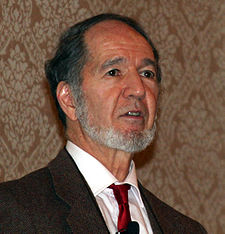
Jared Diamond

In some ways the film didn’t cover any new ground despite it being an interesting way of approaching the subject of the future of our present civilisation.  But what was really worthwhile were the clips from three experts in their various fields.  They were the author Jared Diamond, Daniel Gilbert who is Professor of Psychology at Havard, and Joseph Tainter also an author.  There is much material around from these three gentlemen.

So I am going to start with Jared Diamond.  WikiPedia has Jared’s details.  The following is a video going back to 2003 which is no less relevant in terms of where we are in 2011.  (If you want more of Jared’s ideas, just let me know and they will be included in a future Post.)

“I’ve set myself the modest task of trying to explain the broad pattern of human history, on all the continents, for the last 13,000 years. Why did history take such different evolutionary courses for peoples of different continents? This problem has fascinated me for a long time, but it’s now ripe for a new synthesis because of recent advances in many fields seemingly remote from history, including molecular biology, plant and animal genetics and biogeography, archaeology, and linguistics.”

JARED DIAMOND is Professor of Geography at the University of California, Los Angeles. Until recently he was Professor of Physiology at the UCLA School of Medicine. He is the author of the recently published Collapse: How Societies Choose to Fail or Succeed, and the Pulitzer Prize-winning author of the widely acclaimed Guns, Germs, and Steel: the Fates of Human Societies, which also is the winner of Britain’s 1998 Rhone-Poulenc Science Book Prize.  (From here)

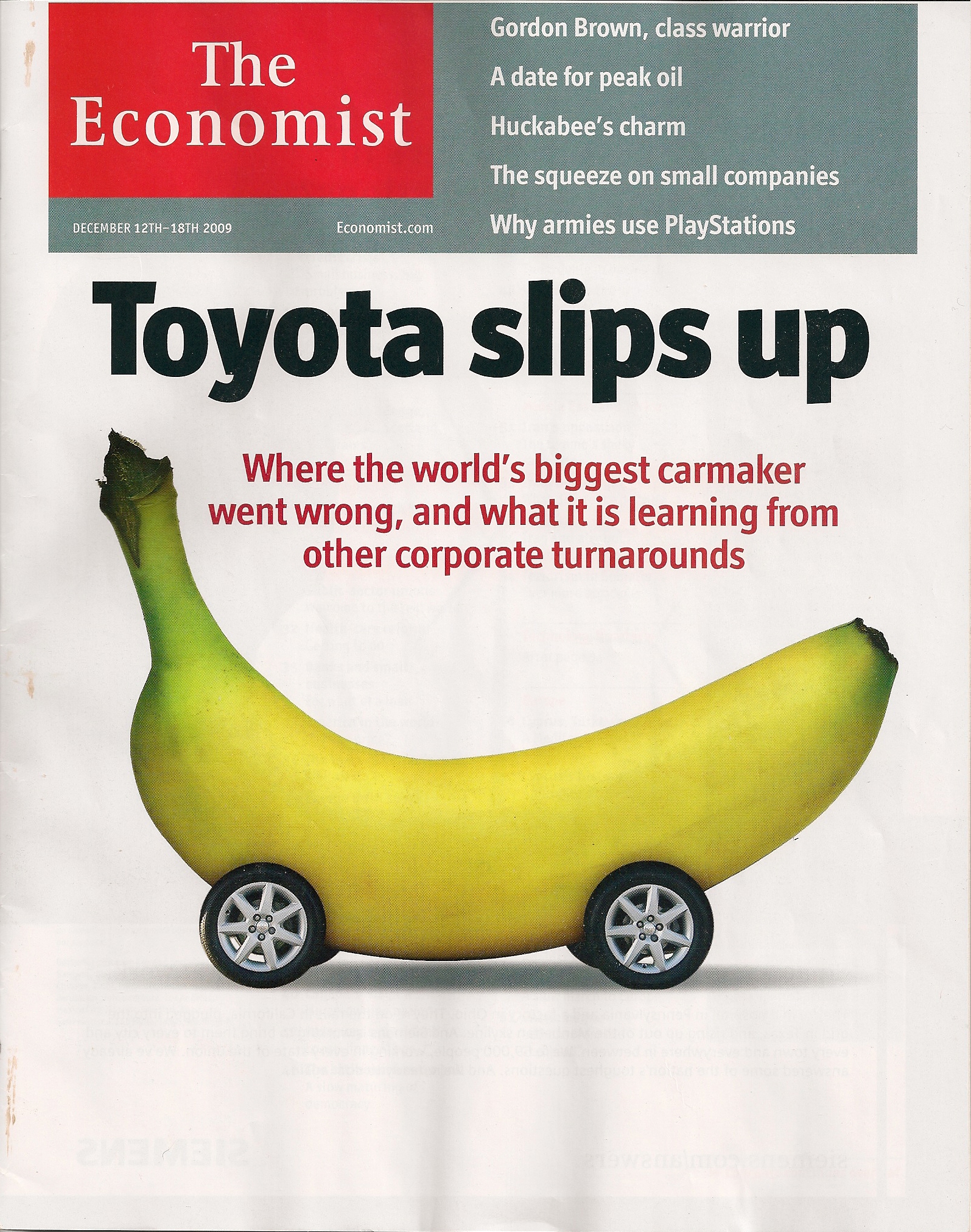
Bananas and common sense!

This is more than about the problems with Toyota.

The Economist is a newspaper.  It was first published in September 1843 which, of itself, makes it a notable newspaper.  Many years ago, more than I can recall just now, I became a subscriber to the newsprint version of this weekly paper.  It has become such a companion, so to speak, that when I left the UK in September 2008 to come to Mexico I made arrangements to continue receiving The Economist each week.

However, the Mexican postal system, despite being thoroughly reliable, is rather slow and, rather logically if you muse on it, the postman always only delivers when there is more than one item.  Thus the particular copy of The Economist that carried the story about Toyota arrived late and with three other editions!

Let me turn to the point of this article.

Read more of this Post

Remarkable people: General Sir Rupert Smith

Conform and/or reform?

Usually, people who have spent a long time in an organisation are steeped in its thinking and its received wisdom. Those who do not fit the mould have difficulty in rising far and may even end up leaving the organisation or being rejected by it.

However, there are people who avoid both outcomes, they fit the mould, and they challenge its thinking. They rise high in the organisation and yet emerge with views which run counter to the common understanding of its purpose. Perhaps they keep their views quiet, at least until they rise above some level where they have sufficient standing based on experience or reputation. To do so, they must very good at what they do and their criticism must be seen, at least on balance, as being constructive.

The utility of force

General Sir Rupert Smith is an impressive independent thinker who combines analysis with clear objectivity; and he has written an important book about it. He has been described as Britain’s foremost “thinking soldier”.

If you’d like to hear a man who has emerged from a substantial military career with a fascinating and important analysis of a major paradigm shift, then you might be interested in his presentation at the Carnegie Council.  He believes that this new era began in 1945 and the first effects were seen in Korea.

“War among the people”

As with so many presentations, the formal content covers the main points and creates the background for discussion; but the subject matter comes alive and the most valuable insights are communicated in the conversations which develop from questions or impromptu stories:

As a fairly young officer, I was in Belfast, responsible for a patch of West Belfast. A bus route came to my area, at the end of its route from Belfast city center. There was a roundabout, and the bus would sit there for twenty minutes and then turn round and go back down into Belfast.

Most Friday nights, somewhere around 9 o’clock in the evening, this bloody bus would get burned. There would be a riot, and people would throw stones at the fire brigade when it came, and then we’d all turn out and fire baton rounds and things at the hooligans throwing the stones, and then someone would shoot as us and we’d shoot back. A good time was had by all. The BBC and everyone were all in there. A burning bus can really get everyone going.

This was going on rather more than I was prepared to put up with. But I couldn’t stop it. I just wasn’t able to defeat this. Until we came up with a cunning wheeze, which involved me persuading two soldiers that it was in their interest to hide in a hidden box on the top of this bus, and when the hooligans appeared with the buckets of petrol and the box of matches, they would leap out before they lit the petrol and capture the hooligans with the petrol, and we would all rush in and help them.

These two soldiers agreed that this was a wizard wheeze and hid in the box. We drove the Trojan Horse in. And, sure enough, we got them.

A quiet conversation took place between the regimental sergeant major and these two little hooligans. It turned out that this thing that we had been treating as IRA terrorism, disrupting the streets, a come-on operation so that we would be pulled in so that then we could be sniped at—that was our complete logic and understanding of it—was wholly and totally wrong. This had nothing to do with terrorism at all. It was the black taxis, and they were paying these hooligans to burn the buses so they got more trade. We hadn’t been fighting anybody.

This story provides a clear example of the analysis in this presentation.

During a related interview by Jeffrey D McCausland, General Smith identifies some key questions:

Who are you supporting, to do what and what is military force’s contribution to achieve that?

Watch that the interview here.

On a comical note

In looking at more material, for this post, I ran across one item which you might be able to view, but I could not; this is due, apparently, to my being in the UK. The message that I am presented with at this location is particularly funny given the subject matter; it is:

Dear Great Britain,

We’re terribly sorry, but full episodes of The Daily Show with Jon Stewart are not available.

But please don’t send any Red Coats in retaliation at this time, as you CAN get your headlines at Channel 4.

(The style of the “Channel 4” text is flashing between white and underlined red. However clicking on it does not appear to have any effect. So does that mean that a gunboat of Red Coats would be acceptable after all?!)

By John Lewis