Category: Spirituality

Home grown!

Further beautiful reflections from John Hurlburt.

By one of those lovely patterns in life, John’s last contribution to Learning from Dogs was exactly a year ago, a Post that was called Definitions, questions and prayers.

oooOOOooo

Synergy

Past, present and future combine

In the natural beauty of a moment


The sigh of the wind in the pines

Is a hymn to ancient growth

The hush of the wind in the willows

Invites peace and well being


 The sparkle of pure water

Assures that tomorrow will include life

                                                                           an old lamplighter

Eric Clapton and change.

A powerful example of grief and repair.

Normally my week-end posts are lighthearted.  But I do hope you will forgive the departure for today.

Regular readers of Learning from Dogs will recall that on the 2nd August I published a piece under the title of Changing the person: Me.  It offered several examples of how personal change or transition is tough but that the rewards that come from understanding the personal and emotional consequences of big life changes are immense.  As I wrote then,

The most important thing to note, and this is why so many ‘change’ ambitions fail, is that change is deeply unsettling at first.  When change happens for the majority of us, often ‘forced’ on us as a result of unplanned life events, we are left deeply unsettled; a strong feeling of being lost, of being in unfamiliar surroundings.  Think divorce or, worse, the death of a partner or child, reflect on how many sign up for bereavement counselling in such circumstances.  Big-time change is big-time tough (apologies for the grammar!).

Then I came across the story of how Eric Clapton coped when his four-year-old son fell from the window of the 53rd-floor window of his mother’s friend’s New York City apartment.  Here’s an extract from the WikiPedia entry:

The years following 1990 were extremely turbulent for Clapton. In August 1990, his manager and two of his roadies (along with fellow musician Stevie Ray Vaughan) were killed in a helicopter accident. Seven months later, on March 20, 1991, Clapton’s four-year-old son Conor died after falling from the 53rd-floor window of his mother’s friend’s New York City apartment. He landed on the roof of an adjacent four-story building.  After isolating himself for a period, Clapton began working again, writing music for a movie about drug addiction called Rush. Clapton dealt with the grief of his son’s death by co-writing “Tears in Heaven” with Will Jennings.

Here’s Tears in Heaven.  Please stop whatever you are doing now and play this video.  In under 5 minutes it demonstrates the power of the saying from Henry David Thoreau, the American author and poet – “Not until we are lost do we begin to understand ourselves”.

And going back to that WikiPedia entry

In an interview with Daphne Barak, Clapton stated, “I almost subconsciously used music for myself as a healing agent, and lo and behold, it worked… I have got a great deal of happiness and a great deal of healing from music“.

Eric Clapton

Let me close with another saying, this time from George Moore, the novelist, “A man travels the world over in search of what he needs and returns home to find it.”

Göbekli Tepe

The most amazing ancient site, possibly in the world.

I know this is a bit of a giant leap from yesterday’s Post but bear with me.  A short while ago, my friend Suzann sent me a link to some information about the archaeological site in Eastern Turkey known as Göbekli Tepe.  Suzann, as many regular readers will know, was the person who caused me to meet Jeannie back in December 2007 when Su invited me to spend Christmas with her and Don, her husband, at their home down in San Carlos, Mexico.

Before I go on to write about Göbekli Tepe let me also muse on another fascinating connection between Suzann and me.  That is that Su and I were sharing the same waters in the Eastern Mediterranean around 1991.  Here’s an extract from a recent email from Su.,

Don’s brother’s boat was Hana Ho.from Honolulu, Hawaii, a Tayana 55…gorgeous thing! They sailed in the Med for years around that time…it is possible you could have run into them…..

When we first flew in to Cyprus June of 1991, Bob’s boat was up on the hard. It took another 5 days to finish, and we had to climb straight up and down a steep, rickety ladder each time we went out, because we slept on the boat every night….was it ever hot and muggy! and no bathroom facilities in use!! But had a lovely time in Cyprus and really got out and saw things there. Delicious food!!

Then we sailed over toward the Turkey/Syrian border area and then gunk-holed west along the coast, ending up at Izmer, after visiting places like Antalya, Kekova Roads,Fethiya and the magnificent Rock Tombs, Marmaris, Bodrum, Kisadasi, Ephesus to name a few….

I, too, was living on a yacht, over-wintering in Cyprus, and cruising the Turkish and Greek coasts during the summer.  Anyway, enough of these musings.

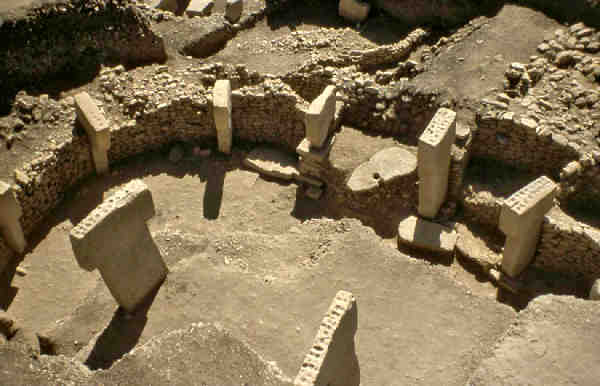
A scene from Gobekli Tepe

Göbekli Tepe is old.  I mean seriously old.  For example, I’m very familiar, being an Englishman, with the mystery and antiquity of Stonehenge.  But even the revised estimates of Stonehenge’s age, now believed to be 3,000 B.C., don’t measure up to the age of Göbekli Tepe.

The Smithsonian website explains much in a fascinating article about Gobekli Tepe, (do click on that link as the Smithsonian article is extremely interesting).

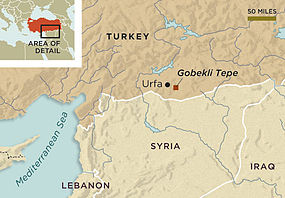
Six miles from Urfa, an ancient city in southeastern Turkey, Klaus Schmidt has made one of the most startling archaeological discoveries of our time: massive carved stones about 11,000 years old, crafted and arranged by prehistoric people who had not yet developed metal tools or even pottery. The megaliths predate Stonehenge by some 6,000 years. The place is called Gobekli Tepe, and Schmidt, a German archaeologist who has been working here more than a decade, is convinced it’s the site of the world’s oldest temple.

[my italics]

Imagine, there are fewer years between today and the building of Stonehenge than there are between the construction of Göbekli Tepe and Stonehenge!  Think about that!

Anyway, enjoy this video,

and if that grabs your interest then there is a longer 25-minute radio broadcast by Klaus Schmidt that is on YouTube, see below:

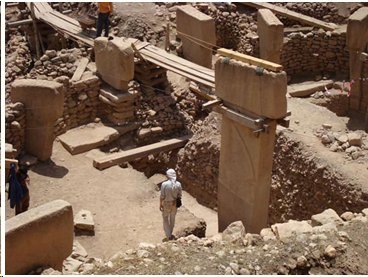
German archeologist Klaus Schmidt, from the German Archaeological Institute, who has been working as the head archeologist at Göbekli Tepe, a temple site located in southeastern Turkey close to the boarder to Syria. Klaus has been excavating there since 1994 and he joins us to talk about the excavation work, and to give us his impressions and theories about the site and the people who built it and worshiped at this ancient temple site. The temple is believed to have been erected in the 10th millennium BC (about 11,500 years ago). It is believed to be the oldest human-made place of worship, it’s even been called the Garden of Eden. Only about 3-5% of the site has been excavated so far, which has unveiled several stone circle rooms, only one of which has been dug down to the floor. As many as 20 such structures are thought to exist under the ground at the site, these have been detected by radar scans. These stone circles have large T-shaped pillars, some of the heaviest stones weigh up to 50 tons. The monoliths are decorated with carved reliefs of animals, abstract pictograms, sacred symbols and similarities to Neolithic cave paintings have been pointed out. The carefully carved figurative reliefs depict lions, bulls, boars, foxes, gazelles, donkeys, snakes and other reptiles, insects, arachnids, and birds, particularly vultures and water fowl. Göbekli Tepe means “Hill with a potbelly” although there already exists other interpretations of the name, connected to the word “Zep Tepi” or “The First Time” a period in beliefs of a mythological golden age when the gods lived amongst humanity together with half-divine offsprings of gods and humans. Is Göbekli Tepe the Garden of Eden? June 24, 2010

If you want more to read then I can do no better than recommend the article that Suzann linked to in her email.  It’s here and it starts thus,

Gobekli Tepe: 12,000 Years Old and Rewriting Human History

“This time what came first was the temple and then the city.”

– Klaus Schmidt, Ph.D., German Archaeological Institute

12,000-year-old circles of limestone columns weighing from 7 to 15 tons or more have been excavated in Gobekli Tepe, Turkey, about 6 miles northeast of Urfa.

Older than Egypt, Sumeria and Stonehenge, 40 standing T-shaped columns have so far been uncovered in four circles 98 feet (30 meters) in diameter. To date, no metal tools have been found since meticulous digging and dating began in 1994. Only 5% of the temple complex in repeating circles has been uncovered.

Ground-penetrating radar surveys indicate there might be at least 250 more standing stones in 18 still-buried circles. Finely honed reliefs and some 3-dimensional sculptures on the limestone columns depict boars, foxes, lions, birds, snakes, scorpions, vultures, reptiles, humans and other figures.

You’ll have to read the rest of the article here.

Sort of puts the history of man into perspective!

The power of touch

Some of life’s lessons are easy to learn – once we have been taught!

Readers be warned!  This is one of my more subjective posts written in the hope that many will ‘connect’ with the emotions expressed.

Learning touch from Casey

I want to explore the power of touch.

Not just in a direct manner such as a hug or an arm around the shoulder but also the way that love can reach out and ‘touch’ us from afar.  I’m going to do that by recounting something that Jean and I have experienced over the last couple of weeks.  Here we go!

A while after we had moved to Payson in February, 2010 both Jean and I noticed that I was getting forgetful. Initially we thought it was just a characteristic of the vestibular migraine that I was diagnosed with in 2009 but eventually it seemed a good idea to have a local doctor here in Payson check me out.  That examination took place last April 24th., a little over two weeks ago.  The doctor dropped a huge bombshell in our laps by saying that she thought that I was exhibiting signs of early-onset Alzheimer’s Disease!

To say that I was shocked was an understatement.  Jean was beside herself with worry as her late American husband, who had died in 2005, had suffered badly from Alzheimer’s Disease for his last two years.  We had 48-hours of wall-to-wall worry!

A few days later, I was getting very angry at the lack of gentleness in the way that the doctor had spoken to me.  Jean had the brilliant idea of contacting a retired doctor friend.  His response was loud and clear; he advised me to get a second opinion and continued by recommending a neurologist that he knew well.  That appointment was held this last Tuesday, May 8th, down in Phoenix.

The neurologist asked me many questions, including such verbal tests as how many animals can you name in a minute, spell the word ‘world’ backwards, deduct 7 from 95 (and then keep deducting 7 from the resultant answer!!), and then undertook a physical examination including co-ordination skills, blood flow in the neck and other relevant aspects.

All of which lead him to the conclusion that I was not showing any signs of dementia.  My forgetfulness was normal for someone of my age (67 last birthday) especially taking into account all the life changes of the past few years.

Then the neurologist went on to warn me about anxiety.  He said it was a ‘killer’ of healthy bodies and healthy minds, especially as we got older.  So my anxiety over my sister’s dementia, my half-sister living in Devon, England, whom I am very close to, is now badly affected by vascular dementia and got me thinking I might be following in her path, and my anxiety over thinking my life now was ‘too good to be true’, was getting in the way of me being a relaxed, ‘go with the flow’ individual.

Thus a couple of extremely stressful and worrying weeks came to a most wonderful conclusion; an outcome that couldn’t have been better.  The degree of emotional and psychological disruption that Jean and I have been through was not however without some major lessons being learnt.

Being scared – I’ve always taken for granted that I would have good health throughout my life, aided and abetted by the fact that I have never been admitted to hospital and have avoided serious illnesses.  The first doctor’s so-called diagnosis was one giant slap-in-the-face especially realising that the future in store could be a steady decline in my cognitive skills.

For the first time in my life I was truly scared and last Monday, the day before the visit to the neurologist, I broke down in Jean’s arms saying how scared I was.  Revealing such vulnerability was not easy for me but being held by Jean under those circumstances was deep and pure bliss.  As the saying goes, ‘If one doesn’t run the risk of being lost, then one can never be found.’

Love and friendship – The number of people that came up to Jean and me, gave us big hugs and said that they would be thinking of us during our trip down to Phoenix last Tuesday was indescribably beautiful.  So many showed such a depth of feeling for what Jean and I were going through.  Many others from distant places sent encouraging emails or telephoned.  It all amounted to preventing us from feeling alone and reinforced our determination that whatever the medical outcome, we would find a way of handling it.

The power of the mind – my brother-in-law, in a recent telephone call, said that once the mind latches on to an idea, it does everything it can to reinforce that idea, however illogical it may be.  Thus over the last couple of weeks, every time I dropped something, or forgot where I had put my glasses, or wasn’t clear which day of the week it was, and on and on, I used that as ‘proof’ that I was rapidly losing my mind.  It should serve as a strong warning that we can literally think ourselves into a crisis!

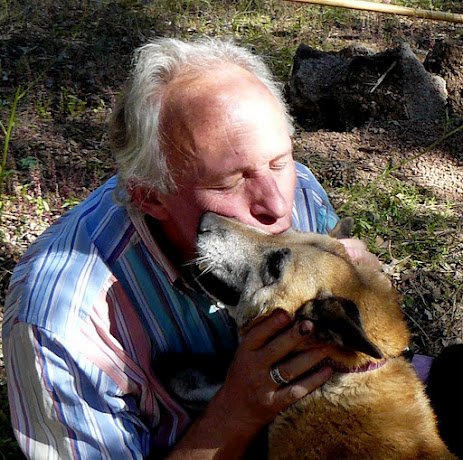
The love between a dog and a human – hugging a dog when one is feeling emotionally vulnerable is beyond measure.  Dogs always sense when we humans are feeling fragile and they offer their uncomplicated hearts to us without any condition or need for return.  That selfless love is an inspiring example of what we all need to learn to give one another.

Touch and social intimacy – we have so much to learn from dogs when it comes to touch and social intimacy.   We are all needy for touch.

Which leads me providentially to a recent item from Terry Hershey.  Terry came to Payson in March, 2011 and he was a most inspirational speaker.  I have followed him ever since.

Last Monday’s Sabbath Moment included the following story, republished with Terry’s kind permission – the story is all about touch!

Caroline was very sad. Caroline was only six years old and her father had just died. In fact, her father had been assassinated.

Sitting in the back of big black limousine, Caroline Kennedy didn’t quite know what to do with her sadness. On the seat next to her sat her nanny, Maud Shaw, and next to Maud, Caroline’s younger brother John.

Through the windshield Caroline could see her mother, Jackie, and her uncles, Robert and Ted, walking in front of the limousine as it slowly made it’s way down the Boulevard to St. Matthew’s Cathedral.  Looking out of her side of the car, Caroline recognized the friendly face of Secret Service agent, Robert Foster. She liked and trusted Robert Foster.

Not knowing what to do with her sadness, and on impulse, she rolled down the window and stuck out her six-year old hand. Agent Foster had a choice to make. Secret Service agents are not allowed to have their hands occupied, needing to be ready for any emergency. But Robert Foster didn’t even think twice. He held Caroline’s hand tightly the entire way to the cathedral.

Later, Agent Foster said it was all he could do to “fight back his own tears of sadness, for little Caroline Kennedy.” When asked about his kindness, he seemed surprised, “All I did was hold a hand,” he answered.

Terry then goes on to say,

We all know sadness. Life breaks for each one of us in different ways and in different places. And sometimes the sadness seems too much to carry.

It requires courage to roll down the window, to connect or ask or invite. For whatever reason, there is a knee-jerk need to deny any sadness, or dismiss it, or apologize for it. “I’m sorry,” people will say, wiping away their tears, as if their sadness is a violation of some tenet of propriety. Heaven forbid if any humanity is exposed.

So sometimes I am afraid to ask. Not sometimes; most times. I don’t want to appear weak. Asking for help is a hard pill to swallow.

I spent Saturday in Clearwater, Florida, with a group talking about intimacy and communication. (Yes, it is easier to talk about than to practice.)  Here’s what I told the group.

If we don’t bring it with us, we’re not going to find it there.  Which means intimacy–trust, vulnerability, authenticity, honesty–begins here.

With me. With this me.

I was raised in a religious environment that taught me to eradicate my messiness (to quash my sadness or grief or untidiness).

I now believe differently. I now know that we find and express acceptance, love and grace (the place where we can be fully human), in our messy, imperfect, and fully thorny selves. In other words: We can embrace this life–without any need to photoshop it.

To be human is to be vulnerable.  I am capable of being wounded and cut and sad… which also means that I am capable of being kind and generous and present.

In such moments of heartache, I can have the courage to ask for a hand to hold.

In such moments of heartache, I can have the courage to hold a hand the needs to be held.

Robert Foster didn’t think twice about holding a hand that needed to be held. And he wasn’t posturing or amassing heavenly brownie points. He was doing what needed to be done.

Here’s the deal: we don’t need more remedies or advice. We need more touch. We become more human when we touch. Why? Because when we touch, we are seen.  And when we are seen, we recognize that our value is not tied solely to our sorrow.

And we, you and I, will find no better lesson to learn from our beautiful canine friends, than this lesson of touch.

The loving touch of a dog.

Being at sea!

A discovery of some writing from the past triggers memories.

Way back on the 15th November, 2009, I wrote a post about single-handed sailing and how it caused me much disquiet.  Rather than just leave you with a link to that reflection, I’m going to include the post again, below.  The reason is that a few days ago, in looking through some of my earlier writings in conjunction with a writing group that Jean and I belong to, I came across a piece that I wrote following a solo voyage from Larnaca in Cyprus, west along the Mediterranean Sea and then out over the Atlantic from Gibraltar to Horta on the  island of Faial in the Azores.  That last leg was a little over 1,100 nautical miles (1,300 land miles) and took me eight days.

So first here’s that earlier post from 2009.

A personal reflection on this rather strange way of travelling!

The recent Post about young Jessica Watson sailing alone around the world raised a few comments but also reminded me of my own experiences of solo sailing.

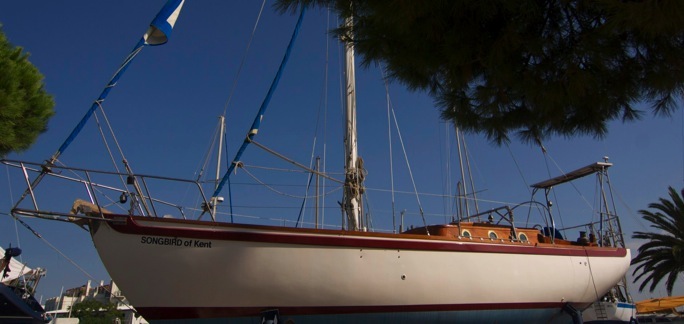
Some years ago, having successfully sold my own IT company, I warmed to the idea of being a full-time yachtie! A second-hand Tradewind 33 was discovered on the Island of Corfu.  (Now here’s a surprise!  I was just browsing the web looking for a picture of a Tradewind and came across my old yacht currently up for sale.  Her name is Songbird of Kent! Picture below.)

Songbird of Kent
Tradewind 33 - Songbird of Kent

Anyway, the deal was done and having sold my house in England I flew out to Corfu to collect Songbird of Kent. Inevitably it was a number of months before the boat was ready to head out into the Mediterranean but in early Spring 1988 it was time to explore the long coastlines of Greece and Turkey.

After a fantastic summer cruising from one idyllic anchorage to another mostly with friends or family on board, it was time to find a winter haven.  Many recommended Larnaca Marina in Cyprus.  Thus it was late in the summer of 1988 that I said goodbye to friends and set out on my own to cross from Antalya in Turkey to Cyprus and along the South coast of Cyprus to Larnaca, on the SE side of the island.

That sea crossing, a little over 200 nautical miles, was to become a regular solo experience at the start and end of each summer season. Impossible to do in a single day thus it always included a night at sea and rarely, if things didn’t go well with the weather, a couple of nights. I hated it! Maybe it was the sudden transition from coastal sailing to a deep water crossing, often going from having friends on board to being alone, but whatever it was I never enjoyed my time on my own and knew that long-distance solo sailing was never going to be my scene.

Anyway, I ended up spending several very happy winters in Larnaca.

One time, there was news of a Frenchman who had come into Larnaca on his way home to France having nearly completed a circumnavigation of the world. He was on his own!

I was astounded to hear how someone could do this and made a point of calling round to his berth. The boat was a beautiful, solid steel yacht, the very epitome of a craft that could challenge the oceans. The owner’s name was Pierre (it would be!). Pierre invited me aboard and we went down to his saloon to drink a hot coffee – real French coffee!

Inevitably the conversation turned to the challenges of sailing alone. Pierre said that the big cargo ships at sea moved quickly relative to the speed of a yacht so at night he set an alarm for every 15 minutes. That was the time that a ship could go from being hull down over the horizon to being close enough to be a hazard. Thus while at sea Pierre got up briefly every 15 minutes during the night to avoid being run down! It sounded totally exhausting.

Then Pierre asked me about the sailing I had done and whether I had sailed on my own. I declared my trivial journeys back and forth from Cyprus to Turkey and revealed that being on my own made me very, very unhappy. Pierre was surprised to hear that as he admitted that being at sea alone was one of the most tranquil and peaceful experiences ever. Pierre asked how long these solo journeys took. I replied, two or three days.

Ah!”, he said, “That is the problem.” “I, too, hate the three days. It is always a period where you adjust and it is terrible.

My friend, you must find a way to be alone for more than three days. You will see that it is very different.

It was some years before that opportunity came about but, in the end, I did undertake a solo journey of 8 days. Pierre was right. The first three days were hell, the rest were heaven!

Thank you, Songbird of Kent, you gave me some fabulous memories!

at sea

By Paul Handover

Now on to my writings about being out at sea alone on a small yacht.

Being at Sea

Going to sea in a small vessel is a profound experience.

In harbour we build up a reliance on things external. We have no need to worry if there is insufficient food on board, we can plug into the dockside power supply, sleep through the night undisturbed and we can wander off and enjoy the company of others if the boat feels a little claustrophobic.

Then slowly, imperceptibly, but with huge force, arrives the need to move on.  The realisation that our cosy life connected to the busy, bustling and self-obsessed world of shoreside is not fulfilling our search for adventure and for the truths that lay over the horizon.  It is time to leave.

The act of casting off is always exciting as it heralds a new adventure. But it also carries feelings of loss and apprehension as one lets go of the bonds of a previous certainty.  The first few hours are filled with the workload of getting one’s craft shipshape and battened down for the unknown seas. Then gradually comes the realisation that the land is now less the dominating visual feature than the vastness of the seascape that is ahead.  But with the land in sight, albeit a distant horizon behind one, you can still sense the life you are leaving.

Now all that surrounds you is the sea.  You are now truly disconnected from the land.  It is often at this point that despondency and uncertainty play with your mind; after all this new life is still very unfamiliar compared to the warmth of that island home that still resonates in your heart. Time to remind yourself of why you wanted to take this voyage.

A small boat is very fragile.  Just a centimetre of hull separating you from the unimaginable depths of the ocean beneath your keel. Not until the end of your voyage, when you draw your boat up, metaphorically on to that beach, will you ever stop feeling how close fate is, how it rides on your shoulder night and day. That, of course, is why we go to sea. It is the place where we taste life, where we savour each moment of the present because the future seems too bound up in the mystery, the uncertainty of the ocean. You are in charge of your tiny craft. Your survival depends on how you manage your small ship, how you navigate these seas, how you read the weather ahead and avoid the storms.

Soon your life on the ocean becomes everything to you. You have time to reflect on so much that is left behind. The distance seems to dissolve all the nuisances, bring into focus all the things that are important to you. There is no certainty with the ocean apart from the knowledge that you are very small and very, very vulnerable and yet, in a sense, also so strong.

In the end, we have to break away from our insecurities and our emotional dependencies on external people and situations because, without that, we are never able to command our own life and the destiny that flows from that captaincy.  There is a real strength in knowing ourselves as we would know our own boat.  If we really know every spar, sail, rope and fitting, if we have real understanding of the strengths and weaknesses of our small vessel then we are able to know when to breast the waves or when to turn and run before the storm.  We are secure that our small craft will protect us day and night.

Thus self-knowledge gives us the same freedom to manage our lives, to know when to fight and when to turn away.  And just as after every long voyage the boat will need hours of careful maintenance so our own souls need regular love and caring from our spiritual keeper.

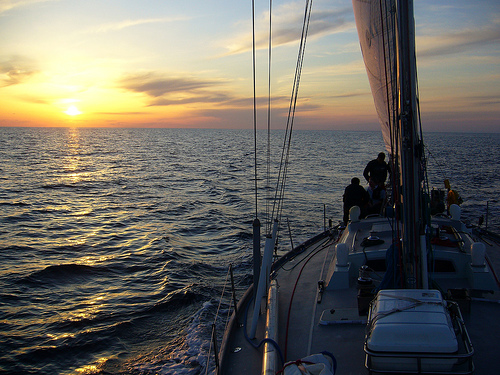
The setting sun ahead of a night on the ocean.

Copyright © 2008 Paul Handover

Winds of Change

A guest post from Sue Dreamwalker.

Introduction

Sue has been a wonderful supporter of Learning from Dogs for which I am very grateful.  Sue is the author of the blog, Dreamwalker’s Sanctuary and I do recommend that you pop across there and read her wonderful Posts.  Recently, I read a beautiful poem that Sue had written and not only did she give me permission to republish that Post but also offered the following introduction.  Thank you, Sue.  The rest is all Sue!

First my thanks go to Paul who continues to awaken our knowledge to the Earth and our environment and whose posts are in-depth and informative posts on subjects which we should all be immersed in.

For Planet Earth is our Home and she is dying.  And we Humans are still in a slumber as to the destruction we have inflicted upon her.

Our Native American Brothers knew long ago that we have to balance nature and we should only take that which we need.. But we have used Greed as our cutting tools and we as a species have become out of balance with nature and ourselves.

Paul has kindly asked if he could re-blog my poem .  This poem speaks of those changes we all feel is happening within our world.  I firmly believe like the Native Americans that we are united in Consciousness and that extends to our Earth Mother. We are linked together As One.

…oooOOOooo…

The Winds Of Change

The Winds of Change.

The Winds of Change flow across our land

Sweeping us up like the grains of sand

Twisting us round to look in the mirror

Cutting us deep to make us consider…

~

Our past which holds so many stains

As Ego rules in a world full of pain

The winds of Change are here to uplift

It’s time for Humanity to embrace all her gifts

~

But before we fly along with the wind

Mankind is reaping all his sown sins

The Anger, the Hatred, the Greed and his Pride

Will no longer have any places to hide

~

For the Winds of Change a tornado will swirl

As into the Abyss the Material will hurl

A river so deep into Oceans will run

With all tears cried from when time first begun

~

A cleansing of hearts as each soul will cry

As the Winds of Change blows into our eyes

Eyes that will open as we come awake

And Mankind will realise he can no longer take

~

The road of discovery can often be hard

A lonely walk as the Winds they bombard

It strips us bare to reveal our true souls

In a journey we’ve walked from Millennia of old

~

And as our tears fall they wash us all clean

Of the lies of the Past and all that has been

The Winds of Change it whistles in our Hearts

Get ready to fly – for we’re soon to depart.

~~~

Many things are happening around our world right now, and for many we are all going through some personal changes.. Change is always hard, and painful, for we resist it as we cling onto that which is familiar. But without Change we do not grow, or progress..

Some of those Changes which are taking place around our Earth are bringing with it tears..

Tears we weep help cleanse our inner-most souls as we wash ourselves from within and we release our emotions.

So, too, our Earth Mother is getting ready for Change… her Winds too are blowing a warning, as she is releasing her tears as she lets them spill as rain..

Too long has she held them within…

We are One with Mother Nature… Watch her, as she is stirring..

Be Ready..

She is Changing, and as she does we will feel her shake, as her body sobs.

By sending out your love,

By loving your selves we are helping each other over these Changes..

We are helping Unite ourselves and Mother Earth once again in Harmony

~~~~

A tree knows how to bend in the wind, or it breaks and falls..

Water finds its path as it flows into ALL to find its own level

So too we must go within that flow and follow our hearts

We need to be that Oneness,

We need to stop hurting one another,

We need to breath in that Light of Love

And Share it in Unity of Oneness

This is the Time of Change

Let the Winds blow

Love into your

Hearts

 Native American Indian Quote

“You must teach your children that the ground beneath their feet is the ashes of your grandfathers.
So that they will respect the land, tell your children that the earth is rich with the lives of our kin.
Teach your children what we have taught our children, that the earth is our mother.
Whatever befalls the earth befalls the sons of the earth.
If men spit upon the ground, they spit upon themselves.”
~ Unknown ~

© Sue Dreamwalker – 2012 All rights reserved.

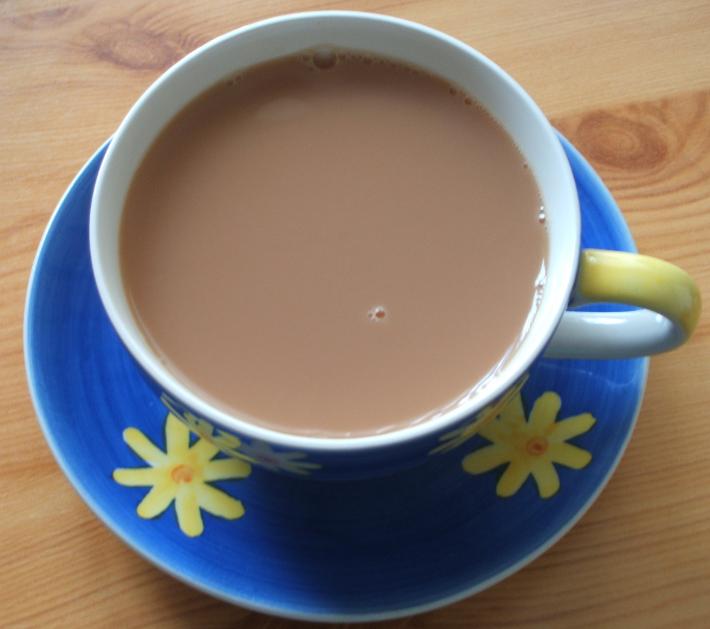
The joys of a cup of hot tea!

Taking a bit of a breather.

A'hhh!

All my life, well all the years that I have appreciated a ‘tea-break’, stopping for a cup of hot tea has been laden with symbolism.  A chance to let the brain catch up with whatever one is doing.  When working with others an opportunity to stand back and evaluate how the particular project is going.  When sharing a project with a loved one, an opportunity to lay down memories for future years, and so forth. (Jean and I were building a chicken coop yesterday afternoon.)  Sure there are millions of people that share these feelings.

Anyway, as many of you have been aware, the last 10 days or so on Learning from Dogs have been pretty ‘full-on’ in terms of man and Planet Earth.  It started with me publishing on the 27th February a Post called Please help! – A plea to those who understand climate science so much better than I do!.  Then on the 2nd March, I republished a Post from Patrice Ayme called The collapse of the biosphere.

Then on the 5th March, with a big thanks to Dan Gomez, I published A skeptic’s view and then responded to that Post with Reply to a skeptic on the 8th March.  Finally, last Friday, I republished a Post first seen on Naked Capitalism which I called I must go down to the sea again, spelt H2CO3!

That there were a total of 6,313 viewings of those Posts and 69 comments (OK, that doesn’t mean different individuals) was incredibly gratifying – a very big ‘thank you’ to all of you that read the Posts, and likewise to those that commented.

But one of the most wonderful aspects for me was the incredible sharing of ideas and resources.  So the point of today’s Post is to bring all those links and contacts onto one ‘page’, so to speak.

Martin Lack was the first to point me in the direction of the book, Merchants of Doubt.  There are a number of videos on YouTube but the one below is a good introduction to Naomi Oreskes.

On October 28, 2010 historian of science Naomi Oreskes gave a presentation at Forum Lectures (US Embassy Brussels), based on her new book, Merchants of Doubt: How a Handful of Scientists Obscured the Truth on Issues from Tobacco Smoke to Global Warming, about how right wing scientists founded the George Marshall Institute which has become a key hub for successfully spreading fear, uncertainty and doubt about climate change, along with other environmental issues, and how myths about science enable these political strategies to work.

An in-depth video of over an hour from the University of Rhode Island’s Spring 2010 Vetlesen Lecture Series, hugely worth watching, is here.

Then there is the powerful blog site, De Smog Blog.  As the site explains, “The DeSmogBlog Project began in January 2006 and quickly became the world’s number one source for accurate, fact based information regarding global warming misinformation campaigns.  TIME Magazine named DeSmogBlog in its “25 Best Blogs of 2011” list.

Moving on.  One of the challenges is knowing how to look up some reasonably reliable information about a person who is claiming this or that.  That’s where SourceWatch is invaluable.  The website describes itself, “The Center for Media and Democracy publishes SourceWatch, this collaborative resource for citizens and journalists looking for documented information about the corporations, industries, and people trying to influence public policy and public opinion. We believe in telling the truth about the most powerful interests in society—not just relating their self-serving press releases or letting real facts be bleached away by spin.

Let me give you an example of how SourceWatch works.  In my Post A skeptic’s view, Dan offered extensive comment about U.S. Senator James Inhofe’s book The Greatest Hoax.  A quick search on SourceWatch revealed (a) (my emboldening)

Arthur B. Robinson is one of the three co-founders of the Oregon Institute of Science and Medicine, a group best known for organising a petition disputing the scientific evidence for human-induced global warming.

On January 7, 2009, the Willamette Week reported that Robinson is “in the vanguard of a small but vocal and persistent collection of scientists, industry advocates and commentators who dismiss human culpability for climate change. … Robinson’s critics say his analysis is simplistic, but it remains persuasive a decade later with powerful policymakers like U.S. Senator James Inhofe (R-Okla.), a visible and effective player in blocking a bill to limit greenhouse-gas emissions last fall.

and then very quickly revealed (b),

James Mountain Inhofe, usually known as Jim Inhofe, has been a Republican Senator for Oklahoma since winning a special election in 1994.

Oil
James M. Inhofe has voted in favor of big oil companies on 100% of important oil-related bills from 2005-2007, according to Oil Change International. These bills include Iraq war funding, climate change studies, clean energy, and emissions.

On to another book.  I forget who recommended the book by James Hansen, Storms of my Grandchildren but it’s another ‘must-read’ for all those wanting to better understand the risks that lay ahead.  As the book’s website explains,

IStorms of My Grandchildren, Dr. James Hansen—the nation’s leading scientist on climate issues—speaks out for the first time with the full truth about global warming: The planet is hurtling even more rapidly than previously acknowledged to a climatic point of no return.

On that website there is a section Hansen On The Issues that includes this 2-minute YouTube video of Dr. Hansen talking about his book.

I can’t close without mentioning some other wonderful websites.  There is Skeptical Science, described thus,

Explaining climate change science & rebutting global warming misinformation

Scientific skepticism is healthy. Scientists should always challenge themselves to improve their understanding. Yet this isn’t what happens with climate change denial. Skeptics vigorously criticise any evidence that supports man-made global warming and yet embrace any argument, op-ed, blog or study that refutes global warming. This website gets skeptical about global warming skepticism. Do their arguments have any scientific basis? What does the peer reviewed scientific literature say?

Then there’s ClimateSight, a wonderful effort by Kate, “Kate is a B.Sc. student and aspiring climatologist from the Canadian prairies. She started writing this blog when she was sixteen, simply to keep herself sane, but hopes that she’ll be able to spread accurate information about climate change far and wide while she does so.”  Kate’s interest and passion in the subject is unmissable and it’s a real pleasure to subscribe to her postings.

Bill McKibben’s famous site, 350.org, is a must for the thousands of people that are working for a better future.  As the mission statement opens up,

350.org is building a global grassroots movement to solve the climate crisis. Our online campaigns, grassroots organizing, and mass public actions are led from the bottom up by thousands of volunteer organizers in over 188 countries.

350 means climate safety. To preserve our planet, scientists tell us we must reduce the amount of CO2 in the atmosphere from its current level of 392 parts per million to below 350 ppm. But 350 is more than a number—it’s a symbol of where we need to head as a planet.

350.org works hard to organize in a new way—everywhere at once, using online tools to facilitate strategic offline action. We want to be a laboratory for the best ways to strengthen the climate movement and catalyze transformation around the world.

Read the full statement here.

Plus you should stay close to RealClimate, which describes itself as,

RealClimate is a commentary site on climate science by working climate scientists for the interested public and journalists. We aim to provide a quick response to developing stories and provide the context sometimes missing in mainstream commentary. The discussion here is restricted to scientific topics and will not get involved in any political or economic implications of the science. All posts are signed by the author(s), except ‘group’ posts which are collective efforts from the whole team. This is a moderated forum.

There are so many more fabulous sources of real caring about the society we are and, more importantly, the society we hope to be.  In this category comes Wibble.  Then there’s Dogs of Doubt, that I shall be referring to tomorrow on Learning from Dogs, and The Green Word and so on and so on.  It shows the power of ‘hands across the ether’ that the modern world of web sites now offers.  I put great faith in this power becoming the power of truth and the power of change.  (If you have a blog or a website that resonates with the ones mentioned here, please do drop me an email giving me details.)

Finally, I’m closing with this.  If it all sometimes feels too much for you and you want to drift away into the world of the inner consciousness, into the world of dreamtime, then you can do no worse than to call by Sue Dreamwalker‘s wonderful website.  Try this, for example.  Dan and I had no idea what we were getting into. 😉

Oh blast, my tea’s gone cold!

Mr Carter’s amazing photo.

A poetic response from reader Marcia G.

This is in response to the item that I republished last Thursday, originally on Nakib’s blogsite, Freedom to Survive.  Do visit it.  Marcia in response sent in the following poem.

The Onlooker

He stood across the street and sadly saw
The little match girl standing in the rain;
She looked as if she didn’t have a prayer.
He wondered why there wasn’t yet a law
To spare her from unnecessary pain,
And how could people just walk by her there?

He raised his head toward Heav’n in awe and fear
And let the raindrops hit his youthful face,
While speaking toward the softly weeping sky,
“Dear God, why haven’t you done something here?
“I have the faith that You’re nearby some place,
“But there’s no sign that you’ve been helping; why?”

Then God replied, “I have…it’s nothing new;
“For such a purpose I created you.”

Thank you, Marcia.

When I see how this new, virtual world connects us across the world with so many others that know what is truly important, I do have hope for the future.

Words of wisdom

Leaning on a recent item from Terry Hershey

As many of you will appreciate, this has been a bit of a week.  It started last Sunday with my contribution to the national ‘preach-in’ for the health of our planet, and ended with the sad loss of Phoebe.  I normally post something light-hearted or trivial for the week-end but seem to be in a more reflective mood just now (Friday).

For some time I have subscribed to the weekly spiritual offering from Terry Hershey and am going to republish a story that came out from Terry Hershey on the 13th.

Letting go and walking

February 13, 2012

Some of us think holding on makes us strong, but sometimes it is letting go. Herman Hesse.

Uncertainty is the only certainty there is, and knowing how to live with insecurity is the only security. John Allen Paulos

When you let go of trying to get more of what you don’t really need, it frees up oceans of energy to make a difference with what you have. Lynne Twist

And now the story,

There is a Tibetan story about an earnest young man seeking enlightenment. (Earnest people must think this quite unfair–since they play a central role in most parables and stories about enlightenment.)

A famous sage passes through the man’s village. The man asks the sage to teach him the art of meditation. The sage agrees. He tells the man, “Withdraw from the world. Mediate every day in the specific way I will teach you. Do not waver and you will attain enlightenment.”

The earnest man follows the sage’s instructions to the letter. Time passes–and no enlightenment. Two years, five, ten, twenty pass.

It happens that the sage once again passes through the man’s village. The man seeks him out, grumbling that despite his best intentions and devotion and diligent efforts, he does not achieve enlightenment. “Why?”

The sage asks, “What type of meditation did I teach you?
The man tells him.

The sage says, “Oh, what a terrible mistake I made! That is not the right meditation for you. You should have done another kind altogether. Too bad, for now it is too late.”

Disconsolate, the man returns to his cave. Staking his life on the sage’s instructions, and now believing he is without hope, the man abandons all his wishes and efforts and need to control his road to enlightenment. He does not know what to do. So, he does what knows best: he begins meditating. And in a short while, much to his astonishment, his confusion begins to dissolve, and his inner world comes to life. A weight falls away and he feels lighter, and regenerated. When he walks out of the cave, the sky is bluer, the snow capped mountains whiter, and the world around him more vivid.

There is no doubt that all too often, our efforts–to succeed or achieve or attain–get in the way of our living. It brings to mind my favorite Robert Capon quote, “We live life like ill-taught piano students. So inculcated with the flub that will get us in dutch, we don’t hear the music, we only play the right notes.”

I understand. I was weaned on a spirituality that predicated itself on artifice. In other words, the importance is placed upon appearance, rather that just being. (It was vital to “look spiritual.” Which begs the question, “What do spiritual people look like?” As a boy, I always thought the “spiritual people” looked as if some part of their clothing was a size too small.)

What is it we are holding on to–so rigid, so firm, white-knuckled in our determination?  At some point, we’ve got to breathe.  Just breathe.  Without realizing it (and after the sage’s disheartening news), the man in the story “let go.”

He let go of the need to see life as a problem to be solved.
He let go of the need to have the correct answers (or experiences) for his “enlightenment.”
He let go of the need to see his spiritual life in terms of a formula.
He let go of the restraints that come from public opinion.

Abandon your masterpiece, sink into the real masterpiece.
Leonard Cohen

Without realizing it, he took Leonard Cohen’s advice. He abandoned his “masterpiece”–the perception of what he needed to accomplish, or how he needed to appear, or what he needed to feel–in order to allow himself to sink down into this life, this moment, even with all of its uncertainty and insecurity.

So a big thank you to Terry Hershey for those words of wisdom.


Phoebe, RIP

Now we are down to nine.

Back on the 18th January we had a scare in that we lost Hazel for a few hours; I wrote about that here.  The reason that comes to mind so clearly is that on the 19th we took our dog, Phoebe, down to see a specialist vet in Phoenix.

Phoebe in healthier times

Phoebe had been showing signs of blood in her stools but otherwise was a fit and happy dog and still eating well.  Our local vet thought that a colonoscopy might throw some better light on the problem.  In fact, the specialist in Phoenix rapidly identified swollen lymph glands, gave Phoebe a scan and diagnosed lymphoma.  It was a bombshell, more so as the specialist didn’t give Phoebe’s chances at much more than 7 to 10 days.

A loving Phoebe right to the end.

One of the recommendations from the specialist was to put Phoebe immediately on a grain-free diet and we have subsequently learnt the dangers of many grain-based dog foods.  We declined chemotherapy as her liver had already been compromised.

The change of diet plus boundless love and attention extended Phoebe’s life until yesterday morning when, around 3.15 am she had a seizure and entered a coma.  By 7.30 am Phoebe was very weak and not registering the world around her.  But she wasn’t in pain, and to the best of our knowledge, had not experienced pain during her last journey.

Last hugs before the last sleep.

Sometime around 9am Phoebe slipped away and Jean and I buried her a little later.  She lies in peace, under the shade of a tall Ponderosa pine.

Lilly, Phoebe and Paloma - Phoebe will live on in their memories.

Phoebe was such a sweet, loving dog.  Jean found her back in the Summer of 2004 when Jean was living, with her late husband Ben, in the coastal Mexican town of San Carlos.  Jean had been running a dog rescue operation for years just out of her love for dogs.

Jean came across this young, female dog, about 4 months old, running through the village of Santa Clara about 12 miles from San Carlos.  The dog was really thin and didn’t seem to belong to anyone so Jean brought her back to San Carlos and placed her in the lot where she looked after her rescue dogs while they were waiting for adoption by caring humans.  Jean found that this little black dog was totally friendly and loving to all.  But within a few weeks some of the bigger dogs in the lot started to pick on her and, Phoebe, as she was now known was taken back to Jean’s house and that was that.

And a final footnote.

Back to Phoebe’s seizure around 3am on Thursday morning.  Something woke me around 3.10am and I rolled out of the bed to make tracks for the bathroom.  Pharaoh sleeps on his blanket just inside the door to the bedroom and is always dead to the world until 7am, give or take.

But not yesterday morning.  He was sitting on his haunches, facing the closed door and totally alert.  He knew something was wrong in the room where Phoebe was, despite there being no sound at all.  Jean and I like to think that the last message that Phoebe sent out to her world was heard by Pharaoh.