“Once you eliminate the impossible, whatever remains, no matter how improbable, must be the truth.” Arthur Conan Doyle.
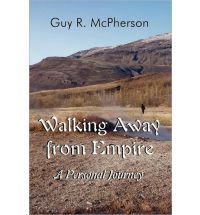
Ten days ago, I finished reading the book Walking Away from Empire: A Personal Journey. It had been sent to me by the author.
Let me explain how this came about.
A few weeks ago, I published an item under the title of Doggedly seeking the truth. I included the video “The Twin Sides of the Fossil-Fuel Coin: Developing Durable Living Arrangements in Light of Climate Change and Energy Decline.“ That video was a presentation by Prof. Guy McPherson.
Subsequently, during an exchange of emails with Prof. McPherson there was an offer to receive a free copy of his book, Walking Away from Empire: A Personal Journey. Naturally, I accepted.
Having finished reading the book it seemed only fair to write a review.
So far, so good!
I tried to marshal my thoughts for well over a week. Couldn’t get started. Strange, because when immersed in the book the messages were crystal clear.
Why the struggle to embrace Guy McPherson’s messages? Then in a moment of insight I realised that I was struggling to understand why I was struggling!
Published by PublishAmerica, LLLP
Because the blunt truth of the matter is that this book spells out the bleedin’ obvious. Humanity is between a rock and a hard place!
Look no further than the very first paragraph of the first chapter, Reason,:
At this late juncture in the era of industry, it seems safe to assume we face one of two futures. If we continue to burn fossil fuels, we face imminent environmental collapse. If we cease burning fossil fuels, the industrial economy will collapse. Industrial humans express these futures as a choice between your money or your life, and tell you that, without money, life isn’t worth living. As should be clear by now, industrial humans — or at least our “leaders” — have chosen not door number one (environmental collapse) and not door number two (economic collapse), but both of the above.
Sandy Krolick of Transition Voice wrote a review of Guy McPherson’s book in September, 2011. His last sentence was, “This is a book you will not put down; and having read it, you’ll no longer be able to ignore its conclusions.”
Again, what Sandy Krolick writes is perfectly correct. No argument. Yet …. something about that sentence from Sandy doesn’t speak to me. That struggle again.
Then I got it!
Let me go straight to page 177 of Prof. McPherson’s book and quote this:
It’s no longer just the living planet we should be concerned about. It’s us. The moral question, then: What are you going to do about it?
Then one paragraph later, come this:
There is simply no feeding the hollow spot in my gut and my psyche, as there was when I replaced my invisible, omnipotent friend in the sky with reason. Instead of abandoning the mirage of eternal life, I’m abandoning the mirage of globalization. Instead of giving up an everloving god, I’m giving up a comfortable life spent with my best friend. I’m taking yet another step in the path from make-believe to reality. And, as we all know, reality is a harsh, dispassionate mistress who doesn’t give a damn about the emptiness in my fragile little psyche. Fortunately, I still have the amusing memories of the absurdity of my former life, in which I believed I was saving the world by conducting and publishing mundane research and teaching irrelevant concepts to a largely disinterested audience.
I found the first step to be the most difficult. Simply recognizing the industrial economy as an omnicidal imperial beast forced me to cross a threshold most people find far too formidable to attempt.
Just reflect on those key words, “a threshold most people find far too formidable to attempt.”
Keep those words in mind as I quote the next paragraph from the book.
We’ve never been here as a species, much less as individuals. And every cultural message tells us we’re wrong, that the industrial age will last forever, that justice and goodness will prevail over every enemy (i.e., terrorist), that progress is a one-way street to industrial nirvana, that the harbinger of hope will keep the oil coming and the cars running and the planes flying so we can all soak up the sun on a sandy beach any time we need a break from our tumultuous lives in the cube farms of empire.
This, then, was the result of reading the book. The realisation of the reality of our existence. The immensity of the truth of where mankind is. The here and NOW!
Sorry, let me amend those last sentences. My realisation of the reality of my existence. The immensity of the truth of where I am. My here and NOW!
No wonder I struggled.
So not much of a book review, more a review of yours truly! That is the power of this book. Sandy Krolick was right; “This is a book you will not put down; and having read it, you’ll no longer be able to ignore its conclusions.”
Be warned. When you read this book brace yourself for what you see staring out of the mirror back at you. There will be no room left for delusion.
As Carl Sagan said, “It is far better to grasp the universe as it really is than to persist in delusion, however satisfying and reassuring.“
“Fear comes from uncertainty. When we are absolutely certain, whether of our worth or worthlessness, we are almost impervious to fear.”William Congreve, English playwright and poet.
It’s Sunday (i.e. yesterday). I woke around 6am to a cold morning (28 deg F/-2.2 deg C), the result of a clear, moonlit night.
Then as the night sky lightened with the coming dawn, the green, forest-cloaked valleys, visible to the East through the bedroom windows filled with a white, morning mist. In a metaphorical sense that descending mist matched a mood of gloom that was trying to descend on me.
Early morning mist, taken 7:15 am Sunday, 24th Feb.
As I lay back against the headboard of the bed, Jean still sleeping close to me, dogs Cleo, Hazel and Sweeny snoozing on and around me, I pondered on my mood. It came to me that I might be picking up the growing sense of anxiety, of uncertainty, that seems to be ‘in the air’. Me reading too many blog articles about global warming, climate change, et al. Being three-quarters through Professor Guy McPherson’s book Walking Away from Empire: A Personal Journey wasn’t helping either!
Then I recalled a recent conversation with dear friend and colleague from our Payson, AZ. days, John Hurlburt, who said that fear is the absence of faith. That if we trust what will be will be, then we can counter the fear of the unknown and embrace the present day, one day at a time. Living in the now as, you’ve guessed it, that dogs do so supremely well. Something else to learn from dogs!
I made a decision to take a stroll in the forest, emotionally speaking, for this week, so far as Learning from Dogs is concerned. Enjoy the beauty of the world around me and offer a few essays on the meaning of life. No blog posts at all about anything that engenders fear from any quarter!
And if that doesn’t slash the readership figures, I don’t know what will! So there! You have been warned.
So let me start by offering this essay from John. John is one of those rare people who has been through more than his fair share of ‘challenges’ over the years, yet has grown from those experiences.
Here’s John – I’m turning over and going back to sleep!
oooOOOooo
Education, Formation and Transformation
Most Americans remain comfortably complacent despite world economic brinksmanship, the escalating deterioration of our planetary environment and raging world discontent. Although we may be caring and compassionate in our personal lives, we are often reluctant to take any risk of reducing our personal comfort.
Education is a process. A process of learning how to think life through in order to become aware of whom we are, what we are, where we are, and why we exist. Education has always been the human gateway to a better future.
Knowledge does not guarantee wisdom. Education, formation and transformation are an integrated process which includes studying to gain knowledge, making natural connections based on the best information available, and experiencing the higher levels of conscious awareness we recognize as wisdom. The educational process works best when it is open minded, factual and sustained. We learn best when we learn together.
The human wisdom tradition is rich in myth, mysticism, symbols, imagination and creativity. It tells a common story of emergence through centuries of sacred writings stretching back through time to the earliest human cave scratchings roughly 17,000 years ago, and the beauty of the prayers of the Rig-Veda 12,000 years ago which all begin with an homage to the natural energy of the Sun.
We’re conscious components of a living planet. We’re surface dwellers with exposure to universal and planetary energies. Our species is only 200,000 years old. The universe is roughly 13 billion years old. Our planet is deteriorating and we’ve lost our collective moral compass. What can we do to make a local difference?
We only recently learned to hunt woolly mammoths in packs using bows, arrows and spears as tools. A perception of God in relation to our responsibility to each other and creation exists as the foundation of a human wisdom tradition which, relatively speaking, has just began.
In many ways, nothing seems to have changed as we have passed through successive cyclic waves of emergence and contraction. It becomes simultaneously increasingly more complex and exquisitely simple to understand. That is as we begin to realize how our metanexus emerges, contracts and turns inside out without breaking … like a pulse.
The next ten years are more important than the next several thousand years in respect to the choices we make about our biosphere.
There seems to be little doubt that our world problems are steadily increasing. What’s the next right thing to do? It’s time to grow our conscious connection in God. It’s time to share the spring of human wisdom from the ground up. It’s time to develop a world economy which is gentle to the earth.
The Clearing Rests in Song and Shade
The clearing rests in song and shade.
It is a creature made
By old light held in soul and leaf.
By humans joy and grief,
By human work,
Fidelity of sight and stroke,
By rain, by water on
The parent stone.
We join our work to Heaven’s gift,
Our hope to what is left,
That field and woods at last agree
In an economy
Of widest worth.
High Heaven’s Kingdom come on earth,
Imagine Paradise
O dust, arise!
Wendell Berry; 1909
oooOOOooo
“The illiterate of the future will not be the person who cannot read. It will be the person who does not know how to learn.” Alvin Toffler
(Reposted from The Liberated Way with the generous permission of Alex Jones)
Go beyond the appearance and the behaviour to the nature that underpins everything.
The truth of being a cat is relative only to this cat.
Recent events got me thinking about what truth is. I find that nobody has a monopoly on truth, that truth is relative. Take for example the colour red, I see red as red, the bee sees red as black. Truth is the product of self, the bee brain makes red black and my brain red as red; truth in this sense is relative to the beholder of the truth.
God.
Take the example of God, some believe in God, some reject God, some like me sit on the fence as agnostics. Those that believe in God differ on what God is: energy, gravity, a mind, with no mind, in creation, separate from creation. God is one of those ideas that can neither be disproved or proven with any certainty. Truth is relative to the beholder.
Nothing is certain.
Truth then to me is never one conclusion, but can be a diversity of conclusions. Red can be red but can also be black depending on the beholder, thus truth is relative. It is better to say I believe the truth to be, rather than say this is the truth. With the universe composed of visible and hidden variables, always changing and in feedback loops nothing can be claimed with any certainty.
Belief.
Since truth is relative it is better to say that I act and think according to a belief rather than a truth, the same for everyone. When the word belief is mentioned some people choke on it, they believe that the universe is deterministic, that there is only one truth, often the one they believe it to be. It is apparent neither Bee nor I have a monopoly on the truth of what the colour red is, we hold different beliefs of the colour red relative to ourselves.
The hubristic need to monopolise belief.
I see no harm in a world holding a diversity of beliefs. So what if a Native American believes a tree has a spirit, a belief based on animism? Yet to the Christian missionary the Native American is a lost soul to be saved, and to the Atheist the Native American is one to be converted to the progress of modern science. The outsider has this need to force their own beliefs onto the Native American, resulting in widespread suicide, mental illness, drug abuse and alcoholism amongst the people whose belief systems they obliterated. The need of some to westernise Islam or Islam to convert the West sets the scene for a so-called clash of civilisations: violence, hate, fear and anger.
Black swans.
Even in my own empirical and inductive approach to truth, I know I can only draw a probability of truth. I may count 1000 white swans on a lake and conclude the world only has white swans, then one day a black swan appears. I have to be open to the possibility of black swans, which is a position of humility.
Hubris hates diversity of belief.
The individual or group who claims their truth is the only truth is gripped in hubris. Truth is relative, there can be many truths. Hubris follows through to control, the individual or group needs and acts to force their belief upon other people who have a different belief of a truth relative to them. Those inflicted with hubris hate diversity, they only want one truth, that of their own. The horrors of Nazi Germany, or the Crusades or of Vietnam were because a group of people wanted a world based on their own beliefs with all other beliefs eliminated.
Grounding belief like roots of a tree.
A belief should be grounded like a tree has roots that anchors it into the ground, otherwise it moves into fantasy. To ground a belief it is to be tested by asking questions, by looking for observable, experiential or demonstrable evidence of its existence. A belief untested but accepted without question is ignorance, it is opinion.
Follow the common.
When Heraclitus suggests “follow the common”, he means to deal with things based upon their nature: it is common for all ducks to love water; it is common for all energy to flow; it is common for all things to evolve or change through strife. Heraclitus suggests people go beyond appearances and behaviour to the underlying nature of the universe, and in this one grounds belief in the common of reality rather than in the ignorance of opinion.
As I wrote yesterday, “… out of curiosity I wondered what I had published a year ago, in early February 2012. To my amazement what was published was as fresh and relevant as if it had been published today.”
So here’s the second part of that trilogy of posts from February, 2012. (It reads in its original form with the links and references unchanged.)
Last Friday I started re-publishing the wonderful comments that had appeared on Climate Sight in response to a question that I had raised, namely,
“While in every way that I can think of, I support the premise of mankind affecting global climate, I would love to hear from someone who could reconcile the Post above with these recent items:” and then included the links to the WSJ and Daily Mail items.
If you are not familiar with those WSJ and Daily Mail items, then you will need to go back to Friday’s Post.
So moving on.
The third response was from chrisd3, here’s what he wrote,
Paul, here is the Met Office’s response, which begins, “[The Daily Mail] article includes numerous errors in the reporting of published peer reviewed science undertaken by the Met Office Hadley Centre and for Mr. Rose to suggest that the latest global temperatures available show no warming in the last 15 years is entirely misleading.”
Here is Deltoid taking David Rose apart on some earlier pieces:
And NASA never said anything about the Thames freezing over. Rose just made that bit up.
From this, it is pretty clear why Rose chooses 15 years as his starting point: 1997-1998 was the time of the largest El Nino ever recorded, resulting in a huge temperature spike. Using that as the starting point for a temperature comparison is absolutely classic cherry-picking.
And in any event, you can’t say anything about trends in noisy data by simply comparing two arbitrary points. That is not a valid way to analyze the data (especially if you pick an obvious outlier as your starting point!). It is like trying to say whether the tide is coming in or going out by looking at the height of two waves. It just doesn’t work that way. You have to look at the long-term trend to remove the noise.
Let me take you to that Met Office response (and I’m republishing it in full).
Met Office in the Media: 29 January 2012
Today the Mail on Sunday published a story written by David Rose entitled “Forget global warming – it’s Cycle 25 we need to worry about”.
This article includes numerous errors in the reporting of published peer reviewed science undertaken by the Met Office Hadley Centre and for Mr. Rose to suggest that the latest global temperatures available show no warming in the last 15 years is entirely misleading.
Despite the Met Office having spoken to David Rose ahead of the publication of the story, he has chosen to not fully include the answers we gave him to questions around decadal projections produced by the Met Office or his belief that we have seen no warming since 1997.
For clarity I have included our full response to David Rose below:A spokesman for the Met Office said: “The ten year projection remains groundbreaking science. The complete period for the original projection is not over yet and these projections are regularly updated to take account of the most recent data.
“The projections are probabilistic in nature, and no individual forecast should be taken in isolation. Instead, several decades of data will be needed to assess the robustness of the projections.
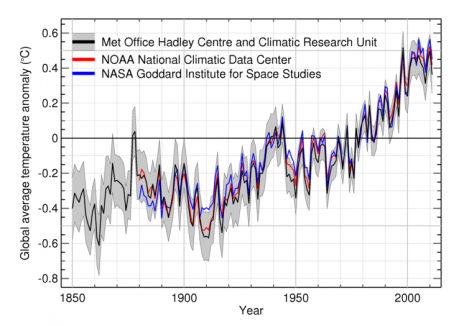
“However, what is absolutely clear is that we have continued to see a trend of warming, with the decade of 2000-2009 being clearly the warmest in the instrumental record going back to 1850. Depending on which temperature records you use, 2010 was the warmest year on record for NOAA NCDC and NASA GISS, and the second warmest on record in HadCRUT3.”
Global average temperatures from 1850 to 2011 from the three individual global temperature datasets (Met Office/UEA HadCRUT3, NASA GISS and NOAA NCDC)
Furthermore despite criticism of a paper published by the Met Office he chose not to ask us to respond to his misconceptions. The study in question, supported by many others, provides an insight into the sensitivity of our climate to changes in the output of the sun.
It confirmed that although solar output is likely to reduce over the next 90 years this will not substantially delay expected increases in global temperatures caused by greenhouse gases. The study found that the expected decrease in solar activity would only most likely cause a reduction in global temperatures of 0.08 °C. This compares to an expected warming of about 2.5 °C over the same period due to greenhouse gases (according to the IPCC’s B2 scenario for greenhouse gas emissions that does not involve efforts to mitigate emissions). In addition the study also showed that if solar output reduced below that seen in the Maunder Minimum – a period between 1645 and 1715 when solar activity was at its lowest observed level – the global temperature reduction would be 0.13C.
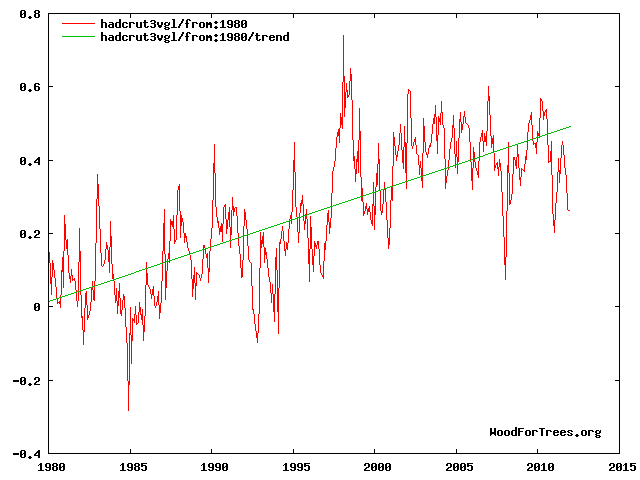
Back to that response from chrisd3. He offered this, “Finally, here is a chart of global temps from HadCRU.” Here is that chart, remember we are looking at Global temperatures.
Global temperature trend
OK, between this Post and my Post last Friday, you probably get the message! There were many other contributions and I could go on and on quoting the great responses I got, all of them uniformly saying there IS global warming unprecedented in recent years. The message is crystal clear and those who wish to deny the evidence … well, I can’t come up with a polite term, so will just leave it at that!
My final contribution is from Martin Lack, author of the Blog Lack of Environment, and a good friend of Learning from Dogs. Here is what he wrote in a recent email,
When I eventually saw your earlier comment, I was surprised and disappointed in equal measure because I almost feel that I have failed in some way. Let me explain: Unlike ClimateSight and SkepticalScience, which both do an excellent job of focusing on the science of climate change, my blog is deliberately focused on the politics underlying the denial of all environmental our problems; including 2 key aspects to my MA dissertation, namely the political misuse of scepticism; and the psychology of denial. See my How to be a Climate Change ‘Sceptic’ for more detail.
Therefore, although not specifically categorised as such, just about everything I have posted is traceable back to Paul and Anne Ehrlich’sBetrayal of Science and Reason (1996) and/or Naomi Oreskes and Erik Conway’s Merchants of Doubt (2010). For someone who does not currently go to any Church, I am remarkably fond of quoting Scripture so, if necessary, please forgive me but, as the Good Book says: “What has been will be again, what has been done will be done again; there is nothing new under the sun” (Ecclesiastes 1:9).
Therefore, I do not think you should be surprised by the amount of misinformation and misrepresentation contained in the original WSJ Sixteen’s article; and/or the fact that denialist arguments are repeated no matter how many times they have been shown to be false. Furthermore, I would warn against trying to summarise it all on Learning from Dogs. This is definitely Book territory and, in addition to the two mentioned above, the market is already saturated by the likes of Climate Change Cover-up by James Hoggan and Climate Change Denial by Haydn Washington and John Cook.
With very best wishes for a fog-free future,
What to say to close these two Posts off? Frankly, it’s difficult to know how to pitch it. The science seems clear beyond reasonable doubt. But if you are reading this and disagree, then PLEASE offer the science to refute the conclusions presented here. I promise you that I will present it on Learning from Dogs.
So let me end with a simple photograph.
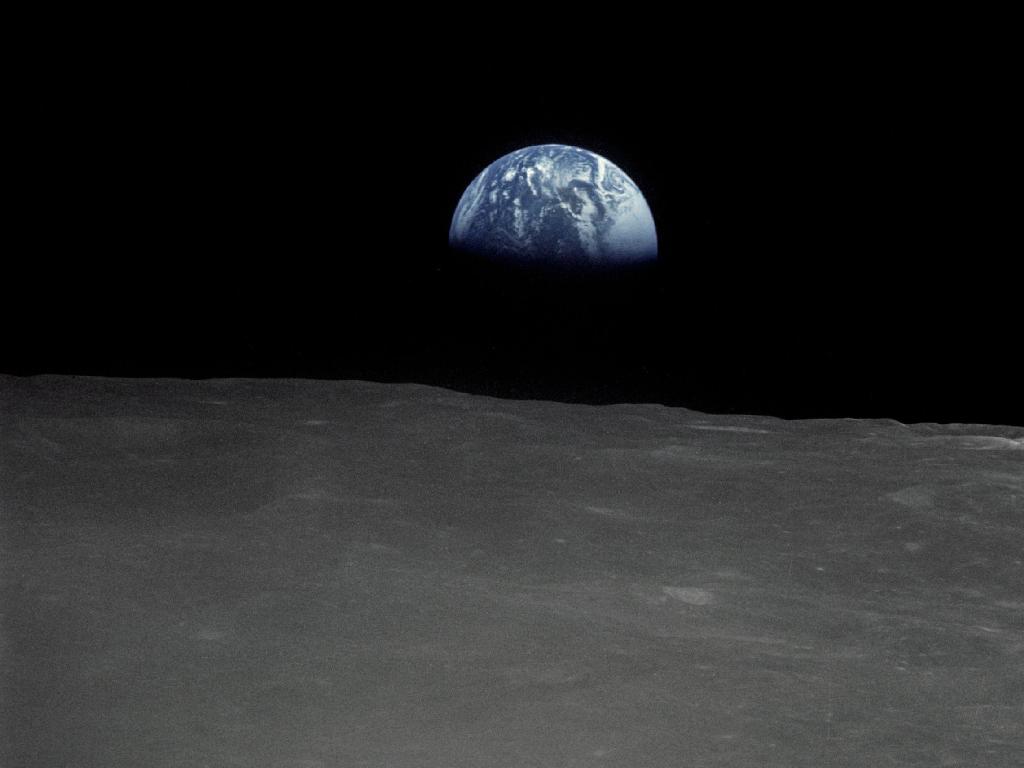
Earthrise
This is the photograph that wilderness photographer Galen Rowell called, “the most influential environmental photograph ever taken.”
The now world-famous photograph was taken by Astronaut William Anders from Apollo 8, the first manned mission to the Moon, a little over 43 years ago on December 24th, 1968.
As the Earth rose above the horizon of the moon, NASA astronaut Frank Borman uttered the words, “Oh my God! Look at that picture over there! Here’s the Earth coming up. Wow, is that pretty.” Bill Anders then took the ‘unscheduled’ photograph.
Now project forward 43 years to the year 2055 and play with the idea of what ‘pretty‘ planet Earth will be like for mankind and so many other species, including our longest companion, the dog, if we don’t get our act together pretty soon!
I must share the feelings of millions of others across the world when I admit to going through periods of quiet despair about where ‘modern man’ has got himself. (I don’t intend to be gender specific!)
It goes way beyond the disbelief at some of the things happening today; way beyond the anger that is generated by so many examples of greed and corruption. It goes to a point where I just want to snuggle down with Jean, curl up with the dogs and kiss the rest of the world good-bye!
The expression that comes to mind is the one about the last person to leave the planet please switch the lights off!
(As if to demonstrate how sensitive dogs are to the feelings of us humans, Cleo just came into the room where I am writing this and laid her head across my left thigh. I stroked her head and then she wandered back to our bed next door – I then took the following photograph)
So what’s feeding my feelings?
Well, as many of you know yesterday and Sunday had posts about saving the Ecuadorian Jaguar and the African Lion. In the case of the former, it’s:
The president of Ecuador claims to stand for indigenous rights and the environment, but he has just come up with a new plan to bring oil speculators in to 4 million hectares of jungle. (That’s 9.9 million acres in old money!)
In the case of the African Lion, it’s:
In the past fifty years, the African lion population declined by as much as 90%. Many of the lion prides that do exist today are so genetically weak from being small and isolated by international borders that they can’t promise a future for African lions ….. two thirds of the African lions killed by trophy hunters end up in the U.S. That’s thousands of lions!
Last Friday I wrote about how community living for wolves and dogs had given those species “group survival and well-being“ that we humans couldn’t even dream about.
I attended a lecture at Essex University Colchester last Wednesday on the plight of indigenous indians in Canada, specifically those in Labrador. The Canadian government has embarked on a scheme to disenfranchise the indians of all their land, wipe out all their rights forever, and place them in perpetual bondage. Underlying this horror was what has happened to the indians themselves, a people tainted with mental illness, alcoholism and high suicide rates.
I asked the lecturer why it is that it appears all indigenous people across the globe share this common trait of high levels of abuse, mental illness, suicide and alcoholism. The answer given was that outsiders desired to force their alien world views upon these people destroying their sense of personal identity. For example many of these people see land as a shared resource, the capitalist ideas of land ownership is at odds with their world view. All Native American problem solving is through talking, and everyone has choice, whereas outsiders prefer to impose solutions and intellectualise with clever words.
Just read that last paragraph carefully again and note “outsiders desired to force their alien world views upon these people destroying their sense of personal identity.”
Back closer to home, the struggles of the North American Indians are well-known.
So no nice, neat solution to this place that I’m in just now other than to put down my pen and let the music from the following two videos wash over me.
If you read this far, thank you for suffering the ramblings of this silly old fart!
1. A conversation with Charles Taylor – THE 2008 KYOTO PRIZE
Video Messages from Dr. Charles MargraveTaylor, the Laureate of 2008 KYOTO PRIZE, Arts and Philosophy. “Feelings on receiving the Kyoto Prize” “What philosophers can do for society” “Future interest and theme”(2008/11/11)
Charles Margrave Taylor, CC GOQ FRSC (born November 5, 1931) is a Canadian philosopher from Montreal, Quebec best known for his contributions to political philosophy, the philosophy of social science, and intellectual history. This work has earned him the prestigious Kyoto Prize and the Templeton Prize, in addition to widespread esteem among philosophers. In 2007, Taylor served with Gérard Bouchard on the Bouchard-Taylor Commission on Reasonable Accommodation with regard to cultural differences in the province of Quebec. Taylor currently teaches at McGill University in the Department of Religious Studies. He is a practicing Roman Catholic.
2. How we see circumstances is so much more important – Rory Sutherland on Perspectives.
The circumstances of our lives may matter less than how we see them, says Rory Sutherland. At TEDxAthens, he makes a compelling case for how reframing is the key to happiness.
From unlikely beginnings as a classics teacher to his current job as Vice Chairman of Ogilvy Group, Rory Sutherland has created his own brand of the Cinderella story. He joined Ogilvy & Mather’s planning department in 1988, and became a junior copywriter, working on Microsoft’s account in its pre-Windows days. An early fan of the Internet, he was among the first in the traditional ad world to see the potential in these relatively unknown technologies.
Southwest forests are already in the early stages of a mega drought brought on by climate change.
Southwest forests are already in the early stages of a mega drought brought on by climate change that will result in massive tree die-offs and sweeping changes in Rim Country forests, according to an analysis published in the scientific journal Climate Change.
Severe drought will dominate much of this century, creating stresses on forests not seen for more than 1,000 years, according to the research that used tree ring samples from 13,000 trees, historical rainfall records and computer projections of future climate change.
The shifts will likely dramatically shrink the world’s largest ponderosa pine forest in northern Arizona, replacing pines with junipers at elevations like Payson and replacing junipers with chaparral and cactus at lower elevations.
The article concludes,
Unfortunately, the team’s climate prediction models suggest that within the next 40 years the region will fall deep into mega drought conditions. The models predict that even the wettest, coolest years in the late 21st century will exceed mega drought levels. In that case, the drought conditions of the past decade will prove the new normal rather than a bad stretch.
Williams noted that while winters in the past decade haven’t been exceptionally dry, summer temperatures have soared. As a result, the stress on the trees in the past 13 years has exceeded mega drought levels about 30 percent of the time — conditions not matched for the previous 1,000 years.
One of the clean little secrets about dealing with climate change, is that if we make our cities more efficient, and reduce their carbon footprint, we will also make them more resilient, quieter, more comfortable, more human scaled, more inviting, and more fun.
As global temperatures rise, urban areas are facing challenges in keeping their infrastructure and their residents cool. Chicago is tackling that problem with a green design makeover. This report is part of our Coping with Climate Change series.





 Learning from Dogs