I started writing this early morning last Friday, 10th May. It was prompted by a post then just in from Christine’s blog 350 or bust. I didn’t have the heart to republish it for a few days.
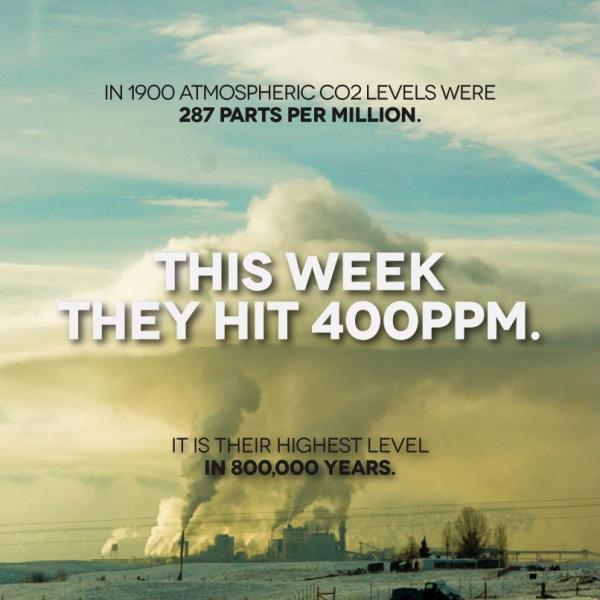
Then as the news of the atmospheric CO2 concentration passing 400 parts per million (ppm) moved more and more into mainstream news, I found myself morphing from sadness and puzzlement into anger and then into some form of determination to ‘do something‘, however insignificant that might be.
Because if humanity does not turn back from our carbon-based lifestyle pretty damn soon then those who are, say, 20 years or more younger than me (I’m 68), are in for some very tough, very rough times indeed.
So over the next two or three days, I shall focus on this topic simply from the motivation of wanting to join the numerous others around the world who are also recognising this moment in the history of man.
Ergo, for today that post from Christine. But I make no apologies for staying with the theme for much of this week.
oooOOOooo
Rolling The Dice: CO2 Concentration Hits Record High Amid Global Inaction On Climate Change
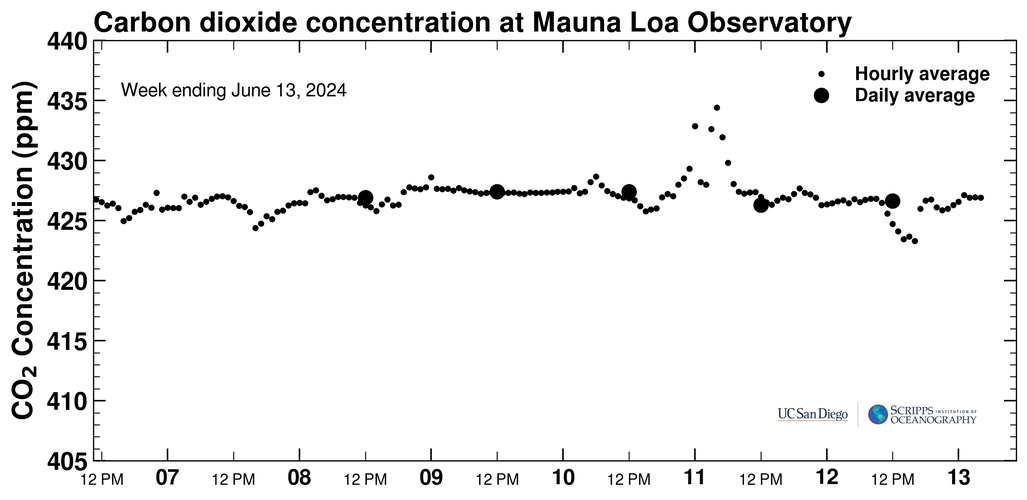
Readings at the US government’s Earth Systems Research laboratory in Hawaii, are not expected to reach their 2013 peak until mid May, but were recorded at a daily average of 399.72ppm on 25 April. The weekly average stood at 398.5 on Monday.
“I wish it weren’t true but it looks like the world is going to blow through the 400ppm level without losing a beat. At this pace we’ll hit 450ppm within a few decades,” said Ralph Keeling, a geologist with the Scripps Institution of Oceanography which operates the Hawaiian observatory.
*
*
Source: Scripps Institute of Oceanography
*
For more on the awful implications of this milestone in human history, check out the links below (hint: it isn’t good news for humans or animals or the ocean).
Now I did say this was going to be an odd assortment of posts for a few days!
Back in my ‘previous’ life in SW England and together with a group of friends we formed an online aviation briefing company, called AvBrief rather unimaginatively! The UK Met Office have their headquarters in Exeter, Devon and AvBrief had a commercial relationship with the Met Office.
Although no longer resident in the UK, I still subscribe to the UK Met Office blog and find many of their posts interesting. Such as this one that came in yesterday.
oooOOOooo
Cyclone twins form in the Indian Ocean by Dave Britton
11th May, 2013
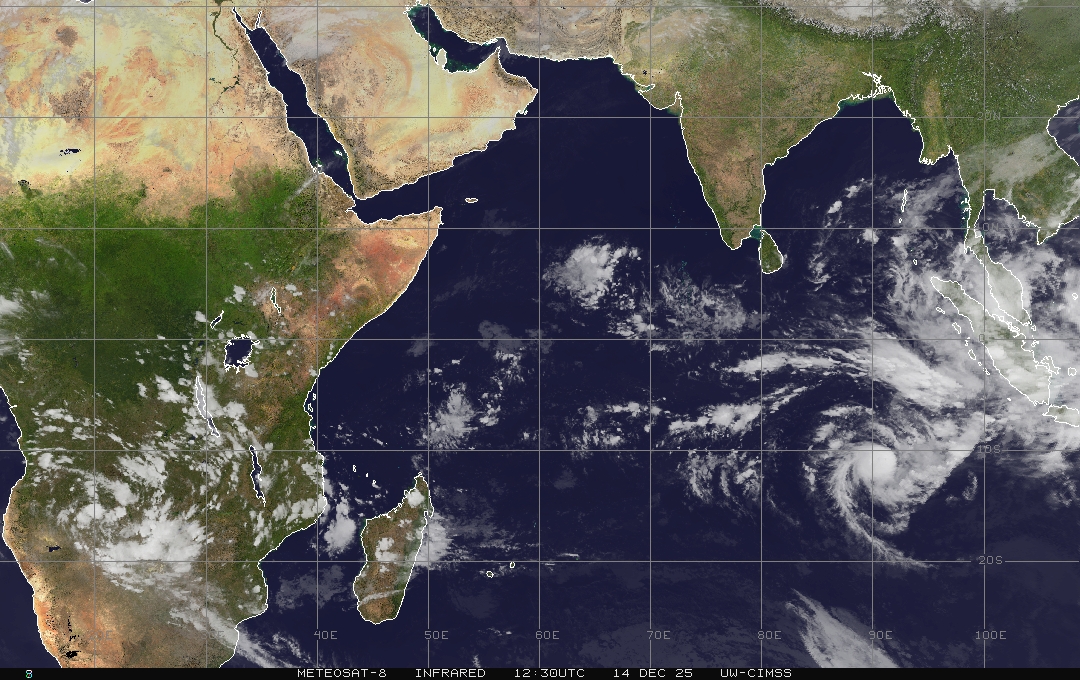
April to June each year usually sees the transition from the southern to the northern hemisphere tropical cyclone season.
During this time it is possible to see cyclones in both hemispheres simultaneously. Furthermore, cyclone ‘twins’ sometimes develop at approximately the same longitude either side of the equator.
For the first time since 2009 cyclone twins have developed in the Indian Ocean.
This was caused by a strong burst of westerly winds along the equator about a week ago. A large mass of clouds located in the same area initially moved eastwards with the wind.
The clouds furthest from the equator then started to curl northwards in the northern hemisphere and southwards in the southern hemisphere due to the earth’s rotation. Over time these cloud masses have consolidated and started to rotate to produce twin tropical storms.
The southern hemisphere storm has been named Jamala and is currently not expected to affect any land areas.
The northern hemisphere storm has been named Mahasen and there is a stronger likelihood of this making landfall next week on one of the Bay of Bengal’s coastal regions.
The Met Office routinely supplies predictions of cyclone tracks from its global forecast model to regional meteorological centres worldwide, which are used along with guidance from other models in the production of forecasts and guidance.
You can keep up to date with tropical cyclones around the world on our website or follow us on Twitter.
You can see the latest image of Tropical Storms Jamala and Mahasen at:
How libertarian ideology is holding back our liberty to change.
Martin Lack, he of the popular blog Lack of Environment is taking a small break from his writings. In his own words,
I am afraid this may be the last post on this blog for a while because – what with the all the willful blindness and ideological prejudice that seems to stop people from recognising what an Eff-ing mess humanity is in – and my as yet unresolved employment situation – I am feeling somewhat emotionally drained. However, please don’t cancel your subscription (as who knows how quickly I may recover).
So what a pleasant surprise when less than a day after those words in came an email that read, “Since I have told readers of my blog that I am taking a rest, I offer you the text appended below to post on your blog instead (or not – as you see fit).”
On reading the text I most certainly ‘saw fit‘ to publish it!
It is a very interesting approach to climate science denialism resulting from an analysis of conspiracy theories.
So over to Martin.
oooOOOooo
Professor Stephan Lewandowsky.
Libertarian ideology is the real road block
I have recently been catching up on a bit of reading – focusing on the recent work of Professor Stephan Lewandowsky (and others). Following in the wake of James Hansen, Ben Santer and Michael Mann, Lewandowsky has recently been the target of hate-mail campaigns by climate change sceptics. Unlike all the others, however, Lewandowsky (formerly at the University of Western Australia but now at Bristol University in the UK) is not a climate scientist. This is how Bristol University announced his recent appointment.
Steve is an internationally renowned cognitive scientist who has joined us from the University of Western Australia. His research has already revolutionised our understanding of human memory and cognition, and he now stands poised to build upon his impressive body of work with a project as ambitious as it is timely. In particular, Steve’s intention to improve our understanding of how people choose to acquire information, and to use this understanding to help create a more informed populace, is a unique and much needed undertaking. Thus, this research offers enormous benefits in the fields of experimental psychology, climate research and the wider public engagement with and understanding of scientific research.
However, now that I have read them, the thing that strikes me most forcefully is not the stupidity of conspiracy “ideation”, the invocation of conspiracy theories, it is the fact that, as Lewandowsky et al acknowledge, their work confirms the findings of many previous studies; that climate change scepticism is associated with prejudicial adherence to libertarian ideology. Also key is that climate change scepticism can be predicted by that prejudicial adherence to libertarian ideology.
Amongst many other things, this explains why EU sceptics are climate sceptics and why the United Kingdom Independence Party (UKIP) do not like Wind Farms. I had understood this for some time. However, I had not fully realised its importance; it was just one theme among others. Anyone who has read my blog recently will probably have noticed my post about New World Order (NWO) conspiracy theory, in which I acknowledged that I had not realised just how significant such thinking is, and how subliminal and subconscious it may be.
Although adherence to free-market economics and libertarian ideology were themes I highlighted in my MA dissertation and in my subsequent book, and mentioned on my blog numerous times, everything I have read in the last few days points to one conclusion: We will not succeed in communicating the urgency of the need for radical changes in energy policy until we can convince people that climate scientists are not trying to perpetuate their research funding or halt human progress.
Professor Lewandowsky’s research shows that little can be achieved by simply telling people they are wrong. Far better is pointing out to people that Limits to Growth and Peak Oil have already halted the progress of globalised Capitalism, as recent times prove dramatically. In other words conveying facts to people rather than ideology.
I must admit that this has been a tough pill to swallow. I am not naturally progressive and certainly not naturally “liberal”. On the contrary, I am socially and politically conservative. However, the reality of anthropogenic climate disruption is a game-changer. Therefore, unlike members of the Flat Earth Society or Young Earth Creationists (YECs), I do not refuse to accept what scientists tell me simply because I don’t like the message.
We cannot defeat such obscurantism by telling people they are irrational; we can only defeat it by focusing on the evidence that suggests strongly that they are mistaken. To this end, I think the words of St Augustine of Hippo are an important consideration; words going back over 1,400 years before anyone started to question the Age of the Earth or the Origin of Species! Words echoed by Thomas Aquinas, (often quoted to those YECs):
“… since Holy Scripture can be explained in a multiplicity of senses, one should adhere to a particular explanation only in such measure as to be ready to abandon it if it be proved with certainty to be false, lest Holy Scripture be exposed to the ridicule of unbelievers, and obstacles be placed to their believing.”
– Thomas Aquinas, Summa Theologica (1273).
In the last 150 years or so, most Christians have now come to reject conspiracy theory explanations for fossils, for example, and have realised that it is inappropriate to treat the Bible as a scientific text book. Regretably, the main source of ideological blindness today is not conventional religion; it is adherence to free-market economics.
Therefore, it is important that we acknowledge the ideological nature of the communication problem we face. That is that the research by Prof Lewandowsky and others has discovered a tendency for libertarians to prefer conspiracy theories to reality. Perhaps, therefore, not surprising that he has been attacked; no-one likes to be told they are deluded.
Roadblocks to policy change will not be cleared by social and political scientists telling libertarians that they are deluded. All that will do is confirm their suspicions and reinforce their prejudices! No, what is needed is for climate scientists to be bolder in stating the facts.
The majority of climate scientists seem content to continue to soft-soap the issue; afraid of “telling it to people straight” because it may induce despair.
No, it is not too late to prevent an ecological catastrophe but I am certain that we are now very short of time and, as everyone from the International Energy Agency, the Pentagon and the IMF agree, further delay will not be cost-effective.
At the same time, I think social and political scientists need to focus on debunking the ‘New World Order’ conspiracy myth and pointing out the logical fallacy in the idea that all Greens are Communists in disguise (the so-called ‘Watermelons’).
The environment has become a political football when it is nothing of the kind. It is our life support system and we have pushed it near to the point of collapse, as E.F. Schumacher once said, by mistaking Nature’s capital for a form of income. Therefore, if we do not change course, bankruptcy would seem inevitable.
oooOOOooo
Having read and reflected on Martin’s essay, a couple of recollections surface. The first is Guy McPherson’s book Walking Away from Empire that I reviewed earlier this year then referred to in a recent republication of a George Monbiot essay:
So very difficult to pick out the sentence that carried the most power, for the essay is powerful from start to end. But this one did hit me in the face, “The impossibility of sustaining this system of endless, pointless consumption without the continued erosion of the living planet and the future prospects of humankind, is the conversation we will not have.“
Finally, I can’t resist reminding you, dear reader, of the point made by Prof. Guy McPherson in his book Walking Away from Empire, which I reviewed on March 6th. particularly in the first paragraph of the first chapter; Reason:
At this late juncture in the era of industry, it seems safe to assume we face one of two futures. If we continue to burn fossil fuels, we face imminent environmental collapse. If we cease burning fossil fuels, the industrial economy will collapse. Industrial humans express these futures as a choice between your money or your life, and tell you that, without money, life isn’t worth living. As should be clear by now, industrial humans — or at least our “leaders” — have chosen not door number one (environmental collapse) and not door number two (economic collapse), but both of the above.
The second recollection comes most recently; from yesterday’s The story of carbon. A story that showed the power of academic, peer-reviewed, properly conducted, rational science!
I will close with a repeat of the closing words from yesterday:
“By my calculation, we have a 5–10 year window to avoid the catastrophe. It won’t be easy — we’re past the point where any transition will be smooth — but we can make the transition and survive as a civilized species, humans in a recognizable world.”
I struggled for a while to decide what to call this post, the first of three. Explain why in just a moment.
The post is predominantly from the hand of a professional writer who goes under the name of Gaius Publius. He is described as contributing editor on AMERICAblog from where one also learns that:
Gaius Publius
Gaius Publius is a professional writer living on the West Coast of the United States. Gaius has written in a variety of genres and styles. He’s published short stories and poetry, books on education & technology, and is currently working on two book-length projects, including one novel.
In addition to writing, Gaius has been a professional educator and currently manages a small publishing consultancy. He holds a Bachelors degree in Great Books with a side concentration in physics and math, and a Masters in English and Communication.
A web search soon comes across a blog where there is a collection of the gentleman’s works.
OK, back to the theme.
Five days ago I read an essay on Yves Smith’s Naked Capitalism blog that struck me as a fabulously bold and clear presentation of the climate crisis. The essay, written by Gaius, also derived a positive message from the boldness and clarity of the argument. I dropped Yves an email asking for permission to republish on Learning from Dogs and not only did I get a quick reply from Yves, that reply included approval for the reposting from Mr. Publius. Thank you both.
The essay was called: The climate crisis in three easy charts. However, I was uncomfortable that the word ‘crisis’ might be a turn-off in a blog post title, so opted for The story of carbon. So with that off my chest, let me go straight to the essay as it appeared on Naked Capitalism.
oooOOOooo
The Climate Crisis in Three Easy Charts
Yves here. This post is the first in a series by Gaius. It starts by looking at the larger climate picture over larger swathes of time and showing what level of temperature changes led to mass extinction events.
I’m preparing to pivot back to climate crisis, starting with some reformatting of the earlier Climate Series posts — the transition to WordPress wasn’t kind to them — and the organization of this material into book form. (There’s also a climate-themed novel in the works; thriller fans, stay tuned.)
As a result, I’m doing serious study to refine both the concepts (or rather, the explanation of them) and the dating of coming events (the crisis in its various stages).
The first part of that pivot includes two media appearances this week. I’ll be on Virtually Speaking With Jay Ackroyd this Thursday (May 2) at 9 pm ET to discuss climate crisis for a full hour, followed by a Sunday appearance with Avedon Carol as part of the Virtually Speaking Sundays weekly media panel.
It’s the climate discussion I want to focus on here, and I’d like to do it by focusing on three diagrams and a few references back to my earlier climate pieces.
Climate catastrophe will usher in a new geologic era
Long-scale earth history is divided into Eons, then Eras, then Periods. But in fact, prior to the Cambrian Period, when life on earth exploded in number and variety, earth history is the story of non-life or small single- or multi-celled life. And starting with the Cambrian period, there’s just one “eon” anyway. It’s eras and periods we care about.
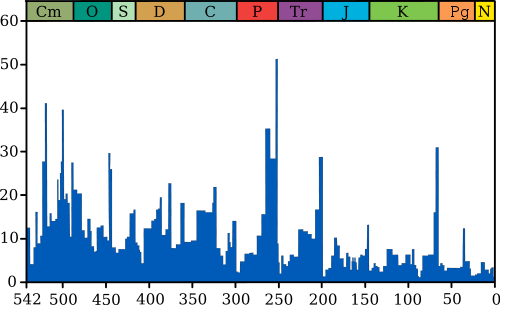
So let’s start there, with the Cambrian Period and the flourishing of life on earth. Consider the chart below:
The divisions across the top are geologic periods, starting with the Cambrian (“Cm”), the period of “visible life”‘ — meaning a proliferation of hardshelled species. It’s the big explosion of life on earth. The numbers across the bottom are millions of years ago. The spikes show extinction events, with the percentage of marine species going extinct expressed on the vertical or Y axis.
The chart doesn’t call them out, but starting with the Cambrian period, we’ve had three geologic eras (the larger divisions):
Paleozoic Era — “old life” Mesozoic Era — “middle life” or the Age of Reptiles (dino days) Cenozoic Era — “new life” or the Age of Mammals (including us)
The Paleozoic Era runs from the start of the graph to the big spike at 250 million years ago on the X axis. It encompasses six geologic periods and ended in the greatest mass extinction event on the planet — geologists call it the “Great Dying”.
The Mesozoic Era runs from the Great Dying at 250 million years ago to the big spike at 65 million years ago, the event that wiped out the dinosaurs — and every other large species. That cleared the way for mammals to grow big and thrive.
We’re now in the Cenozoic Era. Keep those transitions in mind — when mass extinctions change which groups of species can evolve and rule, it’s the end of an era and the start of another. Now look at the chart again. The whole chart shows 540 million years, and just three geologic eras. The next extinction event on the scale of the one at 250 million years ago, or the one at 65 million years ago, will change the shape of life on earth and usher in a new era. Ready for that?
Great question — where does man fit in? Answer: We come in very late.
First, notice the last three geologic “periods” at the top-right in the chart above. The period marked “K” is the Cretaceous, the period at the end of the Mesozoic Era. The next period (“Pg”) is the Paleogene, the one that marks the start of the Cenozoic (new life) Era. The period after that (“N”) is the Neogene, which ended just 2 million years ago. The period after that, not shown, is the Quarternary Period, our current one.
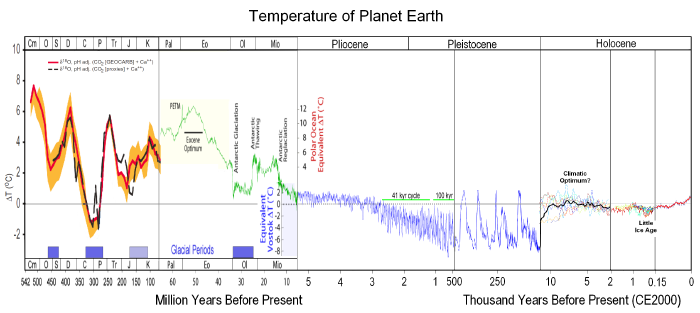
The Neogene-Quarternary boundary is the start of the time of great glaciers, and the best way to show that is with the chart below, showing earth temperatures mapped across the geologic periods (at the left end) and geologic epochs (the rest of the chart).
Click here to open the full version in another tab. It’s a big, interesting chart. (Source here.)
First, get oriented. On the Y axis is global temperature using change — in °C — from global temperature in the year 1800 as the norm or zero mark. (The global pre–Industrial Revolution temperature is generally the mark from which other global temperatures are measured, unless otherwise noted. To convert from °C to °F, just double the number; you’ll be pretty close.)
On the X axis, the first big division — from 542 million years ago to 65 million years ago — represents the first two geologic eras, the Paleozoic and Mezozoic (which unfortunately aren’t called out on this chart). “K” at the top and bottom is still the Cretaceous Period, and the end of the Cretaceous Period is also the end of the dinos and the end of the Mesozoic Era.
In this respect, both charts are the same. Man hasn’t showed up yet — our mammal ancestors were the equivalent of field mice in that world, small prey with soft shells and hiding skills.
But before we look at the rest of the X axis, notice that in the left-most part of the chart, the Y axis shows a huge change in global temperature relative to pre-Industrial norms. Looks like a monster spike, especially the first one, doesn’t it?
The Cambrian temperature spike is 6–8°C (about 11–14°F) higher than pre-Industrial levels.
It’s also the temperature we’re headed for by 2100.
But let’s not get distracted. Let’s set some markers in this chart in the horizontal (time) dimension. The whole rest of the chart — the part after the period called “K” — shows the Cenozoic Era (“new life” or Age of Mammals). From here to the right, the chart’s subdivisions show Epochs, which are sub-parts of Periods.
[Update: For a chart that shows the relationship between eras, periods and epochs, click here. it will help you stay oriented.]
Jump through the next five divisions — the epochs marked “Pal” through “Pliocene”. That takes you through the Neogene Period (“N” in the first chart) and to the start of the modern Quarternary Period, the one we’re in, and the one we’re interested in.
The epoch of the Pleistocene, which starts the Quarternary Period (again, see the chart), is the great age of glaciers. Homo habilis evolves at this time, a little over 2 million years ago. Homo erectus evolves shortly afterward. Each starts in Africa — now you can probably guess why — and each leaves Africa and spreads across the globe. (Homo erectus, by the way, lasts a long time on this earth. Longer than us by a lot.)
Homo sapiens evolved much later, in the Pleistocene — the age of glaciers, remember — just 250 thousand years ago, almost died out in Africa, but rebuilt our numbers, then spread out of Africa like our cousins. Because that was the glacier age, we’re still hunter-gatherers like the the rest of our cousins. The big beasts of the earth are creatures like woolly mammoths and sabre-tooth tigers, and we’re all alive on a fairly frozen planet with glaciers coming and going.
At the end of the Pleistocene is another extinction event. At the same time that the last glaciers recede (see chart), the big mammoths and tigers (et al) die off. Simultaneous with a noticeable change in climate, what we call “human civilization” begins. You can see that above, around 12–10 thousand years ago as the planetary temperature stabilizes. From then until almost now, planetary temperature is pretty stable. Notice it doesn’t take much of a wobble to mark the “Little Ice Age”.
Just two more points to make in this piece and I’m done.
First the bad news
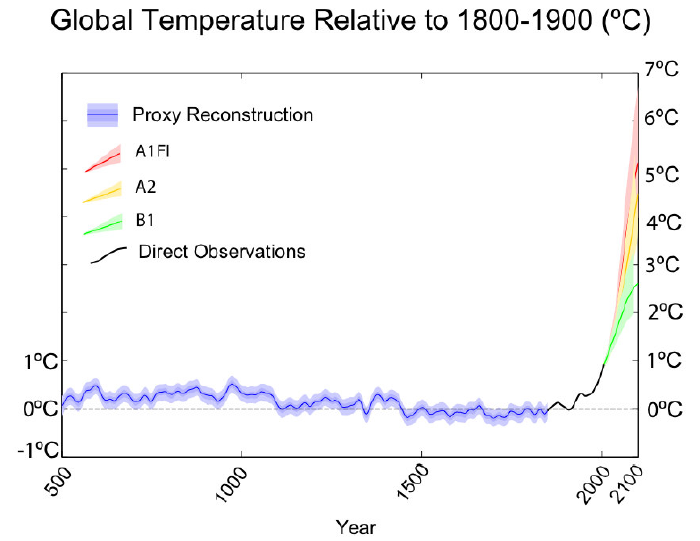
Folks, that little climb in temperature you see near the right end of the graph above is just the beginning. Remember the Cambrian spike at the left end of the graph? Take another look and note the increase — about 7°C. Now here’s Figure 21 from the Copenhagen Diagnosis, a report prepared by … oh … every single one of the world’s top climate scientists for the benefit of our world’s “leaders,” who met in 2009 to discuss how to pass the climate buck one more time:
What you see is temperatures from 500 AD to about 2000, with a number of prediction scenarios going forward. See the scenario called “A1FI”? It’s the one in red. That’s the one we’re on if we don’t stop spewing carbon. I call it the “do nothing” scenario — otherwise known as the “Keep David Koch Happy” scenario.
All you need to know? We’re on track for about +7°C — the peak temperature in the big Cambrian spike — by the year 2100.
Now the good news
Despite all this doom-and-gloom, it’s not over yet. Truly. By my calculation, we have a 5–10 year window to avoid the catastrophe. It won’t be easy — we’re past the point where any transition will be smooth — but we can make the transition and survive as a civilized species, humans in a recognizable world.
But two things are needed:
This has to be our top priority, which means you and everyone you know has to be fully aware and in full battle gear. (For reference, it’s called “hugging the monster.”)
It’s us vs. David Koch and all of his friends and enablers. Tackling any other enemy is tackling a dummy while the game is being played.
Educate your friends, and put a wrench into the Koch machine. How’s that not a plus?
If the Koch Bros keep getting rich, we move backward. If Barack “Hope & Change” Obama approves Keystone, we move backward. If the U.S. develops “domestic oil” resources, we move backward. For every new car (“carbon-delivery system”) sold, we move backward. People need to know this and think like this. We can stop the crisis, but only if we stop carbon. It’s that simple; and that stark.
But it’s also doable, and we’re the species that’s most equiped for “doable.” It’s what our big brains are for.
I’ll have more in the weeks and months ahead. I haven’t given up, not by a long shot. But you can’t pull out of a tail spin if you don’t admit you’re in one. Me, I think we can pull out.
oooOOOooo
So presumably if you are reading this, you have read the essay above. I hope so because while at first sight there appears to be much to take in, the story is clear, informed and powerful. You are unlikely to change the mind of a committed ‘denier’ but if there’s a little part of you that isn’t utterly clear about the risks ahead, then this essay is a fabulous opportunity to embrace clarity – and not to give up hope! Remember those words in the essay:
“By my calculation, we have a 5–10 year window to avoid the catastrophe. It won’t be easy — we’re past the point where any transition will be smooth — but we can make the transition and survive as a civilized species, humans in a recognizable world.”
I subscribe to two blogs: Pendantry’s Wibble and Christine’s 350 or bust. But a temporary lack of quiet reading time has meant that recent posts from each of them were initially only briefly skimmed. I made a mental note to read the one from Pendantry, Where oceans meet, because I have always had a love affair with the oceans. When I did read it, I was blown away, to use the modern vernacular. Why? Stay with me.
Where oceans meet opened thus:
I’ve recently been introduced to two things that demonstrate (to my satisfaction, anyway) that the universe is much stranger than I first thought. Mind you, my first thought was quite some time ago, now.
Then after showing a wonderful photograph of where the Indian Ocean meets the Southern Ocean, (this one below) …
Even vast oceans come together.
…. Pendantry goes on:
The other one of those ‘strange universe’ things is something that I find even more surprising: after decades of eating meat, an hour watching just one film has persuaded me to reconsider the habits of a lifetime.
That really jumped off the page at me because Jeannie has been a vegetarian for most of her life and I have been flirting with the idea.
That ‘one film’ was Vegucated. Here’s the rest of that Wibble post republished with Pendantry’s kind permission.
oooOOOooo
A TED talk highlighted yesterday over on 350orbust (well worth watching — thanks, Christine) included a reference to the film Vegucated. Intrigued, was I, so I trundled off to watch it, and returned a changed man. Well, maybe that’s a bit ambitious, but I do now feel motivated to think more about what I eat, why I’m eating it, and to actively seek out vegan alternatives — something that I have never considered before.
More meat equals more disease.
Vegucated reinforces the betrayal of a society that has sold us all on the idea of having ‘consumer choice’ — but continues to withhold from us the information necessary to make informed choices. And on that point: don’t just take my word for it that this is a film well worth watching: there are many other reviews and quotes about it.
Einstein deliberated, and chose a vegetarian lifestyle
Our world is changing, and, one way or another, we must change with it. I believe that films like Vegucated are essential to help us to choose to move in the direction of a healthier, happier world.
“If slaughterhouses had glass walls, everyone would be vegetarian. “— Paul McCartney.
Naturally I was curious and wandered across to that post. Here are Christine’s own words,
It’s TED Talk Tuesday on 350orbust, and today’s presenter is Zoe Weil who spoke to the young people who gathered at the TEDx Youth symposium held at Cape Elizabeth, Maine, last December. Ms. Weil is the co-founder and president of the Institute for Humane Education. Ms. Weil’s inspiring talk is entitled “How To Be A Solutionary.” Enjoy!
I tell you what! That 11 minute presentation by Zoe Weil was not just inspirational, it was one of the most inspirational speeches I have ever heard! That’s EVER!
Take this quote that comes in less than 2 minutes from the start of the speech, “Never before have we had the capacity to cause the breakdown of so many ecological systems that sustain our life.”
Now if that doesn’t have you gagging for the rest of what Zoe talks about, nothing will. So here it is.
Published on Jan 11, 2013
Zoe Weil is the co-founder and president of the Institute for Humane Education and is considered a pioneer in the comprehensive humane education movement, which provides people with the knowledge, tools, and motivation to be conscientious choicemakers and engaged changemakers for a better world. Zoe created the first Master of Education and Certificate Program in Humane Education in the U.S. covering the interconnected issues of human rights, environmental preservation, and animal protection. She has also created acclaimed online programs and leads workshops and speaks at universities, conferences, and events across the U.S. and Canada. She has taught tens of thousands students through her innovative school presentations, and has trained several thousand teachers through her workshops and programs. Zoe’s most recent book, Most Good, Least Harm: A Simple Principle for a Better World and Meaningful Life, won the 2010 Nautilus silver medal in sustainability and green values. She is the author of several other books including Above All, Be Kind: Raising a Humane Child in Challenging Times for parents; The Power and Promise of Humane Education for educators; and Claude and Medea: The Hellburn Dogs, winner of the Moonbeam gold medal in juvenile fiction, which follows the exploits of two seventh graders who become clandestine activists in New York City, righting wrongs where they find them. Zoe received a Master of Theological Studies from Harvard Divinity School and a Master of Arts from the University of Pennsylvania.
So from the meeting of vast oceans to the meeting of minds.
A few days ago, dear friend Dan Gomez sent me a link to an article in the March/April edition of Maui Magazine (must admit not heard of it before).
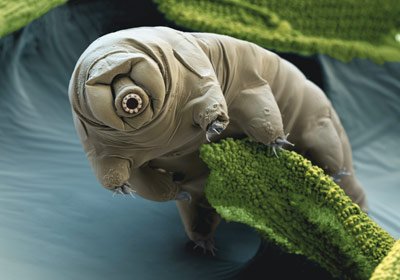
It was a story written by Shannon Wianecki under the title of ‘Eight Tiny Steps for Tardigrades‘. Here’s how it opened;
Eight Tiny Steps for Tardigrades
It might sound like a fairy tale, but it’s fact: Haleakala National Park is home to a troupe of tiny bears. But don’t bother searching for these wee creatures. Tardigrades, better known as water bears, are miniscule, ranging from 50 to 1,200 microns. Which means a couple of water bears could fit into the period ending this sentence.
Water bears are so named for their appearance and form of locomotion. Like microscopic grizzlies, they pad along on eight stumpy legs, brandishing claws and short snouts. Another name — moss piglet — refers to the animal’s most common habitat. Tardigrades are aquatic, but to creatures of their size, suitable swimming holes include the moisture clinging to mosses, or the capillary water between grains of sand. They are found all over the globe: in the arctic, desert, deep sea, and — most of all — in Hawai‘i.
Now if I blow the dust off my aged brain, I recall that a micron is a millionth of a metre (or meter in American speak). Whatever the spelling, that is small.
So even if this little creature can be up to 1,200 microns ‘big’ that would still only be 1.2 thousandths of a metre.
The article is well-worth reading in full. However, I will take the small liberty of republishing the final paragraph;
In 2007, water bears joined astronauts in space to see how they handled cosmic rays. Exposed for ten days to the vacuum of space, without oxygen, water, or heat, and zapped by intense solar radiation, water bears became the first animals to survive in space.
Back on Earth, the mini-cosmonauts continued to breed successfully. Investigating the molecular makeup of these amazing creatures may show humans how to survive future space explorations.
Now without wishing to be too basic, I would love to have this question answered: How does something that small breed? Indeed, how could they ever find each other?
So if you are a pet owner and a bit worried about the costs of feeding and looking after your beloved animal, don’t worry! There’s something else in town a little bit smaller!
“It sometimes feels like a strange movie, you know, it’s all so weird that sometimes I wonder if it is really happening.”
This quote by Marshall Bruce Mathers III (born October 17, 1972), better known by his stage name Eminem, is so apt for today’s item. Because in so many places in so many countries, the weather ain’t what it used to be!
For example, in Grants Pass, Oregon, our local town, yesterday’s high was 86 deg F. (30 deg C.)! Then recently NOAA reported that:
According to NOAA scientists, the globally-averaged temperature for March 2013 tied with 2006 as the 10th warmest March since record keeping began in 1880. It also marked the 37th consecutive March and 337th consecutive month with a global temperature above the 20th century average.
So with all this in mind, I’m republishing a recent item on Climate Crocks, with the permission of Peter Sinclair.
oooOOOooo
Jet Stream Blows Winds of Change
April 19, 2013
I’ve been recovering from earth-month speaking-event whiplash, having criss crossed the state over recent days to talk about climate change, and what scientists are telling us.
Meanwhile, Paul Douglas, above, gave a brief summary of what we know about the extreme spring in the US, just before the current river of moisture hit across the nation’s midsection last night.
Near record setting flooding is hitting at my location, schools closed and evacuations underway. I got a bump from Jeff Masters last night about the situation, he is grappling with the big picture, will be posting more later today. For now, more concern about extreme weather knock-on effects – possible washing of dangerous invasive species into the Great Lakes water system.
The rains have brought the Des Plaines River on the east side of Chicago to major flood stage this morning, and a record flood crest is expected on Friday. The Asian Carp, a dangerous invasive species that would cost billions of dollars were it to get loose in the Great Lakes, is present in the Des Plaines River. Today’s flood event is capable of washing significant numbers of Asian Carp from the Des Plaines River into a canal that feeds directly into Lake Michigan, where they might be able to set up a breeding population capable of devastating the Great Lakes’ fishing industry. However, in October 2010, the U.S. Army Corps of Engineers completed the Des Plaines River barricade, a 13-mile-long system of concrete barriers and a specially fabricated wire mesh that allows water to flow through the fence but prevents the passage of fish. Hopefully, this barricade will withstand the flood and prevent Asian Carp from washing into Lake Michigan.
The Met Office has just released a report entitled “why was the start to spring 2013 so cold?”
–
The immediate cause was a natural climate fluctuation called the North Atlantic Oscillation (NAO). The NAO switches between two states, and this winter (in its negative phase) saw a southward shift of the jet stream, bringing cold air over the UK from northern Europe and Russia.
The Met Office identifies three other natural climate variations that may have made the negative NAO phase more likely.
One is the recent behaviour of another natural climate fluctuation, called the Madden-Julian Oscillation ( MJO). It was particularly strong during late February and March – often a sign that a negative NAO is on the way.
This winter also saw what’s called a Sudden Stratospheric Warming ( SSW) event, where winds in the stratosphere above the north pole reverse direction. This brought cold weather conditions to the UK.
Finally, Europe’s climate is influenced by another natural climate system – the Atlantic Multi-decadal Oscillation ( AMO). While the influence on UK winters is unclear, the report suggests:
“[T]here is some evidence that the changes in Atlantic sea surface temperatures associated with the AMO, dispose the circulation to give drier than normal spring conditions over the UK and northern Europe.”
Arctic Amplification
What about the effects of human-caused climate change? One question that has been much discussed recently is whether the recent rapid decline in Arctic sea ice could contribute to a change in the UK’s weather.
“It is argued that amplification of global warming over the Arctic is reducing the equator to pole temperature gradient, thereby weakening the strength of the mid-latitude jet streams.”
This could allow cold Arctic air to push further south, over mid-latitude countries like the UK, and weather patterns could stay longer in one place.
The possibility of a link between the Arctic and UK weather appears to be gaining scientific support, but the Met Office acknowledges it’s still an “area of ongoing research”. The Met Office has told us it’s holding an “ informal workshop” in the next two to three months for leading UK scientists plus several international experts.
Multiple factors
While scientists are making progress in working out how climate change could influence the odds of abnormal weather, it would be unwise to attribute one year’s events to a single cause. The report points this out, noting that:
“…no single explanation can account for the cold conditions observed”.
The report also highlights that although this spring was unusually cold,”it is not unprecedented or outside the expected natural variability of our climate”.
Nevertheless, with what the Met Office describes as “particularly heightened interest” in recent weather, getting to grips with how climate change could be affecting things is important. Even if, as the Met Office suggests, the complexities of the UK weather make “communicating the science drivers more complicated and nuanced than some audiences may wish.”
oooOOOooo
So wherever you are, do try and watch the Chasing Ice film because the more we all see the truth of what’s happening the better we can embrace change; locally, regionally, and globably.
I can remember everything, except the things I forget!
Today’s post is about something that at it’s heart is no laughing matter; loss of memory. But the opportunity to open in a slightly frivolous manner is simply too tempting!
Because I admit to not remembering when I started to lose my memory! 🙂
But somewhere along the way during the last 5 or 6 years others around me, especially Jeannie, started noticing that my mental recall wasn’t so good. In November, I shall be 69 and have been told (I forget by whom!) that the sort of life changes that these last few years have delivered would be classic causes of declining memory in a person in their sixties.
OK, on with the show.
Some time ago, I received an email from a Daniel Strauss. This is what Daniel wrote:
Hi,
I’m a contributor to an education improvement resource and I recently published an article providing many tips about improving your memory I think you would be interested in. I found your site and your item, Let’s do nothing, during my research and would like to invite you to take a look at my published piece.
Please let me know if you would be interested in taking a look and possibly sharing with your readers.
Thanks,
Daniel
My reply was to query Daniel’s motivation before saying ‘yeah’ or ‘nay’. A further email subsequently arrived:
I am one of many contributors on a research project and recently completed work on resource that provides quick and easy tips to keep your mind sharp and be able to remember things you’ve learned. I reached out because I thought you and your readers would be interested in my resource. Here is the link to the resource. Take a look and let me know if you would consider including it among the other resource links that you’ve provided on your site.
Look forward to hearing from you.
Thanks for your help.
I was happy to feature these memory tips.
The 75 tips are on a website that is called the Open Education Database, from which one learns “We’ve compiled the Open Education Database (OEDb) to help ambitious or prospective students find the most convenient, valuable, and relevant education programs to fulfill their academic and career objectives.”
Not entirely sure why a feature on memory is part of the OEdb website, but so what! The tips strike me as fabulous advice.
The memory feature is called The Memory Toolbox: 75 Tips and Resources to Go from Amnesic to Elephantic, and is introduced, thus:
Many people expect increasing memory loss as they age, but this memory loss can be reduced or stalled with some simple memorization techniques, physical exercise, and a reduction of stress. In fact, impaired memory has more to do with chemicals that are released in the brain when an individual suffers from chronic stress. But, you can reduce the obstacles and increase your memory capacity with the seventy-five tips and resources listed below. In fact, you can go from amnesic to elephantic within a few short weeks.
Some of the tips you may already know, but we’ve repeated them because they may have slipped your mind. Other tips are from recent news stories that contained information you may not have heard. The links will take you to those news items and to other resources that you can use to increase your capacity to remember anything you deem important.
The 75 tips and resources are sorted into 10 groupings; here are some of the recommendations:
Be in the Moment
You can’t remember something if you’ve never learned it, so focus on learning.
It only takes about eight seconds to process data through your hippocampus into the appropriate memory center, so it doesn’t take long to absorb information.
To learn how to stay in the moment, don’t focus on the past or worry about the future while you’re learning.
Don’t multitask, as you create a “brain drain” when you focus on more than one activity.
Create a Learning Environment
Create a learning environment at home. This is crucial for adult learners who will be taking online courses, while balancing work, family, and other factors.
Use All Your Senses
If you’re learning something, involve as many senses as possible to help retain the experience.
Drawing and writing includes the use of motor skills that help you to remember information as you stimulate motor pathways.
If you utilize these motor skills in a task, don’t try something new for a few days. Instead, repeat some of the exercises listed immediately below a few times during the first week so that they become ingrained with your learning habits.
Talk with another person about the information you’ve gathered. This action will incorporate more than one sense and it will help you to categorize information as well.
Attach your ideas to an inert object for your learning process. For instance, connect the introduction of a speech to the entrance of the house, move on to the next room to connect the introduction to the next idea, and so on throughout a building.
Use Mnemonic Devices
Mnemonic (the initial “m” is silent) devices can provide clues to help you remember things. For instance, you can use visual images to memorize names, places, and events. If you wanted to remember Tom’s name, think of a tom cat and connect that person to that image. Or, use something more obvious, like Queen Victoria for Victoria. Just place an imaginary crown on Victoria’s head and you might remember that person’s name the next time you meet them.
“Every Good Boy Does Fine” is a sentence that many musicians use to remember the lines in a treble staff (E, G, B, D, and F). Medical students use silly sentences to remember anatomical features. Try this tool when you need to memorize a sequence of difficult words or a series like the biological taxonomy (Kingdom, Phylum, Class, Order, Family, Genus, Species): “Kids Played Cards On Furry Gray Skins.”
Connect new data to information you already know. For example, if you already know how to cook a turkey, use that information to relate to how you might cook a goose. You’re merely building on information you’ve already retained and relating it to a new recipe. The new recipe will be easier to remember.
Organize
Disorganized people report more memory problems than those individuals who are accustomed to organization. This ability to organize is external as well as internal…External organization can free your brain up for more creative endeavors. Internal organization requires a less stressful lifestyle.
Write things down, but write them down in appropriate places. For instance, write addresses in address books, and write grocery lists in a special notebook that you’ve designated for that list. Accordingly, use specific places in the house for certain items. For instance, if you hang the keys on a hook by the door when you enter, you won’t need to sap your time or brain power to find those keys.
Use online or paper calendars to remember important dates. This will help you to be more social, on time, and employed. Plus, you can free up your mind for more creative endeavors.
Keep a pad, pencil and small flashlight by your bed to write down ideas that you have at night. If you forget these tools, just move something out of place so that you’ll remember that idea in the morning (just throw a tissue or book on the floor so you see it in the morning – those items will trigger memories of the previous evening).
Increase your scholarly productivity with tools that will help you stay organized online.
Overlearn
Spend some time with new material a few hours after you’ve been introduced to it. Review notes and try to consolidate the notes into a broad concept or idea.
Review notes and other information at intervals throughout the next few days. This is called “Spaced Rehearsal” or “Spaced Repetition,” and it’s a more effective method for learning than cramming.
When you use overlearning, you improve recall speed.
Retain a Positive Attitude
Tell yourself that you want to learn and that you can learn and remember the information at hand.
A positive outlook and positive mental feedback sets up an expectation for success.
Exercise Regularly
Exercise increases oxygen to the brain, and oxygen is important for brain function.
Physical exercise reduces the risk for many disorders that relate to memory loss, such as dementia and cardiovascular disease.
The hippocampus is especially vulnerable to age-related deterioration that can affect how well you retain information, so it’s important to maintain an exercise routine as you age.
Walking is not strenuous (unless you power walk), so your leg muscles don’t take up extra oxygen and glucose like they do during other forms of exercise. If you find yourself stressed, take a few minutes to oxygenate your brain with a leisurely walk.
Manage stress
Cortisol, the stress hormone secreted under stress by the human adrenal gland, near the kidneys, can damage the hippocampus if stress is unrelieved.
Physical exercise can help to relieve stress. Even a simple walk can help to clear the mind.
Jokes, soothing music, and even a short nap can help to break the stress.
On the other hand, arousing, exciting, momentous occasions, including stressful ones, get filed away very readily. If you can remember your first date, your first job, 9/11, or when Kennedy was shot, these examples prove that some stressful occasions can create vivid memories.
Other Good habits
A good night’s sleep is necessary for memory consolidation. Sleep disorders (especially in aging women) can leave you tired and unable to concentrate during the day.
Quit smoking – smoking constricts arteries that deliver oxygen to the brain. Research has proven this memory loss in smokers.
Relaxation through meditation, tai chi, yoga, or other techniques that slow respiration, slow metabolism, and release muscle tension can make a huge difference in your overall health and stress levels. Invest about ten to fifteen minutes per day with these techniques.
Staying properly hydrated can do more for your body and mind than eating, at times. Drink your recommended 8-10 glasses per day.
So if you, like me, find the loss of one’s memory to be frustrating, or worse, make a note of the Memory Toolbox website and work your way through all 75 excellent tips and recommendations. It’s a fabulous resource.
I’ll shall be adding the link to my ‘blogroll’ – so long as I don’t forget! 😉
A real pleasure and privilege to republish this article from Mr. Monbiot.
For some time now I have subscribed to the articles published by The Permaculture Research Institute of Australia. From time to time references have been made to PRI articles here on Learning from Dogs.
Recently, I read a PRI essay that had been penned by George Monbiot. It was called The Great Unmentionable. It blew me away. So I took a deep breath and dropped George M. an email asking if I might republish it here. George was very gracious in giving me such permission.
Mr. George Monbiot.
First some background to George Monbiot for those who are unfamiliar with his work and his writings. As his website explains:
I had an unhappy time at university, and I now regret having gone to Oxford, even though the zoology course I took – taught, among others, by Richard Dawkins, Bill Hamilton and John Krebs – was excellent. The culture did not suit me, and when I tried to join in I fell flat on my face, sometimes in a drunken stupor. I enjoyed the holidays more: I worked on farms and as a waterkeeper on the River Kennet. I spent much of the last two years planning my escape. There was only one job I wanted, and it did not yet exist: to make investigative environmental programmes for the BBC.
After hammering on its doors for a year, I received a phone call from the head of the BBC’s natural history unit during my final exams. He told me: “you’re so fucking persistent you’ve got the job.” They took me on, in 1985, as a radio producer, to make wildlife programmes. Thanks to a supportive boss, I was soon able to make the programmes I had wanted to produce. We broke some major stories. Our documentary on the sinking of a bulk carrier off the coast of Cork, uncovering evidence that suggested it had been deliberately scuppered, won a Sony award.
We have offshored both our consumption and our perceptions
By George Monbiot
Every society has topics it does not discuss. These are the issues which challenge its comfortable assumptions. They are the ones that remind us of mortality, which threaten the continuity we anticipate, which expose our various beliefs as irreconcilable.
Among them are the facts which sink the cosy assertion, that (in David Cameron’s words) “there need not be a tension between green and growth.”
At a reception in London recently I met an extremely rich woman, who lives, as most people with similar levels of wealth do, in an almost comically unsustainable fashion: jetting between various homes and resorts in one long turbo-charged holiday. When I told her what I did, she responded, “oh I agree, the environment is so important. I’m crazy about recycling.” But the real problem, she explained, was “people breeding too much”.
I agreed that population is an element of the problem, but argued that consumption is rising much faster and – unlike the growth in the number of people – is showing no signs of levelling off. She found this notion deeply offensive: I mean the notion that human population growth is slowing. When I told her that birth rates are dropping almost everywhere, and that the world is undergoing a slow demographic transition, she disagreed violently: she has seen, on her endless travels, how many children “all those people have”.
As so many in her position do, she was using population as a means of disavowing her own impacts. The issue allowed her to transfer responsibility to other people: people at the opposite end of the economic spectrum. It allowed her to pretend that her shopping and flying and endless refurbishments of multiple homes are not a problem. Recycling and population: these are the amulets people clasp in order not to see the clash between protecting the environment and rising consumption.
In a similar way, we have managed, with the help of a misleading global accounting system, to overlook one of the gravest impacts of our consumption. This too has allowed us to blame foreigners – particularly poorer foreigners – for the problem.
When nations negotiate global cuts in greenhouse gas emissions, they are held responsible only for the gases produced within their own borders. Partly as a result of this convention, these tend to be the only ones that countries count. When these “territorial emissions” fall, they congratulate themselves on reducing their carbon footprints. But as markets of all kinds have been globalised, and as manufacturing migrates from rich nations to poorer ones, territorial accounting bears ever less relationship to our real impacts.
While this is an issue which affects all post-industrial countries, it is especially pertinent in the United Kingdom, where the difference between our domestic and international impacts is greater than that of any other major emitter. The last government boasted that this country cut greenhouse gas emissions by 19% between 1990 and 2008. It positioned itself (as the current government does) as a global leader, on course to meet its own targets, and as an example for other nations to follow.
But the cut the UK has celebrated is an artefact of accountancy. When the impact of the goods we buy from other nations is counted, our total greenhouse gases did not fall by 19% between 1990 and 2008. They rose by 20%. This is despite the replacement during that period of many of our coal-fired power stations with natural gas, which produces roughly half as much carbon dioxide for every unit of electricity. When our “consumption emissions”, rather than territorial emissions, are taken into account, our proud record turns into a story of dismal failure.
There are two further impacts of this false accounting. The first is that because many of the goods whose manufacture we commission are now produced in other countries, those places take the blame for our rising consumption. We use China just as we use the population issue: as a means of deflecting responsibility. What’s the point of cutting our own consumption, a thousand voices ask, when China is building a new power station every 10 seconds (or whatever the current rate happens to be)?
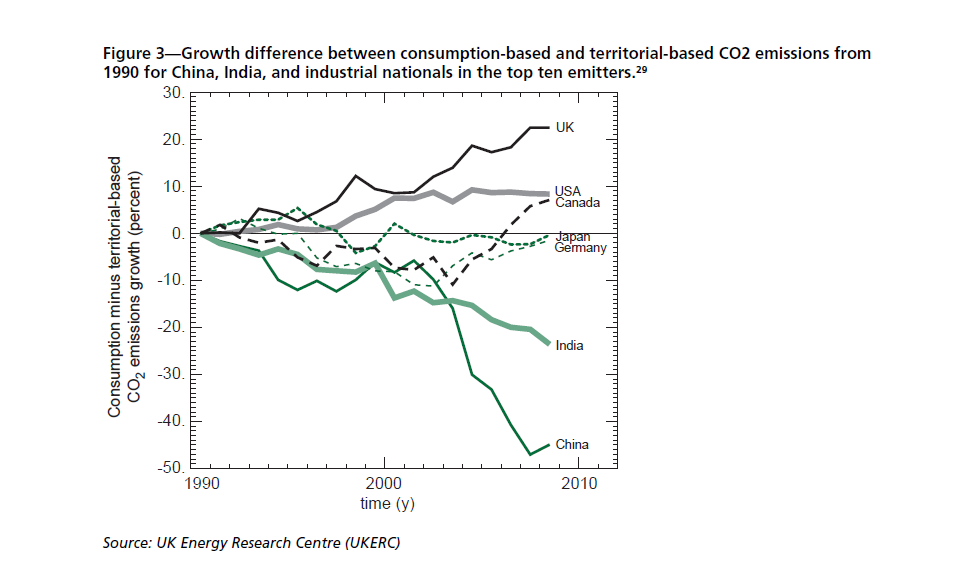
But, just as our position is flattered by the way greenhouse gases are counted, China’s is unfairly maligned. A graph published by the House of Commons Energy and Climate Change Committee shows that consumption accounting would reduce China’s emissions by roughly 45%. Many of those power stations and polluting factories have been built to supply our markets, feeding an apparently insatiable demand in the UK, the US and other rich nations for escalating quantities of stuff.
The second thing the accounting convention has hidden from us is consumerism’s contribution to global warming. Because we consider only our territorial emissions, we tend to emphasise the impact of services – heating, lighting and transport for example – while overlooking the impact of goods. Look at the whole picture, however, and you discover (using the Guardian’s carbon calculator) that manufacturing and consumption is responsible for a remarkable 57% of the greenhouse gas production caused by the UK.
Unsurprisingly, hardly anyone wants to talk about this, as the only meaningful response is a reduction in the volume of stuff we consume. And this is where even the most progressive governments’ climate policies collide with everything else they represent. As Mustapha Mond points out in Brave New World, “industrial civilization is only possible when there’s no self-denial. Self-indulgence up to the very limits imposed by hygiene and economics. Otherwise the wheels stop turning”.
The wheels of the current economic system – which depends on perpetual growth for its survival – certainly. The impossibility of sustaining this system of endless, pointless consumption without the continued erosion of the living planet and the future prospects of humankind, is the conversation we will not have.
By considering only our territorial emissions, we make the impacts of our escalating consumption disappear in a puff of black smoke: we have offshored the problem, and our perceptions of it.
But at least in a couple of places the conjuring trick is beginning to attract some attention.
On April 16th, the Carbon Omissions site will launch a brilliant animation by Leo Murray, neatly sketching out the problem*. The hope is that by explaining the issue simply and engagingly, his animation will reach a much bigger audience than articles like the one you are reading can achieve.
(*Declaration of interest (unpaid): I did the voiceover).
On April 24th, the Committee on Climate Change (a body that advises the UK government) will publish a report on how consumption emissions are likely to rise, and how government policy should respond to the issue.
I hope this is the beginning of a conversation we have been avoiding for much too long. How many of us are prepared fully to consider the implications?
So very difficult to pick out the sentence that carried the most power, for the essay is powerful from start to end. But this one did hit me in the face, “The impossibility of sustaining this system of endless, pointless consumption without the continued erosion of the living planet and the future prospects of humankind, is the conversation we will not have.“
Finally, I can’t resist reminding you, dear reader, of the point made by Prof. Guy McPherson in his book Walking Away from Empire, which I reviewed on March 6th. particularly in the first paragraph of the first chapter; Reason:
At this late juncture in the era of industry, it seems safe to assume we face one of two futures. If we continue to burn fossil fuels, we face imminent environmental collapse. If we cease burning fossil fuels, the industrial economy will collapse. Industrial humans express these futures as a choice between your money or your life, and tell you that, without money, life isn’t worth living. As should be clear by now, industrial humans — or at least our “leaders” — have chosen not door number one (environmental collapse) and not door number two (economic collapse), but both of the above.
Maybe this is why we seem unable to have the conversation because to do so means we have to look at ourselves in the mirror. Each one of us, you and me, has to address something so deeply personal. Back to Prof. McPherson and page 177 of his book (my emphasis):
It’s no longer just the living planet we should be concerned about. It’s us. The moral question, then: What are you going to do about it?
For my money, Mr. Monbiot is yet another voice of reason in the wilderness; another voice that deserves to be followed. I say this because by way of introduction to his philosophy, he opens thus:
My job is to tell people what they don’t want to hear. That is not what I set out to do. I wanted only to cover the subjects I thought were interesting and important. But wherever I turned, I met a brick wall of denial.
Denial is everywhere. I have come to believe that it’s an intrinsic component of our humanity, an essential survival strategy. Unlike other species, we know that we will die. This knowledge could destroy us, were we unable to blot it out. But, unlike other species, we also know how not to know. We employ this unique ability to suppress our knowledge not just of mortality, but of everything we find uncomfortable, until our survival strategy becomes a threat to our survival.
“… until our survival strategy becomes a threat to our survival.”
I sense the growing of this threat to the point where maybe within less than a year the vast majority of open-minded, thinking individuals know the truth of where we are all heading.
Yesterday, I reposted 12 stunning photographs of the world we live on that had been published on Mother Nature Network on the 19th.
Coincidentally, I also saw something on the 19th that was just as breathtaking as those pictures of Planet Earth. Here’s the picture that took my breath away.
Copyright: ESA/Herschel/PACS, SPIRE/N. Schneider, Ph. André, V. Könyves (CEA Saclay, France) for the “Gould Belt survey” Key Programme
Description: Stunning new view from ESA’s Herschel space observatory of the iconic Horsehead Nebula in the context of its surroundings. The image is a composite of the wavelengths of 70 microns (blue), 160 microns (green) and 250 microns (red), and covers 4.5×1.5 degrees. The image is oriented with northeast towards the left of the image and southwest towards the right.The Horsehead Nebula resides in the constellation Orion, about 1300 light-years away, and is part of the vast Orion Molecular Cloud complex. The Horsehead appears to rise above the surrounding gas and dust in the far right-hand side of this scene, and points towards the bright Flame Nebula. Intense radiation streaming away from newborn stars heats up the surrounding dust and gas, making it shine brightly to Herschel’s infrared-sensitive eyes (shown in pink and white in this image).To the left, the panoramic view also covers two other prominent sites where massive stars are forming, NGC 2068 and NGC 2071.
Extensive networks of cool gas and dust weave throughout the scene in the form of red and yellow filaments, some of which may host newly forming low-mass stars.
Don’t know about you but I found that description a little dry, so to speak.
By Jonathan Amos, Science correspondent, BBC News.
Europe’s Herschel space telescope has imaged one of the most popular subjects in the sky – the Horsehead Nebula – and its environs.
The distinctively shaped molecular gas cloud is sited some 1,300 light-years from Earth in the Constellation Orion.
It is in a region of space undergoing active star formation – something Herschel has been most keen to study.
The Hubble space observatory has also returned to the Horsehead scene, to celebrate 23 years in orbit.
Together, these two great facilities give scientists a much broader insight into what is taking place in this familiar patch of the heavens.
“You need images at all scales and at all wavelengths in astronomy in order to understand the big picture and the small detail,” said Prof Matt Griffin, the principal investigator on Herschel’s SPIRE instrument.
“In this new Herschel view, the Horsehead looks like a little feature – a pimple. In reality, of course, it is a very large entity in its own right, but in this great sweep of a picture from Herschel you can see that the nebula is set within an even larger, molecular-cloud complex where there is a huge amount of material and a great range of conditions,” the Cardiff University, UK, researcher told BBC News.
To provide a sense of scale, the Horsehead Nebula, also known in the catalogues as “Barnard 33”, is about five light-years “tall”.
Hubble’s new view of the Horsehead Nebula, a large cloud of hydrogen laced with dust.
Hubble sees the Horsehead in near-infrared light. Herschel, on the other hand, goes to much longer wavelengths. This allows it to see the glow coming directly from cold gas and dust – the material that will eventually collapse under gravity to form the next generation of stars.
Scientists are particularly keen to understand the mechanisms that drive the production of the biggest stars – objects much more massive than our own Sun that form relatively fast, burn bright but brief lives, and interact strongly with their environment, influencing the next round of star formation.
Anyway, that’s more than enough to copy directly from that BBC article. Read the rest by going here. All I will add is Jonathan’s last sentence, “A scholarly paper describing Herschel’s investigation of the Orion Molecular Cloud Complex has been published in the journal Astrophysical Journal Letters.”
Oh, and ponder on how far away from Earth is that Constellation Orion. Remember it was stated as 1,300 light-years.
Well, one light-year is just under 10 million, million kilometres (or about 6 million, million miles). Apparently defined by the IAU, or to give its the full name, the International Astronomical Union, a light-year is the distance that light travels in a vacuum in one Julian year.
So brace yourself! 1,300 light-years is just under 13,000,000,000,000,000 kilometres or in old money, 7,800,000,000,000,000 miles.
Rather puts pottering to the shops in Grants Pass into perspective!








 Learning from Dogs