Category: Science

A bedtime story for mankind.

The latest IPCC report is more than dry science; it’s our future!

Regular readers of Learning from Dogs will be aware that yesterday I published a post called A bedtime story for Jimmy.  It was prompted by learning of an eight-year-old who was offered the opportunity of shooting a wild turkey early last Saturday morning.  The penultimate paragraph read as follows:

If we care for nature then we care for the health of our lands, for our forests and for our seas. We are careful with how we live our lives. If we care for nature then as we live our lives we do our best to leave things better for those that come after us.

Little did I know when writing my post that on the same day of publication would be a chilling post from Patrice Ayme; a post that Patrice has generously given me permission to republish in full.

Indeed, little did I know that when I composed my preface to Jimmy’s story and included these words:

However, this eight-year-old lad is facing a future that demands that he and all his generation accept that embracing nature, totally and whole-heartedly, is their only hope of not being the last generation of humans on this beautiful planet.

That less than twenty-four hours later Patrice’s perspective on the latest IPCC report made that sentence of mine far from hyperbole!  Here is that essay from Patrice.

ooOOoo

Terminal Greenhouse Crisis.

A CRASH TECH PROGRAM IS NEEDED, & HAS TO INVOLVE HYDROGEN.

At the present rate of greenhouse gases emissions, within nine years, massively lethal climate and oceanic changes are guaranteed.

Such is the conclusion one can draw from the Inter Governmental Panel On Climate Change of the UN (the IPCC, with its top 300 climate scientists from all over the world). About 78% of the emissions have to do with heating, cooking, and basic, necessary industrial activities, such as making cement.

They are not elective.

As Bad As An Asteroid?

Notes: CO2 FOLU = CO2 emissions from Forestry and Other Land Use. F-gases = Fluorinated gases covered under the Kyoto Protocol. At the right side of the figure: Emissions of each greenhouse gas with associated error bars (90% confidence interval).

Only a crash program of construction of several hundreds of new technology nuclear fission plants, an all-out renewable energy program, with massive solar plants all over the American South and the (similar latitude) Sahara desert, plus a massive hydrogen economy to store the wind and solar energy could allow us to mitigate the massive lethal change incoming.

In other words, it is already too late to avoid the massive lethal change.

What’s the problem? Simple mathematics. It’s evaluated that human activities in the last century or so released 515 billion tons of greenhouse gases. The IPCC and the best experts believe that 800 to 1,000 billion tons of such gases would bring a rise of global temperatures of two degrees Celsius.

At the present rate, that’s nine years to reach the upper reaches: one trillion tons of GHG.

Most of the temperature rise will be in the polar regions, melting those, and inducing worldwide climate catastrophe, especially if emissions of polar methane turn apocalyptic. The polar regions are the Achilles heel of the Earth’s present biosphere. By striking there mostly, enormous changes can be brought to bear, as they would destroy the Earth’s air conditioning and oceanic circulation.

In 2014, trade winds in the Pacific had four times the energy they usually have, creating abnormally intense ocean upwelling off the west coast of North America, thus a high pressure ridge (thus a drought there), causing a world wide oscillation of the jet stream that dragged cold polar air down the east coast of the USA, before rebounding as continual storms and rain on the west coast of Europe, and so forth.

Nobody can say the weather was normal: precipitation in England beat all records, dating 250 years, whereas most of California experienced extreme drought.

At this point, warm water is piling down to 500 meters depth in the western Pacific in what looks like a preparation for a massive El Nino, similar to the one in 1997-98. If this happens, global temperature records will be smashed next year.

Massively lethal means death to the world as we know it, by a thousand cuts. It means cuts to democracy, privacy, life span, food intake. Some of these are already in plain sight: the Ukraine war is already a war about gas, no less an authority as dictator Putin says so.

Tom Friedman in “Go Ahead, Vladimir, Make My Day.” takes the situation lightly. “SO the latest news is that President Vladimir Putin of Russia has threatened to turn off gas supplies to Ukraine if Kiev doesn’t pay its overdue bill, and, by the way, Ukraine’s pipelines are the transit route for 15 percent of gas consumption for Europe. If I’m actually rooting for Putin to go ahead and shut off the gas, does that make me a bad guy?

Because that is what I’m rooting for, and I’d be happy to subsidize Ukraine through the pain. Because such an oil shock, though disruptive in the short run, could have the same long-term impact as the 1973 Arab oil embargo — only more so. That 1973 embargo led to the first auto mileage standards in America and propelled the solar, wind and energy efficiency industries. A Putin embargo today would be even more valuable because it would happen at a time when the solar, wind, natural gas and energy efficiency industries are all poised to take off and scale. So Vladimir, do us all a favor, get crazy, shut off the oil and gas to Ukraine and, even better, to all of Europe. Embargo! You’ll have a great day, and the rest of the planet will have a great century.”

It’s not so simple. The investments needed are massive, and all the massive investments so far have to do with fracking… Which is, ecologically speaking, a disaster. 3% methane leakage makes fracking worse than burning coal. And this leakage is apparently happening.

Unbelievably, some of the countries with coal beds got the bright idea to burn the coal underground. Australia, about the worst emitter of CO2 per capita, experimented with that. It had to be stopped, because some particularly toxic gases (such as toluene) were coming out, not just the CH4 and CO the apprentice sorcerers were looking for.

Carbon Capture and Storage does not exist (but for very special cases in half a dozen special locations, worldwide, not the thousands of locales needed). And CSS will not exist (profitably).

What technology exist that could be developed (but is not yet)? Not just Thorium reactors. The hydrogen economy is a low key, and indispensable economy. Water can be broken by electricity from wind and sun, and then energy can be stored, under the form of hydrogen. Nothing else can do it: batteries are unable to store energy efficiently (and there is not enough Lithium to make trillions of Lithium batteries).

The hydrogen technology pretty much exist, including for efficient storage under safe form (one thick plate of a material that cannot be set aflame can store 600 liters of hydrogen).

Another advantage of storing hydrogen is that oxygen would be released. Although it may seem absurd to worry about this, too much acidity in the ocean (from absorption of CO2) could lead to phytoplankton die-off, and the removal of half of oxygen production.

In this increasingly weird world, that’s where we are at.

Oh, by the way, how to stop Putin? Europe should tell the dictator he can keep his gaz. Now. As good an occasion to start defending the planet, and not just against fascism.

Patrice Aymé

ooOOoo

I can’t add anything at a scientific level to what Patrice has written.  But I can offer this.  Each and every one of us needs to make sure the message is spread as far and wide as possible (you are free to share and republish this post) and then do something, however small it may seem, to make a difference. And do it now!

For the sake of all the Jimmys in the world – and all the turkeys!
Immediate concern? Try this!

Talk about extreme ends of the spectrum!

Yesterday, I posted about the prediction that in four billion years the Milky Way galaxy would collide with the Andromeda galaxy.  I called the post Not of immediate concern.

Today, I am writing about something that is of immediate concern. That is if you regard the next couple of decades as ‘immediate’.

The post is prompted by an item that was published on the BBC News website two days ago.  It carried the title Climate inaction catastrophic – US

Climate inaction catastrophic – US

By Matt McGrath
Environment correspondent, BBC News, Yokohama, Japan

The costs of inaction on climate change will be “catastrophic”, according to US Secretary of State John Kerry.

Mr Kerry was responding to a major report by the UN which described the impacts of global warming as “severe, pervasive and irreversible”.

He said dramatic and swift action was required to tackle the threats posed by a rapidly changing climate.

Our health, homes, food and safety are all likely to be threatened by rising temperatures, the report says.

Scientists and officials meeting in Japan say the document is the most comprehensive assessment to date of the impacts of climate change on the world.

In a statement, Mr Kerry said: “Unless we act dramatically and quickly, science tells us our climate and our way of life are literally in jeopardy. Denial of the science is malpractice. There are those who say we can’t afford to act. But waiting is truly unaffordable. The costs of inaction are catastrophic.”

Putting to one side the mild irony of a representative of the US Government wringing his hands about what mankind is doing to our climate, the report is valuable and potentially significant.

The report was from the Intergovernmental Panel on Climate Change (IPCC) which is, as their website explains:

The Intergovernmental Panel on Climate Change (IPCC) was established by the United Nations Environmental Programme (UNEP) and the World Meteorological Organization (WMO) in 1988 to assess the scientific, technical and socio-economic information relevant for the understanding of human induced climate change, its potential impacts and options for mitigation and adaptation.

Watch this 5-minute video of Stanford professor Dr. Chris Field, co-chair of that IPCC working group, addressing some of the key questions raised by this latest report.  In particular, focus on Dr. Field discussing the potential of the loss of the Greenland ice cap around 3 min 30 seconds.

Back to the BBC report (which you should read in full!).  Back to Dr. Chris Field being quoted as saying:

I think the really big breakthrough in this report is the new idea of thinking about managing climate change as a problem in managing risks. Climate change is really important but we have a lot of the tools for dealing effectively with it – we just need to be smart about it.

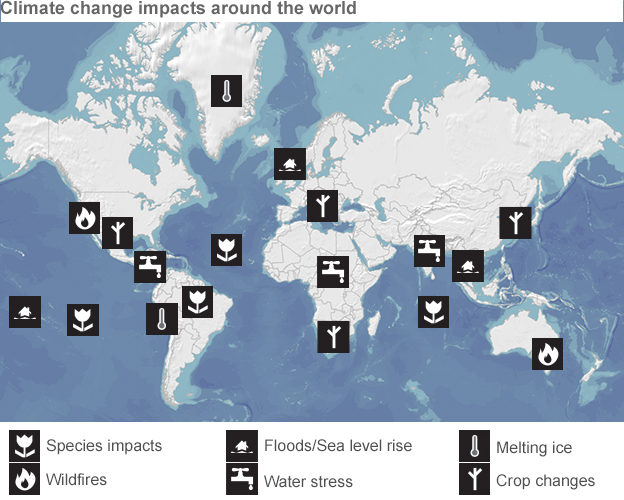
BBC climate-change-impacts_v2

It would be easy to get into the mindset that humanity is not going to change its ways in time.

But, then again, the pace of growing awareness about what the changes are that we all need to make, and make relatively soon, is dramatic.

Maybe, just maybe, this will turn out alright!

Fingers-crossed1

For all the young people in the world, I do so hope!


Not of immediate concern!

Milky Way galaxy heading for a collision – in about 4,000,000,000 years!

As with huge numbers of others who come to this blog, the night sky has always been of incredible fascination to me.  To reinforce that fact, one of the favourite posts on Learning from Dogs for the last three years has been The night sky above published back on the 27th March, 2011.  If you haven’t read it, do pop across and do so as the title is misleading in terms of the post.

Thus it was unavoidable not to pick up on an item recently referred to by Naked Capitalism that had been published by the EarthSky blog.  This particular item was called Night sky as Milky Way and Andromeda galaxies merge.  It began thus:

As seen on Cosmos … the collision and merger between our Milky Way galaxy and the nearby Andromeda galaxy 4 billion years from now.

The video below illustrates what NASA scientists announced in 2012 – and what the Cosmos TV series featured in 2014 – that the nearby Andromeda galaxy will collide and merge with our Milky Way galaxy 4 billion years from now. The video (from the Hubble Space Telescope news center) is from a series of photo illustrations, showing the predicted merger between our two titan spiral galaxies, as seen in Earth’s sky. Will Earth as a planet survive long enough to see this? A word about that at the end of this post.

The video lost a lot for me by not carrying a commentary.  But no problem as one was found that did have a ‘voice-over’.  However, the article photographs were stunning.  For example:

merger-milky-way-andromeda-NASA-e1395662599173
This series of photo illustrations shows the predicted merger between our Milky Way galaxy and the neighboring Andromeda galaxy. Via NASA; ESA; Z. Levay and R. van der Marel, STScI; T. Hallas, and A. Mellinger

A description of what’s happening in the images above:

First Row, Left: Present day.
First Row, Right: In 2 billion years the disk of the approaching Andromeda galaxy is noticeably larger.
Second Row, Left: In 3.75 billion years Andromeda fills the field of view.
Second Row, Right: In 3.85 billion years the sky is ablaze with new star formation.
Third Row, Left: In 3.9 billion years, star formation continues.
Third Row, Right: In 4 billion years Andromeda is tidally stretched and the Milky Way becomes warped.
Fourth Row, Left: In 5.1 billion years the cores of the Milky Way and Andromeda appear as a pair of bright lobes.
Fourth Row, Right: In 7 billion years the merged galaxies form a huge elliptical galaxy, its bright core dominating the nighttime sky.

The sequence is inspired by dynamical computer modeling of the inevitable future collision between the two galaxies.

Further on in the article one reads:

This illustration shows the collision paths of our Milky Way galaxy and the Andromeda galaxy. The galaxies are moving toward each other under the inexorable pull of gravity between them. Also shown is a smaller galaxy, Triangulum, which may be part of the smashup. Via NASA; ESA; A. Feild and R. van der Marel, STScI.

Will Earth survive long enough to see this merger of galaxies, as depicted in the video above? Earth as a planet might, but life on Earth – probably not. Astronomers say that the luminosity, or intrinsic brightness, of our sun will steadily increase over the next 4 billion years. As the sun’s luminosity increases, the amount of solar radiation reaching the Earth will also increase. It’s possible that – around 4 billion years from now – the increase in the Earth’s surface temperature will cause a runaway greenhouse effect, perhaps similar to that going on now on the planet next door, Venus, whose surface is hot enough to melt lead. No one expects to find life on Venus. Likewise, life on Earth will probably not exist 4 billion years from now. What’s more, our sun is expected to become a red giant star eventually. A probable fate of the Earth is absorption by the sun in about 7.5 billion years, after our sun has entered the red giant phase and expanded to cross Earth’s current orbit.

Anyhow, I mentioned that I found a better video on YouTube than the one included in the original article, and that is now presented.

Rather puts the grunt and grind of daily life into perspective! 😉

Has it always been like this?

An essay from George Monbiot that highlights a world most would rather not think about.

It was past 4pm when I realised that I didn’t have a post for tomorrow (today!).  I went through my email folder that I devote for potential blog posts and came across this recent essay from George Monbiot.  Some time ago George gave me a general permission to republish his essays here on Learning from Dogs.

As it happens, this essay from George resonated unpleasantly with an article that I read this morning on the Permaculture Research Institute website.  It was called 10 Ways to Prepare for a Post-Oil Society.  Take this extract, for example:

2. We have to produce food differently.

The Monsanto/Cargill model of industrial agribusiness is heading toward its Waterloo. As oil and gas deplete, we will be left with sterile soils and farming organized at an unworkable scale. Many lives will depend on our ability to fix this. Farming will soon return much closer to the center of American economic life. It will necessarily have to be done more locally, at a smaller-and-finer scale, and will require more human labor. The value-added activities associated with farming — e.g. making products like cheese, wine, oils — will also have to be done much more locally. This situation presents excellent business and vocational opportunities for America’s young people (if they can unplug their iPods long enough to pay attention). It also presents huge problems in land-use reform. Not to mention the fact that the knowledge and skill for doing these things has to be painstakingly retrieved from the dumpster of history. Get busy.

When I read the full piece it made me feel angry that those in power both sides of ‘The Pond’ display no focus or interest in the future of modern societies over the next 25-years; well none that I can pick up!  Yet when you speak to friends, neighbours and people one meets when out-and-about, almost without exception people are nervous about just where it’s all heading – and that’s even before Russia and the Ukraine comes up!

Read George’s essay and see what comes to your mind.  Oh, and do leave a comment!

Follow the smoke trails!

ooOOoo

How the media gives Big Tobacco everything it wants.

By George Monbiot, published in the Guardian 18th March 2014

Almost everything is fake. The brave proverbs with which we were brought up – the truth will out, cheats never prosper, virtue will triumph – turn out to be unfounded. For the most part, our lives are run and our views are formed by chancers, cheats and charlatans. [Ed. my emphasis!]

They construct a labyrinth of falsehoods from which it is almost impossible to emerge without the help of people who devote their lives to navigating it. This is the role of the media. But the media drags us deeper into the labyrinth.

There are two kinds of corporate lobbyists in the UK. There are those who admit they are lobbyists but operate behind closed doors, and there are those who operate openly but deny they are lobbyists. Because David Cameron has broken his promise to shine “the light of transparency on lobbying in our country and … come clean about who is buying power and influence” we still “don’t know who is meeting whom. We don’t know whether any favours are being exchanged. We don’t know which outside interests are wielding unhealthy influence. … Commercial interests – not to mention government contracts – worth hundreds of billions of pounds are potentially at stake.” (All that was Cameron in 2010 by the way)(1). At the same time, the media is bustling with people working for thinktanks which refuse to say who is paying them, making arguments which favour big business and billionaires.

Perhaps the most prominent is the Institute of Economic Affairs. Like most groups of this kind, it refuses to disclose its funding. But there’s a trail of smoke. We now know that it has been taking substantial sums from British American Tobacco (BAT), Japan Tobacco International, Imperial Tobacco and Philip Morris International(2,3). BAT has funded the institute since 1963(4). By pure coincidence, the IEA has fiercely defended the tobacco companies from efforts to regulate their products.

In their indispensable new book A Quiet Word, Tamasin Cave and Andy Rowell explain why corporations want other people to front their campaigns. “The third party has the credibility of looking independent; seems to be motivated by something other than self-interest and profit; and therefore has a much greater chance of being believed. Credibility, authenticity and the impression of independence are key. It is about separating the message from the self-interested source.”(5) While many controversial companies use this tactic, it is particularly important for tobacco firms; first because no one trusts them; secondly because they are banned from seeking to influence public health policy, under the Convention on Tobacco Control, which the UK has ratified(6).

Last year a presentation made in 2012 by Philip Morris International (which sells Marlboro and other brands) was leaked(7). It explained how the company intended to fight the proposed plain packaging rules in the UK. Plain packaging is a misnomer: the packs show only horrible photographs of medical conditions caused by smoking. The evidence suggests that they’re a powerful deterrent(8). Philip Morris listed the arguments that should be made in the media to try to prevent the government from introducing plain packaging, identified the BBC as a key outlet, and named the Institute of Economic Affairs and the Tax Payers’ Alliance as potential “media messengers”(9).

So you might imagine that the media – and the BBC in particular – would exercise a certain amount of caution when interviewing think tanks funded by tobacco companies about the regulation of tobacco. Such as disclosing that they are, er, funded by tobacco companies. You would of course be wrong.

At the end of last year the BBC’s Today programme interviewed Mark Littlewood, the head of the Institute of Economic Affairs, about plain packaging(10). It failed to inform listeners that the IEA has received funding from tobacco companies. Mark Littlewood used two of the arguments recommended by Philip Morris in that leaked document: there’s no evidence that plain packaging affects the number of people who smoke, and it stimulates a black market in cigarettes.

I encouraged readers to complain, on the grounds that the BBC’s failure to disclose his interests in the issue he was discussing flatly contravenes three of its editorial guidelines. The BBC’s responses astonished me. First it claimed that it was not “appropriate or necessary” to include this information, on the grounds that the IEA doesn’t publish it(11). In other words, if you’re not candid about who funds you, you’re off the hook. Then, as the complaints continued, it maintained that “all we have to go on are newspaper reports. In the absence of any independent verification therefore, it remains an allegation”(12).

When the BBC was told that tobacco companies have admitted funding the IEA, the reasoning changed again. Now it argues that it would be wrong to assume “that an organisation adopts a particular position on an issue because it receives funding from an interested party”: it might have formed the position first and received the money as a consequence(13). That’s true, though it’s hard to see what difference it makes: if think tanks survive and prosper because their position just happens consistently to align with the grimmest of corporate interests, the politics of the relationship don’t change very much. In either case, surely listeners should be allowed to make up their own minds. Who would not wish to be told that an organisation whose spokesperson is defending Big Tobacco on the Today programme receives money from Big Tobacco? What kind of broadcaster does not see that as relevant information?

Since then, the IEA’s staff have been interviewed by the BBC about tobacco eight more times(14). In none of the interviews I have listened to are their interests declared. It’s all about to blow up again, as the government’s review of plain packaging reports at the end of this month, and the thinktanks will be trundling all over the media(15). The petition I published on change.org, calling on the BBC to disclose its contributors’ financial interests, has 11,000 signatures so far(16). If they reach 20,000, I’ll present it.

Stories like this remind me that much of life is a struggle against disappointment. Perhaps I’m an idiot, but I expected a world that was so much better. I still believe it’s possible. But getting there requires a daily struggle against those who would mislead us.

www.monbiot.com

References:

1. http://toryspeeches.files.wordpress.com/2013/11/david-cameron-rebuilding-trust-in-politics.pdf

2. http://www.theguardian.com/society/2013/jun/01/thinktanks-big-tobacco-funds-smoking

3. http://www.tobaccotactics.org/index.php/Institute_of_Economic_Affairs

4. As above.

5. Tamasin Cave and Andy Rowell, 2014. A Quiet Word: Lobbying, Crony Capitalism and
Broken Politics in Britain. Bodley Head, London.

6. Article 5.3. http://whqlibdoc.who.int/publications/2003/9241591013.pdf

7. www.tobaccotactics.org/index.php/PMI%E2%80%99s_Anti-PP_Media_Campaign

8. Crawford Moodie et al, no date give. Plain Tobacco Packaging: A Systematic Review. Report for the Department of Health by the Centre for Tobacco Control Research, University of Stirling. http://phrc.lshtm.ac.uk/papers/PHRC_006_Final_Report.pdf.

9. www.tobaccotactics.org/index.php/PMI%E2%80%99s_Anti-PP_Media_Campaign

10. Today, 28th November 2013. BBC Radio 4.

11. BBC Complaints, 4th December 2013.

12. BBC Complaints, 9th January 2014.

13. BBC Editorial Complaints Unit, 19th February 2014.

14. http://www.iea.org.uk/in-the-media/media-coverage

15. http://www.thelancet.com/journals/lancet/article/PIIS0140-6736%2814%2960480-3/fulltext?version=printerFriendly

16. https://www.change.org/en-GB/petitions/the-bbc-always-disclose-the-financial-interests-of-the-people-you-interview-in-the-issues-they-are-discussing

ooOOoo

Won’t be the first time, nor the last time, that I mention the need, the critical need, for human society to learn the value of integrity: the quality that we see coming from our animals day-in; day-out!

Sometimes one just has to wonder ….

…. about the most peculiar species of all: man!

A number of essays and items from a variety of sources have passed my screen in recent times that ….. well, you complete the sentence! Let me illustrate; in no particular order.

I have long been a follower of the writings of George Monbiot.  Those who haven’t come across Mr. Monbiot before can avail themselves of his background and dip into his articles, many of which underscore my proposition that we really are a peculiar race.  For example, just three days ago George Monbiot published an article under the title of The Benefits Claimants the Government Loves.  It highlights one mad aspect of UK Policy.

Corrupt, irrational, destructive, counter-productive: this scarcely begins to describe our farming policy.

By George Monbiot, published in the Guardian 4th March 2014

Just as mad cow disease exposed us to horrors – feeding cattle on the carcasses of infected cattle – previously hidden in plain sight, so the recent floods have lifted the lid on the equally irrational treatment of the land. Just as BSE exposed dangerous levels of collusion between government and industry, so the floods have begun to expose similar cases of complicity and corruption. But we’ve heard so far just a fraction of the story.

You really do need to read the article in full to get your arms around the terrible state of affairs of the UK benefits scandal.  But try this:

As a result of these multiple failures by the government, even Farmers’ Weekly warns that “British soils are reaching crisis point” (16). Last week a farmer sent me photos of his neighbours’ fields, where “the soil is so eroded it is like a rockery. I have the adjoining field … my soil is now at least 20 cm deeper than his.” In the catchment of the River Tamar in Devon, one study suggests, soil is being lost at the rate of five tonnes per hectare per year (17).

I could go on. I could describe the complete absence of enforceable regulations on the phosphates farmers spread on their fields, which cause eutrophication (blooms of algae which end up suffocating much of the freshwater ecosystem) when they run into the rivers. I could discuss the poorly-regulated use of metaldehyde, a pesticide that is impossible to remove from drinking water (18). I could expand on the way in which governments all over Europe have – while imposing a temporary ban for flowering crops – permitted the use of neonicotinoid insecticides for all other purposes, without any idea of what their impact might be on animals in the soil and the rivers into which they wash. The research so far suggests it is devastating, but they were licensed before any such investigation was conducted (19).

There is just one set of rules which are effective and widely deployed: those which enforce the destruction of the natural world. Buried in the cross-compliance regulations is a measure called GAEC 12 (20). This insists that, to receive their money, farmers must prevent “unwanted vegetation” from growing on their land. (The rest of us call it wildlife habitat). Even if their land is producing nothing, they must cut, graze or spray it with herbicides to get their money. Unlike soil erosion, compaction and pollution, breaches of this rule are easy to detect and enforce: if the inspectors see trees returning to the land, the subsidy can be cut off altogether.

Perhaps a clue to the extreme unfairness of who is in receipt of UK benefits can be explained by the fact expressed by George Monbiot above, “The biggest 174 landowners in England take £120m between them.

With that in mind, let’s move on.  Move on to a recent essay from Patrice Ayme: WAR MAKES HISTORY! To say it makes disturbing reading is, trust me, an understatement.  But in the context of the UK’s rich landowners, as George Monbiot explained above, try this closing extract from Patrice’s essay:

We are a deeply equalitarian species. Out of equality rises our superior cultural performance. Plutocracy, the rule of the Dark Side, denies giving, love, and the equality which make us possible. Thus plutocracy is a denial of our species. Only an anger great enough to destroy it, will save us, and the biosphere. And there is hope: greed is neither as natural, nor as strong as anger.

It’s time to get angry against dictator Putin. Angry now is better than very sorry tomorrow.

War makes history. Of this we must think, if we want to make history better.

Patrice Aymé

Frankly, my own knowledge of these ‘dark forces’, of the influence of money and power, is practically zero. But the more that one looks at the madness of so many aspects of mankind’s existence, the more one thinks the truth, as Patrice writes it, is the real truth.  Indeed, here’s how Patrice opens his essay:

WAR MAKES HISTORY

HERE WE GO AGAIN

The earlier unjustifiable, unprovoked fascism, greedy plutocracy, imperial overstretch, murderous paranoia and other aspects of the Dark Side get smashed, the better.

Such is the most basic lesson of the 1930s.

For the millions of us that live relatively comfortable lives, it’s easy to read this stuff, nod sagely, and wonder if the heating needs to be left on this coming night.  But, pardon the pun, wake-up calls as to the approaching nightmares (sorry!) are not hard to find.

Try this from an interview with Elizabeth Kolbert, as recently published on Grist:

In “The Sixth Extinction,” Elizabeth Kolbert reports from the frontlines of a dying world

By 

betsy-kolbert-cropped
University of Montana

The New Yorker writer and acclaimed author Elizabeth Kolbert has a penchant for depressing topics. Her 2006 book, Field Notes from a Catastrophe, helped push climate change into the mainstream (with bonus points for not mincing words in the title).

Now that climate change is safely keeping most of us up at night, Kolbert turned her pen to another big bummer: the sixth extinction. We’re currently losing species at a rate of 1,000 to 10,000 times higher than unassisted nature wiping out the occasional newt. While humans weren’t responsible for the last five mass extinctions, our fingerprints are all over this one. Yep: We collectively have the force of an asteroid when it comes to erasing species (high five, guys!) and for the most part, our response has been classic Urkel.

That interview concludes:

Q. You also write about some efforts to save species. Could you share some of those?

A. I happened to go to the San Diego Zoo, where they have a very impressive conservation program. I was there to see something called the “frozen zoo.” It’s just a bunch of vats of liquid nitrogen with cell lines from, in many cases, highly endangered animals and, in one case, an animal that doesn’t exist anymore, a Hawaiian bird. The idea is pretty much what it sounds like: You have these cell lines, you’re going to keep them alive forever, and eventually people are going to figure out how to resurrect some of these species. Or maybe if you don’t want to go quite that sci-fi, we’ll take the cell lines, we’ll do a DNA analysis, we’ll try to figure out why this population is having trouble.

They took me to see this bird named Kinohi, one of the last Hawaiian crows. He’s “reluctant to part with his genetic material,” let’s put it that way. He had been taken from this breeding facility on Maui to San Diego, and he is ministered to by a PhD physiologist who is trying to, let’s say, pleasure this bird, so that he will give up some sperm, so she can artificially inseminate a bird back in Maui. When I visited he had not yet, you know, come through. She was literally preparing to try again — I don’t know if it has ever worked, I should call her.

That was really, to me, emblematic of this crazy situation we find ourselves in. We’re incredibly smart, we’ve figured out how to freeze cell lines and quite possibly bring back extinct animals — we’re willing to pleasure crows. And yet, the Hawaiian Islands are called the extinction capital of the planet — it’s an absolutely devastated ecosystem. Many, many birds are extinct already; those that aren’t are just clinging to existence. Those forces are not changing and, in fact, things are getting worse. There used to be no mosquitoes in Hawaii; there are now mosquitoes. They carry avian malaria, and as the climate warms, avian malaria is moving up the slopes so that even these refugees species that are high on the mountains are increasingly not there. A lot of birds are in terrible trouble there.

All of these things are happening at once and, once again, they’re all true. People are devoting a lot of time and energy and love to trying to preserve these species, and meanwhile the world is increasingly screwed up. So that is how I end the book: They can both be true; it’s not one or the other.

Did you notice the reference to yet another example of mankind’s madness? “That was really, to me, emblematic of this crazy situation we find ourselves in. We’re incredibly smart, we’ve figured out how to freeze cell lines and quite possibly bring back extinct animals — we’re willing to pleasure crows. And yet, the Hawaiian Islands are called the extinction capital of the planet — it’s an absolutely devastated ecosystem.

I believe inherently that the great majority of individuals are good people.  Take Kevin Richardson for instance. Not for him money and power.  Just a passion to save lions.  Oh, and hugging them!  Just watch, and be moved.

Don’t know how to close this? Maybe using a quotation from Ernest Hemingway:

The world breaks everyone, and afterward many are strong at the broken places.

So in these broken times, let all the good people come out strong – stronger than those who are corrupt, irrational, destructive and counter-productive!

It is the ultimate time for hope and faith in the power of goodness!

The history of everything – In just three minutes.

The history of life on Earth  – quicktime!

A whole clutch of things happened yesterday to conspire in me running out of creative time.  Indeed, it was after 4pm when I sat down in front of my computer wondering about today’s LfD blog post.

Luckily (well for me!), amongst the list of draft posts was this one from January 1st, 2014.  So I cheated by grabbing it and offering it for you today. I just hope you find it of interest.  It was originally presented on Big Think on the 1st January, 2014.

ooOOoo

The History of Life on Earth in Three Minutes

by BIG THINK EDITORS
JANUARY 1, 2014, 12:00 AM

earth_dna

Happy New Year, planet Earth!

According to the Anno Domini designation, the year is now 2014. But the Earth has been around a lot longer than that – about 4.567 billion years. The first evidence of life dates back to around 3.8 billion years ago. Homo sapiens first appeared on the planet around two hundred thousand years – or ten thousand generations – ago.

How’s that for perspective?

Kirk Johnson, director of the National Museum of Natural History, calls this perspective “deep time.” This is the story of our planet preserved in “the DNA of living things,” Johnson explains, as well as “in the fossils we find, in the geologic structures of our planet, in the meteorites we scavenge from the ice fields in Antarctica. Those things together give us an incredible manual for thinking about the planet.”

Why is this manual useful? We are facing a century that will be an incredibly challenging one for humanity. We now live on a planet with seven billion people, which is up from 1.7 billion people just three or four generations ago. So we have more people, and a greater need for resources.

Fortunately we have the bodies of extinct plants and animals that lived for the last three-and-a-half billion years. These fossils are not only a source of energy, but also a source of knowledge about how this planet works. Over its history the Earth has seen an incredible diversity of life – maybe as many as fifty million species. Johnson says we’re learning “as much about the evolution of life on Earth by looking at what happened in the past as we are at looking at the breakthroughs in genomics and DNA of living things.” Furthermore, Johnson sees the sequencing of the human genome as the vanguard for what will eventually be “the study of the genomics of all living things.”

We have the opportunity right now, Johnson says, to choose what our future will be. Our understanding of the diversity of life on this planet, he says, will be our guide. This story is being told at a current exhibition at the National Museum of Natural History called “Genome: Unlocking Life’s Code.”

In the video below, Johnson shares a unique perspective on deep time in the form of a timeline of life on this planet in just three minutes.

ooOOoo

Don’t know about you but I found the video fascinating.

Dogs and humans – fascinating research.

Serendipity, or just coincidence?

Yesterday, I published a post and called it Dogs and wolves – fascinating research.  Then blow me down in yesterday’s online BBC News, there was an article headlined: Dogs’ brain scans reveal vocal responses  This is how it opened.

Dogs’ brain scans reveal vocal responses

By Rebecca Morelle, Science reporter, BBC World Service

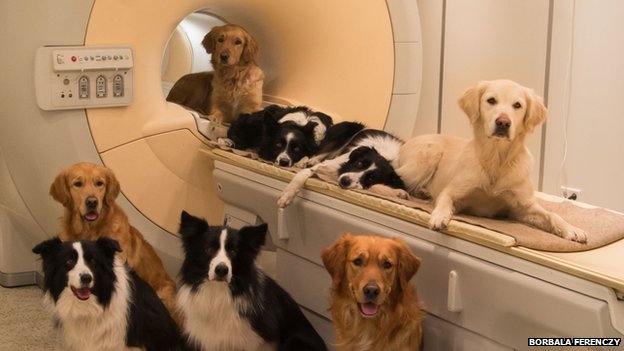
Pet dogs took part in the MRI scanning study.

Devoted dog owners often claim that their pets understand them. A new study suggests they could be right.

By placing dogs in an MRI scanner, researchers from Hungary found that the canine brain reacts to voices in the same way that the human brain does.

Emotionally charged sounds, such as crying or laughter, also prompted similar responses, perhaps explaining why dogs are attuned to human emotions.

The work is published in the journal Current Biology.

Lead author Attila Andics, from the Hungarian Academy of Science’s Eotvos Lorand University in Budapest, said: “We think dogs and humans have a very similar mechanism to process emotional information.”

Eleven pet dogs took part in the study; training them took some time.

Going across to that Current Biology link, one reads:

Summary

During the approximately 18–32 thousand years of domestication [1], dogs and humans have shared a similar social environment [2]. Dog and human vocalizations are thus familiar and relevant to both species [3], although they belong to evolutionarily distant taxa, as their lineages split approximately 90–100 million years ago [4]. In this first comparative neuroimaging study of a nonprimate and a primate species, we made use of this special combination of shared environment and evolutionary distance. We presented dogs and humans with the same set of vocal and nonvocal stimuli to search for functionally analogous voice-sensitive cortical regions. We demonstrate that voice areas exist in dogs and that they show a similar pattern to anterior temporal voice areas in humans. Our findings also reveal that sensitivity to vocal emotional valence cues engages similarly located nonprimary auditory regions in dogs and humans. Although parallel evolution cannot be excluded, our findings suggest that voice areas may have a more ancient evolutionary origin than previously known.

Back to the BBC news item.

The canine brain reacted to voices in the same way that the human brain does.

“There were 12 sessions of preparatory training, then seven sessions in the scanner room, then these dogs were able to lie motionless for as long as eight minutes. Once they were trained, they were so happy, I wouldn’t have believed it if I didn’t see it.”

For comparison, the team looked at the brains of 22 human volunteers in the same MRI scanners.

The scientists played the people and pooches 200 different sounds, ranging from environmental noises, such as car sounds and whistles, to human sounds (but not words) and dog vocalisations.

The researchers found that a similar region – the temporal pole, which is the most anterior part of the temporal lobe – was activated when both the animals and people heard human voices.

“We do know there are voice areas in humans, areas that respond more strongly to human sounds that any other types of sounds,” Dr Andics explained.

“The location (of the activity) in the dog brain is very similar to where we found it in the human brain. The fact that we found these areas exist at all in the dog brain at all is a surprise – it is the first time we have seen this in a non-primate.”

Emotional sounds, such as crying and laughter also had a similar pattern of activity, with an area near the primary auditory cortex lighting up in dogs and humans.

Likewise, emotionally charged dog vocalisations – such as whimpering or angry barking – also caused a similar reaction in all volunteers,

Dr Andics said: “We know very well that dogs are very good at tuning into the feelings of their owners, and we know a good dog owner can detect emotional changes in his dog – but we now begin to understand why this can be.”

However, while the dogs responded to the human voice, their reactions were far stronger when it came to canine sounds.

They also seemed less able to distinguish between environmental sounds and vocal noises compared with humans.

About half of the whole auditory cortex lit up in dogs when listening to these noises, compared with 3% of the same area in humans.

Commenting on the research, Prof Sophie Scott, from the Institute of Cognitive Neuroscience at University College London, said: “Finding something like this in a primate brain isn’t too surprising – but it is quite something to demonstrate it in dogs.

“Dogs are a very interesting animal to look at – we have selected for a lot of traits in dogs that have made them very amenable to humans. Some studies have show they understand a lot of words and they understand intentionality – pointing.”

But she added: “It would be interesting to see the animal’s response to words rather than just sounds. When we cry and laugh, they are much more like animal calls and this might be causing this response.

For the full report, as it was posted on the BBC website, click here.

Plus, do watch this five-minute video abstract.

Published on Feb 20, 2014

The video presents the first study to compare brain function between humans and any non-primate animal. Scientists at MTA-ELTE Comparative Ethology Research Group in Hungary found that dogs and humans use similar neural mechanisms to process social information in voices. The fact that dogs can be trained to lie motionless during fMRI tests opens up the space for a new branch of comparative neuroscience.

Paper in Current Biology: http://dx.doi.org/10.1016/j.cub.2014….

Group home page: http://mta-etologia.elte.hu/

The first study to compare brain function between humans and any non-primate animal shows that dogs have dedicated voice areas in their brains just as people do. Dog brains, like those of people, are also sensitive to acoustic cues of emotion, according to a study in the Cell Press journal Current Biology.

The findings suggest that voice areas evolved at least 100 million years ago, the age of the last common ancestor of humans and dogs, the researchers say. It also offers new insight into humans’ unique connection with our best friends in the animal kingdom, perhaps explaining how our two species have lived and worked together so effectively for tens of thousands of years.

“Our findings suggest that dogs and humans not only share a similar social environment, but they also use similar brain mechanisms to process social information,” said Atilla Andics of MTA-ELTE Comparative Ethology Research Group in Hungary. “This may help the successfulness of vocal communication between the two species.”

Andics and his colleagues trained eleven dogs to lay motionless in an fMRI brain scanner. That made it possible to run the very same neuroimaging experiment on dog and human participants — something that had never been done before. They captured both dogs’ and humans’ brain activities while they listened to dog and human sounds, ranging from whining or crying to playful barking or laughing.

The images show that dog and human brains include voice areas in similar locations. Not surprisingly, the voice area of dogs responds more strongly to other dogs, while that of humans responds more strongly to other humans. The researchers also noted striking similarities in the ways the dog and human brain processes emotionally loaded sounds. In both species, an area near the primary auditory cortex lit up more with happy sounds than unhappy ones. Andics said they were most struck by the common response to emotion across species.

There were some differences too: in dogs, 48 percent of all sound-sensitive brain regions respond more strongly to sounds other than voices. That’s in contrast to humans, in which only three percent of sound-sensitive brain regions show greater response to non-vocal versus vocal sounds.

The study is the first step to understanding how it is that dogs can be so remarkably good at tuning into the feelings of their human owners. “This method offers a totally new way of looking at neural processing in dogs,” Andics said. “At last we begin to understand how our best friend is looking at us and navigating in our social environment.”

Dogs and wolves – fascinating research.

Something new to learn every day!

I have been saving this report for a few weeks.  Following yesterday’s great news about the latest concerning wolves in Oregon, today seemed a perfect follow-on with a report first published in online journal PLOS ONE. However, what follows is a full republication of the report as I read it on the Science Daily website.

ooOOoo

Teaching young wolves new tricks: Wolves are considerably better imitators than dogs

Date: January 31, 2014

Source: Veterinärmedizinische Universität Wien

Summary: Although wolves and dogs are closely related, they show some striking differences. Scientists have undertaken experiments that suggest that wolves observe one another more closely than dogs and so are better at learning from one another. The scientists believe that cooperation among wolves is the basis of the understanding between dogs and humans.

Wolves are considerably better imitators than dogs. Credit: Walter Vorbeck
Wolves are considerably better imitators than dogs.
Credit: Walter Vorbeck

Although wolves and dogs are closely related, they show some striking differences. Scientists from the Messerli Research Institute at the University of Veterinary Medicine, Vienna have undertaken experiments that suggest that wolves observe one another more closely than dogs and so are better at learning from one another. The scientists believe that cooperation among wolves is the basis of the understanding between dogs and humans.

Their findings have been published in the online journal PLOS ONE.

Wolves were domesticated more than 15,000 years ago and it is widely assumed that the ability of domestic dogs to form close relationships with humans stems from changes during the domestication process. But the effects of domestication on the interactions between the animals have not received much attention. The point has been addressed by Friederike Range and Zsófia Virányi, two members of the University of Veterinary Medicine, Vienna (Vetmeduni Vienna) who work at the Wolf Science Center (WSC) in Ernstbrunn, Niederösterreich.

Wolves copy other wolves solving problems

The scientists found that wolves are considerably better than dogs at opening a container, providing they have previously watched another animal do so. Their study involved 14 wolves and 15 mongrel dogs, all about six months old, hand-reared and kept in packs. Each animal was allowed to observe one of two situations in which a trained dog opened a wooden box, either with its mouth or with its paw, to gain access to a food reward. Surprisingly, all of the wolves managed to open the box after watching a dog solve the puzzle, while only four of the dogs managed to do so. Wolves more frequently opened the box using the method they had observed, whereas the dogs appeared to choose randomly whether to use their mouth or their paw.

Watch closely …

To exclude the possibility that six-month old dogs fail the experiment because of a delayed physical or cognitive development, the researchers repeated the test after nine months. The dogs proved no more adept at opening the box than they were at a younger age. Another possible explanation for the wolves’ apparent superiority at learning is that wolves might simply be better than dogs at solving such problems. To test this idea, the researchers examined the animals’ ability to open a box without prior demonstration by a dog. They found that the wolves were rarely successful. “Their problem-solving capability really seems to be based on the observation of a dog performing the task,” says Range. “The wolves watched the dog very closely and were able to apply their new knowledge to solve the problem. Their skill at copying probably relates to the fact that wolves are more dependent on cooperation with conspecifics than dogs are and therefore pay more attention to the actions of their partners.”

The researchers think that it is likely that the dog-human cooperation originated from cooperation between wolves. During the process of domestication, dogs have become able to accept humans as social partners and thus have adapted their social skills to include interactions with them, concomitantly losing the ability to learn by watching other dogs.

—-

Story Source: The above story is based on materials provided by Veterinärmedizinische Universität WienNote: Materials may be edited for content and length.

—-

Journal Reference:

  1. Friederike Range, Zsófia Virányi. Wolves Are Better Imitators of Conspecifics than DogsPLoS ONE, 2014; 9 (1): e86559 DOI: 10.1371/journal.pone.0086559

ooOOoo

So if you, like me, are one of many people who believe that your dog knows what you are thinking, then we need to thank the wolf!

The scent of danger.

A reflection on our reptilian brains.

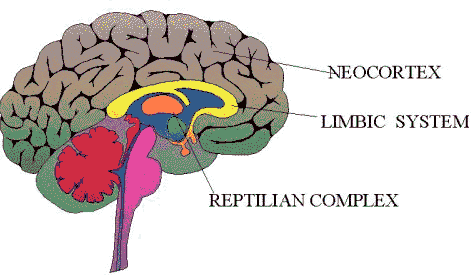
Now of all the things I am not, I am neither a biologist nor a scientist of any description.  However, general knowledge told me years ago that the human brain is composed of three areas, as the following diagram shows.

The constituents of the human brain.

A quick web search brings up THE EVOLUTIONARY LAYERS OF THE HUMAN BRAIN, from which I quote:

The first time you observe the anatomy of the human brain, its many folds and overlapping structures can seem very confusing, and you may wonder what they all mean. But just like the anatomy of any other organ or organism, the anatomy of the brain becomes much clearer and more meaningful when you examine it in light of the evolutionary processes that created it.

The most efficient model for understanding the brain in terms of its evolutionary history is the famous triune brain theory developed by Paul MacLean. According to this theory, the following three distinct brains emerged successively in the course of evolution and now co-inhabit the human skull:

The reptilian brain, the oldest of the three, controls the body’s vital functions such as heart rate, breathing, body temperature and balance. Our reptilian brain includes the main structures found in a reptile’s brain: the brainstem and the cerebellum. The reptilian brain is reliable but tends to be somewhat rigid and compulsive.

The limbic brain emerged in the first mammals. It can record memories of behaviours that produced agreeable and disagreeable experiences, so it is responsible for what are called emotions in human beings. The main structures of the limbic brain are the hippocampus, the amygdala, and the hypothalamus. The limbic brain is the seat of the value judgments that we make, often unconsciously, that exert such a strong influence on our behaviour.

The neocortex first assumed importance in primates and culminated in the human brain with its two large cerebral hemispheres that play such a dominant role. These hemispheres have been responsible for the development of human language, abstract thought, imagination, and consciousness. The neocortex is flexible and has almost infinite learning abilities. The neocortex is also what has enabled human cultures to develop.

These three parts of the brain do not operate independently of one another. They have established numerous interconnections through which they influence one another. The neural pathways from the limbic system to the cortex, for example, are especially well developed.

I’m well into reading the book Waking The Tiger: Healing Trauma authored by Peter A. Levine.  As early as Chapter One, Peter Levine explains [my emphasis]:

The involuntary and instinctual portions of the human brain and nervous system are virtually identical to those of mammals and even reptiles. Our brain, often called the ‘triune brain,’ consists of three integral systems. The three parts are commonly known as the ‘reptilian brain’ (instinctual), the ‘mammalian or limbic brain (emotional), and the ‘human brain or neo-cortex’ (rational). Since the parts of the brain that are activated by a perceived life threatening situation are the parts we share with animals, much can be learned by studying how certain animals, like the impala, avoid traumatization. To take this one step further, I believe that the key to healing traumatic symptoms in humans lies in our being able to mirror the fluid adaptation of wild animals as they ‘shake out’ and pass through the immobility response and become fully mobile and functional.

Unlike wild animals, when threatened, we humans have never found it easy to resolve the dilemma of whether to fight or flee. This dilemma stems, at least in part, from the fact that our species has played the role of both predator and prey. Prehistoric peoples, though many were hunters, spent long hours each day huddled together in cold caves with the certain knowledge that they could be snatched up at any moment and torn to shreds.

Anyway, to get back to what triggered today’s post.

If you read yesterday’s post you will recall me chatting with Jon Lavin and Jon reminding me that humans are drawn to positive messages.  But in stark contrast, the news media industry excels in promoting ‘doom and gloom’.  Why is this?  Why are we so fascinated by danger?

Well here’s my theory.

That is our evolution would not have succeeded if early man didn’t become pretty smart at identifying animal behaviours and plants and fruits that had the capacity to harm or even kill.  For example, what parent hasn’t made it a priority to teach their children the difference between harmful fungi and edible mushrooms.  Indeed to the extent that most of us would think long and hard before eating any fungi found in the wild unless we were 150% certain it was edible.  Look at the following picture.  Your instinct tells you if it’s safe to eat or not – it’s not!

Amanita muscaria photo © Michael Wood

So early man became over-sensitised to dangers to his health for his own good and continued existence. While modern man functions in ways almost unrecognisable from early man, that good old reptilian brain still is doing it’s best to protect us (flight, fight or freeze).  Think how we all respond to a sudden alarming sound, such as a gun shot or a scream, to know that the old reptilian brain is still alive and well.

Thus while all of us hate negativity we all seem to have this fascination with doom and gloom – just in case it helps us and our loved ones survive.

Back to Jon Lavin.  He makes it very clear that anything more than a small amount of ‘doom and gloom’ speaking to our consciousness increases the odds of depression and introversion.

Thus the message is that we humans should allow our Neocortex to tell our Reptilian ‘neighbour’ to go easy on the bad news, go and open a beer and watch the world go by! Whoops! Watch the world go by with a smile!

Oh, and Happy Valentine’s Day to you all.

Science and understanding

Our weather systems are entirely driven by the laws of science.

Come forth into the light of things, let nature be your teacher.

So wrote William Wordsworth.

The last twelve months has been a period of untypical weather in many parts of the world.  It’s easy to scratch one’s head with puzzlement and blame it on the most convenient and fashionable theory of the moment.  Unusual jet stream pattern; polar vortex; aliens! You get the idea! However, the principle behind what is happening to the weather systems across our planet is very straightforward.  Our weather systems are described by the laws of science.

Thus it is a great pleasure to offer the following guest post from a scientist: Martin Lack.  Martin should be no stranger to readers of Learning from Dogs; his most recent contribution was the major three-part essay From Environmentalism to Ecologism.

Martin is the author of the blog Lack of Environment and this essay was first published there on the 11th July, 2012.

ooOOoo

Conserving mass, water, and energy

I must admit that I am rather fond of quoting Sir Arthur Eddington as having once said, “…if your theory is found to be against the Second Law of Thermodynamics, I can give you no hope; there is nothing for it but to collapse in deepest humiliation.” Without quibbling over the detail, the Law of Conservation of Mass is pretty darn close; but what, you may ask, has this got to do with climate change denial?

Conservation of mass of water
Well, consider for a moment that scientists seem to agree that there has been a 4% increase in the average moisture content of the Earth’s atmosphere since 1970. That being the case, I am bound to say that this extra 4% is making its presence felt in the UK at the moment! This year we have had the wettest 3 months (April – June) in over 100 years; the wettest June on record; the rain is still falling (sometimes as much as 80mm in a day); and – we are now being told – there is no change anticipated in coming weeks. So, if you’re coming over for the Olympics, expect to get wet!

However, whilst the UK suffers from near Biblical levels of flooding, if the Law of Conservation of Mass is to be upheld and – all other things like terrestrial ice volume remaining equal(!) – the volume of water in the oceans is to remain constant, then it must be failing to rain somewhere else. If so, is there any evidence to support this theory Law? Well, funnily enough, there is: Whilst the UK continues to receive more rain than it wants or needs (all hose pipe bans and drought restrictions have now been lifted), many parts of the World continue to suffer from persistent drought (in sub-Saharan West Africa) and/or record-breaking temperatures (in most of North America).

Sadly, none of this seems to stop self-confessed scientifically-illiterate English graduates such as James Delingpole from ridiculing the entire notion of global warming simply because it is raining a lot here at the moment. It may seem that he has just got a nasty case of tunnel vision and/or short-term memory loss but this is what the fake sceptics always do; they never look at the big picture: Rather than look at daily, monthly, or even annual average temperatures over multi-decadal periods to determine significant long-term trends; they just cherry pick data to reach fallacious conclusions such as “global warming stopped in 1998″.

I am therefore left hoping that the 57% of the British adult population that seem to fall for this kind of nonsense will soon decide that it is time to stop running down the up escalator and, by embracing the reality of what is happening, decide to become part of the solution rather than being part of the problem. If not, climate change denial may well lead to a failure to conserve mass; with the mass in question being the sustainable number of humans this planet can support in the long-term.

Conservation of mass of carbon
If the Law of Conservation of Mass explains why anthropogenic global warming climate disruption is not invalidated by any amount of cold weather or torrential rainfall in one place; can it be used to validate concern regarding a 40% increase CO2 in the Earth’s atmosphere? Funnily enough, it can: Since the Industrial Revolution began in the mid-18th Century, a vast amount of fossilised carbon has been burnt; with the carbon it contained combining with oxygen in the air to form CO2. Note here that the oxygen was in the air anyway; whereas the carbon had been out of circulation for hundreds of millions of years. All this new carbon has to go somewhere and, given that it will be many more millions of years before any of it gets taken back out of circulation by nature, it is either making the atmosphere warm-up or it is reducing the pH of seawater (just enough to make life very difficult for corals and shellfish).

So then, what is the human response to all this? Shall we stop burning the fossil fuels now we know we’re causing a problem? It doesn’t look like it! It seems far more likely that we shall gamble the future habitability of all the planets diverse ecosystems on finding a way to defeat the Law of Conservation of Mass by artificially removing this carbon from the biosphere: Carbon Capture and Storage (CCS). And do you know what I find most astonishing about CCS? It is the fact that our governments are spending huge sums of money on long-term tests to simulate the effects of CO2 leaking from a submarine CCS repository – to see if it has any noticeable effects on marine life?

Errr, hello-oh? If any CO2 ever escapes from any CCS repository, the entire exercise will have been a complete waste of time and money! The CO2 will be back in circulation and the Law of Conservation of Mass will have won (again). If the genie will not stay in the bottle we will all be in big trouble: Rather than being likely to“collapse in deepest humiliation”; such a failure to defeat the Law of Conservation of Mass will probably result in the collapse of the entire planetary ecosystem; because of our other big problem – the Law of Conservation of Energy: The reason the atmosphere is warming up in the first place; more energy is coming in from the Sun than is getting out into Space!

Conclusions
So, this year’s weather should be a wake-up call to all of us: Irrespective of the actual kind of extreme weather being experienced in any one place, the impacts on agriculture seem to be equally destructive and spiralling food costs the inevitable end result: All just as was predicted by people dismissed for decades as doomsayers: People like Garrett Hardin, Paul Ehrlich, Dennis Meadows, E.F. Schumacher, William Ophuls, Mathis Wackernagel, Ernest Callenbach, and Lester Brown… It looks like that darn ‘wolf’ finally showed up!

Funnily enough, it turns out that a doubling in the size of the global human economy every 50 years is not sustainable after all; and worshipping at the Temple of the God of Growth has got us in some serious trouble; otherwise known as a global debt crisis (see the short video embedded below). We thought we could just lend imaginary money to each other indefinitely but someone blinked and the spell was broken. Sadly, it turns out the Emperor was naked after all; it’s just a shame that by the time we realised this we were all completely sold on the latest fashion ourselves: The New Clothes are everywhere; and we have all been left looking for fig leaves to cover our genitals.

Just as The Limits to Growth (Meadows et al) predicted all those years ago, the Earth is running out of the ability to cope with the effects of our chronically dysfunctional mis-management of it. This was why, as I pointed out six months ago, the failure of food harvests in 2010 led to the Arab Spring of 2011… Are you, like me, wondering what is going to happen this time around? My prediction is that some economist such as Tim Worstall will get himself on TV and tell everyone that the Second Law of Thermodynamics is a load of old rubbish; and that technology will save us from the consequences of our selfish pursuit of profit at any cost; and from our failure to recognise that we humans are not superior to nature – we are part of it – and we cannot survive without it. Or, to put it another way, as a Native American tribal leader once did:
When all the trees have been cut down, when all the animals have been hunted, when all the waters are polluted, when all the air is unsafe to breathe, only then will you discover you cannot eat money.

ooOOoo

I can add nothing to the above other than to thank Martin for giving me the opportunity to republish his post.