Category: Science

Our thoughts make us human

Serendipity strikes again!

Recently I read a post from Val Boyco over on her delightful blog Find Your Middle Ground.  Her topic was about breathing. Here’s a flavour of her post:

I’ve written before about how our breath is connected with our wellbeing and emotional state. Noticing how we are breathing is a tool that we can use to monitor how we are doing.

There is another pause that comes with our breath which is also revealing. The pause at the end of the exhale before we take in more air. When we are distracted, stressed or in an anxious state, there is no pause. We don’t trust we have enough air and we don’t allow ourself to relax and let go.

Just take a moment to tune into how you are breathing right now. Just notice without judgment.

Pausing at the end of an exhale can only happen when we are relaxed and in tune with our mind and body. When our body and mind are aligned in the present moment.

I then left a reply in the comments section:

Excellent advice. For the last few weeks I have been using a biofeedback unit that through guiding one to breathe in harmony with a musical phrase allows one to slow the whole body down. Down to about 4.8 breaths per minute. It really underlines how slow one’s breathing rate can be and, supporting your post, the glorious pauses after each inhale and exhale.

And offered to write a post about the unit and my experiences. (Coming out tomorrow.)

However, what I wanted to do as a ‘lead-in’ to that post was to discover if there was any research into the benefits, as in scientific benefits, of slowing one’s body down in this fashion. What is surely nothing more than a form of meditation. Where to start looking? Needn’t have worried; there were many items on YouTube that covered the benefits of meditation.

There was a video from the AsapSCIENCE guys Mitchell Moffit and Gregory Brown, but I found it too jazzy and irritating, rather ironically! Then there was one from physicist John Hagelin that seemed much more appropriate to my tastes (and that is featured tomorrow as well).

By now it was coming up to 4:30pm and I had a dozen other things to do, plus try and fit in a biofeedback session – I could feel the stress rising within me.

Then I dipped into Terry Hershey’s latest Sabbath Moment and, guess what! Here’s what I read:

Learning to let go

January 26, 2015

Hershey2

Some of us think holding on makes us strong, but sometimes it is letting go. Herman Hesse

Uncertainty is the only certainty there is, and knowing how to live with insecurity is the only security. John Allen Paulos

When you let go of trying to get more of what you don’t really need, it frees up oceans of energy to make a difference with what you have. Lynne Twist

——-

Today I am sitting in a café (and bar) in Vaison-la-Romaine, in the Provence region of France, nursing my espresso.

No, wait… that was last week.

It just sounds sexier than saying, “Today I’m looking out my window at a gloomy winter sky, here in the Pacific Northwest, with a Thesaurus in hand hoping for a gushing synonym for gray.”

Welcome home. Home for me is always awaited and valued, but still elicits a bout of scotoma (selective vision), where we end up comparing the life we have, for the “life we deserve” (the actual wording for a recent advertised e-course).

My favorite part of my recent France trip was visiting family run wineries, spending time with the owner / wine-maker, with the permission to linger, sensing a comfort grounded in story and connection. Said one (when we asked him about being a small winery–in a world where big is everything), “I am glad. I am not alone. I work with family.” (Referring to his son and three daughters.)
And it makes me wonder about this mental sleight of hand we use, thinking about the life we are destined for, as somehow different (or better) from the life we now we live.

There is a Tibetan story about an earnest young man seeking enlightenment. (Earnest people must think this quite unfair–since they play a central role in most parables and stories about enlightenment.)

A famous sage passes through the man’s village. The man asks the sage to teach him the art of meditation. The sage agrees. He tells the man, “Withdraw from the world. Mediate every day in the specific way I will teach you. Do not waver and you will attain enlightenment.”

The earnest man follows the sage’s instructions to the letter. Time passes — and no enlightenment. Two years, five, ten, twenty pass.

It happens that the sage once again passes through the man’s village. The man seeks him out, grumbling that despite his best intentions and devotion and diligent efforts, he does not achieve enlightenment. “Why?”
The sage asks, “What type of meditation did I teach you?”
The man tells him.
The sage says, “Oh, what a terrible mistake I made! That is not the right meditation for you. You should have done another kind altogether. Too bad, for now it is too late.”

Disconsolate, the man returns to his cave. Staking his life on the sage’s instructions, and now believing he is without hope, the man abandons all his wishes and efforts and need to control his road to enlightenment. He does not know what to do. So, he does what he knows best: he begins meditating. And in a short while, much to his astonishment, his confusion begins to dissolve, and his inner world comes to life. A weight falls away and he feels lighter, and regenerated. When he walks out of the cave, the sky is bluer, the snow capped mountains whiter, and the world around him more vivid.

There is no doubt that all too often, our efforts–to succeed or achieve or attain–get in the way of our living. It brings to mind my favorite Robert Capon quote, “We live life like ill-taught piano students. So inculcated with the flub that will get us in dutch, we don’t hear the music, we only play the right notes.”

I understand. I was weaned on a spirituality that predicated itself on artifice. In other words, the importance is placed upon appearance, rather that just being. (It was vital to “look spiritual.” Which begs the question, “What do spiritual people look like?” As a boy, I always thought the “spiritual people” looked as if some part of their clothing was a size too small.)

What is it we are holding on to–so rigid, so firm, white-knuckled in our determination?
At some point, we’ve got to breathe.
Just breathe.
Without realizing it (and after the sage’s disheartening news), the man in the story “let go.”

He let go of the need to see life as a problem to be solved.
He let go of the need to have the correct answers (or experiences) for his “enlightenment.”
He let go of the need to see his spiritual life in terms of a formula.
He let go of the restraints that come from public opinion.

Abandon your masterpiece, sink into the real masterpiece. Leonard Cohen

Without realizing it, he took Leonard Cohen’s advice. He abandoned his “masterpiece”–the perception of what he needed to accomplish, or how he needed to appear, or what he needed to feel–in order to allow himself to sink down into this life, this moment, even with all of its uncertainty and insecurity.

For the first many years, meditation or prayer was a requirement or compulsion. In his emptiness, meditation and prayer was an offering of thanks, freely given, and without constraint. True spiritual enlightenment, it seems, happens when you are not trying to impress anyone, or score any points with heavenly bookkeepers.
It sounds easy doesn’t it?
But here’s the deal: My best intentions to play the right notes can fabricate an armor that keeps me from the vividness of life–whether it be to pray or meditate or notice or give or mourn or dance or play or grieve or laugh or celebrate or love… or just to walk.

I never did find a good enough synonym for the gray (although I’ll keep looking). Gladly, the sun has broken through. And there is enough warmth to persuade us that spring may arrive tomorrow. Daffodil shoots everywhere–up through the leaves and debris–help the ruse. So it’s garden time this afternoon, turning manure into the vegetable garden beds, beginning to cut back and clean some of the perennial beds. Enough work for the back to call a time out and request reprieve. I’m headed to the swing under the maple, when I look up to see the sun illuminating the red-twig dogwood shrubs, 10 foot canes glowing, a bright cranberry red. It catches my breath. And I am glad to be alive.

People say that what we’re all seeking is a meaning for life. I don’t think that’s what we’re really seeking. I think what we’re seeking is an experience of being alive… of the rapture of being alive. Joseph Campbell

Such power in those words. Then how moments later what I had read from Terry made so much sense to me. So perfectly connected with yesterday’s post Animals make us human. So relevant that quotation yesterday about animal happiness. This one:

Neuroscience key to animal happiness

…research in neuroscience has been showing that emotions drive behavior, and my thirty-five years of experience working with animals have shown me that this is true. Emotions come first. You have to go back to the brain to understand animal welfare.

Animals Make Us Human : Creating the best life for Animals

by Temple Grandin & Catherine Johnson

Such a close parallel with that well-known saying about us humans: ‘we are what we think‘. How our own happiness, just as it is with our animals, has its roots in our emotions.

How letting go, how staying in the present, is so good for us. How dogs do that so perfectly.

How we humans have so much to learn from our dogs.

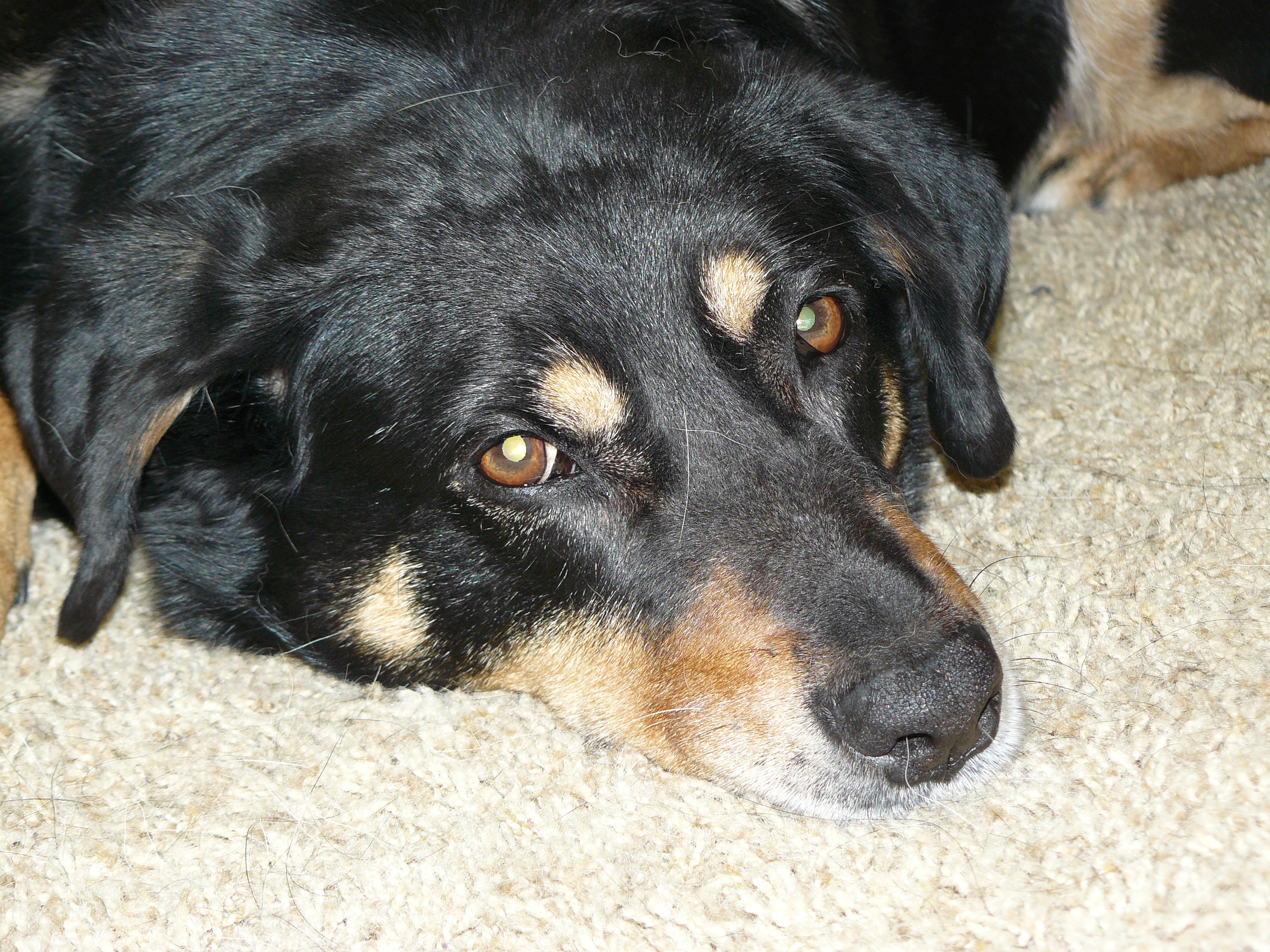
Pure, deep peace radiating out from Hazel's loving eyes.
Pure, deep peace radiating out from Hazel’s loving eyes.


Animals make us human.

Animal and human happiness.

As I have mentioned in the past and undoubtedly will do so again in the future, one of the most wonderful aspects of this world of blogging is the way that connections are made. Just a few weeks ago, a connection was made between Learning from Dogs and Dog Leader Mysteries. DLM’s byline is: Saving dogs’ lives and dog lovers’ sanity. Dog Leader Mysteries is written by author Deborah Taylor-French.

Anyway, out of the exchanges that have taken place between Deborah and myself, came a reference to a post about animal happiness that was published on Deborah’s blog in October, 2013.  It is very interesting and I am delighted to be given permission to share it with you.

ooOOoo

Neuroscience key to animal happiness

…research in neuroscience has been showing that emotions drive behavior, and my thirty-five years of experience working with animals have shown me that this is true. Emotions come first. You have to go back to the brain to understand animal welfare.

Animals Make Us Human : Creating the best life for Animals

by Temple Grandin & Catherine Johnson

Water dogs having a blast in Spring Lake Park.

By Deborah Taylor-French

Those of us who live and/or work with animals know…

animals have emotions.

Temple Grandin has made the understanding, care and handling of farm animals her life’s work. I refer to her book Animals Make Us Human because not only has she studied farm animals, but she also loves and lives with pets. In her books, especial this one, she insists that we must understand how animals brains work, how they see, hear and smell every sensory detail in their surroundings.

Animals emotions drive their behavior.

To make a better life for our pets, for domestic and wild animals we must understand the main emotions that drive behavior. This will help us to turn on their positive emotions and avoid turning on FEAR, RAGE and GRIEF.

Example: Rabbits and horses are prey animals.

  • Never chase either rabbits or horses.
  • Teach your pet rabbit or horse to come to you.
  • Always reward them for recognizing their name and coming when called.
  • When you chase a prey animal, you make him or her fearful of you!

Emotions are the gifts of our ancestors. We have them and so do other animals. We must never forget this. When it comes to animal welfare we can always do better. Most of the time “good welfare” is not “good enough.”

The Emotional Lives of Animals by Marc Bekoff.

Dogs Depend on us for freedom from fear and safety

  • Never tie up your dog unless it is in your company in a human training session.
  • A dog needs to feel he can flee to safety.
  • Be sensitive to your dog’s fear signals and show him you will protect and calm him.
  • Increase your dogs positive emotions by interesting, but not overstimulating activities.
  • Always stop training before your dog gets tired.

Dogs are the only animals that live with us inside of their flight zone.

Dogs depend on us for positive and playful lives

When you help increase an animal’s curiosity, you turn on his or her positive emotions of SEEKING and PLAY.

Example: Dogs love to play.

  • Find a time and place when both you and your dog seem relaxed.
  • Invite your dog to play by doing a play bow or picking up his favorite toy.
  • Use an excited and happy tone of voice to call your dog.
  • Run away.
  • When your dog chases you, stop.
  • Wait for your dog to run then chase.
  • Always stop before your dog seems fearful or overexcited.

Dogs love this game, which dog lovers know dogs play every chance they get.

Temple Grandin Website and Book Orders

Thank you for reading.

blogthechange

Please share for the sake of all animals, because as

Temple Grandin says,

“Animals make us human.”

Please visit and share Blog for the Change for Animals

Animals defy our tendency to define their lives and their limits.

For further information on brain research, emotions in animals and the primary-process emotional-affective networks of mammalian brains read US National Library of Medicine National Institutes of Health on the work of Jaak Panksepp, Ph.D. Affective neuroscience of the emotional BrainMind: evolutionary perspectives and implications for understanding depression.

ooOOoo

Follow that, as they say!

A wonderful insight into dogs.

The republication of a wonderful post about a dog that rides a bus!

I’m in the middle of reading Jean Donaldson’s book The Culture Clash.  Here’s a summary of what the book is about from the Dogwise website.

Donaldson

Summary: The book that has shaped modern thinking about canine behavior and the relationship between dogs and humans has been revised. Dogs are not humans. Dogs are clever and complex creatures that humans need to take the time to understand in order to live together successfully. You must read this book… because your dog sure can’t!

Here’s an extract from page 13 of the first chapter: Getting the dog’s perspective.

We crave anecdotes about genius dogs and these abound. Everyone knows a story that illustrates how smart dogs are. But a fundamental question has never been answered by proponents of reasoning in dogs: if dogs are capable of these feats of brain power at all, why are they not performing them all the time? Why never in controlled conditions? What is the most upsetting about these claims is the lack of rigour in evaluating them.

You get the picture of where Jean Donaldson is coming from!  (And I’m still only just into the book myself.)

So with those words echoing around your mind, just hold your breath while you read this article from author Deborah Taylor-French‘s blog: Dog Leader Mysteries.

ooOOoo

Bus riding dog: Photo Friday

JANUARY 16, 2015 ~ DOGLEADERMYSTERIES

Can your dog do this?

Have you read about this dog? A friend shared a news clipping on this dog’s unusual behavior in Seattle, Washington. Eclipse, as an independent city dog, seems to know to walk only on the sidewalk, get on the bus, take a seat and look out the window, all without assistance from his person. Eclipse even knows, which bus stop to get off at for the dog park. “Bus riders report she hops onto seats next to strangers, and watches out the window for her stop. Says commuter Tiona Rainwater, “All the bus drivers know her … she makes everybody happy.”

A Metro Transit spokesman said the agency loves that a dog appreciates public transit. The City of Seattle representative suggested that it would be safer for Eclipse to wear a leash and be with her human when she rides the bus, but with a dog this smart, is it a problem? I don’t know the answer. Black lab rides bus alone to dog park USA Today Network Associated Press 1:01 p.m. EST January 14, 2015.

What do you think, can dogs take the bus without their human families?

No dogs off leash.
No dogs off leash.

We know that big dogs differ in temperament and dog to dog communication from little lap dogs. But what makes a dog mature and experienced enough to take on full independence in the confusion and untranslated rules of human life? Yes, free-roaming dogs ride trains in organized and peaceful groups in Russia. Yes, often those who live with dogs, like we do, find they understand far more of our human lives than we think possible. After watching dozens of dogs off leash on city streets of Baja California Sur, Mexico. No dog seemed homeless and all but one stayed on the sidewalk.

Do dogs ever become 100% street-smart?

Street smarts or leash required?

What do dogs know? What do dogs remember? We know dogs learn. We know some dogs show exceptional learning abilities, much greater than other dogs. Somewhere I read that the average dog has the intelligence of a human toddler. Now, none of us would let a toddler walk city streets, get on and off a bus alone. But what of special cases? History shows exceptions to rules and to the “average.” Clearly, Eclipse breaks the rule, the average and reshapes our expectations of what dogs can and should be able to do.

The greatness of a nation can be judged by the way its animals are treated.” Mahatma Gandhi

Have you read Merle’s Door: Lessons from a Freethinking Dog by Ted Kerasote? Of book talks, life and books by Kerasote can be found on his Website his 2014 Pukka’s Promise: The Quest for Longer-Lived Dogs, in paperback, looks to be interesting to those of us who want our dogs to live the longest, healthiest lives possible. Find more about this top creative nonfiction author on his Website Kerasote.com.

True dog story (tearjerker ahead)

A Marin County ethical keeshond breeder shared this true story of their longtime and favorite dog. For years and years, the behavior of their family dog and top champion male looked totally stable. His nature showed pure calm and obedience. They all got into a pattern of allowing this canine patriarch time to lay on the front lawn in their neighborhood circle street. He always remained serene, watching, never chasing, barking or moving.

On afternoon as the kinglike keeshond patriarch lay on his grassy lawn – the unthinkable happened – he ran in front of car. Now fortunately, this big keeshond did not die. But he suffered, ever after with epileptic fits. Makes me wonder if we fool ourselves in imagining that dogs can navigate city streets safely.

Please share, comment and sign up for my blog updates. Thanks, Deborah Taylor-French

ooOOoo

So leave it up to you to assess the brain power of dogs, especially that bus-riding black Labrador dog. To help you make your mind up, take a look at the video.

http://www.youtube.com/watch?v=TPdJXNKRaUU

Published on Jan 14, 2015

Seattle’s public transit system has had a ruff go of things lately, and that has riders smiling.

You see, of the 120 million riders who used the system last year, one of them is actually a dog. Seattle’s KOMO-TV reports the 2-year-old black Labrador mix, named Eclipse, has become a regular fixture on the city’s D-Line after she figured out how to ride the bus alone to the dog park.

“All the bus drivers know her. She sits here just like a person does,” fellow rider Tiona Rainwater told KOMO. “She makes everybody happy. How could you not love this thing?”

The dog’s owner, Jeff Young, lives next to the stop. He said Eclipse sometimes hops on board without him if he’s not yet finished smoking his cigarette when the bus arrives. The pup has become a regular on the route, riding three or four stops before exiting at her destination of choice. “I catch up with her at the dog park,” Young explained.
Miles Montgomery, a Seattle radio host and D-Line commuter, was taken by surprise when Eclipse hopped into the seat next to him on a ride last Friday, looked out the window, then got off at her stop. Montgomery snapped a bemused selfie with the commuting canine, adding the caption, “Bus is full this morning:”

A Metro Transit spokesperson told the AP they’re happy a dog can appreciate public transit, though Eclipse should really be on a leash. King County says dogs are allowed to ride buses at the discretion of the driver, provided the animal isn’t a hazard and doesn’t create a disturbance.

Seattle isn’t alone in having a streetwise dog. Stray dogs in Moscow, Russia, have learned to commute in and out of the city from the suburbs by riding the subway, even watching out for other dogs to make sure they exit at the correct stop.

Get along, little doggies.

oooo

Golly, I have just seen how long I have spent getting this post written.  Poor old Shelby must be wondering if I really did want to play with him; should have made my next move simply ages ago!

dog-playing-chess-graphic

Mind you, I so rarely win against him!

Truly out of this world.

Just puts everything back into perspective.

The NASA/ESA Hubble Space Telescope has revisited one of its most iconic and popular images: the Eagle Nebula’s Pillars of Creation. This image shows the pillars as seen in visible light, capturing the multi-coloured glow of gas clouds, wispy tendrils of dark cosmic dust, and the rust-coloured elephants’ trunks of the nebula’s famous pillars. The dust and gas in the pillars is seared by the intense radiation from young stars and eroded by strong winds from massive nearby stars. With these new images comes better contrast and a clearer view for astronomers to study how the structure of the pillars is changing over time.

I subscribe to EarthSky and the link to this image and background information was in yesterday’s daily summary. The mind-blowing facts are that the Eagle Nebula is found in the constellation Serpens and is 6,500 light-years away from our dear planet.  To put that into context, that is 38,210 trillion miles from us. The star cluster associated with the nebula is about 5.5 million years old.

EarthSky has the very interesting text of the NASA Press Release regarding this new, high-resolution image.

For me, I just want to let that image wash over me. Not least because it reminds me that I am a very lucky person to be living at a time when one can lose oneself in such sights.

Here’s the image again, this time without the explanation.

New view of the Pillars of Creation — visible

The history of the wolf and dog

A return to a theme previously presented in this place.

The primary motivation for today’s post was to continue the theme in my post last Wednesday: Canada – Ellesmere Island, that featured the most beautiful film from the BBC about the wolves on Ellesmere: Snow Wolf Family and Me.

Now it struck me that in writing a blog called Learning from Dogs there was a fair chance that the history of dogs had been featured before. I ran a quick search through previous posts using the search term ‘history of dogs’. There were a number of returns. Such as the republication of an article by Mark Derr: The Wolf Who Stayed last November. Then there was a post called Dogs and Wolves: Fascinating Research in February, 2014. Back in 2013, a post Dogs and Man: An eternity of a relationship.

Yet, all these and more didn’t quite offer what I am presenting today. (Well, that’s my story!)

First up was the chance finding of a blog called Bioventures. On the 11th September, 2013 there was a post published by D.K. Taylor under the title of: The Science of Dogs: Dogs Vs. Wolves.  Here’s how it started:

While watching The Science of Dogs, one portion of the documentary that interested me was the comparison of domestic dogs verses wolves. I knew beforehand that dogs and wolves behaved differently, but it was not until now that I knew much about these differences. Wolves depend upon their pack only, while dogs have been taught to rely on humans to meet many of their needs. The difference must be extreme for it to have been so obvious in the demonstration with the meat and rope from the documentary! (For anyone in the class that watched the other documentary: A piece of meat was tied to a rope, and a wolf kept pulling at it and trying to solve the problem for itself while the dog almost immediately looked to the nearby human for help.)

Then, and I forget how, I came upon a news blog, for want of a better description, called The Examiner. More precisely, I came across an article published on The Examiner back in January, 2013 called: How wolves became dogs explained in groundbreaking study.

A study by a team of American and Swedish researchers published on Jan. 23 in the Journal of Nature, shows that dogs have more genes involved in starch metabolism than wolves.

The finding suggests that this was a major factor in the evolution process of the wolf. No one knows exactly when or how our ancestors began to be so closely linked to dogs, but archaeological evidence indicates that it was thousands of years ago.

One theory suggests that modern behavior of the dogs came from the hunters that used wolves as guards or fellow hunters.

But another theory – that underpins the study – suggests that domestication began when the wolves began to approach the villages in search of food, stealing the remains left by people.

This practice became increasingly common and as a result, wolves began to live around humans. According to this second hypothesis, when we became sedentary and dependent on agriculture, waste dumps created around our settlements soon became the power source of many wolves, explains Erik Axelsson, of the University of Uppsala.

You will need to go here to read the full article, but I will offer this further piece:

Dr. Axelsson and colleagues examined the DNA of more than 50 modern breeds – from the Cocker Spaniel to the German Shepherd.

They then compared their genetic information with 12 wolves from around the world. They scanned DNA sequences of the two canids in areas with large differences. They assumed that these areas contained genes that could help explain the domestication of dogs. Axelsson’s team identified 36 regions, with more than one hundred genes.

The analysis detected the presence of two major functional categories – genes involved in brain development and starch metabolism.

The latter suggests that dogs have many more genes encoding enzymes needed to break down starch, a feature that could have been advantageous to the ancestors who rummaged among the wheat and corn of the farmers.

“The wolves also have these genes, but not used as efficiently as dogs,” said Dr. Axelsson.

“When we look at the wolf genome, we only see one copy of the gene [for the amylase enzyme] on each chromosome. When we look at the dog genome, we see a range from two to fifteen copies; and on average a dog carries seven copies more than the wolf.”

“That means the dog is a lot more efficient at making use of the nutrition in starch than the wolf.”

As for the genes related to brain development, these probably reflect some of the behavioral differences we now see in the two canids.

The dog is an animal that is much more docile, which is probably due to the past humans preferring to work with animals that were easier to tame.

“Previous experiments have indicated that when you select for a reduction in aggressiveness, you obviously get a tamer animal but you also get an animal that retains juvenile characteristics much longer during development, sometimes into adulthood,” said Dr. Axelsson.

This may help explain why it is said that dogs act like puppies throughout their lives.

The study of the origin of dogs is still, in many ways, a puzzle.

Fossil evidence suggests that some populations have been around for tens of thousands of years, long before the advent of agriculture. One reason why it is so difficult to determine the time of this change of behavior is that domestication may have occurred more than once.

Over on YouTube, there are many videos about the subject of ‘the science of dogs’, albeit many of them lengthy. But so what!

I have gone for a 2013 Documentary film that has found its way on to YouTube: Wolf and Human – The Creation of The Dog (Full Nature Documentary). It is 90-minutes long and, at the time of writing this post, Jean and I haven’t watched it.  We will this evening. But it comes highly rated and I very much hope it is a good film.  The title of the film is perfectly aligned with the theme of today’s post. (N.B. We had bandwidth issues last night and gave up the struggle after just eleven minutes.  Despite the poor resolution of the video, it still looked like an interesting video to watch in full.)

http://www.youtube.com/watch?v=zfrL1YF44G0

Canada – Ellesmere Island

One of the most remote places on this Planet.

The reason I am choosing to write about Ellesmere Island is because of a recent BBC film: Snow Wolf Family and Me.

This video offers a great insight into the film:

Published on Dec 29, 2014

A new BBC film, Snow Wolf Family and Me, explores the lives and habits of arctic wolves, revealing the family secrets of one of our most feared predators. Ellesmere Island is one of the most remote and beautiful places on Earth. This is the only place in the world where wolves are naive to man and have no fear. It allowed wildlife cameraman Gordon Buchanan and scientists an unparalleled opportunity to form bonds with a wild wolf family, revealing the remarkable story of their relationships and behaviour.

Here series producer Ted Oakes talks about some of the highlights and challenges of being accepted by a wild wolf pack.

Snow Wolf Family and Me will be broadcast on 29th and 30th December 2014 at 21:00 on BBC Two.
Music by Jean-Marc Petsas. Photofilm produced by Dualtagh Herr.

Subscribe to BBC News HERE http://bit.ly/1rbfUog
Check out our website: http://www.bbc.com/news
Facebook: http://www.facebook.com/bbcworldnews
Twitter: http://www.twitter.com/bbcworld
Instagram: http://instagram.com/bbcnews

Family members back in England who did watch both episodes of the film said it was breath-taking, especially the scenes in the second episode where the wolves were filmed coming right up close to Gordon.

Gordon Buchanan and White wolf.

What captivated me, seeing how quickly the wolves acclimatised to Gordon and his two colleagues, was imagining that this must have been what it was like when, thousands of years ago, wild wolves bonded with early man providing the start of the glorious and beautiful relationship between canines and humans.  A wonderful relationship experienced by millions of us around the world today.

The next short video illustrates that the ancient lineage, from wolf to dog, still resonates between both species.

Ellesmere Island Expedition 2008 – Howling Good Time

Will Steger Foundation

Uploaded on Feb 21, 2010

After a long day of pulling, the dogs serenade the team with a round of howling.

Couple more pictures to close today’s post.

wolfdog


oooo

Another incredible photograph from Tanj
Another incredible photograph from Tanja Askani

The tail of the dog!

Or should that be the tell of a dog!

In the funny way that items flow around the internet, I recently read an item that appeared on the daily email summary from EarthSky. It was entitled: Read the message your dog sends with his tail. That, in turn, had been prompted by an article published on the website ScienceDirect. It was a study announced in Current Biology and published on the 18 November 2013, (Pages 2279–2282). Here’s how that article opens (and go here to read the numbered references):

Seeing Left- or Right-Asymmetric Tail Wagging Produces Different Emotional Responses in Dogs
Marcello Siniscalchi, Rita Lusito, Giorgio Vallortigara, Angelo Quaranta

Summary

Left-right asymmetries in behavior associated with asymmetries in the brain are widespread in the animal kingdom [1], and the hypothesis has been put forward that they may be linked to animals’ social behavior [2 and 3]. Dogs show asymmetric tail-wagging responses to different emotive stimuli —the outcome of different activation of left and right brain structures controlling tail movements to the right and left side of the body. A crucial question, however, is whether or not dogs detect this asymmetry. Here we report that dogs looking at moving video images of conspecifics exhibiting prevalent left- or right-asymmetric tail wagging showed higher cardiac activity and higher scores of anxious behavior when observing left- rather than right-biased tail wagging. The finding that dogs are sensitive to the asymmetric tail expressions of other dogs supports the hypothesis of a link between brain asymmetry and social behavior and may prove useful to canine animal welfare theory and practice.

Graphical Abstract

Wagging tails

In terms of understanding for the non-scientific minded, then the EarthSky article is an easier read.

Read the message your dog sends with his tail

Tail-wagging is a reflection of what’s happening in your dog’s brain. Learn to read your dog’s tail signals, and you’ll know if he’s happy … or stressed.

Tail-wagging in dogs is the classic signal for happiness. But researchers have found that tail-wagging can mean that your dog is either happy or stressed.

Activation of the left-brain causes a dog’s tail to wag to the right. Activation of the right-brain causes a wag to the left. That’s not new knowledge. Scientists detected that difference seven years ago.

What is new is that, not surprisingly, other dogs can easily read the message your dog is sending with his tail. And so can you.

Researchers at the University of Trento in Italy tested 43 dogs of various breeds for their ability to distinguish between tail wags. They showed the dogs videos of other dogs wagging their tails (much like the one above) and monitored the dogs’ heart rates and reactions. How could they be sure that the dogs weren’t watching their canine buddies’ facial or body cues? The researchers also showed the dogs only a silhouetted version of a tail-wagging dog.

As it turned out, every dog responded the same way. Dogs watching other dogs wag their tails to the left looked anxious, and their heart rates increased. In other words, they, too, became stressed. But dogs watching others swing their tails to the right stayed calm and relaxed — an indication that right wags are an expression of companionship and confidence, according to these scientists.

Why study tail wags in dogs? The team said in the summary to their study, which was published in Current Biology last year:

The finding that dogs are sensitive to the asymmetric tail expressions of other dogs supports the hypothesis of a link between brain asymmetry and social behavior and may prove useful to canine animal welfare theory and practice.

Bottom line: A dog wagging his tail to the right is happy, but a dog wagging to the left is stressed, say researchers.

Let me finish off today’s post with the following video.

So here’s to dozens of people watching their dogs’ tails!

Ancient rhythms.

The Winter Solstice.

I’m breaking the pattern of publishing a new post at midnight, Pacific Time, (08:00 UTC) because it seemed like fun to publish Monday’s post at the moment of the Winter Solstice; namely Sunday, December 21 at 23:03 UTC (15:03 PST).

There is no doubt in my mind that everyone is familiar with the Winter Solstice being the moment when the planet has perfect opposites, in terms of light and darkness, as the following image shows so clearly.

Day and night sides of Earth at the instant of the December 2014 solstice (2014 December 21 at 23:03 Universal Time). Note that the north polar region of Earth must endure 24 hours of night, while the south polar region gets to bask in 24 hours of daylight. Image credit: Earth and Moon Viewer

What may not be so well-known is that it occurs within about two-and-a-half hours of the new moon.

From times immemorial, early peoples on Earth knew much about the sun and the seasons, the length of daylight, and how the direction of the sunrise and sunset all shifted in a regular way throughout the year. As an Englishman, who in past times frequently drove the A303 road between London and Exeter, going past the ancient site of Stonehenge was always wonderful. Many are familiar with the sun rising during the Summer Solstice over the Heel Stone but far fewer realise that Stonehenge also marks the sun’s dawning the morning after the Winter Solstice.

winter-solstice-stonehenge
The shortest day is behind us.


The English Heritage website Discover Stonehenge is brim full of facts and information so won’t ‘copy and paste’ from one to the other! Suffice to say that what we see today was completed about 3500 years ago.

However, it seems as though the ancient site is still delivering new surprises.  I write this simply because just a few days ago, on the 19th December, 2014, the BBC reported:

Stonehenge dig finds 6,000-year-old encampment

Archaeologists found the encampment during a dig at Blick Mead near Stonehenge

Archaeologists working on a site near Stonehenge say they have found an untouched 6,000-year-old encampment which “could rewrite British history”.

David Jacques, from the University of Buckingham, made the discovery at Blick Mead in October, and said the carbon dating results had just been confirmed.

But he also raised concerns about possible damage to the site over plans to build a road tunnel past Stonehenge.

The Department of Transport said it would “consult before any building”.

The Blick Mead site is about 1.5 miles (2.4km) from Stonehenge and archaeologists said “scientifically tested charcoal” dug up from the site had “revealed that it dated from around 4000 BC”.

The archaeologists found burnt flints, remains of animals and tools

David Jacques said the dig had also found “evidence of feasting” including burnt flints, tools and remains of giant cattle, known as aurochs, which were eaten by early hunter gatherers.

Mr Jacques said: “British pre-history may have to be rewritten. This is the latest dated Mesolithic encampment ever found in the UK.

“Blick Mead site connects the early hunter gatherer groups returning to Britain after the Ice Age to the Stonehenge area, all the way through to the Neolithic in the late 5th Millennium BC.

“But our only chance to find out about the earliest chapter of Britain’s history could be wrecked if the tunnel goes ahead.”

Archaeologists said the latest carbon date suggested it was continuously occupied between 7500-4000 BC

Andy Rhind-Tutt, a former mayor and current chairman of Amesbury Museum, which part-funded the dig, said the discovery could “provide what archaeologists have been searching for centuries – the answer to the story of the pre-history of Stonehenge.”

Earlier this month, the government announced funding for a 1.8-mile (2.9km) tunnel to remove congestion from the main road past Stonehenge.

A Department for Transport spokesman said: “As with any road scheme, we will consult with interested parties before any building begins on the A303.

“English Heritage and National Trust are supportive of our plans, and we will ensure sites of cultural or historical significance are safeguarded as we progress with the upgrade.”

The A303 past Stonehenge is a highly congested route.

So as the planet and the sun continue their dance to a rhythm, ancient beyond comprehension, let us reflect on the scale of the universe and our fortune to be alive this Winter Solstice, 2014.

We are in and of nature itself!

Yet another powerful essay from George Monbiot.

I wonder at times why the most obvious things about us humans can be so easily overlooked. I have in mind that we humans are a product of a natural world, that we cannot survive without nature; however we examine our lives.

Take, for example, this picture of a city spread, in this case Chicago, where one might expect the natural world to be practically out of sight, reduced to a single point, metaphorically speaking. Yet nature is still hanging on, albeit courtesy of some local gardeners, I don’t doubt.

Chicago_cityscape_(5253757001)

All of which is my introduction to yet another powerful essay from George Monbiot, republished here with his very kind permission.

ooOOoo

Civilisation is Boring

December 9, 2014

We are pre-tuned to the natural world; wired to respond to nature.

By George Monbiot, published on BBC Earth, 8th December 2014

This is the first of BBC Earth’s longform essays about our relationship with the natural world.

One of the penalties of an ecological education is that one lives alone in a world of wounds,” the pioneering conservationist Aldo Leopold wrote. “An ecologist must either harden his shell and make believe that the consequences of science are none of his business, or he must be the doctor who sees the marks of death in a community that believes itself well and does not want to be told otherwise.”(1)

I remembered that when I read the news that the world has lost 52% of its vertebrate wildlife over the past 40 years(2). It’s a figure from which I’m still reeling. To love the natural world is to suffer a series of griefs, each compounding the last. It is to be overtaken by disbelief that we could treat it in this fashion. And, in the darkest moments, it is to succumb to helplessness, to the conviction that we will keep eroding our world of wonders until almost nothing of it remains. There is hope – real hope – as I will explain later, but at times like this it seems remote.

These wounds are inflicted not only on the world’s wildlife but also on ourselves. Civilisation is but a flimsy dust sheet that we have thrown over a psyche rich in emotion and instinct, shaped by the living planet. The hominims from whom we evolved inhabited a fascinating, terrifying world, in which survival depended on constant observation and interpretation. They contended not only with lions and leopards, but with sabretooths and false sabretooths, giant hyaenas and bear dogs (monstrous creatures with a huge bite radius).

As the work of Professor Blaire van Valkenburgh at UCLA suggests, predators in the pre-human past lived at much greater densities than they do today(3). The wear and breakage of their teeth show that competition was so intense that they were forced to consume the entire carcasses of the animals they killed, bones and all, rather than just the prime cuts, as top carnivores tend to do today. In other words, the animals with which we evolved were not just bigger than today’s predators; they were also hungrier.

Navigating this world required astonishing skills. Our ancestors, in the boom-and-bust savannahs, had to travel great distances to find food, through a landscape shimmering with surprise and hazard. Their survival depended upon reacting to the barest signals: the flicker of a tail in the grass, the scent of honey, a change in humidity, tracks in the dust. We still possess these capacities. We carry with us a ghost psyche, adapted to a world we no longer inhabit, which contains – though it remains locked down for much of the time – a boundless capacity for fear and wonder, curiousity and enchantment. We are pre-tuned to the natural world; wired to respond to nature.

In computer games and fantasy novels, we still grapple the monsters of the mind. In the film of Lord of the Rings: the Two Towers, the orcs rode on giant hyaenas(4). In the first Hunger Games film, bear dogs were released into the forest to prey on the contestants(5). I don’t believe these re-creations were accidental: the directors appear to have known enough of our evolutionary history to revive the ancestral terror these animals provoke. The heroic tales that have survived – tales of Ulysses, Sinbad, Sigurd, Beowulf, Cú Chulainn, St George, Arjuna, Lạc Long Quân and Glooskap – are those that resonate with the genetic memories lodged in our minds. I suspect that their essential form has remained unchanged for hundreds of thousands of years; that the encounters with monsters recorded in writing were a consolidation of stories we have been telling since we acquired the capacity to use the past tense.

You can see how such tales might have originated in a remarkable sequence in the BBC’s Human Planet series(6). Three men in southern Kenya, described by the programme as Dorobo people (though this is not a designation many ethnographers accept) stalk to within about 50 metres of a lion kill. Fifteen lions, blood dripping from their jaws, are eating the carcass of a wildebeest. The men suddenly stand and walk towards the pride. Rattled by their astonishing confidence, the lions flee. They watch from the bushes, puzzled and indecisive, as the three men walk up to the carcass, hack off one of the hind legs, then saunter away. That night, the adventurers roast the meat in their cave. “We really robbed those lions”, one of them boasts. “How many do you think there were?”, another asks. “Fifteen, but there might have been more.”

This, surely, is how sagas begin. Those men, led by a veteran of such ruses, are heroes of the old stamp. They outwitted a party of monsters, using guile and audacity, much as Ulysses did. A few hours later, they tell the first version of a story that might echo down the generations, every time with new flourishes and embellishments. Now imagine that, thousand of years hence, lions are long extinct, and the descendants of the Dorobo have only the haziest notion of what they were. They have become monsters even bigger and more dangerous than they were in life, and the feat becomes even more outrageous and unlikely. The saga remains true to its core, but the details have changed. We are those people, still telling the old stories, of encounters with the beasts that shaped us.

The world lives within us, we live within the world. By damaging the living planet we have diminished our existence.

We have been able to do this partly as a result of our ability to compartmentalise. This is another remarkable capacity we have developed, which perhaps reflects the demands of survival in the ever more complex human world we have created. By carving up the world in our minds we have learnt to shut ourselves out of it.

One of the tasks that parents set themselves is to train their children in linearity. Very young children don’t do linearity. Their inner life is discursive, contingent, impulsive. They don’t want to walk in a straight line down the pavement, but to wander off in the direction of whatever attracts their attention. They don’t begin a task with a view to its conclusion. They throw themselves into it, engage for as long as it’s exciting, then suddenly divert to something else.

This is how all animals except adult humans behave. Optimal foraging, the term biologists use to describe the way animals lock onto the best food supply, involves pursuing a task only for as long as it remains rewarding. Our own hunting and gathering would have followed a similar pattern, though it was complicated by our ability to plan and coordinate and to speculate about imagined outcomes. Broadly speaking, ours was a rambling and responsive existence, in which, by comparison to the way we live today, we had little capacity or inclination to impose our will on the world, to lay out a course of action and to follow it without deviation or distraction.

Only with the development of farming did we have to discipline ourselves to think linearly: following a plan from one point to another across weeks or months. Before long we were ploughing in straight lines, making hedges and ditches and tracks in straight lines, building houses and then towns in straight lines. Now almost every aspect of our lives is lived within grids, either concrete or abstract. Linearity, control and management dominate our lives. We fetishise progress: a continuous movement in the same direction. We impose our lines on the messy, contradictory and meandering realities of the human world, because otherwise we would be completely lost in it. We make compartments simple enough, amid the labyrinths we have created, to navigate and understand.

Thus we box ourselves out of the natural world. We become resistant to the experiences that nature has to offer; its spontaneity and serendipity, its unscripted delights, its capacity to shake us out of the frustrations and humiliations which are an inevitable product of the controlled and ordered world we have sought to create. We bully the living world into the grids we impose on ourselves. Even the areas we claim to have set aside for nature are often subjected to rigid management plans, in which the type and the height of the vegetation is precisely ordained and, through grazing or cutting or burning, nature is kept in a state of arrested development to favour an arbitrary assemblage of life over other possible outcomes. Nothing is allowed to change, to enter or leave. We preserve these places as if they were jars of pickles.

The language we use to describe them is also rigid and compartmentalised. In the UK we protect “sites of special scientific interest”, as if the wildlife they contain is of interest only to scientists. The few parts of the seabed which are not ripped up by industrial trawling are described as “reference areas”, as if their only value is as a baseline with which to compare destruction elsewhere. And is there a more alienating term than “reserve”? When we talk about reserve in people, we mean that they seem cold and remote. It reminds me of the old Native American joke: “we used to like the white man, but now we have our reservations.” Even “the environment” is an austere and technical term, which creates no pictures in the mind.

It’s not that we have banished our vestigial psychological equipment from our minds, or lost our instinct for engagement with wildlife. The tremendous popularity of nature programmes testifies to its persistence. I remember sitting in a café listening to a group of bus drivers talking, with great excitement and knowledge, about the spiders they had seen on television the night before, and thinking that, for all our technological sophistication, for all the clever means by which we shield ourselves from our emotions, we remain the people we have always been.

But we have suppressed these traits, and see the world through our fingers, shutting out anything that might spoil the view. We eat meat without even remembering that it has come from an animal, let alone picturing the conditions of its rearing and slaughter. We make no connection in our compartmentalised minds between the beef on our plates and the destruction of rainforests to grow the soya that fed the cattle; between the miles we drive and the oil wells drilled in rare and precious places, and the spills that then pollute them.

In our minds we have sanitised the world. WH Auden’s poem Et in Arcadia Ego describes how “Her jungle growths / Are abated, Her exorbitant monsters abashed, / Her soil mumbled,” while “the autobahn / Thwarts the landscape / In godless Roman arrogance”(7). But the old gods, the old fears, the old knowledge, have not departed. We simply choose not to see. “The farmer’s children / Tiptoe past the shed / Where the gelding knife is kept.”

Civilisation is boring. It has many virtues, but it leaves large parts of our minds unstimulated. It uses just a fraction of our mental and physical capacities. To know what comes next has been perhaps the dominant aim of materially-complex societies. Yet, having achieved it, or almost achieved it, we have been rewarded with a new collection of unmet needs. Many of us, I believe, need something that our planned and ordered lives don’t offer.

I found that something once in Cardigan Bay, on the west coast of Wales. I had stupidly launched my kayak into a ten-foot swell to fish a couple of miles from the shore. As I returned to land, I saw that the tide had risen, and ugly, jumbled breakers were smashing on the seawall. From where I sat, two hundred metres from the shore, I could see that the waves were stained brown by the shingle they flung up. I could hear them cracking and soughing against the wall. It was terrifying.

Behind me I heard a monstrous hiss: a freak wave was about to break over my head. I ducked and braced the paddle against the water. But nothing happened. Then a hooked grey fin, scarred and pitted, rose and skimmed just under the shaft of my paddle. I knew what it was, but the shock of it enhanced my rising fear. I glanced around, almost believing that I was under attack.

Then, from the stern, I heard a different sound: a crash and a rush of water. A gigantic bull dolphin soared into the air and almost over my head. As he flew past, he fixed his eye on mine. I stared at the sea into which he had disappeared, willing him to emerge again, filled with a wild exaltation, and a yearning of the kind that used to afflict me when I woke from that perennial pre-adolescent dream of floating down the stairs, my feet a few inches above the carpet. I realised at that moment that I had been suffering from a drought of sensation which I had come to accept as a condition of middle age, like the loss of the upper reaches of hearing.

I found that missing element again in the Białowieża Forest in eastern Poland. I was walking down a sandy path between oak and lime trees that rose for perhaps one hundred feet without branching. Around them the forest floor frothed with ramsons, celandines, spring peas and May lilies. I had seen boar with their piglets, red squirrels, hazel grouse, a huge bird that might have been an eagle owl, a black woodpecker. As I walked, every nerve seemed stretched, tuned like a string to the forest I was exploring. I rounded a curve in the path and found myself face to face with an animal that looked more like a Christian depiction of the Devil than any other creature I have seen.

I was close enough to see the mucus in her tear ducts. She had small, hooked black horns, heavy brows and eyes so dark that I could not distinguish the irises from the pupils. She wore a neat brown beard and an oddly human fringe between her horns. Her back rose to a crest then tapered away to a narrow rump, from which a black tail, slim as a whip, now twitched. She flared her nostrils and raised her chin. I fancied I could smell her sweet, beery breath. We watched each other for several minutes. I stayed so still that I could feel the blood pounding in my neck. Eventually the bison tossed her head, danced a couple of steps then turned, trotted back down the path then cantered away through the trees.

Experiences like these are the benchmarks of my life, moments in which dormant emotions were rekindled, in which my world was re-enchanted. But such unexpected encounters have been far too rare. Most of the lands in which I walk and the seas in which I swim or paddle my kayak are devoid of almost all large wildlife. I see deer, the occasional fox or badger, seals, but little else. It does not have to be like this. We can recharge the world with wonder, reverse much of the terrible harm we have done to it.

Over the past centuries, farming has expanded onto ever less suitable land. Even places of extremely low fertility have been cultivated or grazed, and the result has been a great disproportion between damage and productivity: the production of a tiny amount of food destroys the vegetation, the wild animals, the soil and the watersheds of entire mountain ranges. In the face of global trade, farming in such areas is becoming ever less viable: it cannot compete with production in fertile parts of the world. This has caused a loss of cultural diversity, which is another source of sadness.

But at the same time it means that the devastated land could be restored. In Europe, according to one forecast, 30 million hectares – an area the size of Poland – will be vacated by farmers by 2030(8). In the United States, two thirds of those parts of the land which were once forested, then cleared, have become forested again(9), as farming and logging have retreated, especially from the eastern half of the country. Rewilding, the mass restoration of ecosystems, which involves pulling down the redundant fences, blocking the drainage ditches, planting trees where necessary, re-establishing missing wildlife and then leaving the land to find its own way, could reverse much of the damage done to these areas. Already, animals like lynx, wolves, bears and moose, on both continents, are moving back into their former ranges.

There are also possibilities of restoring large parts of the sea. Public disgust at a fishing industry that has trashed almost every square metre of seabed on the continental shelves is now generating worldwide demands for marine parks. These are places in which commercial extraction is forbidden and the wildlife of the seas can recover. Even fishing companies can be persuaded to support them, when they discover that the fish migrating out of these places greatly boost their overall catches, a phenomenon known as the spillover effect. Such underwater parks are quickly recolonised by sessile life forms. Fish and crustacea proliferate, breeding freely and growing to great sizes once more. Dolphins, sharks and whales move in.

In these places we can leave our linearity and confinement behind, surrender to the unplanned and emergent world of nature, be surprised once more by joy, as surprise encounters with great beasts (almost all of which, despite our fears, are harmless to us) become possible again. We can rediscover those buried emotions that otherwise remain unexercised. Why should we not have such places on our doorsteps, to escape into when we feel the need?

Rewilding offers something else, even rarer than lynx and wolves and dolphins and whales. Hope. It offers the possibility that our silent spring could be followed by a raucous summer. In seeking to persuade people to honour and protect the living planet, an ounce of hope is worth a ton of despair. We could, perhaps, begin to heal some of the great wounds we have inflicted on the world and on ourselves.

George Monbiot is the author of Feral: rewilding the land, sea and human life. There’s an archive of his articles at http://www.monbiot.com

References:

1. Aldo Leopold, 1949. A Sand County Almanac. Oxford University Press.

2. http://www.theguardian.com/environment/2014/sep/29/earth-lost-50-wildlife-in-40-years-wwf

3. http://www.eci.ox.ac.uk/news/events/2014/megafauna/valkenburgh.pdf

4. https://www.youtube.com/watch?v=F3GFYKIwJ9Y

5. http://www.imdb.com/title/tt1392170/

6. http://vimeo.com/22616099

7. http://www.nybooks.com/articles/archives/1965/jun/03/et-in-arcadia-ego/

8. http://www.rewildingeurope.com/assets/uploads/Downloads/Rewilding-Europe-Brochure-2012.pdf

9. http://articles.chicagotribune.com/2012-11-16/features/ct-prj-1118-book-of-the-month-20121116_1_wild-animals-wildlife-wild-game-meat/2

ooOOoo

I’m sure that you will agree with me that this is a wonderful essay from Mr. Monbiot, an essay that speaks to us in ways that we all intuitively know makes huge sense.

There is hope for us!


The smell of the North

The things science unearths!

Having nine dogs here at home and quite a few acres of land, you can easily imagine that one needs to keep a good lookout for the numerous ‘land mines’.

But as much as they are a common and familiar sight, especially around the house, never in a thousand years would I have noticed a magnetic alignment!

All brought to my awareness by a wonderful article over on the ZME Science website.

Are you a dog lover? Did you know this?

ooOOoo

Dogs can sense Earth’s magnetic field… while pooping

Jenny Ricken / Univ. of Duisberg-Essen via AFP – Getty Images

Every dog owner can attest that canines are remarkable navigators, like some sort of living, breathing compasses. For some time, researchers have suspected that they can sense Earth’s magnetic field and use it in turn for navigation. A recent study confirmed this as a fact, however the findings came after studying the dogs in one of their most intimate poses – while pooping. Apparently, in stable conditions, dogs always relieve themselves while facing either north or south.

Led by zoologist Hynek Burda of Germany’s University of Duisburg-Essen, the researchers closely followed 70 dogs of 37 breeds for two years. Initially, the dogs didn’t seem to follow any particular pattern while going on with their business. After taking in account, however, things like the time of the day, the position of the sun, wind direction and, of course, the slight daily variation in the Earth’s magnetic field a whole new level of appreciation was revealed.

“The emerging picture of the analysis of the categorized data is as clear as [it is] astounding: Dogs prefer alignment along the magnetic north-south axis, but only in periods of calm magnetic field conditions,” said Burda.

Alignment of a sampling of dogs while defecating during stable geomagnetic conditions. Photo: Hart et al. / Frontiers in Zoology

Poop compass

So, dogs will always poop or pee facing north or south during stable conditions. The study not only proves that dogs can sense the Earth’s magnetic field, but also exhibit specific behavior in response to natural magnetic field variations. To our current knowledge, they’re the only mammals that do this. Previously it was shown that cattle, deer, foxes and other types of mammals sometimes line up preferentially along Earth’s magnetic field lines.

To some, dogs’ “sixth sense” might not come as a surprise, while others may view the present study as a complete waste of grant money. While it’s still unclear how dogs use this skill, it may be too early to dismiss the practical applications of the findings. If anything, however, this research proves yet again that dogs are extraordinary animals.

“To many dog owners who know about the good navigation abilities of their protégés, the findings might not come as a surprise, but rather as an explanation for the ‘supernatural’ abilities—although it is not clear to the researchers what the dogs might use their magnetic sense for,” Burda said.

Next, the researchers plan on studying how dogs use this ability and how magnetic storms affect their ability to orient themselves. Findings were reported in the journal Frontiers in Zoology.

ooOOoo

To say that I’m just a tiny bit sceptical wouldn’t be a lie.  But, trust me, I shall be outside tomorrow morning with my compass and camera and will report the results!