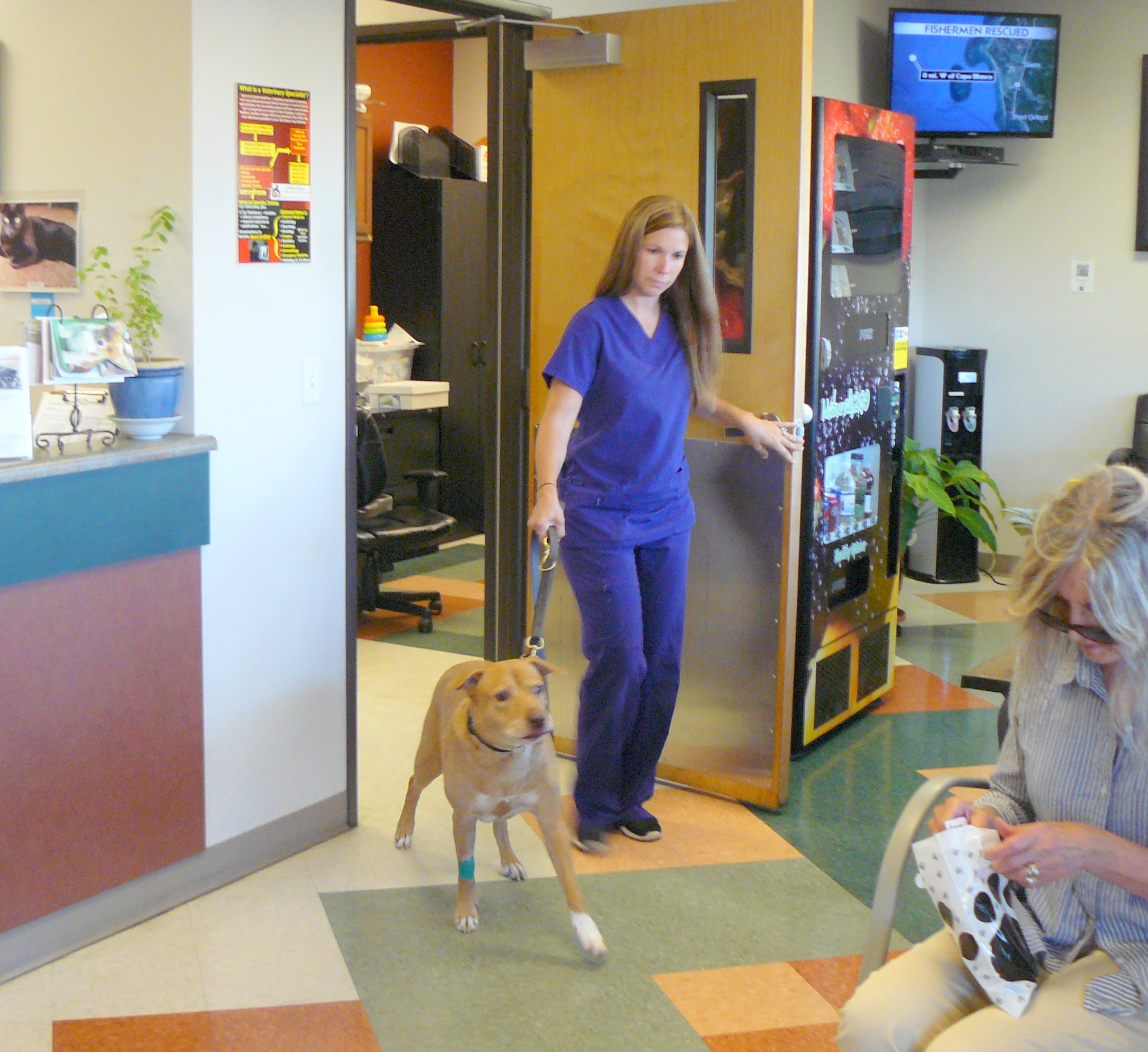
I’m writing this post at 5pm yesterday (Tuesday) shortly after we returned home from collecting Hazel from Lincoln Road Vet Clinic following her earlier examination by Dr. Parker using his mobile sonogram.
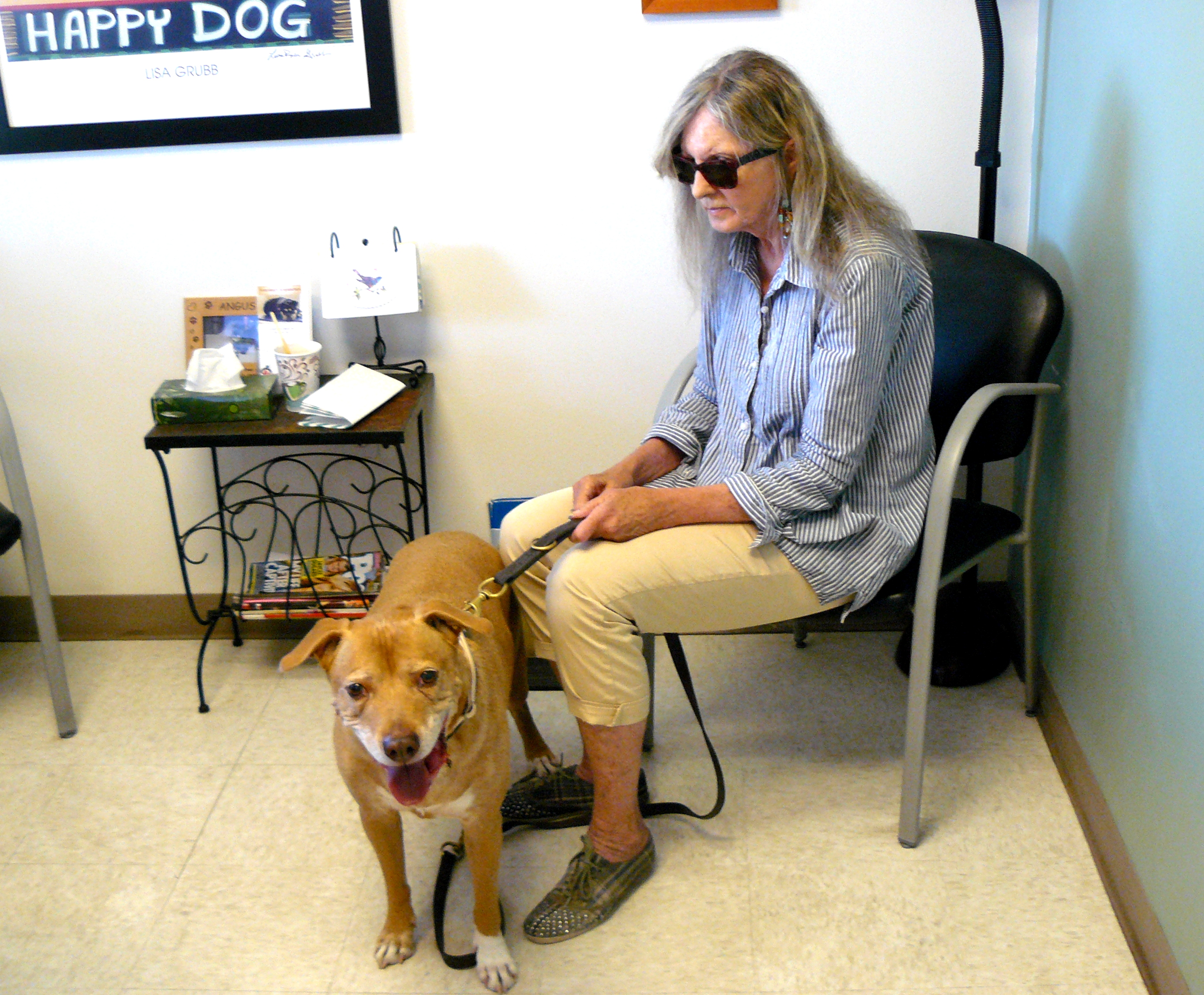
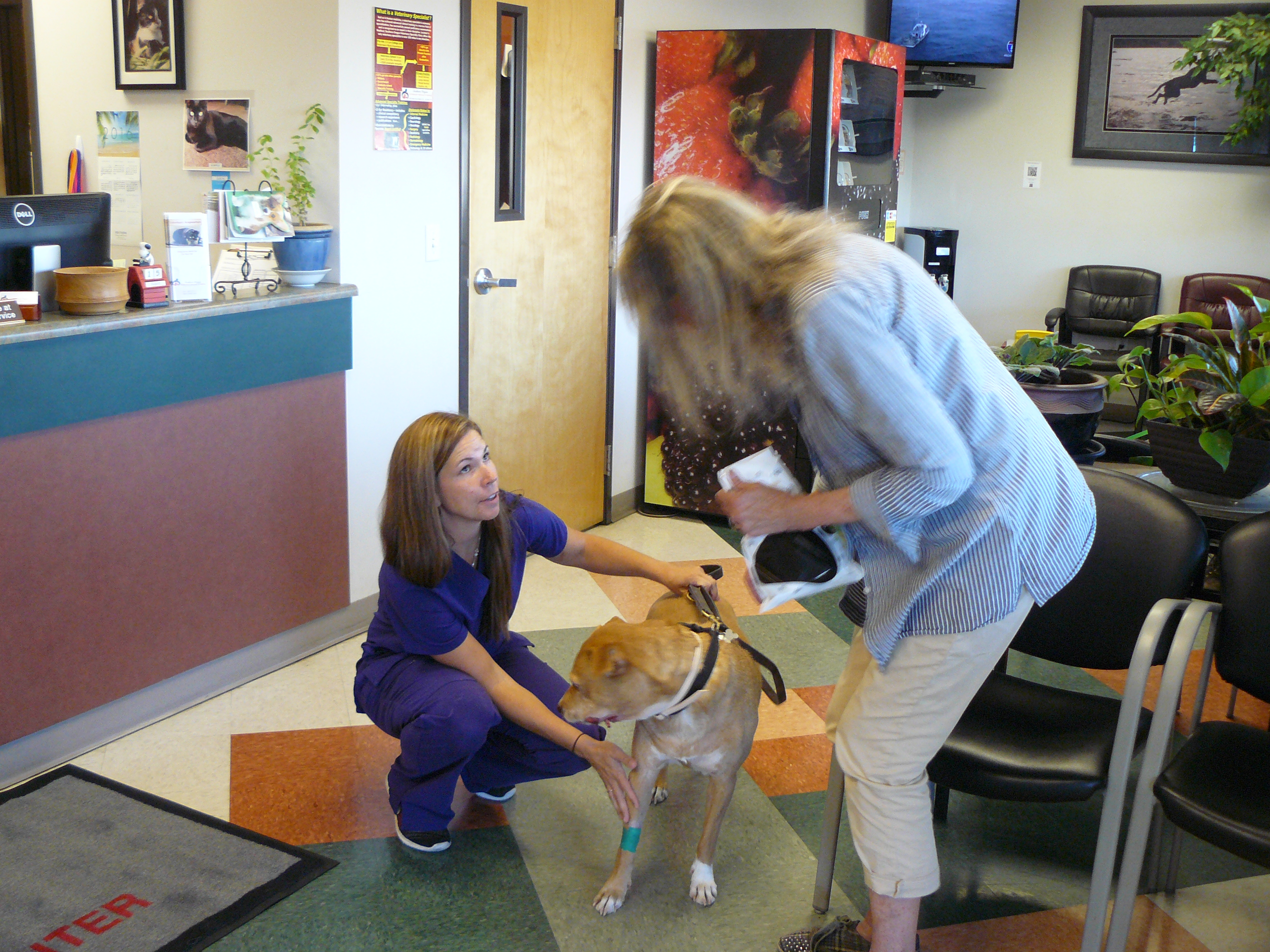
Hazel at the clinic shortly before she was taken in by the staff.
The good news is that Dr. Parker did not find any sign of trauma or life-threatening illnesses in Hazel’s body especially focusing on her abdomen.
Dr. Parker to the left being assisted by clinic staff as he examines Hazel ultra-sonically.
(I should be quick to say that I left my camera with one of the technicians and wasn’t present. Indeed, Jean and I did not get to meet Dr. Parker.)
Dr. Parker, who is a board-certified veterinarian doctor, came to the conclusion that the most likely cause of Hazel’s illness was the fungal lung infection, as Dr. Codd and the radiologist supposed.
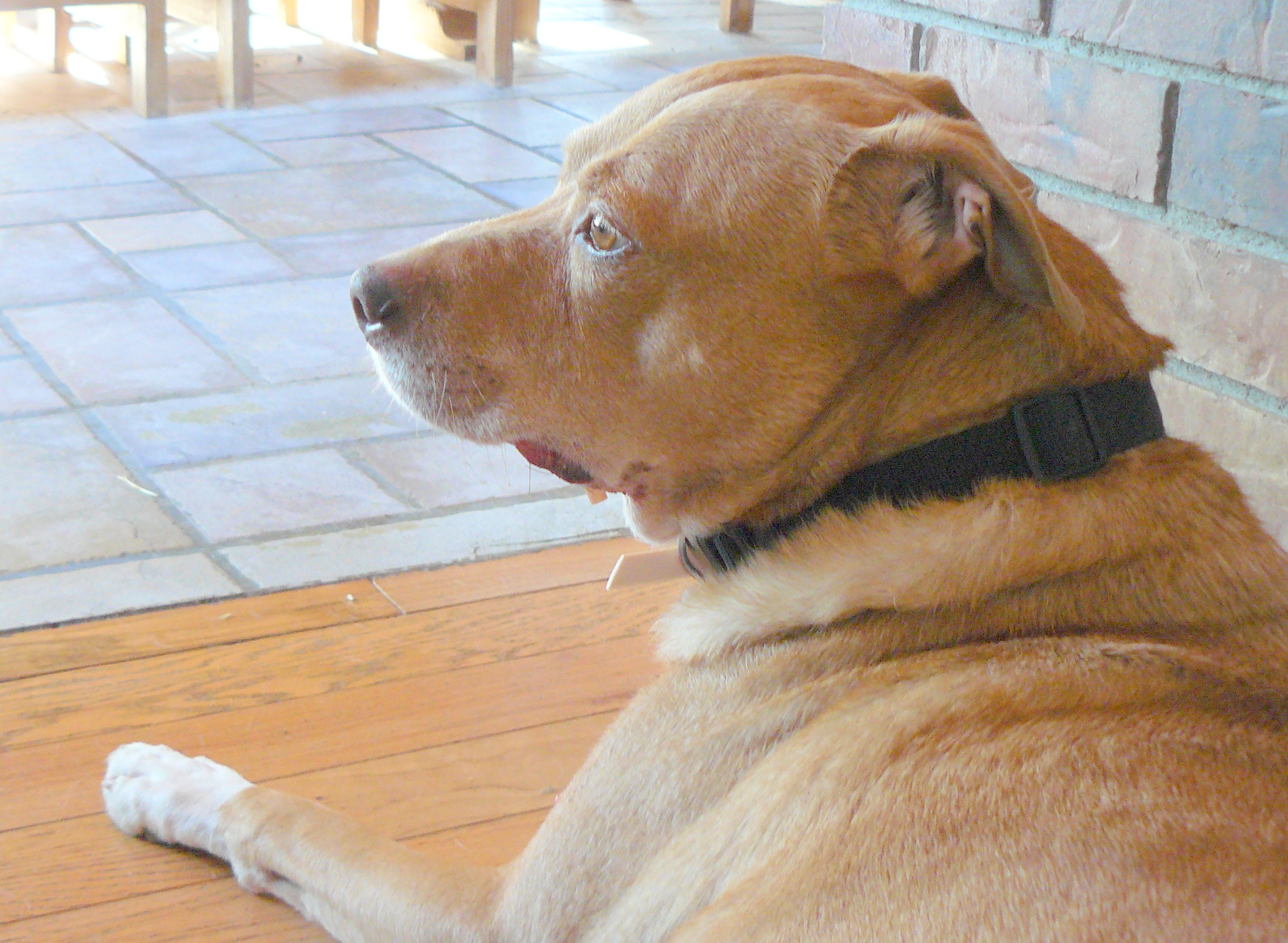
Nothing frightening seen!
To try and narrow down the exact fungal infection a further blood sample was taken and the lab results should be known in three or four days time.
Dr. Codd, in his briefing to Jean and me when we collected Hazel late afternoon, said that his recommendation based on the lack of any notable findings from the scan could be summarised as follows:
Regard treating the fungal infection as the number one priority,
Hold off from treating the tick fever in the interim,
Dose Hazel with 100mg of Fluconazole twice a day even if she is eating hardly anything,
The measure is whether Hazel, with a very small food intake, can take that dosage without vomiting,
Add a B12 tonic to her diet with immediate effect,
Give Hazel appetite stimulant medicine,
Consider the hemp oil (as queried by me) if the proper dosage can be determined.
(Petspeopleandlife: Hazel’s current weight is 53 lbs (24 kg). Any advice?)
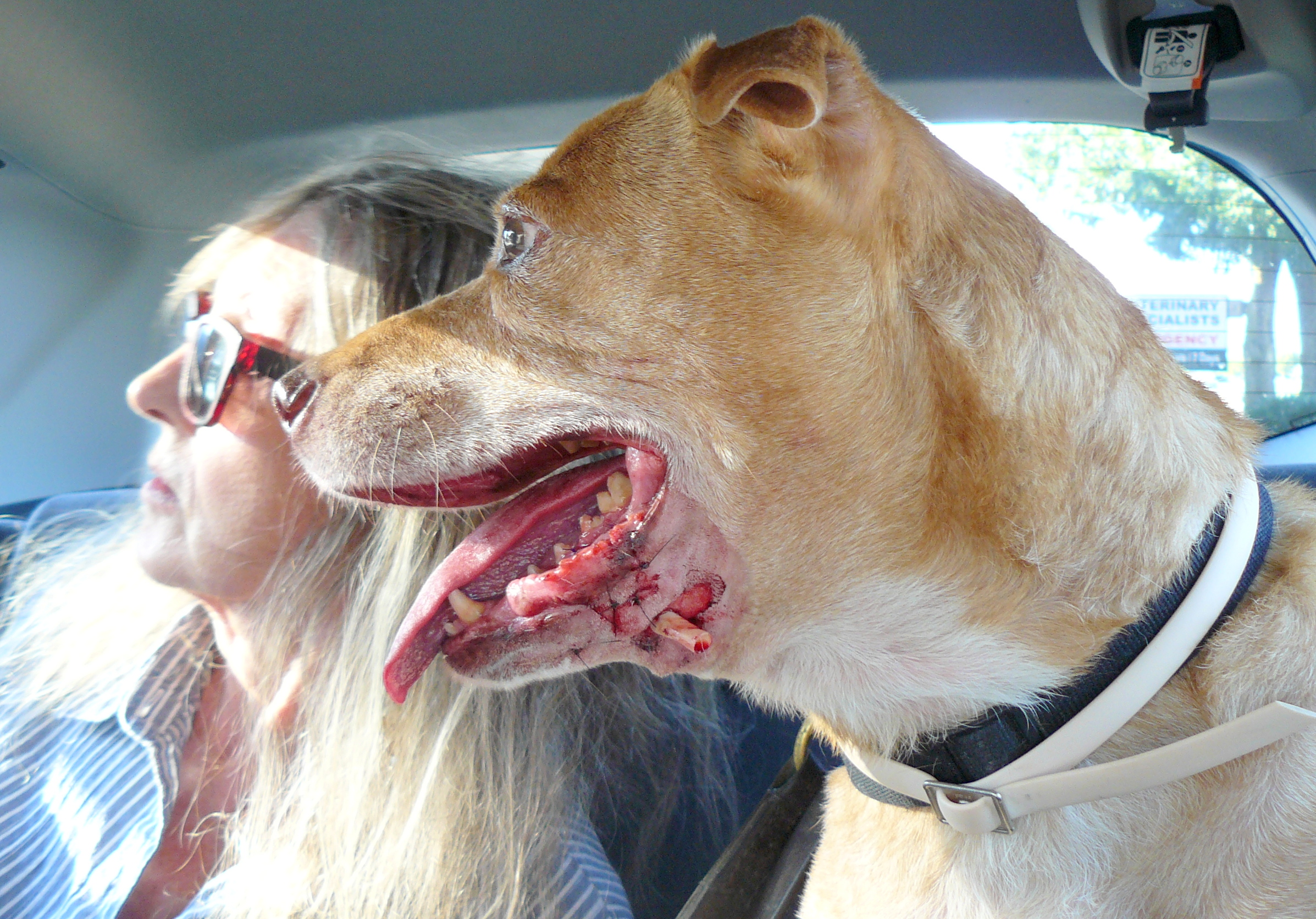
Back home again albeit still feeling a little drowsy!
Thus while we have not yet got to the bottom of what precisely is the nature of Hazel’s infection at least we know there isn’t anything else silently killing her.
Thank you so much, dear readers, for taking so much interest in Hazel and for sending your love and caring wishes – it’s working! 🙂
Still a long way from getting to the bottom of what is ailing Hazel.
In my last post about Hazel I opened by saying:
In the last post on Hazel’s condition, back last Thursday, I passed on Dr. Codd’s observation, “… that by not having Hazel on her meds we were, of course, letting the fungal infection continue its damage.”
Dr. Codd also recommended reducing the dosage of the Fluconazole to lower its side effect of suppressing appetite.
So since then, with outstanding care and patience, Jean has been coaxing Hazel to eat just sufficient food for Hazel to be able to take the Fluconazole, for her fungal infection in her lungs, and Doxycycline, for her tick infection. (Mind you, Hazel is still a long way from eating reliably.)
That was a week ago and while, at best, Hazel is just eating sufficient to take her meds she is far from improving to any noticeable degree. But she is not eating enough food to stabilise her weight and yesterday morning Jean was worried we might lose her if we didn’t rethink what was going on.
Jean is attempting to get Hazel to eat many times each day.
A Sunday morning call to Dr. Jim Goodbrod brought us the advice to re-think the evidence.
The titre results were negative but because there are so many variants of fungal infection that was discounted.
The film of Hazel’s lungs show what the radiologist described as a clear case of fungal infection.
However, if that infection had been in the past, before Hazel was taken in by us down in Mexico, and that infection had ceased, that film could be showing scarring in the lungs.
The positive result for Tick Fever showed evidence of antibodies not antigens. That might be interpreted as a previous incident.
Jim liaised with Dr. Codd and it was agreed that further examinations needed to be conducted to obtain a clear, unambiguous diagnosis and that in the interim we stop giving Hazel any medications and offer her body systems a bit of a rest.
One option being discussed is to call in a mobile sonogram or ultra-sonic scanner. There is a very expert doctor in the area who uses such a mobile device and scans can be taken of Hazel’s abdomen and lungs here at home.
Because we will do everything to try and return Hazel to good health.
More information will be passed to you just as soon as it is to hand.
Last Wednesday, dear friend Dan Gomez sent me an email that was headed Going to be controversial. It simply contained a link to a recent ScienceAlert item: You need to stop hugging your dog, study finds. I have to admit that my response was a rather rude one! Here’s how that article opened:
With their sweet faces, soft fur, and huge dumb grins, dogs were basically born to be hugged. As a species, they evolved over thousands of years with one clear path – to garner our attention and affection, and profit from all the benefits awarded to ‘Man’s best friend’. But along the way, they’ve had to make some serious trade-offs.
A family dog will never be the leader of the pack. It will be closed in, told when and where to pee, and now, preliminary data from a new study suggests that in return for room and board, our dogs suffer through our hugs.
I know, I know, it’s tough to hear, but bear with us, because it’s not all terrible news. Maybe your dog is cool with hugs. Maybe it finds your hugs annoying, but affection is affection, so it’ll take what it can get. Or maybe it freaking hates hugs and you’re stressing the crap out of it. All dogs are different, you just need to know how to read them.
Anyway, I was delighted to see the Care2 blogsite put out a slightly different assessment. I have great pleasure in republishing that Care2 article in full.
On the feel-good scale of one to 10, tenderly wrapping your arms around your dog and giving your pooch a gentle squeeze rates a solid 10, am I right?
But for dogs, the feeling apparently isn’t mutual, at least according to research by dog-training expert Dr. Stanley Coren, a psychology professor at the University of British Columbia.
Coren examined 250 images on Google and Flickr of people hugging dogs. In his blog “The Data Says ‘Don’t Hug the Dog!’” on Psychology Today, he noted that 81.6 percent of the dogs showed some symptoms of stress, anxiety or discomfort.
“I can summarize the data quite simply by saying that the results indicated that the Internet contains many pictures of happy people hugging what appear to be unhappy dogs,” Coren wrote.
The reason dogs dislike hugs, Coren explained, is because when they are threatened or otherwise under stress, their natural instinct is to run away, so being wrapped in our arms prevents them from doing what comes naturally. This can raise their stress levels.
“Save your hugs for your two-footed family members and lovers,” Coren wrote. “It is clearly better from the dog’s point of view if you express your fondness for your pet with a pat, a kind word and maybe a treat.”
I think it’s important to note that Coren’s study was not peer reviewed (i.e., it has not been approved by other scientists as being legit), nor was it published in any scientific journal, but only on PsychologyToday.com. “This is a set of casual observations,” Coren told the Washington Post in regard to all the recent media attention to his findings.
With this in mind, I decided to conduct my own non-peer-reviewed study for Care2.com. (I’ve been writing professionally about dogs for years and have had them as pets for most of my life, so that makes me kinda-sorta an expert, in my humble opinion.)
For my research, instead of passively Googling photos, I actively hugged two very willing study participants: my dogs, Leroy and Ella.
Leroy (that’s him getting hugged in my profile picture) seemed to enjoy the hug; he wagged his tail and the corners of his mouth curled up in what could be interpreted as a smile. Although Ella, who is a nervous dog, tensed her body at first, she relaxed after a few seconds and calmly rested her chin on my shoulder.
My conclusion: Dogs don’t hate hugs. While I wouldn’t recommend walking up to a strange dog and giving him a big ol’ bear hug, I don’t think there’s any need to stop hugging our own dogs based on Coren’s casual observations.
Neither does Corey Cohen, a companion animal behavior therapist. He told the New York Times the dogs in the photos Coren studied may have appeared anxious because they didn’t like having their pictures taken, or perhaps they were being forced to pose.
“My dogs love being hugged,” Cohen said, probably speaking on behalf of many of us dog owners. “I can definitely tell. Their facial expression changes: ‘Oh, give me more!’”
How to Tell if Your Dog Enjoys Hugs
If you’re not quite sure whether your dog likes to be hugged, here are some of the signs that he’s not into it, according to Coren and Erica Lieberman, a New York City dog trainer and behavior consultant.
Your dog turns his head away as you hug him.
He closes or half-closes his eyes. “Alternatively, dogs will often show what is commonly called a ‘half-moon eye’ or ‘whale eye,’ which is where you can see the white portion of the eyes at the corner or the rim,” Coren wrote.
He lowers his ears.
He licks his lips.
He yawns.
Lieberman told the New York Times that people should look for what she called “cutoff signals” when hugging their dogs. If dogs “shake off” after the hug, just as they shake off water after a bath, it means they didn’t enjoy it.
If your dog shows none of these warning signals, I say go ahead – hug it out.
In case you’ve forgotten the section on the food web from high school biology, here’s a quick refresher.
Plants make up the base of every food chain of the food web (also called the food cycle). Plants use available sunlight to convert water from the soil and carbon dioxide from the air into glucose, which gives them the energy they need to live. Unlike plants, animals can’t synthesize their own food. They survive by eating plants or other animals.
Clearly, animals eat plants. What’s not so clear from this picture is that plants also eat animals. They thrive on them, in fact (just Google “fish emulsion”). In my new book, “A Critique of the Moral Defense of Vegetarianism,” I call it the transitivity of eating. And I argue that this means one can’t be a vegetarian.
Chew on this
I’ll pause to let the collective yowls of both biologists and (erstwhile) vegetarians subside.
A transitive property says that if one element in a sequence relates in a certain way to a second element, and the second element relates in the same way to a third, then the first and third elements relate in the same way as well.
Take the well-worn trope “you are what you eat.” Let’s say instead that we are “who” we eat. This makes the claim more personal and also implies that the beings who we make our food aren’t just things.
How our food lives and dies matters. If we are who we eat, our food is who our food eats, too. This means that we are who our food eats in equal measure.
Plants acquire nutrients from the soil, which is composed, among other things, of decayed plant and animal remains. So even those who assume they subsist solely on a plant-based diet actually eat animal remains as well.
This is why it’s impossible to be a vegetarian.
For the record, I’ve been a “vegetarian” for about 20 years and nearly “vegan” for six. I’m not opposed to these eating practices. That isn’t my point. But I do think that many “vegetarians” and “vegans” could stand to pay closer attention to the experiences of the beings who we make our food.
For example, many vegetarians cite the sentience of animals as a reason to abstain from eating them. But there’s good reason to believe that plants are sentient, too. In other words, they’re acutely aware of and responsive to their surroundings, and they respond, in kind, to both pleasant and unpleasant experiences.
Check out the work of plant scientists Anthony Trewavas, Stefano Mancuso, Daniel Chamowitz and František Baluška if you don’t believe me. They’ve shown that plants share our five senses – and have something like 20 more. They have a hormonal information-processing system that’s homologous to animals’ neural network. They exhibit clear signs of self-awareness and intentionality. And they can even learn and teach.
I suspect how some biologists may respond: first, plants don’t actually eat since eating involves the ingestion – via chewing and swallowing – of other life forms. Second, while it’s true that plants absorb nutrients from the soil and that these nutrients could have come from animals, they’re strictly inorganic: nitrogen, potassium, phosphorus and trace amounts of other elements. They’re the constituents of recycled minerals, devoid of any vestiges of animality.
As for the first concern, maybe it would help if I said that both plants and animals take in, consume or make use of, rather than using the word “eat.” I guess I’m just not picky about how I conceptualize what eating entails. The point is that plants ingest carbon dioxide, sunlight, water and minerals that are then used to build and sustain their bodies. Plants consume inasmuch as they produce, and they aren’t the least bit particular about the origins of the minerals they acquire.
With respect to the second concern, why should it matter that the nutrients drawn by plants from animals are inorganic? The point is that they once played in essential role in facilitating animals’ lives. Are we who we eat only if we take in organic matter from the beings who become our food? I confess that I don’t understand why this should be. Privileging organic matter strikes me as a biologist’s bias.
Then there’s the argument that mineral recycling cleanses the nutrients of their animality. This is a contentious claim, and I don’t think this is a fact of the matter. It goes to the core of the way we view our relationship with our food. You could say that there are spiritual issues at stake here, not just matters of biochemistry.
Changing how we view our food
Let’s view our relationship with our food in a different way: by taking into account the fact that we’re part of a community of living beings – plant and animal – who inhabit the place that we make our home.
We’re eaters, yes, and we’re also eaten. That’s right, we’re part of the food web, too! And the well-being of each is dependent on the well-being of all.
From this perspective, what the self-proclaimed “farmosopher” Glenn Albrecht calls sumbiotarianism (from the Greek word sumbioun, to live together) has clear advantages.
Sumbioculture is a form of permaculture, or sustainable agriculture. It’s an organic and biodynamic way of farming that’s consistent with the health of entire ecosystems.
Sumbiotarians eat in harmony with their ecosystem. So they embody, literally, the idea that the well-being of our food – hence, our own well-being – is a function of the health of the land.
In order for our needs to be met, the needs and interests of the land must come first. And in areas where it’s prohibitively difficult to acquire the essential fats that we need from pressed oils alone, this may include forms of animal use – for meat, manure and so forth.
Simply put, living sustainably in such an area – whether it’s New England or the Australian Outback – may well entail relying on animals for food, at least in a limited way.
All life is bound together in a complex web of interdependent relationships among individuals, species and entire ecosystems. Each of us borrows, uses and returns nutrients. This cycle is what permits life to continue. Rich, black soil is so fertile because it’s chock full of the composted remains of the dead along with the waste of the living.
Indeed, it’s not uncommon for indigenous peoples to identify veneration of their ancestors and of their ancestral land with the celebration of the life-giving character of the earth. Consider this from cultural ecologist and Indigenous scholar-activist Melissa Nelson:
The bones of our ancestors have become the soil, the soil grows our food, the food nourishes our bodies, and we become one, literally and metaphorically, with our homelands and territories.
You’re welcome to disagree with me, of course. But it’s worth noting that what I propose has conceptual roots that may be as old as humanity itself. It’s probably worth taking some time to digest this.
ooOOoo
In reflecting on how to close this post I couldn’t help thinking that “The bones of our ancestors have become the soil, ” presumably includes the bones of our dogs! Leading me to ponder that maybe our dogs from old are nourishing our bodies; I would like to think that is the case.
The powerful combination of good medicine and unconditional love.
In the last post on Hazel’s condition, back last Thursday, I passed on Dr. Codd’s observation, “… that by not having Hazel on her meds we were, of course, letting the fungal infection continue its damage.”
Dr. Codd also recommended reducing the dosage of the Fluconazole to lower its side effect of suppressing appetite.
So since then, with outstanding care and patience, Jean has been coaxing Hazel to eat just sufficient food for Hazel to be able to take the Fluconazole, for her fungal infection in her lungs, and Doxycycline, for her tick infection. (Mind you, Hazel is still a long way from eating reliably.)
Yesterday, (Saturday) Hazel was showing clear signs of feeling better but still having to be hand-fed by Jean.
Then this morning (Sunday) she really was perky and readily came out for a walk with the other dogs.
First time in recent days when Hazel has shown an interest in the world around her.
oooo
A return of a head gesture unique to Hazel that we haven’t seen in ages! 🙂
More generally, Dr. Jim was trying to track down supporting details to the observation made by Dr. Russ:
Namely, that there was evidence that fungal infections can lay dormat for quite long periods of time.
Jim sent me the following email:
Paul …
The following article is the one and only reference I have found so far that refers to the possible dormancy of this fungal infection. In paragraph 2 (Clinical Disease) I have highlighted it in red. I have to admit, I was skeptical.
Jim
The article was:
Coccidioidomycosis (Zoonotic) Last updated on 2/4/2011.
Contributors:
Rhea V. Morgan DVM, DACVIM, DACVO
Synonyms:
San Joaquin Valley Fever
Valley Fever
This is that domancy aspect from that paper that Jim highlighted (in red):
The incubation period in the dog is 1 to 3 weeks.1,2The organism can remain dormant, with exposure preceding the onset of clinical signs by 3 years or more.1,3 Although people may acquire the disease from the same sources as domestic animals and the mycelial forms are highly infectious, with one exception the disease has not been transmitted from animals to people. One published report exists of transmission to a veterinary assistant via the bite of an infected cat.15
Meanwhile, over in Brandy’s corner, he has very quickly healed after his neutering operation last Thursday. It was fair to say that he was not a happy chappy when he arrived home that day.
Didn’t like that!
oooo
And I can’t even lick my balls!
But his cone was off by Saturday and he is back to the wonderful, bouncing dog we all love so much. (Can’t believe that last Saturday was only the second week that Brandy had been with us; he has so quickly woven his way into all our hearts.)
Checking out the stables yesterday (Sunday) morning.
oooo
Behind that placid expression is the most docile, loving brain and heart one could ever wish for!
Returning to Hazel we are still some way from knowing that she has returned to a fully fit dog but the love and caring sent her way by all of you out there has been precious beyond imagination.
A fabulous example of how we reach out to others across the internet!
A week-and-a-half ago in came an email to me:
Hi Paul,
Just came across a post of yours for Earth Day 2014.
Absolutely love the fact that you’ve written about a “Green” topic!
In fact, I wanted to reach out and let you know that in honor of this year’s Earth Day (April 22), I just finished designing an infographic about 14 easy ways dog owners can become more environmentally friendly people.
Would it be okay with you if I passed it along? I’d love to hear your thoughts on it!
Best,
Mike
Mike was Mike Shannon, about which more at the bottom of this guest post. Of course, I was delighted to receive his lovely guest post and infographic. Over to Mike.
ooOOoo
In its 46th anniversary to date, Earth Day is bound to continue to do what it has always succeeded in doing, help raise awareness among† individuals from all across the globe about environmentally-friendly topics so they work together to make this† world a better place to live in for the future generations to come.
In honor of this year’s Earth Day, which happens to be on Friday, April the 22nd, Ultimate Home Life have designed an info-graphic† that explains the most important 14 steps you can take as of today to go green with your dog.
This topic is certainly nothing to be taken lightly, and most certainly nothing of the impossible. Just look at the statistic provided at the beginning of the info-graphic – nearly 50% of families in the United States alone have a dog at home, which makes for more than 70 million dogs!
Let’s kick off our “going green” mission this year by making our dogs greener, one dog at a time.
If you have any tips for going green with your dog, make yourself heard in the comments!
Bio: Michael is the creator, editor, webmaster – alright, let’s just say he runs the show over at UltimateHomeLife.Com! He regularly blogs about anything and everything dog related, with an emphasis on trying to cover all questions that dog owners tend to worry about. So, hop over and give him a bark!
ooOOoo
What a fabulous and highly pertinent post for these times.
Happy Earth Day to all of us and our wonderful dogs right across this magnificent planet.
So said Sophocles. But too slow a decision, or no decision is, of course, a decision in its own right.
Last Tuesday in my update on Hazel Of art, and science I wrote:
It seemed to make sense that until we had confirmation of whether or not Hazel had a lung fungal infection, for which taking Fluconazole would be an excellent course of action, we should pause in her dose until the results were in.
At 08:45 this morning we had to take Brandy in to Lincoln Road Clinic for his neutering operation (that we heard a short time ago has gone well with no complications – he will be collected in about an hour). Dr. Codd asked after Hazel and we said that she was brighter but still not eating sufficient for her to be taking her medications.
Dr. Codd then made the eminently sensible observation that by not having Hazel on her meds we were, of course, letting the fungal infection continue its damage.
In response to the query as to why a fungal infection from either Mexico or Arizona had taken so long to appear, Dr. Codd added more sense to the situation. Namely, that there was evidence that fungal infections can lay dormat for quite long periods of time. Possibly in Hazel’s case the trigger for the infection becoming active was the additional stress on Hazel’s body systems from her recently contracting an Ehrlichia Infection from a local tick.
The final element for the argument of not delaying any longer Hazel’s healing medications was that the titre results would only be a result of one particular ‘brand’ of fungal infection. Dr. Codd said that it may well have been one of many other fungal infections that took hold of Hazel’s lungs.
So the decision was made to try Hazel on an oral anti-nausea med that would be much easier to administer. It is Ondansetron Orally. Also to cut down the dosage of the Fluconazole so that it doesn’t dampen Hazel’s appetite for food, a known side effect of Fluconazole, in quite such a dramatic fashion. (Note: Fluconazole is the least appetite suppressant compared to alternatives.)
So there we are.
We hang on to the fact that Hazel is still with us and coping with what is ailing her, albeit with a heightened stomach sensitivity that is complicating eating. Time is on our side.
A thousand thanks to all of you that have shown so much love and concern for our dear hazel.
Dear people, I must add this: CAUTION: The following is offered by way of information reaching out to other loving dog owners. Please do not assume I have any specialist veterinarian knowledge and please do not take the following as a replacement for seeing your own vet.
Finally, Mike Shannon is my guest blogger with a lovely post for Earth Day 2016 that will be published in a little under 10 hours time. That is why this post has been published now.
The learning and healing journey continues with Hazel.
The title to today’s post came from Dr. Jim Goodbrod, DVM. When he and I were taking a walk yesterday Jim mentioned that diagnosing exactly what an animal is suffering from is as much an art as it is a science.
Jim and Janet are close friends and neighbours who live a couple of roads away. Jim also attends the Lincoln Road Vet Clinic on a part-time basis. Off his own volition he has been speaking with Dr. Codd (Russ) about the situation with Hazel and the pair of them are showing incredible devotion to getting to the bottom of what is happening.
So, like yesterday’s post, today is being offered to you in the spirit of information. Forgive me if I repeat the caution from yesterday. (This is being written at 4pm on April 19th, 2016.)
CAUTION: The following is offered by way of information reaching out to other loving dog owners. Please do not assume I have any specialist veterinarian knowledge and please do not take the following as a replacement for seeing your own vet.
Late on Sunday afternoon Hazel was becoming so weak and lethargic that Jean and I feared that she wouldn’t make it through the night. So it was wonderful to see that she was alive and still connected to the world at 6am yesterday; Monday. Nonetheless, Hazel had not eaten since Saturday afternoon and was only drinking very small amounts of water. We made the decision to ring the Clinic as soon as they opened on Monday at 8am. They recommended that Hazel be brought in to go on to an IV drip to boost her anti-fungal intake and also to receive an anti-nausea intake to help her regain an appetite. But there was the question hanging over everyone that if this was a fungal infection, as in Coccidioidomycosis, that is not present in the Oregonian soil but is found in the drier parts of the USA and Mexico then why had it been such a long time before it brought Hazel down?
Jean also had this suspicion that Hazel might be suffering from a form of ‘Tick Fever’ that is very common in Mexico.
So off we went to the Clinic again. There were discussions about the whole situation.
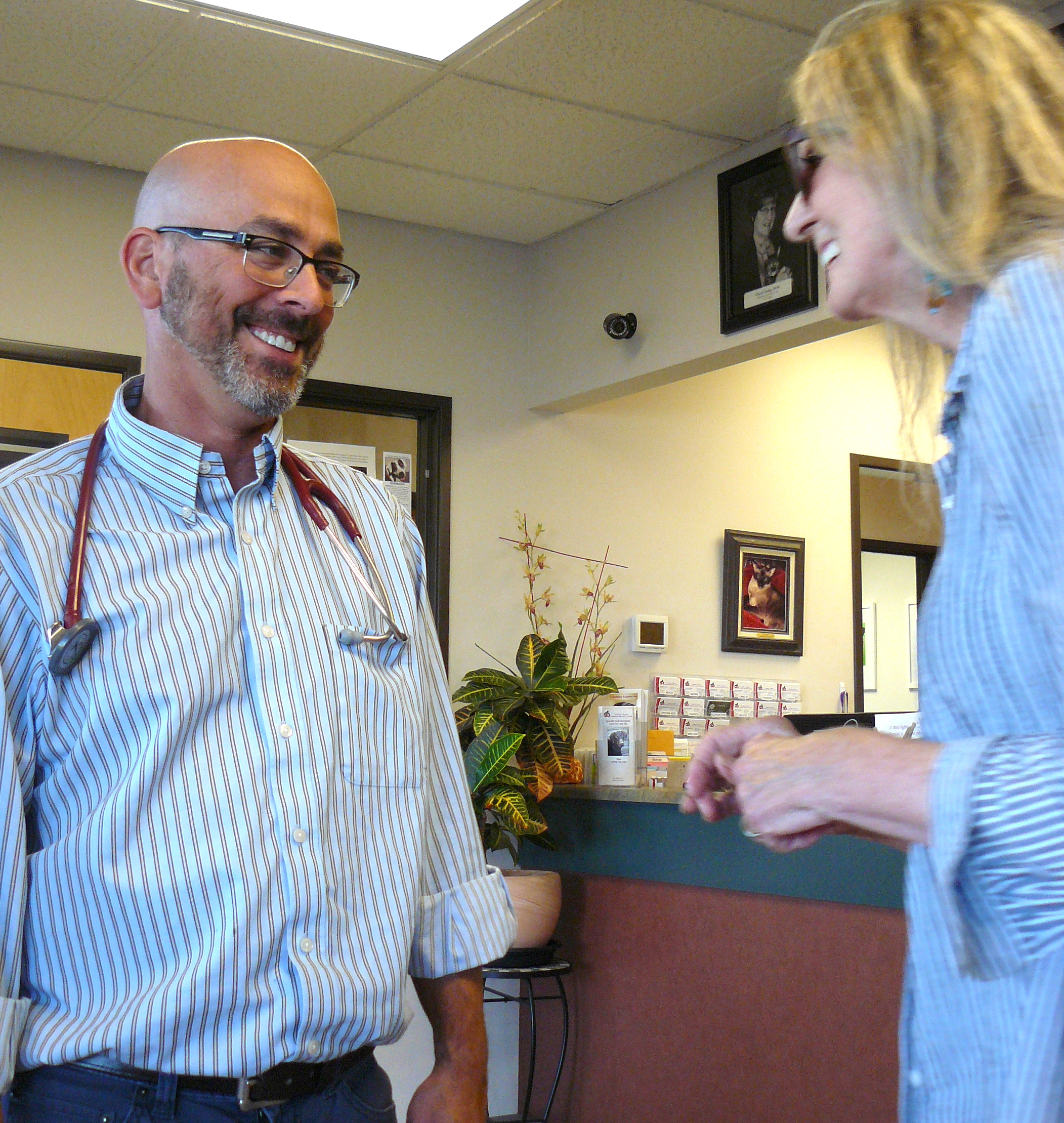
Dr. Codd (RHS) speaking with Jean at the Clinic.
Dr. Codd took a quick blood test and, bingo, it revealed that Hazel was showing that she had, or had had in the past, an Ehrlichia Infection; a tick-borne infection.
The lower of the left-hand spots is the indicator of a past or present Ehrlichia Infection.
The cure for that was a course of Doxycycline.
So now we are looking at battling two separate diseases.
The blood that was taken from Hazel last Friday, when she also had radiographs taken of her lungs, had been sent for a ‘titre’ that would confirm one way or another if her lungs were suffering from a fungal infection. Those results will be available on Wednesday or Thursday of this week.
One of the radiographs taken of Hazel.
Back to Hazel’s lack of appetite. One of the side-effects of Fluconazole is that it depresses appetite. Getting Hazel eating again was becoming a priority. It seemed to make sense that until we had confirmation of whether or not Hazel had a lung fungal infection, for which taking Fluconazole would be an excellent course of action, we should pause in her dose until the results were in. To speed up the return of an appetite Dr. Jim prescribed a short course of Mirtazipine.
So that’s about it for the time being. Except for Jean and me to say how much we appreciate the art and the science that is being so skillfully offered by the Clinic. (As of 19:00 PDT yesterday Hazel was eating again! 🙂 )
Great team effort!
Their “Special Love of Animals” comes over in spades!
A few weeks ago I was speaking to Larry, one of our lovely neighbours who, as with me, is the wrong side of 65 (as with me, by quite a lump) and he was bemoaning how more quickly time seems to pass by the older one gets. It had never previously crossed my mind but in that instant I knew exactly what Larry meant.
For today I have been a Permanent Resident (aka Green Card holder) for precisely five years. And in seven months time I will be 72 years old. Where did it all go!
As you know, exercise is essential for your heart and overall health. Now, a new study published in the journal Medicine & Science in Sports & Exercise has quantified the powerful impact exercise can have on the length of your life.
For this study, researchers looked at data collected in the National Health and Nutrition Examination Study which included 3,000 participants ages 50-79. All of the study participants wore highly sensitive activity trackers, called accelerometers, for seven days. Then, they compared the participants’ activity levels with recorded deaths during the following eight years. What they found is that the participants who had the lowest level of activity were five times more likely to have died during the follow-up period than those participants who had the highest activity level. Those with the lowest level of activity were also three times more likely to have died than those who had moderate activity levels.
There’s no question that inactivity is a prominent risk factor for many health problems, and even minimal amounts of regular activity can have immediate benefits. Plus, for seniors the benefits of exercise go far beyond good cardiovascular health, increasing strength and flexibility so you can stay independent in your senior years.
What Type of Exercise Should You Do?
My answer is always the one that you will enjoy and stick with for the long-term—whether it’s walking, tennis, dancing, swimming or another activity you enjoy. My personal favorites are pilates and yoga, which are good for range of motion, flexibility, and strength.
But regardless of the type of activity you choose, here are some tips to get you started:
If you haven’t exercised in a long time and you have a medical condition such as osteoarthritis or cardiovascular disease, talk to your doctor about what kind of limits you may need to abide by. You don’t want to take on more than your body can handle. Also, consider having your feet checked for irregularities that require shoe inserts.
Start slowly and pace yourself. Should you experience shortness of breath or pain in your chest or arms, see your doctor as soon as possible. If you feel ill, stop. If symptoms persist after 3–5 minutes of rest, seek medical attention immediately. Symptoms may occur up to an hour after exercising, so be mindful of how you feel as you cool down and resume your regular activities.
The joints, ligaments, tendons, and muscles aren’t as forgiving as they were when we were younger, and they require an appropriate level of training. If you train with weights—even light ones—you must use correct form to avoid microtrauma and aggravation to joints. A personal trainer who is experienced in working with middle-agers and seniors can help with this. Long term, strengthening the muscles around ailing joints can help reduce pain.
Warning signs that you may be doing too much exercise include light-headedness or dizziness, palpitations, jaw pain, tingling or numbness in the arms, a tight feeling in the lungs, and shortness of breath (being unable to carry on a conversation).
And to close this post with nothing at all to do with exercise but everything to do with loving a dog, here’s a picture of Brandy taken on Tuesday morning.
I was working outside until late afternoon and didn’t leave myself sufficient time for a new post for today. So, as I do on these occasions, I pick one from previous times. Like Meet Molly from this day three years ago.
ooOOoo
A most heart-warming story! Beats the heck out of murders, politics and terrorists!
This was sent in by John Hurlburt for Jean who has been a bit of a ‘horse lady’ in her times and is devoted to the two miniature horses we have here in Oregon.
oooOOOooo
Meet Molly
Molly is a gray speckled pony who was abandoned by her owners when Hurricane Katrina hit southern Louisiana . She spent weeks on her own before finally being rescued and taken to a farm where abandoned animals were stockpiled. While there, she was attacked by a dog and almost died. Her gnawed right front leg became infected and her vet went to Louisiana State University (LSU) for help.
However, LSU were overwhelmed and Molly became a ‘welfare’ case. You know where that goes, don’t you!
Then surgeon Rustin Moore met Molly and changed his mind. He saw how Molly was careful to lie down on different sides so she didn’t seem to get sores. He saw how Molly allowed people to handle her. She protected her injured leg. She constantly shifted her weight and didn’t overload her good leg. She was a smart pony with a serious survival ethic.
Surgeon Moore agreed to remove her leg below the knee and a temporary artificial limb was built. Molly walked out of the clinic and, in a very real sense, that’s where her story really begins.
“This was the right horse and the right owner!” Moore insisted.
Molly happened to be a one-in-a-million patient. She’s tough as nails, but sweet, and she was willing to cope with pain. She made it obvious she understood that she was in trouble. The other important factor, according to Moore , is having a truly committed and compliant owner who is dedicated to providing the daily care required over the lifetime of the horse.
Molly’s story turns into a parable for life in Post-Katrina Louisiana. The little pony gained weight and her mane finally felt a comb. Then, amazingly, a prosthesis designer built her a leg.
The prosthetic has given Molly a whole new life, Allison Barca DVM, Molly’s regular vet, reports:
And she asks for it. She will put her little limb out and come to you and let you know that she wants you to put it on. Sometimes she wants you to take it off too. And sometimes, Molly gets away from Barca. “It can be pretty bad when you can’t catch a three-legged horse,” she laughs.
Most important of all, Molly has a job now. Kay, the rescue farm owner, started taking Molly to shelters, hospitals, nursing homes, and rehabilitation centers. Anywhere she thought that people needed hope. Wherever Molly went, she showed people her pluck. She inspired people, and she had a good time doing it.
“It’s obvious to me that Molly had a bigger role to play in life,” Kay said. “She survived the hurricane, she survived a horrible injury, and now she is giving hope to others.”
Allison Barca concluded, “She’s not back to normal, but she’s going to be better. To me, she could be a symbol for New Orleans itself.”
This is Molly’s most recent prosthesis.
Wherever Molly goes, she leaves a smiley hoof print behind. Literally as well as metaphorically.
The photo shows that the bottom flat surface of the prosthesis has a smiley face embossed in it!
Leave you with that wonderful feeling of love for Molly? Feel free to share it with all the animal lovers that you know.